

PREF_SHELTER: Modular Flood Architecture Rooted in Kerala's Boat-Building Traditions
A phased disaster shelter system uses precast concrete, bamboo reinforcement, and traditional shipcraft to rebuild flood-ravaged communities in Kerala.


What if the same techniques that kept Kerala's fishing boats afloat for centuries could keep entire communities above water after a flood? PREF_SHELTER takes that provocation seriously, translating traditional ship-building methods into a modular construction system designed for rapid deployment in post-disaster landscapes. The result is a phased architecture that moves from air-dropped emergency shelters to permanent community hubs, all built from locally sourced materials like fibre-reinforced concrete, bamboo, and terracotta.
Designed by H.S and recognized as part of the HEAL+ initiative, the PREF_SHELTER project responds directly to Kerala's recurring flood crises, which displace thousands and destroy critical infrastructure with grim regularity. Rather than proposing a singular building, the project outlines an entire framework: a scalable, cooperative system of construction tailored to the materials and labour available in the immediate aftermath of flooding.
Pavilions at the Water's Edge

The opening render places a cluster of pavilion structures directly above a churning brown waterfall, their copper-toned roofs and exposed timber rafters reading almost like a settlement that has always been there. That is the point. PREF_SHELTER is not designed to look like emergency housing; it is designed to look like architecture that belongs to its landscape. The raised plinth and open structural bays are direct responses to flood-level water, but the materiality and proportions draw from Kerala's vernacular building traditions, lending the shelters a sense of permanence and cultural continuity that most disaster relief structures deliberately avoid.
Three Phases: From Air Drop to Permanent Community Hub
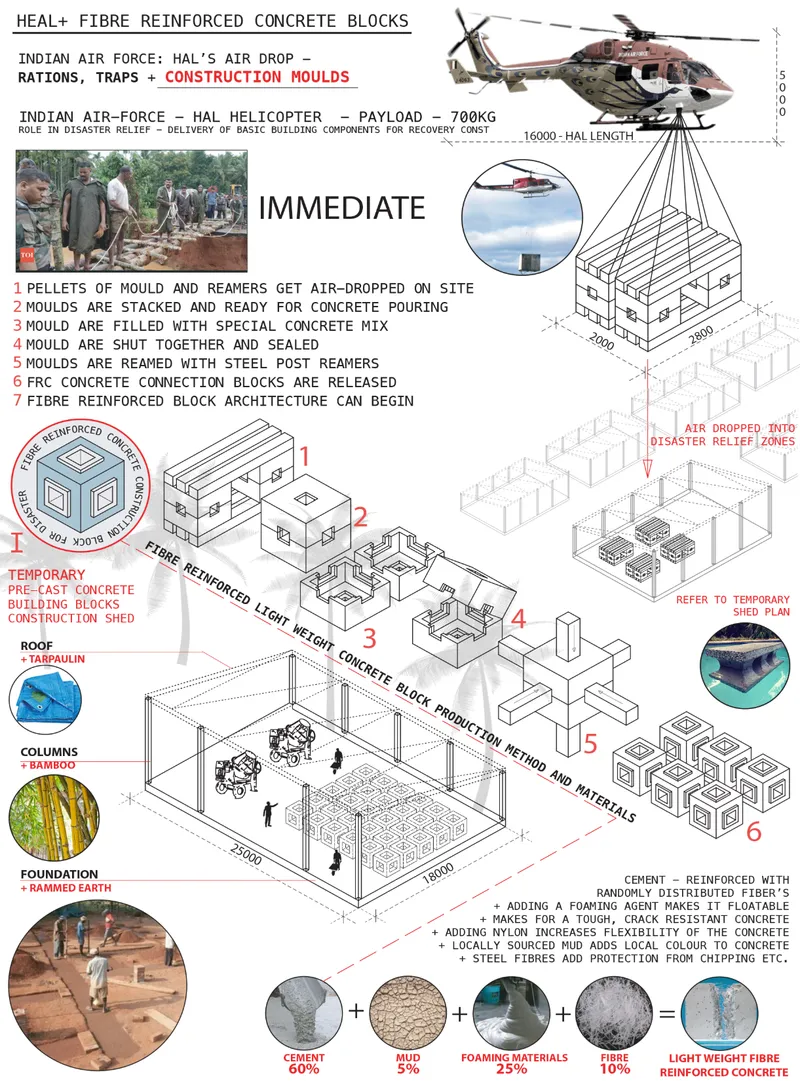

The construction diagram lays out the project's phased deployment strategy with striking clarity. In the immediate response phase, helicopters deliver prefabricated construction moulds and fibre-reinforced concrete blocks to flooded sites, enabling communities to erect temporary shelters within hours. The fibre-reinforced concrete is lightweight, crack-resistant, and critically, floatable, a property borrowed directly from boat-building logic. Short-term housing follows: precast modular homes assembled with bamboo-reinforced columns and terracotta roof slabs that offer dignified, structurally sound living conditions for displaced families.
The exploded axonometric drawing dissects one of these dwelling units, revealing the interplay between a timber frame, bamboo columns, and terracotta slabs. Each component is designed for rapid assembly and potential relocation. What distinguishes PREF_SHELTER from typical modular disaster kits is the third phase: long-term resilience. The same shelters are intended to evolve into permanent community infrastructure, functioning as flood shelters, ration depots, communal kitchens, and observation centres. Architecture here is not a product but a process.
Stepped Foundations and Layered Roofs: Structural Logic for Rising Water
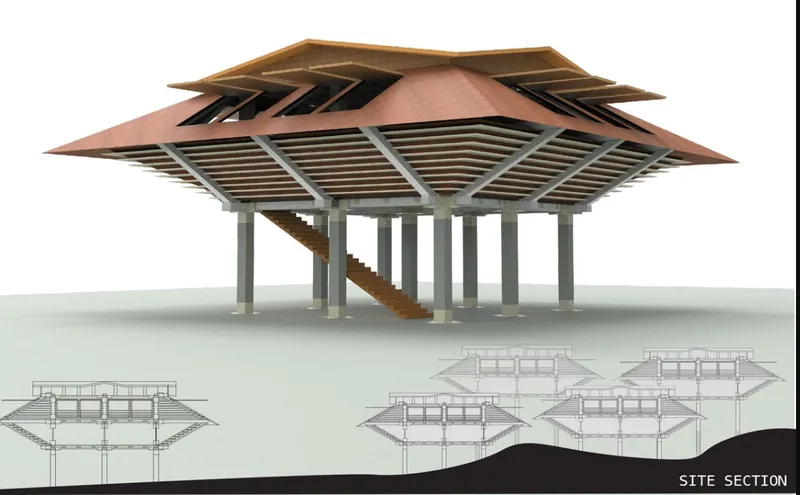
The site section reveals how the shelters negotiate terrain and water levels simultaneously. Concrete columns support a layered roof structure, while stepped foundation levels allow the buildings to sit on sloping ground without extensive earthwork. Lower levels are dedicated to pre-casting factories, turning the shelter itself into a production facility for its own expansion. Upper levels serve as gathering and living spaces. This vertical programme split makes each structure self-sufficient: it can generate the components needed to build more of itself while sheltering residents above anticipated flood lines.
Scalable Settlement: A Cooperative Land-Use Model
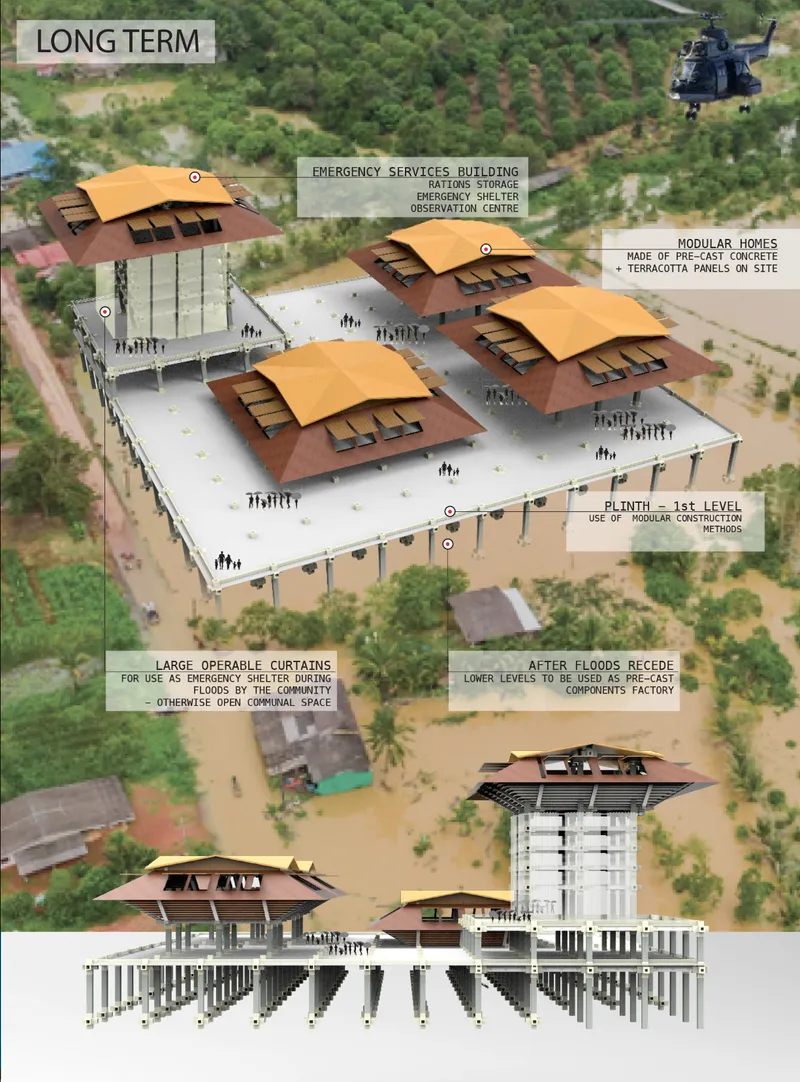
The aerial diagram pulls back to show the full settlement logic: modular pavilions arranged on a shared plinth, annotated with a long-term flood-resistant construction strategy. Helicopter delivery routes and cooperative land-use zones are mapped alongside the architecture, positioning the project not just as a building design but as an integrated disaster management plan. Shared rebuilding sites are central to the approach, designed to plug into government relief frameworks so that construction, resource distribution, and community organization happen in the same physical space.
Scalability is built into every decision. The modular system allows shelters to be expanded, reconfigured, or relocated depending on flood severity and local conditions. Because the construction relies on locally available bamboo, terracotta, and fibre-reinforced concrete rather than imported industrial materials, the model is theoretically transferable to other flood-prone regions beyond Kerala, anywhere that traditional craft knowledge and modern precast techniques can intersect.
Why This Project Matters
Disaster relief architecture too often defaults to the temporary: tents, containers, flat-pack shelters designed to be forgotten. PREF_SHELTER refuses that trajectory. By embedding long-term community functions into what begins as emergency housing, the project reframes disaster response as an opportunity for collective infrastructure building. The integration of pre-casting factories at the ground level is a particularly sharp move, transforming each shelter from a passive recipient of aid into an active production node.
What gives the project cultural weight is its insistence on local material intelligence. Bamboo reinforcement, terracotta slabs, and boat-building waterproofing techniques are not sentimental gestures toward tradition; they are pragmatic choices that reduce supply chain dependency and empower communities to participate directly in their own reconstruction. H.S has proposed something more ambitious than a shelter: a framework where resilience is not imposed from above but grown from the ground up, one precast block at a time.
View the Full Project
About the Designers
Designer: H.S
Enter a Design Competition on uni.xyz
uni.xyz runs architecture and design competitions year-round that reward proposals with spatial conviction and real site intelligence.
Project credits: PREF_SHELTER by H.S.


Popular Articles
Popular articles from the community


David Ortega Stacks a Two-Story Mexico City Penthouse Around a Steel Stair and a Pergola-Shaded Roof Terrace
In Colonia Roma, a 300 m² penthouse uses oak joinery, a planted steel stair and a slatted roof pergola to make a new-build apartment feel like a house.

Juan García Correa, John González and Claudia Rueda Sink a Circular Amphitheater into a Manizales Engineering Building
On the La Nubia campus in Manizales, Colombia, the S1 Building folds labs and offices into a hillside of ramped lawns that double as a campus route.

David Macias Steps a Doorless Stone and Plaster House Down a Tropical Colombian Hillside
In the humid hills of Colombia, Threshold House replaces the front door with an open void and terraces its 850 m² down the slope instead of fighting it.

GROUP A Strips a 1969 Rotterdam Harbor Headquarters to Its Frame and Wraps It in Timber Louvers
In Rotterdam's M4H harbor district, Ferro Offices reuses a 1969 frame, adds one timber storey and reaches BREEAM-NL Outstanding.

Similar Reads
You might also enjoy these articles

Gil Mello Arquitetura Tilts a Single Roof Toward the Waterfalls on a Plateau Above Aiuruoca, Brazil
In Aiuruoca, Minas Gerais, a 200 m² house of local labor and reclaimed poles pairs a low valley veranda with a tall mountain one.

U.GA Architects Wraps an Oval Rooftop Pool in Curved Board-Formed Concrete on Busan's Jeollidan-gil
In Busan's Jeonpo-dong, a 454 m² mixed-use block stacks a neighborhood facility, guest rooms and an oval rooftop pool inside spiraling concrete walls.

Felipe Hess Arquitetos Turns a Blind Stone Wall to the Street and Opens a Brazilian House onto a Courtyard and Canal
A canal-front house in Brazil hides behind painted stone and planting, then opens to an olive-tree courtyard, a reed-ceilinged porch and a curving pool.
David Macias Steps a Doorless Stone and Plaster House Down a Tropical Colombian Hillside
In the humid hills of Colombia, Threshold House replaces the front door with an open void and terraces its 850 m² down the slope instead of fighting it.

Explore Kerala Floods Competitions
Discover active competitions in this discipline

Challenge to reimagine the Iron Throne

Photograph architecture without architects

Illustrate the lost glory of Angkor Wat - Render Challenge

Design challenge to reuse E-waste
Comments (0)
Please login or sign up to add comments
No comments yet. Be the first to comment!