
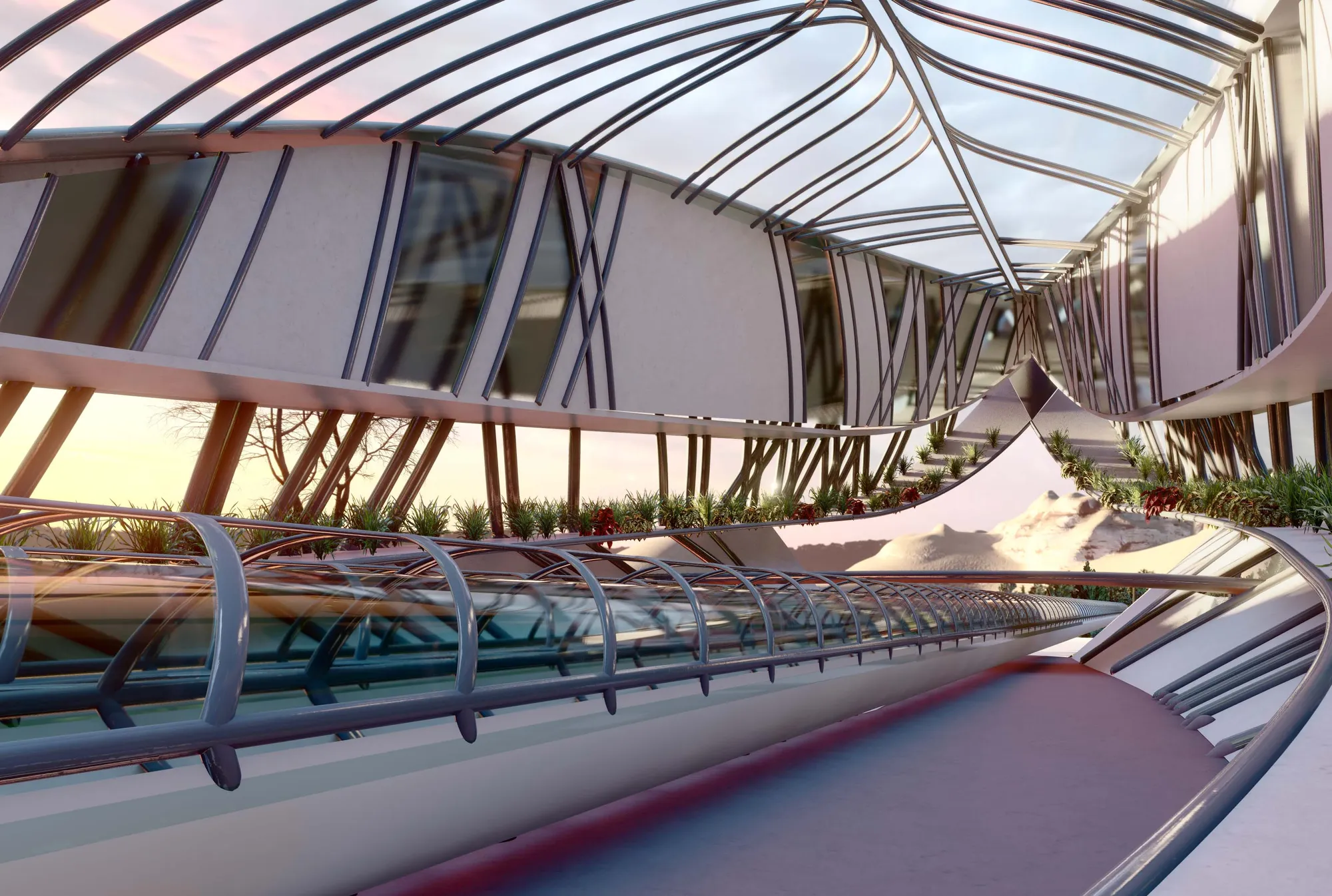
Hyperstem Station
Hyperloop technology is a huge advancement and calls for a redefining of typology to celebrate such technological progress. Similar to a hyperloop, Hyperstem offers efficiency and sustainability practices. It focuses on a variety of local issues including transportation, living, and nutrition. This multi-program station will be the hub of public transit, housing, and commercial space.

The concept of the Hyperstem is to incorporate the new technology of the hyperloop station into a hub that will also house services for the residents in the city. These programs will include housing, a farmers market, and the hyperloop station itself for arrivals and departures through the city. Housing becomes an important component to address for all design concepts moving forward for the future in that as we keep developing structures, the population continues to increase. The site is located in Mumbai, India, which is densely populated on the West Coast of India. The biggest thing that the city struggles with is poor housing conditions. Although the addition of the hyperloop will ideally solve housing in Mumbai, it should be expected to draw attention, leading to growth in population in the city. The housing units in the Hyperstem will not be strictly for new residents moving into the city but for the residents already in Mumbai that live in poor squatter settlements. And with housing should come food and services to help produce these resources for the people. Incorporating the green space and essentially creating a farmers market where food is grown and sold all in the same area will allow for not only a source of food and improve quality of health, but will improve the quality of the air too given the fact that the green space will be designed open to the main center of the hub creating a flow of fresh air. Mumbai also lacks proper sanitation in areas and a polluted water source. The idea of the station is to not only help the people that are going to use the hyperloop in their daily commute but also provide services to the public and to the residents who already reside in the area. The Hyperloop would ideally help provide services that help promote a better quality of life and health for the people.
The significance of the Hyperstem is the design and organizational process. It is a hybridized model of a plant and a hyperloop. The plant informs the structure and organization logic of the hub while the shape was taken from the aerodynamics qualities of the hyperloop. A plant's structure composition includes vast stem networks that aid in transportation and is multicellular. The Hyperstem station carries these ideas into the structural system by creating a multi-spine armature that marks the center point of each skin. The spines branch out further connecting into one fluid network that encompasses the site. The network of armature includes three varying armature scales. The smallest size armature is tasked with dividing the skin of the hyperloop hub. As a result, the skin of the Hyperloop hub is fractured into multiple shapes, resulting in multi-shaped panels. The medium size armature composes the interior spaces creating cells within the structure that are used for other programs such as housing and the green market. The large-scale armature is the structural support of the hub and hyperloop rails. The massing of the structure took after the aerodynamic qualities of a hyperloop. The massing began as a flat organic surface. The surface evolved by folding and creasing to create a massing that encourages aerodynamic behavior. The design address the unique qualities of the site. The existing highway is physically connected and is invited into the structure by creating a bridge that stems from the armature. The multi-road below is visually connected and is framed out by the large-scale armature.
Mumbai is one of India’s largest cities and the expansion of its transportation services with the hyperloop and this station will further grow and develop the city. It’ll also help solve the housing crisis by providing housing into the station and allowing people to choose the suburbs to make the busy city less dense. When time passes, the station would ideally transform by being able to allow for more services other than just housing and green market spaces. Hyperloop stations would surely be multiplied throughout the cities allowing for fast transportation to be a problem no longer needing to be addressed. The station will provide positive economic, social, and environmental solutions to the city to allow for everyone to live comfortably and healthily in the area. The Hyperstem Station will be the change the future needs!



Popular Articles
Popular articles from the community


Play: Fragments of Their World
Familiar architecture becomes modular playground design, creating safe spaces where displaced children can learn, connect, imagine and play.

Co-life: Sustainable Architecture for Age-Friendly Community Living
Co-life reimagines sustainable architecture for seniors through courtyards, rammed earth, shared gardens, and spaces designed for belonging.

The Ocean Hive: Sustainable Architecture for a Self-Sufficient Civilization at Sea
The Ocean Hive imagines sustainable architecture at sea, where modular habitats, algae, wave power and ocean waste sustain a growing colony.

Riyadh For All: Intergenerational Urban Design for Active Aging in Rabat
Riyadh For All reimagines urban design in Rabat with intergenerational co-living, adaptive courtyards, and Moroccan cultural exchange today.


Similar Reads
You might also enjoy these articles

Day and Night Park: A Time-Based Urban Newsstand in Beijing
A temporary urban newsstand in Beijing blending travel, light, and reading through poetic colors, compact form, and community-focused design.

Modernist Patio Renovation in El Masnou, Barcelona by Oliver Segura Arquitectura + Cebrià Arquitectura
Modernist patio renovation blending tradition and innovation with a movable pool, leveled floors, and Catalan materials in El Masnou.

Alto Residencial Coop: Cooperative Housing Development in Santiago de Compostela by Carbajo Barrios Arquitectos
A linear cooperative housing complex blending white volumes and perforated metal façades, enhancing community living, natural light, privacy, and urban integration.
Vil Genis School by BPA ARCHITECTURE – Massy, France
Vil Genis School in Massy, France, features sustainable design, south-facing classrooms, community integration, accessible spaces, and modern educational architecture.


Explore Hyperloop Competitions
Discover active competitions in this discipline




Challenge to reimagine the Iron Throne


Photograph architecture without architects


Illustrate the lost glory of Angkor Wat - Render Challenge


Design challenge to reuse E-waste
Comments (0)
Please login or sign up to add comments
No comments yet. Be the first to comment!