

ilsangarchitects Builds a Village-Scaled Playground Without Rides in Jeonju
A UNICEF-backed community center in South Korea replaces swings and slides with timber pavilions, sand courts, and water channels.


The phrase "playground without rides" sounds like a contradiction, but it is the founding brief of Mamkkeot House, a 178 m² community center in Jeonju designed by ilsangarchitects. Developed jointly by the city of Jeonju and UNICEF as part of the municipality's child-friendly city initiative, the project asks a pointed question: what happens when you strip a playground down to landscape, architecture, and the space between them? The answer, completed in 2021, is a cluster of gabled timber volumes arranged around courtyards, sand terraces, and a serpentine water feature, all threaded together by elevated walkways and connected by the kind of loose spatial logic that invites children to invent their own games.
Lead architects Hun Kim and Jeong in Choi, working with landscape consultants Studio 101, treated the site not as a flat surface on which to deposit equipment but as a topography to be sculpted. Planted mounds, shallow channels, and terraced sand areas replace the usual catalog of climbing frames and rubber matting. The architecture itself becomes the play structure: bridges to cross, columns to weave through, shadow patterns to chase. It is a small building with an unusually generous idea behind it.
A Landscape Built for Running, Not Riding
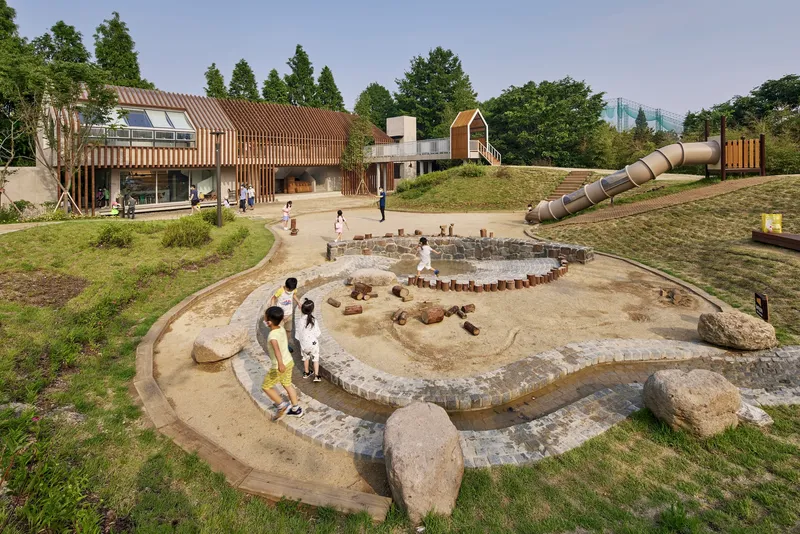
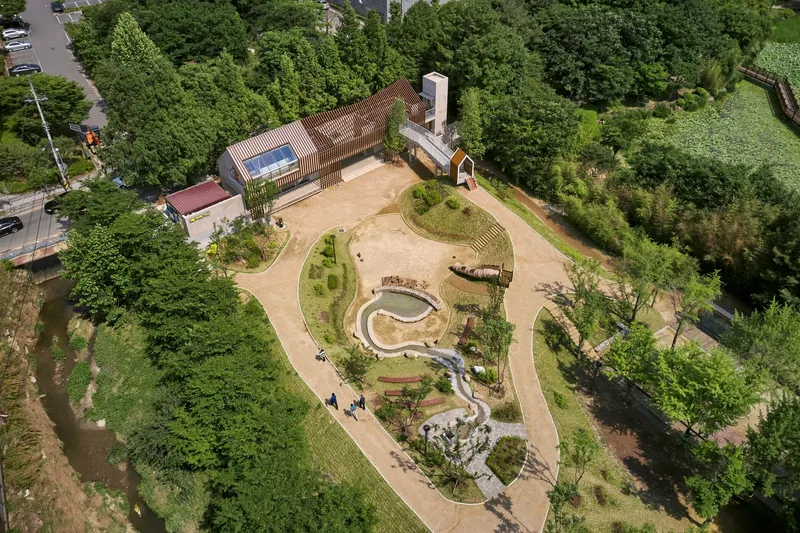
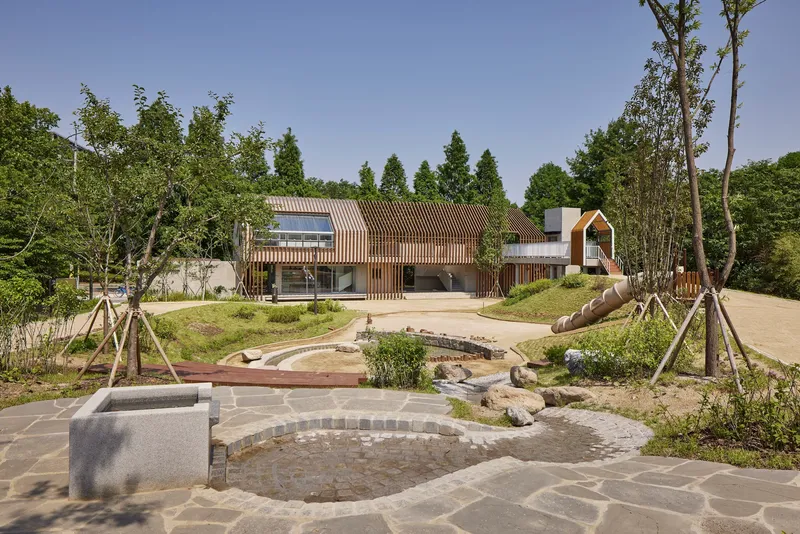
The ground plane does most of the work here. Terraced sand courts edged with stone give children an open, tactile surface to dig, roll, and sprint across. A serpentine water channel winds through planted mounds and forest canopy, turning hydrology into a toy. Curved stone paving guides movement between zones without fencing anything off. The absence of prescribed equipment is the design move: Studio 101's landscape is structured enough to suggest activities but loose enough to let kids define them.
This approach has an almost anti-institutional quality. There are no bright primary colors, no safety-padded enclosures, no signage telling anyone what to do. The palette is stone, sand, water, and timber. It trusts children to engage with material rather than apparatus, which is a quietly radical stance for a publicly funded playground.
A Cluster of Gabled Rooms
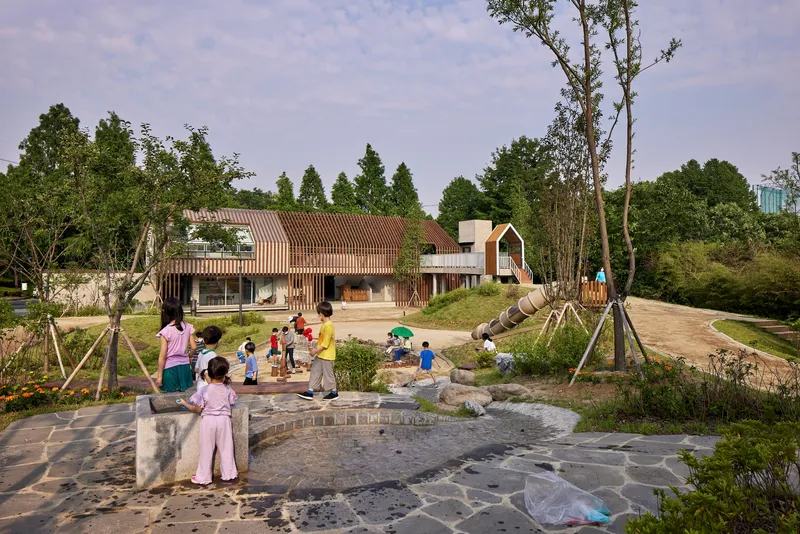
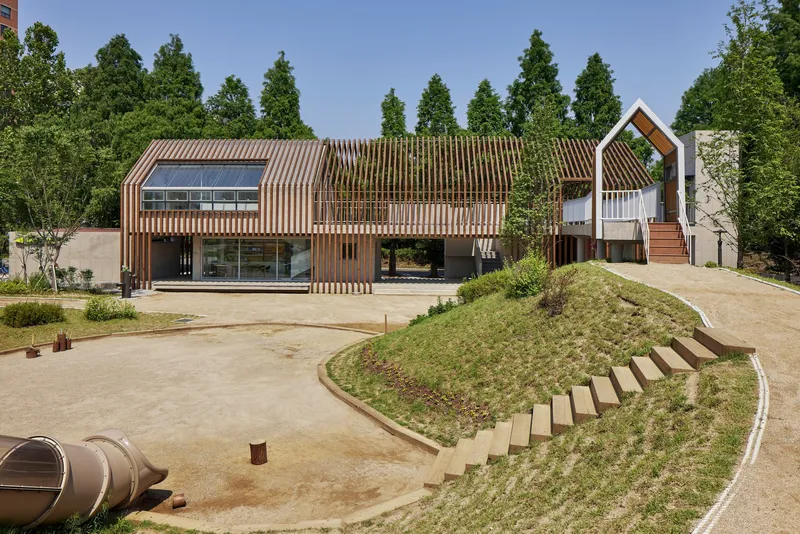
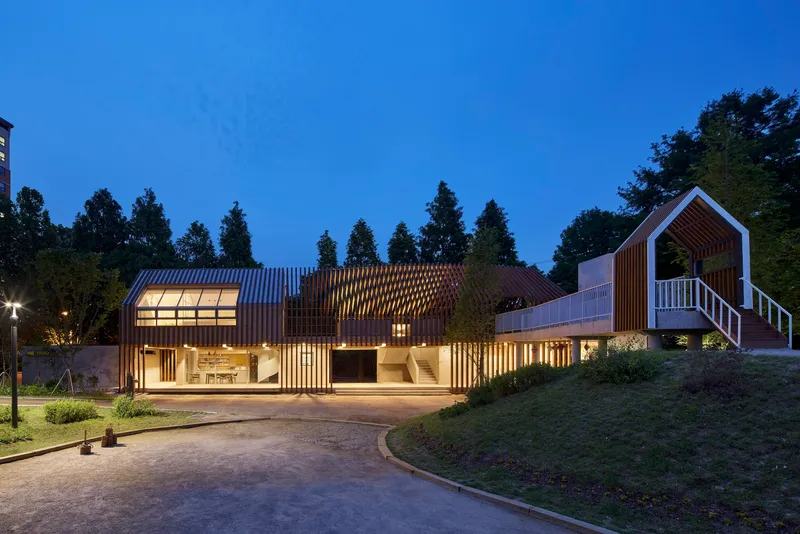
The built form reads as a small village rather than a single building. Multiple gabled volumes, each modest in scale, cluster around a central courtyard and connect via bridges and covered passages. The house-shaped silhouette is deliberate, borrowing the archetypal profile that children draw with crayons and turning it into a repeating module. Against the backdrop of Jeonju's residential towers, these pitched roofs assert a domestic warmth that a monolithic community center could never achieve.
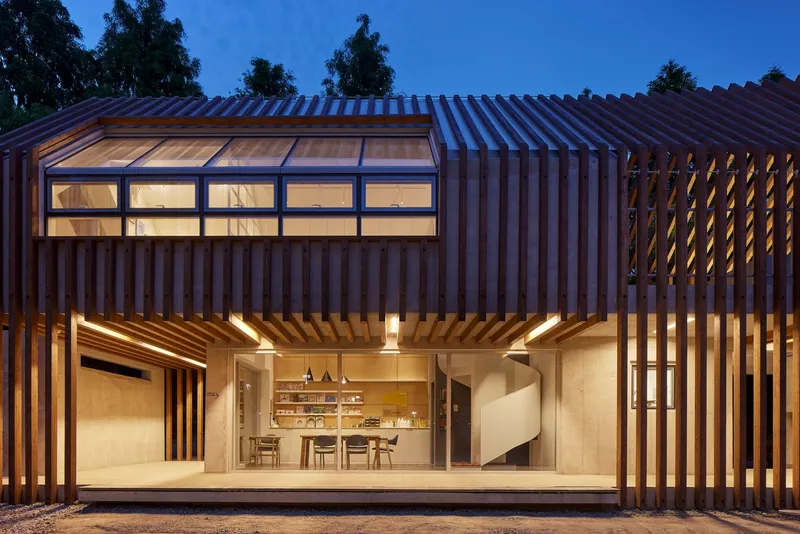
At dusk the strategy becomes especially legible. Glazed walls glow from within, each volume registering as a distinct lantern on a sloped lawn. The effect is of a constellation of small rooms rather than a corridor of program, which aligns with the project's philosophy: give children many small worlds to discover, not one big box to occupy.
Timber Screens and Shadow Play
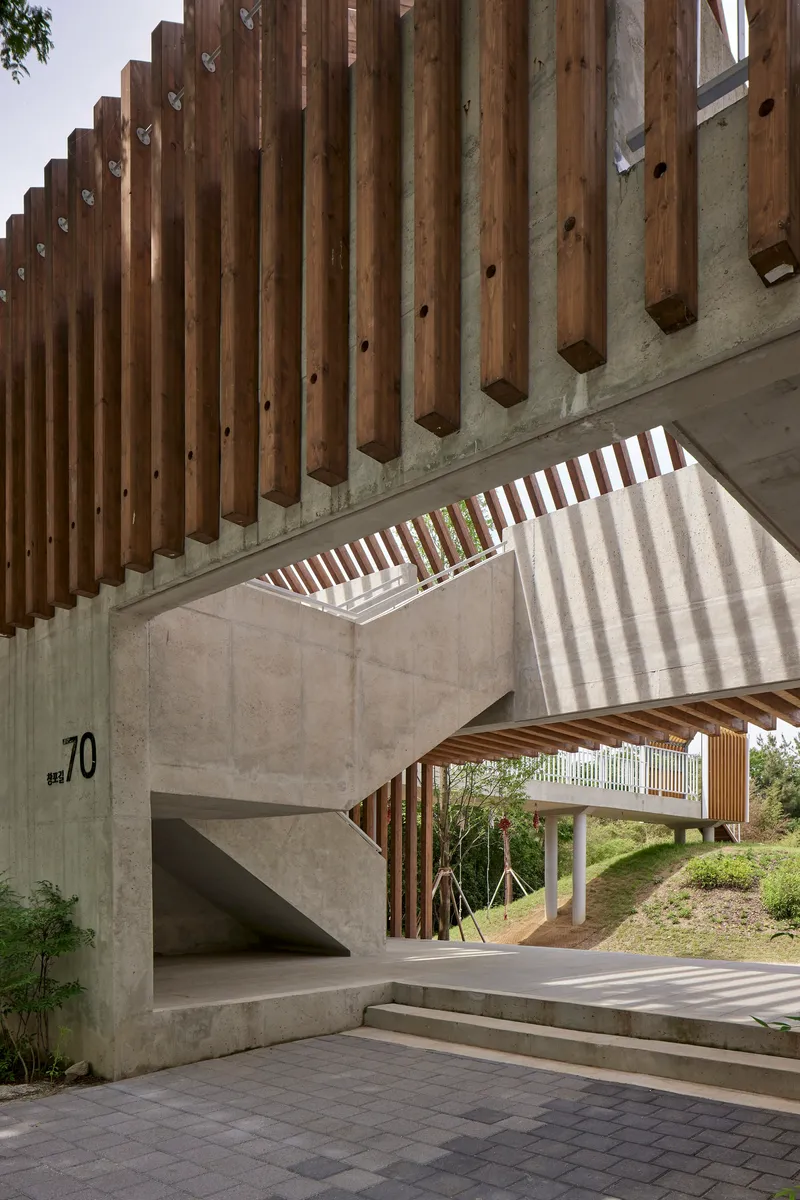
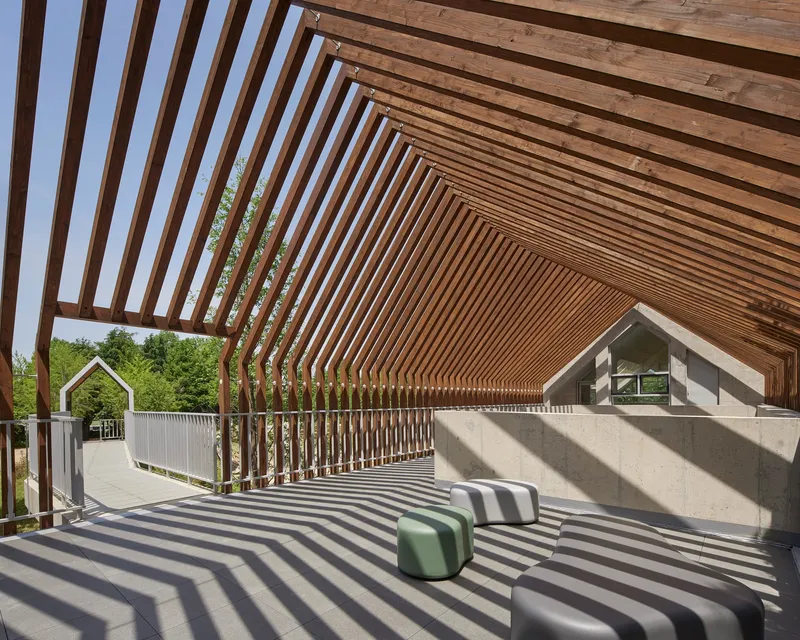
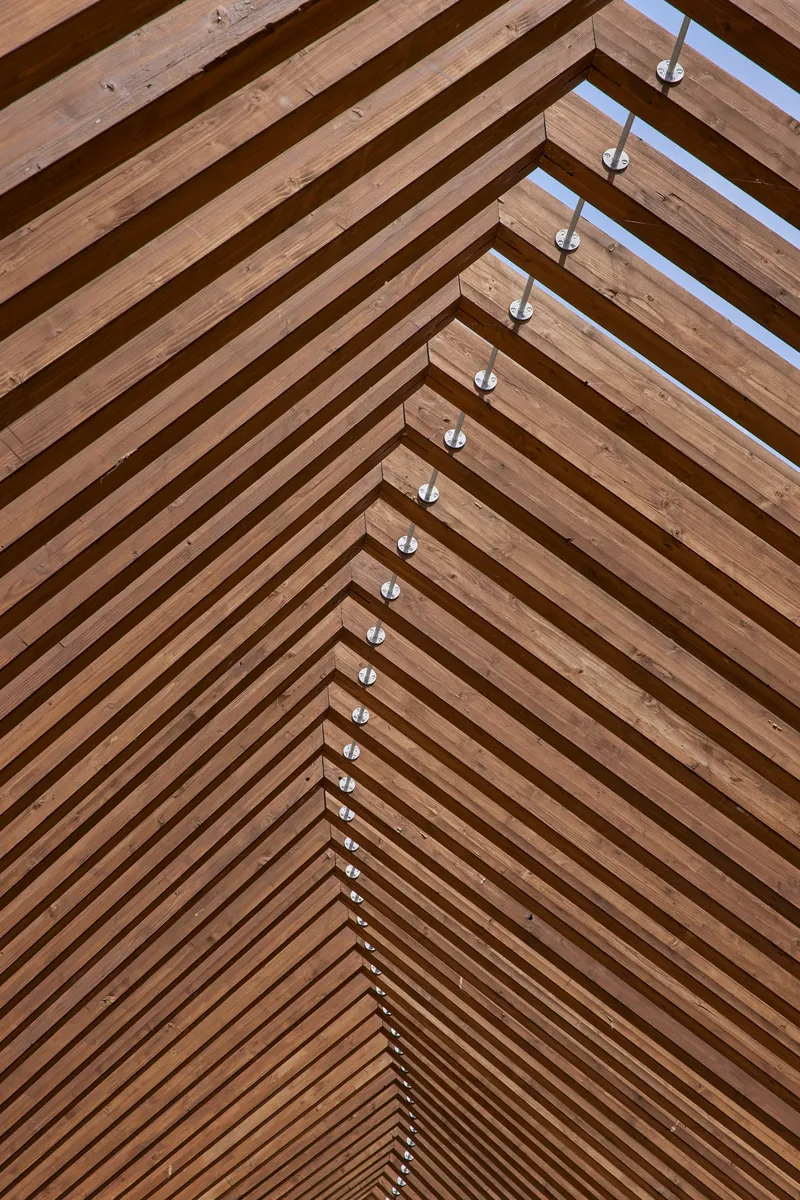
Vertical timber louvers wrap nearly every surface, from facade screens to roof canopies to the bridge that arcs over the courtyard. Supplied by Wonjin Aluminium for the structural connectors and finished with Jevisco coatings, these closely spaced slats perform double duty. They modulate daylight into precise stripes of shadow that migrate across concrete walls and floors as the sun moves. For a facility centered on play, this is architecture doing something genuinely playful: making the building itself a kinetic surface.
The close-up of the ridge detail reveals how the slats are gathered by steel T-connectors along the apex of each gable, a clean solution that turns the roof assembly into an honest expression of joinery. There is a craft sensibility running through the project that resists the industrial efficiency of most public buildings. It wants to be touched and looked at closely, which is exactly the right ambition for a space designed for curious children.
Bridges, Columns, and the Architecture of Discovery
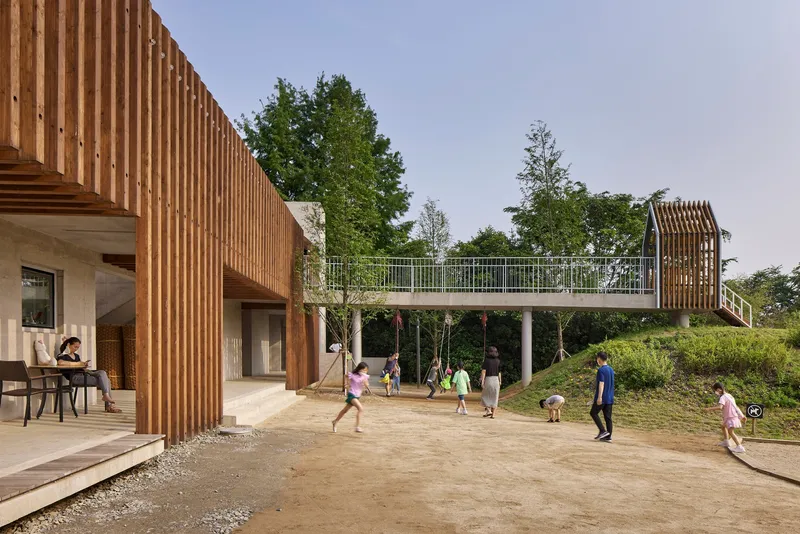
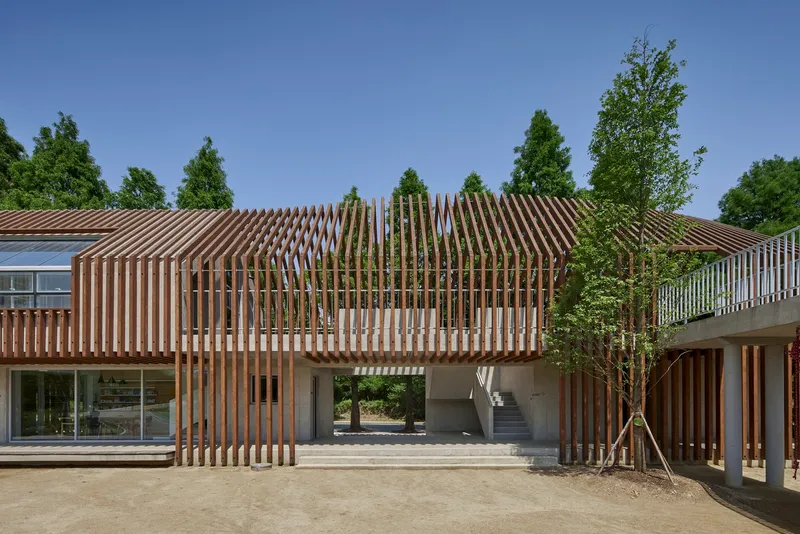
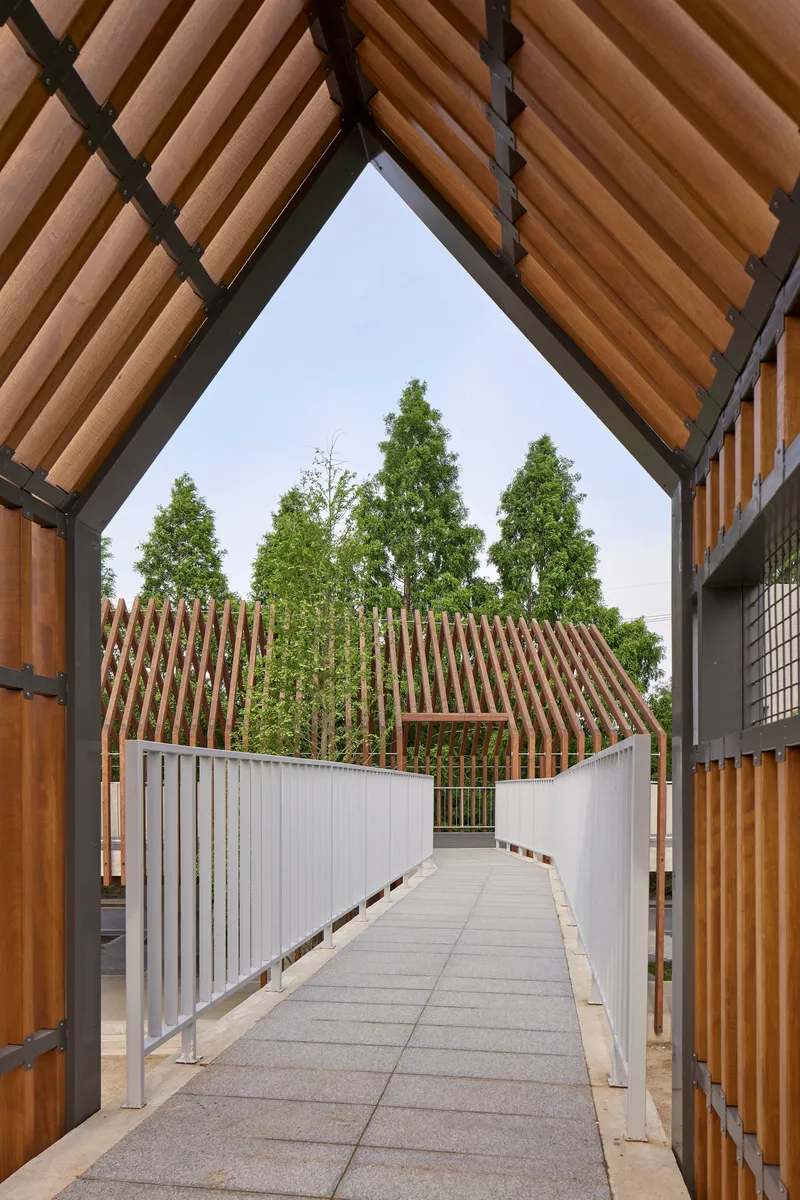
The elevated timber-slatted bridge is the project's signature moment. Spanning above the courtyard, it connects two volumes at the upper level and gives children an aerial vantage point over the play landscape below. It is simultaneously a circulation element and a play element, which is the building's essential trick: every piece of architecture is also an invitation.
At ground level, a forest of densely spaced vertical timber columns frames a passage between planted areas. The effect is deliberately labyrinthine. You can see through the columns but not walk through them in a straight line, creating the kind of semi-transparent threshold that children love to negotiate. Framed openings between volumes offer peek-a-boo views of the gabled roofline and the bridge above, layering depth into a compact footprint.
Interiors That Extend the Courtyard
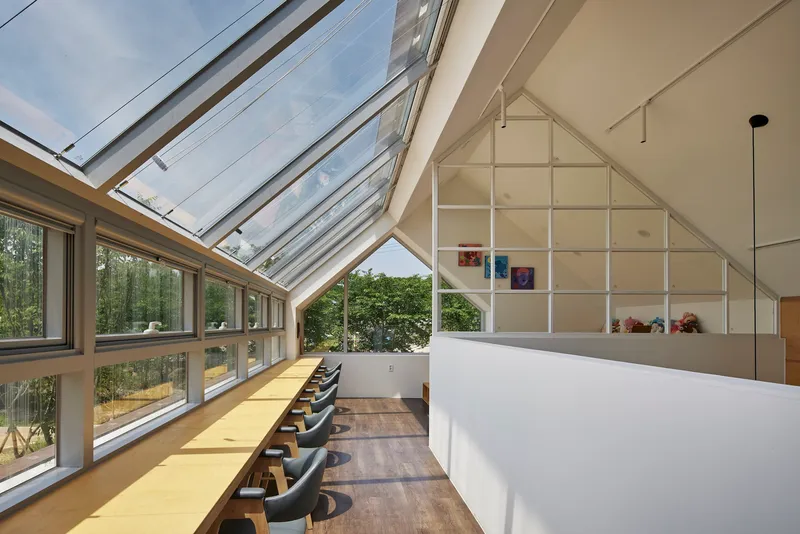
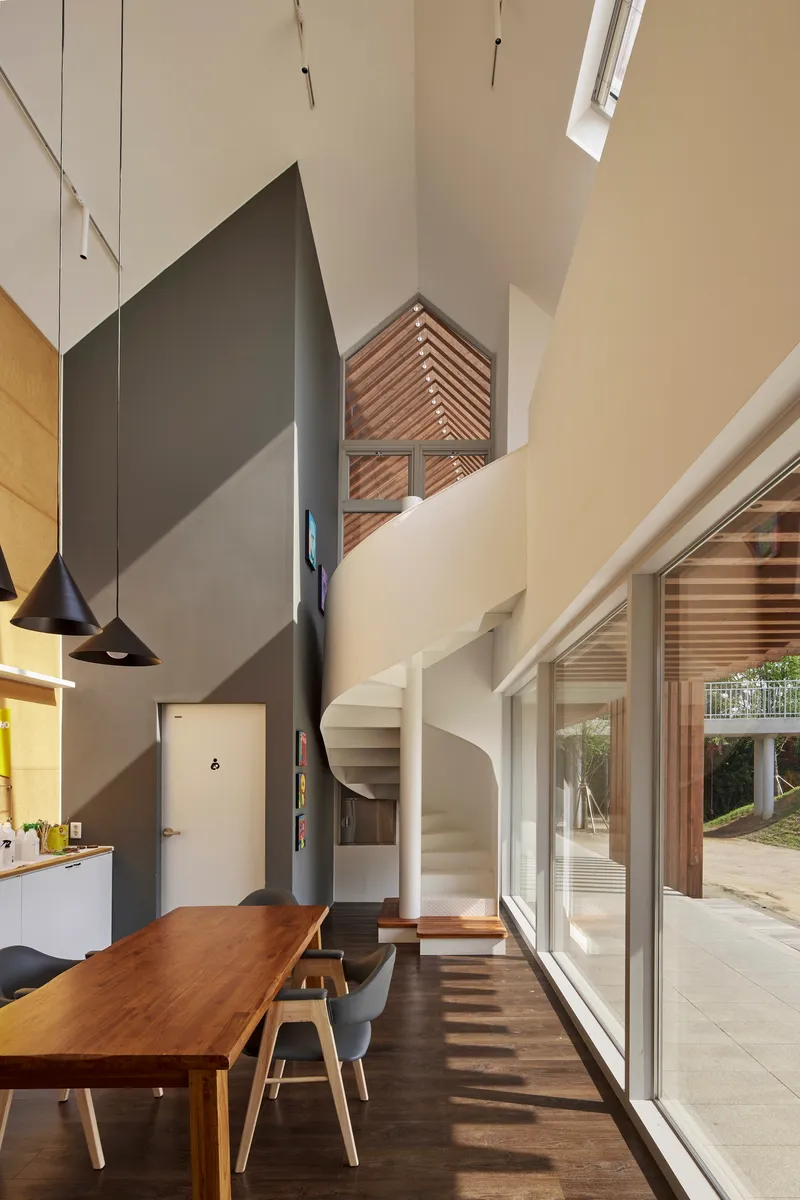
Inside, the pitched roof volumes create generous ceiling heights lit by clerestory glazing and skylights. A yellow counter and built-in shelving in one space suggest a children's kitchen or workshop, while a dining area with a black stovepipe and spiral stair offers a more domestic register. These are rooms that feel like they belong to a particularly well-designed house, not a municipal facility. The scale stays small and the finishes stay warm.
At blue hour, the glass-walled dining area becomes a vitrine framed by vertical timber louvers. Clerestory windows above the main glazing pull light deep into the roof peak. The boundary between interior and courtyard effectively dissolves, which reinforces the project's central proposition: that the entire site, inside and out, is one continuous landscape for exploration.
Covered Thresholds and the In-Between
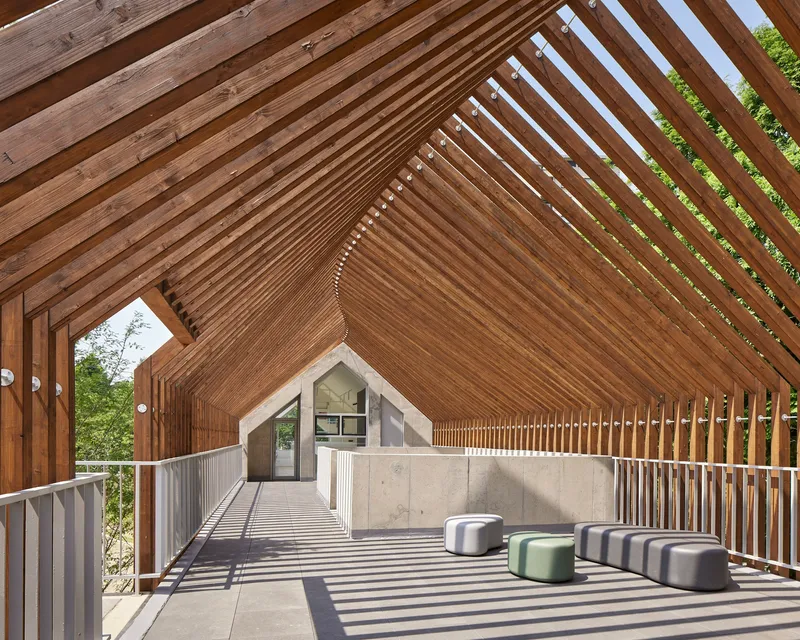
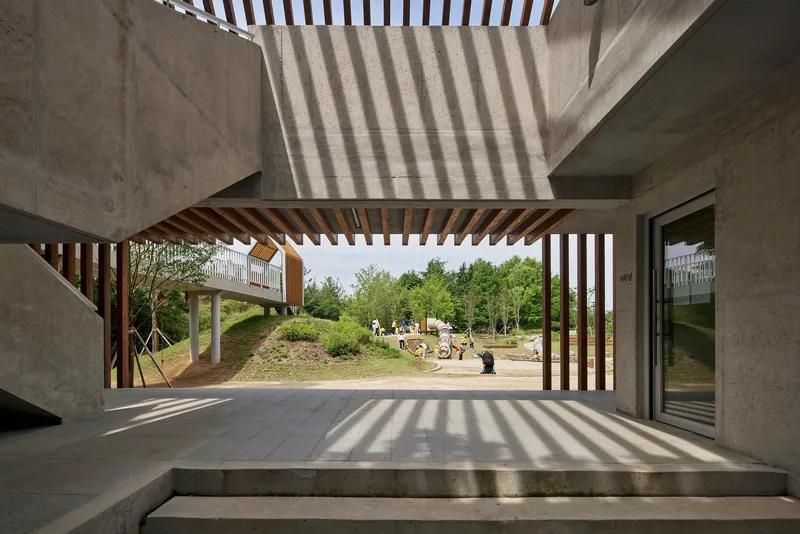
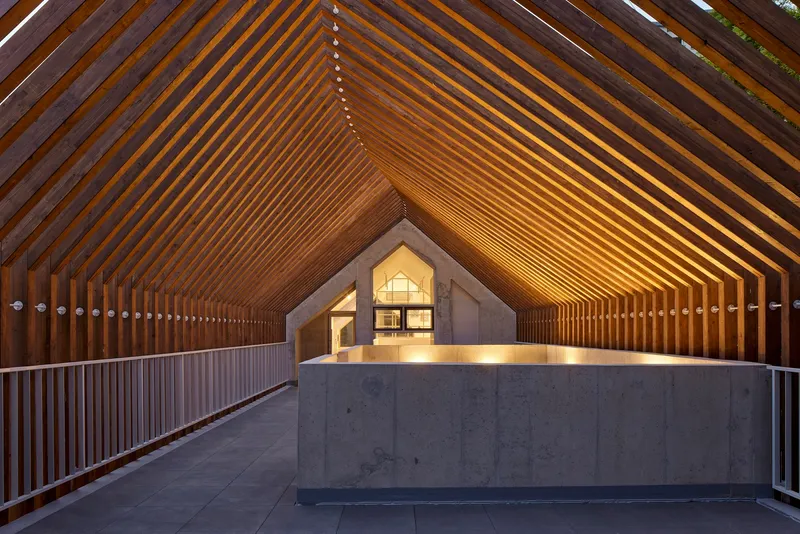
Some of the project's best spaces are neither fully inside nor fully outside. Covered terraces with slatted timber gable roofs filter afternoon sunlight onto seating pods. A timber-slatted porch frames the playground and wooded landscape beyond, creating a picture window made of shadow. A covered walkway with a rhythmic slat ceiling and a concrete reception desk operates as an entry sequence at twilight, the striped light overhead guiding visitors inward.
These in-between zones are critical for a community center that serves families. Parents need shade and seating while children play. Grandparents need shelter from rain. The slatted canopies provide all of this without closing off the visual and acoustic connection to the landscape. You can sit under cover and still hear the water channel, still see kids running across the sand court. It is supervision by design rather than by barrier.
Plans and Drawings
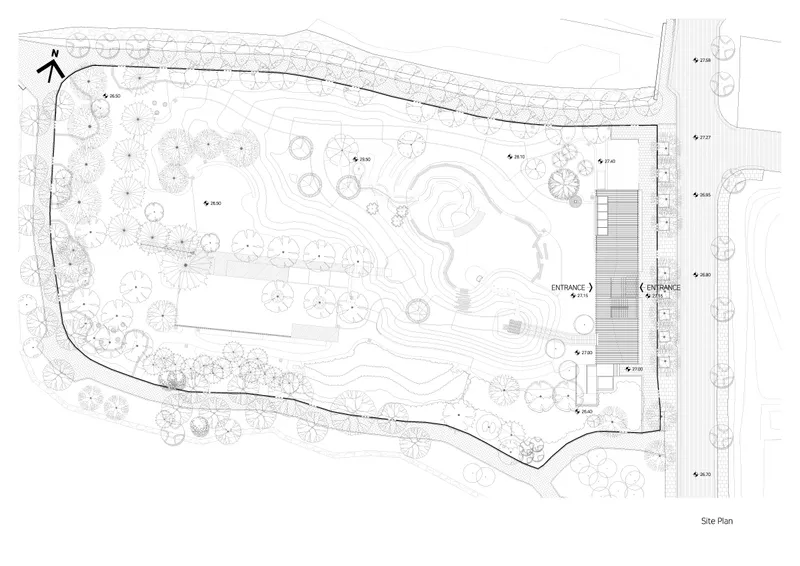
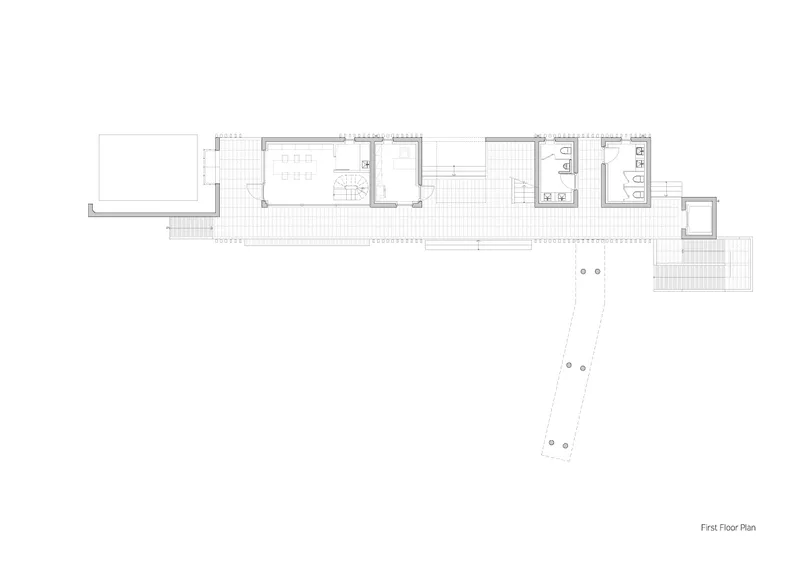
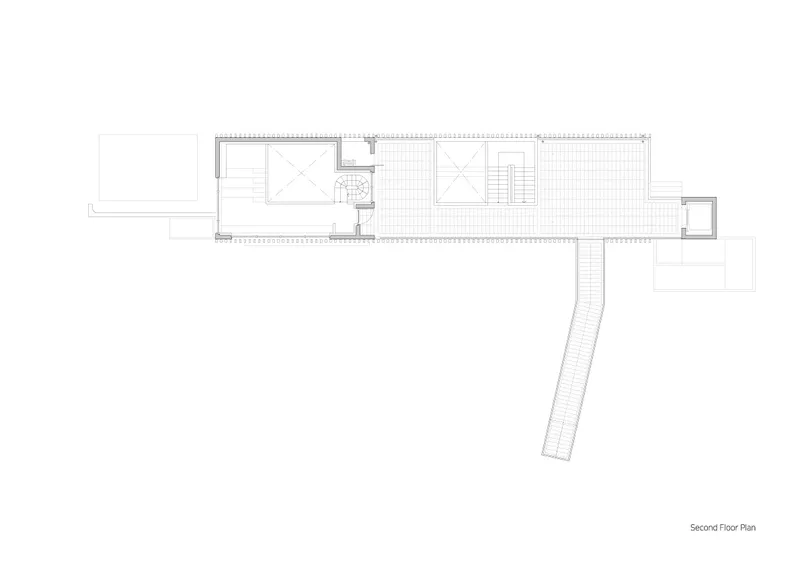
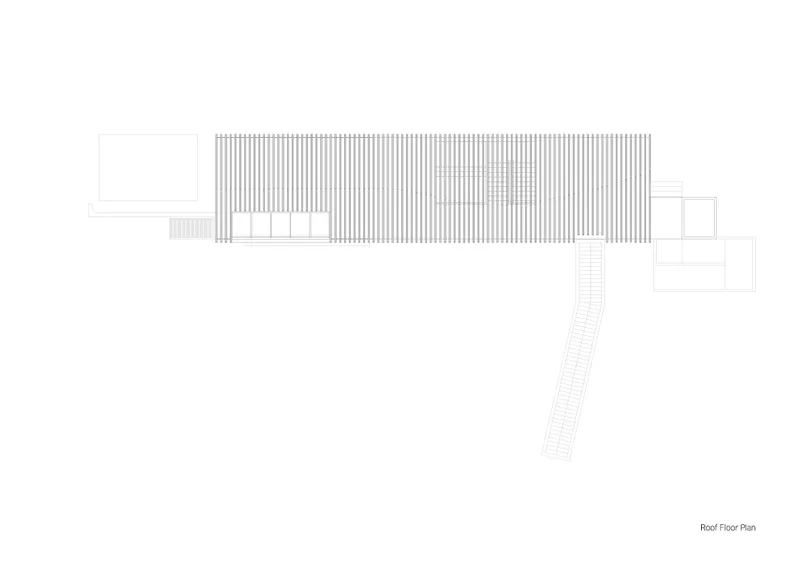
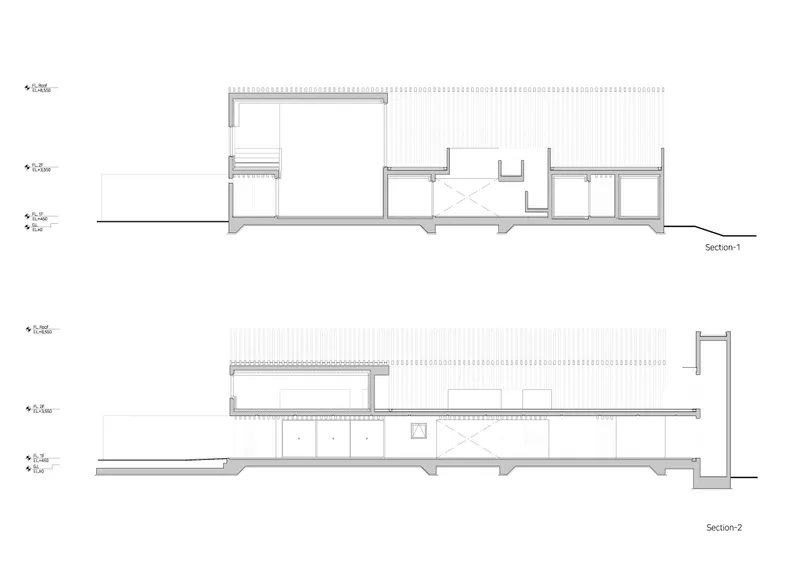
The site plan makes the relationship between building and landscape explicit. The linear structure runs alongside a network of curved pathways and sculpted topography, with the angled wing extending from the main volume to embrace the courtyard. First and second floor plans reveal a compact organization where every room opens to the exterior on at least two sides, maximizing cross-ventilation and visual connection to the play landscape. The roof plan shows the tightly packed linear slat elements that generate those signature shadow patterns, while the section drawings expose the surprisingly complex spatial layering: split levels, mezzanines, and double-height volumes packed into a building that reads from outside as a collection of simple houses.
Why This Project Matters
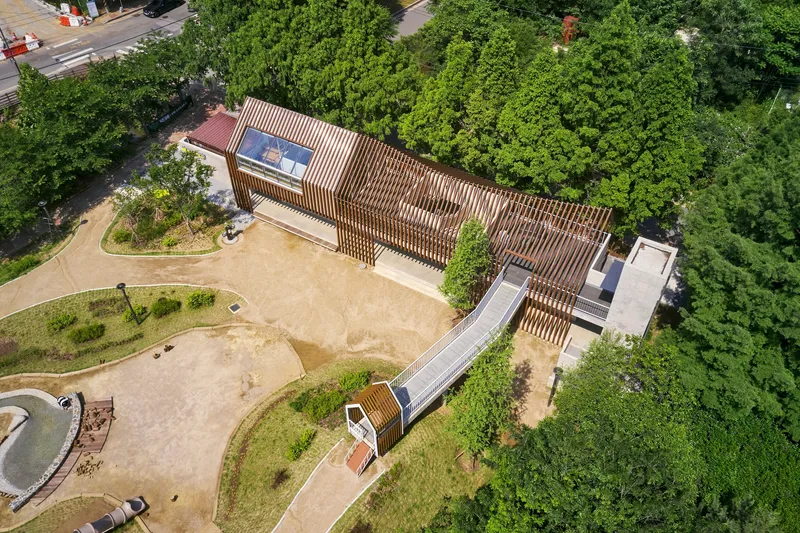
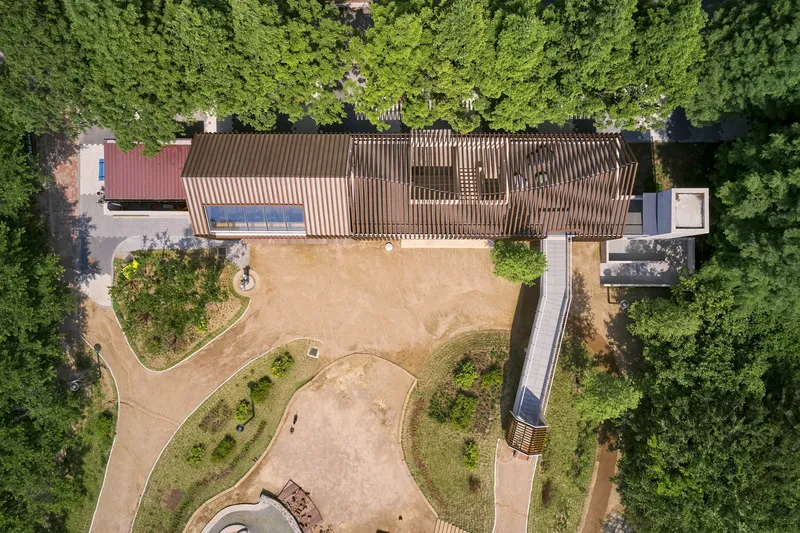
Mamkkeot House matters because it refuses the default vocabulary of public playgrounds. Instead of purchasing off-the-shelf equipment, Jeonju and UNICEF invested in architecture and landscape that treat children as capable of self-directed play. The result is a space where the building, the ground, the water, and the light all become instruments of discovery. At 178 m², it is small enough to feel intimate but spatially rich enough to sustain repeated visits without exhaustion.
It also offers a model for how community centers can sit within their neighborhoods without dominating them. The village-scaled cluster of gabled volumes, the warm timber materiality, and the permeable boundary between site and city all argue for a kind of civic architecture that is generous without being monumental. ilsangarchitects have built something that belongs to its context, serves its users on their own terms, and gets better the closer you look at it. That is a high bar for any public building, let alone one designed for people under four feet tall.
Mamkkeot House Community Center by ilsangarchitects (Lead Architects: Hun Kim, Jeong in Choi). Jeonju, South Korea. 178 m². Completed 2021. Landscape design by Studio 101. Structural engineering by Synergy Engineering Consultants. Photography by Gyeong Roh.
About the Studio
Share Your Own Work on uni.xyz
If projects like this are the kind of work you want to make, uni.xyz is a place to publish your own, find collaborators, and enter design competitions.


Popular Articles
Popular articles from the community


Cloaked Colonization: A Mobile Underwater Habitat That Moves Like a Fish
Micah Abaya's shortlisted EHC Pacific entry reimagines ocean settlement as a dispersed network of self-sustaining architectural organisms.
Temporary Home for Dogs: A Reversed Zoo Rethinks Animal Shelter Architecture
In Bucharest, a sinuous corridor and freed landscape flip the logic of containment, designing a shelter that works to make itself unnecessary.

Tsunami Convergenics: Turning Catastrophic Ocean Forces into Underwater Housing Infrastructure
A speculative underwater settlement off the coast of Onagawa, Japan, treats tsunamis and typhoons as energy sources rather than threats.

Singing Woman: Contemporary Architecture Inspired by Estonia’s Voice and the Sea
Singing Woman turns Estonia’s song culture into flowing opera house architecture, blending public life, landscape, sea, and national memory.

Similar Reads
You might also enjoy these articles

Bao Huynh Watercolor Atelier: A Serene Art Retreat in Hội An
Bao Huynh Watercolor Atelier in Hội An blends multifunctional art spaces, sustainable design, local materials, and family-friendly living in a serene environment.

Atelier Macri Concept Store Interior Design by CASE-REAL
Atelier Macri store features a "ko" counter, walnut wood details, cork displays, blending retail, gallery, and seamless customer experiences.

Manuel Vargas Izquierdo Stadium and High-Performance Sports Center: Architectural Excellence in Jalpa de Méndez
The Manuel Vargas Izquierdo Stadium blends sustainable design, inclusive sports facilities, and cultural-inspired architecture, revitalizing Jalpa de Méndez’s public spaces.
KAKR Buluh Awar Hall: Revitalizing Community and Ecology Through Bamboo Architecture
Community built bamboo hall revitalizes Buluh Awar village, empowering youth, restoring ecology, celebrating vernacular craftsmanship through sustainable architecture and culture.

Explore Community Center Competitions
Discover active competitions in this discipline

Challenge to design locus for the upliftment of human rights

Challenge to design mud housing for contemporary communities

Design challenge to reuse E-waste
Comments (0)
Please login or sign up to add comments
No comments yet. Be the first to comment!