

A Horticulturist's Home Wrapped in Brick and Green
L Architects transforms a 98 sqm Singapore apartment into a layered landscape of red brick screens, timber joinery, and living plants.


Renovating a compact apartment for a horticulturist is a rare brief. The client's profession isn't just context here; it's the organizing principle. In a Park, designed by L Architects in northeast Singapore, rethinks a standard three-bedroom flat as a continuous interior garden, where built elements and planting merge into a single spatial system. Every surface, screen, and shelf has been designed to host or frame vegetation, collapsing the boundary between dwelling and nursery.
What makes the project genuinely compelling is its refusal to treat the greenery as decoration. The architecture does not simply accommodate plants. It is structured around them. Red brick screens, timber louvers, and corrugated canopies filter light in ways that serve both the occupant and the collection of species living alongside them. The result is a 98 square metre apartment that feels neither cramped nor precious, but textured, alive, and deeply specific to one person's way of inhabiting space.
Brick as Landscape
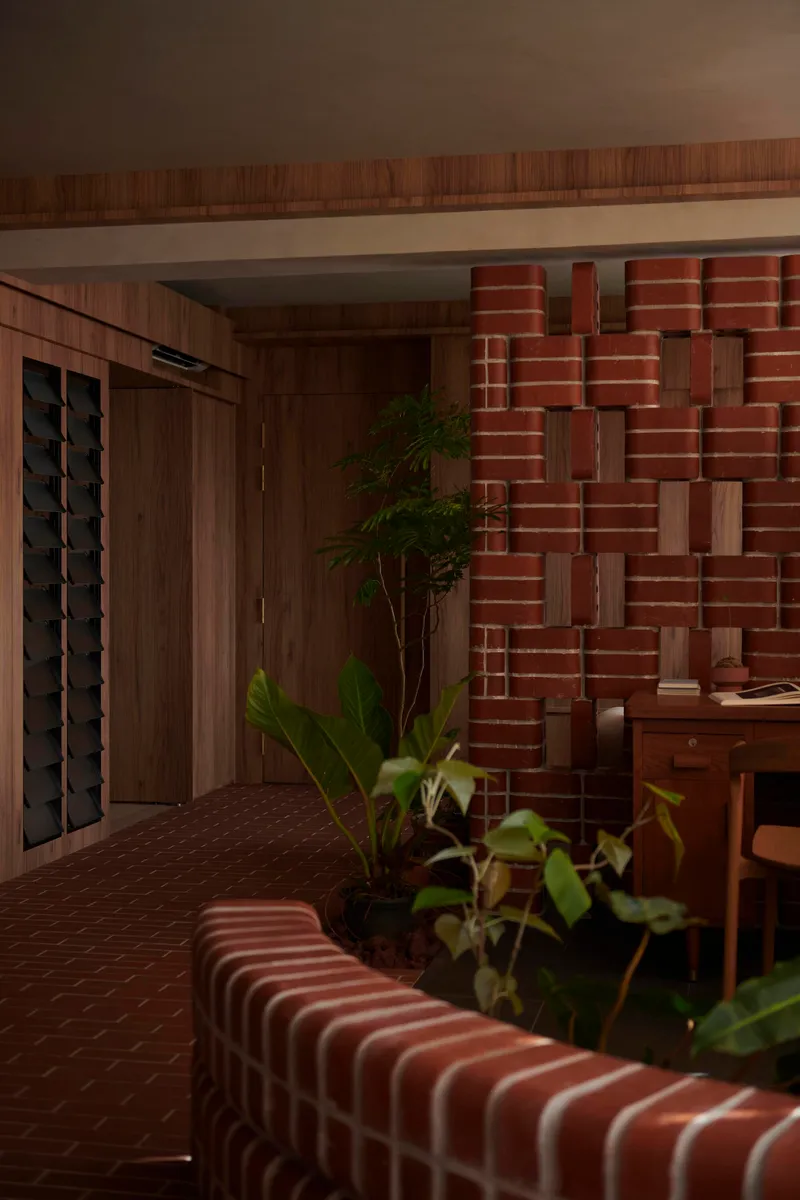
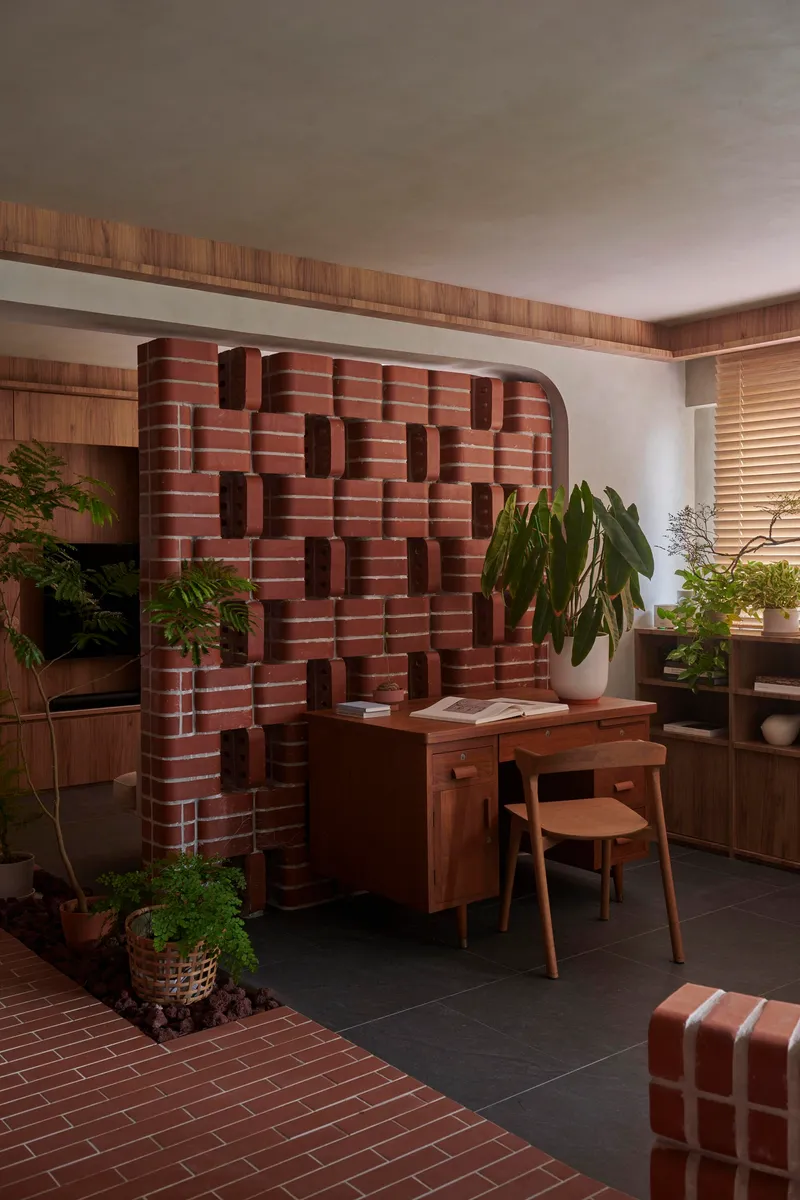

The most striking element in the apartment is its sculptural red brick wall, which undulates and protrudes in a relief that reads more like topography than partition. Blocks are stacked at varying depths, creating slots, ledges, and shadows that change character throughout the day. It's a wall that refuses to be flat, and in doing so it provides niches for small pots, recesses for books, and a visual rhythm that anchors the entire interior.
The choice of material is deliberate. Red brick carries tropical associations in Singapore, and here it absorbs and radiates warmth in a way that painted plaster never could. L Architects exploit its modularity to build texture at the scale of the hand, making the wall something you want to touch as much as look at.
Screens That Breathe
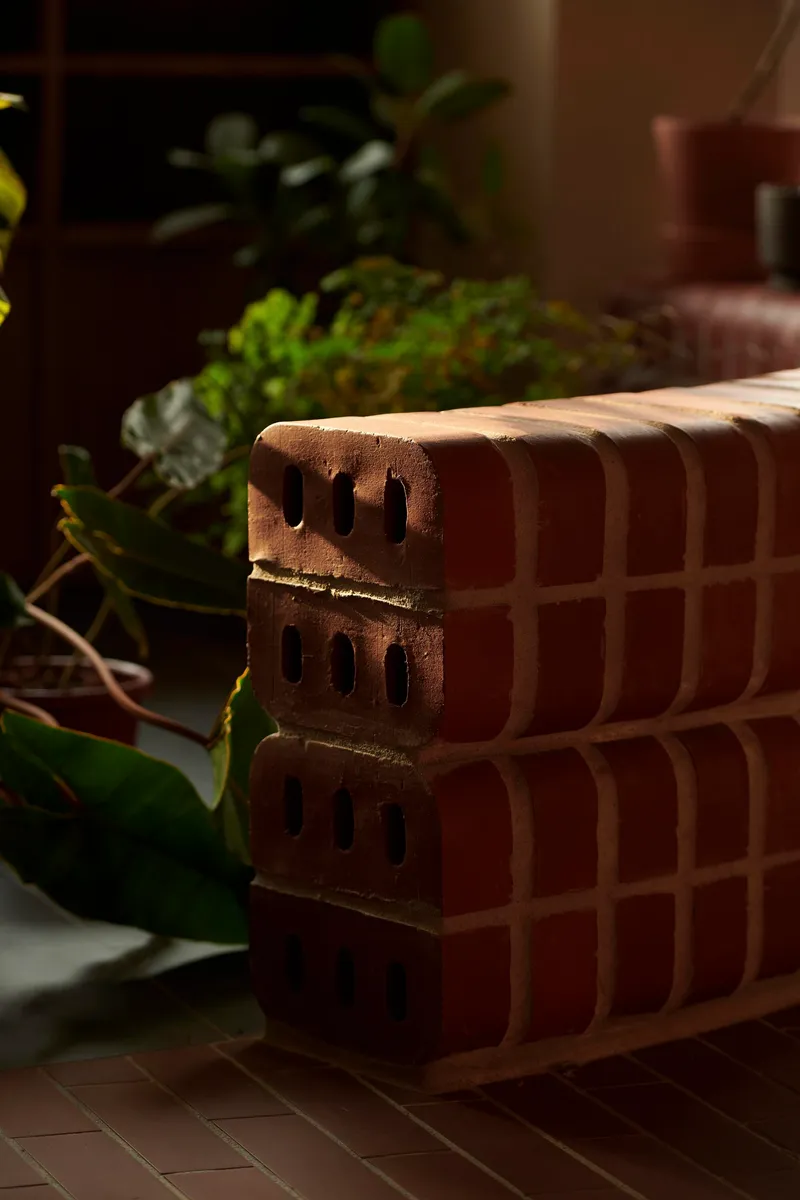
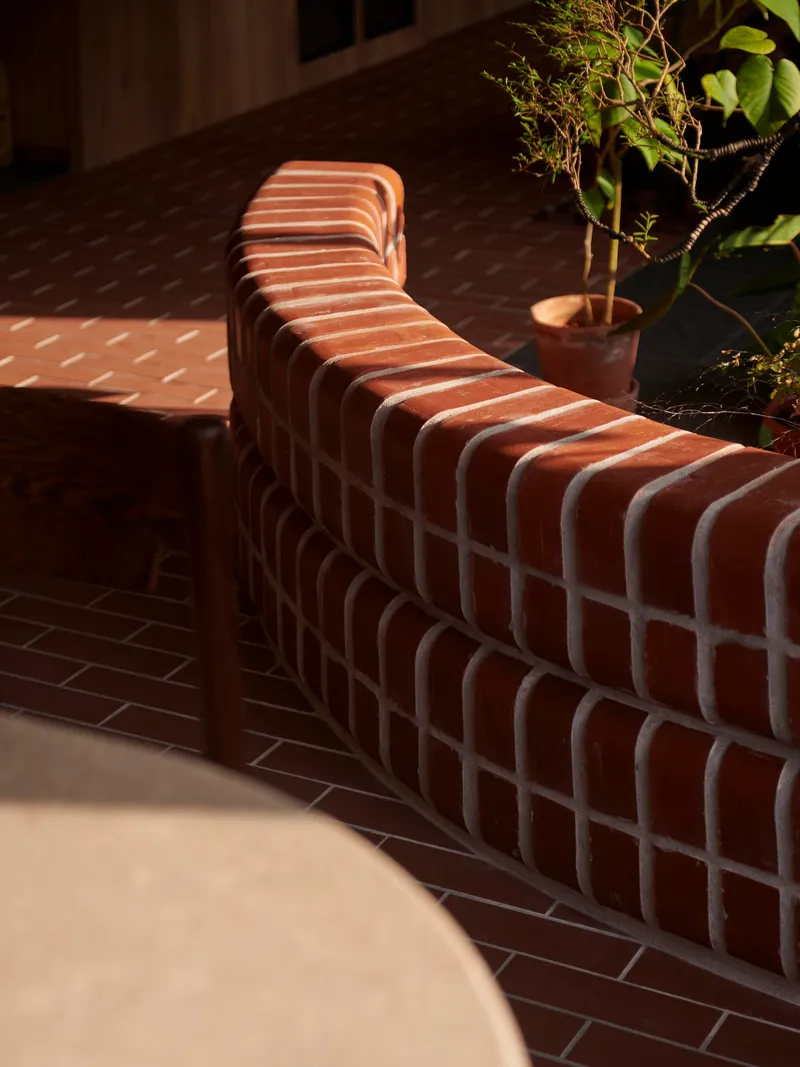

Terracotta brick appears again in the apartment's perforated screens and curved planter walls. These elements do double duty: they divide space without sealing it, and they allow light to pass through in dappled patterns that mimic the canopy of a park. The perforations are not uniform. Some bricks are solid, some are slotted, and the alternation creates a visual porosity that keeps air and sightlines moving.
The curved planter wall is particularly effective. It holds a small tree and receives overhead light filtered through slats, casting long shadow lines that migrate across the brick surface as the sun moves. It turns a corner of the apartment into a moment of genuine calm, something closer to a garden folly than a room divider.
Kitchen and Dining as Commons
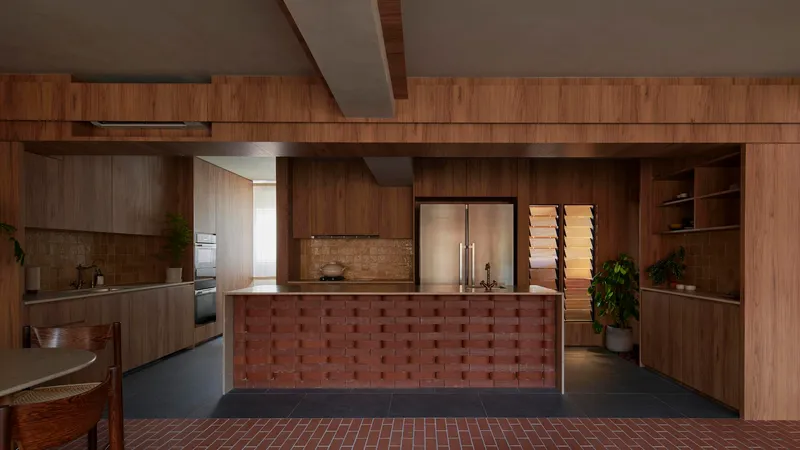
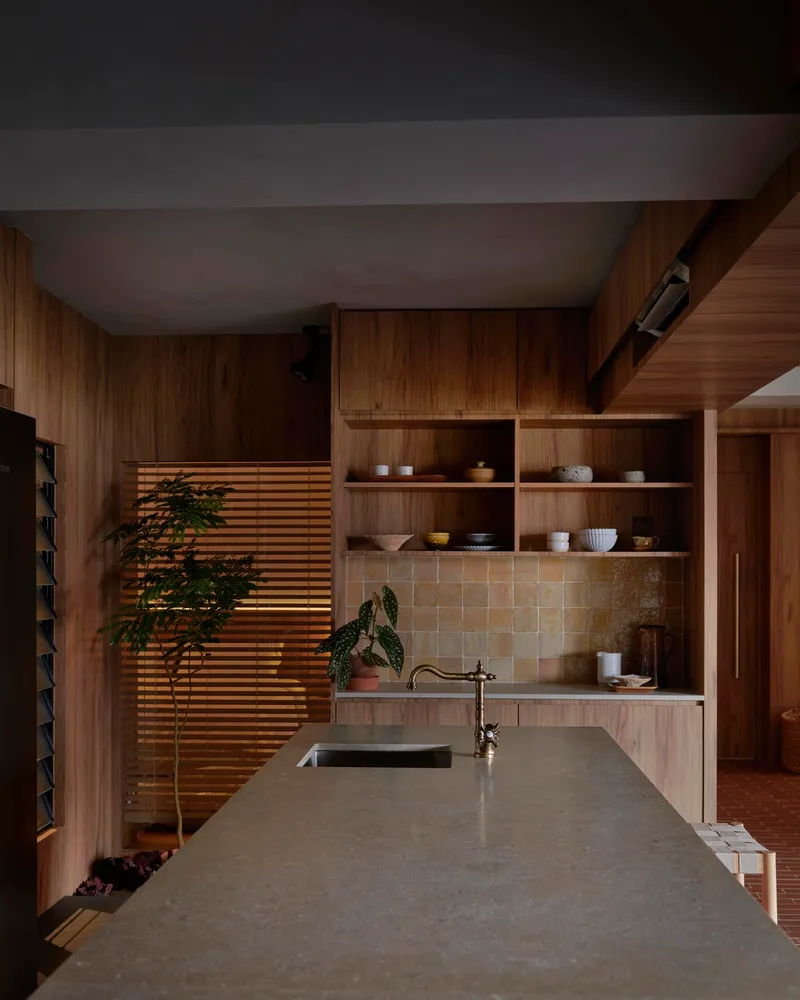

The kitchen is clad in checkered red brick tile and topped with walnut veneer cabinetry, a combination that sounds risky on paper but reads as warm and grounded in person. The island counter doubles as a work surface and social anchor, positioned so that the cook faces into the living areas rather than a wall. Horizontal timber louvers beside the counter filter daylight from an adjacent opening, softening the equatorial sun into something manageable.
A concrete counter runs perpendicular to the island, flanked by open shelving that keeps everyday objects visible and within reach. The earthy tile backsplash in the secondary kitchen zone grounds the palette further. There is no stainless steel minimalism here, just honest materials doing honest work.


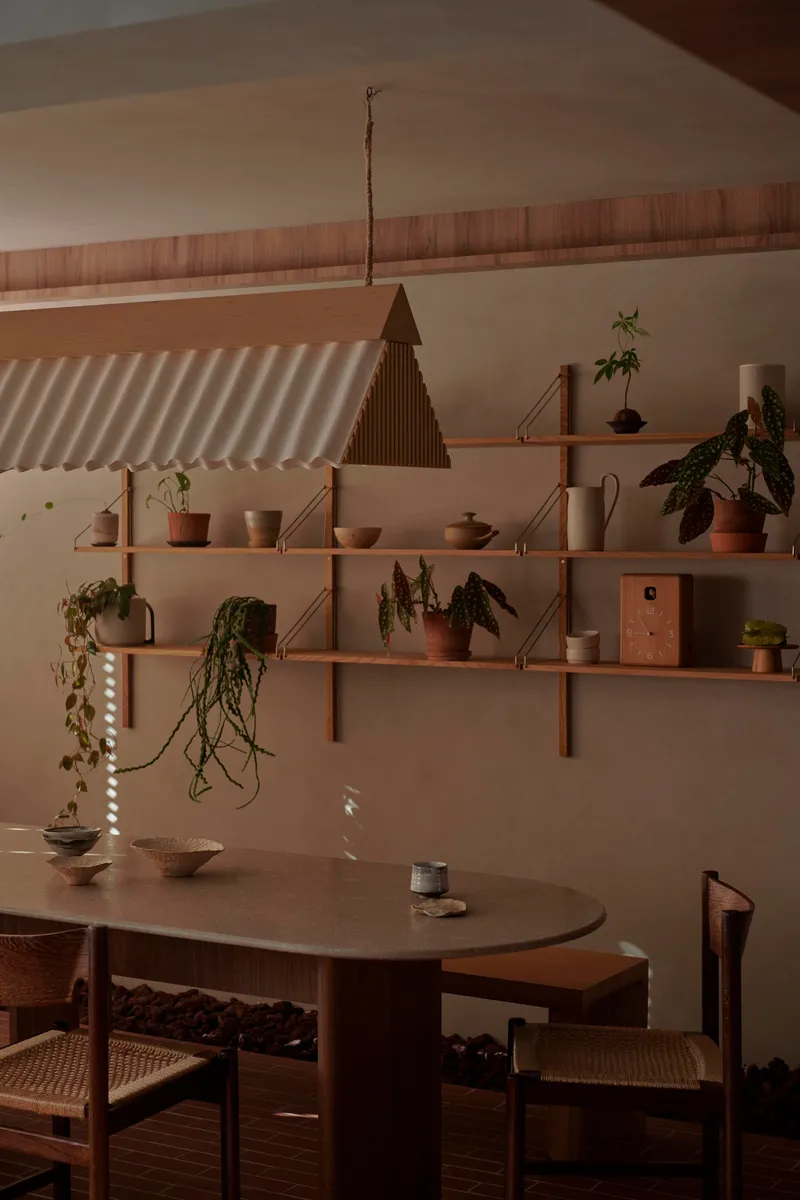
The dining area sits under a corrugated pendant shade that acts as a low canopy, compressing the vertical space just enough to make the table feel intimate. Woven-seat chairs and an oval timber table soften the geometry. Brick tile flooring extends from the kitchen into this zone, reinforcing the sense of a continuous ground plane. Freestanding plants occupy the edges, blurring the threshold between eating area and greenhouse.
Living with Plants, Not Around Them
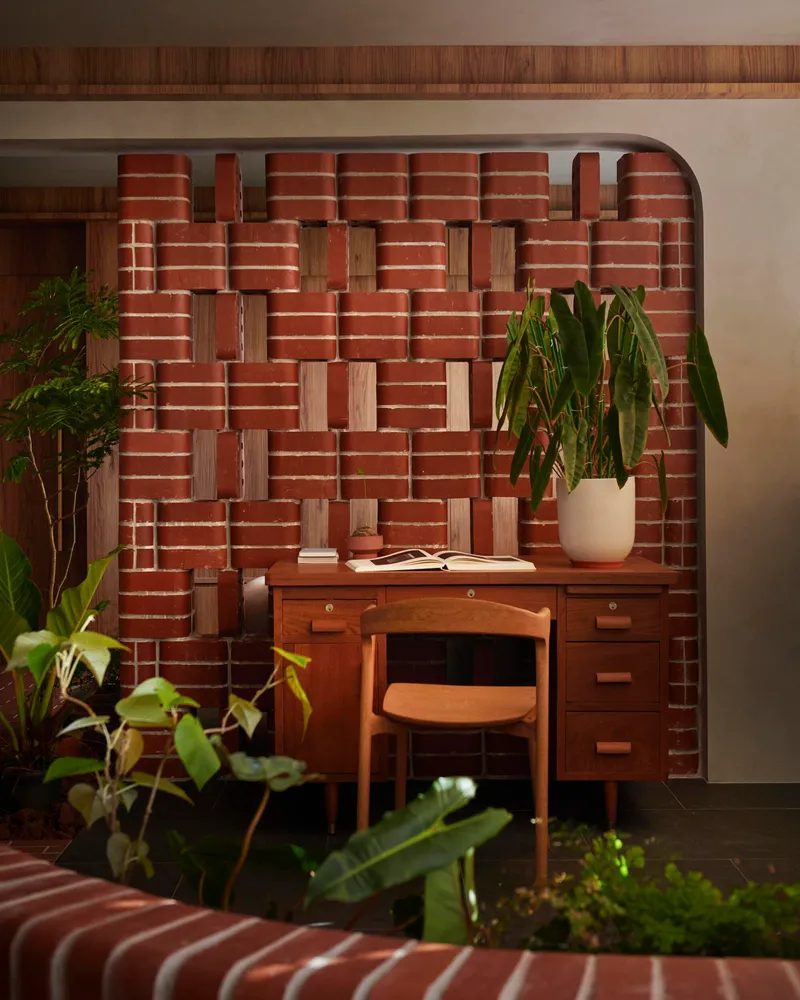


A timber desk is tucked into a niche defined by woven brick and wood, surrounded on three sides by leafy potted plants. It's a workspace that doubles as a propagation station. Nearby, a glass-doored refrigerator on open shelving reveals wire racks stocked alongside hanging plants, a detail that speaks to the client's life rather than a decorator's mood board.
The corrugated screening that wraps parts of the dining and living areas casts dappled shadows across interior surfaces, mimicking the light quality under a tree canopy. Timber shelving systems throughout the apartment are designed not for display alone but for function: trailing houseplants drape from upper shelves, their tendrils softening the geometry of the joinery below.
Timber, Shade, and the Bedroom Threshold


The bedrooms pull back from the brick and plant density of the public zones, relying instead on timber paneling and horizontal blinds to create a quieter register. Views from the bedroom look through layered screens toward the planted balcony beyond, maintaining a visual connection to greenery even in the most private rooms. A bookshelf sits beside the blinds, positioned to catch afternoon light.
The bedroom corner, with its exposed timber beam and simple bedside lamp, is the one moment where the apartment feels conventionally domestic. It's a deliberate contrast. After moving through rooms saturated with brick texture and living plants, the restraint here reads as a kind of exhale.
Details That Earn Their Place


The open-plan living space, seen as a whole, reveals how carefully the patterned brick dividers and timber joinery work together. Nothing floats free of the system. Wall-mounted timber shelves display potted plants beneath a suspended corrugated canopy in the dining zone, each element reinforcing the overarching logic of filtered light and accessible greenery.
Even the bathroom holds its own. A red stone countertop, framed mirror, and slatted timber blind bring the material language of the public areas into the most utilitarian room in the apartment. It's a small gesture, but it signals that L Architects thought about every square metre, not just the photogenic ones.
Plans and Drawings


The floor plan reveals the strategic placement of planted areas and brick features across the apartment, with a central courtyard acting as the heart of the layout. Bedrooms and bathrooms are pushed to the perimeter, freeing the core for communal space and greenery. The isometric drawing makes the ambition clearer still: planted terraces, interior rooms, and a central void work together as a three-dimensional section through a miniature landscape.
What the drawings confirm is that the density of the planting is not incidental. It is architecturally planned. Every brick screen, every shelf, every louver is positioned to serve the dual requirements of human comfort and horticultural care. The apartment operates as a controlled microclimate.
Why This Project Matters
Most apartments that claim to integrate nature do so with a few token planters and a green wall specification. In a Park goes further by making the entire spatial organization subordinate to the presence of living plants. The architecture is not a container for greenery; it is a framework that supports, filters light for, and coexists with it. For a 98 square metre renovation in Singapore, that level of commitment is unusual and worth paying attention to.
L Architects have also demonstrated something important about material honesty in tropical interiors. Red brick, timber, terracotta, and concrete are not exotic choices, but the way they are combined here, with genuine craft in the brick relief work and careful calibration of screening elements, elevates the apartment well beyond the sum of its specification. It's a project that rewards close looking, and one that will only improve as the plants grow into the spaces made for them.
In a Park Apartment by L Architects. Located in Singapore, Singapore. 98 m². Completed in 2024. Photography by Jovian Lim.
About the Studio
Share Your Own Work on uni.xyz
If projects like this are the kind of work you want to make, uni.xyz is a place to publish your own, find collaborators, and enter design competitions.


Popular Articles
Popular articles from the community


Temporary Home for Dogs: A Reversed Zoo Rethinks Animal Shelter Architecture
In Bucharest, a sinuous corridor and freed landscape flip the logic of containment, designing a shelter that works to make itself unnecessary.

Opera on the Sea: Driftwood Logic Shapes a Timber Opera House on Estonia's Coast
Trevor Orgill's opera house translates the entangled drift of floating timber into a civic building where wood, water, and music converge.

Singing Woman: Contemporary Architecture Inspired by Estonia’s Voice and the Sea
Singing Woman turns Estonia’s song culture into flowing opera house architecture, blending public life, landscape, sea, and national memory.

Opera by the Sea Estonia: Three Shells Dissolving Architecture into Tallinn's Coastline
A winning opera house proposal replaces monumental form with interconnected shells that blur the boundary between building, park and Baltic Sea.

Similar Reads
You might also enjoy these articles

Bao Huynh Watercolor Atelier: A Serene Art Retreat in Hội An
Bao Huynh Watercolor Atelier in Hội An blends multifunctional art spaces, sustainable design, local materials, and family-friendly living in a serene environment.

Atelier Macri Concept Store Interior Design by CASE-REAL
Atelier Macri store features a "ko" counter, walnut wood details, cork displays, blending retail, gallery, and seamless customer experiences.

Manuel Vargas Izquierdo Stadium and High-Performance Sports Center: Architectural Excellence in Jalpa de Méndez
The Manuel Vargas Izquierdo Stadium blends sustainable design, inclusive sports facilities, and cultural-inspired architecture, revitalizing Jalpa de Méndez’s public spaces.

KAKR Buluh Awar Hall: Revitalizing Community and Ecology Through Bamboo Architecture
Community built bamboo hall revitalizes Buluh Awar village, empowering youth, restoring ecology, celebrating vernacular craftsmanship through sustainable architecture and culture.


Comments (0)
Please login or sign up to add comments
No comments yet. Be the first to comment!