
1+1>2 Architects Scatter Adobe Pavilions Among 38 Jackfruit Trees to Build a Vietnamese Rural Resort
On a 1.7-hectare lake peninsula west of Hanoi, Jackfruit Village uses earth bricks and thatch to rethink sustainable hospitality.


There is a quiet radicalism in refusing to clear a site. On a 1.7-hectare peninsula bordered by a lake to the south and southwest in Cổ Đông Commune, Sơn Tây, 1+1>2 Architects kept every one of the 38 jackfruit trees and 13 pomelo trees already growing on the land, then threaded a resort through the gaps. Jackfruit Village, completed in 2019, contains only 180 square meters of built area across the entire site. That ratio alone, less than one percent coverage, tells you everything about the project's priorities. The trees are not ornament. They are infrastructure: shade canopies, spatial organizers, and the reason anyone would want to stay here in the first place.
Led by architect Hoang Thuc Hao, the design team articulated a philosophy they call the "tolerant village," a framework built on three axes: tolerance to nature, to fellow creatures, and to the self. What could easily have been a wellness-retreat platitude is here given material and spatial reality. Adobe bricks are made from earth excavated on site. Thatched roofs manage solar radiation without mechanical cooling. Buildings sit on elevated platforms to counter humidity and termites. A traditional VAC model, the Vietnamese integration of garden, pond, and livestock pen, turns the resort into a working agricultural landscape. The result is not a theme park of rural nostalgia but a genuinely functional ecology that also happens to accept paying guests.
The Meditation House as Nucleus
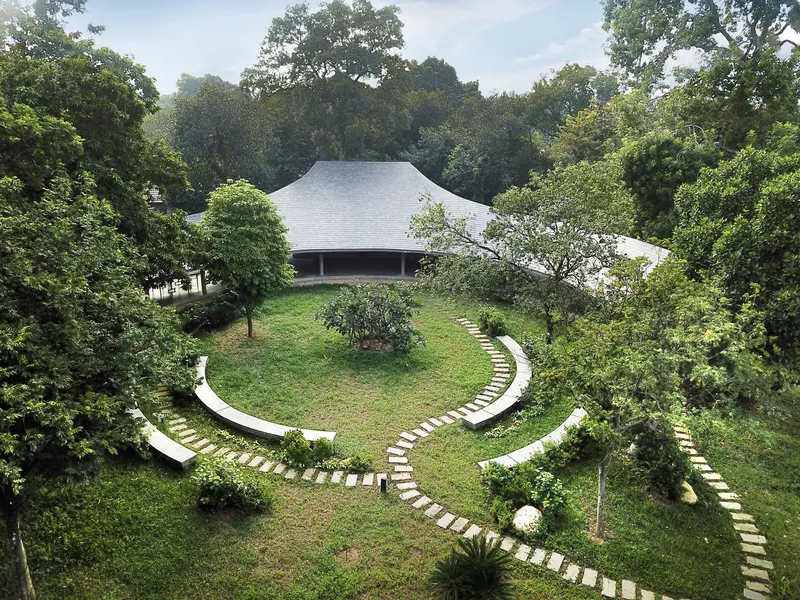
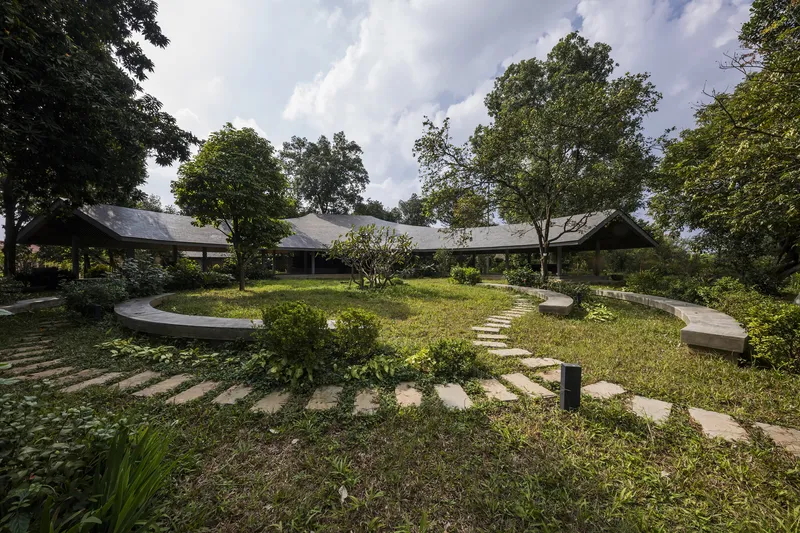
The masterplan radiates outward from a central meditation house that doubles as a community gathering space. Curved stone pathways fan across a grassed courtyard, pulling visitors from the perimeter inward. Residential units occupy positions at the feet of mature trees, their placement dictated not by a grid but by the existing canopy. The effect is centripetal without being rigid: you always know where the center is, but you arrive at it through a landscape rather than along a corridor.
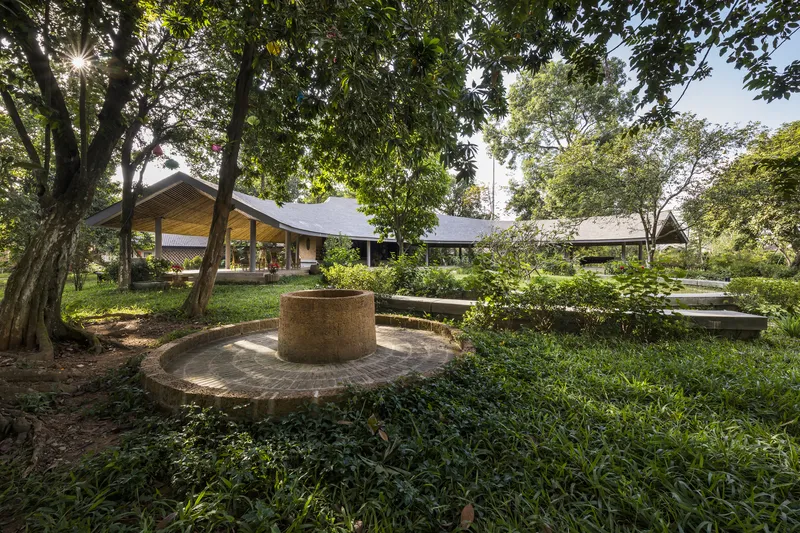
The circular earthen terrace with its central well reads as a kind of village commons, a social anchor that keeps the scattered pavilions from feeling isolated. Stepping stones through planted beds slow your movement down, enforcing the kind of deliberate pace the architects clearly intended. Every path demands attention to where you place your feet, which means you are always looking at the ground, the plants, and the trees rather than at a screen.
Adobe and Thatch: Construction from the Ground Up
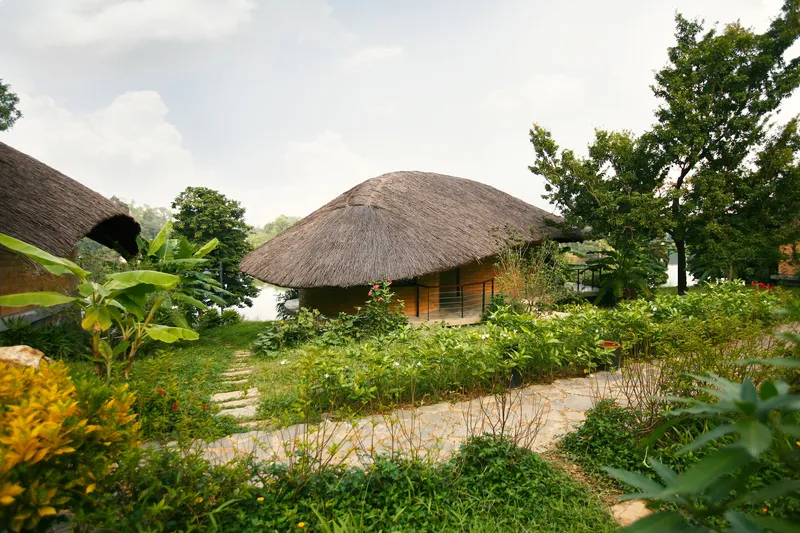
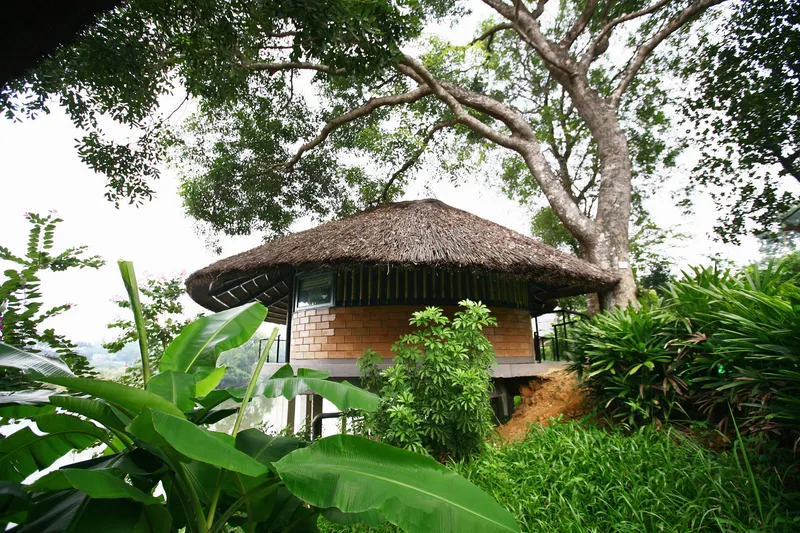
The material palette is almost absurdly local. Adobe bricks were formed from earth dug on site, meaning the buildings are, in a literal sense, made of the ground they sit on. Thatched roofs provide solar shading, rain protection, and acoustic dampening in a single assembly. There is no imported cladding, no polished concrete, no steel moment frames. Construction was carried out by local workers using traditional techniques elevated into a contemporary spatial logic. The dome-shaped pavilion with horizontal timber shutters, for example, is clearly vernacular in its materiality but precise in its geometry, a distinction that separates craft from cliché.
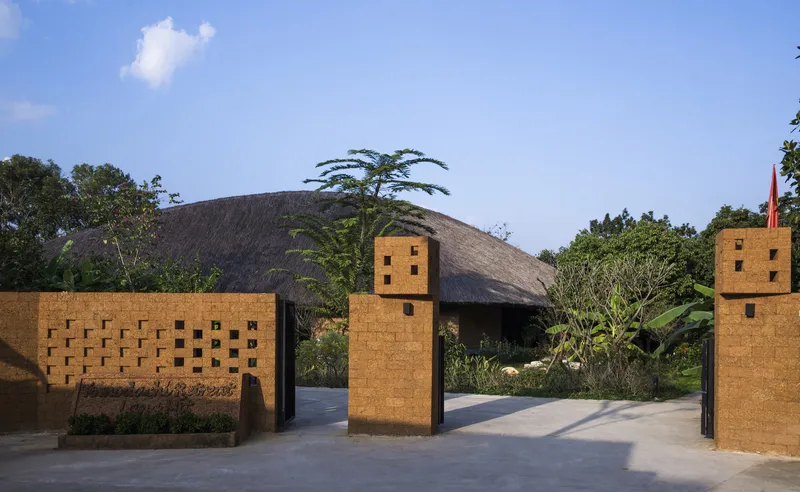
The entry gate deploys perforated rammed earth walls flanking a concrete path, a moment of deliberate threshold between the road and the resort's internal world. Timber towers on either side lend a vertical accent that signals arrival without resorting to grand gestures. The perforations filter light and air, making the wall simultaneously boundary and membrane.
Living Inside the Canopy
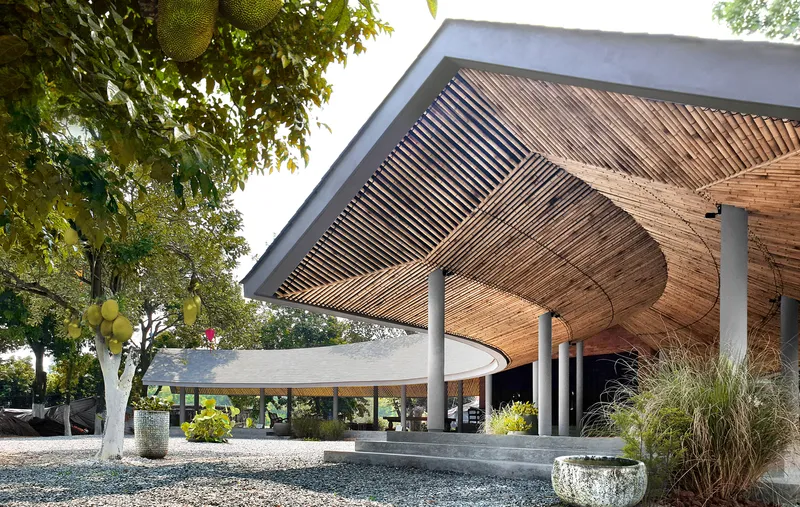
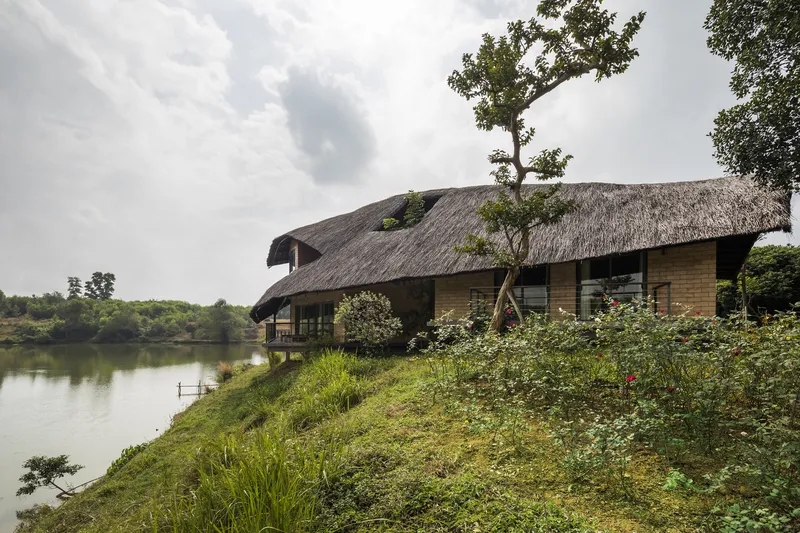
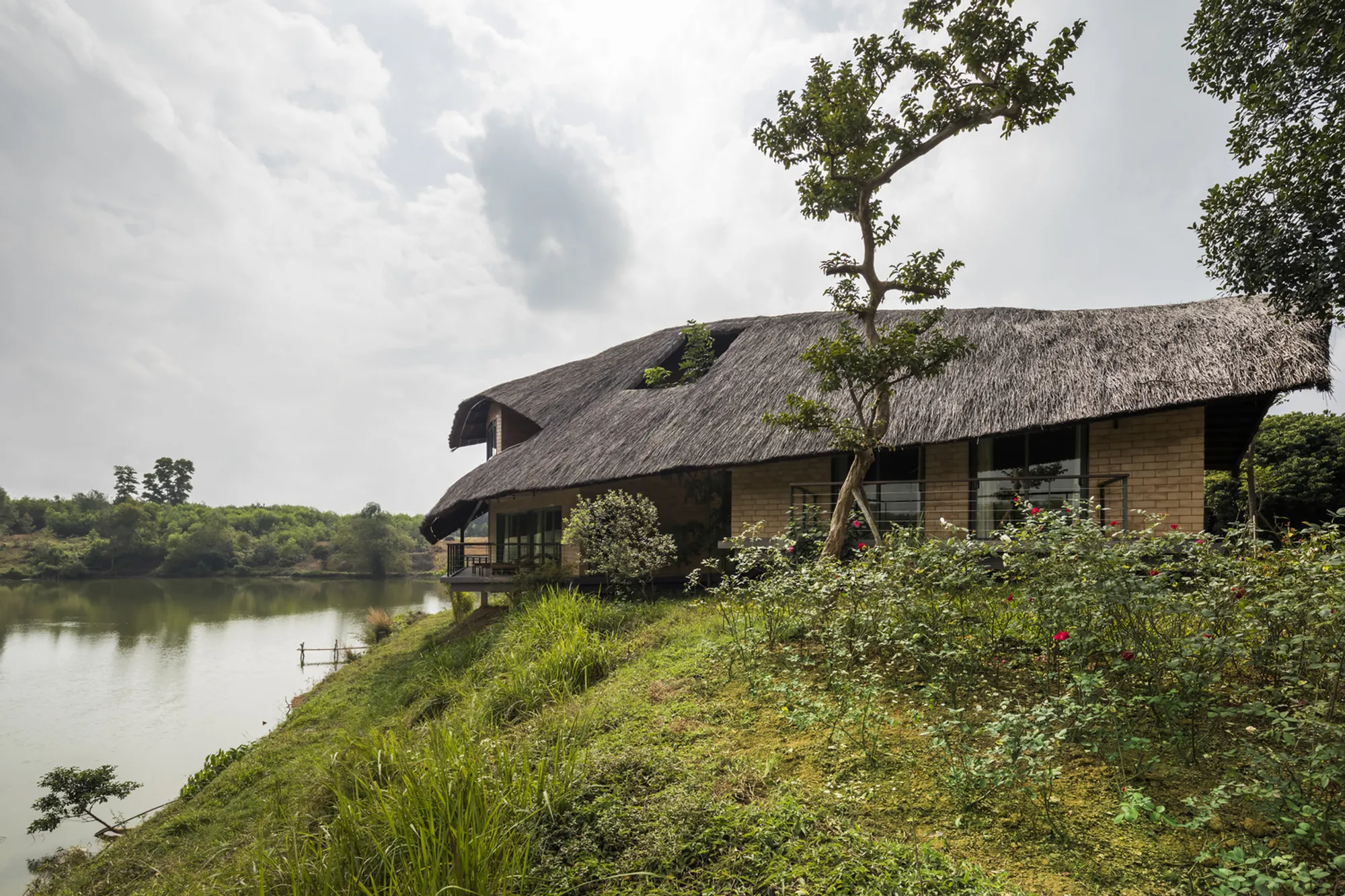
The most compelling detail in the project is the way buildings and trees literally share the same footprint. The lakefront elevation shows a thatched roof cantilevering over rammed earth walls while a tree trunk rises through the structure, its canopy merging with the roof's silhouette. Inside, the patterned timber slat ceiling wraps around circular columns and a jackfruit tree that penetrates the roof plane, treated as a structural participant rather than an obstacle to be removed. These are not tree houses. They are houses that acknowledge trees as cohabitants.
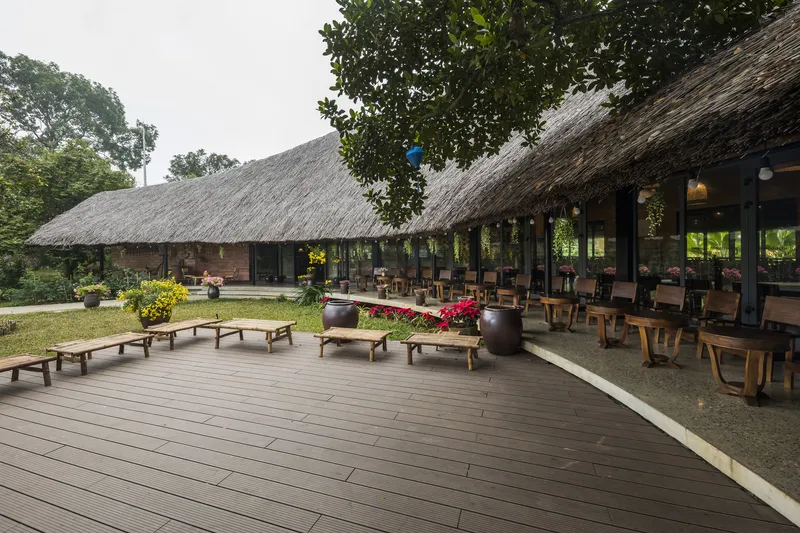
The open-sided dining pavilion, reached via a timber deck terrace with low benches, demonstrates how the thatch creates a deep, shaded zone that eliminates the need for walls on three sides. Cross-ventilation is total. The boundary between interior and exterior is reduced to the shadow line of the roof's edge.
Site and Water: The Peninsula Advantage
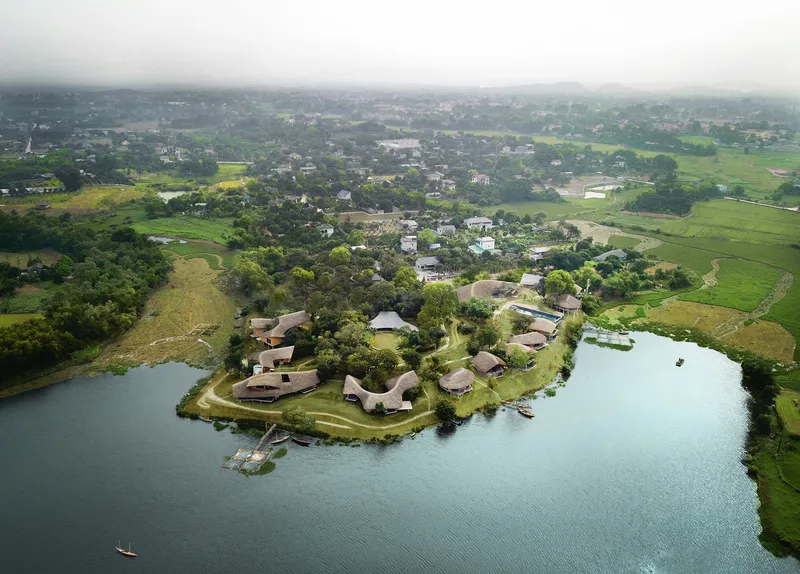
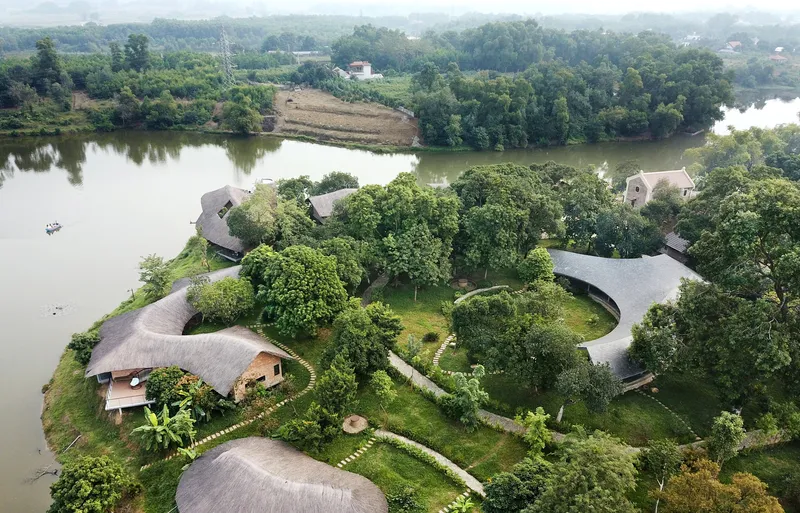
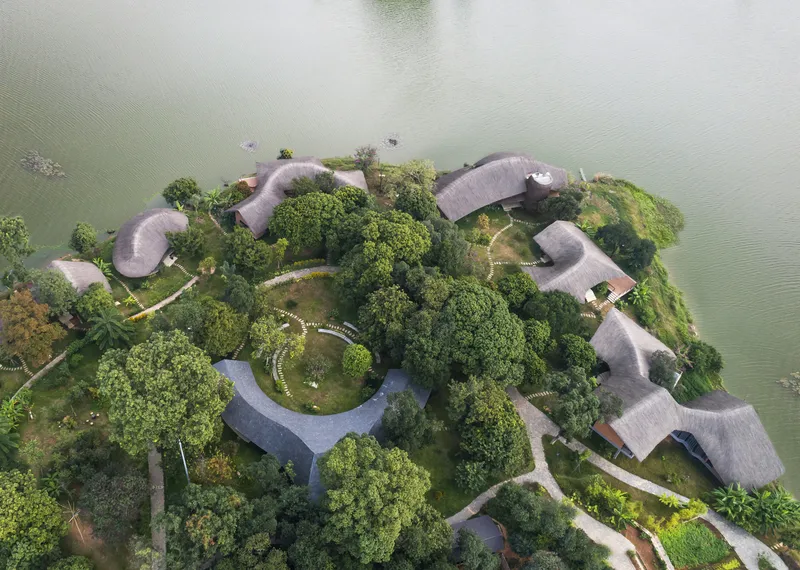
From the air, Jackfruit Village reads as a dense cluster of thatched forms on a green tongue of land extending into a calm lake. The water body serves multiple roles: it defines the site boundary, moderates microclimate, and provides the aquaculture component of the VAC system. Cage fish farming in the lake supplies organic protein, closing one more loop in the project's self-sustaining ambitions.
The drone views reveal how the pathways and pavilions respond to the peninsula's irregular shoreline rather than imposing orthogonal order. Mature trees form a continuous overhead canopy that, from altitude, almost conceals the buildings entirely. The architecture disappears into its landscape, which is of course the whole point.
Infrastructure Below the Surface
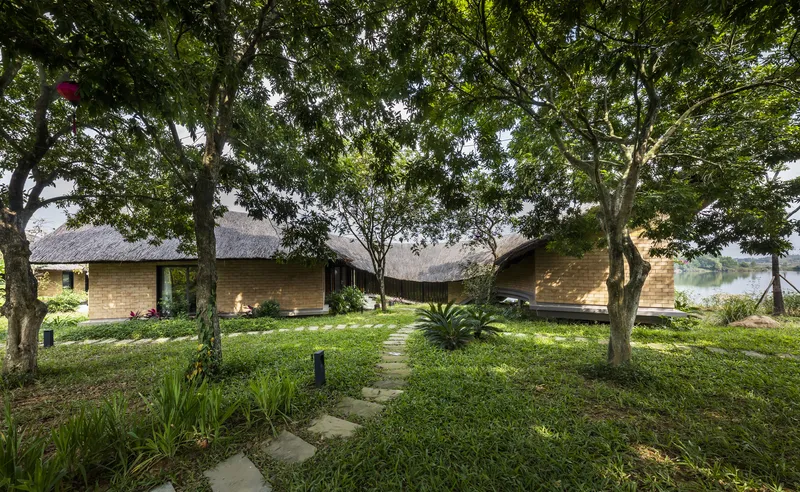
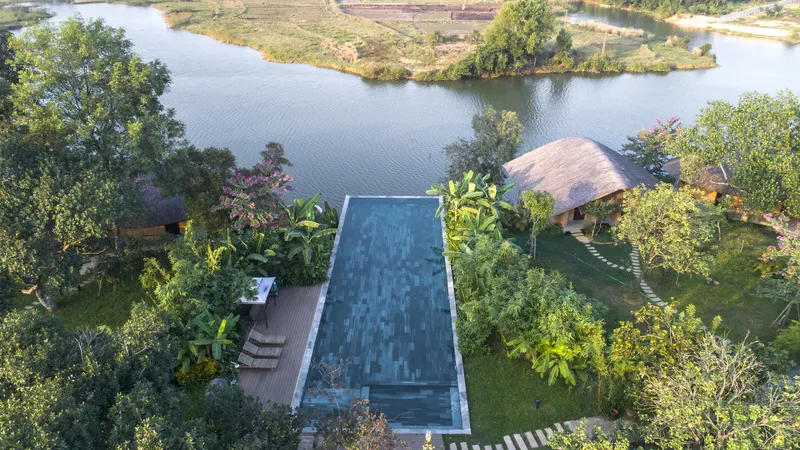
Sustainability claims in resort architecture often stop at material selection. Here, each building sits on an elevated platform that solves three problems simultaneously: termite protection, humidity control, and natural surface drainage. Below grade, every unit connects to its own five-chamber biological septic tank. Wastewater filtration is positioned at the downwind end of the site, a detail that demonstrates the kind of prosaic, essential thinking that separates genuine ecological design from greenwashing.
The swimming pool, finished in dark tile and overlooking agricultural fields at dusk, is the one concession to conventional resort expectations. Even here, though, its placement at the site's edge keeps it from dominating the compound. The low-slung brick volumes with thatched roofs arranged around grassed courtyards are the real protagonist, not the amenity.
The Aerial View: A Village, Not a Resort
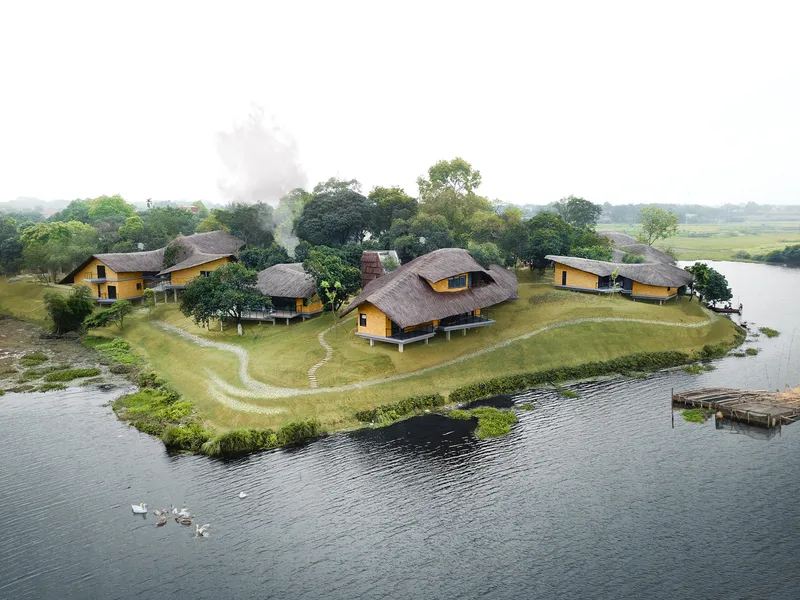
The overhead shots are revealing. Yellow-walled pavilions with thatched roofs cluster on the peninsula much the way houses in a traditional Northern Vietnamese hamlet would, loosely grouped, individually oriented, and held together by shared outdoor space rather than by corridors or lobbies. There is no reception building visible, no grand axis, no hierarchy of arrival sequence. The compound reads as a settlement rather than a facility, and that distinction is fundamental to its hospitality model. Guests participate in a village, not a service transaction.
Why This Project Matters
Jackfruit Village matters because it treats sustainability as a spatial and social proposition rather than a technical one. The adobe bricks, the thatched roofs, the biological septic tanks are all important, but they serve a larger argument: that a hospitality model can be organized around existing ecology rather than replacing it. By preserving every tree on site and building only 180 square meters across 1.7 hectares, 1+1>2 Architects produced a project where the ratio of landscape to building is the design move, not an afterthought.
More broadly, the project challenges the assumption that rural tourism requires importing urban standards of comfort and finish. The materials here are literally underfoot. The food comes from the garden and the lake. The plan is organized by trees, not by circulation diagrams. In an industry saturated with eco-resort branding that rarely survives contact with an energy audit, Jackfruit Village offers a credible alternative: architecture that costs the land almost nothing because it is, in every meaningful sense, already part of it.
Jackfruit Village by 1+1>2 Architects, located in Cổ Đông Commune, Sơn Tây, Hanoi, Vietnam. Site area: 1.7 hectares; built area: 180 square meters. Completed 2019. Photography by Trieu Chien.
About the Studio
Share Your Own Work on uni.xyz
If projects like this are the kind of work you want to make, uni.xyz is a place to publish your own, find collaborators, and enter design competitions.



Popular Articles
Popular articles from the community


The Musturak Paradise: Senior Living Architecture for a Connected Future in Temara, Morocco
The Musturak Paradise reimagines senior living architecture in Temara via private homes, social spaces, culture, community, and shared care.

Conexión: Biophilic Design Reimagines High-Rise Living in Hong Kong
Conexión reimagines high-rise living in Hong Kong through biophilic design, green facades, shared spaces, daylight, water and nature within.

Co-life: Sustainable Architecture for Age-Friendly Community Living
Co-life reimagines sustainable architecture for seniors through courtyards, rammed earth, shared gardens, and spaces designed for belonging.

Co-Life: Senior Housing Design That Reconnects Older Adults With the City
Co-Life reimagines senior housing design through healing gardens, shared streets, workshops, and a sustainable community across generations.

Similar Reads
You might also enjoy these articles


FAMM Arquitectura Organizes Ten Villas Around Courtyards and Jungle in Nosara, Costa Rica
El Molino pairs two elongated volumes with deep overhangs and timber louvers to build a compact coastal community five minutes from the beach.

Oscar Niemeyer's Ibirapuera Park Pavilions Define São Paulo's Cultural Identity in Concrete and Curve
A constellation of modernist volumes set within São Paulo's most important urban park, conceived for the city's 400th anniversary in 1954.
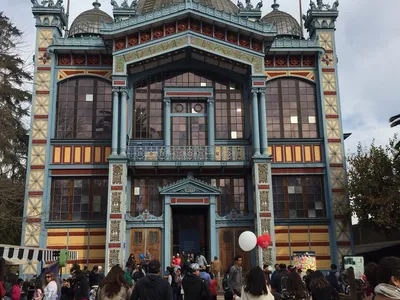
How Henri Picq's 1889 Paris Pavilion Traveled 11,000 Kilometers to Become Santiago's Artequín Museum
A prefabricated iron and glass pavilion built for the Paris Universal Exposition found a second life as a children's art museum in Chile.

Sanjay Puri Architects Wraps a Jaipur Office Tower in Capsule-Shaped Green Buffers
A nine-level climate-responsive workplace near Jaipur Airport uses stacked planter terraces and aluminium screens to fight 40°C heat.


Explore Architecture Competitions
Discover active competitions in this discipline



Challenge to reimagine the Iron Throne


Photograph architecture without architects


Illustrate the lost glory of Angkor Wat - Render Challenge


Design challenge to reuse E-waste
Comments (0)
Please login or sign up to add comments
No comments yet. Be the first to comment!