
Kantina: Three Curtains Transform a Lausanne Theater
BARAKI hung three coloured PVC curtains in a Swiss theater and made a cafe, a bar, and an event hall from one room and stackable furniture.

The Theater of Vidy sits on the shore of Lake Geneva in Lausanne. It is one of Switzerland's most important independent theaters, and its public spaces needed to work as a cafe, a bar, an event hall, a meeting point, and a dining room, sometimes all in the same evening. Kantina, designed by BARAKI, is the interior renovation that makes all of that possible. The tool: three translucent PVC curtains in pink, yellow, and blue.
That sounds simple, and it is. The curtains hang from ceiling tracks and can be drawn, opened, or positioned anywhere on the floor plate. They divide the space, colour the light, and create atmosphere without building a single wall. The rest of the intervention is furniture: tables, benches, and chairs designed to stack, fold, and rearrange. The entire interior can be reconfigured in minutes.
The Theater and Its Setting
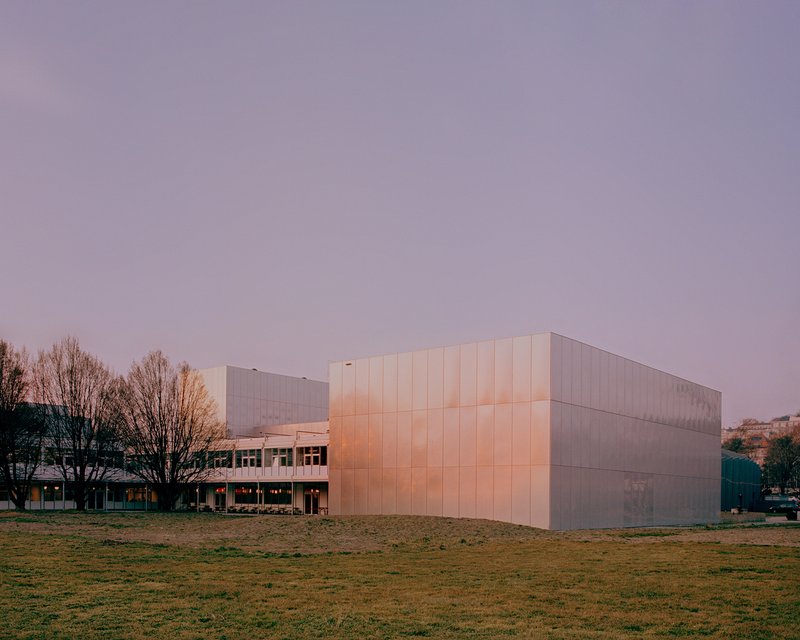
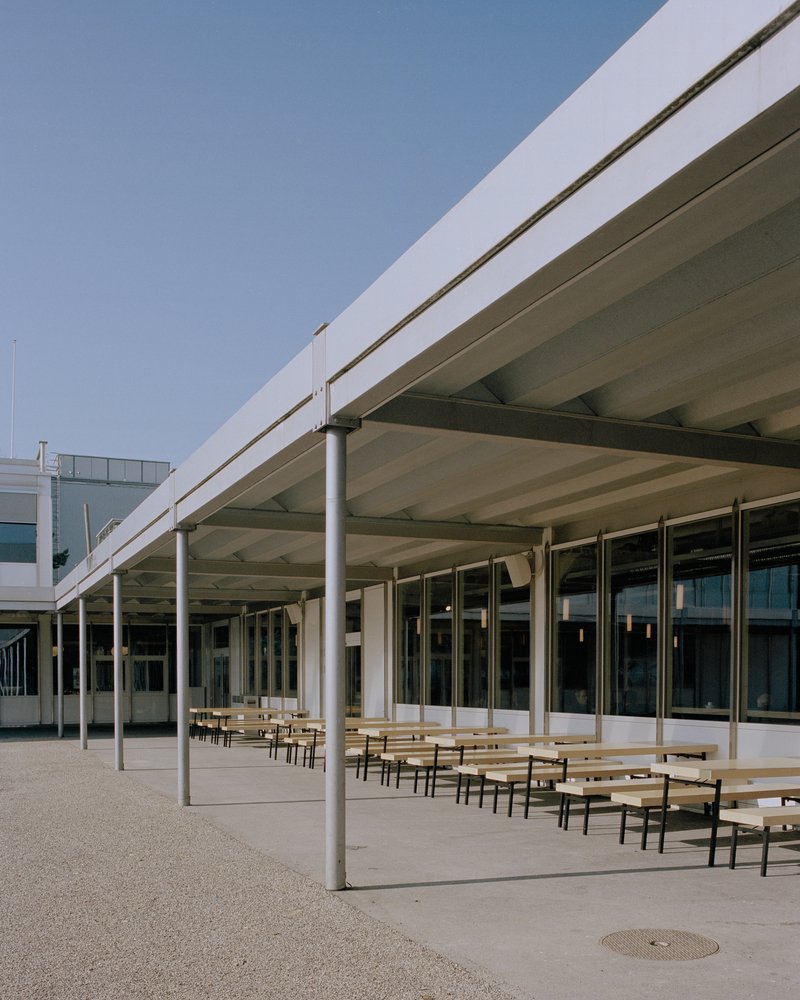
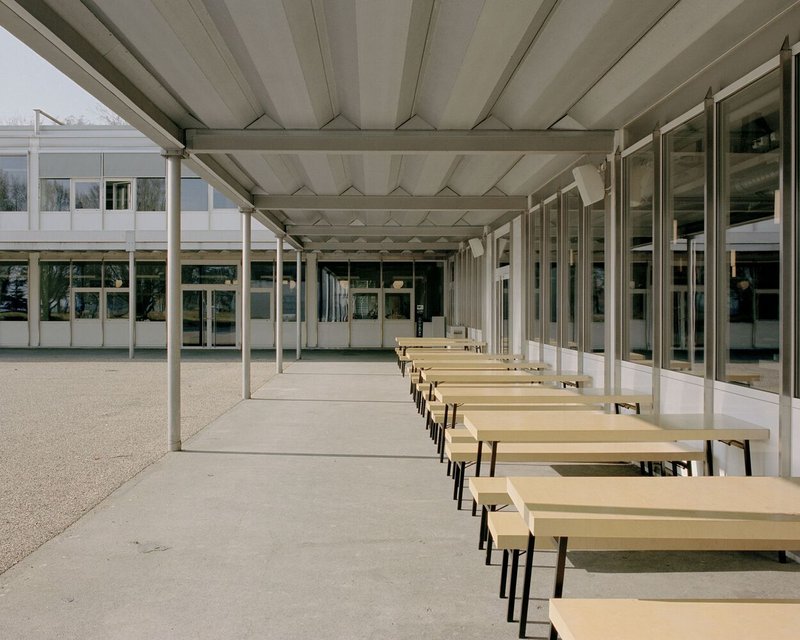
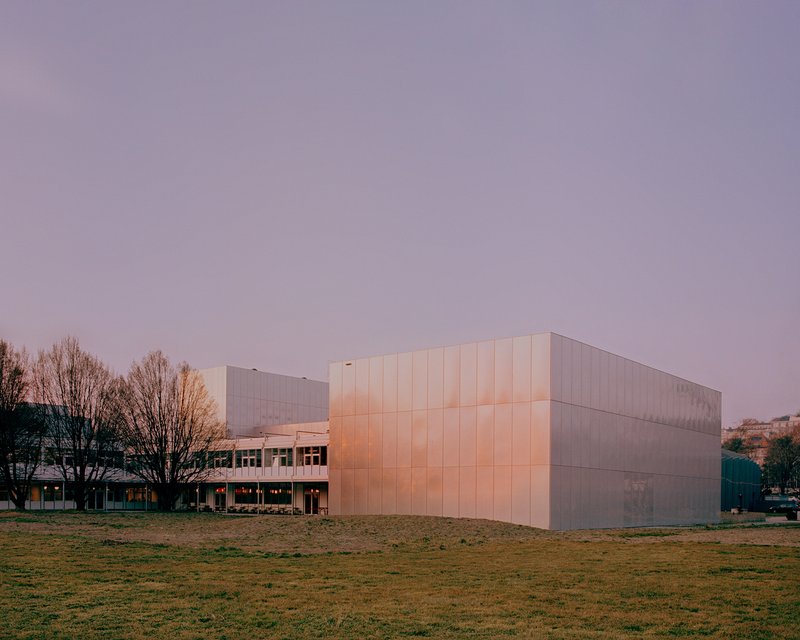
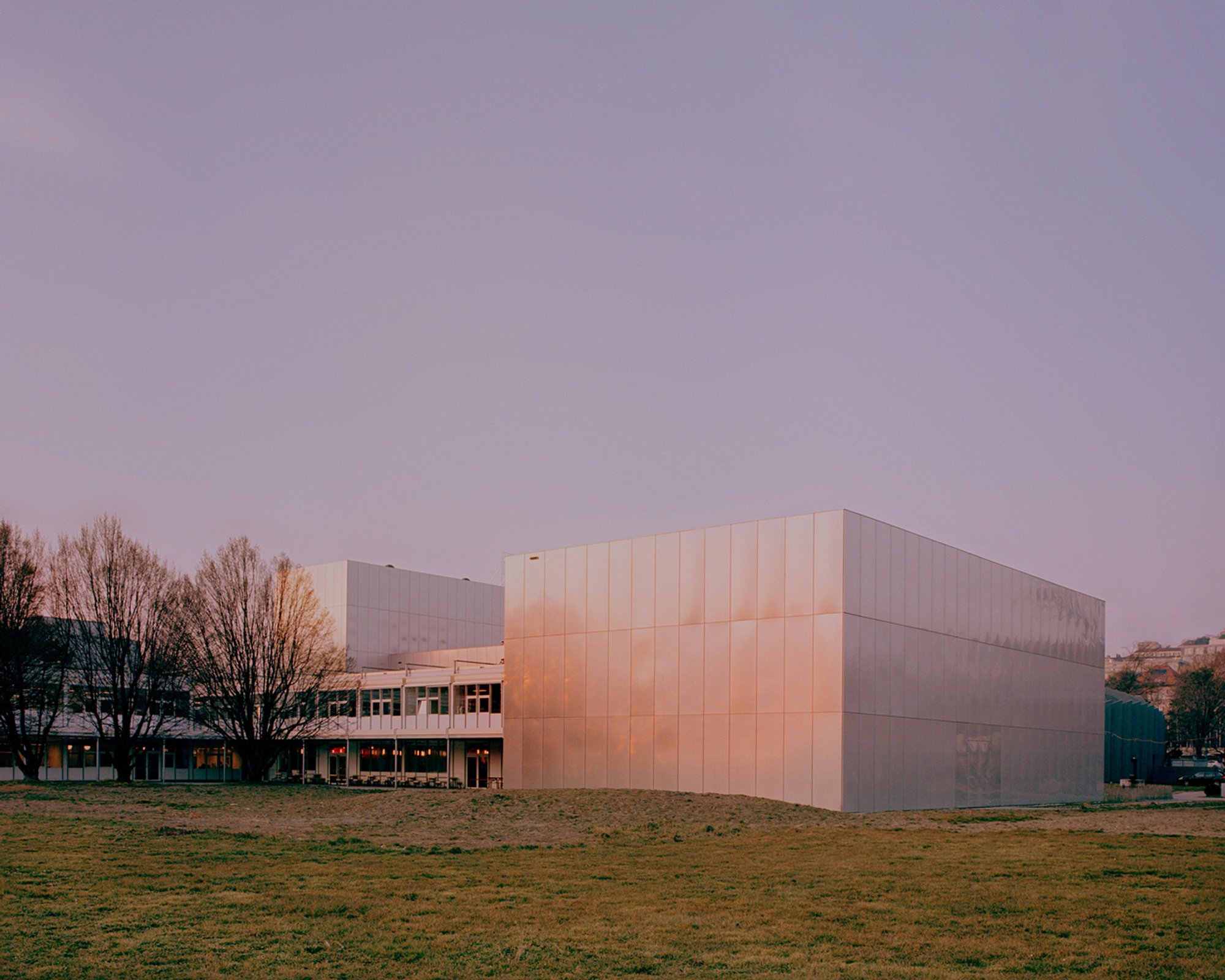
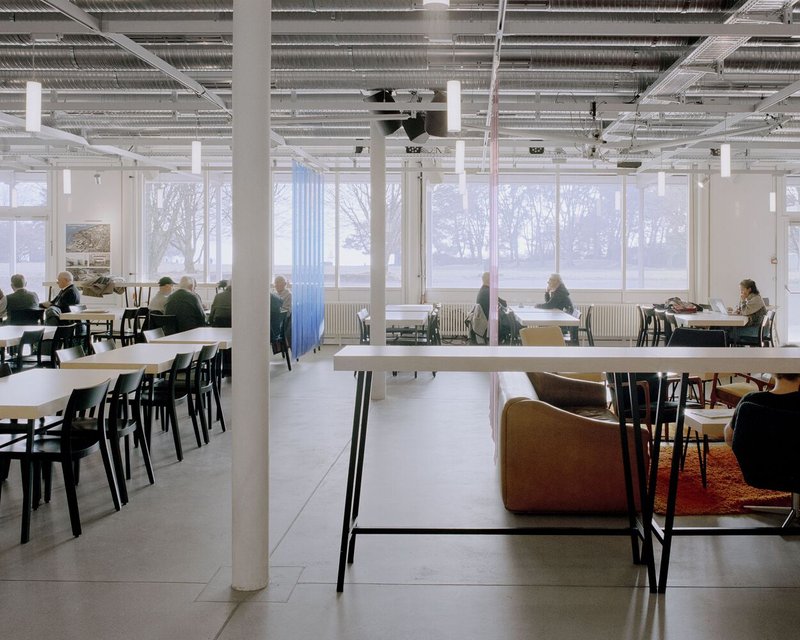
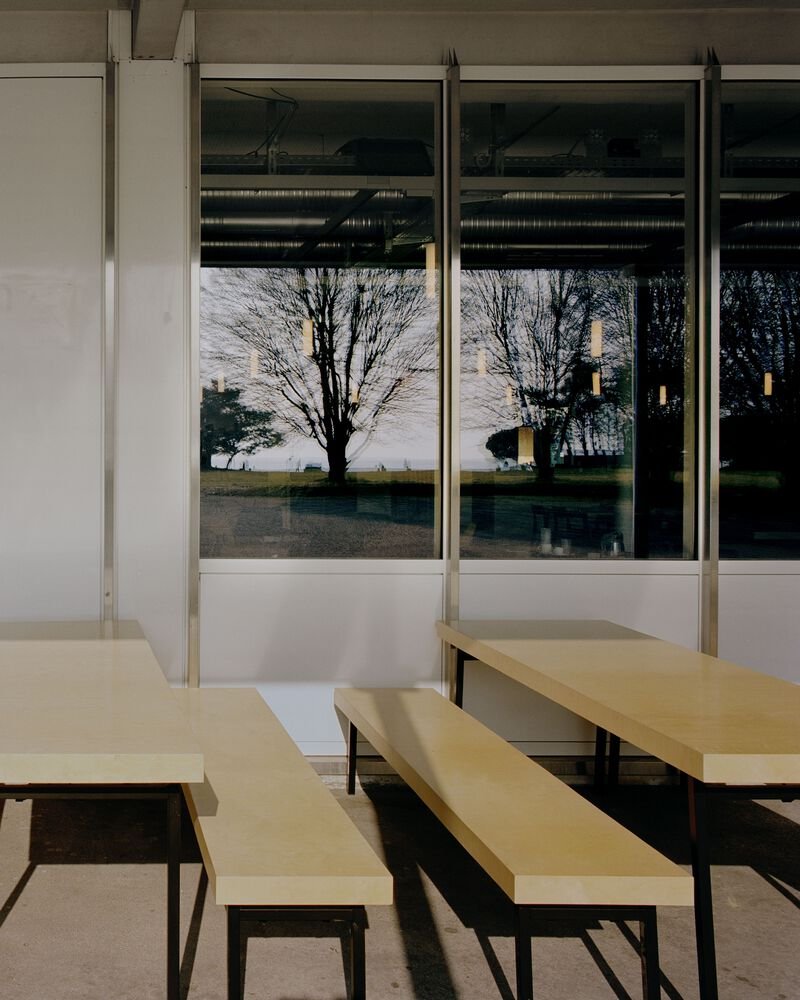
The theater building is a mid-century metallic-clad volume on a lawn by the lake. The covered terrace extends along the glass facade with steel columns and timber bench-tables in rows. In winter, the bare trees and the lake create a stark, beautiful backdrop. The interior is entirely visible from outside through the full-height glazing.
Three Curtains, Three Colours
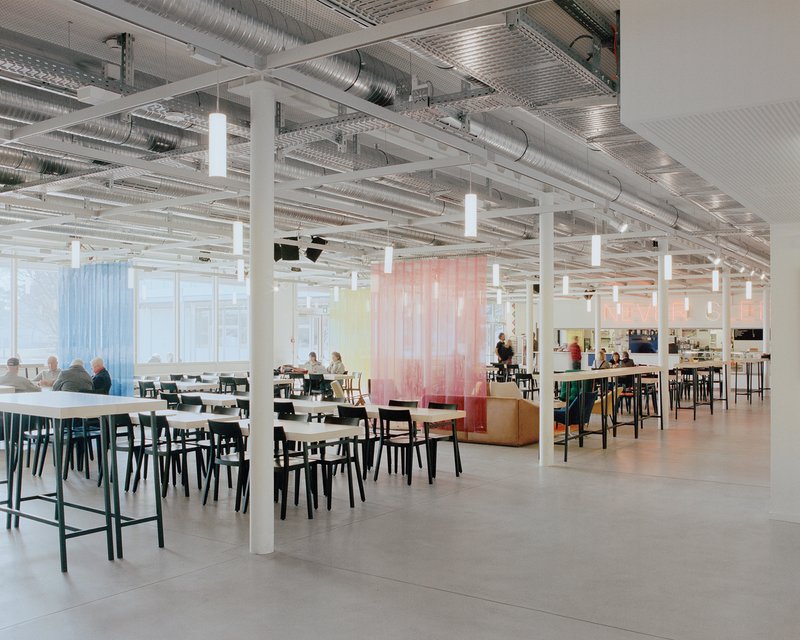
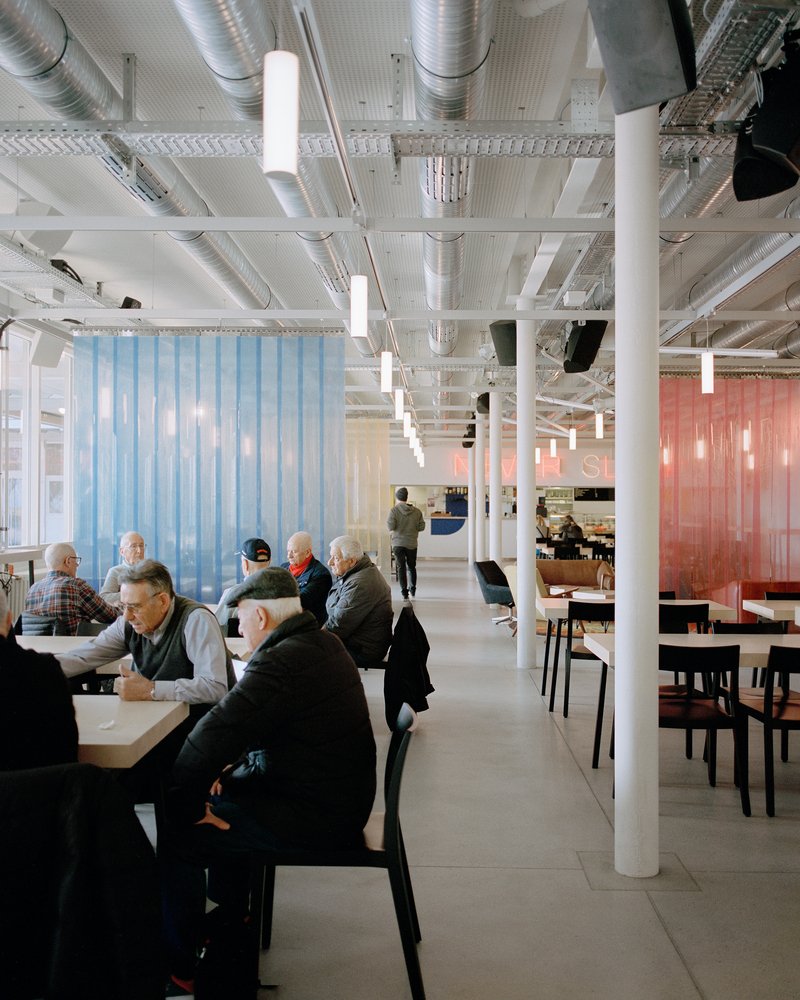
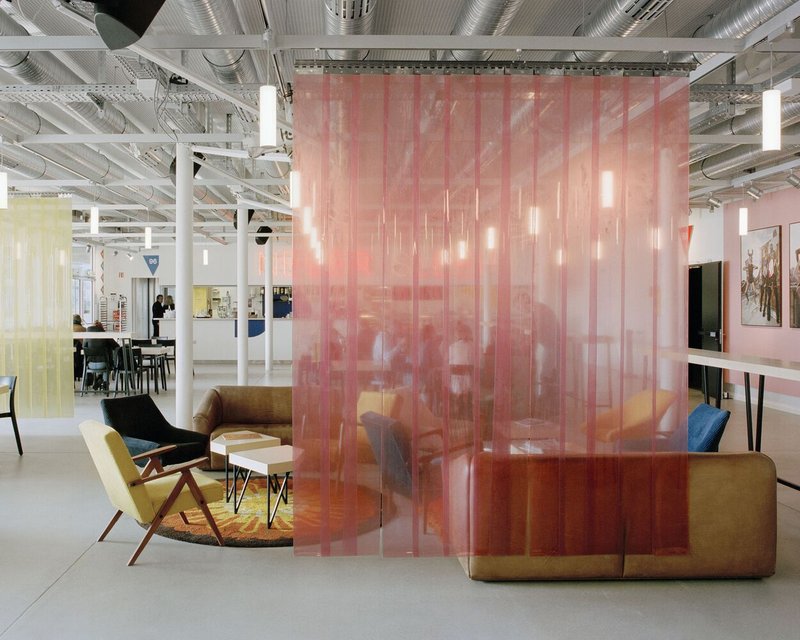
The three PVC curtains are the entire design strategy. Pink, yellow, and blue. Each one is translucent: you can see through it, but it changes the colour and quality of light in the zone it encloses. The pink curtain warms the light. The yellow brightens it. The blue cools it. Together, they produce a space that shifts mood across its length without a single wall or partition.
The curtains are not decorative screens. They are spatial tools. When all three are drawn, the room becomes three distinct zones with three different atmospheres. When they are open, the room is a single open hall. The configuration can change for lunch, for a performance interval, for a private event, and back again. This flexibility is the point.
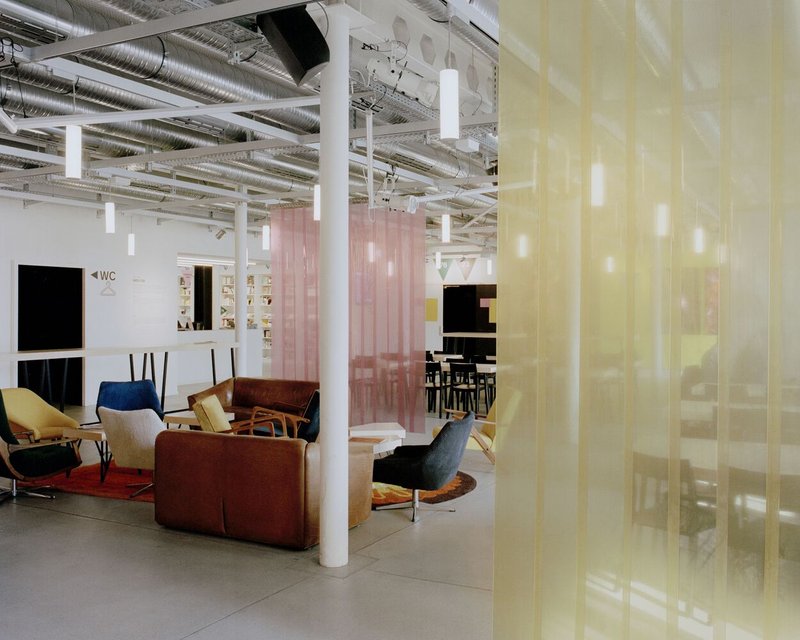
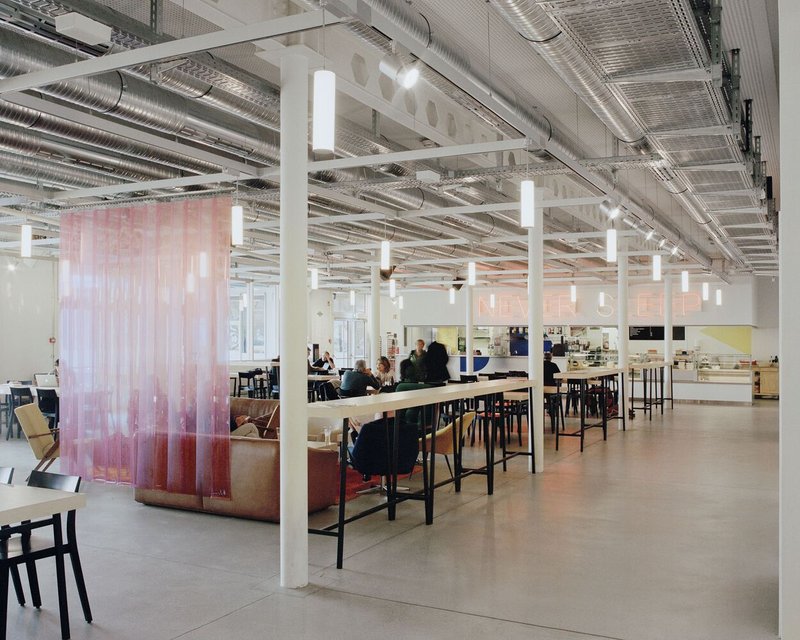
The Interior: Columns, Light, and Atmosphere
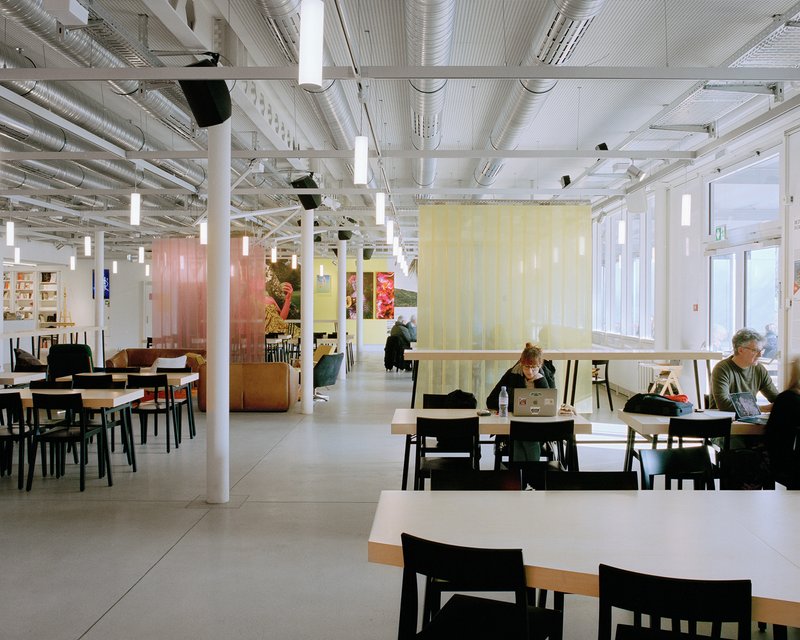
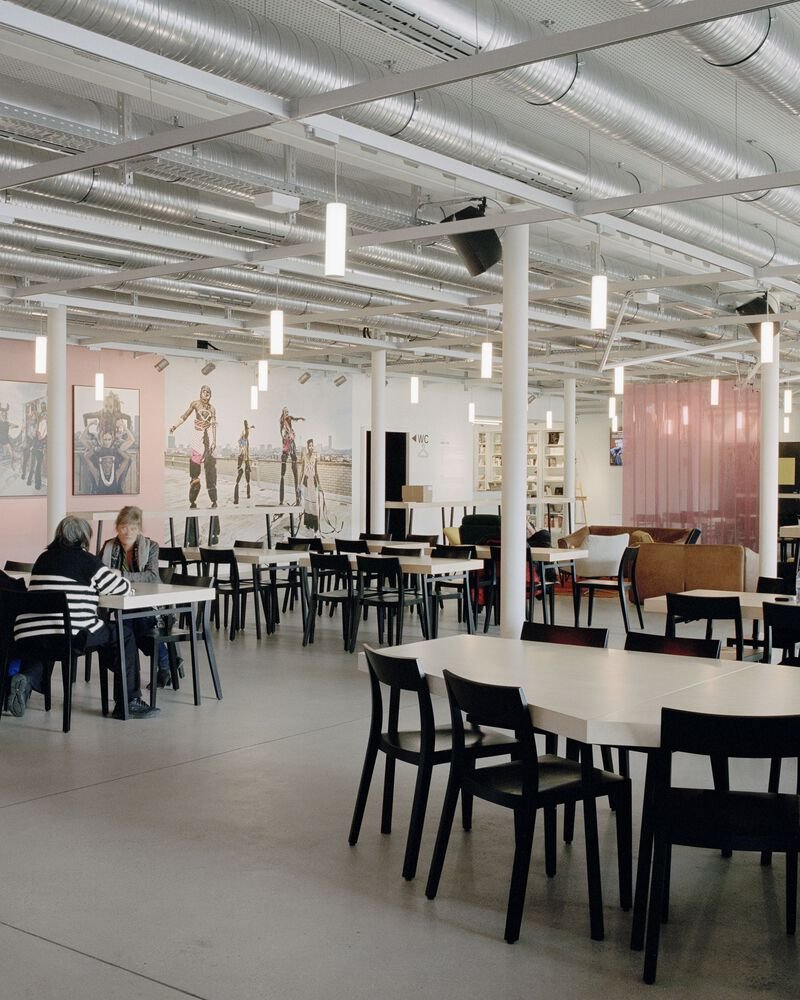
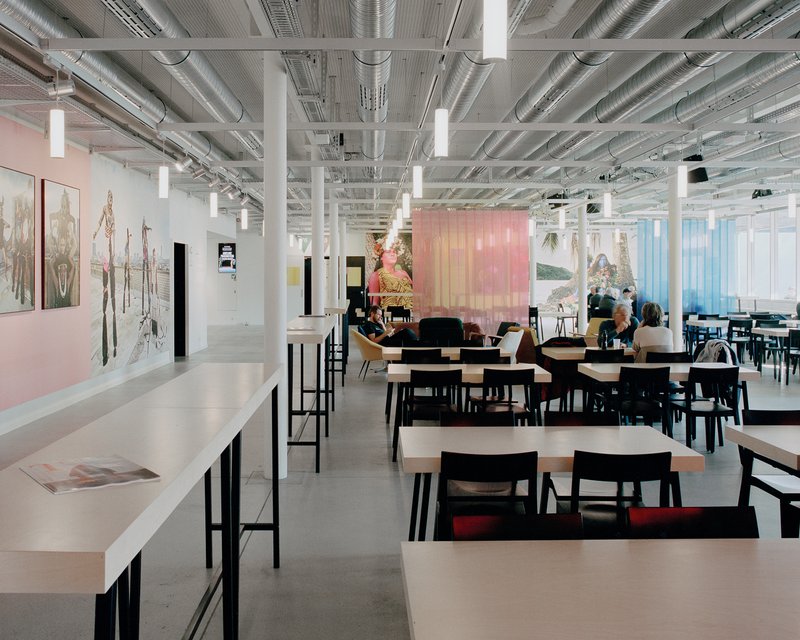
The base interior is minimal: white columns, exposed ceiling services, polished concrete floor, full-height windows to the lake. The curtains and the furniture are the only additions. The bar counter sits near the centre. Art and photographs hang on the walls. Pendant lights drop from the ceiling grid at regular intervals.
The photographs by Matthieu Croizier capture the space at different times and in different configurations, which is exactly the right way to document a project whose identity depends on being changeable. The same room looks like a cafe at lunch, a gallery in the afternoon, and a bar at night.
Light and Mood
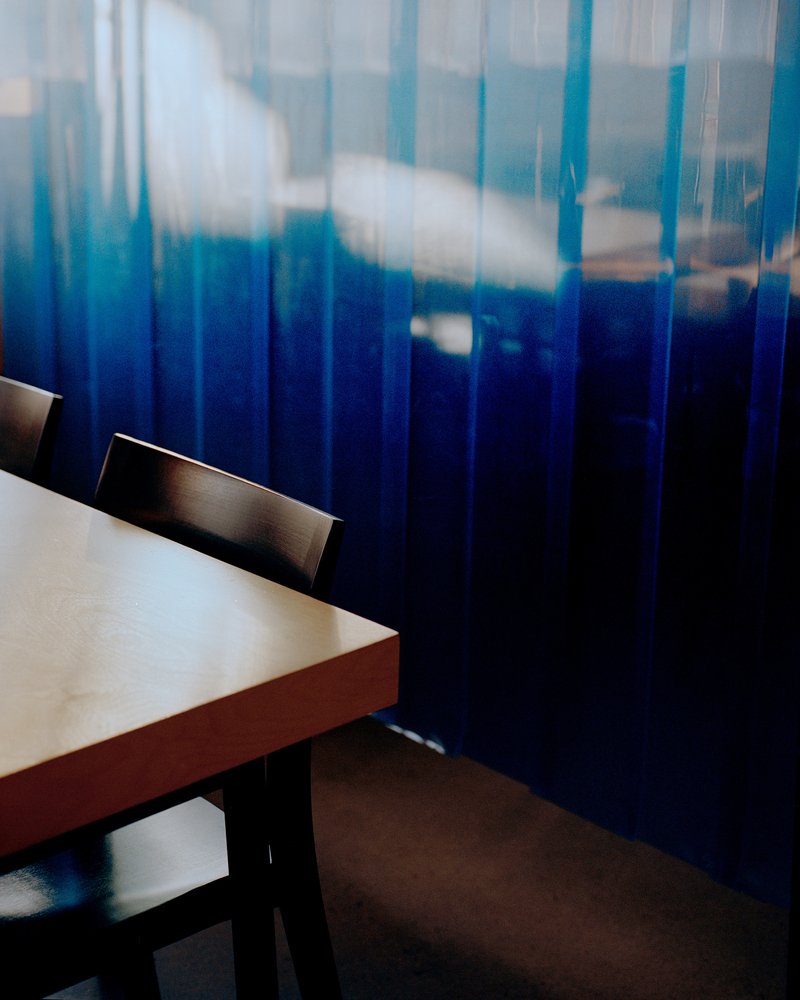
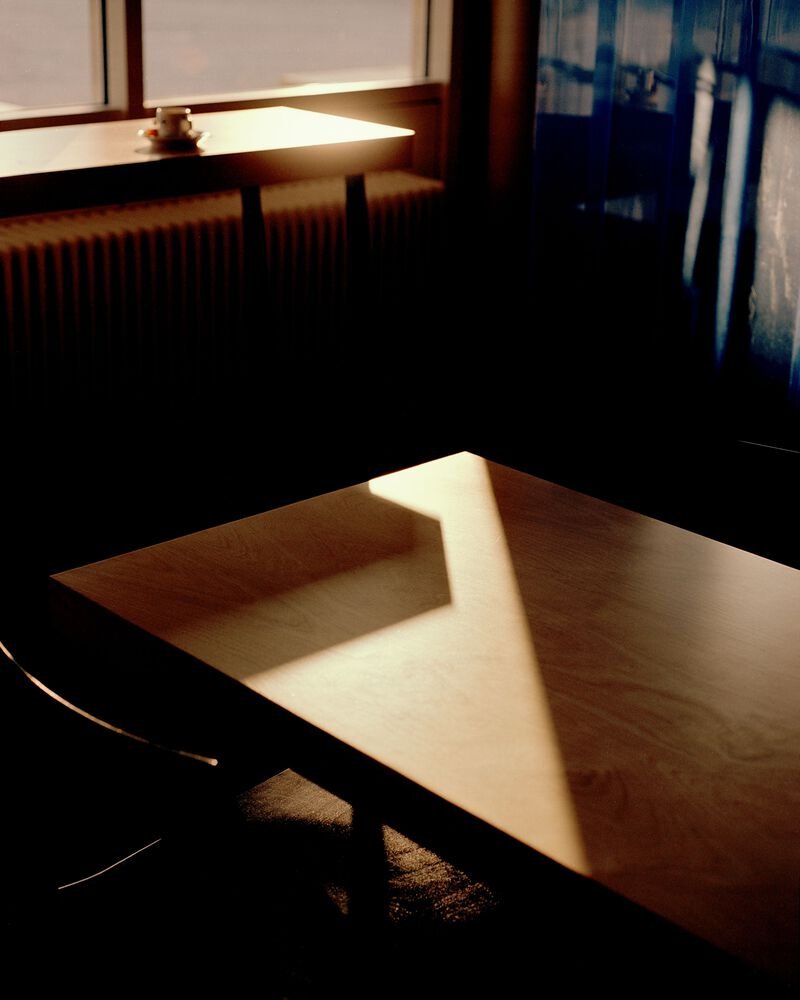
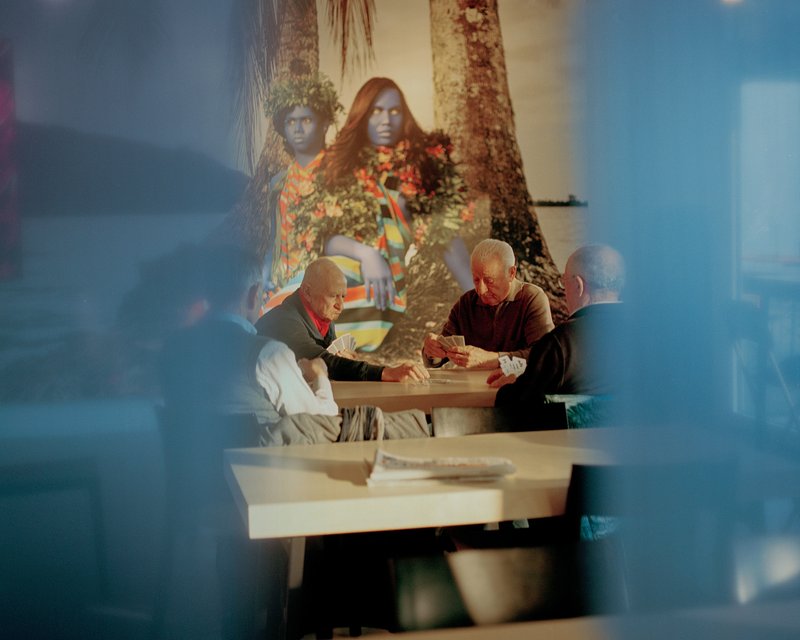
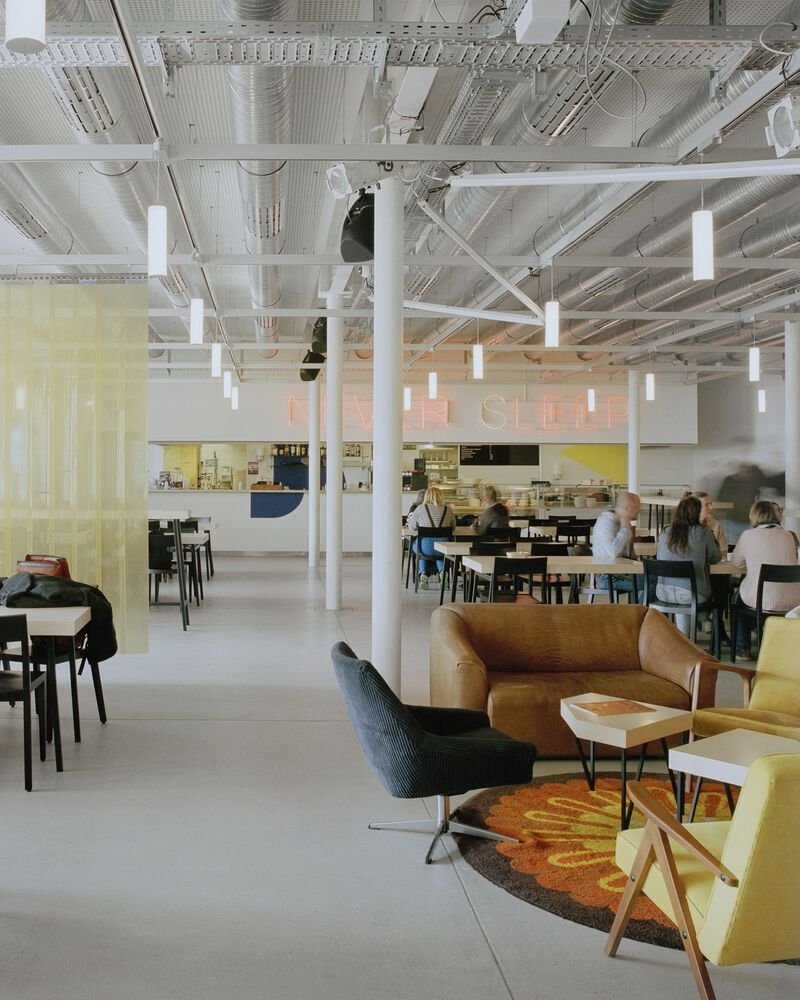
The best images in the series are the ones that show light passing through the curtains. The blue PVC turns a timber table and a window into something close to a painting. The pink PVC makes a leather sofa and a pendant lamp look like a 1970s film set. The yellow PVC catches the afternoon sun and fills the corner with a warm glow. These are not effects. They are the direct consequence of hanging a coloured membrane in a room with good natural light.
The Furniture: Designed to Disappear
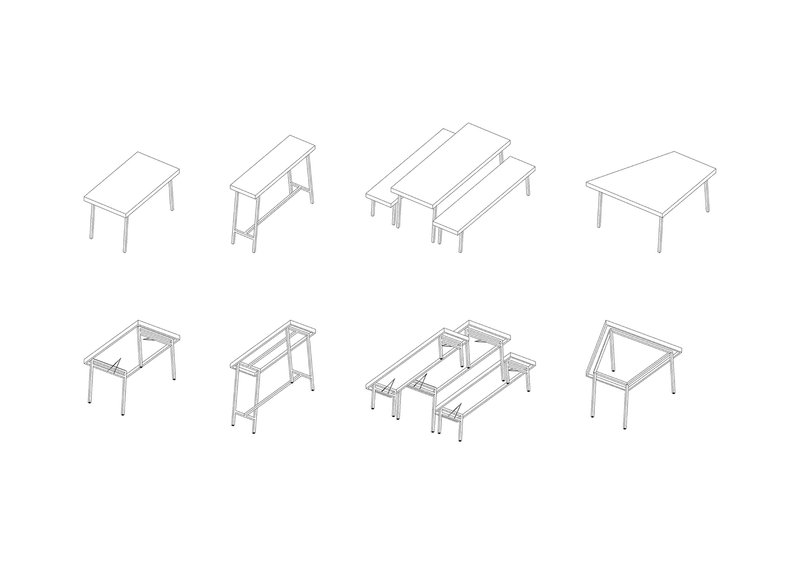
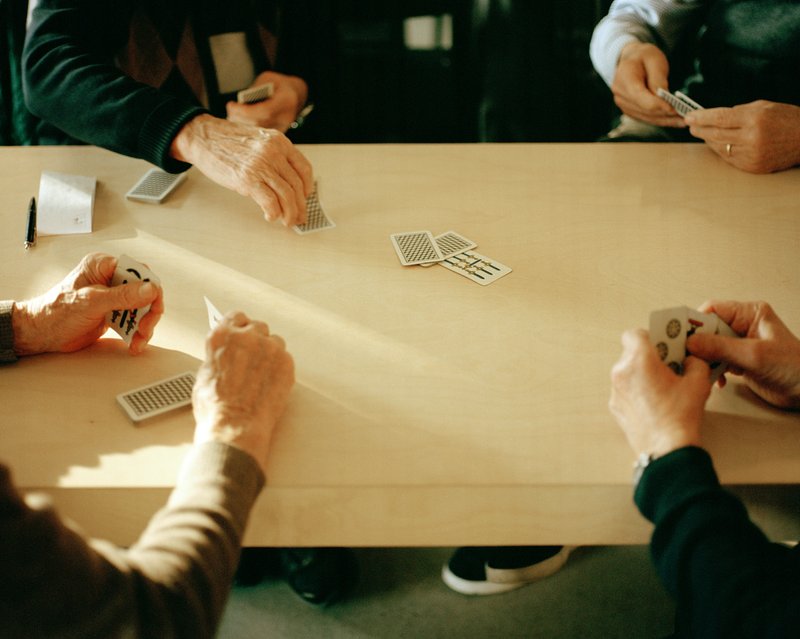
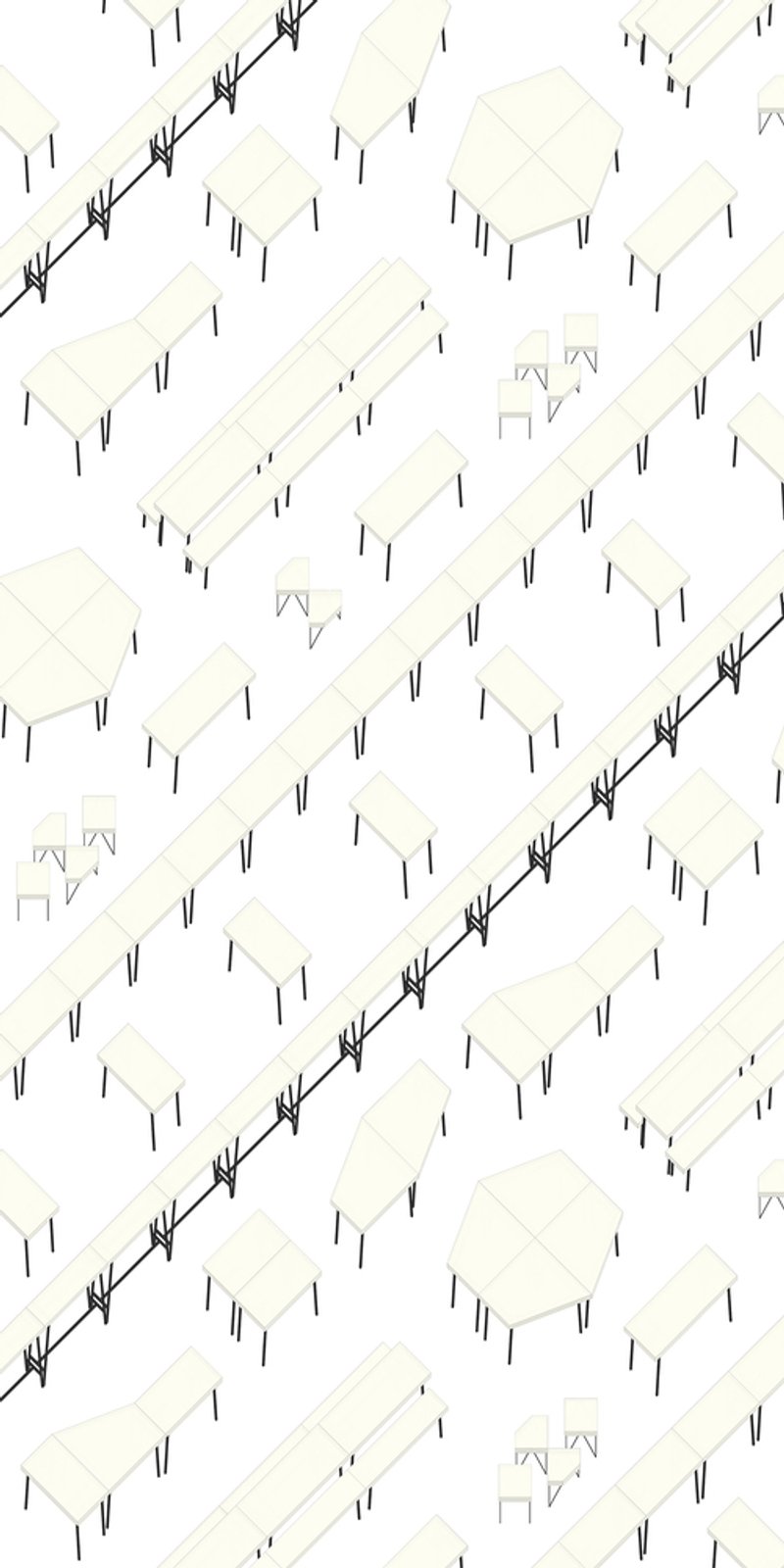
The furniture was crafted in the theater's own workshops. The tables and benches have black steel legs and pale timber tops. They are designed to stack and fold for storage when the space needs to be cleared for a performance or an event. The furniture catalogue drawing shows eight types: dining tables, high bar tables, benches, and small side tables, each with a folding or stacking version.
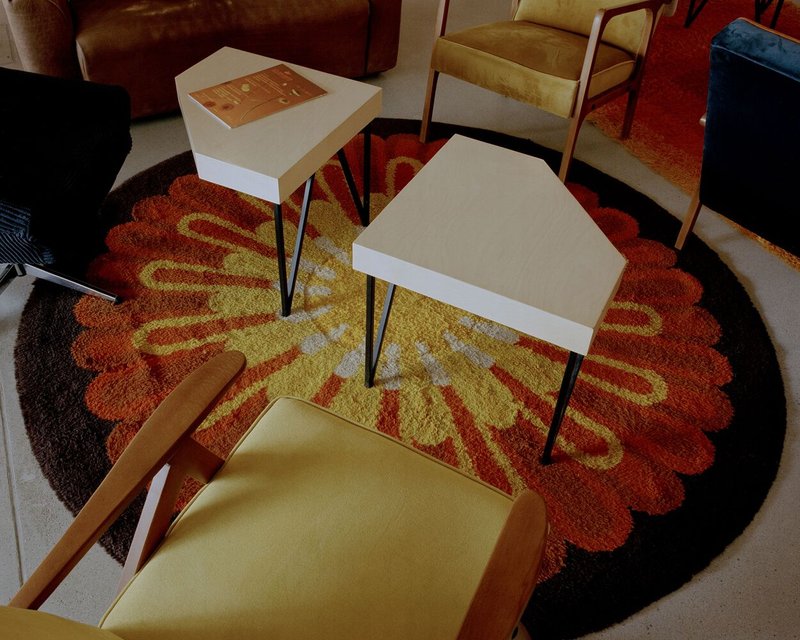
The pentagonal white side tables with hairpin legs are the most distinctive pieces. They sit on round sunburst rugs in the lounge zones, paired with vintage armchairs and leather sofas that were already in the theater's collection. The new furniture and the existing furniture coexist because the palette is restrained enough to hold them together.
Terrace and the Lake
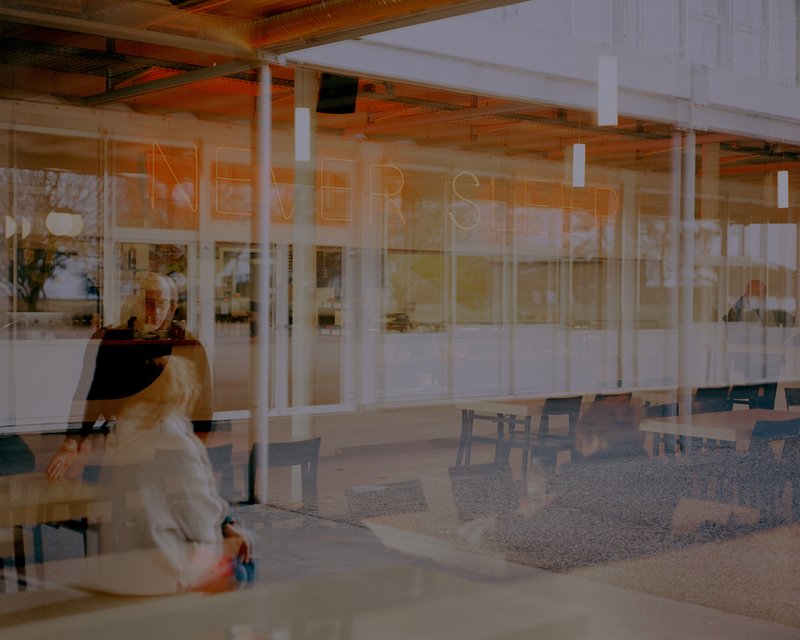
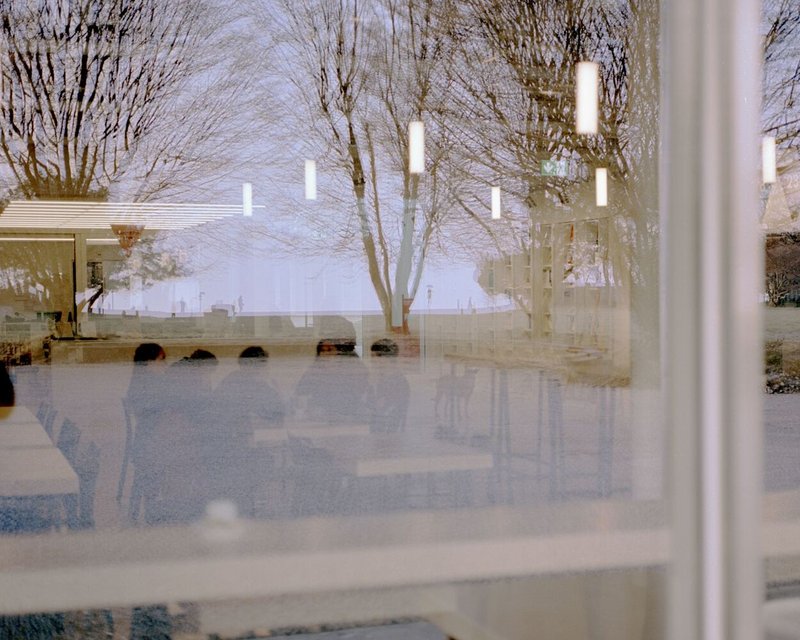
The terrace and the glass facade connect the interior to the lake and the park. In winter, the bare trees and the grey water produce a Nordic atmosphere. In summer, the covered terrace becomes an outdoor extension of the dining room. The timber bench-tables are the same inside and out, which blurs the boundary.
Drawings
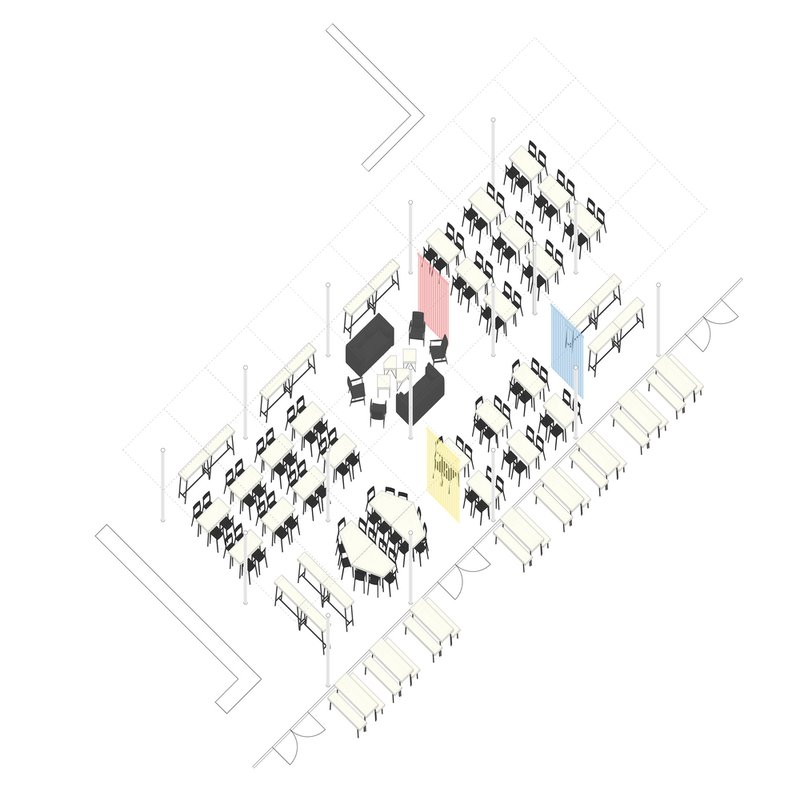
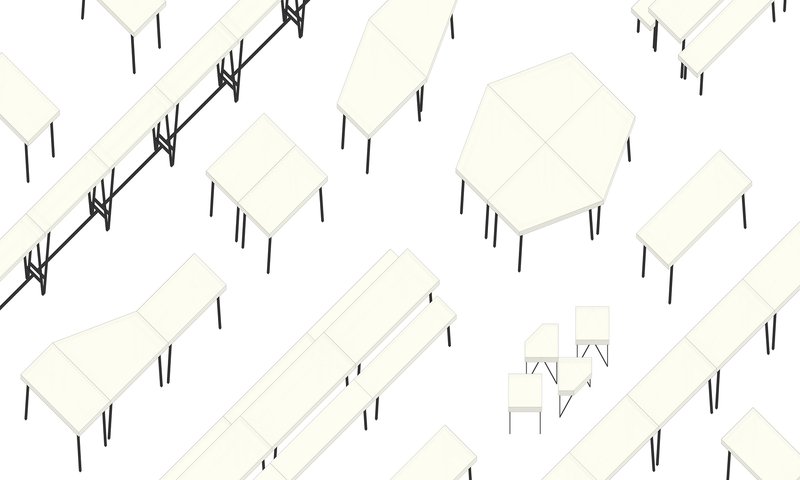
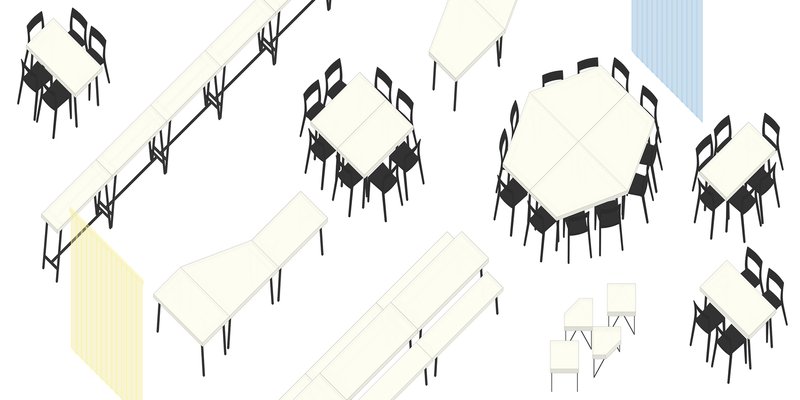
The axonometric drawing shows the full furniture layout with the three PVC curtains dividing the plan into zones. It is the clearest diagram of how the system works: curtains as partitions, furniture in clusters, columns as the structural grid, and the bar as the anchor.
Why This Project Matters
Most cultural venues solve the problem of flexible programming by building movable walls, retractable seating, and complex mechanical systems. Kantina solves it with three curtains and a set of stackable furniture. The budget is tiny. The spatial result is large. The lesson is that flexibility does not require technology. It requires a clear idea executed with discipline.
If you are designing a cultural space, a cafe, or any interior that needs to change configuration regularly, this project is worth studying for how little it takes to produce how much.
About the Studio
Share Your Own Work on uni.xyz
If you are working on cultural interiors, flexible space design, or furniture for public venues, uni.xyz is a place to publish your work and connect with a global design community.
Project credits: Kantina at the Theater of Vidy by BARAKI. Lausanne, Switzerland. Photographs: Matthieu Croizier.




Popular Articles
Popular articles from the community

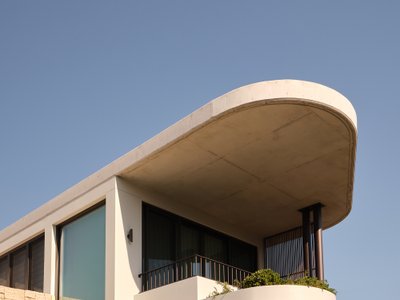
Stanton Architects Sculpts a Curving Family Home into Sydney's Inner West Fabric
Five Dock House uses cantilevers, curved concrete, and layered courtyards to carve out privacy on a tight suburban lot in Sydney.
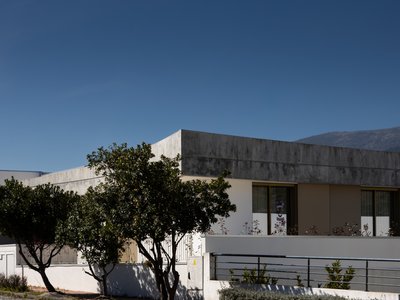
PLATAFORMArq Folds a Concrete Roof Over the Portuguese Mountains in House #474
A 220-square-meter residence in Teixoso, Portugal, wraps board-formed concrete into an angular canopy that frames the Serra da Estrela foothills.
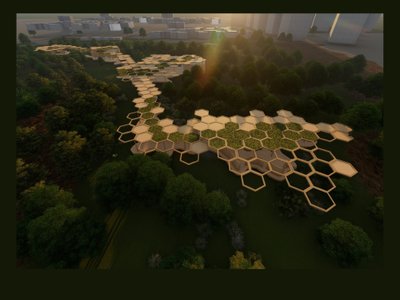
Eco Chapel: A Green Architecture Pavilion Designed in Symbiosis with the Forest
Eco Chapel uses green architecture to weave prayer, learning and reuse into a forest pavilion shaped by modular hexagonal canopies for life.
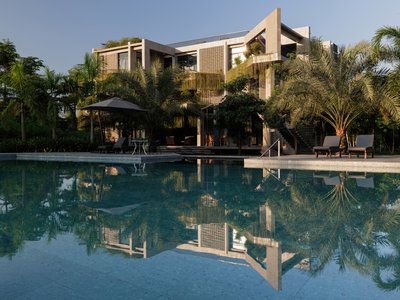
Reincarnation Weaves a Three-Story Retreat into the Green Landscape of Rural Bangladesh
Ara Manor in Narsingdi dissolves the line between domestic architecture and its lush surroundings through screens, courtyards, and planted rooftops.
Similar Reads
You might also enjoy these articles

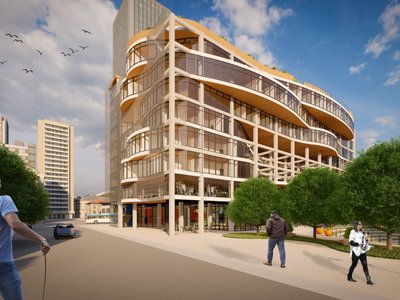
Olio Towers: A Mid-Rise for Performers That Fuses Housing, Rehearsal, and Stage
Located blocks from Houston's Theater District, this modular tower stacks living units around a central performance atrium.
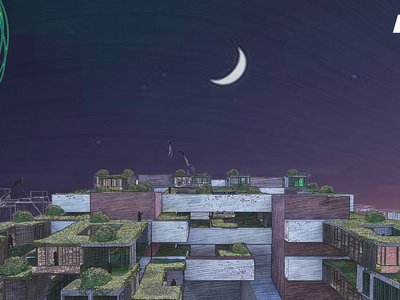
Oasis: Modular Green Housing Carved into Dhaka's Urban Fabric
A shortlisted Plugin Housing entry reclaims unauthorized settlements in Dhaka with stepped concrete volumes, green roofs, and ventilation-driven design.

Black Hole: A Floating Megastructure for the Post-Physical Era
Emiliano Mazzarotto envisions a spherical, self-scaling arena where e-sports, digital hotels, and holographic stadiums replace traditional public space.
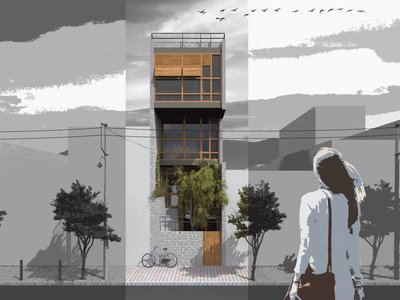
Compact & Sustainable Living in Piraeus: A Four-Level Family Home Built Around Light and Air
A narrow townhouse in one of Greece's densest port cities uses a central atrium and passive strategies to house three generations under one roof.


Explore Architecture Competitions
Discover active competitions in this discipline




The International Standard for Design Portfolios


The Global Benchmark for Architecture Dissertation Awards


The Global Benchmark for Graduation Excellence


Challenge to reimagine the Iron Throne
Comments (0)
Please login or sign up to add comments
No comments yet. Be the first to comment!