

KINETIC CINEMA: Kinetic Architecture Turns Film Into a Physical Experience
KINETIC CINEMA merges moving walls, projections, and responsive seats to turn architecture and films into one tangible immersive experience.

Cinema has always relied on architecture to frame the experience of watching a film. A darkened room, rows of seats, controlled acoustics, and a luminous screen establish a familiar relationship between spectator and image. KINETIC CINEMA radically questions that relationship by proposing a form of kinetic architecture in which the room itself becomes part of the moving image.
Designed by Justin Acevedo, KINETIC CINEMA was recognized as an Editor's Choice entry of Cinema Futurismo. The project explores what might happen when cinematic motion is no longer confined to projected pixels. Instead, walls shift, projection surfaces deform, seats respond, and the architectural enclosure changes alongside the film.
The result is an experimental cinema where virtual imagery and physical movement operate as a single spatial system.

From Moving Pictures to Moving Architecture
Conventional cinema creates motion visually while keeping its physical environment largely static. KINETIC CINEMA proposes the opposite approach. It gives the architectural environment the ability to move with the image.
This transformation places kinetic architecture at the center of the cinematic experience.
Instead of treating walls simply as surfaces onto which images are projected, the project imagines them as flexible, mechanically controlled spatial elements. As a sequence develops, sections of the room can expand, contract, bend, tilt, or shift. Digital movement on screen therefore receives a corresponding physical expression within the auditorium.
The architecture is no longer merely surrounding the audience. It participates in the narrative.
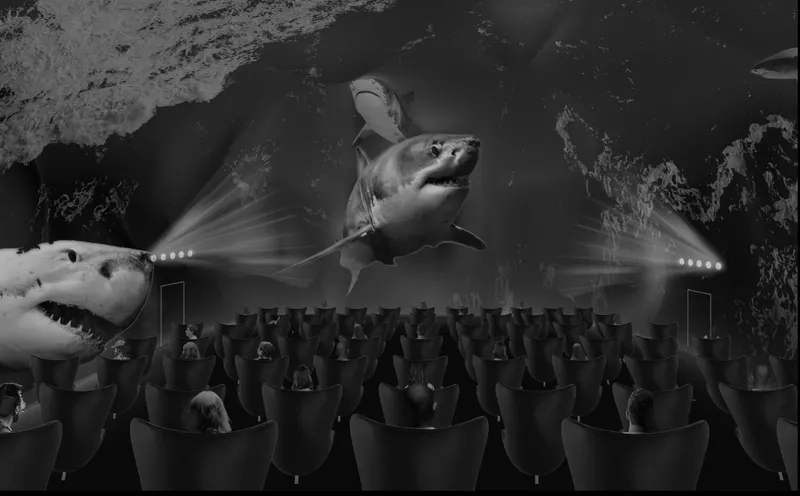
A crashing wave can appear to push the boundary of the room toward the spectators. A vast underwater environment can seemingly expand beyond the normal limits of a flat screen. Changes in depth, scale, direction, and motion can be translated into changes in the physical geometry of the cinema.
Film becomes spatial.
A Cinema Without a Single Front
One of the most significant architectural ideas in KINETIC CINEMA is the dissolution of the conventional frontal screen.
Traditional cinema establishes a clear hierarchy. The screen occupies one side of the auditorium while spectators remain oriented toward it. The drawings for KINETIC CINEMA instead show projected content occupying multiple sides of a rounded, enclosed cinema room.
The interior becomes a continuous visual environment.
A hierarchy of primary and secondary projection surfaces allows different areas of the enclosure to take on different roles during a sequence. Rather than concentrating every image directly ahead of the viewer, projected environments can surround the seating field and direct attention across the room.
The experience therefore becomes closer to inhabiting a cinematic world than observing one from outside.
This spatial strategy also changes how cinema architecture can be composed. The audience is positioned inside an active field of images, changing surfaces, light, motion, and sound. There is no longer a permanent architectural backdrop because the backdrop itself is continuously transforming.
Flexible Walls as Cinematic Instruments
The project's technical diagrams reveal how its kinetic surfaces could operate.
The projection boundary is conceived as a flexible surface supported by a structural frame and mechanically activated components. Different sections can move independently, allowing the wall to transition between relatively flat and dynamically curved configurations.
Sliding, pivoting, and tilting movements are explored as methods for changing the orientation of individual projection surfaces.
Mechanical pistons positioned behind the flexible surface provide another layer of control. By extending or retracting different points, the system can modify the geometry of the projection wall in response to a film sequence.
This creates an important connection between kinetic architecture and cinematic storytelling.
Instead of designing one fixed auditorium geometry, the architect designs a system capable of producing numerous geometries over time.
The cinema therefore behaves less like a conventional room and more like a programmable spatial machine.
Projection Mapping Across a Changing Surface
Moving a projection surface creates an immediate challenge. Once a wall bends or changes position, a conventional projected image becomes distorted.
KINETIC CINEMA addresses this through projection mapping.
The diagrams illustrate a process in which visual content is associated with a mapped grid corresponding to the geometry of the kinetic wall. As the surface moves, the projected image can be adjusted to compensate for physical deformation.
This relationship between digital mapping and physical movement is central to the project's extended reality concept.
Instead of treating distortion as an unwanted consequence, the cinema can deliberately coordinate digital and architectural transformation.
A flat image projected onto a flat wall creates one spatial condition. When the physical wall changes shape, the projection can be remapped so that perspective, depth, scale, and composition continue to correspond with the intended cinematic scene.
Architecture and image effectively become synchronized layers.
The projected environment tells the viewer what they are seeing, while the kinetic surface gives that environment physical depth.
Creating Perceived Depth Beyond the Screen
Depth mapping becomes particularly important within the proposal.
The presentation studies how an original cinematic image can be translated into zones of relative depth and then connected to a kinetic grid. Elements that appear closer to the viewer can correspond with portions of the projection surface moving inward, while distant zones can remain recessed.
Through this process, perceived digital depth receives a physical architectural counterpart.
This differs fundamentally from simply producing a three-dimensional illusion on a flat screen.
The geometry producing the image is itself changing.
An ocean swell, for example, can become more than animated footage. The surface supporting the projected water can physically move, altering the room's boundary as the image develops.
KINETIC CINEMA therefore creates a form of tangible visual depth in which virtual and material transformations reinforce each other.
Responsive Seating Extends the Experience
The kinetic logic is not limited to the walls.
The project's seating diagrams suggest chairs capable of automated rotation and vibration feedback, allowing the audience's physical orientation to respond to events within the film.
Different seating positions demonstrate how spectators could be redirected toward changing areas of the projection environment.
This becomes particularly important in a cinema without one permanent front.
If an important scene develops to the side or behind the audience, the seating system can help reposition the spectator toward the relevant area. Rotation becomes part of the choreography of viewing.
Vibration provides another sensory layer.
Rather than relying exclusively on image and sound to communicate force, speed, collision, or movement, physical feedback can be transmitted through the chair.
The spectator therefore experiences the cinematic event visually, spatially, and physically.


Architecture as Choreography
KINETIC CINEMA can be understood as a carefully choreographed relationship between several moving systems.
The projected image changes.
The projection wall changes.
The audience's orientation changes.
The seat can move or vibrate.
Lighting and projected imagery move across the enclosure.
All of these systems must remain coordinated.
This makes time as important to the architecture as plan or section.
A traditional architectural drawing represents a building at a particular condition. Kinetic architecture requires designers to consider sequences of conditions instead. The project presentation acknowledges this by showing multiple frames in which the same projection wall assumes different physical configurations.
Each frame becomes a moment within a larger spatial performance.
Architecture is therefore not defined by one ideal form. It is defined by its capacity to transition between forms.
When the Cinema Room Becomes Part of the Film
The most compelling aspect of KINETIC CINEMA is the collapse of the traditional distinction between cinematic content and cinema architecture.
Normally, the building remains unchanged regardless of the film being shown. The same auditorium can screen an underwater documentary, a science-fiction film, a landscape sequence, or an action movie without physically responding to any of them.
Here, every film potentially creates a different room.
An underwater scene could transform the surrounding surfaces into an enveloping ocean environment. Large marine animals might appear to travel beyond the boundaries of a conventional screen, surrounding the audience through panoramic projection.
Another sequence might use changes in wall geometry to intensify movement, scale, or acceleration.
The room becomes a physical extension of cinematic editing.
Instead of cutting only between images, filmmakers could potentially choreograph transitions between spatial conditions.
Extended Reality Without Leaving Physical Space
KINETIC CINEMA also presents an alternative interpretation of extended reality.
Immersive digital environments are frequently associated with personal headsets or wearable devices that replace much of the user's perception of physical space. This project takes a different route.
It attempts to bring digital immersion into shared architecture.
The audience remains physically present with other spectators, yet the room surrounding them becomes responsive enough to produce an expanded digital experience.
This maintains one of cinema's most important characteristics: collective spectatorship.
People are not isolated inside individual virtual environments. They inhabit the same transforming room and experience the same cinematic event together.
The architecture itself becomes the interface.
A New Direction for Cinema Architecture
The proposal raises a larger question about the future of cinema.
If digital content can control physical environments in real time, does a cinema still need to be designed as a static auditorium?
KINETIC CINEMA suggests that future cinema architecture could function more like an adaptable platform than a fixed room.
Projection systems, mechanical components, sensors, flexible materials, motion tracking, and responsive seating could work together to create environments that change according to cinematic content.
The same room could adopt dramatically different spatial identities from one film to another.
This possibility shifts architectural design from creating a finished form toward creating rules for transformation.
The architect no longer determines only what a space looks like.
The architect determines how it behaves.
Kinetic Architecture as Storytelling
Movement in architecture is often associated with functional adaptability. Facades open and close according to sunlight. Roofs retract according to weather. Walls shift to create different layouts.
KINETIC CINEMA introduces another possibility: movement as narrative.
Here, architectural transformation is not primarily responding to climate or program. It responds to a story.
A wall changes because something is happening in the film.
A chair rotates because the viewer's attention is being redirected.
A projection surface bends because cinematic depth is being translated into physical space.
This transforms kinetic architecture into a storytelling medium.
Architecture acquires timing, sequence, anticipation, transformation, and climax, qualities normally associated with cinema itself.
Designing the Experience Between Physical and Virtual
Justin Acevedo's KINETIC CINEMA ultimately explores a territory between architecture, cinema, interaction design, mechanical engineering, and extended reality.
Its importance lies not simply in making a cinema more technologically elaborate. The proposal questions a much deeper convention: why should moving pictures always be experienced inside unmoving rooms?
By synchronizing flexible projection surfaces, spatial deformation, mapped imagery, multiple projection directions, rotating seating, and physical feedback, the project proposes an auditorium where architecture can participate in the cinematic event.
Virtual motion creates physical motion.
Physical motion changes spatial perception.
Spatial perception deepens the cinematic experience.
The boundary between film and building begins to disappear.
KINETIC CINEMA and the Future of Immersive Architecture
As digital and physical environments become increasingly interconnected, KINETIC CINEMA offers a provocative model for immersive architecture.
Its auditorium is not simply a container for media. It is an active media system in its own right.
Walls become moving screens.
Seats become responsive interfaces.
Projection becomes spatial material.
Mechanical systems become instruments of narrative.
The cinema becomes a continuously evolving environment.
As an Editor's Choice entry of Cinema Futurismo, KINETIC CINEMA by Justin Acevedo imagines a future in which watching a movie is no longer defined by sitting in front of a screen. Instead, spectators occupy a cinematic environment capable of changing its geometry around them.
Through this fusion of cinema and kinetic architecture, the project proposes a new kind of spectatorship where stories are not simply projected into space.
They physically reshape it.


Popular Articles
Popular articles from the community


Cloaked Colonization: A Mobile Underwater Habitat That Moves Like a Fish
Micah Abaya's shortlisted EHC Pacific entry reimagines ocean settlement as a dispersed network of self-sustaining architectural organisms.

Opera on the Sea: Driftwood Logic Shapes a Timber Opera House on Estonia's Coast
Trevor Orgill's opera house translates the entangled drift of floating timber into a civic building where wood, water, and music converge.

Extended Shell: Retrofitting Kolkata's Balconies as Living Urban Thresholds
A modular retrofit system recovers the social and environmental intelligence of Kolkata's historic verandas for contemporary Park Street residents.

Manzana Morphosis: Stretching Barcelona's Grid into a Living Landscape for 2050
A radical reworking of the Eixample manzana turns density into a tool for generous public space, vertical ecology, and environmental performance.

Similar Reads
You might also enjoy these articles

Eco Chapel: A Green Architecture Pavilion Designed in Symbiosis with the Forest
Eco Chapel uses green architecture to weave prayer, learning and reuse into a forest pavilion shaped by modular hexagonal canopies for life.
Kaffeebühnen: Coffee Shop Architecture Designed as a Civic Stage Between Vienna’s City and Park
Kaffeebühnen turns coffee shop architecture into a civic stage, linking Vienna’s park edge, urban life, warm timber yards, and coffee craft.
Healing Façade: Sustainable Architecture for Reforestation, Community, and Sacred Ecology in Ethiopia
Healing Façade reimagines sustainable architecture as a living wall that restores soil, catches water and renews Ethiopia's forest churches.


Urban Forest: A Vertical Ecosystem for 5,000 Workers in Singapore's Changi Business Park
Radially stacked pods and layered green decks turn a 7-acre plot into 47 acres of ecological workspace projected for 2040.

Explore Kinetic Architecture Competitions
Discover active competitions in this discipline


Challenge to reimagine the Iron Throne

Photograph architecture without architects

Illustrate the lost glory of Angkor Wat - Render Challenge

Design challenge to reuse E-waste
Comments (0)
Please login or sign up to add comments
No comments yet. Be the first to comment!