

Lakeside Retail Pavilion Integrating Public Space and Sustainable Design in Chengdu
A compact lakeside retail pavilion blending public space, lightweight materials, and adaptive sustainability to connect commerce, nature, and community.


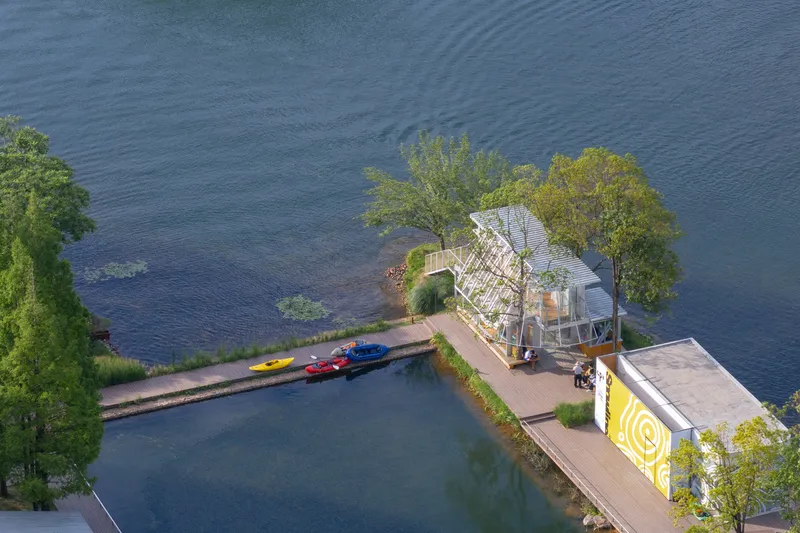
Lakeside Retail Space CPI W-18b is a compact yet conceptually ambitious commercial architecture project designed by YIIIE Architects within the CPI commercial complex at Luxe Lake in Chengdu. Completed in 2024, the 52-square-metre building functions as a display and activity space for water sports equipment, jointly operated by Badmarket and MRS. Despite its modest scale, the project explores larger questions surrounding sustainability, public space, and the evolving role of retail architecture in contemporary urban environments.
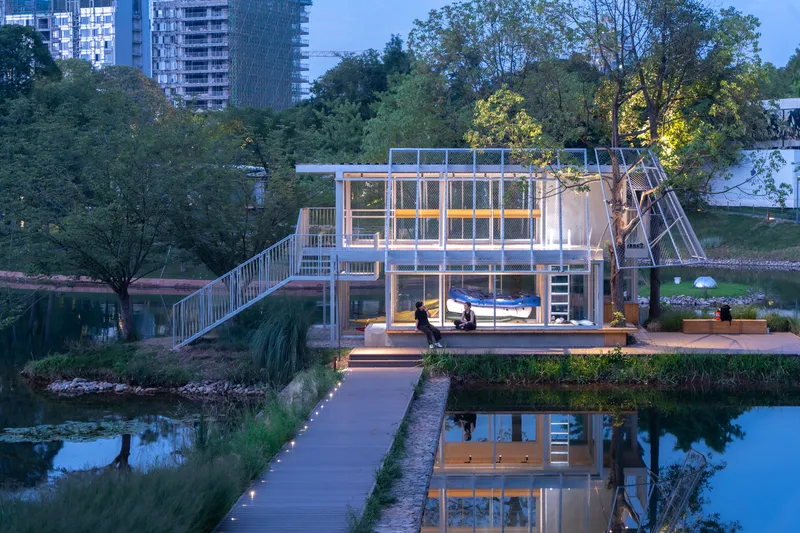

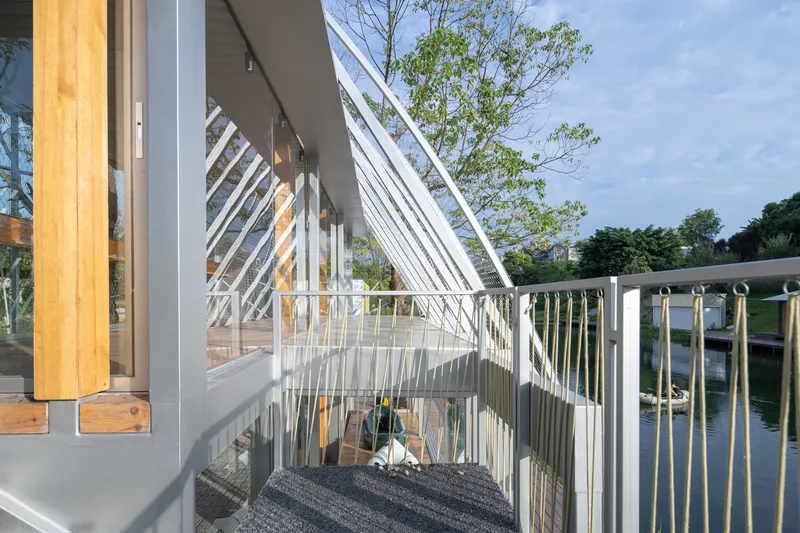
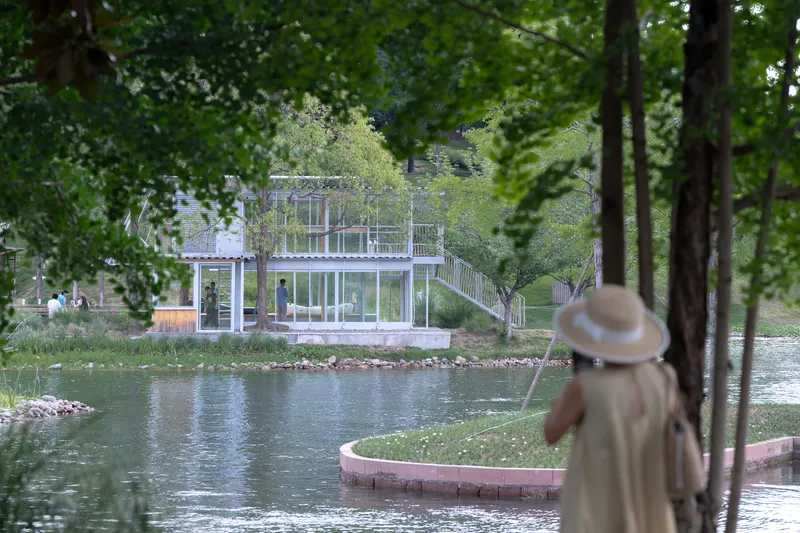
Situated along the lakeside, the building is conceived not as an isolated commercial unit but as an active participant in the broader public realm. The CPI development itself is structured around a network of shared public spaces that connect otherwise independent retail units. Responding to this context, the architects challenge the conventional boundary-driven model of commercial architecture, proposing instead that retail spaces should assume partial responsibility for public life. By softening spatial edges and opening the building toward its surroundings, the project promotes continuity rather than fragmentation, reinforcing a sense of collective urban experience.
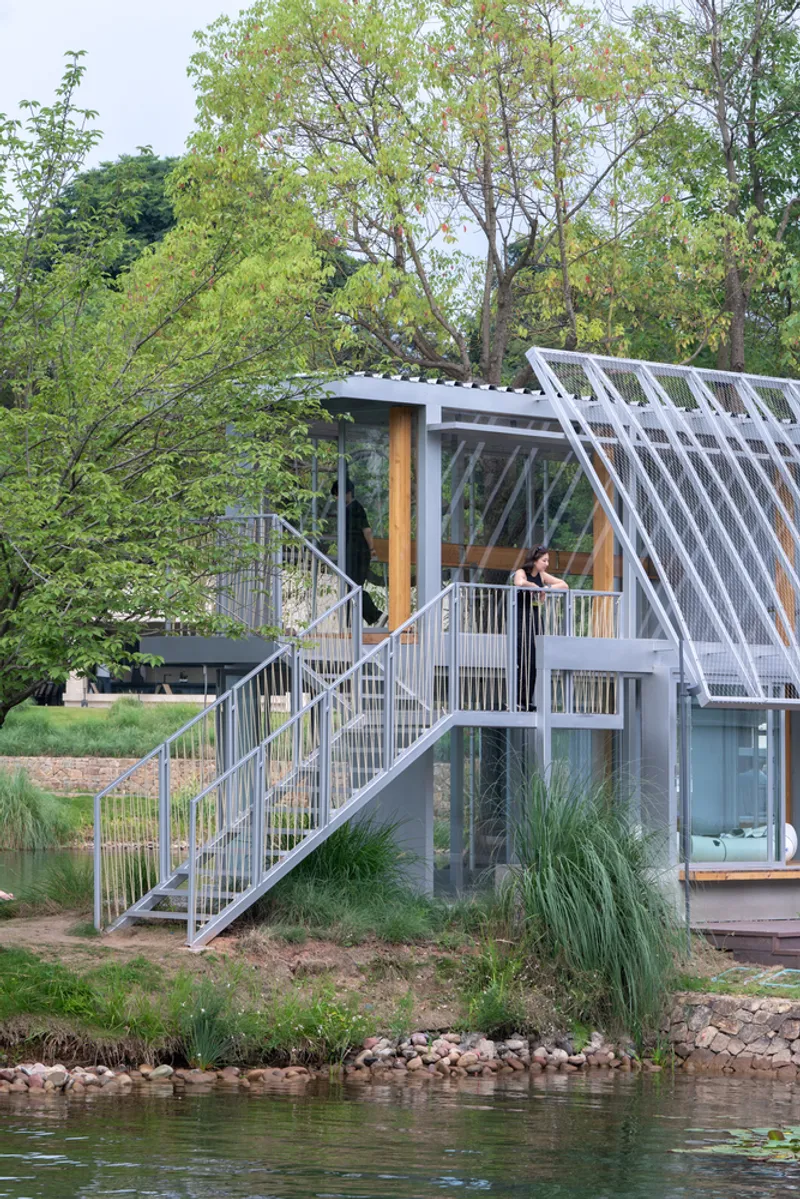


Architecturally, the design strategically negotiates openness and operational functionality. Subtle height differences between interior and exterior zones allow commercial activities to proceed uninterrupted while maintaining strong visual and spatial connections with the lakeside landscape. Transitional spaces are carefully articulated to encourage informal occupation, social interaction, and public engagement. A prominent example is the entrance area, where a large existing tree is embraced rather than removed. A lightweight mesh enclosure surrounds the tree, capturing fallen leaves and creating a seasonal buffer zone that shifts in character over time. This semi-open “gray space” is complemented by a bar counter, transforming it into an adaptable platform for rest, interaction, and small-scale events.

Material strategy plays a central role in shaping both the spatial and environmental performance of the project. The architects adopt an approach described as “light structural materials with heavy spatial forms.” Lightweight industrial components are employed to minimize construction costs, shorten building time, and reduce environmental impact, while the spatial composition retains a sense of solidity and permanence. Exposed wooden beams and columns introduce warmth and tactility, fostering a friendly, approachable atmosphere that aligns with the community-oriented ambitions of the project.
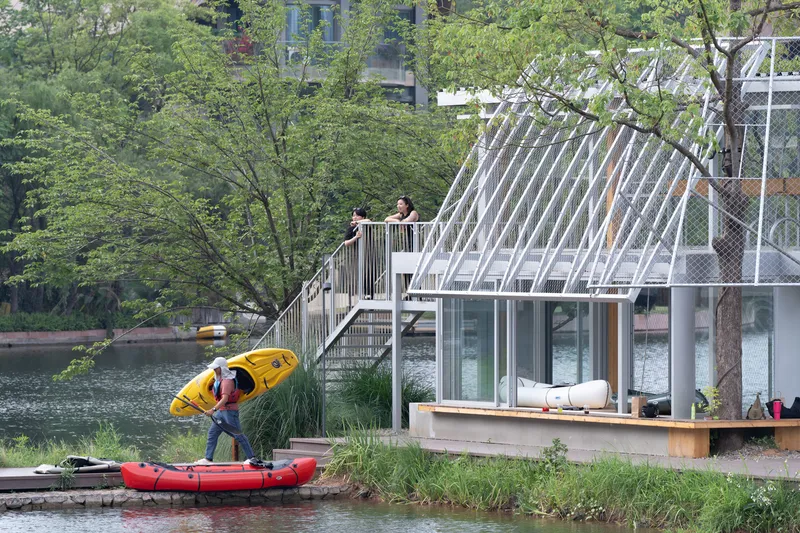
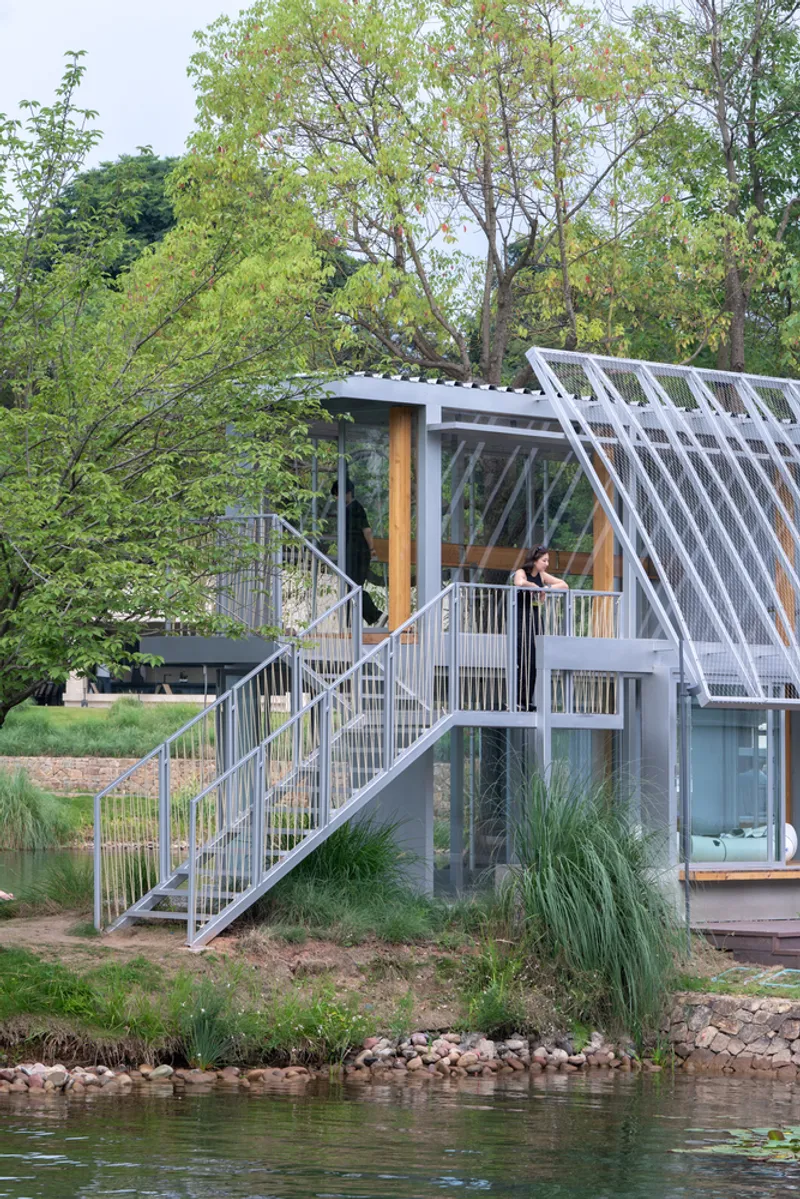
Sustainability is not treated as a fixed technical solution but as an ongoing, adaptive process. The building is designed to register environmental change and respond to seasonal variation. Natural elements are deliberately allowed to enter and transform the space: leaves accumulate on the mesh facade, paving stones extend seamlessly from the exterior into the interior, and traces of soil and vegetation migrate indoors. These gestures blur the line between architecture and landscape, reinforcing the project’s connection to its lakeside setting.


The facade system further demonstrates this adaptive environmental strategy. Composed as a multi-layer assembly, the outer layer consists of a transparent mesh that enables natural ventilation and passive energy savings during mild weather. Behind it, sliding glass doors provide insulation, weather protection, and security when required. This layered envelope allows the building to shift between openness and enclosure, responding flexibly to climatic conditions, operational needs, and patterns of use.
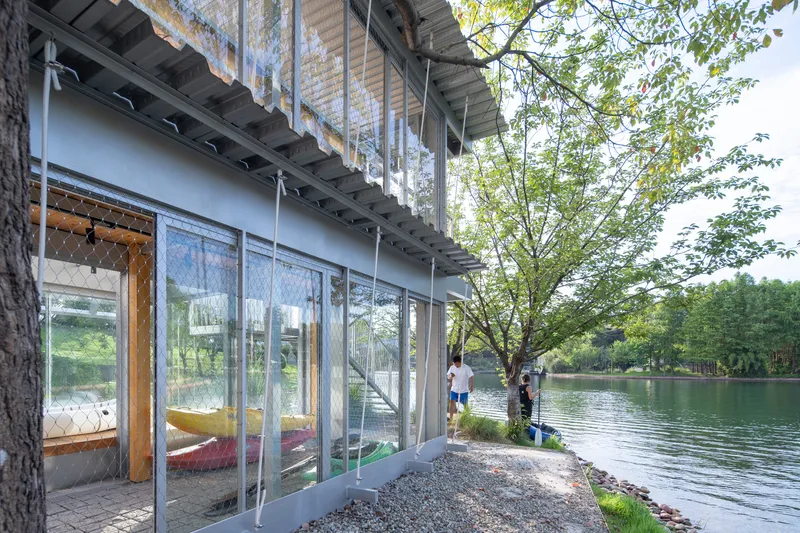


Ultimately, Lakeside Retail Space CPI W-18b positions retail architecture as a mediator between commerce and public life. The project argues that commercial spaces inherently possess public attributes, just as public spaces can support and enrich commercial activity. Rather than viewing urban public space as a static invention, the design frames it as an ongoing negotiation: one defined by exchange, adaptability, and shared responsibility. In this sense, sustainability is understood not only as environmental performance but as the capacity of architecture to evolve alongside social, ecological, and urban change.



Popular Articles
Popular articles from the community


LT2A and OPEN Architectes Thread a Brick and Glass High School Through a Wooded Belgian Campus
In Braine-l'Alleud, a 3,000 m² wing for Collège Cardinal Mercier pairs pale brick with a glazed colonnade, deferring to a small chapel and a dense wood.

U.GA Architects Wraps an Oval Rooftop Pool in Curved Board-Formed Concrete on Busan's Jeollidan-gil
In Busan's Jeonpo-dong, a 454 m² mixed-use block stacks a neighborhood facility, guest rooms and an oval rooftop pool inside spiraling concrete walls.

longwave studio Reorganizes a 112 m² Tainan Apartment Around the Daily Routines of a Family and Two Cats
In Tainan, Taiwan, birch plywood, rust-red furniture and a freestanding plaster wall link arrival, storage, work and family life in one apartment.

Architekt Andreas Gruber Scatters 23 Dark Timber Chalets Across a South Tyrolean Forest Edge
In Molini di Tures, Amonti Chalets breaks a resort into a hamlet of gabled timber houses, with parking, storage and services pushed into the slope.

Similar Reads
You might also enjoy these articles

Gil Mello Arquitetura Tilts a Single Roof Toward the Waterfalls on a Plateau Above Aiuruoca, Brazil
In Aiuruoca, Minas Gerais, a 200 m² house of local labor and reclaimed poles pairs a low valley veranda with a tall mountain one.
U.GA Architects Wraps an Oval Rooftop Pool in Curved Board-Formed Concrete on Busan's Jeollidan-gil
In Busan's Jeonpo-dong, a 454 m² mixed-use block stacks a neighborhood facility, guest rooms and an oval rooftop pool inside spiraling concrete walls.

Felipe Hess Arquitetos Turns a Blind Stone Wall to the Street and Opens a Brazilian House onto a Courtyard and Canal
A canal-front house in Brazil hides behind painted stone and planting, then opens to an olive-tree courtyard, a reed-ceilinged porch and a curving pool.

David Macias Steps a Doorless Stone and Plaster House Down a Tropical Colombian Hillside
In the humid hills of Colombia, Threshold House replaces the front door with an open void and terraces its 850 m² down the slope instead of fighting it.

Explore Landscape Design Competitions
Discover active competitions in this discipline

Challenge to reimagine the Iron Throne

Photograph architecture without architects

Illustrate the lost glory of Angkor Wat - Render Challenge

Design challenge to reuse E-waste
Comments (0)
Please login or sign up to add comments
No comments yet. Be the first to comment!