
Left Over Under the Over: Turning Mumbai's Flyover Voids into Living Public Ground
An adaptive architectural intervention slides a new elevated plane beneath Mumbai's flyovers, reclaiming neglected urban voids for community life.


Every flyover throws a shadow, and in that shadow a city forgets. Beneath Mumbai's elevated highways lie vast stretches of dark, damp, noisy ground that no one claims and everyone avoids. "Left Over Under the Over" refuses to accept these interstitial zones as waste. Instead, the project proposes sliding a new elevated deck beneath the existing flyover structure, creating a parallel ground plane that hosts modular urban furniture, vegetation, and community programming. It is a simple spatial move with outsized implications: if you can't remove the infrastructure that divides a neighborhood, build a second life underneath it.
The project is the work of Pravir Sethi, who situates the intervention within the specific pressures of Mumbai's hyper-dense fabric. Flyovers solved one problem (traffic congestion) while generating another (urban decay at ground level). Residential buildings pressed up against elevated highways suffer noise pollution, loss of privacy, and diminished quality of life. The leftover space below becomes a dead zone, often misused or simply abandoned. Sethi's proposal treats that void not as collateral damage but as the raw material for public space.
Where Guardrails Meet Weathered Walls
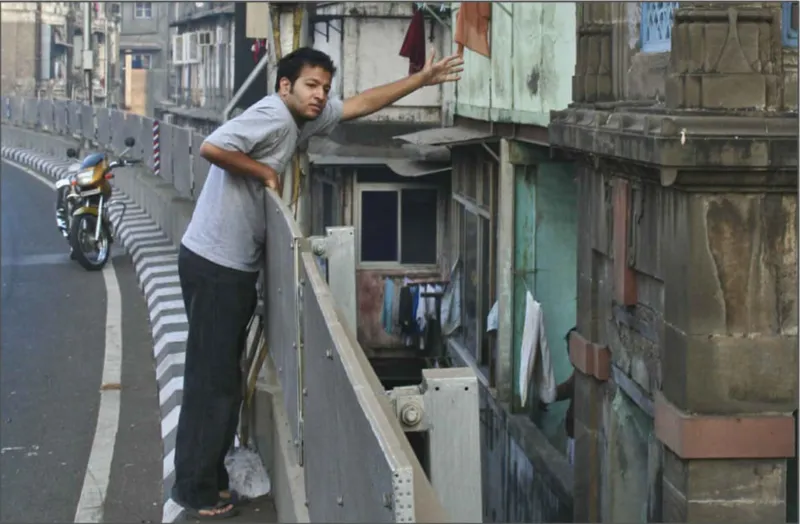
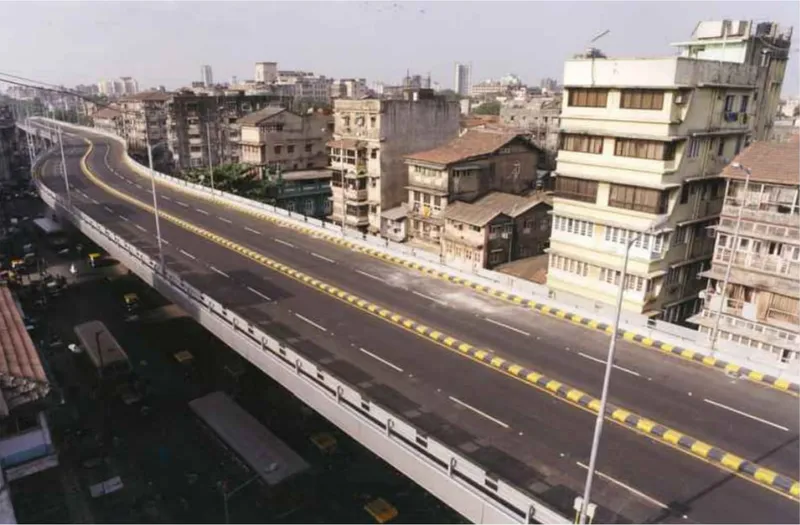
The opening images establish the condition the project seeks to transform. A man reaches toward a patchwork facade of weathered panels and windows, his body pressed between domestic life and a highway guardrail. It is a visceral portrait of proximity: the distance between living room and asphalt measured in centimeters, not meters. The second image pulls back to reveal the full scale of the problem. An elevated highway deck threads through dense housing blocks under pale morning light, its concrete mass carving a corridor that severs one side of the neighborhood from the other. Together, the images make the case that flyovers are not neutral infrastructure; they are spatial events that reshape every building, street, and person they touch.
Reading the Ribbed Soffit as Opportunity

Looking up at the underside of the viaduct, the ribbed soffit stretches above street traffic and apartment buildings like an inverted landscape waiting to be occupied. Most urban planners see this view and think "noise barrier" or "drainage problem." Sethi sees a ceiling for a new public room. The structural grid of the flyover itself becomes the framework for intervention, its rhythm dictating where supports can land and where clear spans allow open gathering. By reading the existing infrastructure as architecture rather than engineering residue, the project shifts the conversation from mitigation to activation.
A Green Platform Threaded Through the Structural Grid
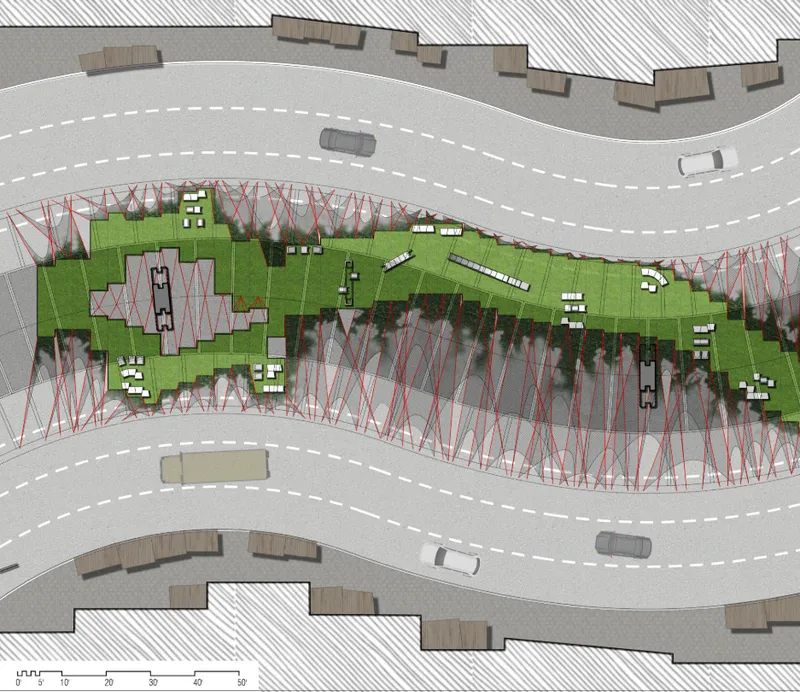
The site plan reveals the spatial strategy at an urban scale. Green platform volumes span curved roadways, their footprints carefully negotiated around parked cars and existing traffic patterns. The structural grid of the new deck aligns with the flyover's column spacing, borrowing its logic while introducing a softer material palette of vegetation and shaded zones. Vertical gardens and planted areas soften the under-flyover environment, helping mitigate heat and pollution while giving the reclaimed ground a visual identity distinct from the concrete overhead. The plan makes clear that this is not a single gesture but a system, capable of extending along the flyover's length and adapting to varying widths and clearances.
Layered Floors Radiating from a Central Core
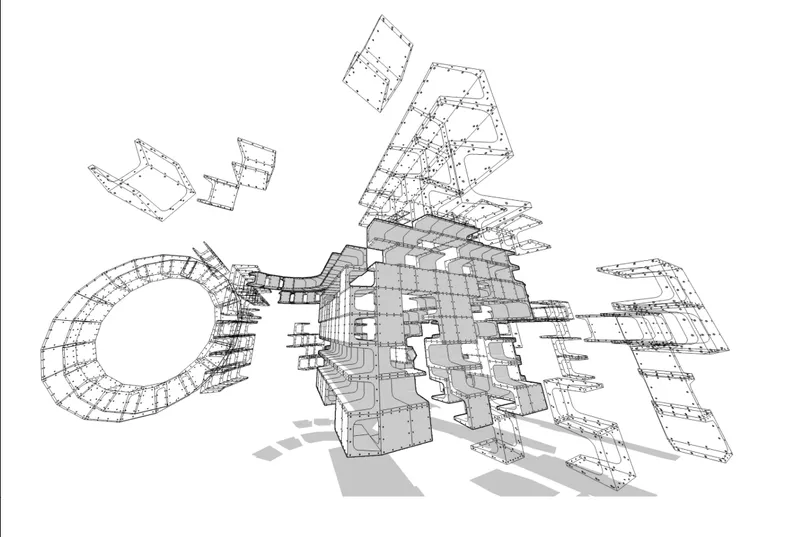
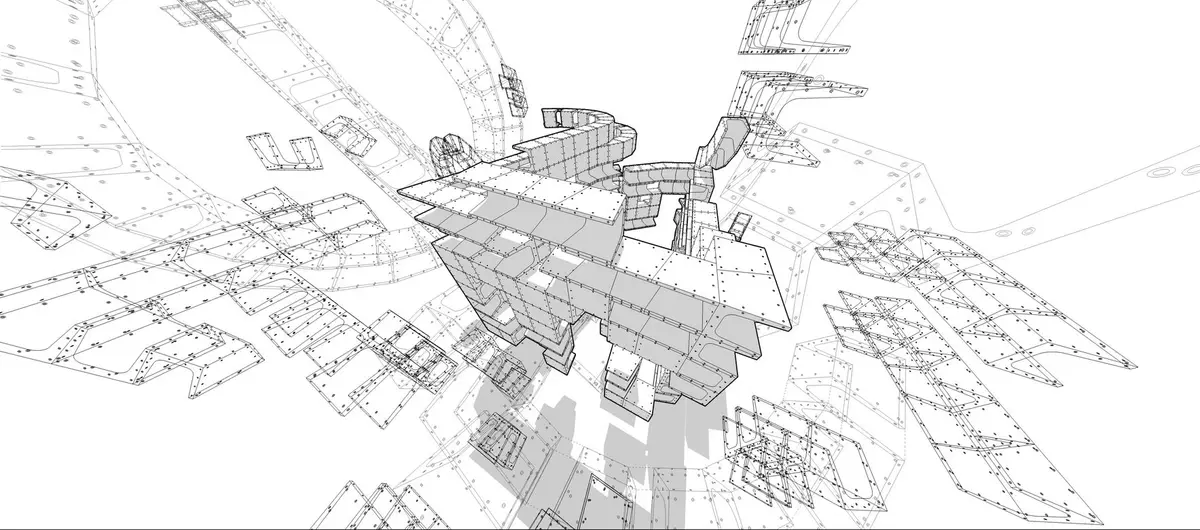
The exploded axonometric drawing is the project's most revealing artifact. Layered floor plates radiate outward from a central circular core, each tier hosting a different program: seating, play, gathering, cultural performances. The modular urban furniture system is designed to be robust, flexible, and reconfigurable, meaning the same structural kit can serve a morning yoga class and an evening music event without permanent commitment to either. Tiered and hanging elements introduce depth and a sense of playfulness, transforming what was once a single plane of neglected asphalt into a three-dimensional public landscape.
The circular core acts as both structural anchor and spatial organizer, drawing people inward and then distributing them across the layered decks. It is a clever inversion of the flyover's own logic: where the highway channels movement linearly and at speed, the intervention below encourages lingering, gathering, and lateral exploration. The drawing also reveals how the modular system could be assembled incrementally, allowing communities to build out their public space over time rather than waiting for a single large capital investment.
Why This Project Matters
The real contribution of "Left Over Under the Over" is not the deck or the furniture or the planting. It is the argument that infrastructure already contains the seeds of its own remedy. Mumbai has hundreds of kilometers of flyovers, and cities from Mexico City to São Paulo face identical conditions. If the residual space beneath even a fraction of those structures could be reclaimed through a modular, replicable system, the aggregate impact on urban quality of life would be enormous. Sethi's proposal offers a scalable template rather than a singular monument, which makes it genuinely useful.
At a moment when megacities are running out of land but not out of problems, looking down instead of out is a necessary reflex. By treating the flyover void as a community-centric public hub rather than an engineering afterthought, the project aligns with broader global discussions around resilience, social equity, and the smart reprogramming of urban landscapes. It is architecture operating not at the scale of the building but at the scale of the infrastructure gap, and that is precisely where it is needed most.
View the Full Project
About the Designers
Designer: Pravir Sethi
Enter a Design Competition on uni.xyz
uni.xyz runs architecture and design competitions year-round that reward proposals with spatial conviction and real site intelligence.
Project credits: Left Over Under the Over by Pravir Sethi.


Popular Articles
Popular articles from the community


Hill & Cross Opera: Sculptural Opera House Architecture Shaped by Tallinn’s Landscape and Identity
Hill & Cross Opera reimagines opera house architecture in Tallinn through its sculptural hill, civic plaza, glass wave and a luminous cross.

Play: Fragments of Their World
Familiar architecture becomes modular playground design, creating safe spaces where displaced children can learn, connect, imagine and play.

The Musturak Paradise: Senior Living Architecture for a Connected Future in Temara, Morocco
The Musturak Paradise reimagines senior living architecture in Temara via private homes, social spaces, culture, community, and shared care.

Lunar Spiral: Space Architecture Shaped by the Mathematics of the Universe
Lunar Spiral reimagines space architecture through Fibonacci geometry, lunar regolith, levitating habitats, and self-sustaining Moon living.

Similar Reads
You might also enjoy these articles

ALGAL REALM: A Bio-Integrated Lunar Habitat Design for Life Beyond Earth
ALGAL REALM reimagines lunar habitat design with algae-powered life support, 3D-printed regolith, and vertical living for a lunar future.

Cinema Futurismo: Futuristic Architecture Reimagining the Future of Cinema
Cinema Futurismo merges futuristic architecture, holographic projection, intimate seating, and landscape into a new social cinema.

Little Red Riding Hood: Architectural Design as a Journey Through Fear, Light, and Storytelling
Little Red Riding Hood reimagines the fairy tale through architectural design shaped by fear, light, scale, memory, uncertainty, and choice.

Playducation: Modular Architecture That Turns Play Into a Space for Learning
Playducation transforms modular architecture into a flexible world of play, learning, and healing for children in refugee settlements.

Explore Urban Layers Competitions
Discover active competitions in this discipline

Challenge to merge furniture with learning

Design challenge to equip cities with modern furniture

Competition to design a workstation for architects

Packaging challenge - Design meets sustainability
Comments (0)
Please login or sign up to add comments
No comments yet. Be the first to comment!