
Leibar Seigneurin Stacks Two Schools on a Slope in Vertou, Letting the Roof Chase the Ground
A 4,255-square-meter timber school complex in France's Vertonne valley works with the terrain rather than flattening it.


Most school buildings treat a sloped site as a problem to be solved with retaining walls and cut-and-fill. Leibar Seigneurin Architectes saw the incline in Vertou's Échalonnières neighborhood as an organizational gift. Their Simone Veil School Complex places an eight-class kindergarten at the lower ground level and a twelve-class elementary school above it, stacking 22 classrooms into a single compact volume that reads, from the valley side, as little more than a long timber line tracing the contour of the land. The roof, clad in standing-seam metal, slopes so gently at points that it nearly brushes the grass.
What makes the project genuinely interesting is not just the topographic maneuver but the rigor with which it carries that logic through every decision. Compactness reduces the building's energy footprint. Wood, sourced responsibly, appears on every facade, in the structure, and deep into the interior, giving each space a filtered warmth before daylight even arrives. Two courtyards punctuate the plan, preserving an existing tree and creating sheltered outdoor rooms for pedagogy that treats observation of the living world as curriculum rather than recess filler. For a 17-million-euro public commission opened in November 2025 to serve 377 students, the building is remarkably quiet in its ambitions and loud in its execution.
A Building That Follows the Land
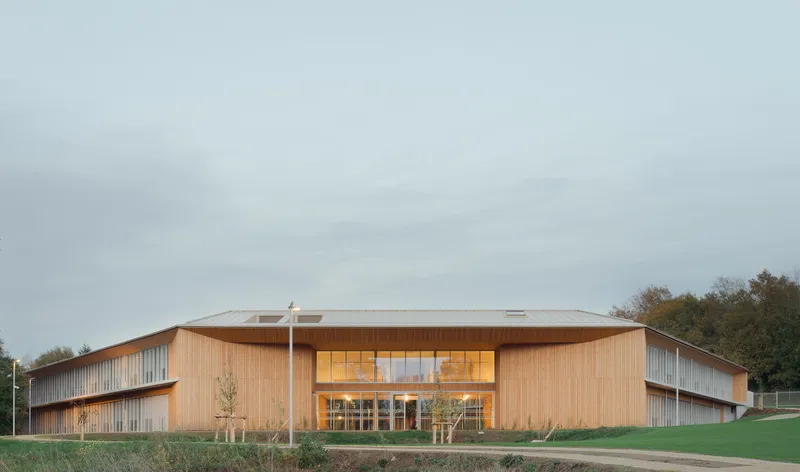
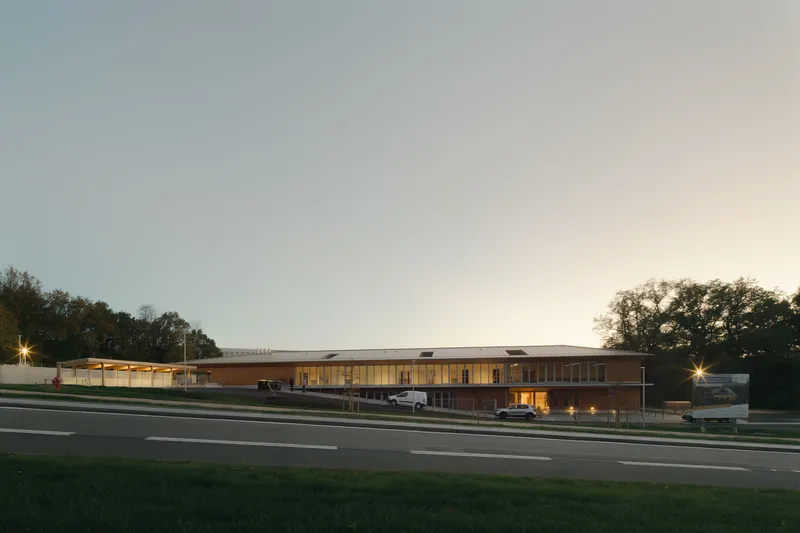
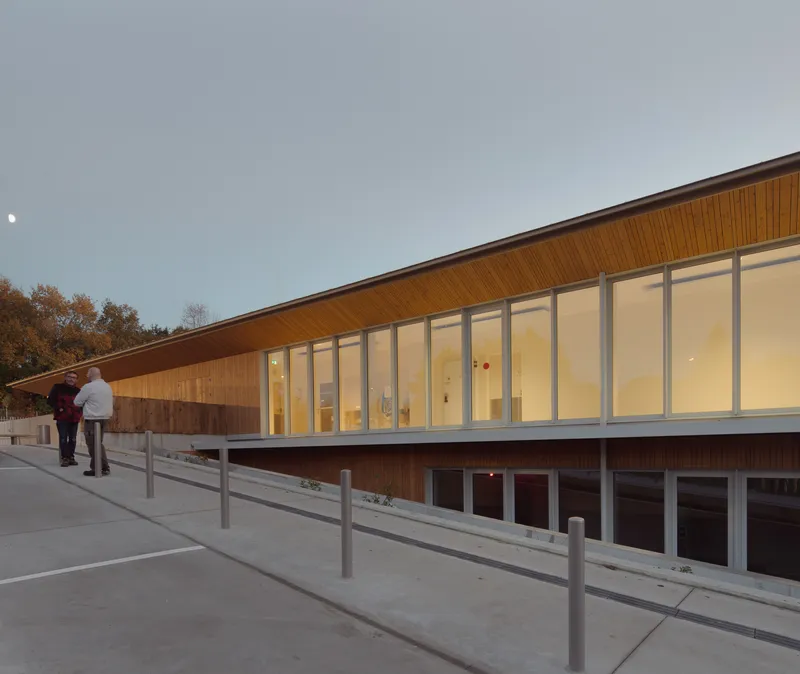
From across the road at twilight, the school reads as a single horizontal bar, its timber cladding absorbing the fading light while glazed sections glow from within. The building's length is its strongest formal gesture: it refuses to break into pavilions or cluster around a quad in the conventional way. Instead it stretches along the slope, the roof pitching subtly to match grade changes. At the southeast corner, a ramp descends past full-height glazing, compressing the distance between interior floor and exterior ground to almost nothing. The kindergarten entrance sits at the base of this gradient, so the youngest children arrive at the lowest, most sheltered point of the site.
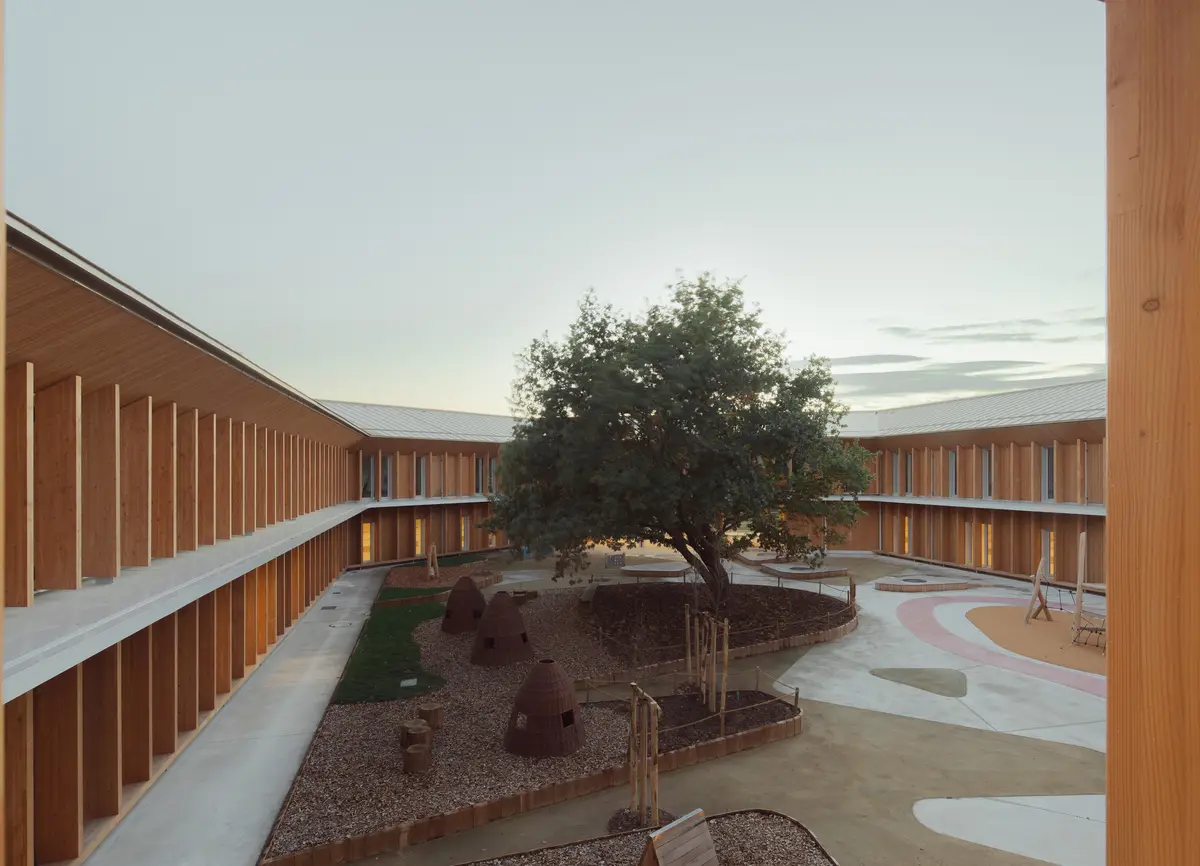
The decision to stack vertically rather than spread horizontally preserves open land around the building. Tall grasses and the existing treeline at the perimeter remain intact, and the architects have deliberately maintained vegetated edges that double as habitat corridors for small fauna. It is a rare case where compactness serves both the energy model and the ecological argument without compromise.
Timber as System, Not Surface
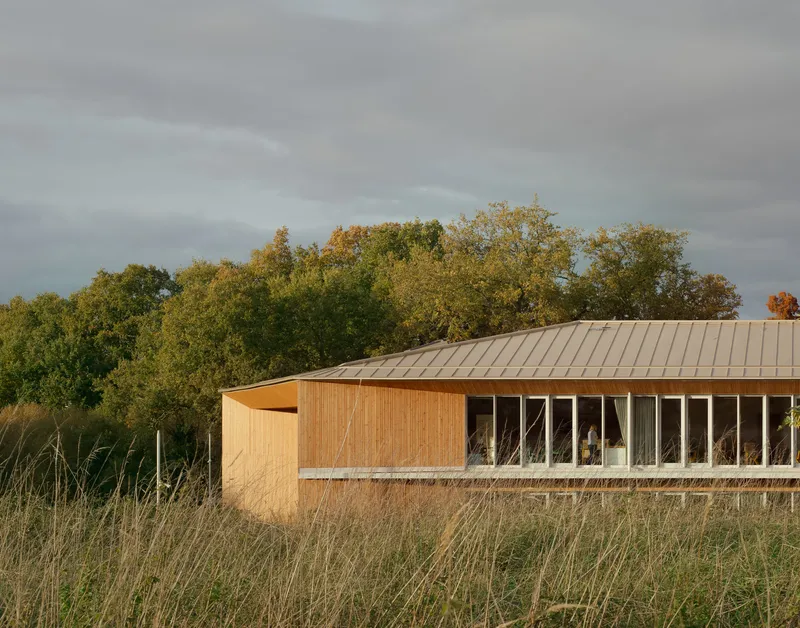
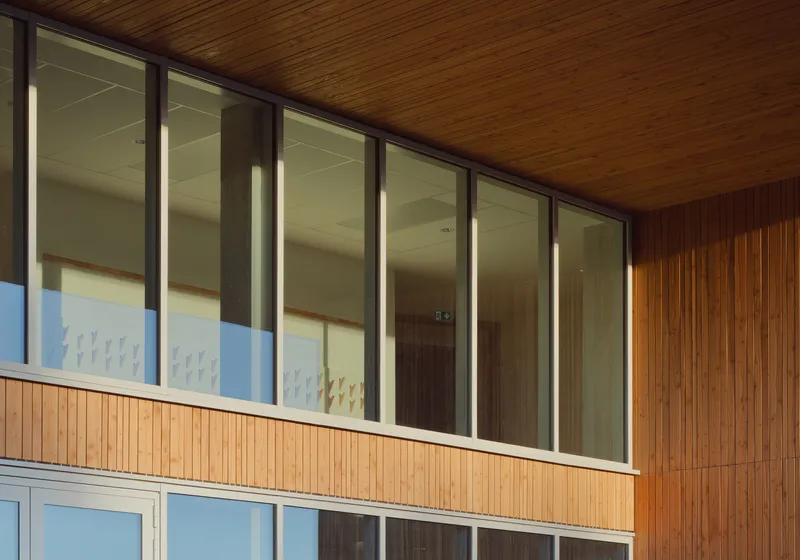
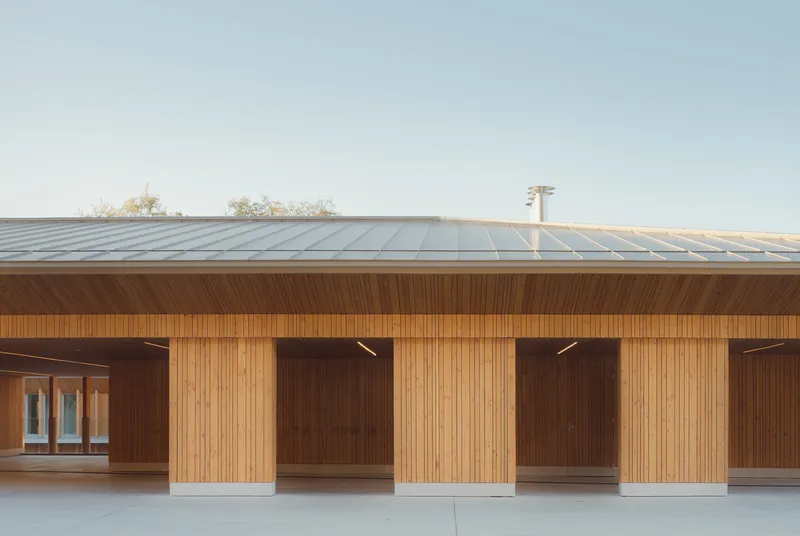
Wood is the dominant material here, but it operates at every scale rather than functioning as mere cladding over a conventional frame. Vertical timber boards wrap the facades in tight rhythm, their spacing calibrated to control solar gain while preserving views. Beneath deep soffit overhangs, the same boards run continuously from wall to ceiling, erasing the joint between vertical and horizontal planes. The standing-seam metal roof sits above this timber shell like a thin lid, reinforcing the reading of the building as a wooden box rather than a metal-roofed shed.
Leibar Seigneurin's use of low-carbon concrete for the primary structure combines with the timber envelope to push the building's embodied carbon well below what a conventional masonry school would demand. The architects describe the wood as producing a "unique quality of light" before it reaches the interior, and in the covered walkways this claim is verifiable: light enters through gaps in the vertical cladding as warm, directional slats rather than flat washes.
Courtyards as Outdoor Classrooms
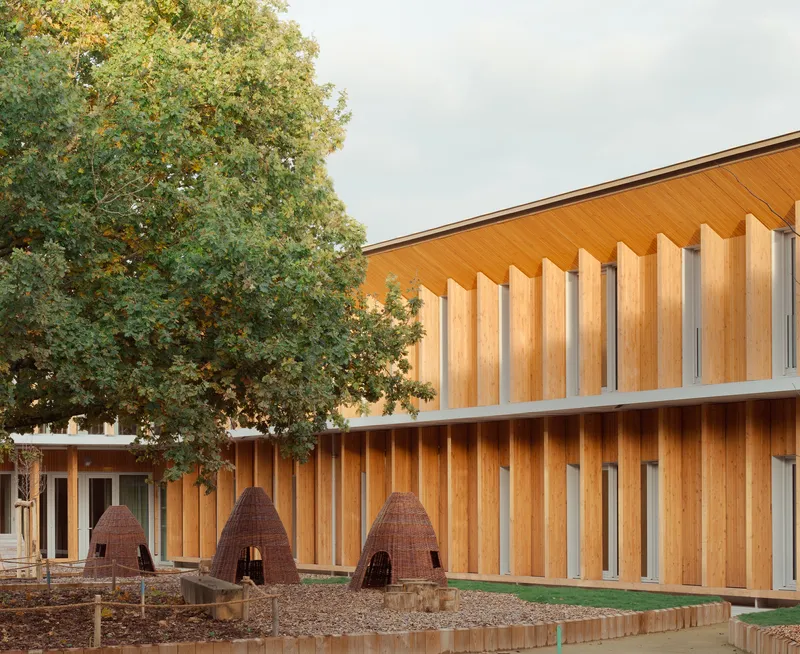
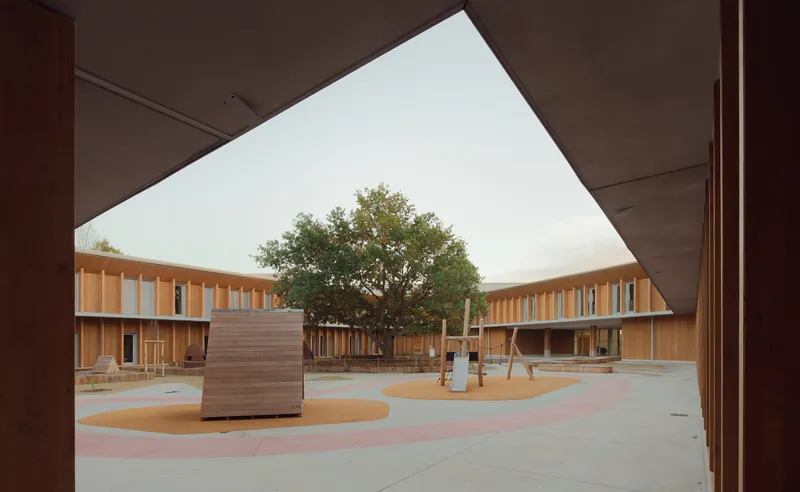
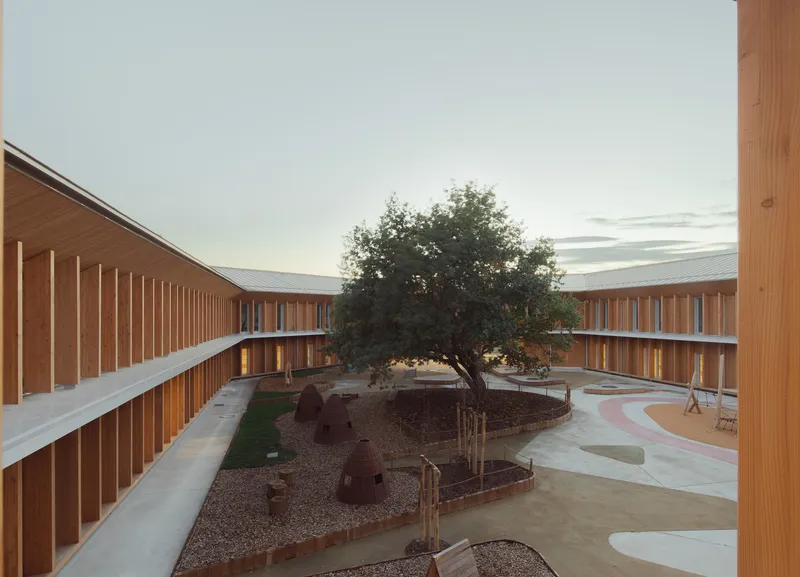
Two courtyards carve into the building mass, each performing a different role. The larger one preserves a mature tree at its center, surrounded by woven pod structures that give children scaled-down shelters for imaginative play. At dusk, the courtyard becomes a lantern, with the timber-clad wings reflecting warm interior light back onto the gravel surface. The smaller courtyard, visible through an angled portal, serves as a more contemplative space, framing views of the tree canopy and the valley beyond.
These are not leftover voids. The school's pedagogical program explicitly integrates outdoor observation, water management, and natural shading into daily learning. The courtyards give teachers a controlled outdoor environment where weather, seasons, and plant growth become teaching material. Vegetated surfaces manage stormwater on site rather than routing it to municipal drains, turning infrastructure into curriculum.
Entry and Threshold
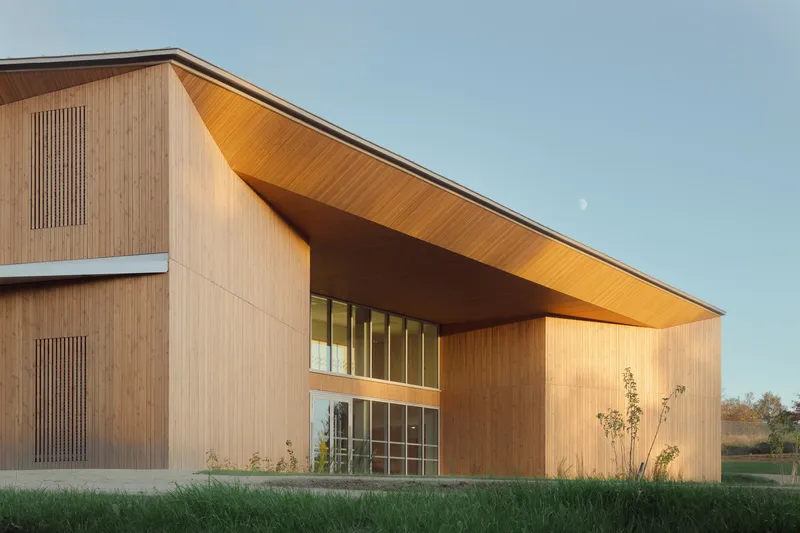
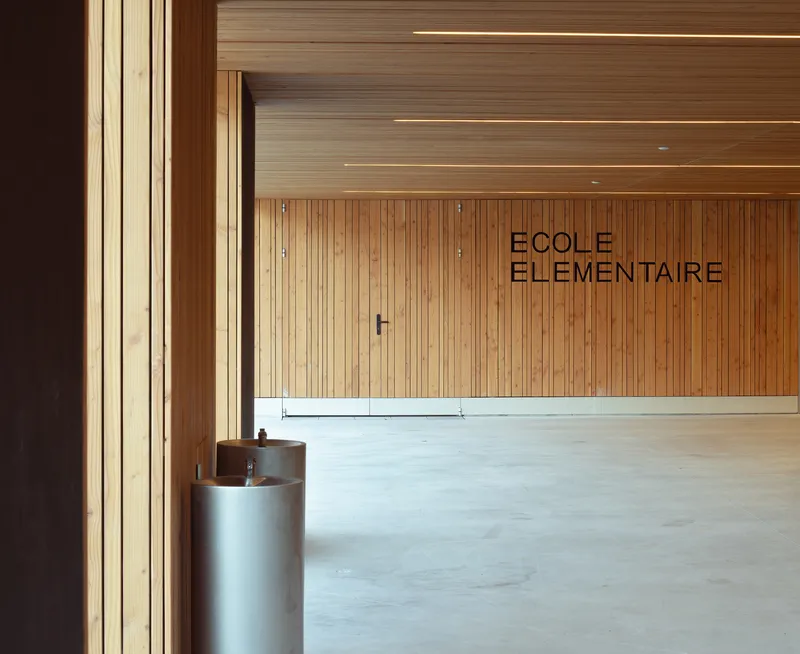
The main entrance is defined by a deep timber canopy that extends the roof plane outward, creating a generous covered threshold between the public realm and the school interior. Vertical cladding runs into the soffit, wrapping visitors in a continuous wood surface before they cross the glazed door line. Inside, a timber-lined entrance hall holds a cylindrical water fountain beside vertical slat cladding, a small civic gesture that signals arrival without monumentalizing it.
There is a deliberate restraint in the entry sequence. No double-height atrium, no graphic wayfinding, no bold color. The building communicates through material and proportion, trusting that children will orient themselves through the rhythm of the structure rather than through signage. It is a bet on spatial intelligence, and the clarity of the plan suggests it pays off.
Interior Life
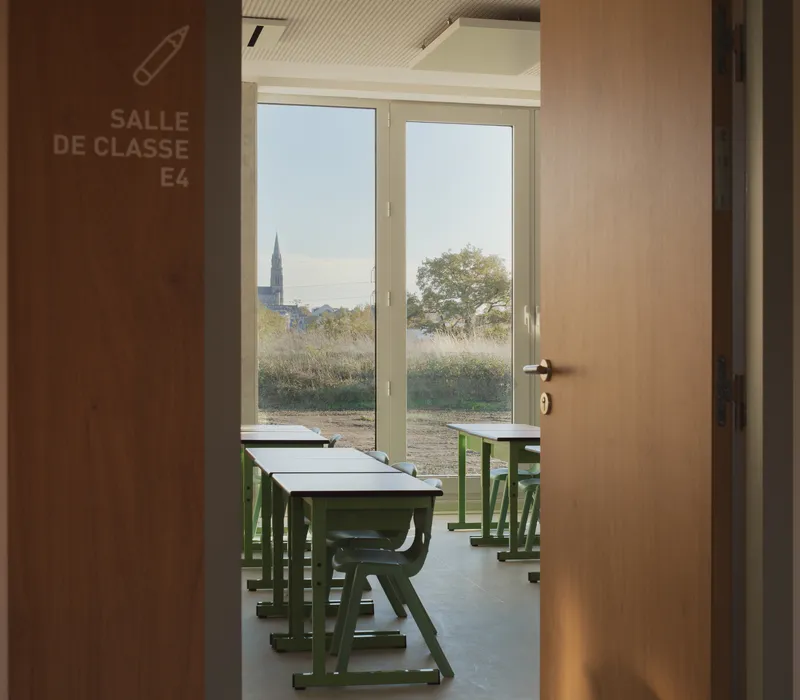
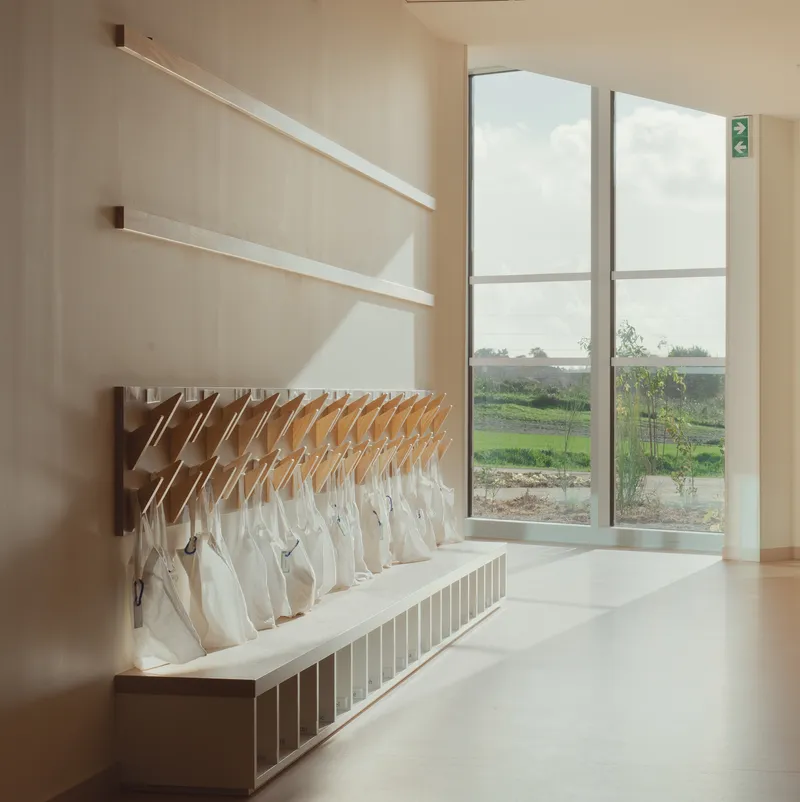
Inside the classrooms, the palette stays simple: pale surfaces, plywood furniture, green desks that introduce a single accent color without competing with the views. One classroom frames Vertou's church spire through its window, anchoring the school in its civic context. Corridors are generous enough to double as informal learning spaces, with built-in coat racks, floating shelves, and tall windows that pull the landscape into circulation routes.
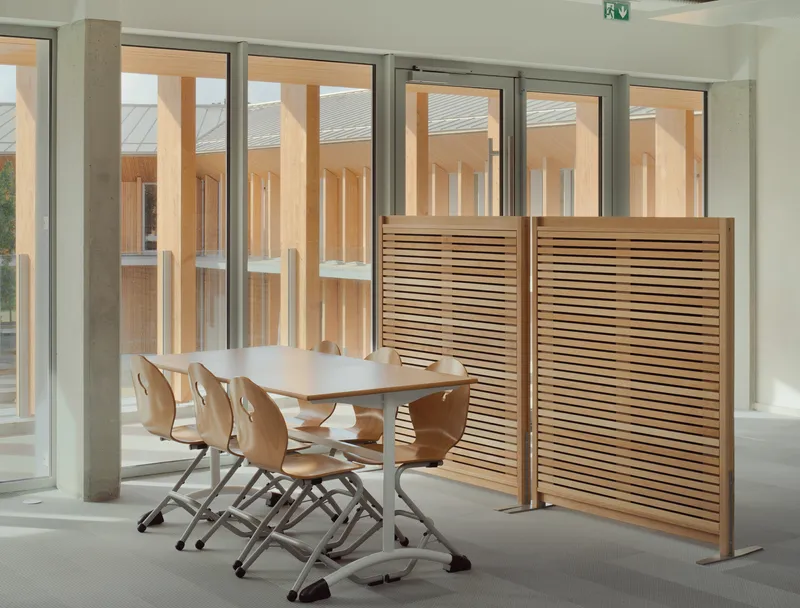
A meeting room beside the central courtyard exemplifies the architects' approach to daylight. A slatted timber screen mediates between interior and exterior, casting parallel shadows across a plywood table. Full-height glazing behind the screen gives occupants a direct visual connection to the courtyard tree while the slats prevent overheating. The quality of light here is warm without being dim, controlled without feeling artificial.
Details at the Scale of a Child
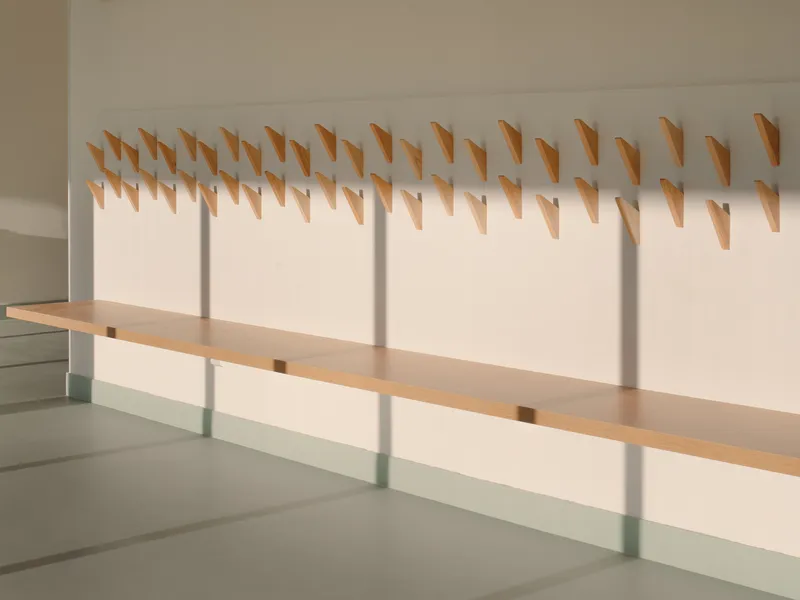
A row of wall-mounted timber coat hooks above a pale green bench is not the kind of detail that wins awards, but it tells you everything about how carefully the architects thought about their users. The hooks sit at a height reachable by small hands. The bench provides a place to sit while changing shoes. Afternoon light washes across the surface, turning a utilitarian moment into something worth lingering over. Elsewhere, corridors feature coat racks and cubbies integrated into the wall plane rather than bolted on as afterthoughts.
Leibar Seigneurin have designed a school where the millwork does as much architectural work as the structure. When storage, seating, and display are embedded in the walls, teachers gain floor area and children gain a sense that the building was made for them specifically, not adapted from a generic office module.
Plans and Drawings
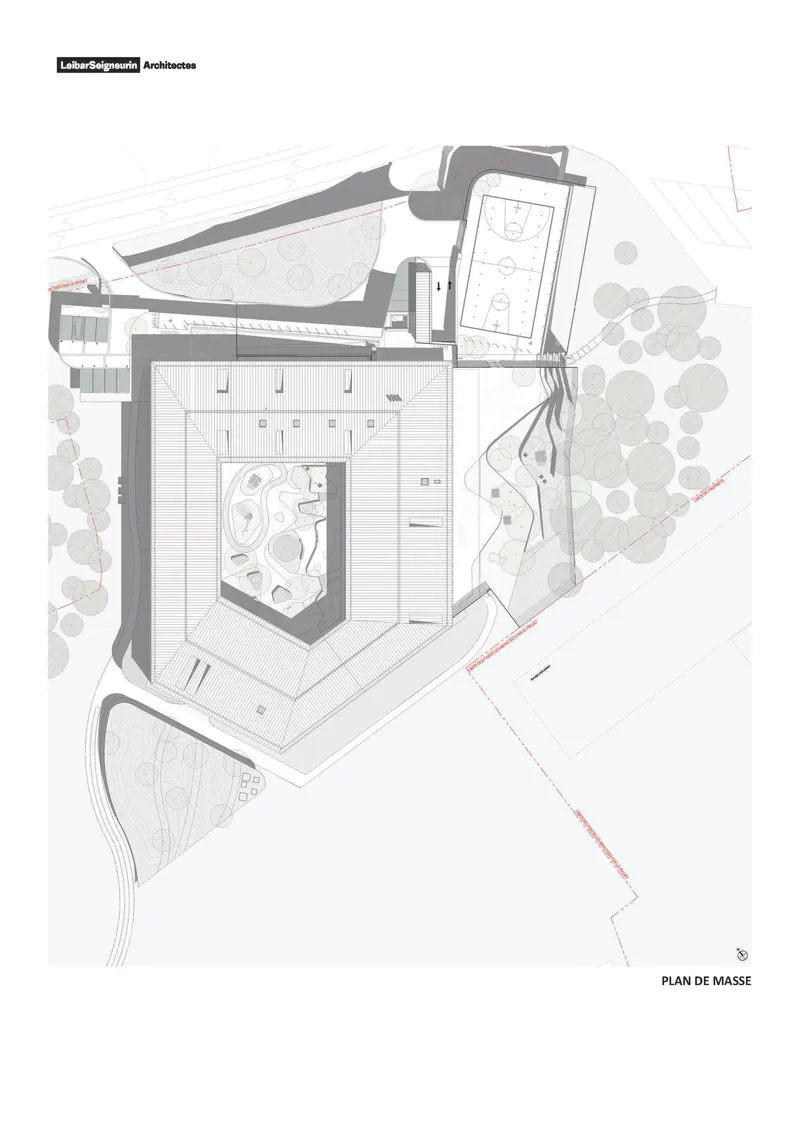
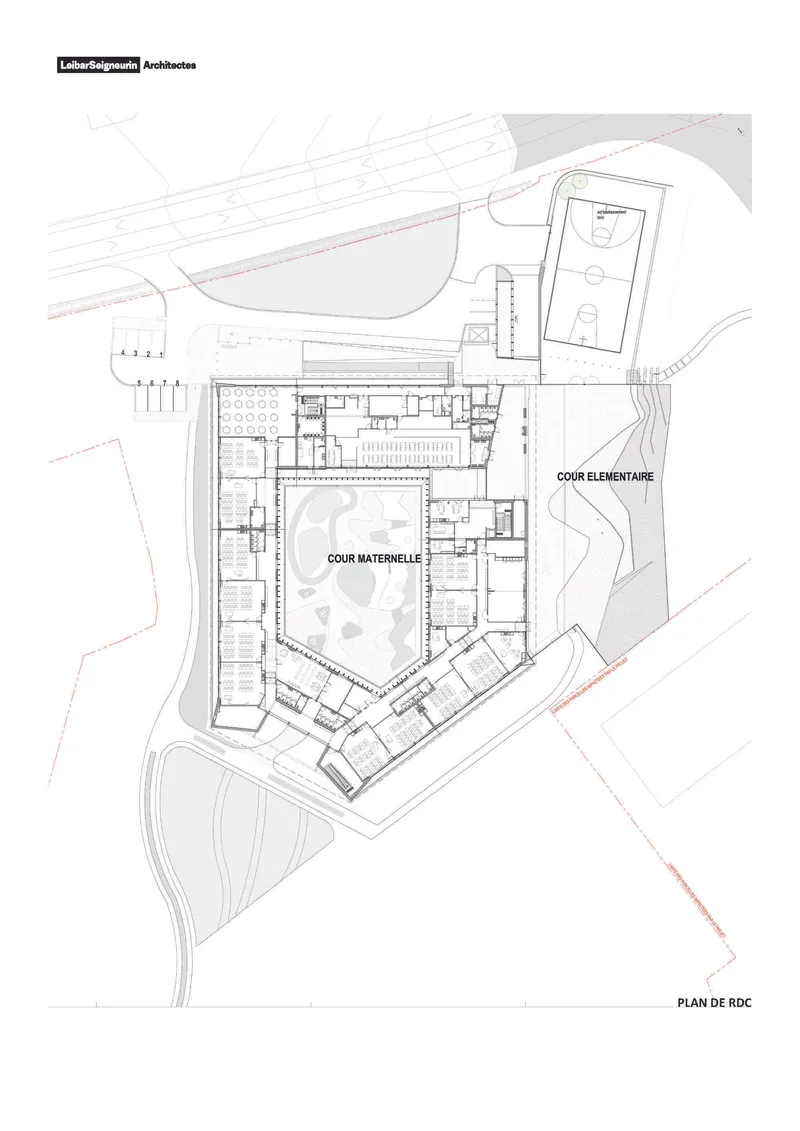
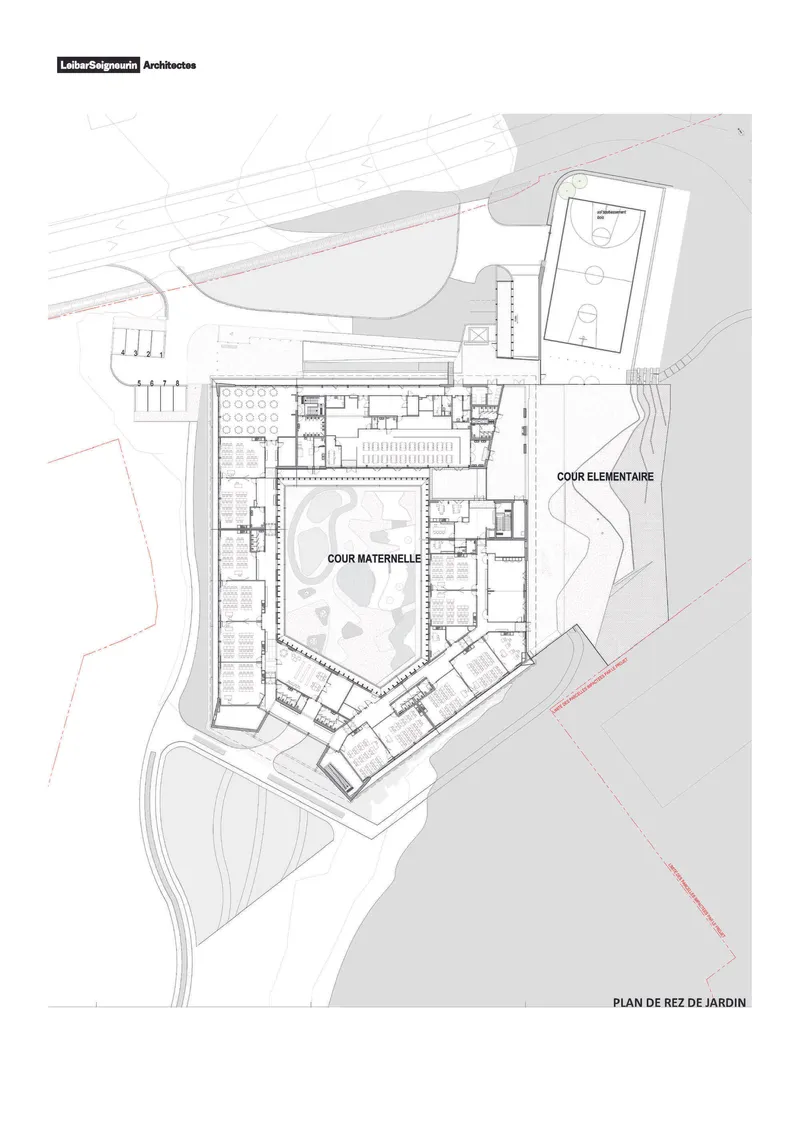
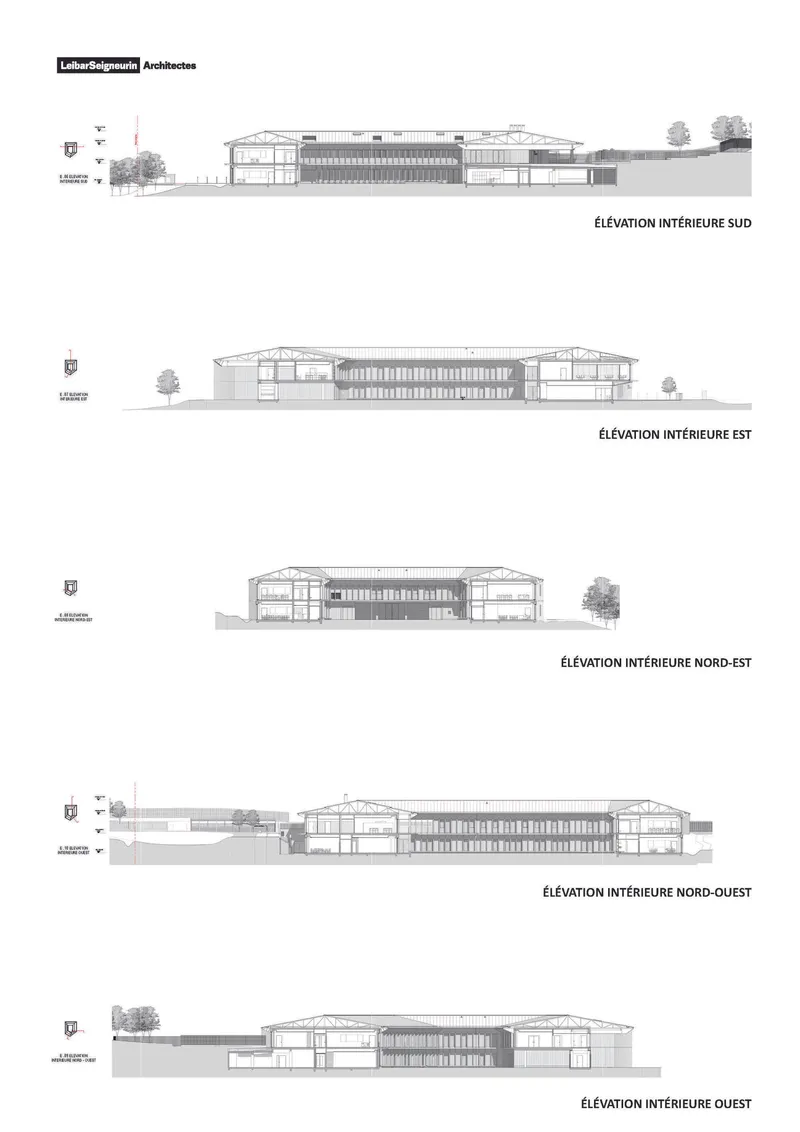
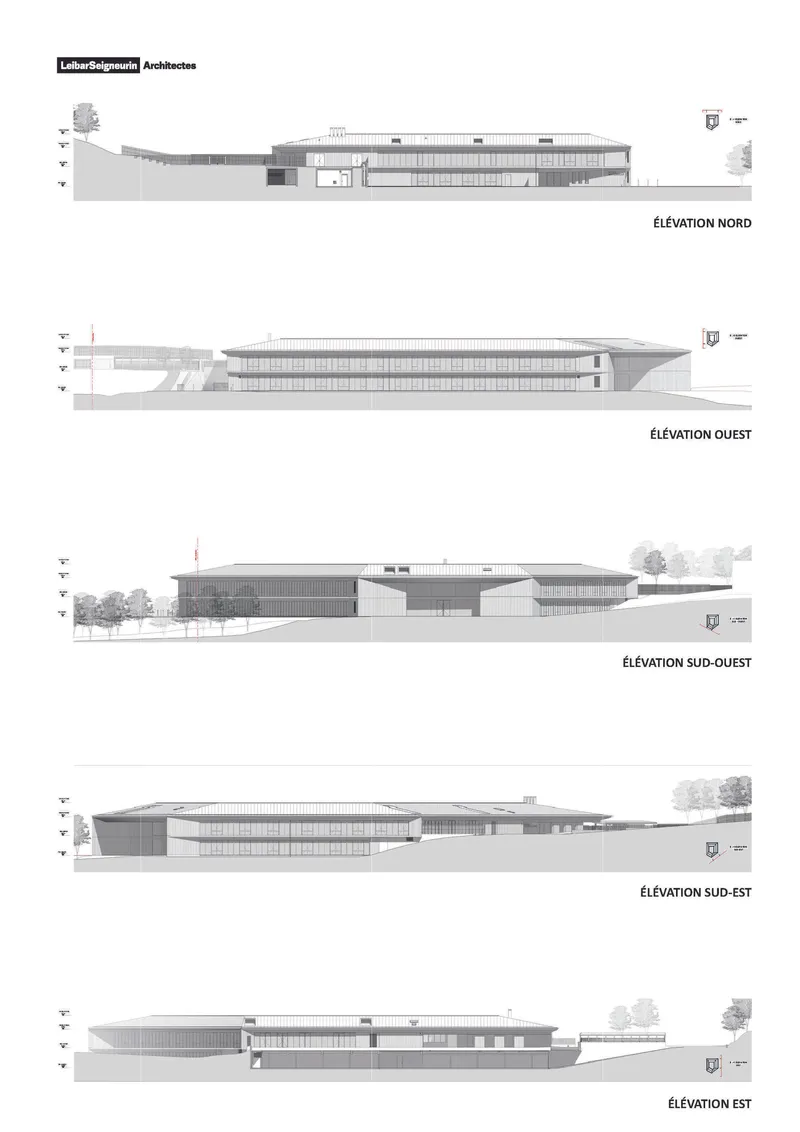
The site plan reveals how tightly the building hugs the slope, with classroom wings arranged around two courtyards and a sports field occupying the flatter terrain to the north. The ground floor plans show the kindergarten and elementary programs separated vertically but sharing a central spine that contains dining, motor skills rooms, and the after-school activity center. Sections and elevations confirm the roof's continuous descent: from the elementary school at the high point of the site to the kindergarten entrance at the low point, the roofline drops without interruption, registering the four-meter grade change as architecture rather than engineering.
The long elevations are particularly telling. The building reads as a single organism, not as two schools bolted together. Vertical louvered elements modulate the facade rhythm, and the exposed structural frames visible in the interior sections show how the timber and low-carbon concrete systems share loads. There is no false ceiling hiding the structure; the children see the bones of the building they inhabit.
Why This Project Matters
France builds a lot of schools, and most of them disappear into the generic landscape of public procurement: metal cladding, minimal overhangs, colors chosen by committee. The Simone Veil School Complex is proof that a public commission with a 17-million-euro budget and a 20-month construction window can still produce architecture that takes its site, its materials, and its users seriously. Leibar Seigneurin did not invent new technology here. They worked with topography, timber, and low-carbon concrete to build a school that consumes less land, less energy, and less attention than most institutional buildings manage.
The building's most radical quality is its restraint. There is no signature gesture, no sculptural roof, no Instagram-ready atrium. Instead there is a continuous roof that follows the ground, a pair of courtyards that turn weather into curriculum, and a material palette that filters light before it reaches the children inside. If this sounds modest, consider how rare it is. Schools that treat children as the primary audience for their architecture, rather than the city council or the photographer, remain the exception. This one earns its place among them.
School Complex Simone Veil by Leibar Seigneurin Architectes, Vertou, France. 4,255 m², completed 2025. Photography by Pierre Leibar.
About the Studio
Share Your Own Work on uni.xyz
If projects like this are the kind of work you want to make, uni.xyz is a place to publish your own, find collaborators, and enter design competitions.


Popular Articles
Popular articles from the community


The Amber Palace Opera: A Geological Fiction Surfaces on Tallinn's Baltic Waterfront
Pierre Brillard reimagines a Baltic legend as a public landscape, opera house, and waterfront promenade rooted in Tallinn's coastal identity.
Tsunami Convergenics: Turning Catastrophic Ocean Forces into Underwater Housing Infrastructure
A speculative underwater settlement off the coast of Onagawa, Japan, treats tsunamis and typhoons as energy sources rather than threats.
Opera by the Sea Estonia: Three Shells Dissolving Architecture into Tallinn's Coastline
A winning opera house proposal replaces monumental form with interconnected shells that blur the boundary between building, park and Baltic Sea.
Cloaked Colonization: A Mobile Underwater Habitat That Moves Like a Fish
Micah Abaya's shortlisted EHC Pacific entry reimagines ocean settlement as a dispersed network of self-sustaining architectural organisms.

Similar Reads
You might also enjoy these articles

Bao Huynh Watercolor Atelier: A Serene Art Retreat in Hội An
Bao Huynh Watercolor Atelier in Hội An blends multifunctional art spaces, sustainable design, local materials, and family-friendly living in a serene environment.

Atelier Macri Concept Store Interior Design by CASE-REAL
Atelier Macri store features a "ko" counter, walnut wood details, cork displays, blending retail, gallery, and seamless customer experiences.

Manuel Vargas Izquierdo Stadium and High-Performance Sports Center: Architectural Excellence in Jalpa de Méndez
The Manuel Vargas Izquierdo Stadium blends sustainable design, inclusive sports facilities, and cultural-inspired architecture, revitalizing Jalpa de Méndez’s public spaces.

KAKR Buluh Awar Hall: Revitalizing Community and Ecology Through Bamboo Architecture
Community built bamboo hall revitalizes Buluh Awar village, empowering youth, restoring ecology, celebrating vernacular craftsmanship through sustainable architecture and culture.


Comments (0)
Please login or sign up to add comments
No comments yet. Be the first to comment!