

Living Together: Three Generations Stacked Around a Courtyard in Xixi Village
A multi-generational courtyard house in southern China layers privacy, climate response, and family life across four floors of locally sourced materials.


How do you fit three generations into a single house without anyone losing their mind? In Xixi Village, an ancient settlement founded in 1621 in southern China, the answer lies in a vertical courtyard house that gives each generation its own floor while binding the family together through a shared central void. The project, titled Living Together, treats the courtyard not as a nostalgic gesture but as a working environmental and social device: it pulls air through the house, regulates temperature in Dongguan's humid subtropical climate, and provides every floor with a visual and spatial connection to the rest of the family.
Designed by Yuting Xiao, this shortlisted entry for Nano Nest 2020 proposes a house built from locally sourced red brick, grey stone, and light wood. Its external form respects the village's traditional typologies while its interior arrangement reimagines multi-generational living for the 21st century. Grandparents on the ground floor, parents on the second, two daughters on the third, and a communal rooftop above: each layer has a distinct spatial identity, yet the courtyard stitches them into a single domestic experience.
A Central Void That Organizes Everything
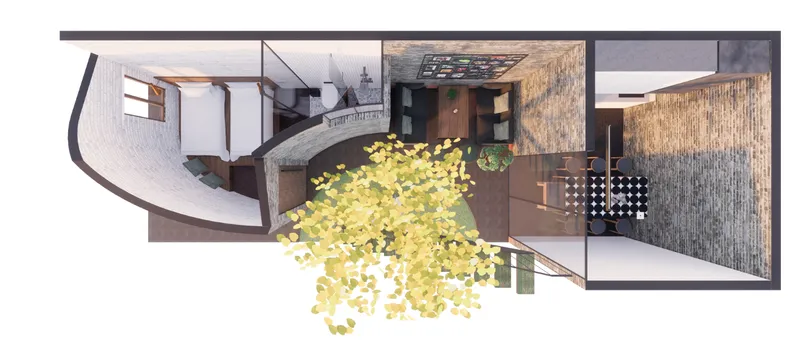
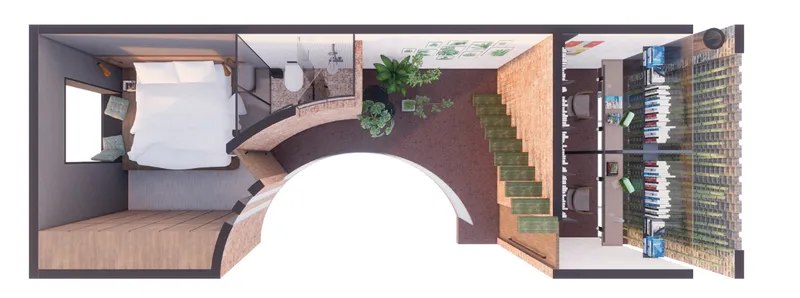
The top-down floor plan reveals the courtyard's role as the organizational spine of the house. A yellow tree canopy overhangs a curved staircase that wraps around the central void, turning vertical circulation into an act of passing through shared domestic space rather than retreating into a corridor. The section cutaway exposes a curved mezzanine with timber stairs and a wine storage wall, demonstrating how even the transitional zones between floors are treated as inhabitable, purpose-driven spaces rather than leftover square footage.
Positioned at the heart of the plan, the courtyard allows uninterrupted airflow through the triple-height volume, regulates indoor temperatures passively, and creates what Xiao calls a "visual and social anchor." Grandparents enjoy its open-air ambience at ground level while the younger family members interact casually across floors through the courtyard's openness. Seasonal flexibility is built in: shaded retreats in summer, light-filled warmth in winter.
Vertical Zoning: One Floor Per Generation

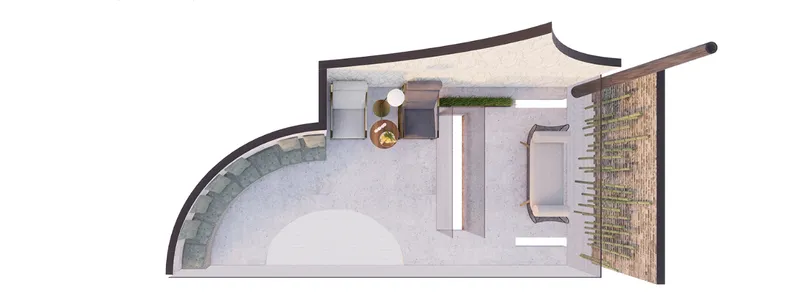
The longitudinal section cuts through all four levels and reveals the logic of the stacking strategy. The ground floor, designed with accessibility in mind, is dedicated to the grandparents, with the kitchen and living areas positioned for comfort and easy access to the courtyard. The second floor belongs to the parents and features study rooms, garden nooks, and reading bays with views of bamboo terraces, catering to working adults balancing professional and parenting lives. The upper-level plan shows a curved balcony overlooking the interior courtyard and a planted wall, offering a glimpse of how the parents' floor mediates between the private domestic realm and the shared green core.
The third floor is given to the two daughters, Summer and Snow, and includes elevated sleeping platforms and a shared study area designed to promote independence and focus in a compact vertical layout. Above them, the fourth-floor rooftop opens up as a communal family zone: sunlit, informal, designed for tea sessions, stargazing, and barbecues. The rooftop also provides visual cues down through the house, reinforcing the feeling of unity that the courtyard establishes from below.
Stacked Living Spaces Around a Shared Atrium
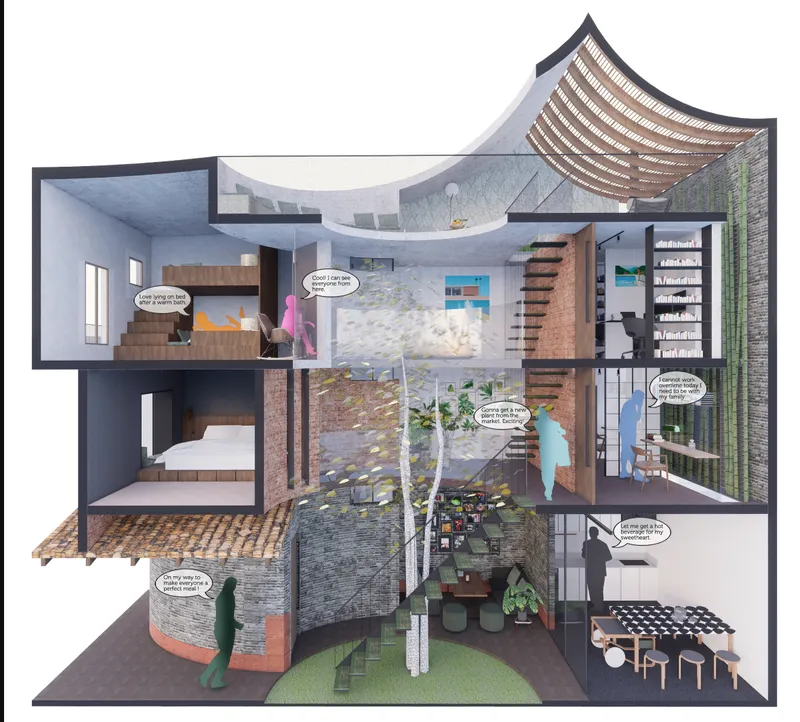
The three-dimensional sectional drawing is perhaps the most revealing image in the set. Cutout figures populate each level, giving immediate scale to the stacked living spaces arranged around the central atrium. What becomes clear is the proportional generosity of the courtyard relative to the overall footprint. Rather than treating it as a narrow lightwell, Xiao sizes it large enough to serve as a genuine gathering space at ground level and a passive ventilation engine for the entire house. The curving roof directs rainwater and supports air movement, while skylights, layered green walls, and bamboo gardens enhance the biophilic quality of the interiors across every floor.
Domestic Scenes: Kitchen, Garden, Workspace
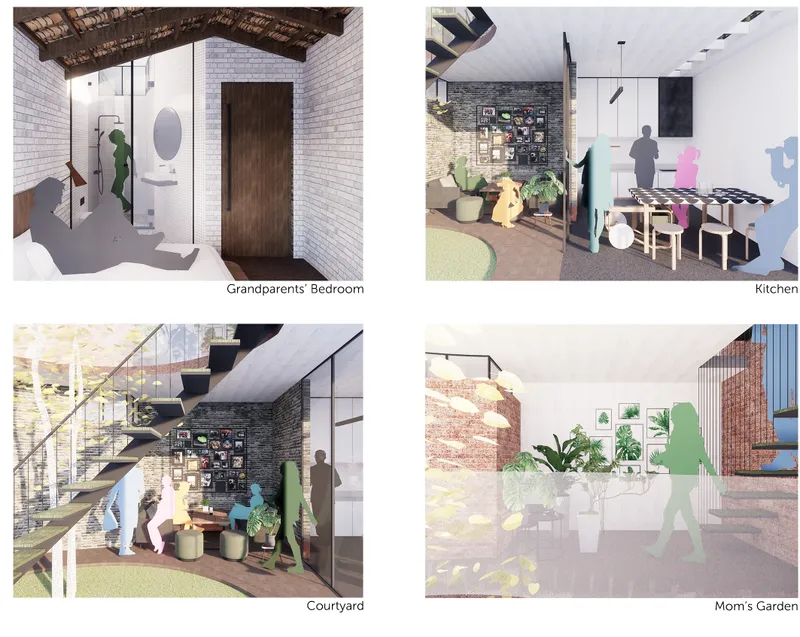
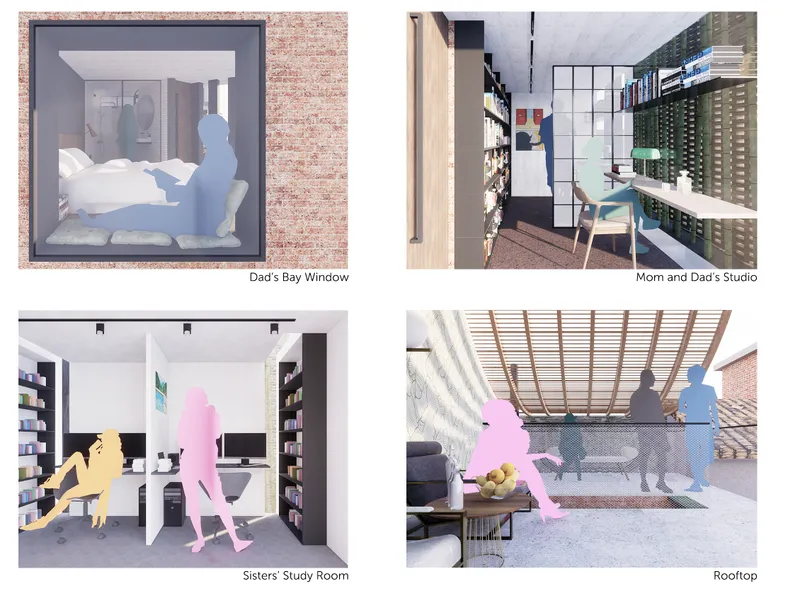
Four perspective renderings bring the house to life at eye level: a bedroom hallway bathed in filtered light, a kitchen with figures moving through it, the courtyard staircase seen from below, and an indoor garden that blurs the line between interior and exterior. The final rendering shows a workspace beneath exposed wood trusses, with gridded steel windows and built-in shelving creating a room that feels simultaneously refined and robust. These views demonstrate how locally sourced materials, specifically the red brick, grey stone, and light wood, produce a coherent material palette that ties the modern interior to the village's architectural character.
Step-back terraces on the south-facing façade filter harsh sunlight while admitting ample daylight. North-facing study rooms minimize heat gain. The thermal envelope is kept breathable, reducing reliance on mechanical cooling. Every architectural decision, from a lightwell to a sloping façade, is calibrated for climate responsiveness in Dongguan's humid conditions, lowering the home's energy footprint without sacrificing comfort.
Why This Project Matters
Multi-generational housing is a perennial topic in architecture, but proposals that actually diagram the tensions between privacy and togetherness in spatial terms are rarer than they should be. Living Together does not simply advocate for families living under one roof; it architecturally negotiates what that coexistence looks like floor by floor, room by room, season by season. The courtyard is not decoration or heritage pastiche. It is the mechanism through which air moves, light enters, and family members see each other without being forced into constant proximity.
Xiao's project also makes a quiet argument about cost efficiency and cultural continuity. By sourcing materials locally and relying on passive environmental strategies rather than mechanical systems, the design keeps construction budgets realistic for a village context while maintaining a genuine connection to Xixi's 400-year-old building traditions. In a competition field focused on compact living, this entry stands out for treating density not as a constraint to overcome but as a social opportunity to design for.
View the Full Project
About the Designers
Designer: Yuting Xiao
Enter a Design Competition on uni.xyz
uni.xyz runs architecture and design competitions year-round that reward proposals with spatial conviction and real site intelligence.
Project credits: Living Togethe by Yuting Xiao Nano Nest 2020 (uni.xyz).


Popular Articles
Popular articles from the community


longwave studio Reorganizes a 112 m² Tainan Apartment Around the Daily Routines of a Family and Two Cats
In Tainan, Taiwan, birch plywood, rust-red furniture and a freestanding plaster wall link arrival, storage, work and family life in one apartment.

Juan García Correa, John González and Claudia Rueda Sink a Circular Amphitheater into a Manizales Engineering Building
On the La Nubia campus in Manizales, Colombia, the S1 Building folds labs and offices into a hillside of ramped lawns that double as a campus route.

LT2A and OPEN Architectes Thread a Brick and Glass High School Through a Wooded Belgian Campus
In Braine-l'Alleud, a 3,000 m² wing for Collège Cardinal Mercier pairs pale brick with a glazed colonnade, deferring to a small chapel and a dense wood.

David Macias Steps a Doorless Stone and Plaster House Down a Tropical Colombian Hillside
In the humid hills of Colombia, Threshold House replaces the front door with an open void and terraces its 850 m² down the slope instead of fighting it.

Similar Reads
You might also enjoy these articles

Gil Mello Arquitetura Tilts a Single Roof Toward the Waterfalls on a Plateau Above Aiuruoca, Brazil
In Aiuruoca, Minas Gerais, a 200 m² house of local labor and reclaimed poles pairs a low valley veranda with a tall mountain one.

U.GA Architects Wraps an Oval Rooftop Pool in Curved Board-Formed Concrete on Busan's Jeollidan-gil
In Busan's Jeonpo-dong, a 454 m² mixed-use block stacks a neighborhood facility, guest rooms and an oval rooftop pool inside spiraling concrete walls.

Felipe Hess Arquitetos Turns a Blind Stone Wall to the Street and Opens a Brazilian House onto a Courtyard and Canal
A canal-front house in Brazil hides behind painted stone and planting, then opens to an olive-tree courtyard, a reed-ceilinged porch and a curving pool.
David Macias Steps a Doorless Stone and Plaster House Down a Tropical Colombian Hillside
In the humid hills of Colombia, Threshold House replaces the front door with an open void and terraces its 850 m² down the slope instead of fighting it.

Explore Shared Living Competitions
Discover active competitions in this discipline

Challenge to design mud housing for contemporary communities

Challenge to design luxury tourism on rails

VR headsets Storefront design competition

Designing a staircase for a client
Comments (0)
Please login or sign up to add comments
No comments yet. Be the first to comment!