Lumination Exploration: Futuristic Architecture for a Mobile Underwater Habitat  Lumination Exploration: Futuristic Architecture for a Mobile Underwater Habitat

Lumination Exploration: Futuristic Architecture for a Mobile Underwater Habitat

UNI logo
UNI Editorial
UNI Editorial published Results under Extreme Architecture, Architecture on

Lumination Exploration, a project by Bobby Diaz-Ontiveros of the University of Texas at Arlington, approaches this question through a speculative vision of futuristic architecture designed for sustained human occupation in the Pacific Ocean. Developed as a mobile underwater habitat, the proposal combines dwelling, research, exploration, energy infrastructure, and environmental observation within a fleet of independent vessels.

The project was recognized as a Shortlisted entry in EHC - Pacific, a competition examining new possibilities for human habitation in one of Earth's most challenging environments.

Rather than imagining a conventional building placed on the seabed, Lumination Exploration proposes architecture that moves. Each vessel functions as an autonomous habitat capable of navigating marine environments, joining a larger community when required, and separating from the group for individual missions.

The result is a speculative intersection of underwater architecture, transportation, marine research, and modular living.

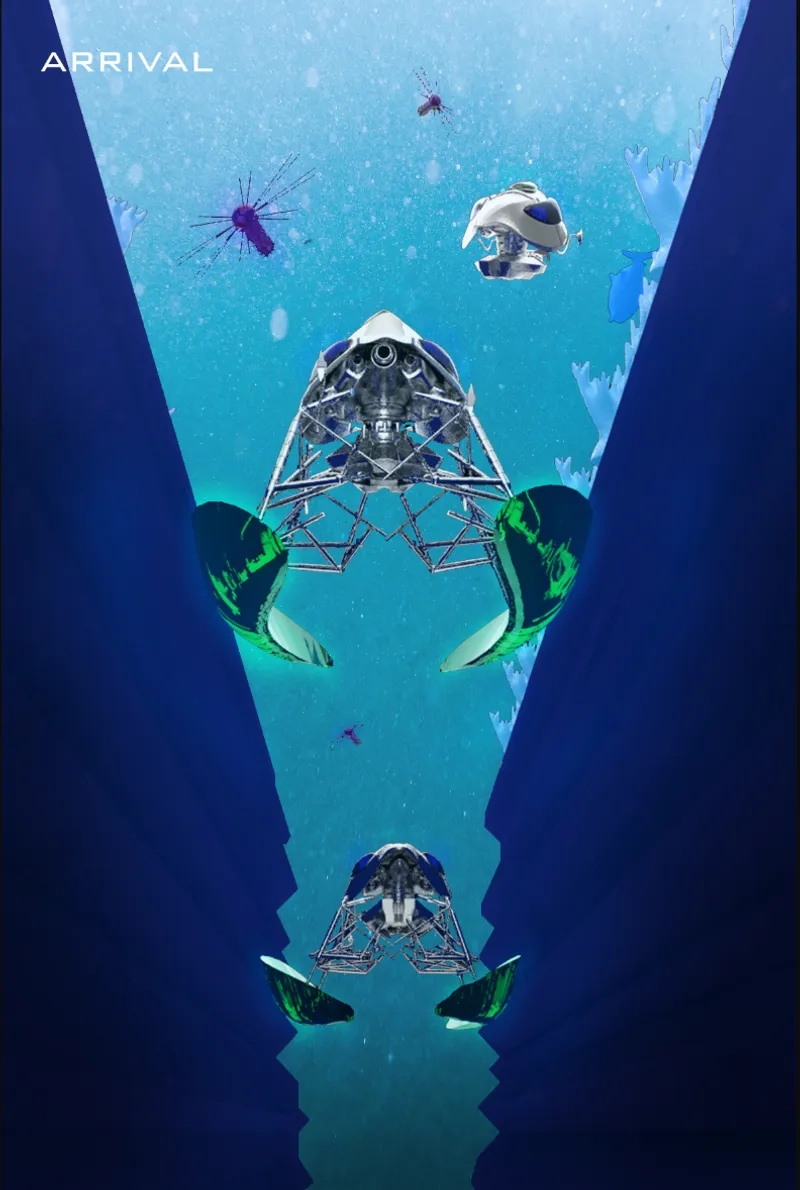
Mobile underwater habitat vessels descend through the Pacific’s deep-sea landscape

Rethinking Futuristic Architecture Beneath the Ocean

Most architecture begins with land.

Foundations establish permanence, buildings occupy defined plots, and infrastructure connects fixed destinations. Lumination Exploration reverses this relationship by imagining a habitat where movement becomes one of architecture's defining characteristics.

The ocean is not treated simply as a site surrounding a building. It becomes an environment through which the architecture travels.

Each unit operates as both a vessel and a dwelling. Instead of constructing a single enormous underwater settlement, the proposal distributes habitation across a fleet of smaller autonomous structures.

This approach introduces a different model for futuristic architecture. Community does not necessarily depend on physical attachment. Independent units can migrate together, separate for exploration, regroup around shared infrastructure, or remain stationary depending on environmental and research requirements.

The habitat therefore becomes less like a traditional building and more like a mobile architectural ecosystem.

Arrival: Entering an Extreme Marine Environment

The project's Arrival sequence establishes the relationship between the vessel and the vast underwater landscape.

The imagery depicts multiple units descending through narrow ocean trenches. Their streamlined bodies contrast with the enormous scale of the surrounding marine environment, emphasizing the difficulty of designing architecture for a place defined by pressure, darkness, isolation, and limited accessibility.

Rather than dominate the landscape, the vessels appear relatively small within it.

This scale is important to the concept. Lumination Exploration imagines units capable of travelling through natural ocean formations rather than requiring major modifications to the seabed.

Mechanical frames, fins, energy components, and enclosed living volumes are integrated into compact vessels designed to negotiate the geometry of underwater trenches.

Here, underwater habitat design becomes an exercise in mobility as much as enclosure.

Migration as an Architectural Strategy

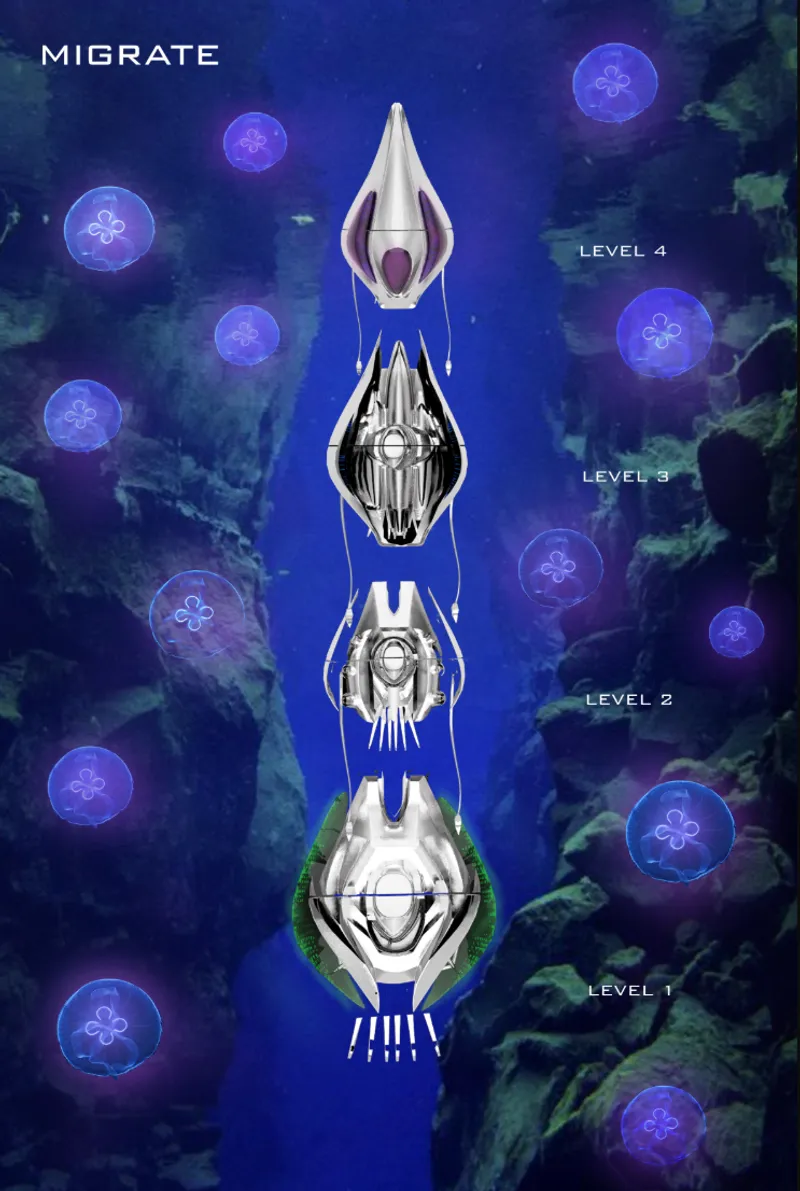
The proposal develops this mobility further through a system of four operational levels.

The illustrated Migrate sequence presents vessels transitioning between configurations identified as Levels 1 through 4. Their changing geometry suggests that different conditions require different relationships between propulsion, enclosure, structural components, and movement.

Migration becomes central to the way the proposed community operates.

A vessel can travel with others as part of a larger underwater fleet, but each habitat retains a degree of independence. Instead of forcing every resident or researcher into one centralized settlement, the system allows units to determine whether they remain together or explore independently.

This flexibility introduces an unusual interpretation of community planning.

Traditional urbanism organizes people through streets, blocks, neighborhoods, and buildings. Lumination Exploration instead organizes its community through proximity, mobility, energy, and communication.

The settlement can potentially change its arrangement continuously.

Its "urban plan" is therefore never completely fixed.

A Dwelling Designed as a Self-Contained Vessel

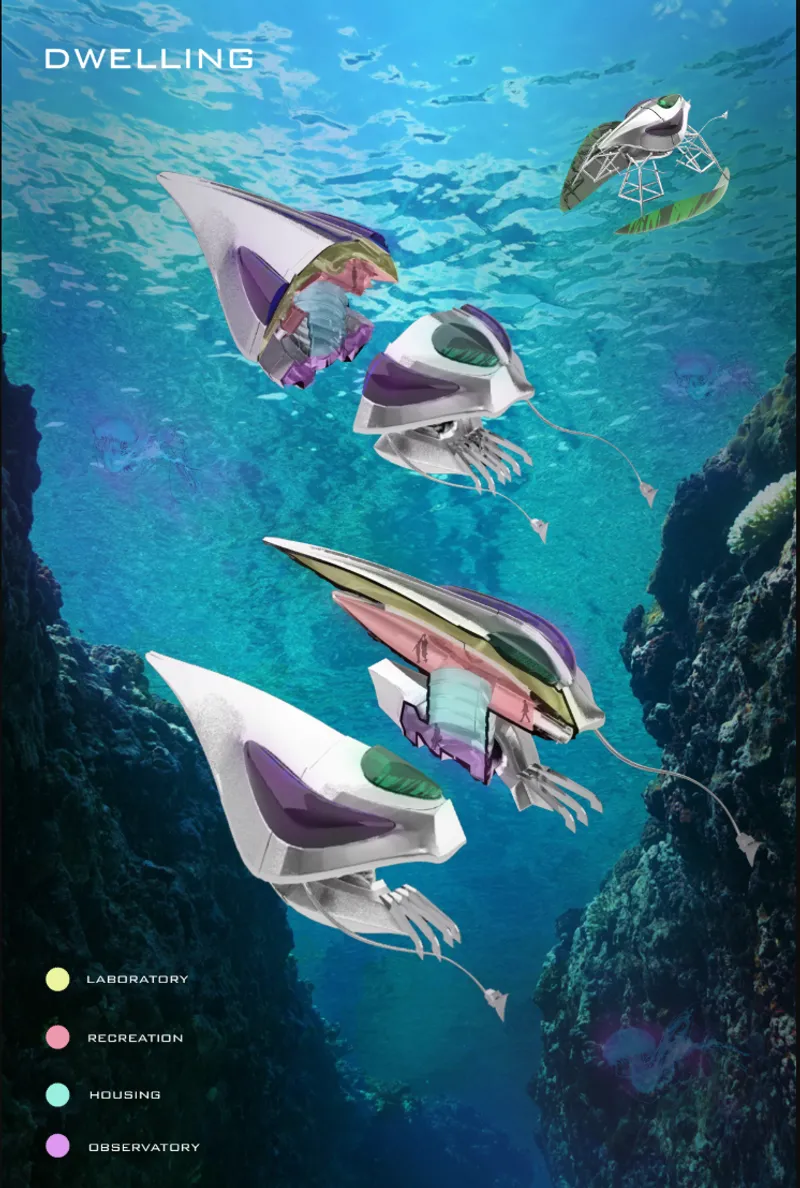
The project's dwelling studies reveal how everyday human activities could be distributed within each underwater unit.

Four principal functions are identified:

Laboratory, recreation, housing, and observatory.

Together, these programs transform the vessel from a transportation device into a complete habitat.

The laboratory supports scientific investigation and the collection of marine samples. Housing provides spaces for prolonged occupation. Recreation addresses the psychological and social demands of living within an isolated environment. The observatory creates a direct relationship between inhabitants and the ocean surrounding them.

The importance of these functions extends beyond practical programming.

Extreme-environment architecture must consider not only survival but also what sustained habitation actually means. People require places to sleep and work, but they also need opportunities for rest, observation, interaction, and mental stimulation.

Lumination Exploration therefore presents habitation as more than physical protection from the ocean.

It imagines an architecture capable of supporting daily life within it.

Biomorphic Forms for Underwater Architecture

Visually, the habitat avoids the familiar language of rigid submarines or cylindrical research stations.

Instead, its white and metallic shell forms curve around purple and green components, creating a distinctly biomorphic appearance. Several configurations resemble marine organisms moving through the water rather than conventional vehicles.

This relationship between technology and natural form strengthens the project's identity as futuristic architecture.

The vessels appear almost like artificial species inhabiting the Pacific ecosystem.

Their aerodynamic, or more accurately hydrodynamic, profiles respond conceptually to underwater movement, while extended fins and appendages contribute to navigation and stabilization.

The design language also reduces the perception of architecture as something foreign to the marine environment. Rather than creating a conventional building beneath the sea, Lumination Exploration attempts to imagine a new architectural typology shaped specifically by underwater conditions.

Learning From Jellyfish and Marine Luminescence

One of the project's most distinctive ideas concerns illumination.

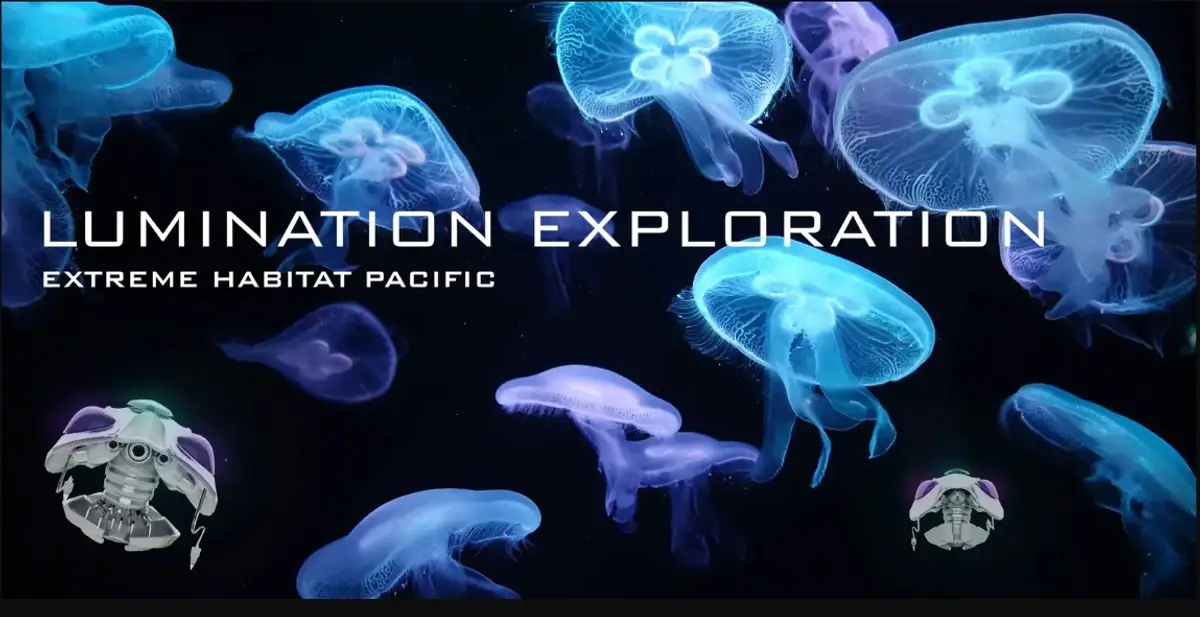
The deep ocean receives increasingly limited natural light, creating a significant challenge for navigation and visual communication. Lumination Exploration responds by looking toward one of the ocean's most recognizable luminous organisms: the jellyfish.

The proposal imagines illuminated pods on the exterior of the vessels that act as visual identifiers.

Much like bioluminescent organisms use light within dark marine environments, these elements would allow individual habitats to recognize nearby members of the fleet.

Light therefore becomes both functional and symbolic.

It assists orientation while giving the mobile architecture a recognizable presence within the darkness of the ocean.

The concept also explains the project's title.

Lumination Exploration connects illumination with discovery, suggesting an environment where architecture becomes a moving source of light within largely unexplored depths.

A four-level transformation sequence illustrates the vessel’s adaptive movement through underwater environments
Sectional views reveal laboratory, recreation, housing, and observatory spaces within the mobile habitat

Disembark: Architecture as an Assembly of Systems

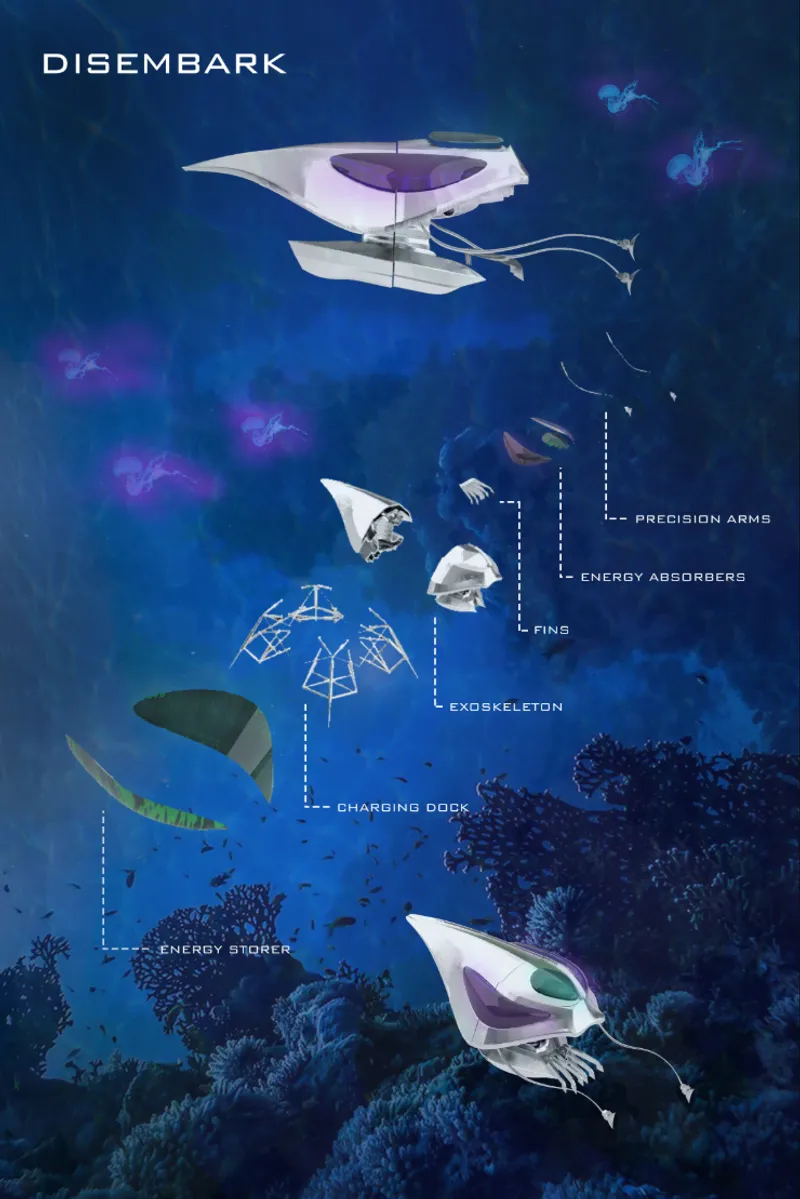
The Disembark visualization breaks the vessel into individual components, revealing the habitat as a coordinated mechanical and architectural system rather than a singular sculptural object.

The diagram identifies elements including:

  • Precision arms
  • Energy absorbers
  • Fins
  • Exoskeleton
  • Charging dock
  • Energy storage

Together, these systems demonstrate how the project attempts to combine habitation, navigation, scientific research, and energy management.

The precision arms are conceived as tools for collecting samples while minimizing disturbance to the surrounding environment.

Fins support underwater maneuverability.

The exoskeleton provides the primary structural framework.

Energy storage and charging infrastructure allow vessels to remain mobile while periodically replenishing power.

The exploded configuration is particularly revealing because it shows that the project's futuristic appearance is intended to emerge from the interaction of multiple functional systems.

The architecture is not simply a shell. It is an interconnected machine for living and exploration.

Energy Independence and the Mobile Charging Network

Long-term underwater habitation depends heavily on energy.

Lumination Exploration addresses this through a decentralized charging strategy in which each vessel is associated with its own charging dock and energy storage infrastructure.

According to the project concept, charging stations contain multiple energy stores and ports capable of supporting vessels operating in challenging conditions.

This network creates an interesting architectural relationship between independence and collective infrastructure.

Individual habitats remain capable of operating separately, but the broader system allows resources to be shared when necessary.

This principle makes expansion possible.

Rather than constructing a completely new centralized habitat whenever the community grows, additional vessels could theoretically be introduced into the existing energy and mobility network.

The design therefore treats scalability as multiplication rather than enlargement.

A Modular Community Instead of a Single Megastructure

Many speculative visions of ocean habitation rely on enormous underwater cities.

Lumination Exploration takes a fundamentally different approach.

Its community is composed of multiple smaller units.

Each vessel contains the essential programs required for its inhabitants, allowing it to participate in the community without depending completely on a single central structure.

This distributed model offers architectural flexibility.

A group of vessels could form a temporary research community around a particular marine location. Individual units could separate for observation or sample collection. The fleet could then migrate toward another environment as research conditions changed.

Community therefore becomes dynamic.

Its boundaries are determined not by walls or property lines but by the movement and coordination of vessels.

This idea gives Lumination Exploration one of its strongest conceptual qualities: architecture itself becomes migratory.

Designing for Ocean Trenches

Scale also plays an important role in the proposal.

The vessels are conceived in relation to natural trenches and underwater passages. Rather than demanding open territory for large construction, the smaller units are intended to navigate constrained marine environments using their fins and compact geometry.

This creates a closer relationship between vessel size and ocean topography.

Within the project's speculative framework, maneuverability allows exploration to become part of habitation.

Residents are not simply living underwater while remaining in one location. Their dwelling becomes a platform from which the surrounding environment can continuously be studied.

The home, laboratory, observatory, and vehicle become one architectural object.

Structural Thinking for Extreme Depths

Hydrostatic pressure represents one of the fundamental challenges of any underwater habitat.

Lumination Exploration responds conceptually through a structural exoskeleton, curved external geometry, compact forms, and a centralized supporting core.

The proposal describes a steel exoskeleton intended to resist pressure while supporting prolonged underwater occupation. Exterior components are minimized, while thinner sampling arms reduce their exposed profile.

The curved geometry is also intended to help the vessel move efficiently through water.

As a conceptual architecture project, these ideas establish a structural direction rather than a final engineering solution. Actual deep-water habitation would require extensive pressure-vessel engineering, materials testing, life-support redundancy, emergency systems, and validation for specific operating depths.

That distinction is significant.

The strength of the proposal lies in using architecture to investigate how people might inhabit an extreme environment while integrating structural, environmental, and technological considerations into one design language.

Architecture That Avoids the Seabed

Environmental preservation is another central component of the concept.

Unlike permanent structures that require foundations or extensive contact with the seabed, the proposed vessels remain suspended within the water.

The charging system is also conceived without direct dependence on land-based foundations.

By reducing physical contact with sensitive marine environments, the project attempts to limit disturbance to underwater ecosystems.

This floating strategy represents an important conceptual shift.

Architecture traditionally modifies the ground beneath it. Lumination Exploration proposes an architecture that attempts to exist without ground at all.

The ocean becomes both context and medium.

Scientific Exploration With Minimal Intervention

The habitat is not imagined only as a place to live.

Research forms a major part of its purpose.

Precision mechanical arms allow inhabitants to collect targeted marine samples while attempting to minimize direct environmental disturbance. Laboratories within individual vessels could then support analysis and observation.

The observatory component provides another layer of research potential by connecting occupants visually with the surrounding ecosystem.

This combination transforms the architecture into an exploratory instrument.

Rather than separating scientific infrastructure from domestic space, Lumination Exploration merges them into a single mobile environment.

The scientist becomes an inhabitant.

The dwelling becomes a research platform.

The architecture becomes part of the expedition.

The Psychological Dimension of Underwater Living

Sustained underwater habitation also creates psychological challenges.

Isolation, limited exterior access, darkness, confinement, and repetitive environments can fundamentally alter the experience of space.

The project's inclusion of recreation areas is therefore significant.

It acknowledges that futuristic architecture cannot focus exclusively on technological survival. It must consider the people living inside the technology.

Observation areas, illuminated environments, social spaces, and the possibility of travelling with a larger fleet could potentially create stronger connections between inhabitants and their surroundings.

Within the project's conceptual narrative, independence also gives inhabitants control over whether they travel collectively or separately.

This introduces autonomy into an environment where most other conditions are highly constrained.

From Building to Living Machine

Lumination Exploration ultimately challenges the definition of architecture itself.

Is architecture still a building if it moves continuously?

Can a dwelling also be a research vessel?

Can a community exist without a permanent location?

Can infrastructure travel with its inhabitants?

These questions place the project firmly within the discourse of futuristic architecture.

Instead of reproducing conventional cities beneath the sea, Bobby Diaz-Ontiveros proposes a different model based on mobility, distributed infrastructure, modularity, environmental observation, and technological independence.

Architecture no longer occupies the landscape.

It travels through it.

A Vision for the Future of Underwater Architecture

As humanity continues to investigate extreme environments, architecture increasingly encounters conditions far beyond those of conventional terrestrial construction.

The deep ocean represents one of the most demanding of these frontiers.

Lumination Exploration approaches that frontier through speculation rather than attempting to replicate familiar buildings underwater. Its vessels behave as mobile habitats, research laboratories, observatories, energy systems, and transportation devices simultaneously.

The imagery reinforces this narrative across four phases: arrival, migration, dwelling, and disembarkation.

Together, these stages describe not merely an object, but a complete way of inhabiting the ocean.

The proposal asks us to imagine a community capable of moving through Pacific trenches, separating into independent vessels, reconnecting around shared infrastructure, studying marine ecosystems, and living within architecture shaped by the conditions of the sea.

As a Shortlisted EHC - Pacific project, Lumination Exploration presents an ambitious exploration of what underwater architecture might become when mobility replaces permanence.

Its most provocative idea is ultimately straightforward.

The future underwater habitat may not need to become a city fixed beneath the ocean.

It could become a fleet.

An exploded diagram highlights the vessel’s exoskeleton, fins, precision arms, charging dock, and energy systems
UNI logo
UNI Editorial

UNI Editorial

Where architecture meets innovation, through curated news, insights, and reviews from around the globe.

Share your ideas with the world

Share your ideas with the world

Write about your design process, research, or opinions. Your voice matters in the architecture community.

Comments (0)

No comments yet. Be the first to comment!

Similar Reads

You might also enjoy these articles
publishedResults2 months ago
Eco Chapel: A Green Architecture Pavilion Designed in Symbiosis with the Forest
publishedResults2 months ago
Kaffeebühnen: Coffee Shop Architecture Designed as a Civic Stage Between Vienna’s City and Park
publishedResults2 months ago
Healing Façade: Sustainable Architecture for Reforestation, Community, and Sacred Ecology in Ethiopia
publishedResults4 months ago
Urban Forest: A Vertical Ecosystem for 5,000 Workers in Singapore's Changi Business Park

Explore Extreme Architecture Competitions

Discover active competitions in this discipline