
Realrich Architecture Workshop Forges a Bioclimatic Steel Canopy Home on Jakarta's Reclaimed Landfill
Lumintu House in North Jakarta's Pantai Indah Kapuk uses hand-bent steel, passive cooling, and Indonesian spatial traditions to tame a brutal tropical site


Building a family home on a former landfill in North Jakarta, where daytime temperatures routinely hit 35 to 40°C and the site faces west toward unrelenting sun, is not an obvious recipe for domestic comfort. Yet that is precisely the challenge Realrich Architecture Workshop set for itself with Lumintu House, a 898 m² residence in the Pantai Indah Kapuk 1 reclamation area. The project poses two provocative hypotheses: can a house on a harsh, barren site still foster genuine family comfort through bioclimatic design alone, and can industrial steel paired with local craftsmanship produce a genuinely sustainable home?
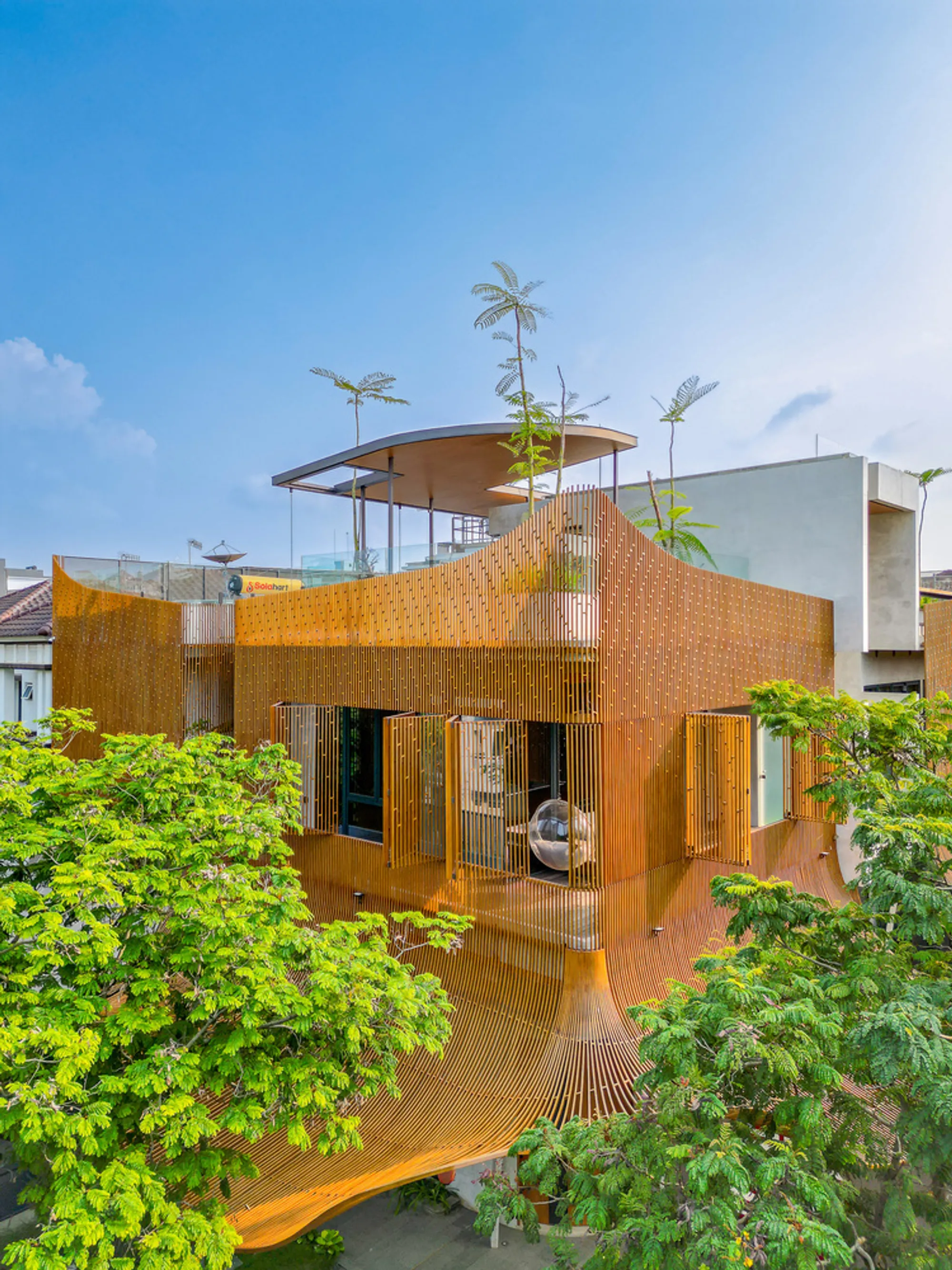
The answer, completed in 2022, is a building that reads less like a conventional house and more like a climate machine wrapped in handcraft. A branching steel lattice canopy extends 3.5 meters beyond the building envelope, shielding walls from western heat while funneling north-south breezes through an open-plan ground floor. Beneath it, concrete catenary arches frame views and hold large expanses of glass without columns interrupting an 11-meter living span. Everything from the rooftop garden that knocks indoor temperatures down by roughly 3°C to the mesh-covered ventilation openings that keep insects out is tuned to one goal: maintaining 27°C indoors without leaning on air conditioning.
The Canopy as Climate Shield
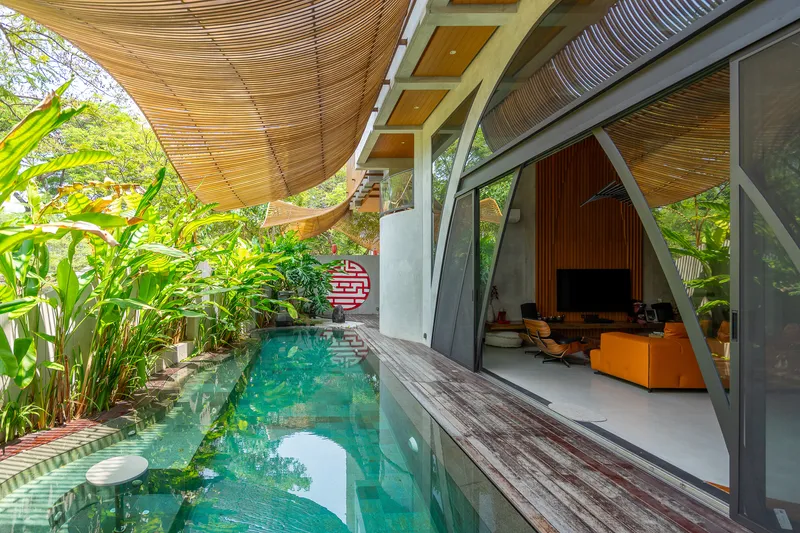
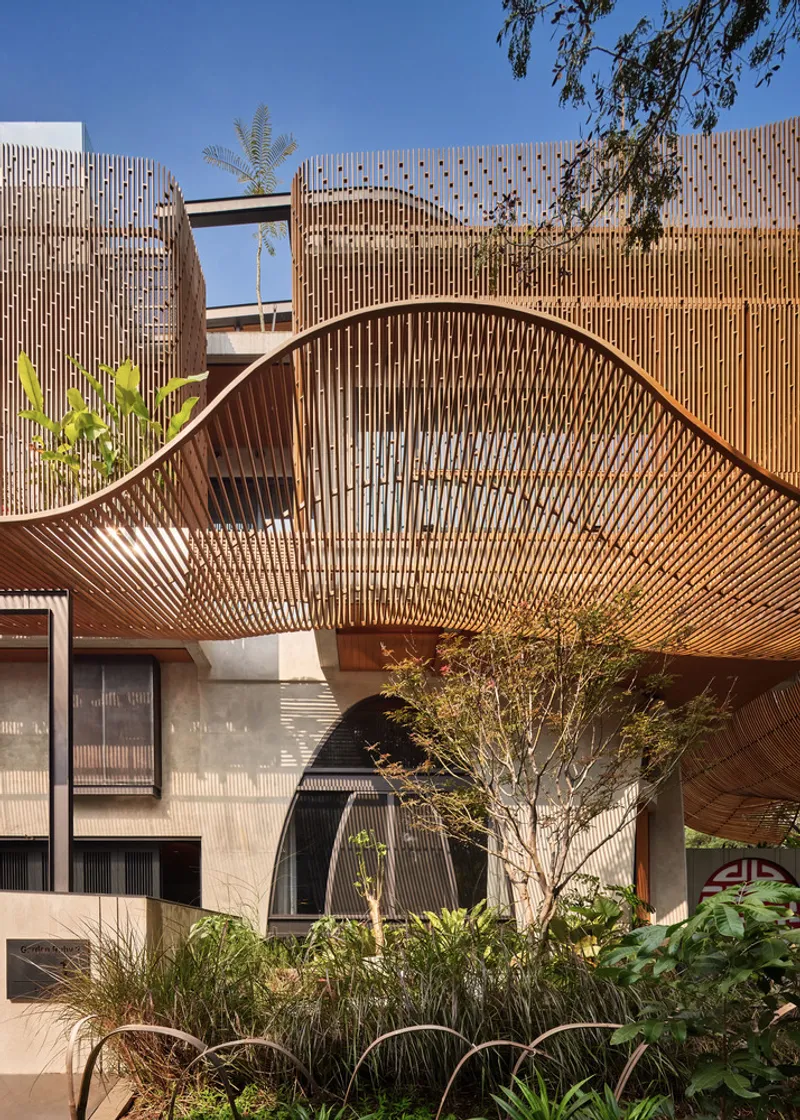
The steel lattice canopy is the building's most visible gesture and its most consequential one. Extending outward like the branching pattern of a tree, it creates deep shade over the poolside deck and the ground-floor terraces while allowing hot air to rise through an air gap between the roof and the floor plates below. The result is a stack effect that pulls cooler air through the living spaces. On the west and south facades, openable steel fins let occupants modulate exposure to sun and wind in real time, turning the envelope into something closer to a responsive skin than a static wall.
What makes this canopy exceptional is its construction. Every steel component was hand-bent by local artisans, one piece at a time. The labor-intensive process fuses industrial material with traditional Indonesian craftsmanship, producing curves that no CNC router would replicate in quite the same way. The canopy does not merely protect the interior; it also nurtures plants beneath its shade, gradually converting what was a barren landfill site into something approaching a garden.
Concrete Catenary and the Plato's Cave Metaphor
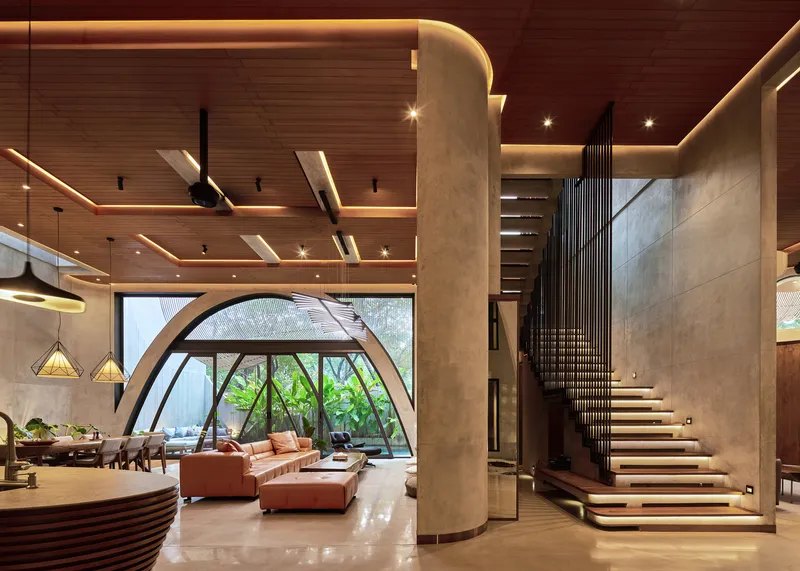
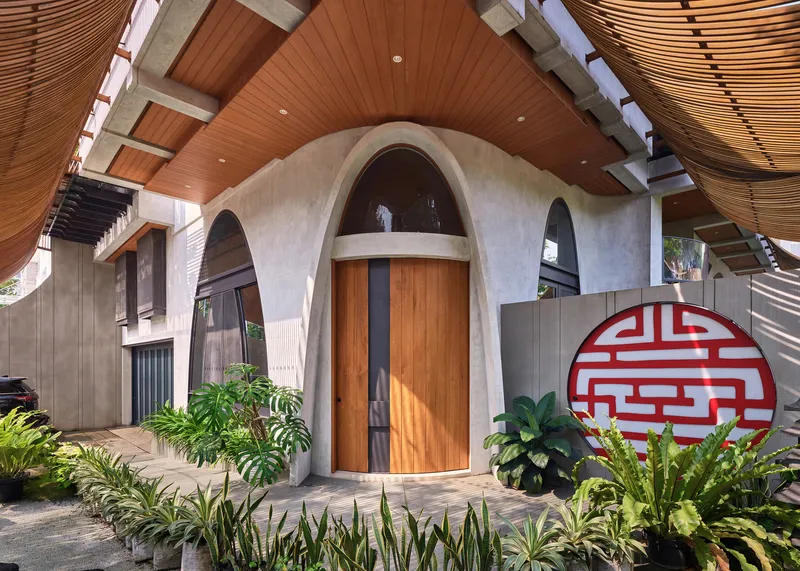
Inside, the dominant structural move is a series of concrete catenary arches. These are not decorative; they carry the structural load that allows the 11-meter column-free main area to exist on the ground floor. The arched openings hold floor-to-ceiling glass panels that flood the double-height living space with light while the catenary profile efficiently transfers weight to the foundations. Realrich describes the shape as a metaphor drawn from Plato's cave, an allegory about perception and reality. Whether or not you buy the philosophical framing, the architectural consequence is powerful: standing inside the arched living room, you look through a curved aperture toward the garden, and the threshold between inside and outside dissolves.
A floating timber staircase beside a cylindrical concrete column reinforces the sense of structural clarity. Nothing here is hidden behind drywall. You see exactly how the house holds itself up, and that legibility is part of the experience.
The Perforated Facade and Operable Skin
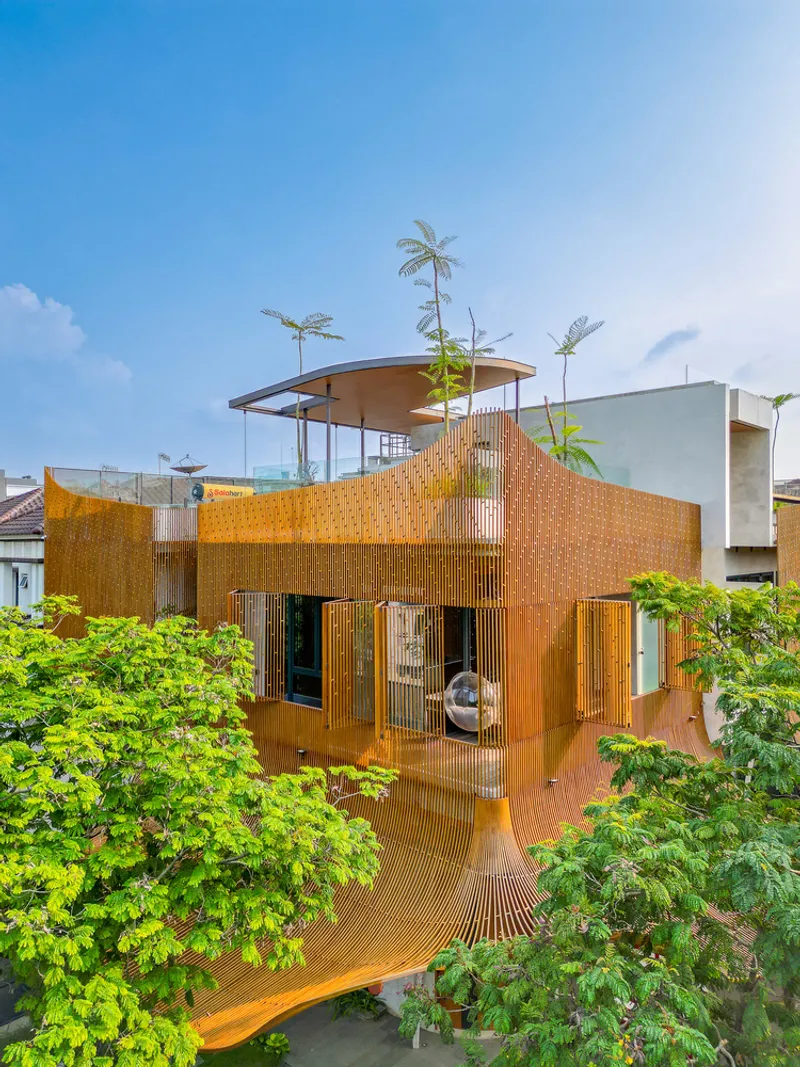
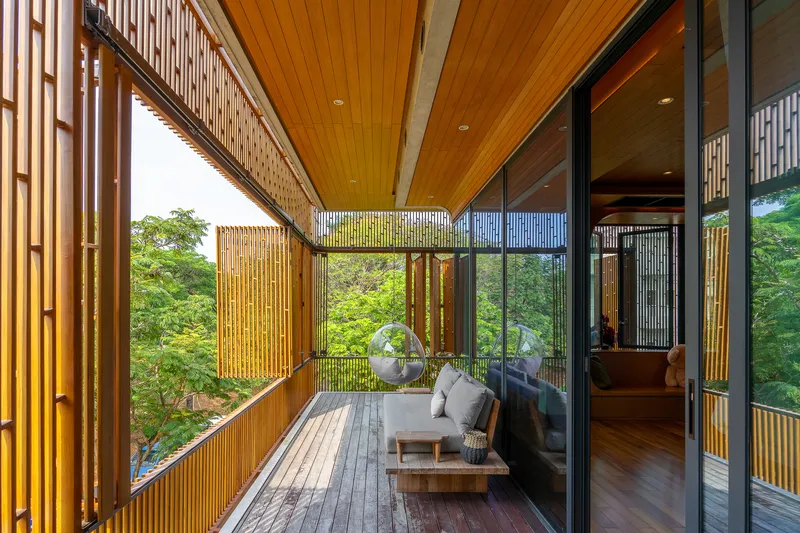
From the street, Lumintu House presents a curved perforated metal facade with operable panels that swing open or shut depending on the time of day and the angle of the sun. The perforation pattern admits diffused light while blocking direct solar gain, a simple move that performs far better in Jakarta's latitude than a solid wall with punched windows ever could. On the upper floors, timber-screened balconies with slatted soffits extend the same logic: filter light, encourage airflow, maintain privacy.
The layering is deliberate. From outer canopy to perforated metal to mesh screens to interior glazing, each successive layer peels away a degree of heat and glare. By the time daylight reaches the living spaces, it is soft and ambient. The wind tunnel effect created between these layers, assisted by ceiling fans and active fan systems for humidity reduction, means the house breathes continuously. For a site with essentially no existing vegetation and no natural shade, that layered defense is not a luxury; it is survival.
Domestic Ritual and Indonesian Spatial Memory
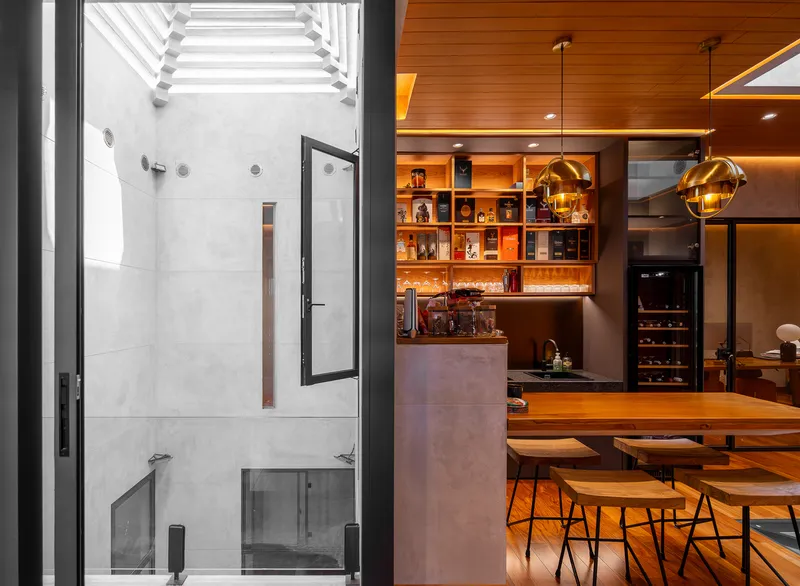
The name Lumintu signifies continuity and flow, and the interior plan takes that idea seriously. On the ground floor, living, dining, and guest areas run together without partition walls, spilling out to the poolside deck and an inner courtyard that echoes the communal gathering spaces of Indonesian family life. The courtyard is not just a light well; it is the social heart of the house, a place where cross-ventilation and conversation converge. The service area sits at the back with separate access, keeping domestic logistics out of the primary social space.
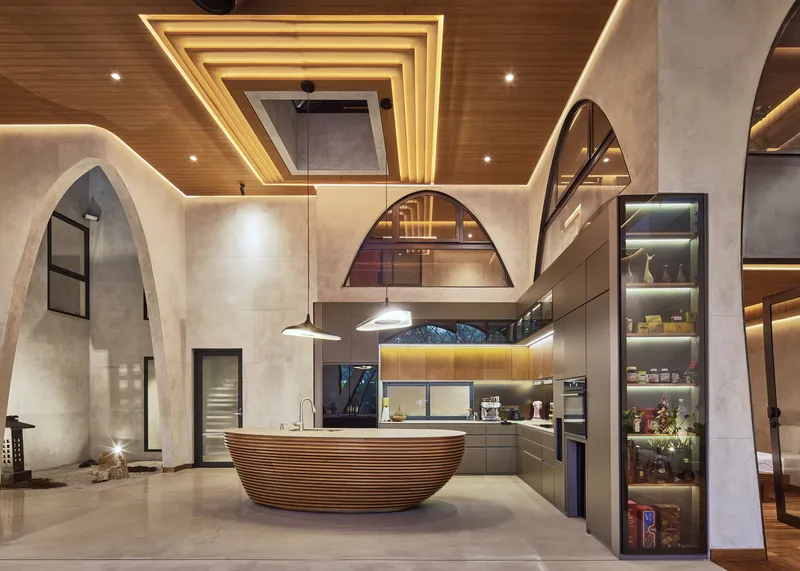
Upstairs, three bedrooms, a home office, and a gym occupy a more private register, with a mezzanine level integrating the gym into the section. The kitchen, with its ribbed timber island beneath layered ceiling coffers and arched concrete niches, is a room worth lingering in. The skylight above is inspired by Indonesia's Punden Berundak, the tiered temple form, channeling light downward through stepped layers. It is a quiet cultural reference, legible only if you know where to look, but it gives the space a vertical pull that ordinary kitchens lack.
Rooftop Garden and Landscape Recovery
The rooftop garden does double duty. As insulation, it reduces indoor temperatures by approximately 3°C compared to a conventional roof. As amenity, it offers sea views and a private retreat above the domestic program below. The decision to place productive landscape on the roof rather than relying on ground-level planting alone makes sense given the site's history as a landfill: the existing soil is hardly hospitable. Meanwhile, the canopy's shade at ground level fosters the gradual return of local plant species, turning the barren periphery of the house into something that will, over time, feel less like a construction site and more like a garden.
Why This Project Matters
Lumintu House matters because it refuses to treat sustainability as an add-on checklist. Every design decision, from the catenary arches to the hand-bent steel fins to the rooftop garden, serves both a climatic and a spatial purpose. The house does not sacrifice comfort for performance or vice versa. In a region where the default response to heat is mechanical air conditioning and sealed envelopes, Realrich Architecture Workshop demonstrates that passive strategies rooted in local materials and craftsmanship can hold indoor temperatures at 27°C on a site where the ambient air exceeds 35°C.
More broadly, the project challenges the assumption that difficult sites demand compromised architecture. A former landfill, west-facing, devoid of shade, in one of the hottest corridors of North Jakarta: by any measure, this is hostile ground. The fact that Lumintu House transforms it into a place of genuine domestic pleasure, while employing artisans who hand-shape every steel element, suggests a model of tropical residential design that is both replicable and deeply specific to its place. That combination is rare, and worth paying attention to.
Lumintu House by Realrich Architecture Workshop, Pantai Indah Kapuk 1, North Jakarta, Indonesia. 898 m². Completed 2022. Photography by KIE Arch, Aryo Phramudhito, and Lu'luil Ma'nun.
About the Studio
Share Your Own Work on uni.xyz
If projects like this are the kind of work you want to make, uni.xyz is a place to publish your own, find collaborators, and enter design competitions.



Popular Articles
Popular articles from the community


The Musturak Paradise: Senior Living Architecture for a Connected Future in Temara, Morocco
The Musturak Paradise reimagines senior living architecture in Temara via private homes, social spaces, culture, community, and shared care.

Riyadh For All: Intergenerational Urban Design for Active Aging in Rabat
Riyadh For All reimagines urban design in Rabat with intergenerational co-living, adaptive courtyards, and Moroccan cultural exchange today.

The Earth Pod: 3D Printed Homes for Resilient Refugee Communities
The Earth Pod reimagines refugee housing through 3D printed homes made from clay, combining resilience, self-sufficiency, and rapid shelter.

The Ocean Hive: Sustainable Architecture for a Self-Sufficient Civilization at Sea
The Ocean Hive imagines sustainable architecture at sea, where modular habitats, algae, wave power and ocean waste sustain a growing colony.


Similar Reads
You might also enjoy these articles


Hodi-Mandai Geram
Project Function: Preservation and revitalization of the Intangible heritage and socio-spatial identity of the Hodi by Housing, Cultural Memory Center, Sacred Grove, landscape, local tourism economy


Olio Towers: A Mid-Rise for Performers That Fuses Housing, Rehearsal, and Stage
Located blocks from Houston's Theater District, this modular tower stacks living units around a central performance atrium.

Oasis: Modular Green Housing Carved into Dhaka's Urban Fabric
A shortlisted Plugin Housing entry reclaims unauthorized settlements in Dhaka with stepped concrete volumes, green roofs, and ventilation-driven design.

Black Hole: A Floating Megastructure for the Post-Physical Era
Emiliano Mazzarotto envisions a spherical, self-scaling arena where e-sports, digital hotels, and holographic stadiums replace traditional public space.


Explore Lumion Competitions
Discover active competitions in this discipline



Challenge to reimagine the Iron Throne


Photograph architecture without architects


Illustrate the lost glory of Angkor Wat - Render Challenge


Design challenge to reuse E-waste
Comments (0)
Please login or sign up to add comments
No comments yet. Be the first to comment!