

MAKER Architecten Weaves Social Housing into Kortrijk's Dense Urban Fabric with Brick and Restraint
A social housing infill in Kortrijk, Belgium, negotiates between existing rooftops, rail corridors, and neighborhood memory with quiet force.


European cities are full of leftover parcels, the kind of irregular lots wedged between party walls, rail infrastructure, and back gardens that never attracted private development. In Kortrijk, a mid-sized city in western Belgium, MAKER architecten led by Ana Castillo and Lieven De Groote have taken on exactly this condition. Their Urban Infill Project for Social Housing, completed in 2025, slots 3,685 square meters of new residential program into a fragmented block without pretending the context is simple or that a single gesture can resolve it.
What makes this project worth studying is not a flashy formal move but a series of disciplined calibrations. The architects break the program into several distinct volumes, each scaled and oriented to respond to what already surrounds it: gabled neighbors, a rail corridor, a newly created courtyard. The result is a cluster rather than a monolith, a set of buildings that look like they arrived over decades rather than all at once. That is an achievement in social housing, a typology that rarely gets the benefit of such contextual care.
Brick as a Dialogue with the Street
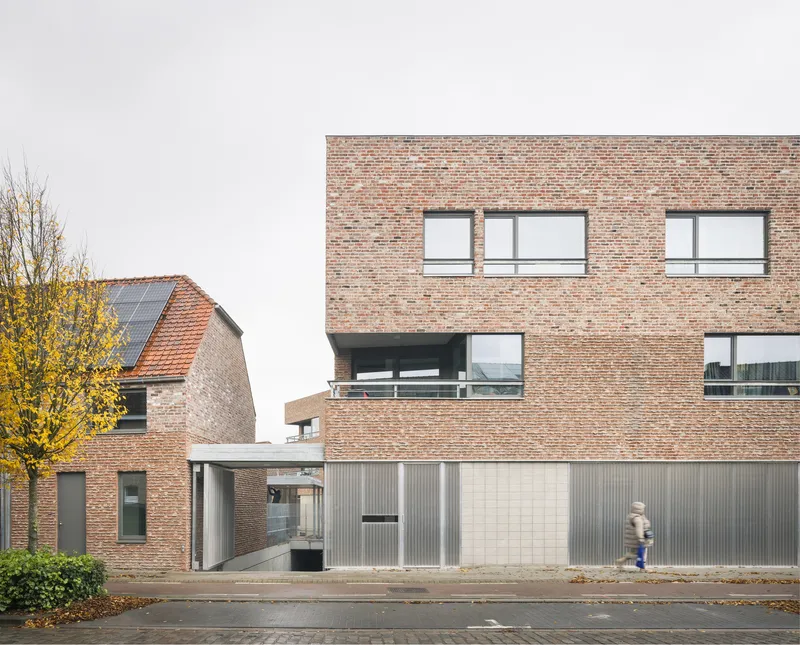
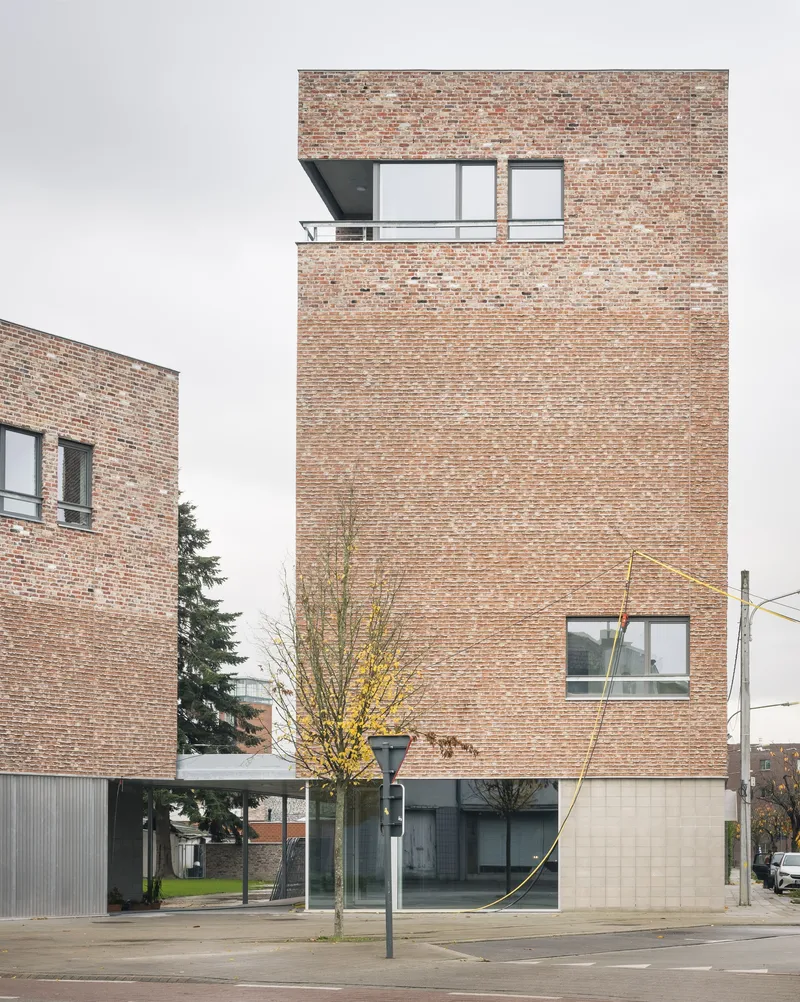
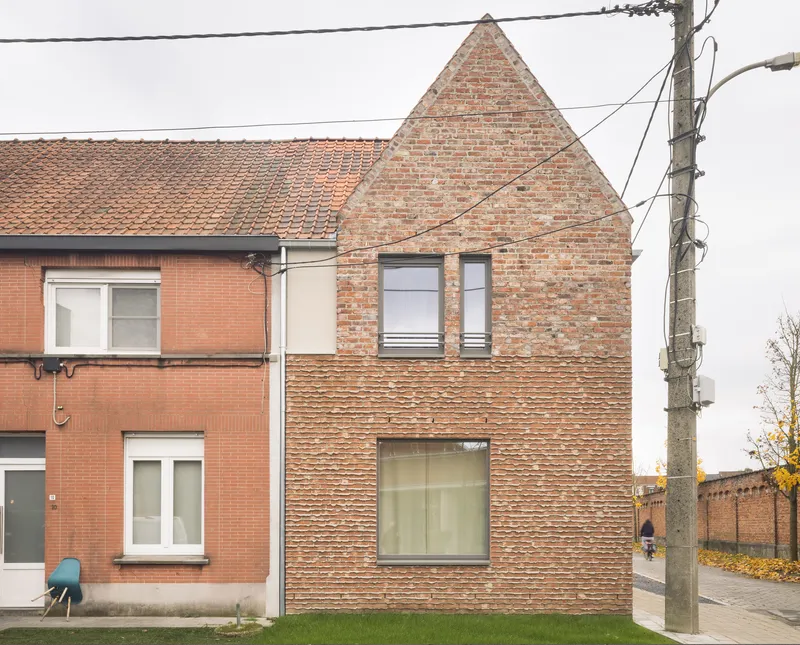
The brick facades do more work than simply dressing the structure. Multiple bond patterns appear across the project, sometimes within a single elevation, registering shifts in floor level, volume, and interior program. On the street-facing sides, the brickwork aligns with the existing residential grain: gabled profiles, offset window openings, and a scale that defers to neighboring rooflines. The ground floor along one edge incorporates a carport screened by corrugated metal cladding, keeping cars present but visually subdued.
The choice to vary the brick coursing is not decorative whimsy. It signals different structural logics and helps the eye break down what could otherwise read as a single imposing mass. Against the overhead tangle of power lines and the modest plaster and brick of the surrounding houses, MAKER architecten's facades hold their own without shouting.
A Courtyard That Earns Its Keep
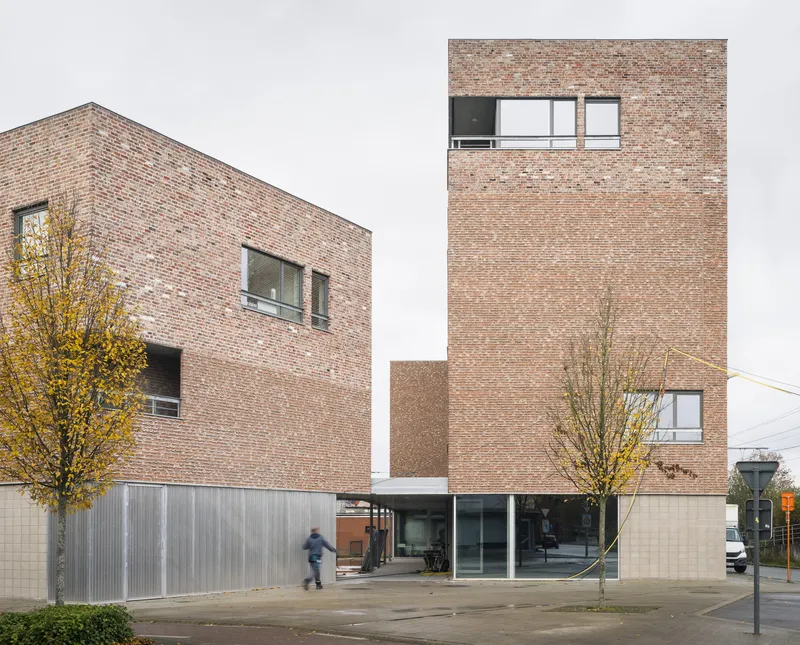
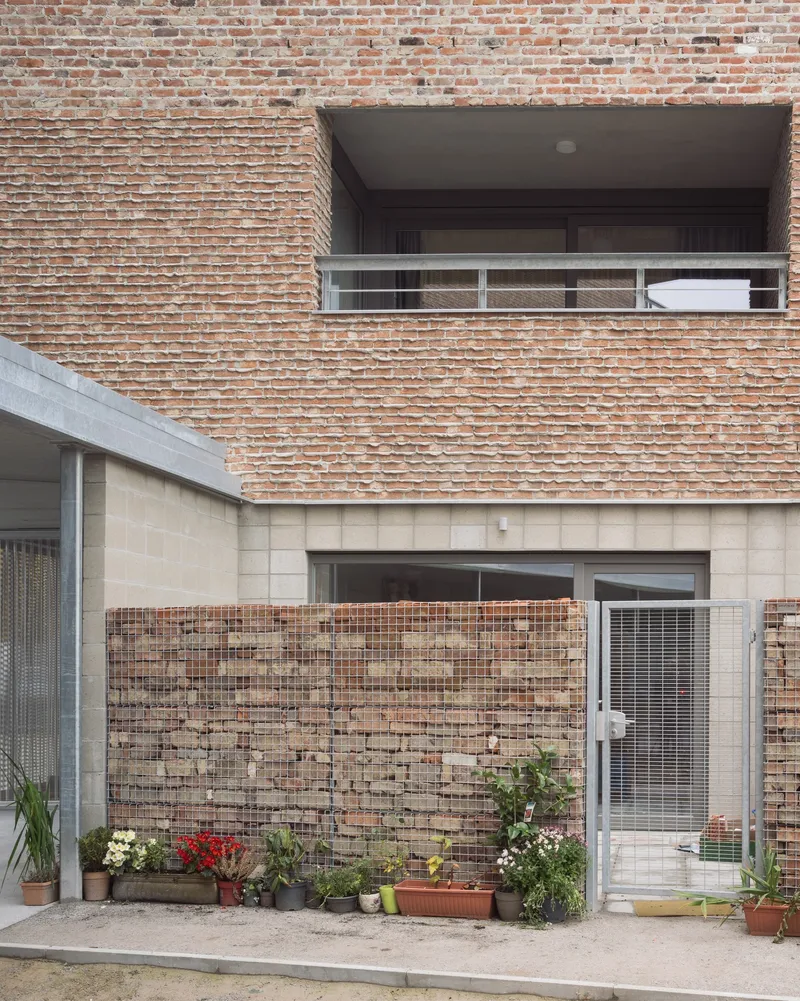
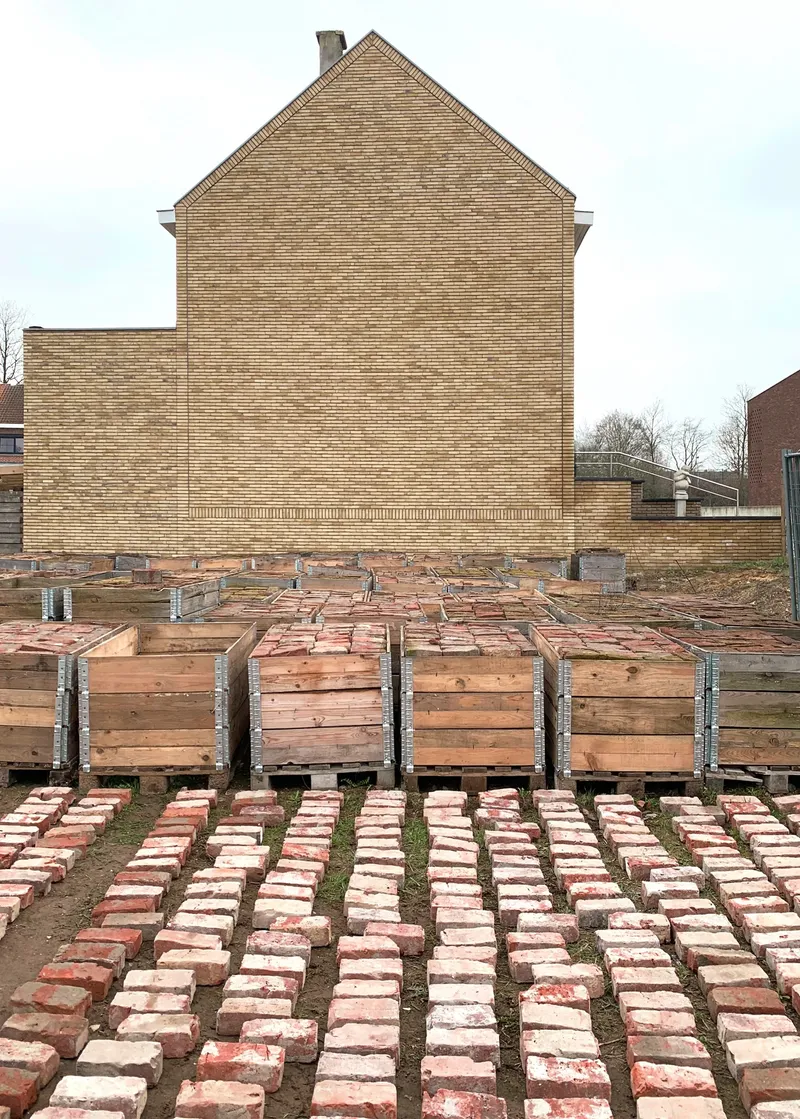
The central courtyard is the project's organizational spine. Rather than treating open space as leftover area between buildings, the architects have configured the volumes to produce a shared exterior room. Young trees, gabion walls, and timber-framed planters give the ground plane a rough but welcoming texture. The courtyard is not a manicured garden; it is a working space that absorbs circulation, planting, and social overlap.
Cantilevered brick facades and corrugated metal shutters frame views into and out of this space, creating a layered sense of enclosure without boxing residents in. The paving pattern extends the geometry of the buildings themselves, reinforcing the idea that interior and exterior were designed as a single system. For a social housing project, this kind of investment in communal outdoor space signals a real commitment to long-term livability.
Balconies, Thresholds, and the View Out
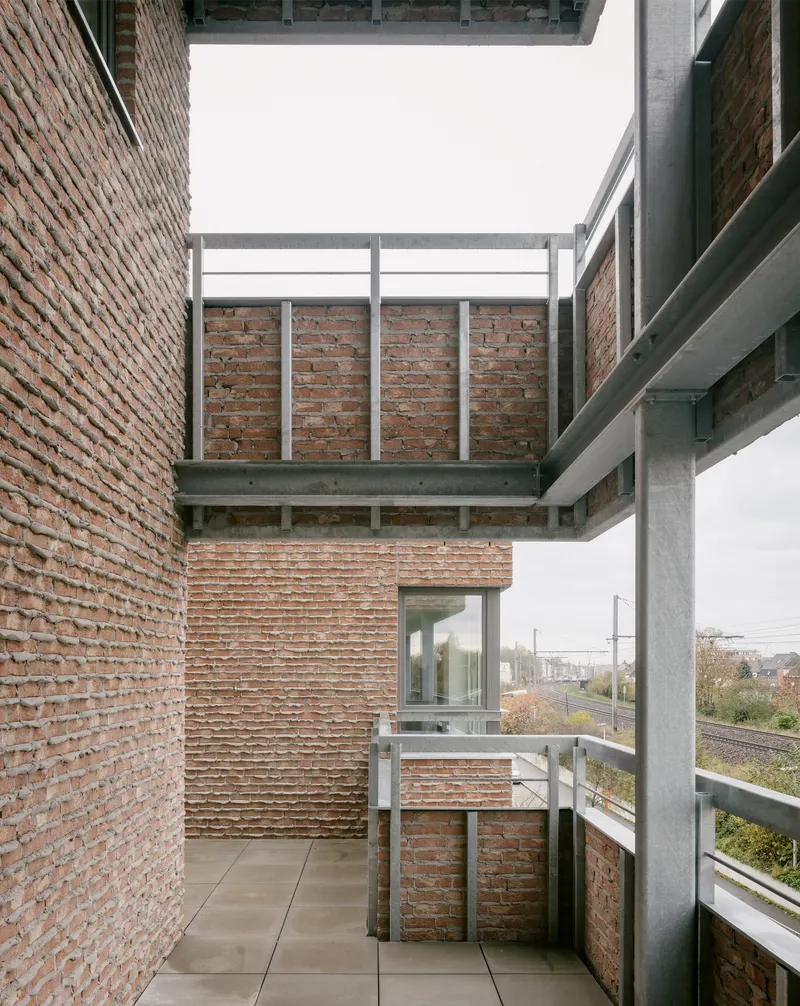
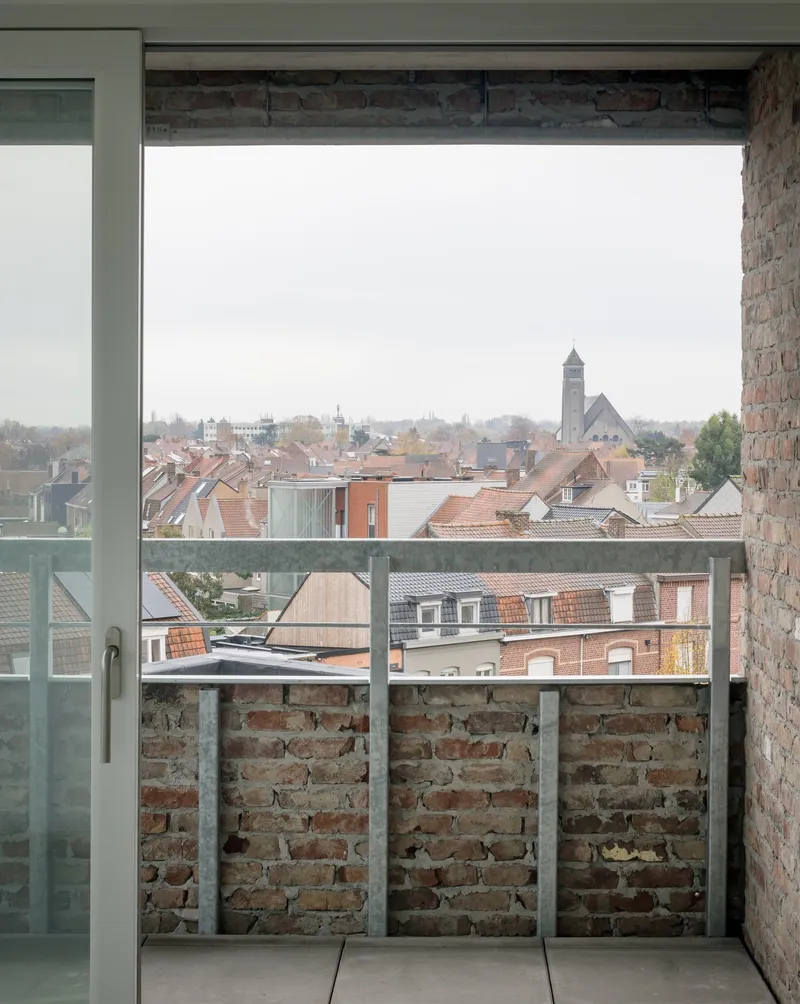

The recessed balconies are among the project's most effective details. Framed in concrete with aluminum handrails, they are pulled back into the brick volume rather than tacked onto the facade. This keeps the building profile clean while giving residents genuine outdoor space, not a token ledge. From the upper levels, views extend over red-tiled rooftops to a distant church spire, connecting inhabitants to Kortrijk's broader skyline.
The balcony overlooking the rail tracks is particularly telling. Instead of turning a deaf wall to the infrastructure, the architects open a generous concrete terrace toward it, acknowledging the rail corridor as part of the neighborhood's identity. Steel-framed glass doors mediate between inside and out, offering residents control over light, air, and noise. These are practical thresholds, not symbolic ones.
Interiors Built for Daylight and Durability
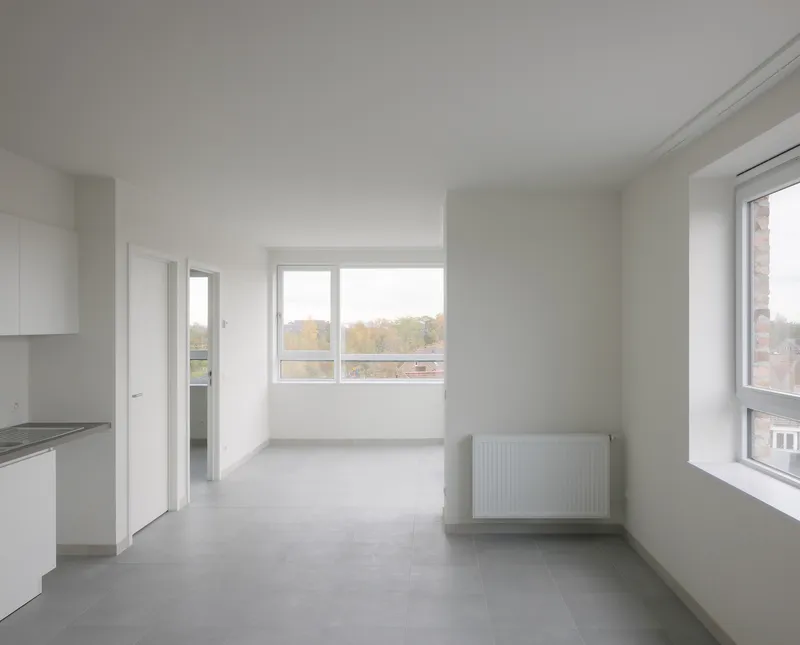
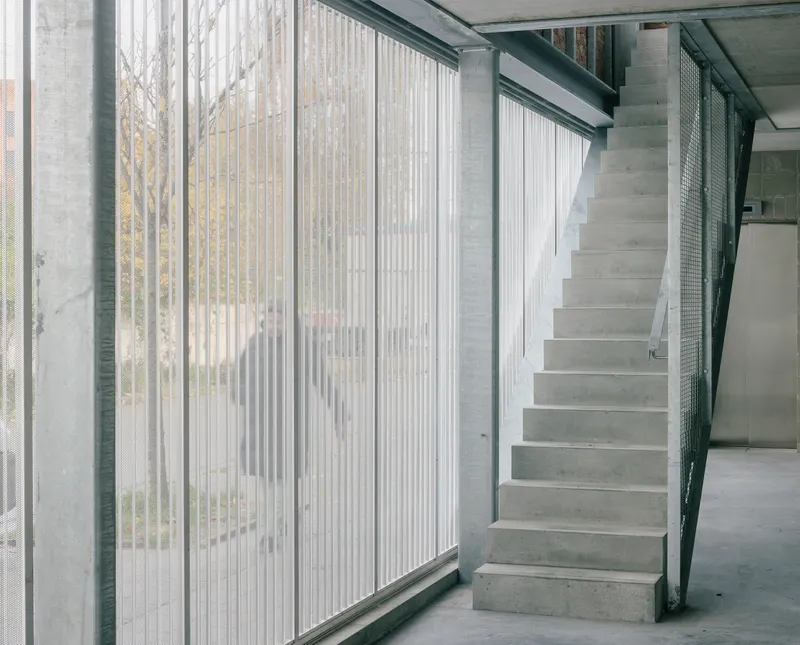
Inside, the palette is deliberately restrained: white walls, grey tile floors, and large windows that pull autumn foliage and courtyard greenery into the rooms. Nothing here is precious. The materials are chosen for their ability to absorb daily life over years. A concrete staircase alongside fluted glass panels admits diffused light while screening sightlines, a small but telling move that addresses privacy without darkening the circulation.
Social housing interiors in Belgium are often reduced to minimum-spec finishes. Here, the careful proportioning of rooms and the quality of natural light suggest that the architects fought for, and won, a higher standard. The windows overlooking foliage in image four are not an accident; they are the result of siting each unit to capture specific views, a luxury more commonly associated with private residential commissions.
Rear Elevations and the In-Between Condition
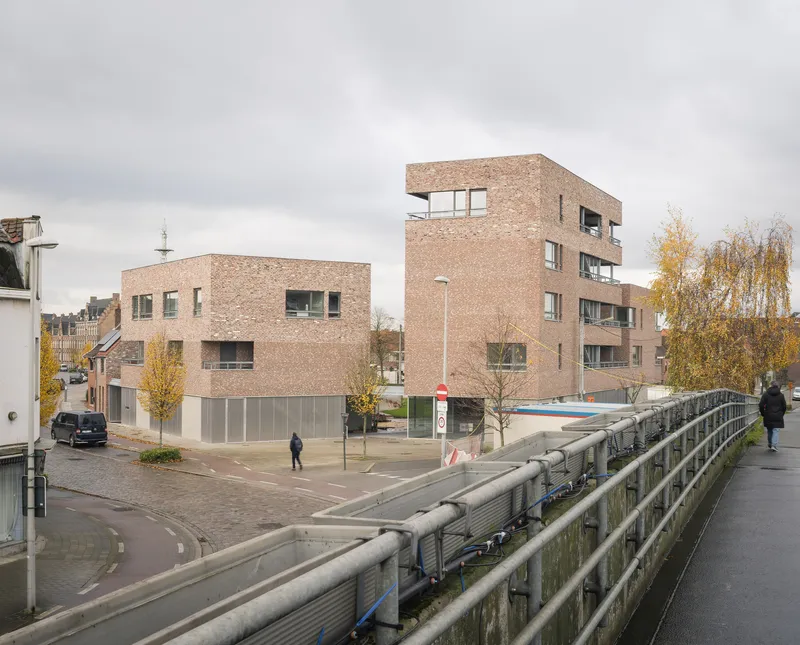
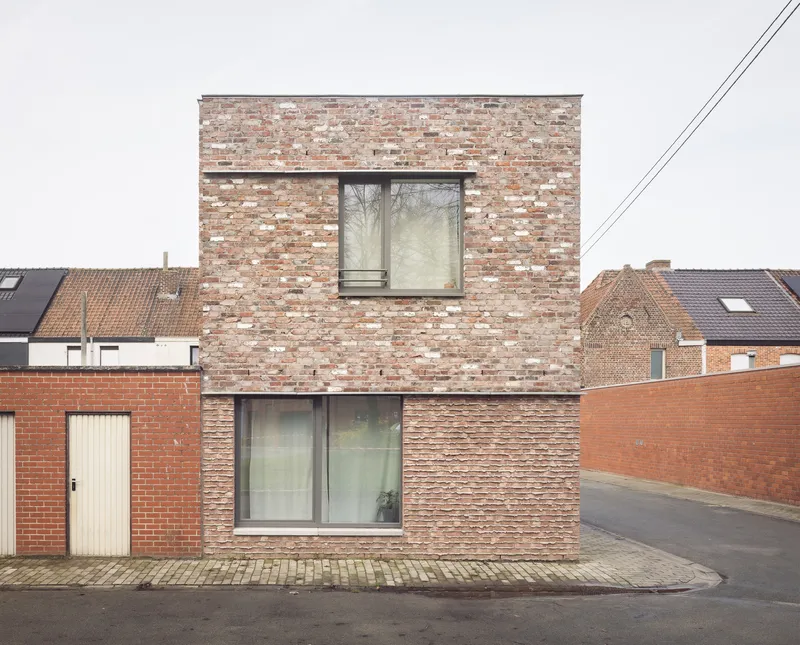

The rear facades are just as considered as the street elevations, which is unusual for this building type. Mixed brick coursing, large glazed openings at the ground floor, and corrugated metal shutters give the back of the project a distinct identity. Seen from the bridge over the rail corridor, the housing blocks read as a composed group rather than a row of utilitarian backsides.
The variegated brick walls flanking courtyard doors and the deliberate alternation between solid and void across the rear elevations suggest that MAKER architecten treated every face of the building as a public face. In dense urban infill, where neighbors look directly onto your secondary facades, this approach is both generous and pragmatic.
Facade Detail and Volumetric Composition

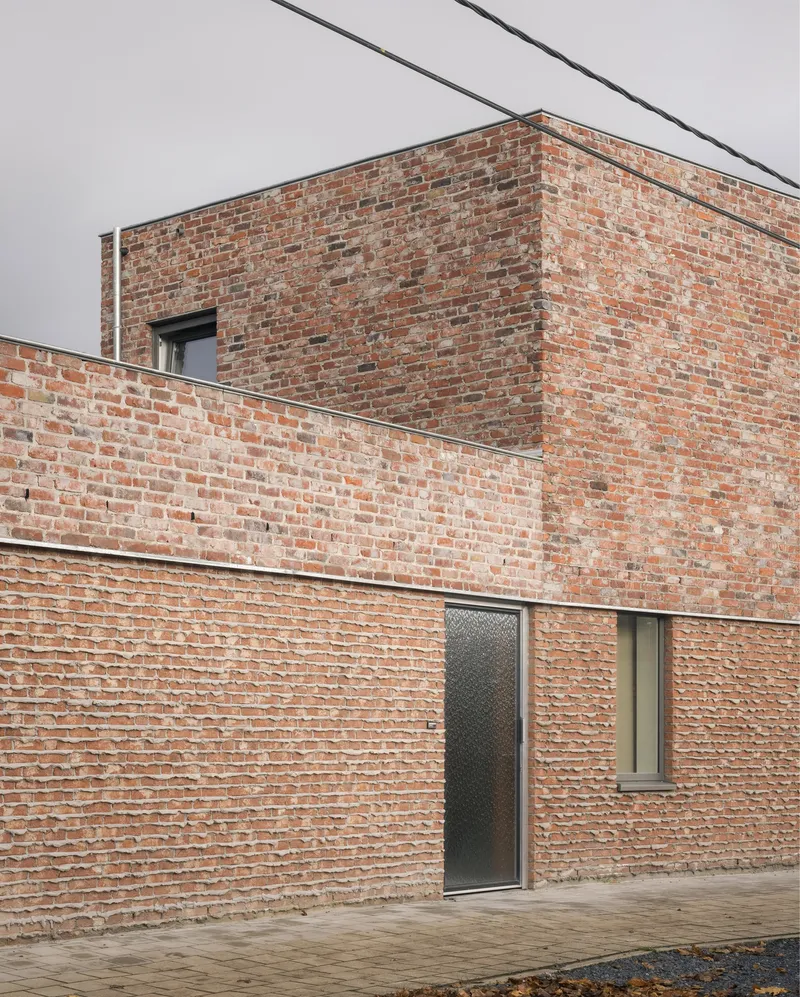
Zooming in on the facade reveals a rhythmic interplay between solid brick piers, recessed window openings, and deep terraces. The stacking of these elements across five stories generates a vertical cadence that recalls traditional Flemish row houses, updated for a contemporary section. Corner windows puncture the mass where views are most valuable, and the planted sidewalk at grade softens the transition from public pavement to private territory.
Plans and Drawings
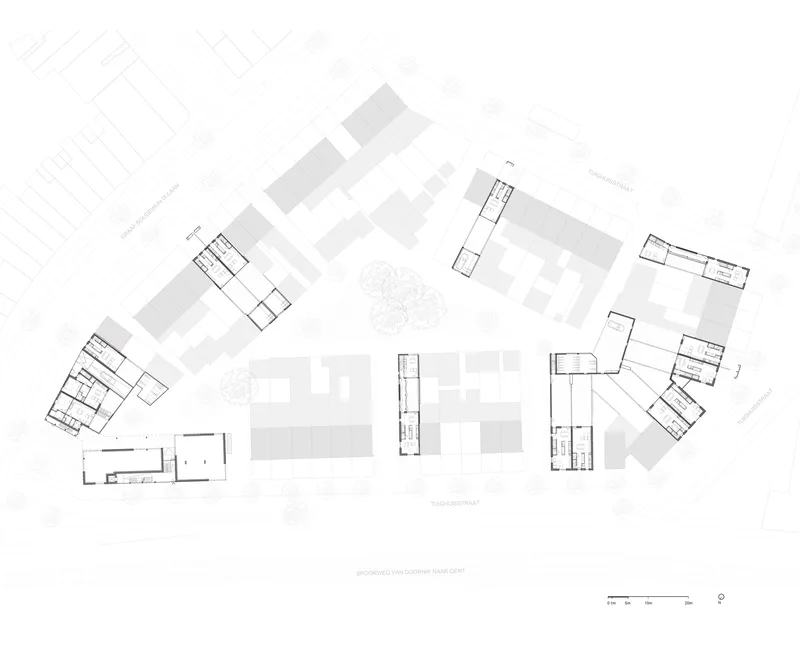


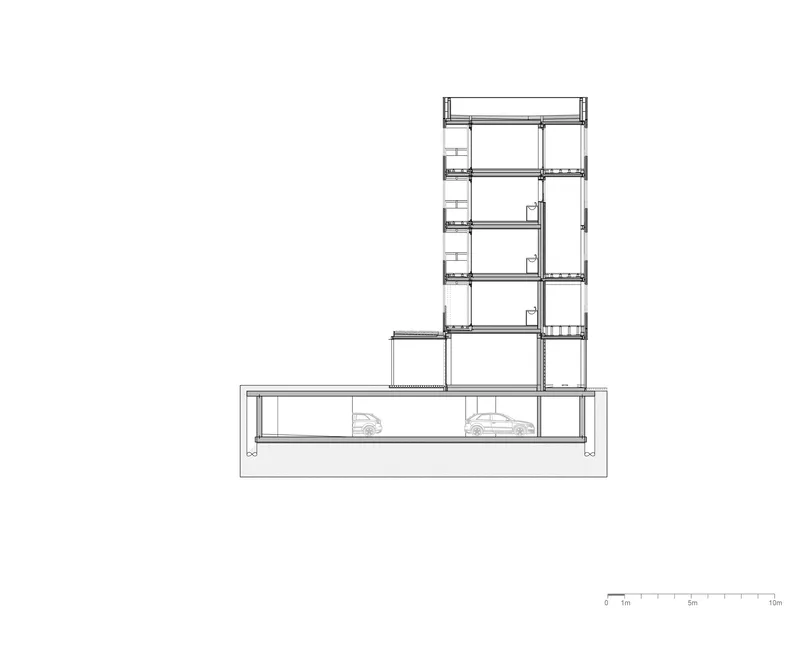
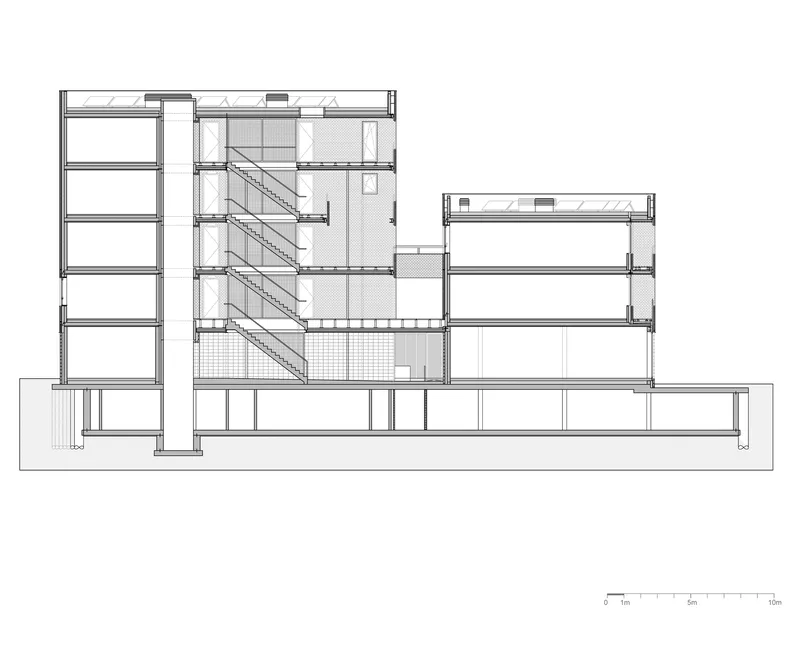
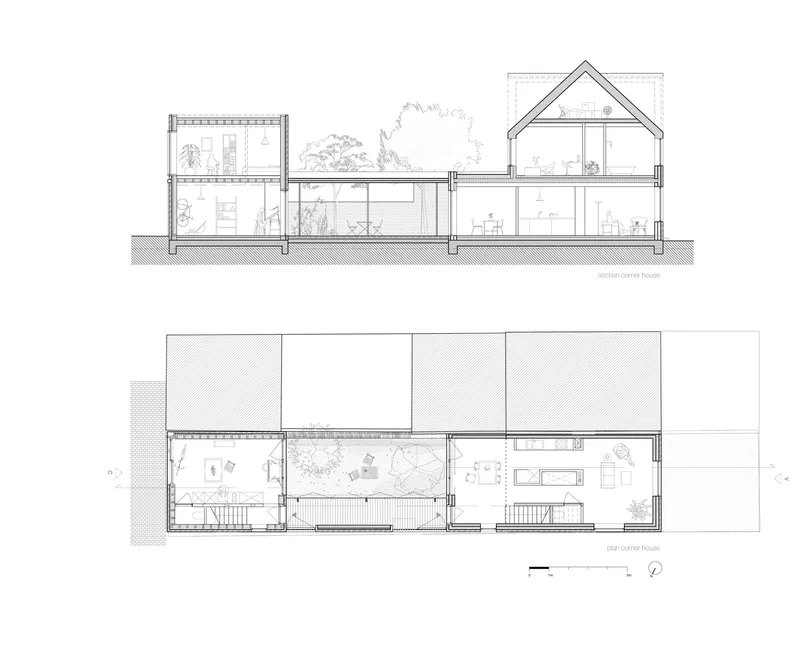
The site plan confirms what the photographs suggest: the project is not a single building but a constellation of volumes organized around a central courtyard with a retained tree. An L-shaped plan connects to a gabled element, with gridded paving unifying the ground plane. Sections through the five-story tower reveal a sunken basement level accommodating parking beneath the residential program, an efficient strategy that frees the courtyard from cars entirely.
The drawn sections are especially instructive in showing how the internal staircase threads through the tower and lower wing, connecting multiple levels with economy. The tree-lined courtyard, visible in the combined section and plan drawings, reads as the project's true center of gravity, the shared space from which each dwelling takes its orientation. These drawings make a strong case that the project's complexity is structural, not superficial.
Why This Project Matters
Social housing across Europe faces a persistent credibility gap. Policymakers fund it; architects design it; communities often resist it. MAKER architecten's Kortrijk project narrows that gap by proving that infill social housing can be contextually precise, materially rich, and spatially generous without exceeding the means of a public commission. The decision to break the program into multiple scaled volumes, rather than packing it into a single block, is a planning lesson as much as a design one.
In a moment when housing discourse is dominated by prefabricated towers and modular systems, this project reasserts the value of site-specific thinking. Every facade is tuned to its neighbor, every section calibrated to capture light and view. That level of attention is what separates buildings that age well from buildings that simply age. Kortrijk now has a piece of social housing that belongs to its block as thoroughly as the houses that were there before it.
Urban Infill Project for Social Housing by MAKER architecten (Ana Castillo, Lieven De Groote). Kortrijk, Belgium. 3,685 m². Completed 2025. Photography by Stijn Bollaert.
About the Studio
Share Your Own Work on uni.xyz
If projects like this are the kind of work you want to make, uni.xyz is a place to publish your own, find collaborators, and enter design competitions.


Popular Articles
Popular articles from the community


The Amber Palace Opera: A Geological Fiction Surfaces on Tallinn's Baltic Waterfront
Pierre Brillard reimagines a Baltic legend as a public landscape, opera house, and waterfront promenade rooted in Tallinn's coastal identity.

Singing Woman: An Opera House That Performs Before the Curtain Rises
Ovidiu Cristian Pavel's conceptual opera house translates Estonia's choral identity into a sculpted waterfront landmark facing the Baltic Sea.

Cloaked Colonization: A Mobile Underwater Habitat That Moves Like a Fish
Micah Abaya's shortlisted EHC Pacific entry reimagines ocean settlement as a dispersed network of self-sustaining architectural organisms.

Opera on the Sea: Driftwood Logic Shapes a Timber Opera House on Estonia's Coast
Trevor Orgill's opera house translates the entangled drift of floating timber into a civic building where wood, water, and music converge.

Similar Reads
You might also enjoy these articles

Pixel Gardens: One Repeated Module Stacked Into a Terraced Social Housing Tower for Famagusta
Salem Bader's shortlisted housing tower builds a vertical neighbourhood from one repeated module, offsetting units to carve terraces, light and air.

Bao Huynh Watercolor Atelier: A Serene Art Retreat in Hội An
Bao Huynh Watercolor Atelier in Hội An blends multifunctional art spaces, sustainable design, local materials, and family-friendly living in a serene environment.

Atelier Macri Concept Store Interior Design by CASE-REAL
Atelier Macri store features a "ko" counter, walnut wood details, cork displays, blending retail, gallery, and seamless customer experiences.

Manuel Vargas Izquierdo Stadium and High-Performance Sports Center: Architectural Excellence in Jalpa de Méndez
The Manuel Vargas Izquierdo Stadium blends sustainable design, inclusive sports facilities, and cultural-inspired architecture, revitalizing Jalpa de Méndez’s public spaces.

Comments (0)
Please login or sign up to add comments
No comments yet. Be the first to comment!