
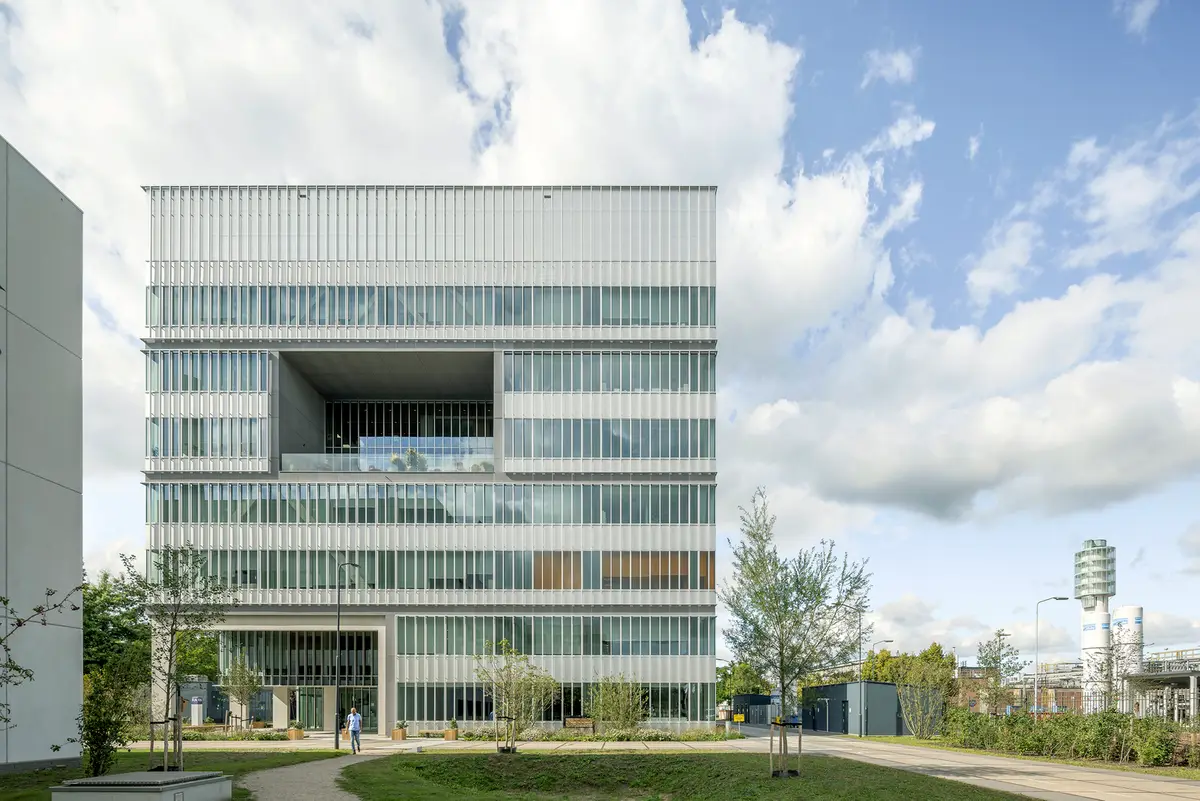
Marie Curie Office Building: Proof of the Sum | Oss, The Netherlands
The Marie Curie Office Building in Oss combines flexible labs, sustainable design, collaborative spaces, and striking architecture, fostering innovation and pharmaceutical research.


The Marie Curie Office Building in Oss, designed by Proof of the Sum, represents a landmark in modern commercial and office architecture. Completed in 2024, this 11,700 m² building is part of Pivot Park, a leading open innovation campus in the Netherlands dedicated to drug discovery and pharmaceutical research. The building is set to host over 350 talented professionals, primarily working on cancer treatments and pharmaceutical advancements.
Strategic Location and Design Concept
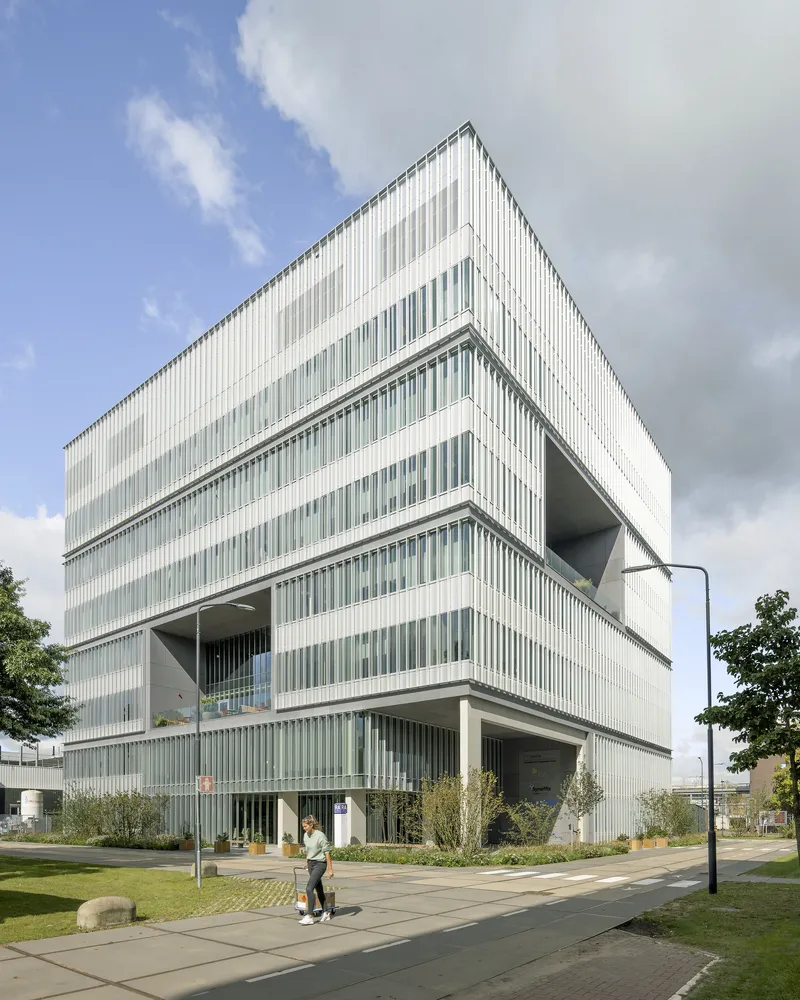
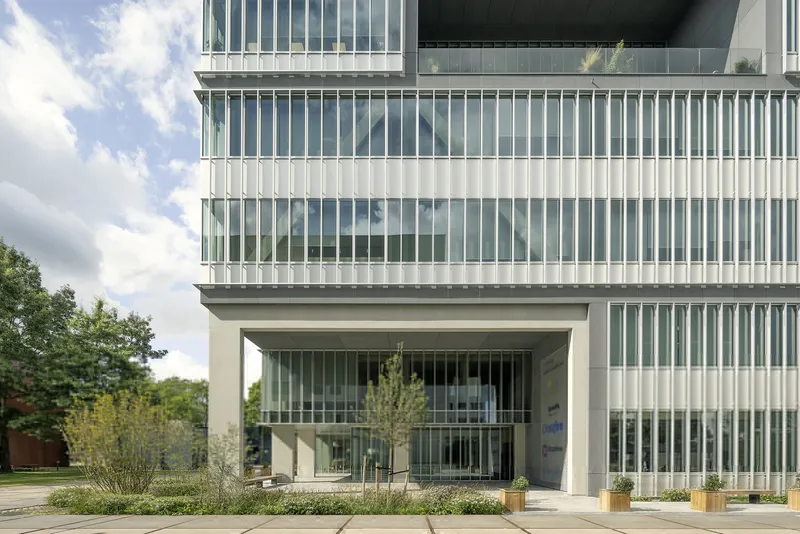
Strategically positioned at the forefront of Pivot Park’s master plan, the Marie Curie building is the first sight for visitors entering the campus. Its corner entrance is designed with a semi-public plinth, opening up twice as high as the standard façade to create a transparent visual link to the campus heart. Directly behind this entrance lies a central grandstand staircase, serving as a venue for lectures, events, and a starting point for public circulation throughout the building.
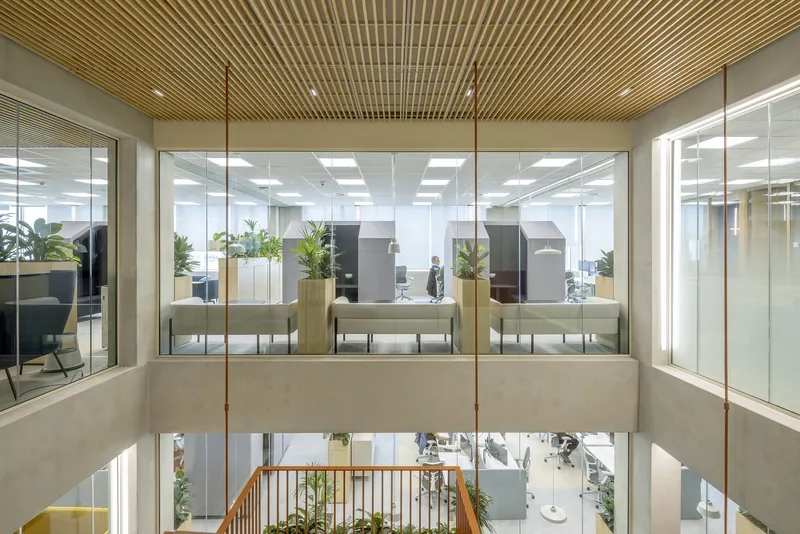
Fostering Collaboration and Innovation
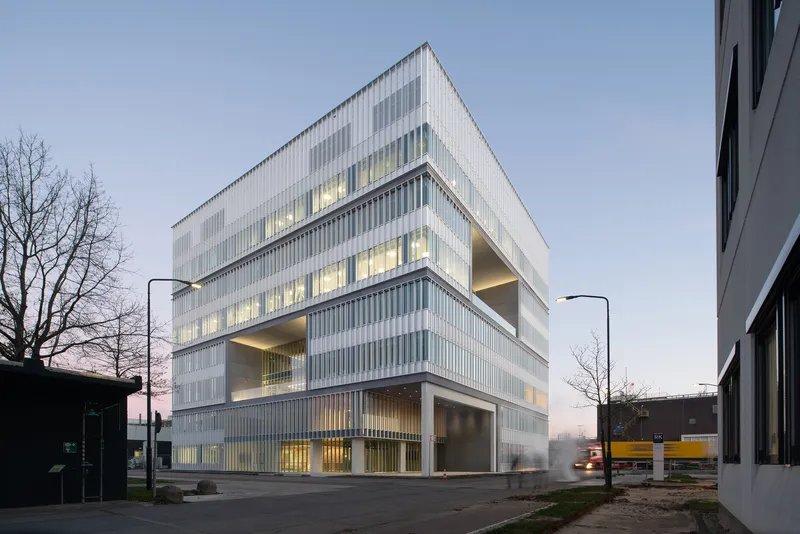
The building’s design encourages both planned and spontaneous collaboration. A central atrium weaves like a canyon through the exposed concrete support structure, connecting co-working spaces, shared meeting areas, and roof terraces. Integrated lighting subtly guides occupants along the public route, while selective openings towards the façade and roof terraces maximize natural daylight penetration, creating vibrant, collaborative environments that enhance knowledge exchange.
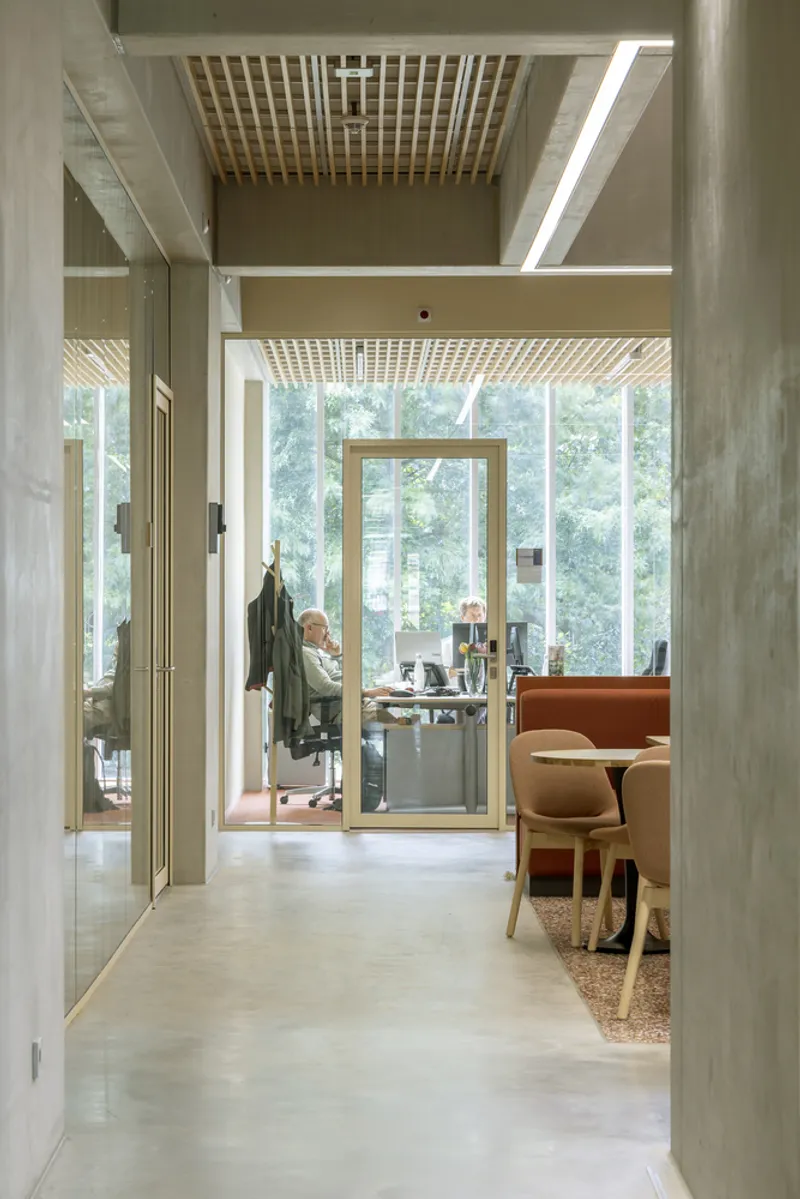
Flexible Floor Plans for Modern Workspaces
The floor plan is divided into four quadrants, each approximately 250 m², offering a flexible mix of laboratory and office spaces. Tenants can easily expand by combining units to occupy a full floor. The modular laboratory design ensures adaptability for evolving chemical and biological research needs, making the building future-proof for changing pharmaceutical requirements.
Sustainable Architecture and Materials
Sustainability is a core principle of the Marie Curie Office Building. Despite its concrete structural framework, the building features a flexible, beam-free shell with generous story heights to accommodate extensive technical installations. Key sustainable features include:
- Fossil-free technical installations
- Passive sun blinds and low-energy lighting
- Heat recovery systems and solar panels
- Achieved BREEAM certification for sustainable performance
The material palette is deliberately limited yet impactful. Recycled aluminum window frames with tubular slats reduce direct sunlight by 20%, while the exposed concrete structure is highlighted with linear lighting. Common areas feature alternating floored printing layers and terrazzo finishes, complemented by wooden ceilings that enhance acoustics for both public gatherings and private meetings.
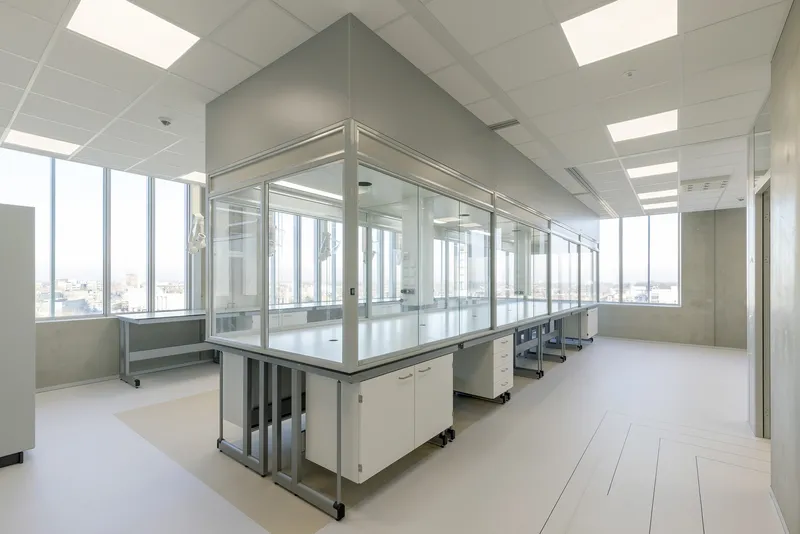
A Landmark for Knowledge Exchange
By blending flexible, sustainable architecture with a strong focus on collaboration and innovation, the Marie Curie Office Building is not only a functional workspace but also a symbol of scientific progress and modern design excellence. Its integration of co-working areas, laboratories, and semi-public spaces ensures that Pivot Park remains a key hub for pharmaceutical research in the Netherlands.
All photographs are works of Marcel van der Burg, Egbert de Boer


Popular Articles
Popular articles from the community


Lunar Spiral: Space Architecture Shaped by the Mathematics of the Universe
Lunar Spiral reimagines space architecture through Fibonacci geometry, lunar regolith, levitating habitats, and self-sustaining Moon living.

The Musturak Paradise: Senior Living Architecture for a Connected Future in Temara, Morocco
The Musturak Paradise reimagines senior living architecture in Temara via private homes, social spaces, culture, community, and shared care.

Play: Fragments of Their World
Familiar architecture becomes modular playground design, creating safe spaces where displaced children can learn, connect, imagine and play.

Hill & Cross Opera: Sculptural Opera House Architecture Shaped by Tallinn’s Landscape and Identity
Hill & Cross Opera reimagines opera house architecture in Tallinn through its sculptural hill, civic plaza, glass wave and a luminous cross.

Similar Reads
You might also enjoy these articles


Hodi-Mandai Geram
Project Function: Preservation and revitalization of the Intangible heritage and socio-spatial identity of the Hodi by Housing, Cultural Memory Center, Sacred Grove, landscape, local tourism economy


Olio Towers: A Mid-Rise for Performers That Fuses Housing, Rehearsal, and Stage
Located blocks from Houston's Theater District, this modular tower stacks living units around a central performance atrium.

Oasis: Modular Green Housing Carved into Dhaka's Urban Fabric
A shortlisted Plugin Housing entry reclaims unauthorized settlements in Dhaka with stepped concrete volumes, green roofs, and ventilation-driven design.

Black Hole: A Floating Megastructure for the Post-Physical Era
Emiliano Mazzarotto envisions a spherical, self-scaling arena where e-sports, digital hotels, and holographic stadiums replace traditional public space.

Explore Commercial Buildings Competitions
Discover active competitions in this discipline

Challenge to reimagine the Iron Throne

Photograph architecture without architects

Illustrate the lost glory of Angkor Wat - Render Challenge

Design challenge to reuse E-waste
Comments (0)
Please login or sign up to add comments
No comments yet. Be the first to comment!