

Marta Brandão and Mimahousing Rebuild a Crumbling Granary as a Timber Retreat in Arouca
Reclaimed slate and heat-treated wood revive a traditional Portuguese granary typology on a riverside site in northern Portugal.


In Arouca, a mountainous municipality in northern Portugal known for its dense forests and rushing rivers, a near-collapsed granary has been replaced by something that looks like it grew out of the same hillside. Marta Brandão and Mimahousing designed a 110 square meter guesthouse that matches the original building's footprint, height, and gable proportions while stripping the form down to its essentials: darkened timber, reclaimed slate, and microcement. The result is a two-bedroom retreat that reads as both ancient and precise.
What makes this project worth studying is not that it references the vernacular, which is common enough in Portuguese rural architecture, but how it controls that reference. The entire material palette, from the heat-treated wood cladding to the black metal interior hardware to the sand-toned microcement walls, operates within a single tonal register. There is no moment where a contemporary flourish announces itself against a rustic backdrop. The building simply is what it is: a dark, slender volume sitting quietly beside a river, wrapped in sliding shutters that let it breathe or close up into a monolith.
A Facade That Breathes

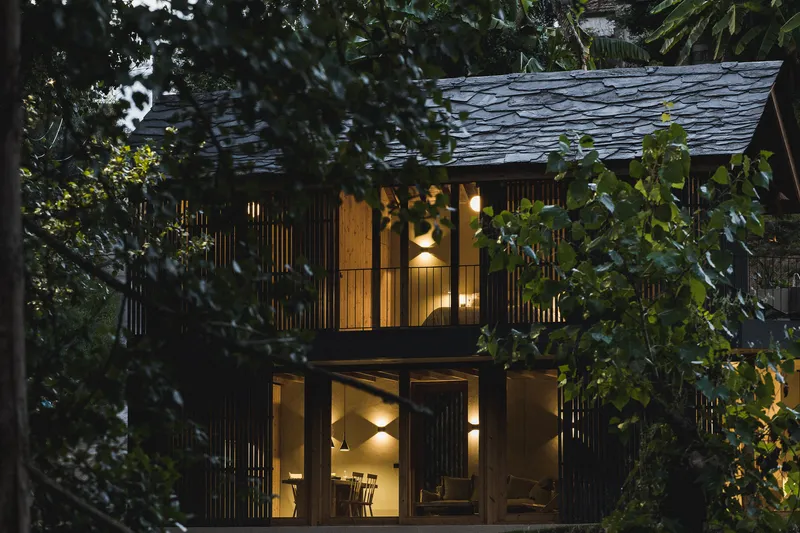

The south facade is the building's most dynamic element. Subdivided into vertical sliding timber shutters, it transforms from an opaque wall of dark slats into a permeable screen that floods the interior with light. At dusk, the effect is striking: warm interior illumination leaks through the gaps, turning the whole volume into a lantern set against dense foliage. When closed, the shutters create a monolithic surface that gives nothing away.
This is practical climate control dressed as architecture. The adjustable panels allow the occupants to manage solar gain and privacy without relying on mechanical systems, a passive strategy that suits both the humid riverside setting and the building's commitment to material restraint. The corrugated metal on adjacent surfaces and the aged slate above complete a cladding system that never asks for maintenance it won't get.
Slate, Stone, and the Weight of Place


The roof is covered in aged slate tiles salvaged from local ruins. Lichen and moss have already colonized the shingles, a material decision that accelerates the building's integration into its site rather than fighting it. The layered texture of the slate against the crisp lines of the dark corrugated cladding below produces a tension between entropy and order that defines the whole project.
Recycling these tiles is not merely a sustainability gesture. Slate is the traditional roofing material of the Arouca region, and reusing it establishes a direct physical continuity between the predecessor structure and its replacement. The new building carries the old one's skin.
In the Trees


Seen through the surrounding woodland grove, the building almost disappears. Its narrow gable proportions, inherited from the granary typology, keep the volume slender enough to read as another vertical element among the tree trunks. The dark cladding absorbs light rather than reflecting it, and the corrugated metal siding picks up just enough texture from the forest's dappled shade to avoid looking industrial.
The site itself required a land cut to the north, creating a cliff backdrop that gives the building a sense of being embedded in the terrain. Smoke rising from the chimney in José Campos's photographs completes a scene that feels deliberately timeless, as though the house has been here for decades rather than since 2022.
Ground Floor: Living Under the Beams


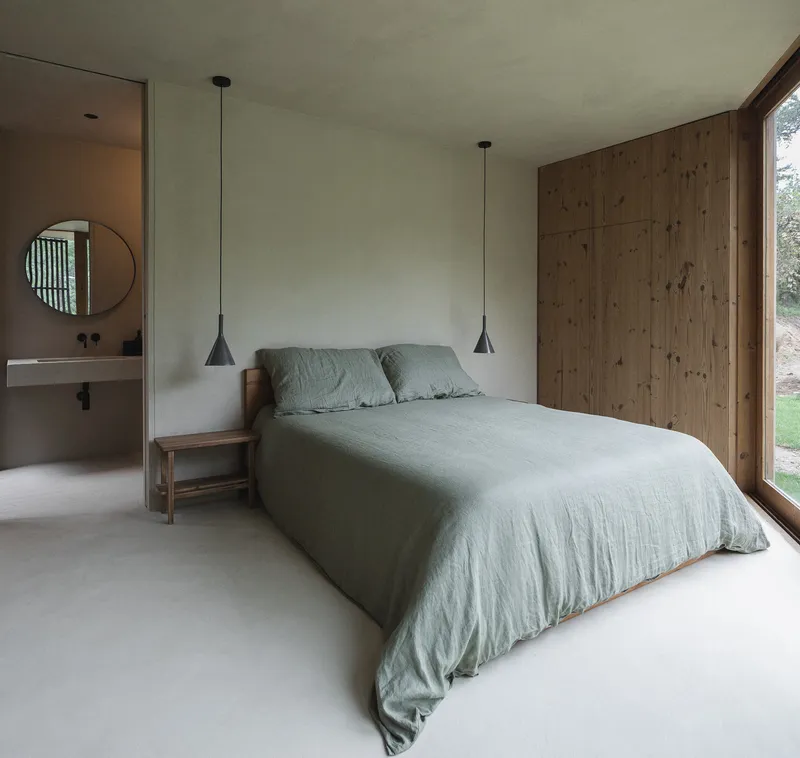
The ground floor organizes an open living and dining area alongside an en-suite bedroom within the 110 square meters. Exposed timber beams run the length of the ceiling, and the structural framework is left visible everywhere, celebrated rather than concealed. A steel spiral staircase occupies the center of the plan like a piece of furniture, connecting to the upper floor without consuming much footprint.
One of the most compelling moments occurs at the dining table, where a tall narrow doorway frames the exposed rock face of the north cliff cut. It is a controlled view of raw geology, framed with the precision of a gallery opening. The microcement floors and sand-toned walls keep the interior palette warm without competing with the timber overhead, while black metal details on fixtures and hardware provide the only contrast.
Upper Floor: Sleeping Under the Slope


Upstairs, the large bedroom occupies the gable volume with exposed rafters that follow the roof slope to their apex. Glass doors open to a narrow balcony that runs the length of the bedroom, offering views out through the vertical slatted screen. The room is generous despite the building's compact footprint, and the sloping ceiling creates a sense of enclosure that suits the retreat's purpose.
The relationship between the steel railing at the mezzanine edge and the timber structure is carefully managed. Black metal meets warm wood without fussy detailing, a restraint that keeps the upper floor feeling continuous with the ground level rather than like a separate apartment. Afternoon light entering through the slatted facade casts rhythmic shadows across the floor, marking time in a room designed for stillness.
Thresholds and Circulation
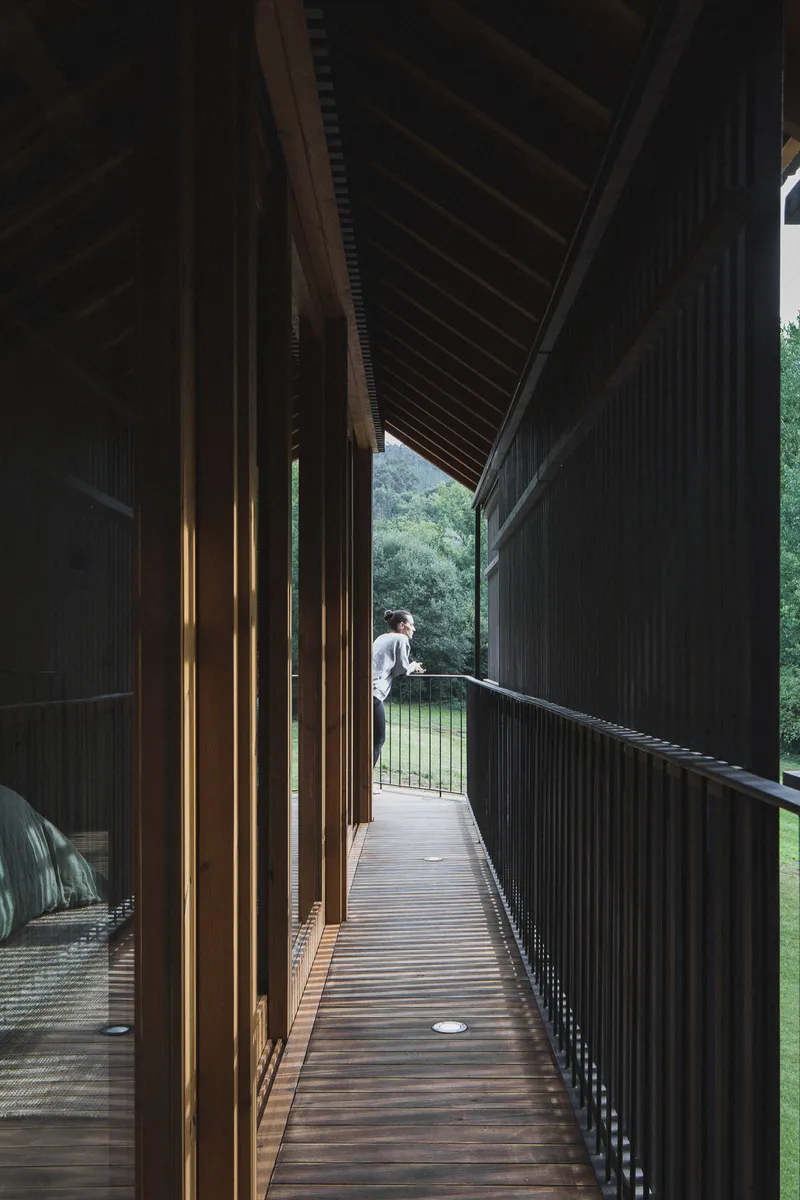
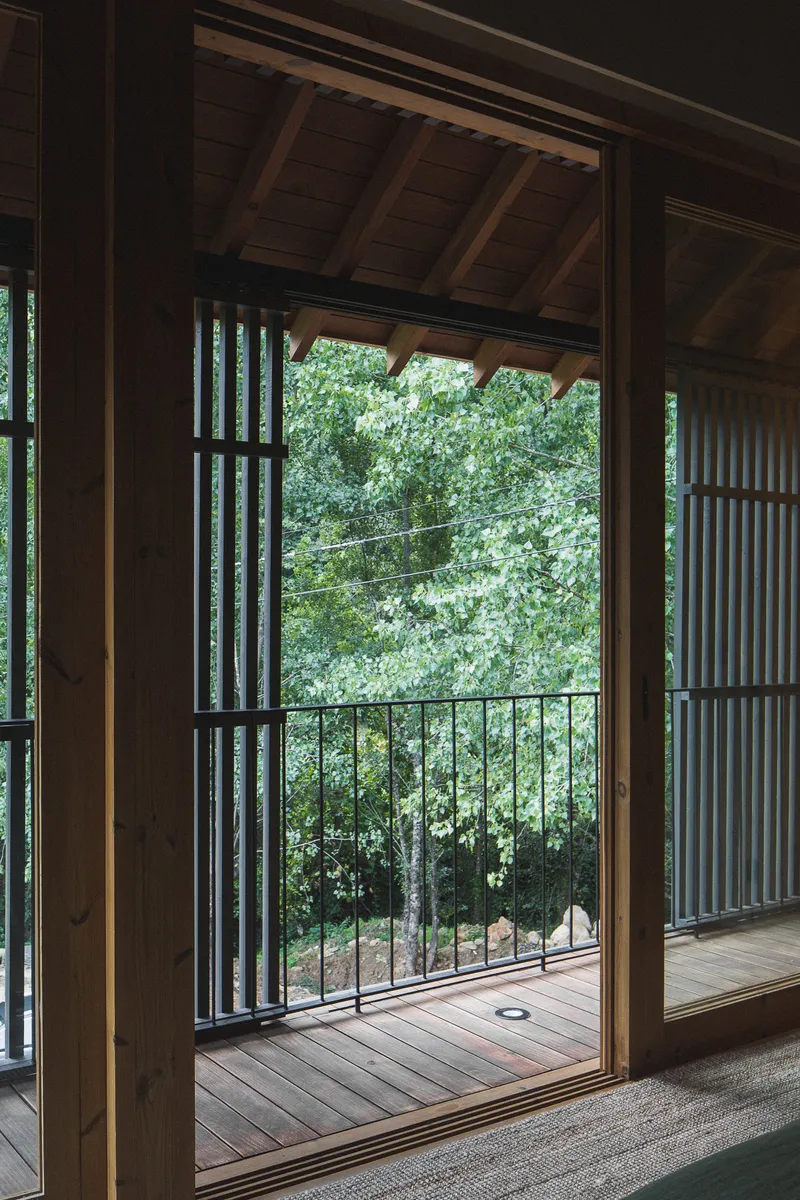
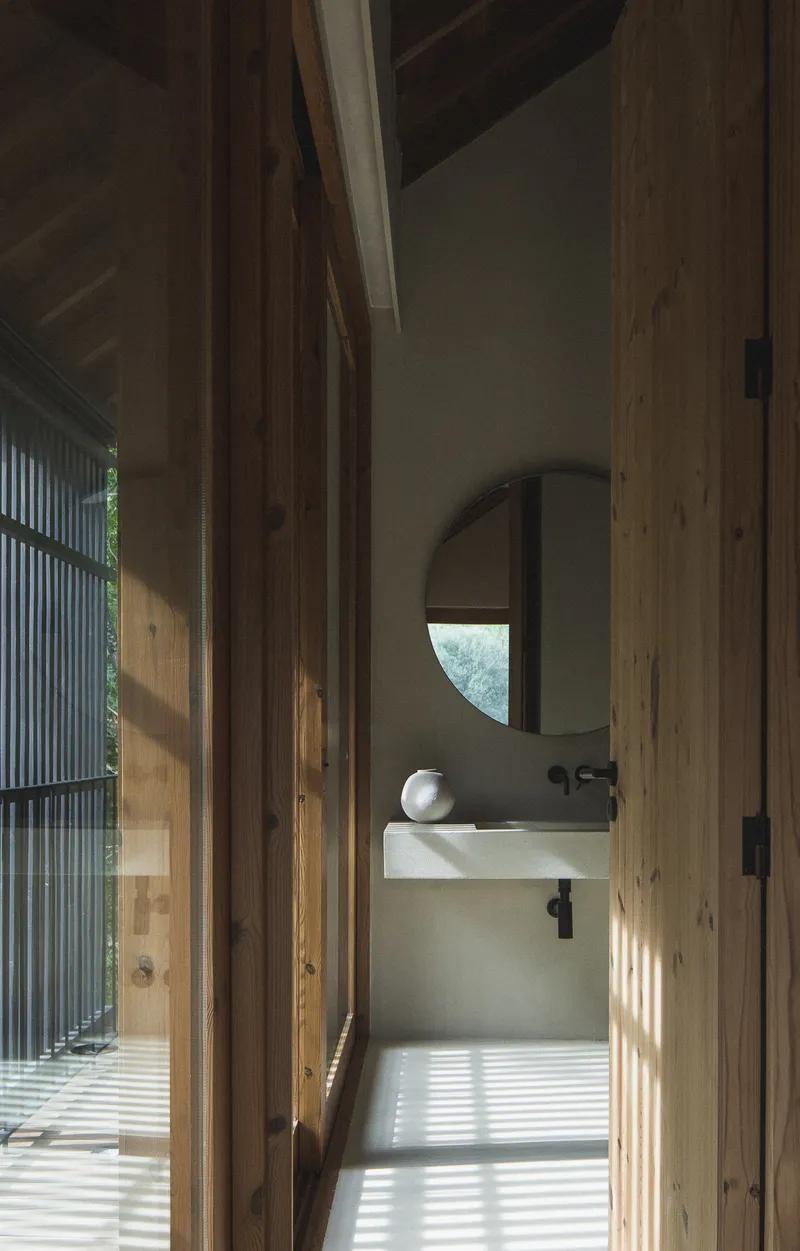
The narrow timber walkway at the upper level, walled by vertical slats on both sides, compresses the experience before releasing it at the exterior railing overlooking the lawn. Every transition in this house is considered. Doorways are tall and narrow, echoing the building's proportions. The striped shadow pattern cast across the polished concrete floor near the bathroom entrance turns a functional corridor into a moment of visual pleasure.
These in-between spaces do the real work of connecting inside and outside. The open timber doorway framing a view of the green canopy beyond treats the deck and railing as an extension of the room rather than an afterthought. There is no abrupt boundary between shelter and landscape.
Bathrooms Built Like Rooms
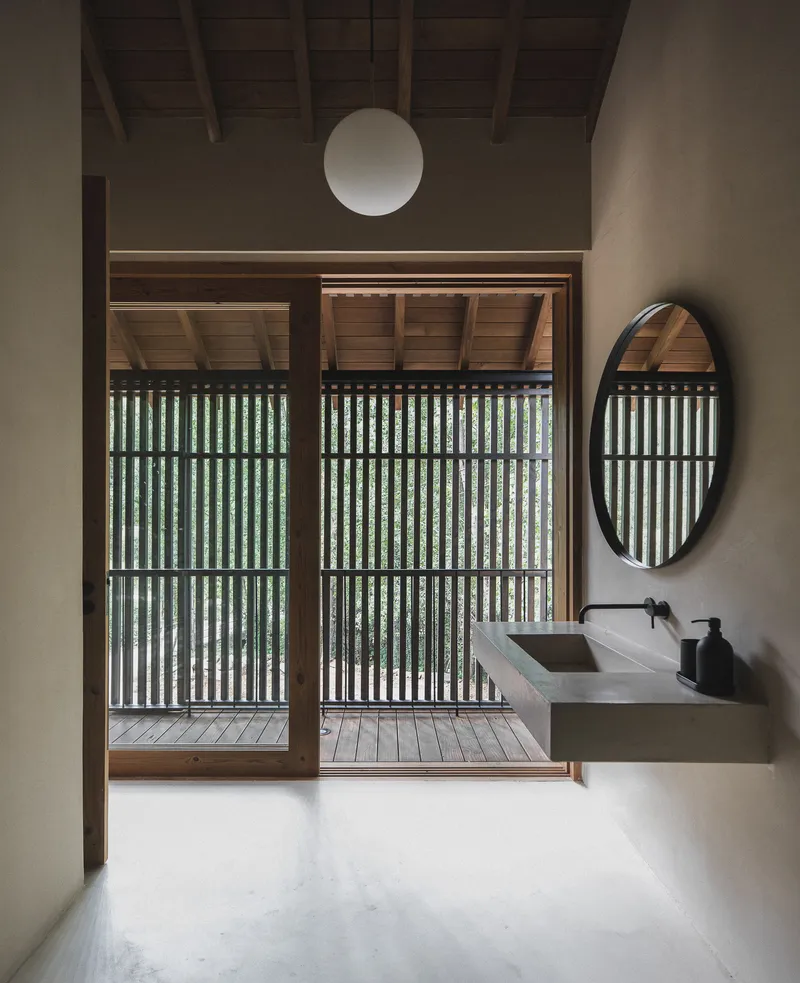
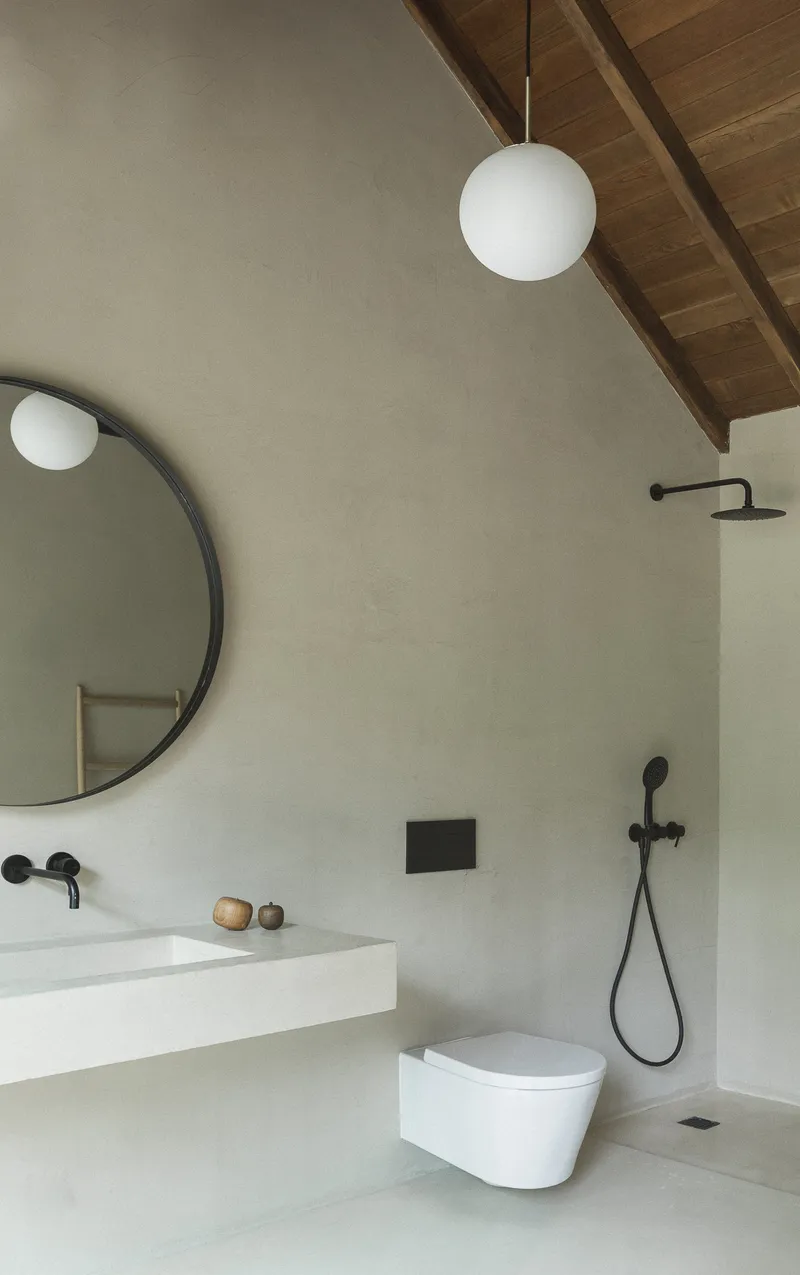

The bathrooms deserve attention because they refuse to be secondary spaces. The upper bathroom, with its vaulted timber ceiling and globe pendant, has the presence of a living room. Black shower fixtures and a wall-hung toilet sit against microcement walls that carry the same material language as the rest of the house. A circular mirror recurs in both bathrooms, a simple motif that softens the rectilinear geometry.
In the ground floor bathroom, a concrete sink faces timber-framed sliding doors that open to the slatted screen balcony. Bathing here involves the same negotiation between enclosure and exposure that defines the entire project. The oval mirror, the timber frame, the filtered light through the slats: it all coheres without feeling styled.
Plans and Drawings
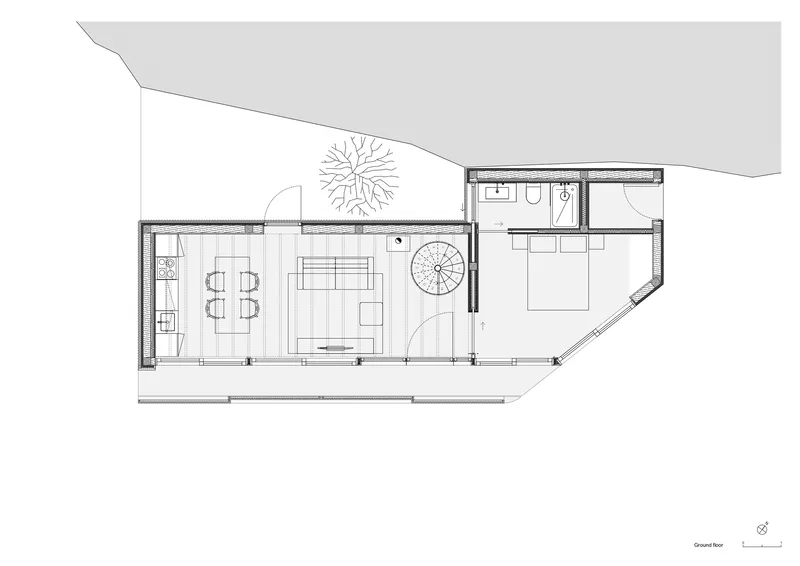


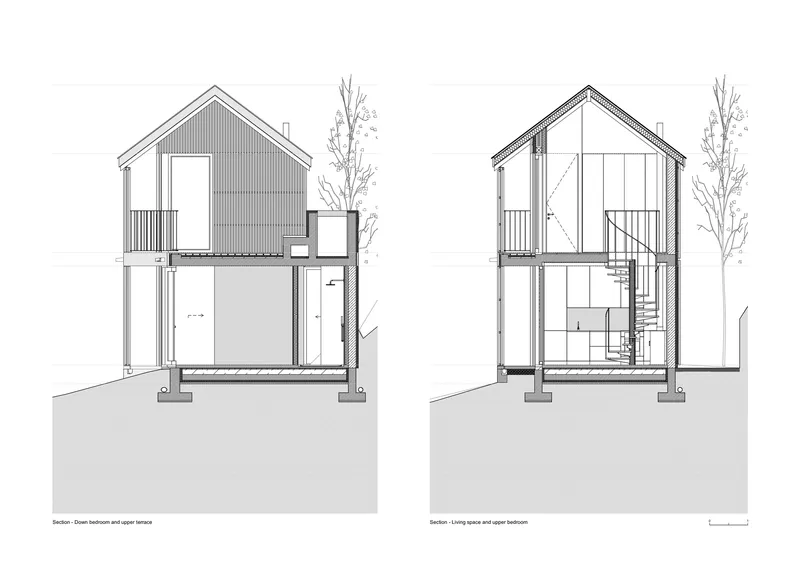



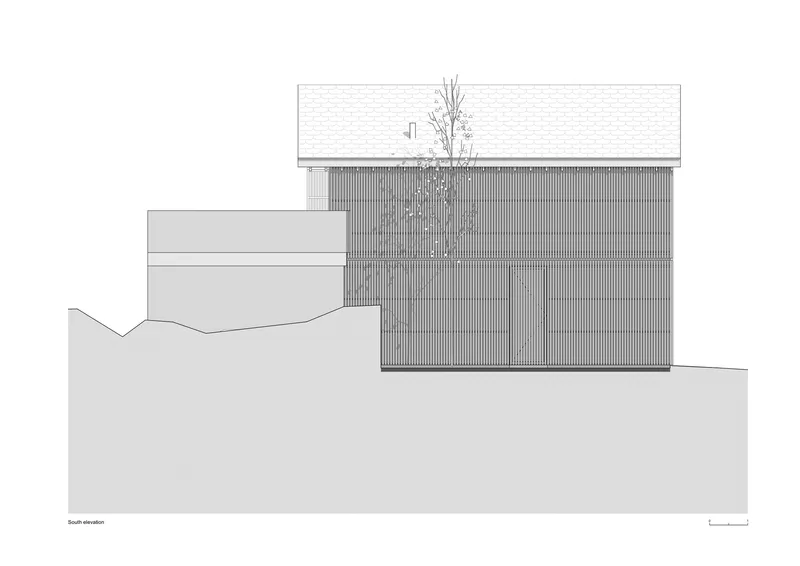

The floor plans reveal how tightly the 110 square meters are organized. The spiral stair sits at the plan's center, freeing the perimeter for living space and views. The ground floor keeps the open living area and en-suite bedroom on a single level, while the upper floor devotes nearly all its area to a single bedroom and bathroom under the sloping roof. The section drawings expose the relationship between the roof terrace, the upper balcony, and the double-height spiral staircase, making clear how vertical circulation drives the spatial experience.
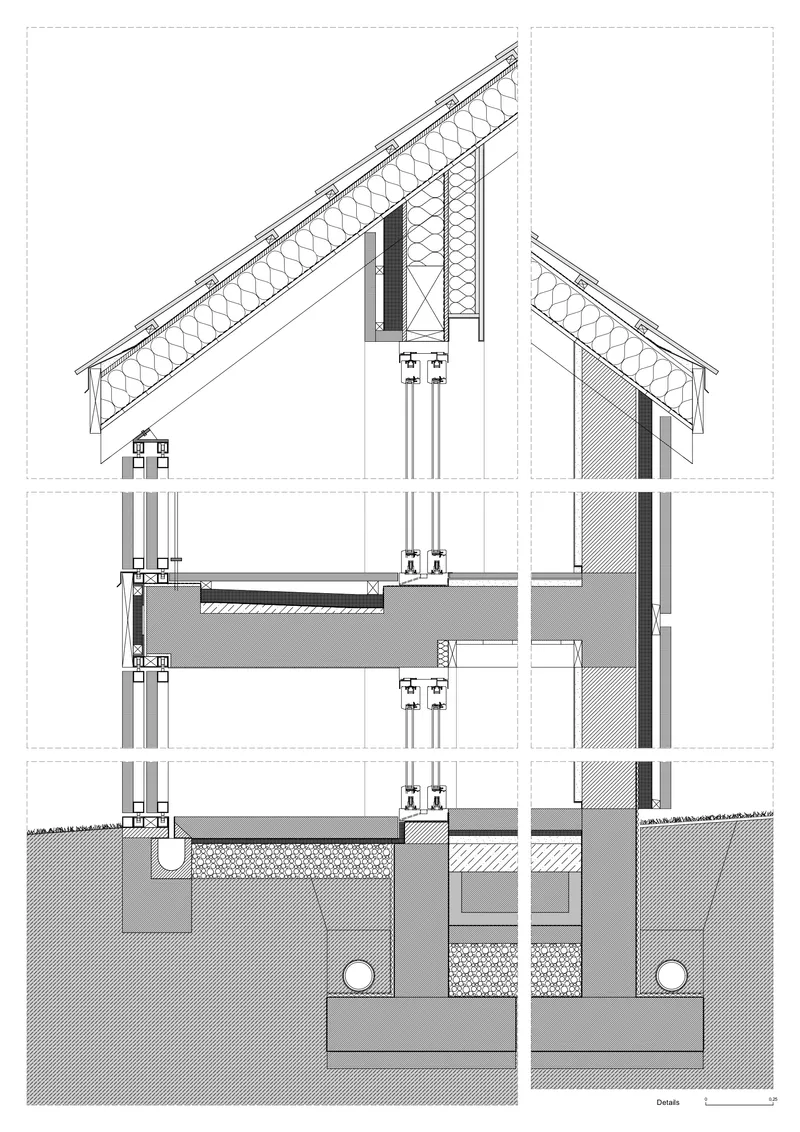
The construction detail drawing is particularly revealing, showing the foundation, floor structure, column supports, and truss assembly in sequence. The timber post-and-beam system is not decorative: it is the building's skeleton, and its dimensions and connections are worked out with structural honesty. The dimensioned axonometric of the cylindrical spiral staircase confirms what the photographs suggest, that this element was designed as a standalone object, precise in its geometry and fabrication.
Why This Project Matters
The Granary House succeeds because it treats a regional building type as a spatial brief rather than a nostalgic image. By matching the predecessor's proportions and reusing its slate, the architects establish continuity with the site's history. But the sliding shutter facade, the spiral staircase, and the controlled material palette belong entirely to contemporary practice. The building does not pretend to be old. It simply refuses to ignore what came before.
At a moment when rural retreat architecture often defaults either to glass-box minimalism or exaggerated rusticity, this project holds a disciplined middle ground. The unified tonal palette, the passive climate strategy embedded in the facade, and the structural legibility of the timber frame add up to something more rigorous than a holiday house. It is a small building with a clear argument about how to build in a landscape you want to keep.
Granary House in Arouca by Marta Brandão and Mimahousing. Arouca, Portugal. 110 m². Completed 2022. Photography by José Campos.
About the Studio
Mimahousing
Share Your Own Work on uni.xyz
If projects like this are the kind of work you want to make, uni.xyz is a place to publish your own, find collaborators, and enter design competitions.


Popular Articles
Popular articles from the community


Tsunami Convergenics: Turning Catastrophic Ocean Forces into Underwater Housing Infrastructure
A speculative underwater settlement off the coast of Onagawa, Japan, treats tsunamis and typhoons as energy sources rather than threats.

Singing Woman: Contemporary Architecture Inspired by Estonia’s Voice and the Sea
Singing Woman turns Estonia’s song culture into flowing opera house architecture, blending public life, landscape, sea, and national memory.

Faces of the Soviet Avant-Garde: Turning Moscow's Street Names into an Open-Air Museum
A network of sculptural installations across a Moscow residential district transforms forgotten architect names into spatial encounters with cultural memor
Extended Shell: Retrofitting Kolkata's Balconies as Living Urban Thresholds
A modular retrofit system recovers the social and environmental intelligence of Kolkata's historic verandas for contemporary Park Street residents.

Similar Reads
You might also enjoy these articles

Bao Huynh Watercolor Atelier: A Serene Art Retreat in Hội An
Bao Huynh Watercolor Atelier in Hội An blends multifunctional art spaces, sustainable design, local materials, and family-friendly living in a serene environment.

Atelier Macri Concept Store Interior Design by CASE-REAL
Atelier Macri store features a "ko" counter, walnut wood details, cork displays, blending retail, gallery, and seamless customer experiences.

Manuel Vargas Izquierdo Stadium and High-Performance Sports Center: Architectural Excellence in Jalpa de Méndez
The Manuel Vargas Izquierdo Stadium blends sustainable design, inclusive sports facilities, and cultural-inspired architecture, revitalizing Jalpa de Méndez’s public spaces.

KAKR Buluh Awar Hall: Revitalizing Community and Ecology Through Bamboo Architecture
Community built bamboo hall revitalizes Buluh Awar village, empowering youth, restoring ecology, celebrating vernacular craftsmanship through sustainable architecture and culture.

Explore Granary Competitions
Discover active competitions in this discipline

Challenge to design mud housing for contemporary communities

Challenge to reimagine the Iron Throne

Photograph architecture without architects

Illustrate the lost glory of Angkor Wat - Render Challenge
Comments (0)
Please login or sign up to add comments
No comments yet. Be the first to comment!