
Negishi Kenchiku Studio Converts a Rural Storehouse at the Foot of Mount Akagi into an Office
An agricultural storehouse in the Japanese countryside keeps its timber skeleton and tiled roof while gaining a second life as a workspace.


At the base of Mount Akagi, where rice paddies and greenhouses stretch to the horizon, a nondescript storehouse sat tethered to a house it had long outlived its usefulness for. Built for agricultural storage, expanded more than once, and eventually clad in galvanized iron, the building was not a candidate for preservation in the conventional sense. It held no designation, no plaque, no claim to architectural distinction. What it held was something harder to quantify: the structural memory of its original timber frame, a roof silhouette that belonged to this landscape, and the quiet accumulation of decades of rural life.
Negishi Kenchiku Studio saw exactly that value when they took on the building's conversion into a private office. Rather than gutting the storehouse and projecting a new identity onto it, the firm worked within the logic the building already possessed: its heavy timber columns and beams, its double-height volume, its generous eaves. The result, completed in 2024, is a workspace that feels both quietly contemporary and genuinely old, a building that knows what it was and is comfortable with what it has become.
A Familiar Silhouette, Renewed
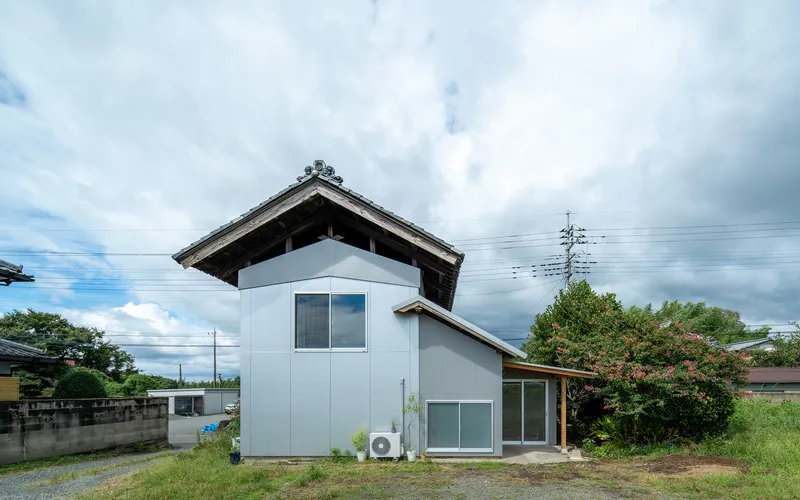
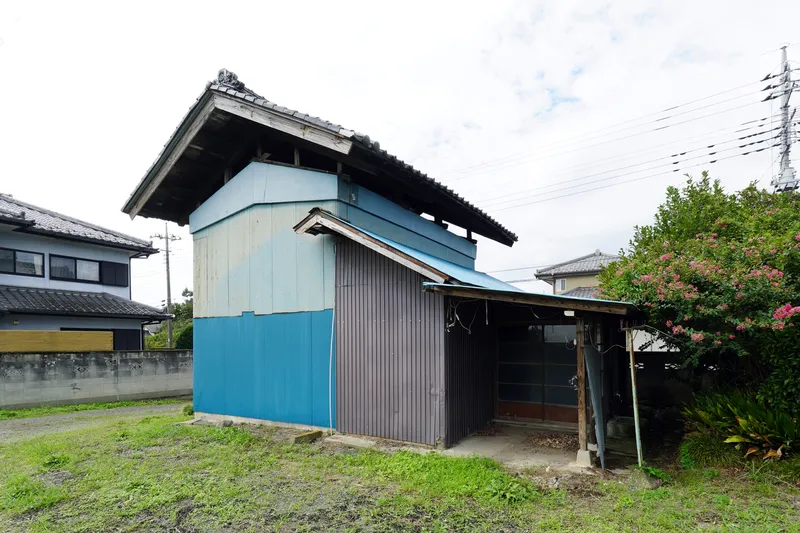
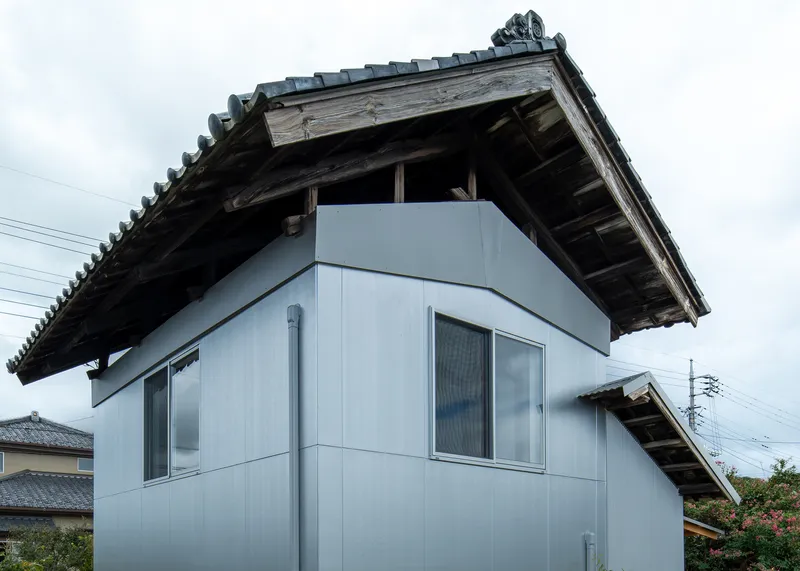
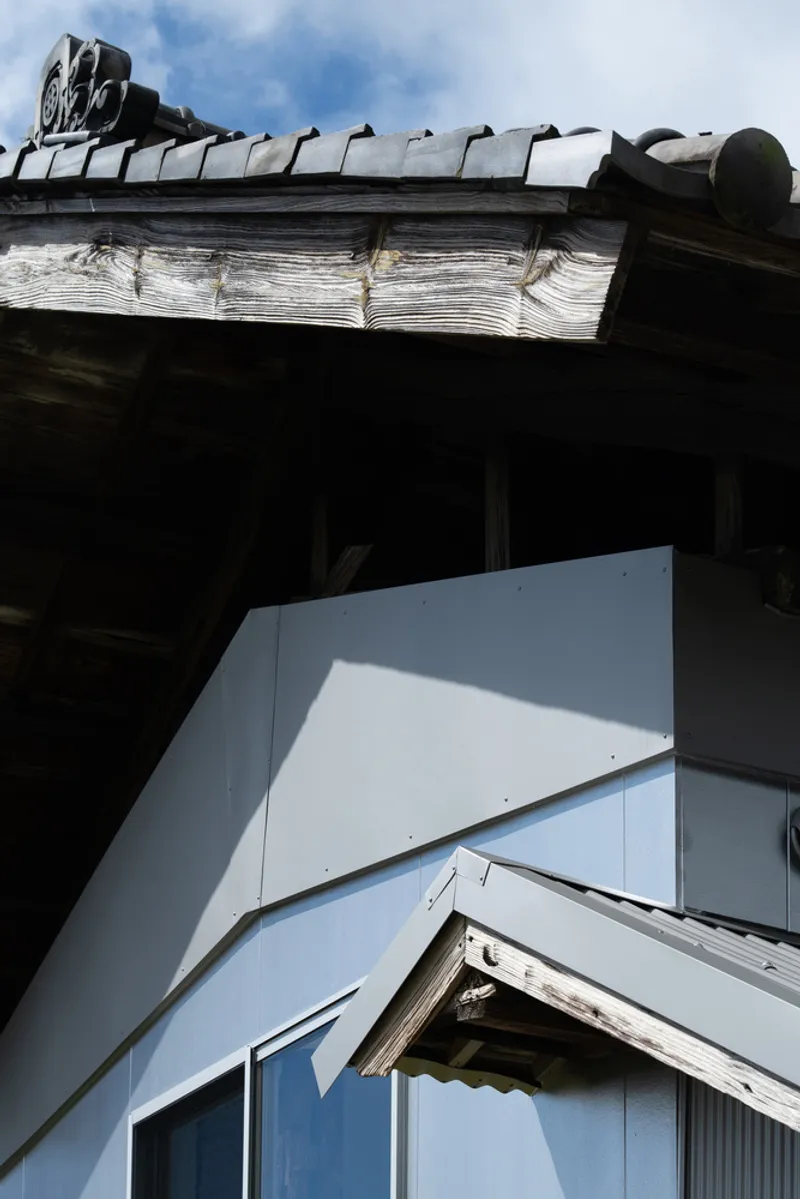
From the road, the storehouse reads as it always has: a gabled roof of curved clay tiles, deep eaves, and a compact rectangular footprint. The most visible change is the re-cladding. Pale blue metal panels now wrap the walls, replacing the deteriorated galvanized sheets while preserving the building's proportions. It is a practical move, not a cosmetic one. The new skin protects the timber structure beneath and, through its silvery blue tone, absorbs the shifting colors of the surrounding sky and fields.
The decision to keep the roof untouched is central to the project's philosophy. The clay tiles and weathered timber eaves are the storehouse's most legible historical layer, the element that anchors it to the vernacular tradition of this part of Gunma Prefecture. By leaving them intact and concentrating the renovation on the walls and interior, Negishi Kenchiku Studio avoided the trap of turning the building into a facsimile of itself.
The Timber Frame as Organizing Principle
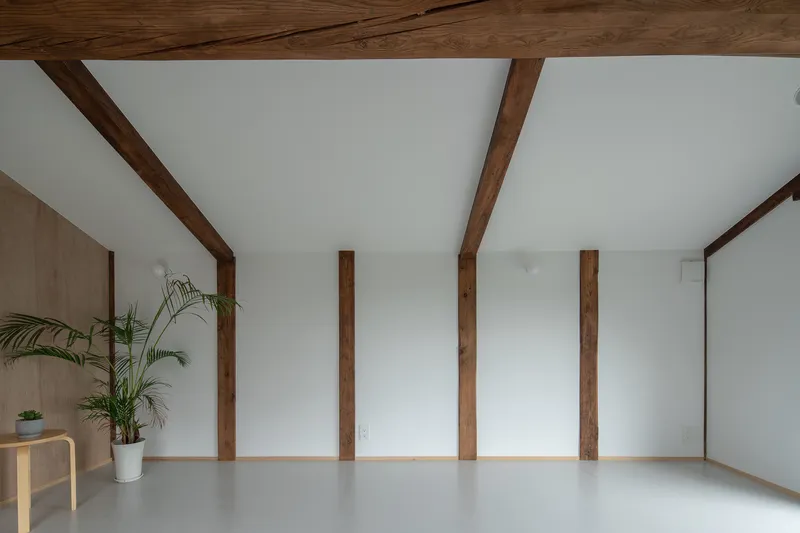
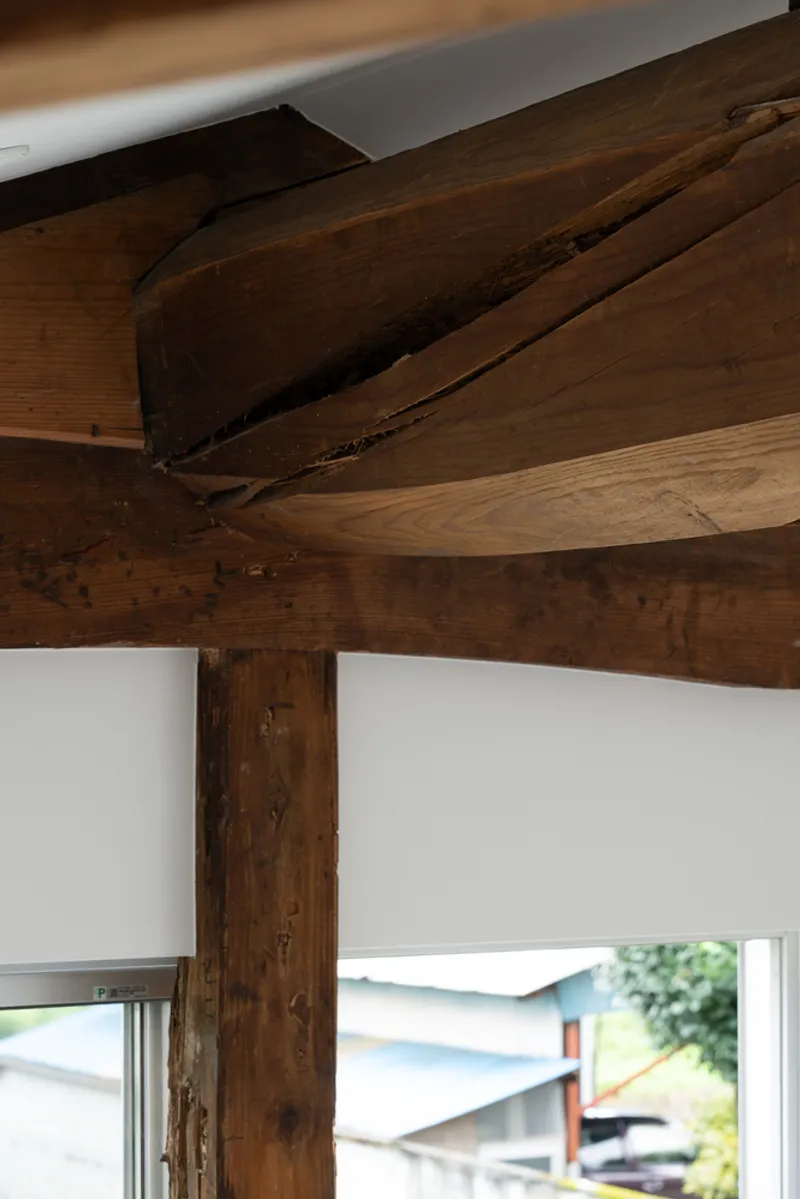
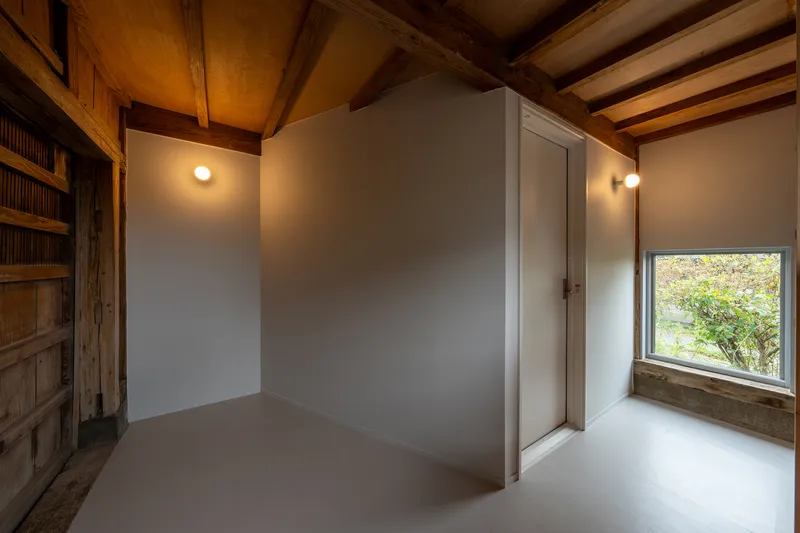
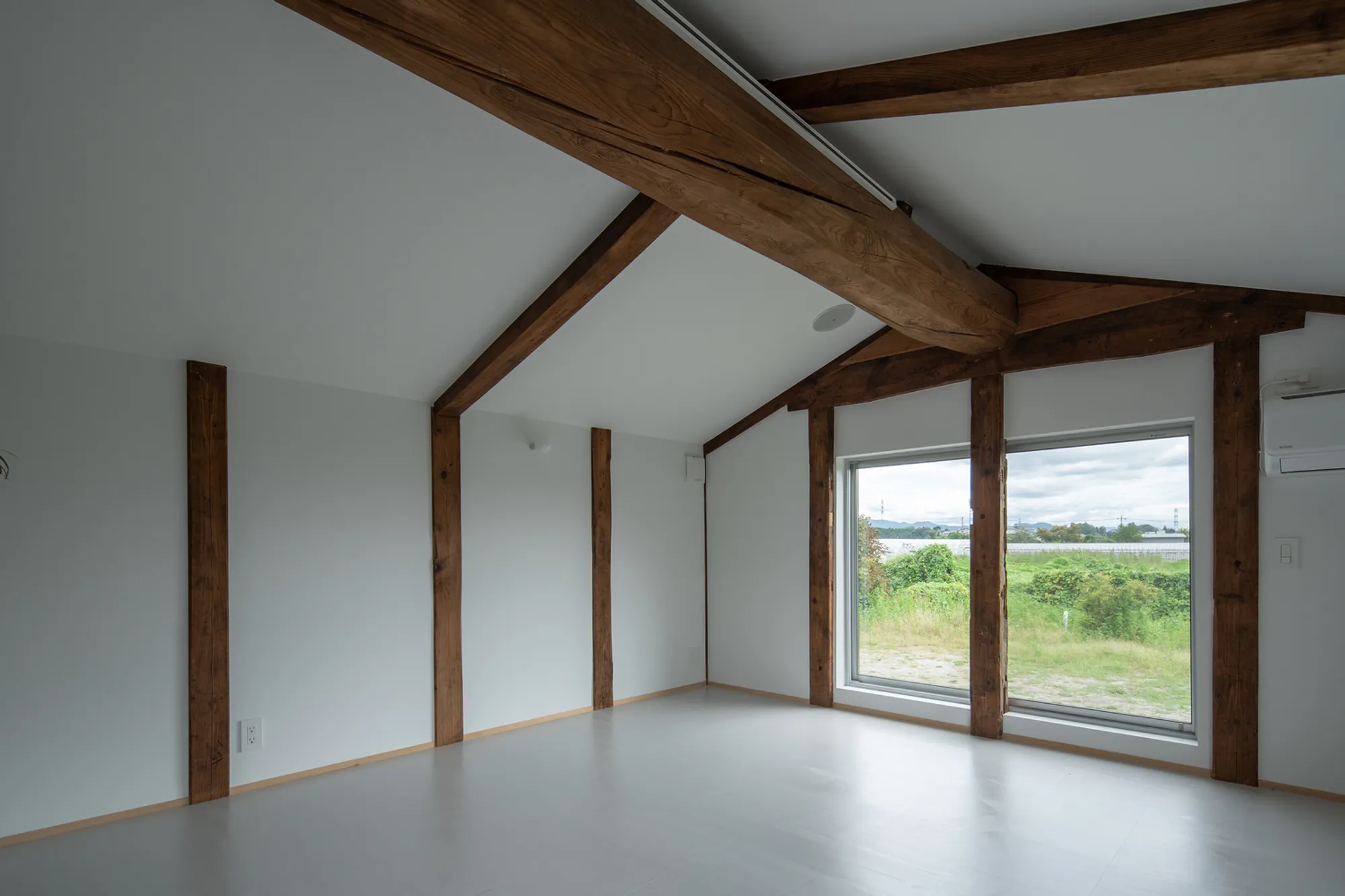
Step inside and the exposed timber structure takes over. Thick columns and crossing beams define the interior in every direction, their darkened surfaces carrying the patina of age against freshly finished white walls. These are not decorative elements left visible for atmospheric effect. They are the load-bearing skeleton of the building, and the renovation treats them as non-negotiable: everything new works around them, not through them.
The close-up of a beam-to-column joint tells the story well. The wood is hand-hewn, its surfaces slightly irregular, its joinery tight and deliberate. Placing this kind of craftsmanship alongside smooth plaster and pale grey flooring produces a tension that is productive rather than jarring. The old timber gives the space weight and specificity; the new finishes give it air and usability.
Light, Windows, and the View Out
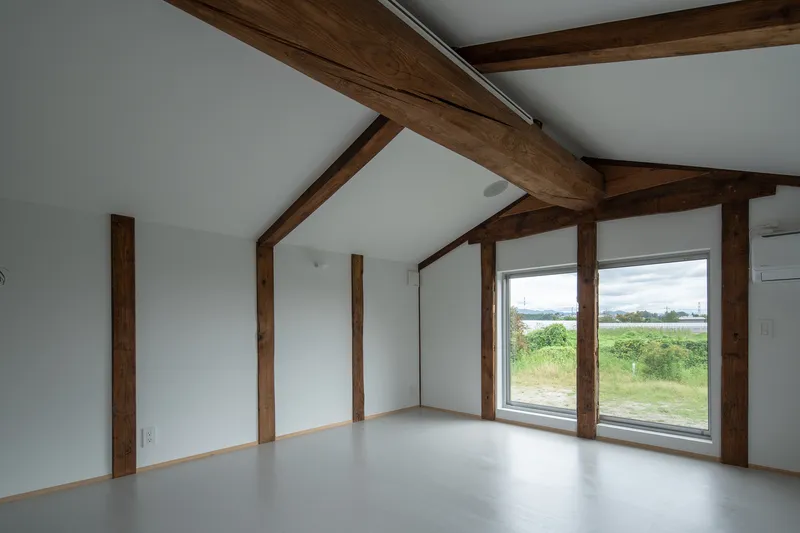
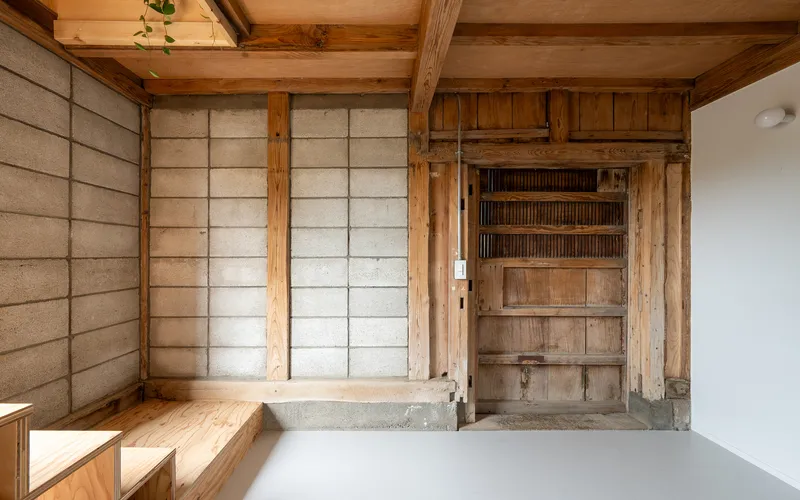
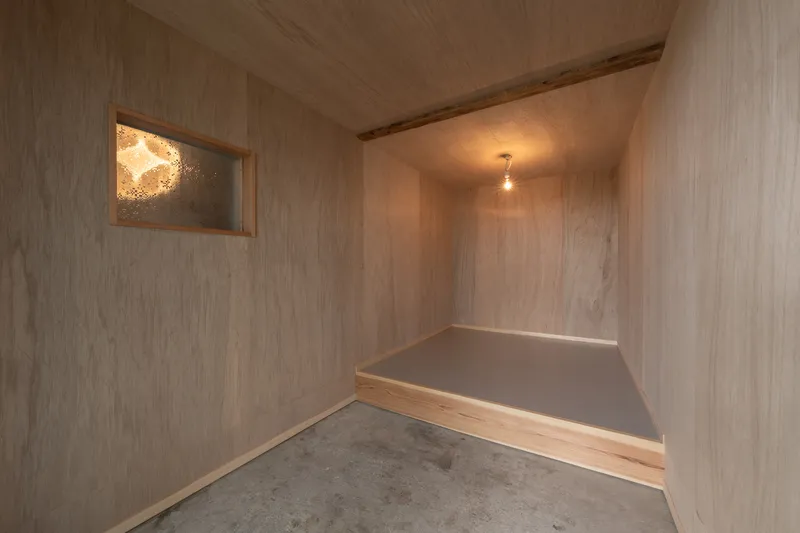
A storehouse, by definition, is designed to keep things in and weather out. Windows were not a priority. Converting it to an office meant introducing natural light without compromising the structural frame. Negishi Kenchiku Studio placed new openings strategically: a large window on the upper level frames a grassy meadow, while smaller apertures on the ground floor bring controlled daylight into deeper rooms. The result is an interior that never feels like a warehouse, despite retaining the proportions of one.
The use of translucent paper sliding screens, or shoji, adds a second layer of light modulation. In the room with the recessed alcove, the screens filter daylight into a soft glow that dissolves the boundary between structure and atmosphere. A small raised platform backed by a translucent panel creates a reading nook or contemplation space that feels borrowed from a much older building type, the tea room or study of a traditional Japanese house, without imitating one directly.
Circulation as Furniture
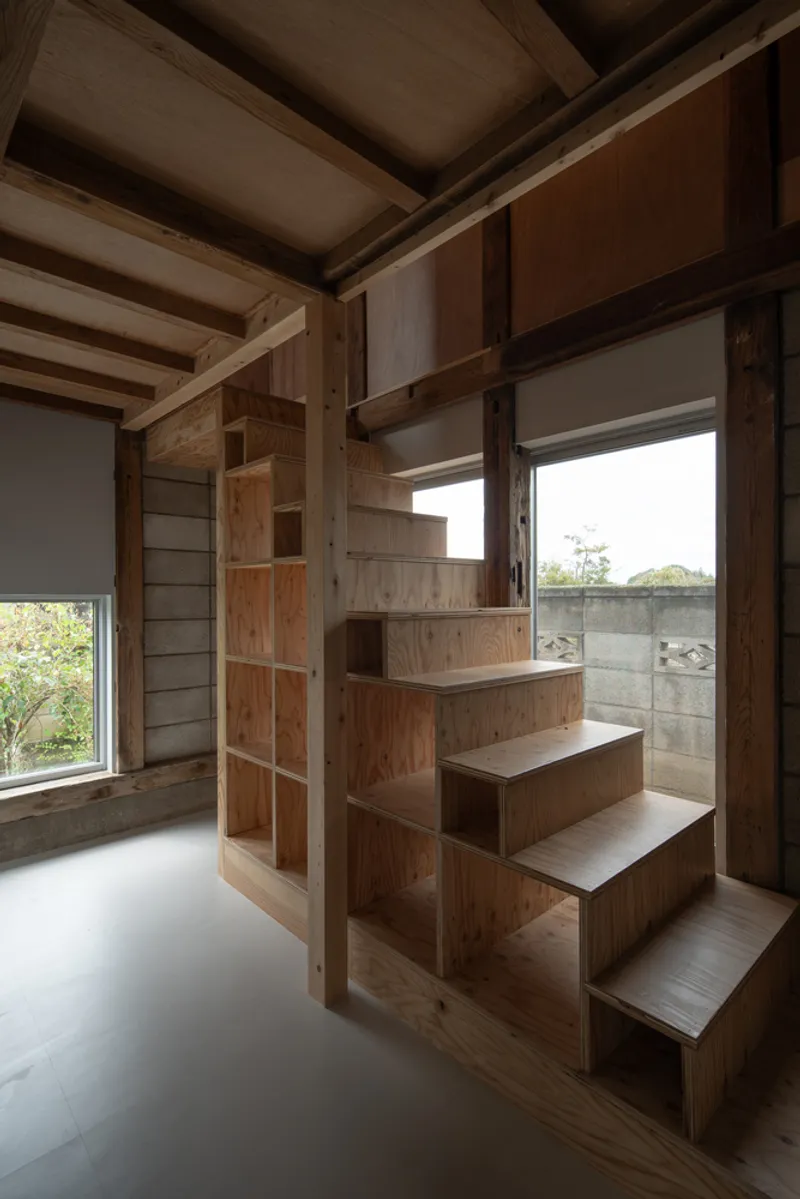
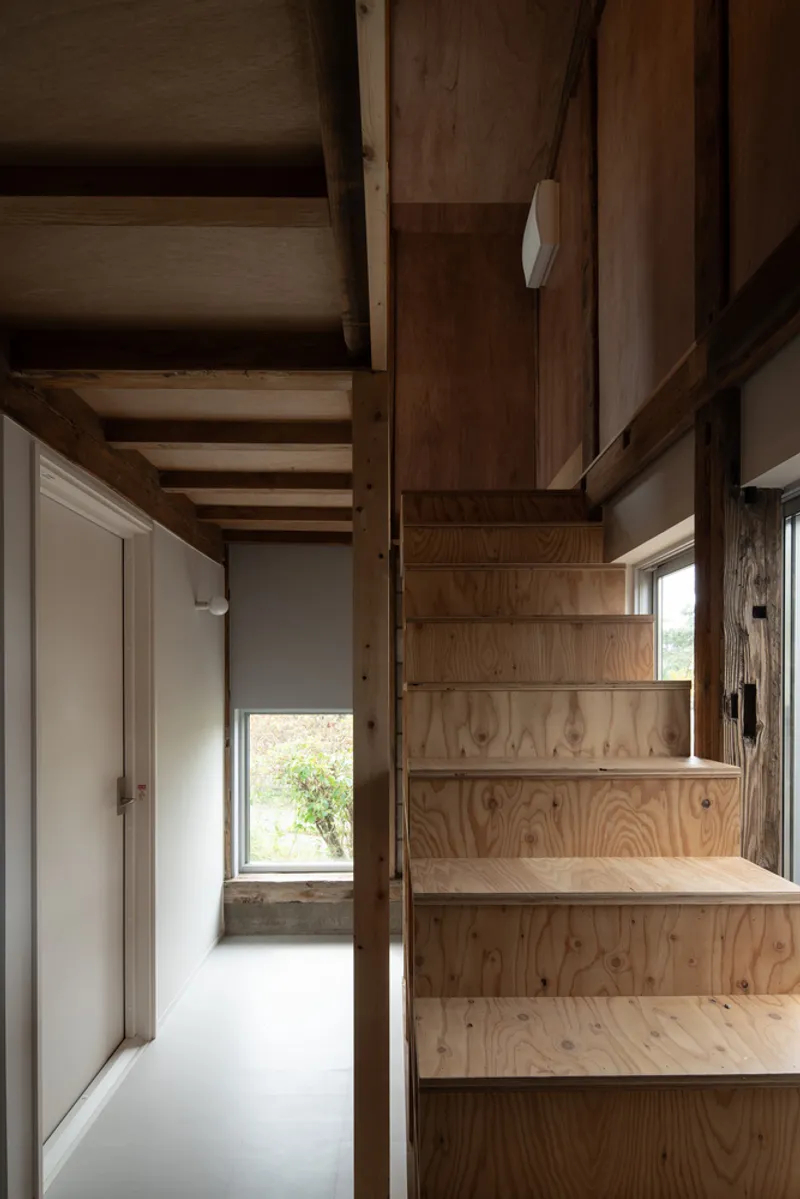
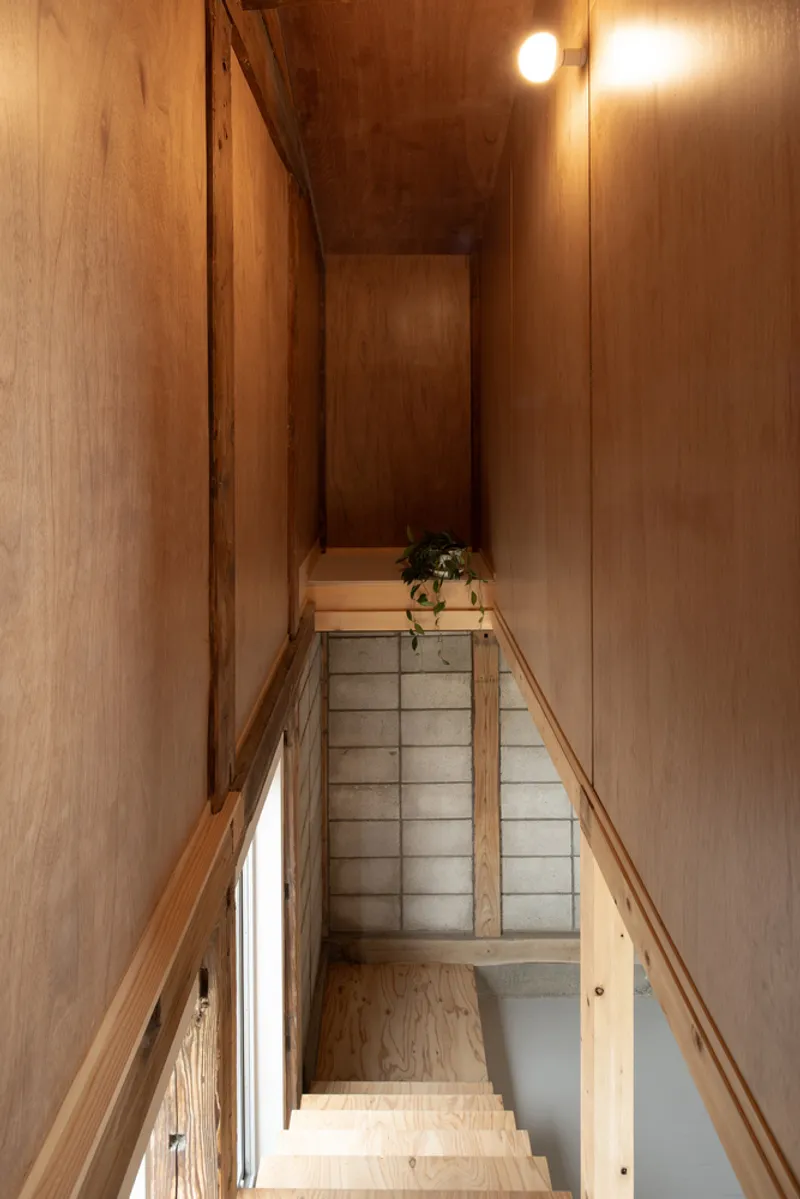
The staircase is one of the most considered insertions in the project. Built from plywood and slotted beneath the existing ceiling beams, it doubles as shelving on its underside and creates a vertical spine that connects the ground-level entry to the upper office. The material choice is deliberate: plywood is warm but clearly contemporary, distinguishing the new intervention from the reclaimed timber around it.
Seen from above, the narrow stairwell becomes an almost graphic composition of plywood planes, paper screens, and timber joists. A small plant on the landing is the only decoration. The restraint is characteristic of the whole project. Negishi Kenchiku Studio trusted the existing materials to carry the visual interest and limited their additions to what was functionally necessary.
Threshold and Garden
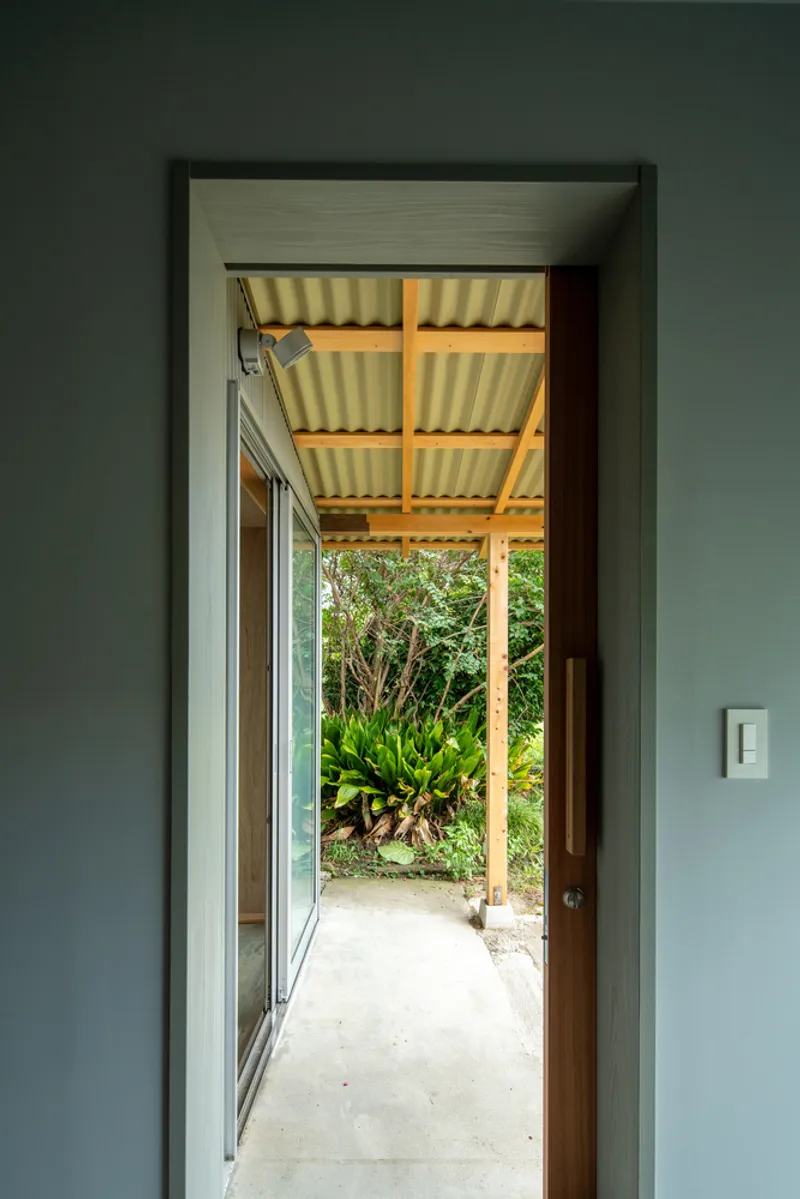
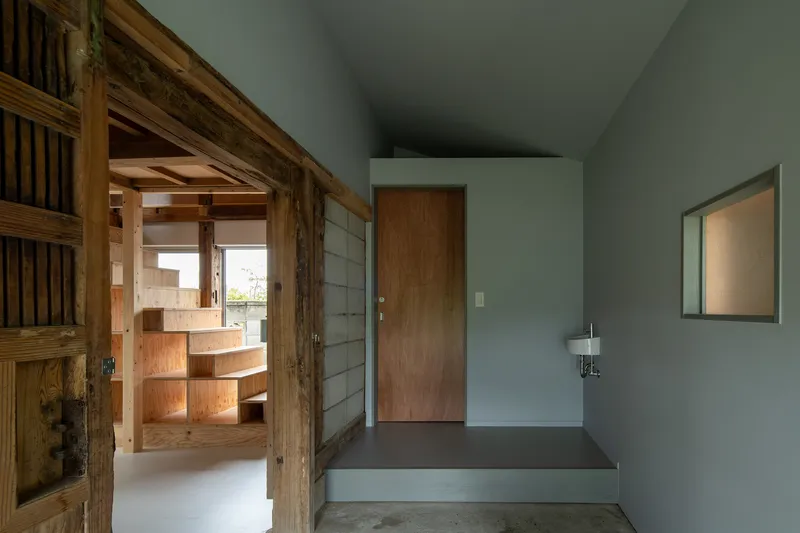
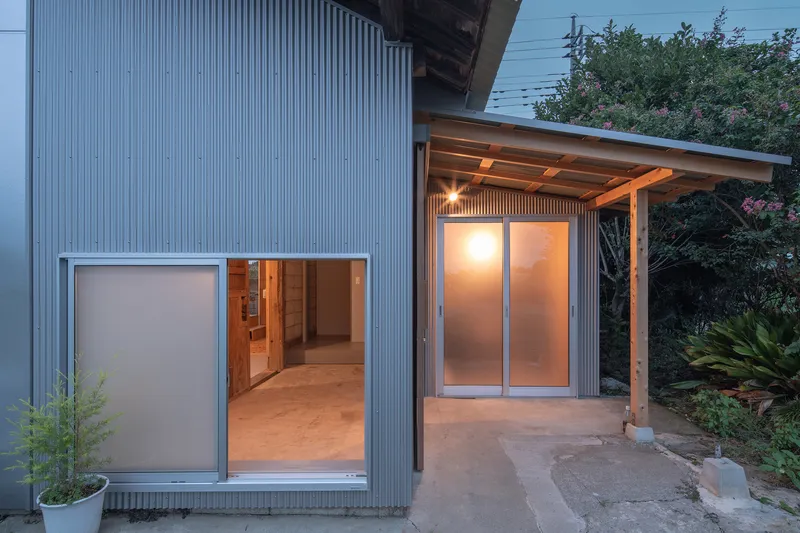
The entry sequence moves through several thresholds before arriving at the workspace proper. A covered porch with a corrugated metal ceiling opens to a planted garden, framed by a doorway that compresses the view into a single green rectangle. Inside, a timber-framed vestibule with a sliding door filters the transition once more. The layered approach to arrival slows you down, a useful quality for a building whose purpose is concentrated work.
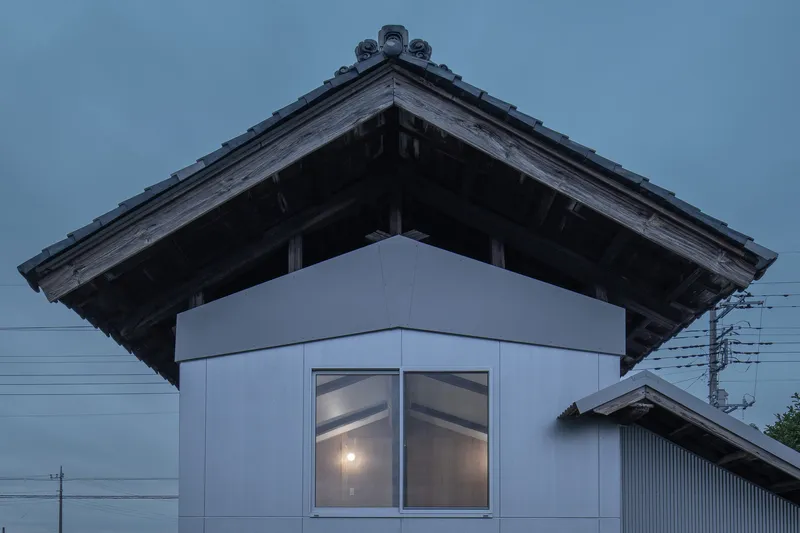
At twilight, the corner window beneath the tiled eaves glows from within, turning the storehouse into a lantern set against the darkening fields. It is a small moment but a telling one: the building is no longer sealed and opaque. It participates in the landscape's daily cycle of light and shadow in a way it never could as a storehouse.
The Rural Context
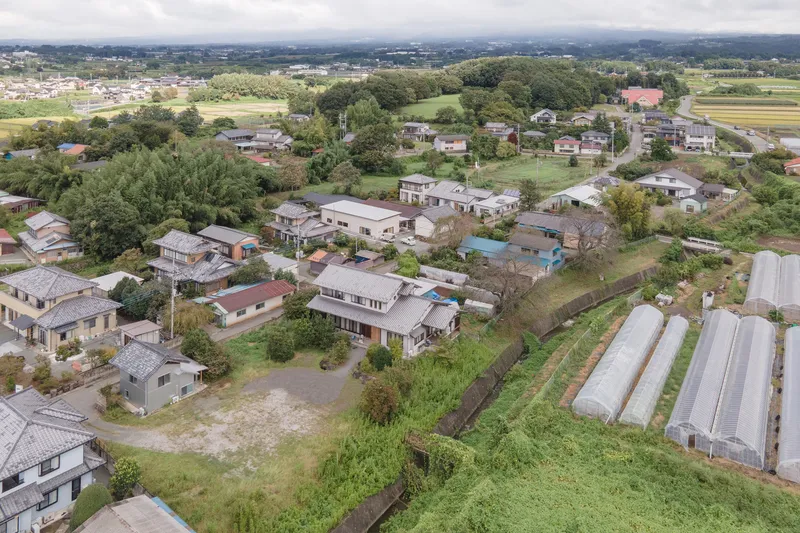
The aerial view places the project in its true context: a scattered residential neighborhood where houses, fields, and greenhouses coexist without formal planning. The storehouse is not a landmark here. It is one element in a patchwork of modest structures, each adapted over time to suit changing needs. That ordinariness is precisely what makes its renovation significant. Negishi Kenchiku Studio is not saving a monument; they are demonstrating that everyday rural buildings deserve the same care and intelligence that gets lavished on urban flagships.
At dusk, the corrugated metal facade and sliding glass doors glow with warm interior light, revealing the life inside without spectacle. The building sits comfortably beside its neighbors, neither hiding its renovation nor advertising it. In a landscape shaped by pragmatism, that kind of architectural humility is exactly right.
Plans and Drawings
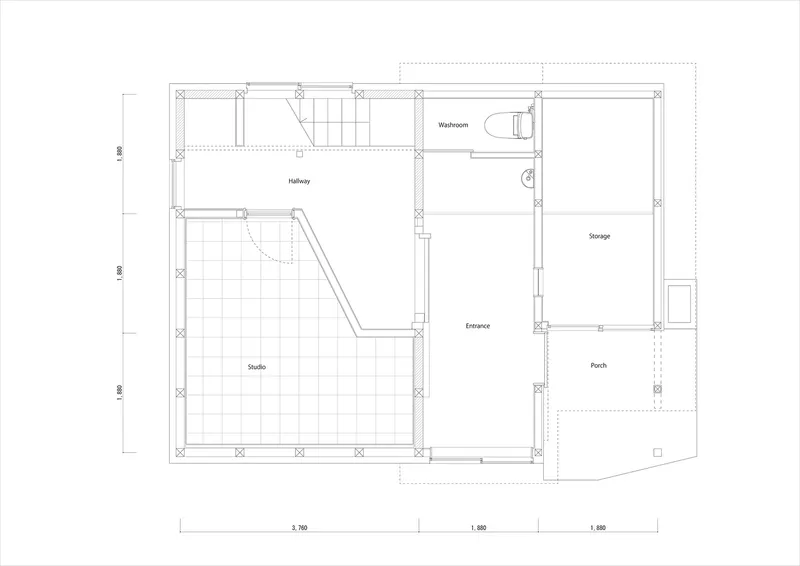
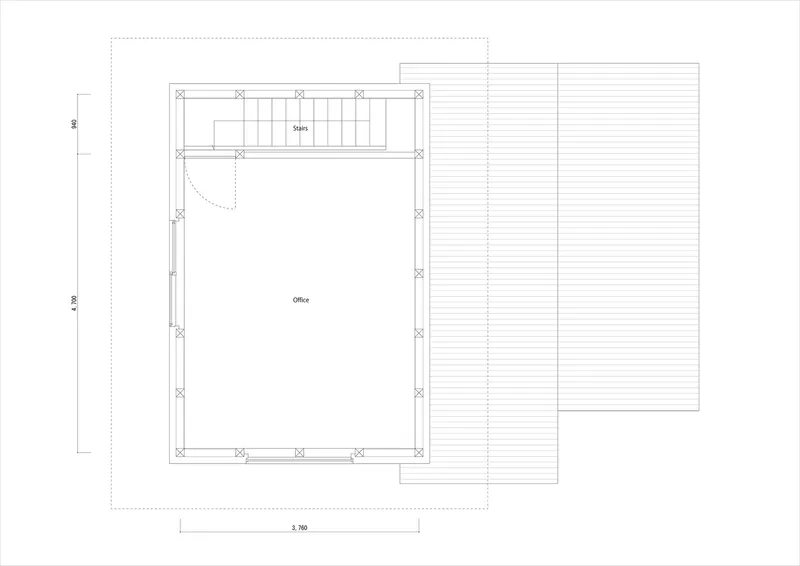
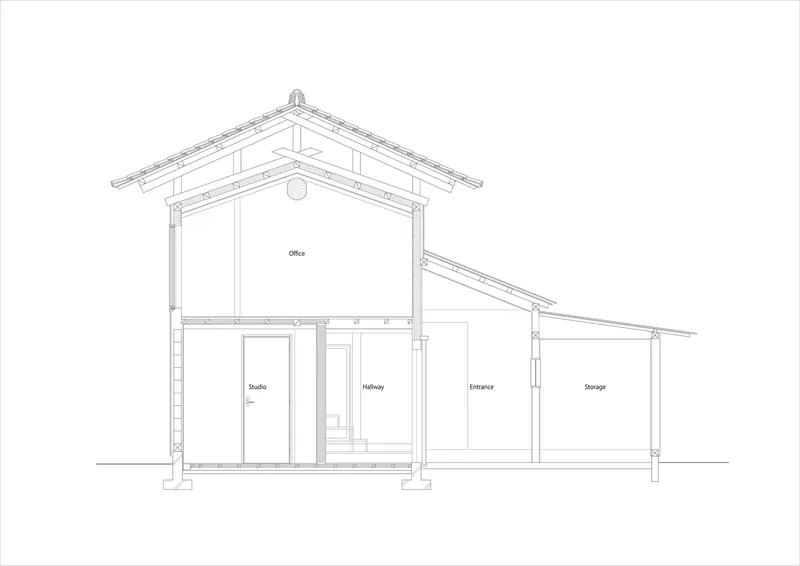
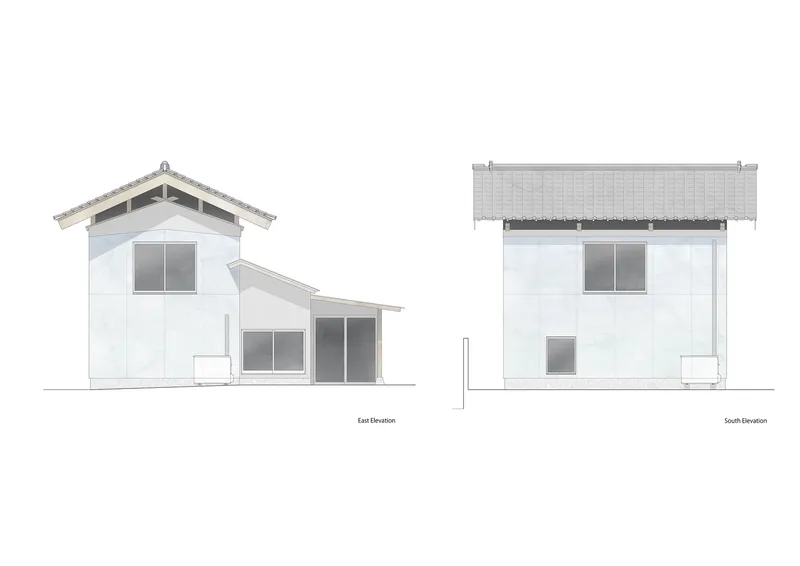
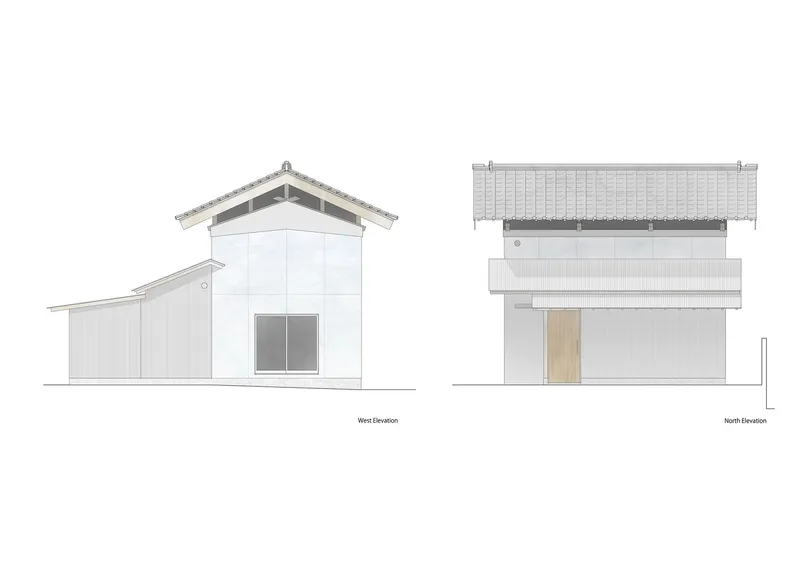
The ground floor plan reveals a compact organization: studio space, entrance, hallway, washroom, and storage arranged around the angled staircase, with a porch mediating between interior and garden. Upstairs, the office occupies the full volume of the original storehouse, opening onto a timber deck that extends the workspace outdoors. The section drawing is the most revealing: it shows how the double-height volume of the storehouse, crowned by exposed timber roof trusses, contrasts with the single-story wing that houses support functions. The elevations confirm the restrained material palette, with the gabled profile and clay tiles reading consistently from every direction while the cladding shifts between pale blue panels and corrugated metal.
Why This Project Matters
Japan's rural regions are losing buildings faster than they are gaining people. Storehouses, barns, and auxiliary structures are the first to go, dismissed as obsolete and too modest to warrant preservation. Memory of a Storehouse pushes back against that calculus, not with nostalgia, but with a clear-eyed argument that existing structures already contain the spatial and material intelligence that new construction labors to achieve. The timber frame, the proportioned volume, the deep eaves: these are not problems to solve. They are assets to build on.
Negishi Kenchiku Studio's achievement here is less about design flair than about editorial judgment, knowing what to keep, what to remove, and what to add. The storehouse did not need a dramatic gesture. It needed someone to recognize the quality already embedded in its bones and to create the conditions for it to be seen. That kind of architecture may not generate headlines, but it produces buildings that will outlast the ones that do.
Memory of a Storehouse by Negishi Kenchiku Studio, located at the foot of Mount Akagi, Japan. Completed in 2024. Photography by Shinsuke Hayakawa.
About the Studio
Share Your Own Work on uni.xyz
If projects like this are the kind of work you want to make, uni.xyz is a place to publish your own, find collaborators, and enter design competitions.



Popular Articles
Popular articles from the community


Conexión: Biophilic Design Reimagines High-Rise Living in Hong Kong
Conexión reimagines high-rise living in Hong Kong through biophilic design, green facades, shared spaces, daylight, water and nature within.

Riyadh For All: Intergenerational Urban Design for Active Aging in Rabat
Riyadh For All reimagines urban design in Rabat with intergenerational co-living, adaptive courtyards, and Moroccan cultural exchange today.

Lunar Spiral: Space Architecture Shaped by the Mathematics of the Universe
Lunar Spiral reimagines space architecture through Fibonacci geometry, lunar regolith, levitating habitats, and self-sustaining Moon living.

Hill & Cross Opera: Sculptural Opera House Architecture Shaped by Tallinn’s Landscape and Identity
Hill & Cross Opera reimagines opera house architecture in Tallinn through its sculptural hill, civic plaza, glass wave and a luminous cross.


Similar Reads
You might also enjoy these articles

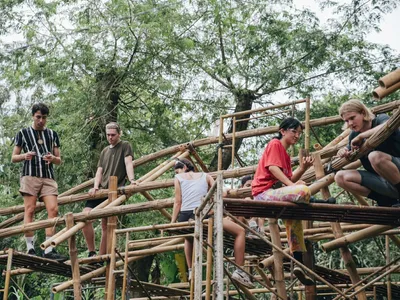
Bamboo Housing Challenge 2026: Design Affordable, Sustainable Homes Using Bamboo
An international design competition by Bamboo U and IBUKU inviting architects and designers to reimagine affordable housing using bamboo — with the winning design built full-scale in Bali.

Computational Design & Education: Beegraphy Design Awards Introduces 7th Category (Featuring Jiyun's Innovative Approach)
Dive into Beegraphy’s 7th Design Awards category, where computational design meets education to create immersive, interactive learning tools, inspired by Jiyun’s work.

From Parametric Lighting to Urban Furniture: Join the 2nd Workshop in Beegraphy’s Computational Design Series
Dive into Cutting-Edge Design Techniques and Practical Applications with Industry Experts

Last Call: Unleash Your Architectural Genius in SHAK's Kindergarten Design Competition
Urgent call for architects to join SHAK's kindergarten design competition before the looming deadline


Explore Adaptive Reuse Competitions
Discover active competitions in this discipline



Challenge to reimagine the Iron Throne


Photograph architecture without architects


Illustrate the lost glory of Angkor Wat - Render Challenge


Design challenge to reuse E-waste
Comments (0)
Please login or sign up to add comments
No comments yet. Be the first to comment!