
Architect Nonsense Carves a Concrete and Timber Café into a Narrow Thai Shophouse Plot
Bun Pastry & Beverages slots a 100 square meter café between shophouses in Phang Nga, Thailand, using reclaimed wood and raw concrete.

A 14-by-30-meter plot squeezed between two-story shophouses in Thaimuang District is not the kind of site that invites grand gestures. Architect Nonsense understood that. For Bun Pastry & Beverages, a café that doubles as a family baking hub in Phang Nga Province, the studio treated the narrow footprint as a virtue, stringing a sequence of indoor rooms and courtyards along a single linear axis. The result is a 100 square meter space that feels far larger than its dimensions suggest, because it never lets you see everything at once.
What makes the project genuinely interesting is how it choreographs movement and light through a tight urban slot. Rather than filling the site wall to wall, the architects punched voids into the plan: a gravel forecourt set five meters back from the street, a central semi-outdoor courtyard anchored by a single tree, and a rear garden connected through split-level changes. These voids do the heavy lifting for ventilation, daylighting, and atmosphere, turning a constrained commercial fit-out into something closer to a garden pavilion threaded through the bones of a shophouse row.
A Screen Wall That Announces Without Shouting
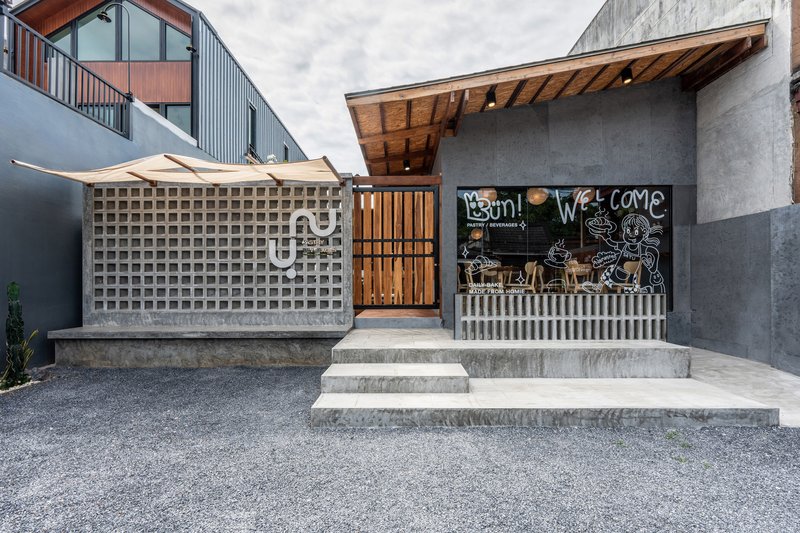
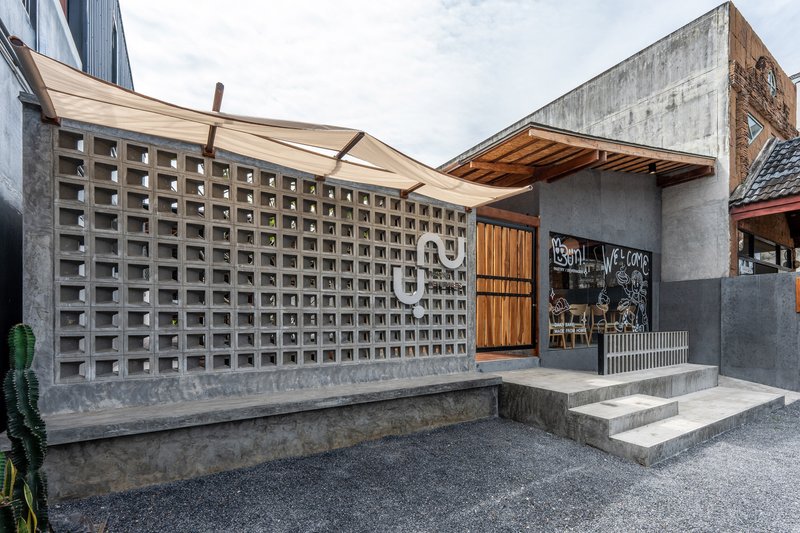
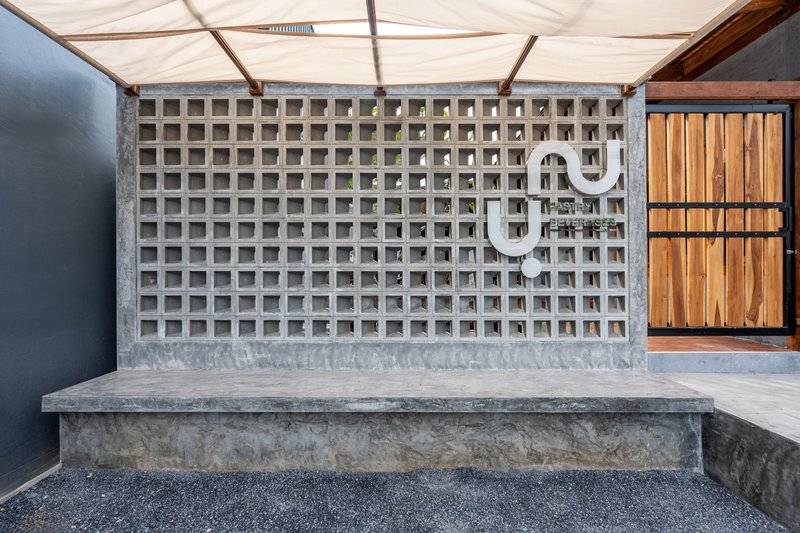
The café's street presence is handled almost entirely by a perforated concrete breeze block wall. It sits below a translucent corrugated canopy and above a raised timber entry platform, creating a threshold that is clearly public but not transparent. The square perforations filter daylight and wind while screening the interior courtyard from the road. It is a simple, affordable move that solves privacy, ventilation, and identity in one gesture.
A fabric canopy extends outward to shade the entrance steps, signaling the café from street level without competing with the neighboring shophouse facades. The elevation is deliberately restrained: concrete, timber, and corrugated roofing are the only materials in play. There is no signage arms race here, just material honesty doing the work of branding.
Courtyards as the Organizing Principle
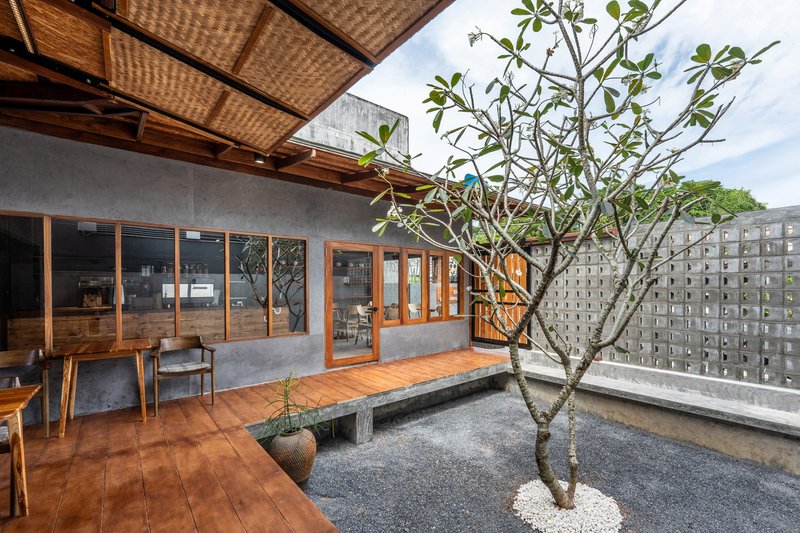
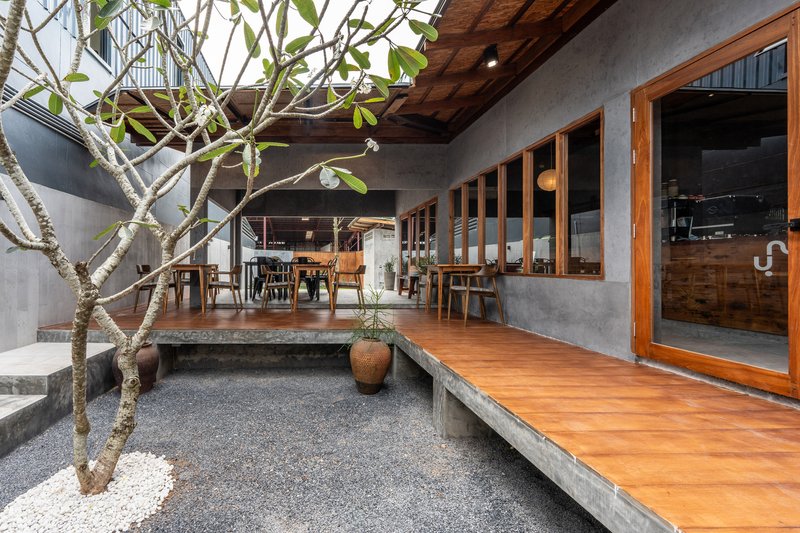
The central courtyard is not a leftover; it is the project's spine. A single tree rises from a gravel bed bordered by a raised timber deck, and the space is framed on all sides by concrete walls and timber-framed glazing. This void pulls air through the building, draws daylight deep into the plan, and gives every seated position a view of something green and growing. On a narrow site flanked by solid party walls, that kind of spatial generosity is an act of discipline, not indulgence.
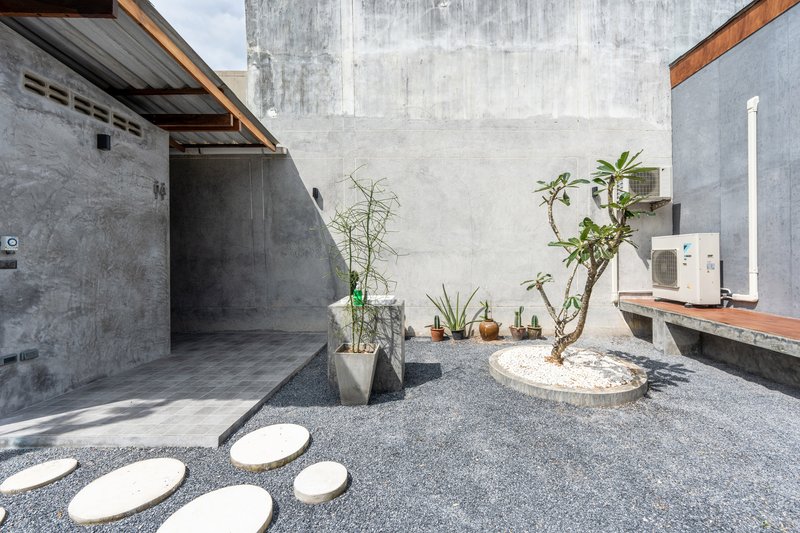
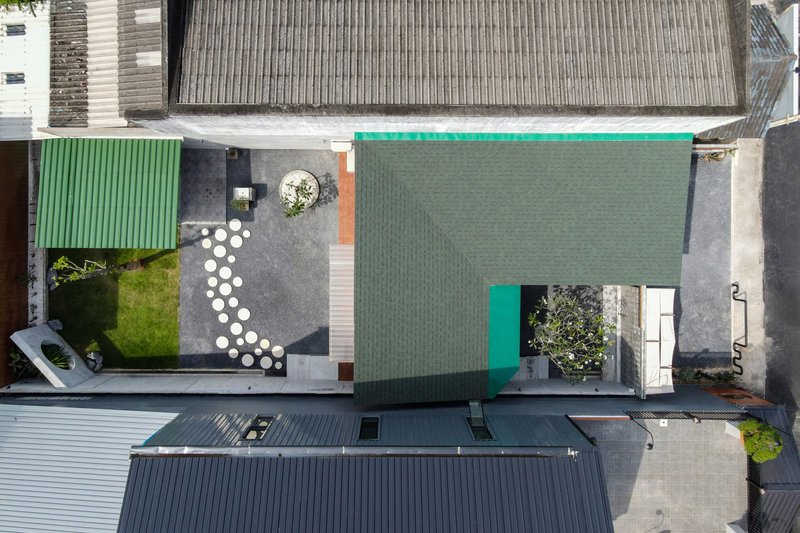
The gravel courtyard at the rear follows a different logic. White circular stepping stones create a path through loose grey aggregate, with potted plants and board-formed concrete walls defining the edges. It functions as a secondary garden and service area, but its careful detailing suggests it was designed with the same attention as the dining spaces. The aerial view confirms how much of the plot is deliberately left open to the sky, a counterintuitive choice for a commercial program that usually demands every rentable square meter.
Reclaimed Timber and Raw Concrete in Dialogue
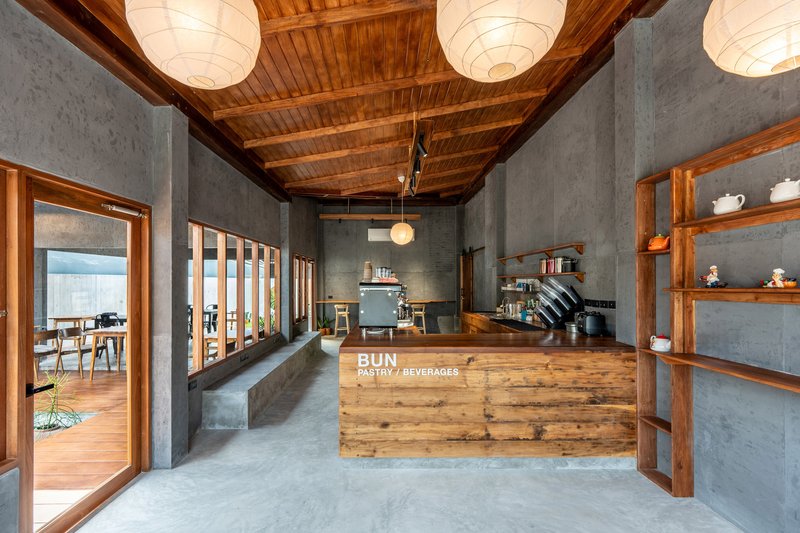
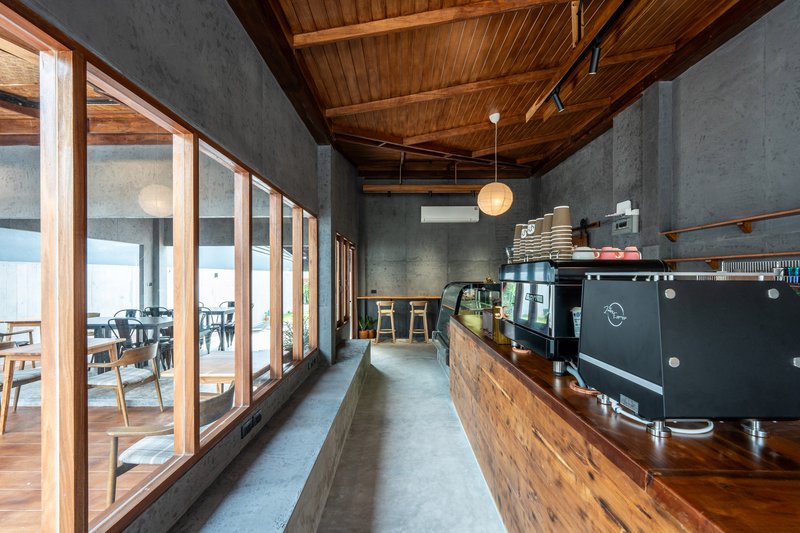
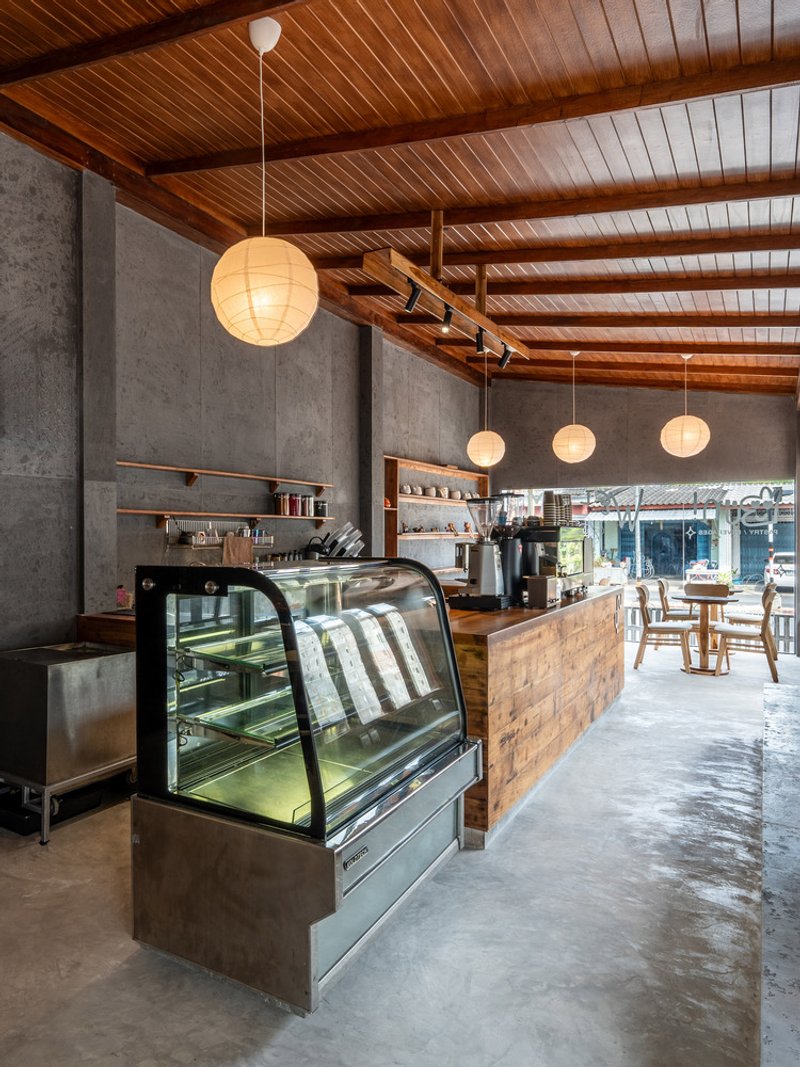
The material palette is limited to two voices: exposed concrete and reclaimed wood. The counter bar, ceiling rafters, and shelving are all built from timber the owner had collected over the years, giving the interior a warmth and patina that new materials cannot replicate. Overhead, the wood structure is left fully exposed, with paper globe pendants hanging between the rafters to soften the light and scale.
The concrete walls carry a dark grey plaster finish textured with PVC sheet formwork, a technique that introduces visual grain without resorting to decorative cladding. Against this backdrop, the curved glass display case and espresso machine read as functional objects rather than design statements. Everything in the material strategy reinforces the same message: keep it honest, keep it buildable, and let the spatial sequence do the talking.
Indoor Rooms That Borrow from the Outside
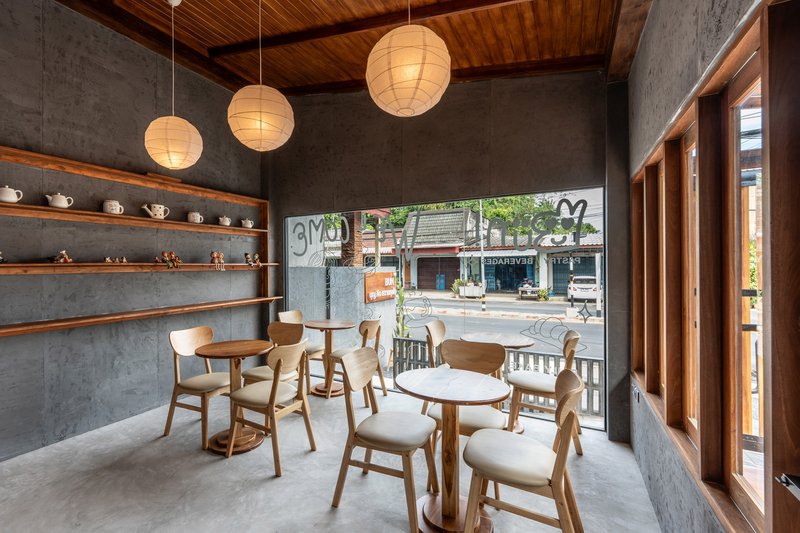
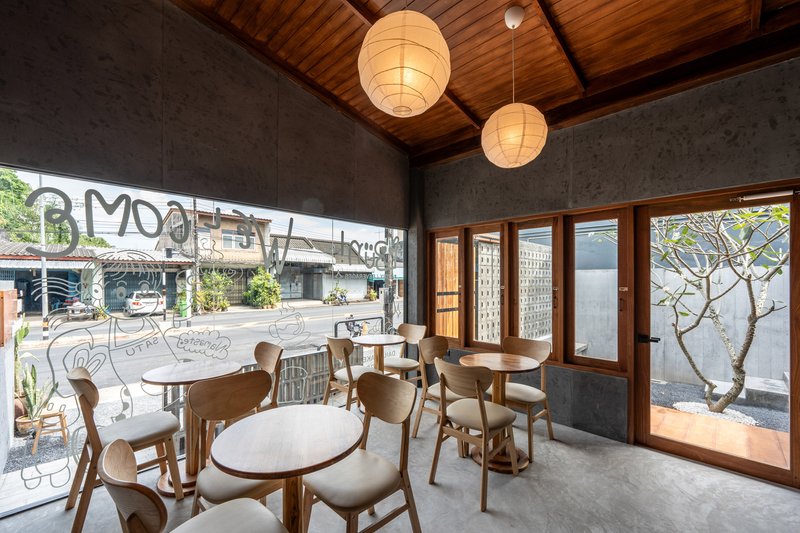
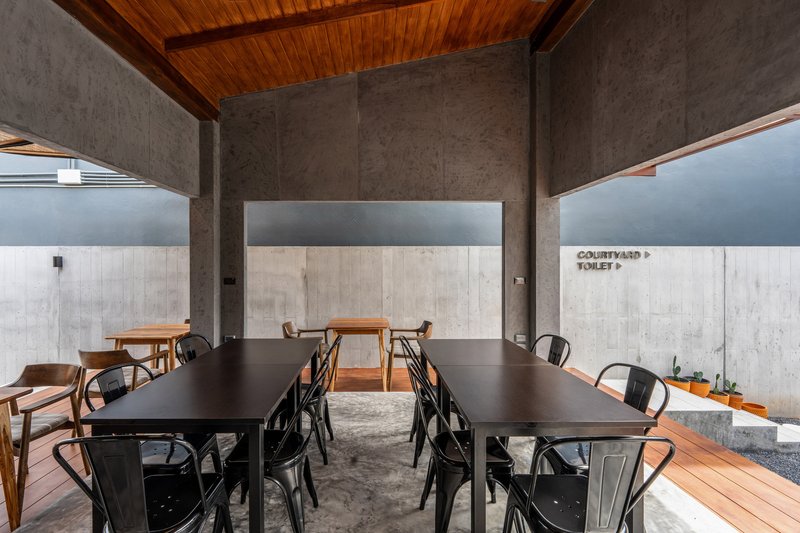
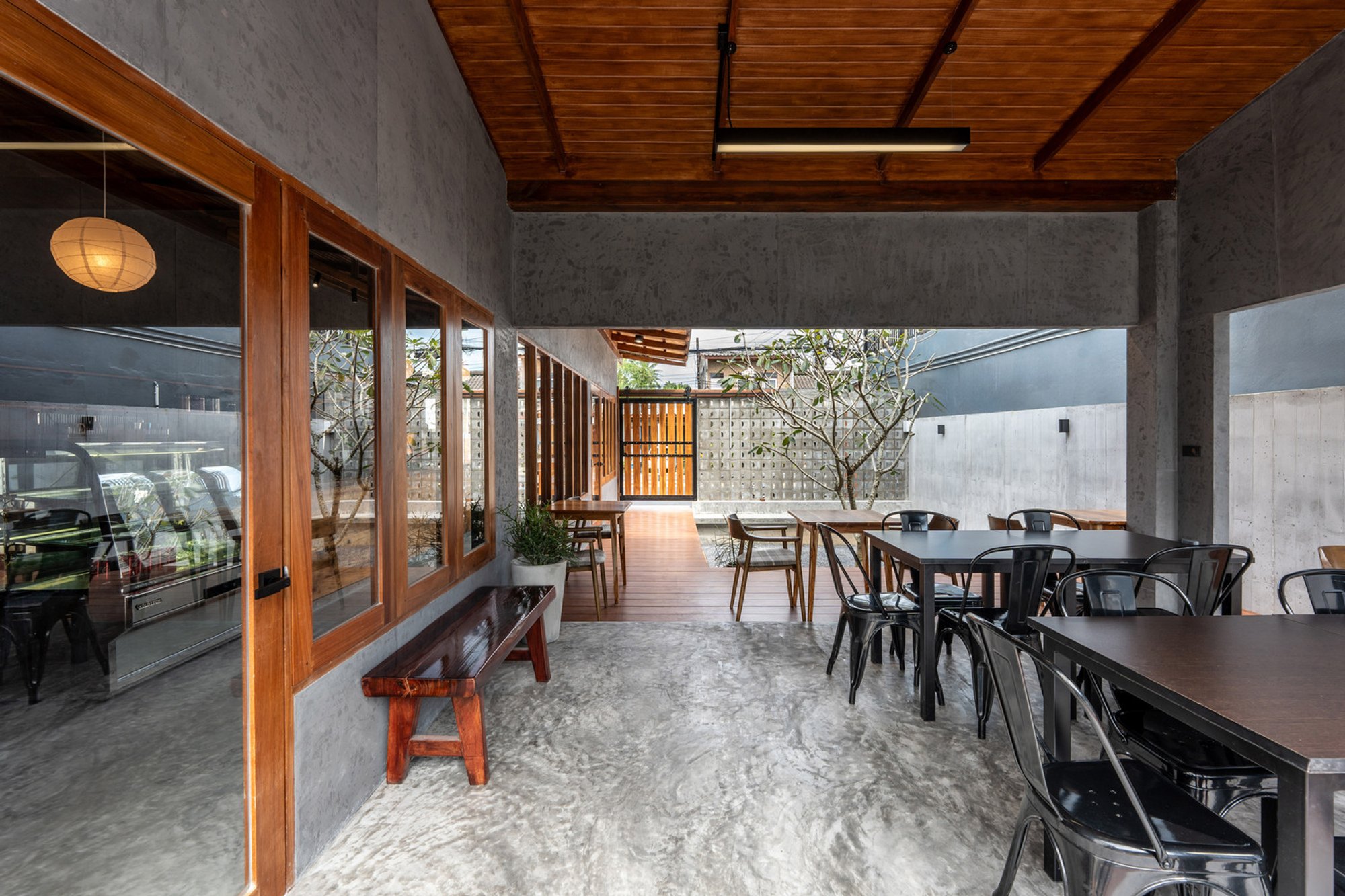
Full-height glazing on the front facade frames the street as a live tableau, while the dining area's timber shelving wall anchors the interior in warmth. The glazed doors facing the courtyard fold open, collapsing the boundary between the timber deck and the indoor seating. When those doors are open, the café becomes a covered terrace; when they are closed, the courtyard tree still reads as part of the room.
Horizontal clerestory windows along the concrete walls introduce daylight from above without sacrificing wall surface, a practical detail that also reinforces the linear directionality of the plan. Directional signage painted on the concrete adds wayfinding without cluttering the surfaces. The interiors are calm without being sterile, largely because every room has a visual escape route to a garden or courtyard beyond.
The Semi-Outdoor Threshold
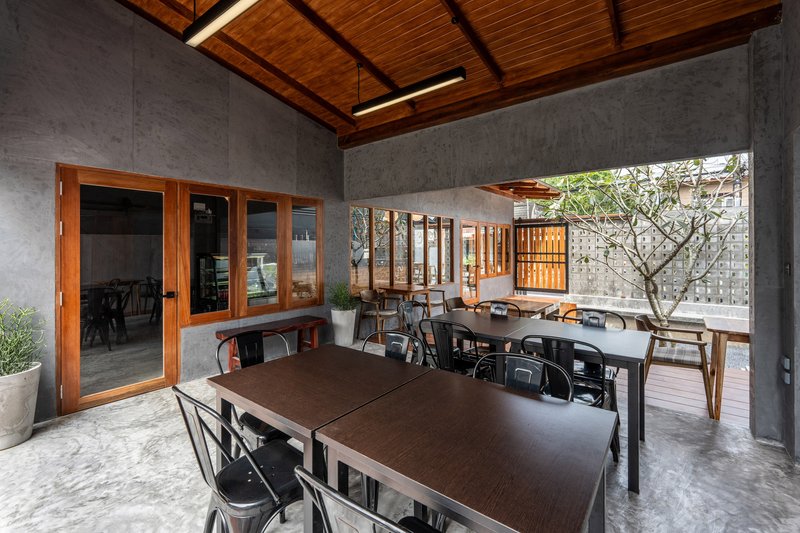
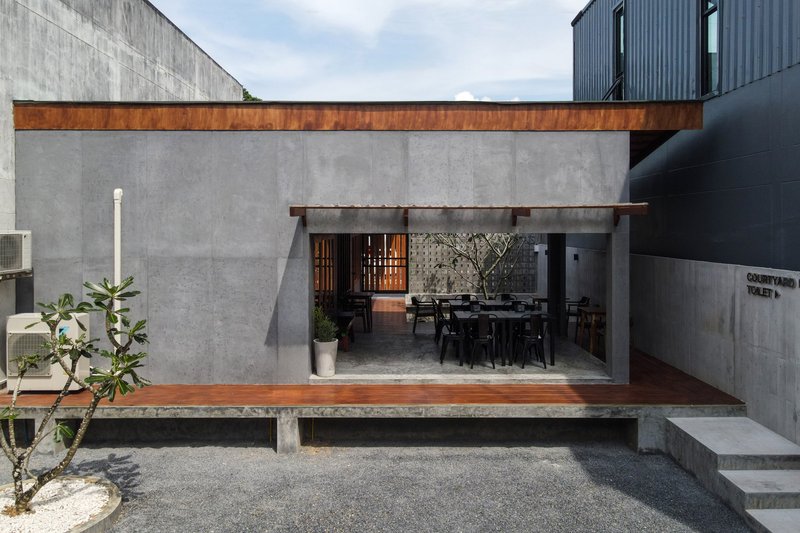
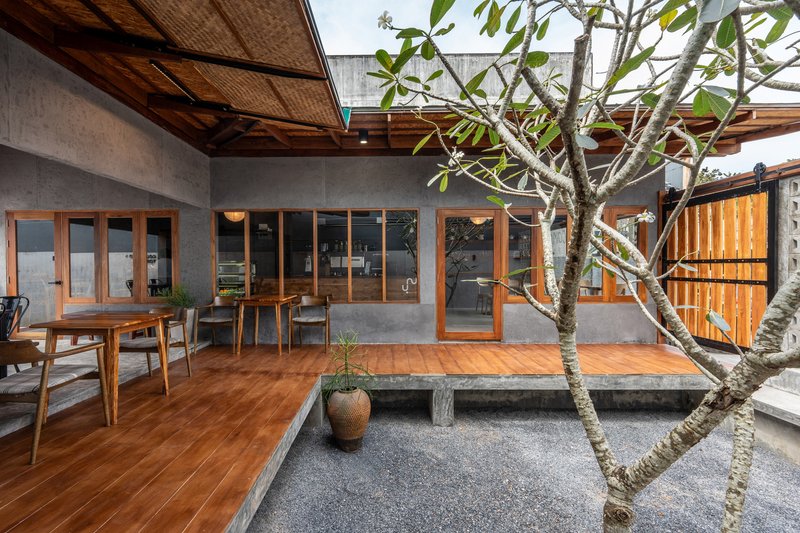
The semi-outdoor space at the core of the plan is the project's most effective move. A covered terrace with dark metal tables sits between the interior café and the courtyard, protected by the extended roof overhang. Folding glass doors on one side and vertical wood screens on the other allow the space to be fully open or partially enclosed depending on weather and crowd. This is where the café's social life concentrates, and the architects clearly designed it that way.
The timber deck steps down into the gravel courtyard, and the open timber-framed roof overhead lets filtered light and air pass through. It is not quite inside, not quite outside, and that ambiguity is exactly what makes it comfortable in a tropical climate. The potted tree at the center anchors the view and gives the space scale, turning a functional transition zone into the most desirable seat in the house.
Gravel Gardens and Site Legibility
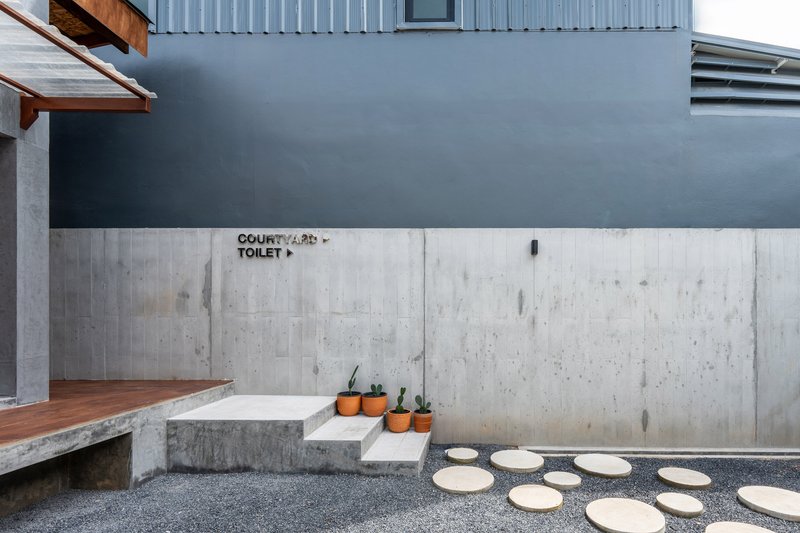
The board-formed concrete wall along the rear courtyard carries stenciled signage, a small gesture that identifies the café from secondary approaches without requiring additional elements. White circular stepping stones set in grey gravel define circulation paths through the gardens, giving the landscape a graphic clarity that echoes the precision of the architecture.
The aerial view reveals the full site strategy: the corrugated roof covers only the occupied rooms, leaving the courtyard and rear garden open to the sky. The adjacent green lawn belongs to the owner's residential side, reinforcing the project brief of integrating a commercial café into an existing family compound. The gravel surfaces handle drainage, reduce maintenance, and provide permeable ground cover, practical decisions that also read as deliberate design choices.
Plans and Drawings
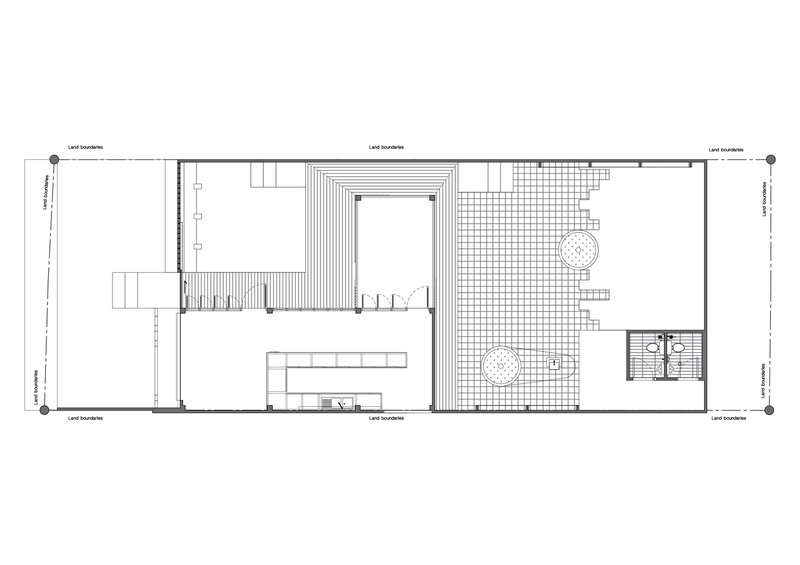
The floor plan confirms what the photographs imply: three interior rooms are arranged linearly along one side of the plot, with a gridded courtyard occupying the adjacent zone. Two circular planters mark the tree positions that organize the outdoor spaces. The plan's simplicity is deceptive. Every room is calibrated to borrow light and air from the courtyard, and the offset entry path creates the sense of procession that visitors experience on arrival. There is nothing accidental here.
Why This Project Matters
Bun Pastry & Beverages does not try to reinvent the café typology. It does something harder: it takes a constrained urban plot, a modest budget, and a handful of honest materials, and produces a space that feels generous, calm, and rooted in its context. The decision to leave half the site open to the sky, on a plot where every square meter has commercial value, is the kind of restraint that separates good architecture from good-looking interiors.
Architect Nonsense demonstrates that biophilic design does not require a jungle on a wall or a rainforest atrium. A single tree in a gravel bed, a folding glass door to a timber deck, a clerestory window that catches the morning light: these are sufficient when they are placed with precision and intention. For architects working on tight sites in Southeast Asian shophouse towns, this project is a clear-eyed case study in doing more by building less.
Bun Pastry & Beverages by Architect Nonsense. Thaimuang District, Phang Nga Province, Thailand. 100 m². Completed 2024. Photography by Thanarit Jirarapeephan.
About the Studio
Share Your Own Work on uni.xyz
If projects like this are the kind of work you want to make, uni.xyz is a place to publish your own, find collaborators, and enter design competitions.




Popular Articles
Popular articles from the community

Eco Chapel: A Green Architecture Pavilion Designed in Symbiosis with the Forest
Eco Chapel uses green architecture to weave prayer, learning and reuse into a forest pavilion shaped by modular hexagonal canopies for life.

Milan Crossover: Sustainable Architecture for a New Fashion Culture in Milan
Milan Crossover transforms fashion culture through sustainable architecture, linking material libraries, remake studios, and public runways.
Inside a Timeless Mumbai Residence by Aether Studio
Aether Studio's 2,250 sq ft apartment in Malad, Mumbai uses marble, brass, boucle, and disciplined restraint to build a quiet retreat from the city.
IKC de Geluksvogel: Sustainable School Architecture Designed for Free Movement and Digital Learning
IKC de Geluksvogel turns sustainable school architecture into a flexible Maastricht campus for digital learning, nature, and free movement.


Similar Reads
You might also enjoy these articles

Olio Towers: A Mid-Rise for Performers That Fuses Housing, Rehearsal, and Stage
Located blocks from Houston's Theater District, this modular tower stacks living units around a central performance atrium.
Oasis: Modular Green Housing Carved into Dhaka's Urban Fabric
A shortlisted Plugin Housing entry reclaims unauthorized settlements in Dhaka with stepped concrete volumes, green roofs, and ventilation-driven design.

Black Hole: A Floating Megastructure for the Post-Physical Era
Emiliano Mazzarotto envisions a spherical, self-scaling arena where e-sports, digital hotels, and holographic stadiums replace traditional public space.
Compact & Sustainable Living in Piraeus: A Four-Level Family Home Built Around Light and Air
A narrow townhouse in one of Greece's densest port cities uses a central atrium and passive strategies to house three generations under one roof.


Explore Architecture Competitions
Discover active competitions in this discipline




The International Standard for Design Portfolios


The Global Benchmark for Architecture Dissertation Awards


The Global Benchmark for Graduation Excellence


Challenge to reimagine the Iron Throne
Comments (0)
Please login or sign up to add comments
No comments yet. Be the first to comment!