

Johan Sundberg Tucks a Larch-Clad Extension into the Apple Trees of a 1920s Lund Villa
A low-slung volume in untreated larch and sedum-covered zinc gives a century-old Swedish home a new ground-level entrance and guest wing.


Adding to a house that has survived a century of use is a gamble. Copy the original too closely and you get pastiche. Ignore it entirely and you get a collision. Johan Sundberg Arkitektur sidesteps both traps with the Timjan extension in Lund, Sweden: a single-storey volume wrapped in untreated larch that sits low enough under the apple trees to read as garden architecture rather than a competing building. Completed in 2020, the addition gives the owners something the 1920s villa never had, a ground-level entrance hall, while also slipping in a guest room, kitchenette, and bathroom.
What makes the project worth studying is its discipline. The material palette is stripped to three elements: vertical larch boards, anthracite-patinated zinc on the roof, and stone underfoot. The color is deliberately muted so the existing peach-rendered villa remains the protagonist. The extension refuses to imitate the old house's pitched roof and stucco walls, yet it never shouts over them. It is a quiet building that gets more interesting the longer you look at its joints, its proportions, and the way its glass surfaces pull the orchard into the interior.
A Garden Piece, Not a Building Wing
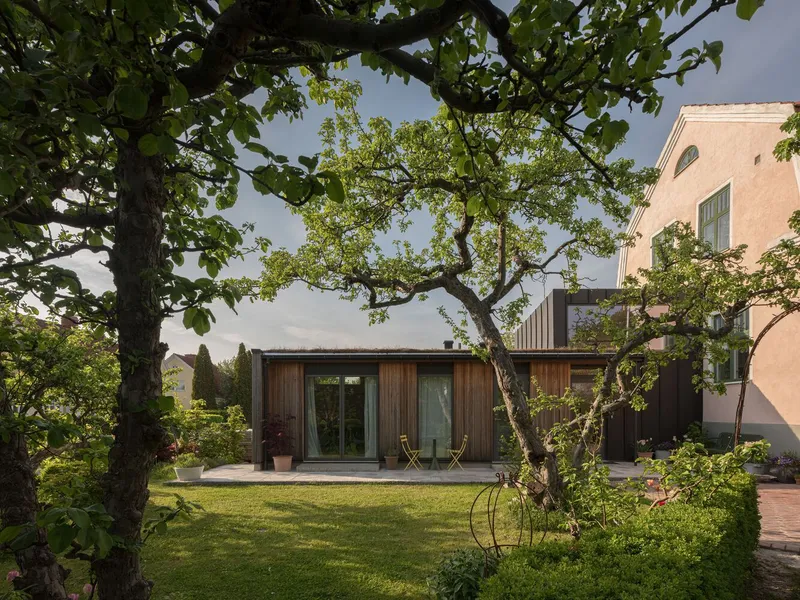
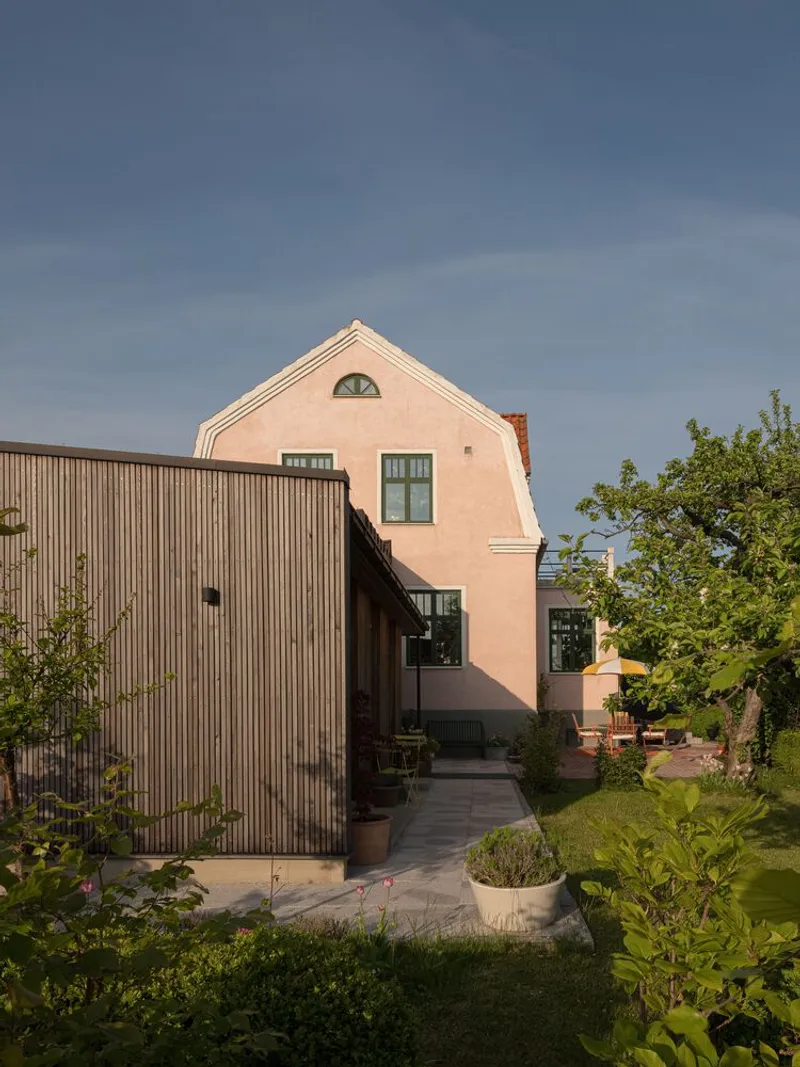
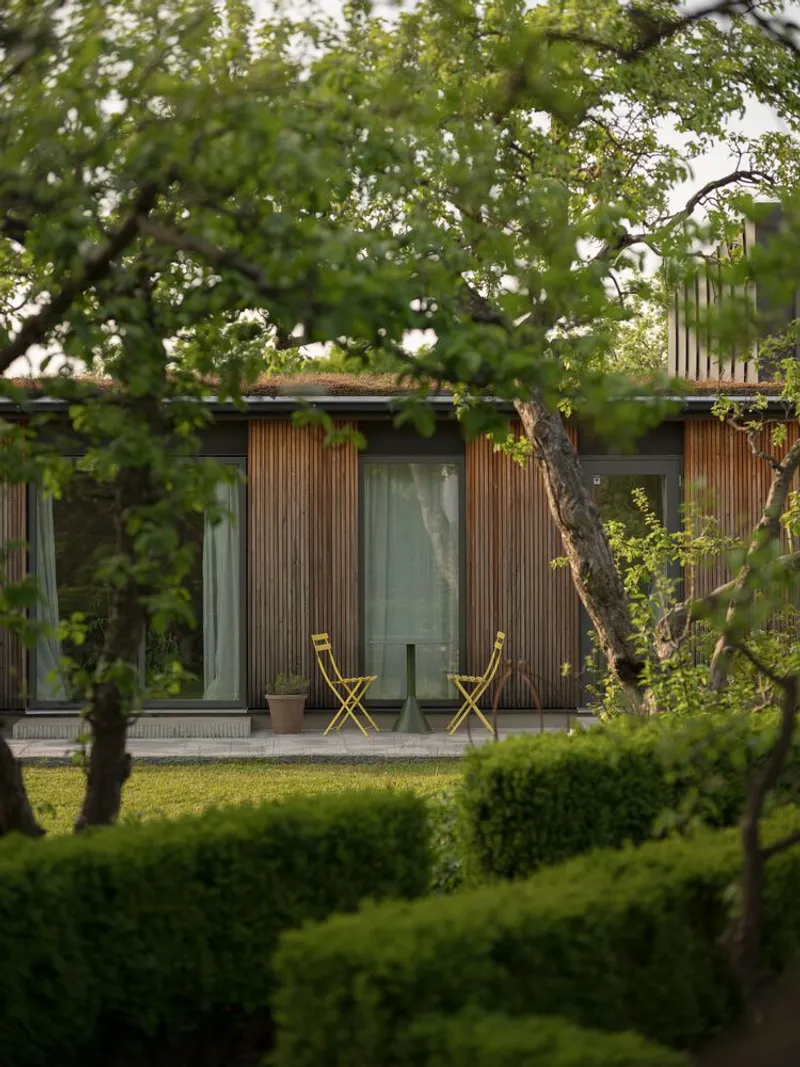
Seen from the garden, the extension barely rises above the fence line. Its gently sloping sedum roof pitches toward a stone terrace on one side and climbs just enough on the other to meet the original gable wall. The roof slope is strategic: it angles away from the neighboring plot for privacy while opening the volume toward the garden and sky. Large glazed panels on the garden facade turn the interior into a kind of inhabited greenhouse, framing mature apple trees and bouncing their reflections back into the orchard.
The vertical larch cladding will silver over the coming years, drawing it closer in tone to the weathered timber structures already dotting the garden. Sundberg has spoken about choosing materials that "mirror materials used in the garden," and the logic is visible here: the building is designed to age into its context rather than resist it.
The Dusk Effect
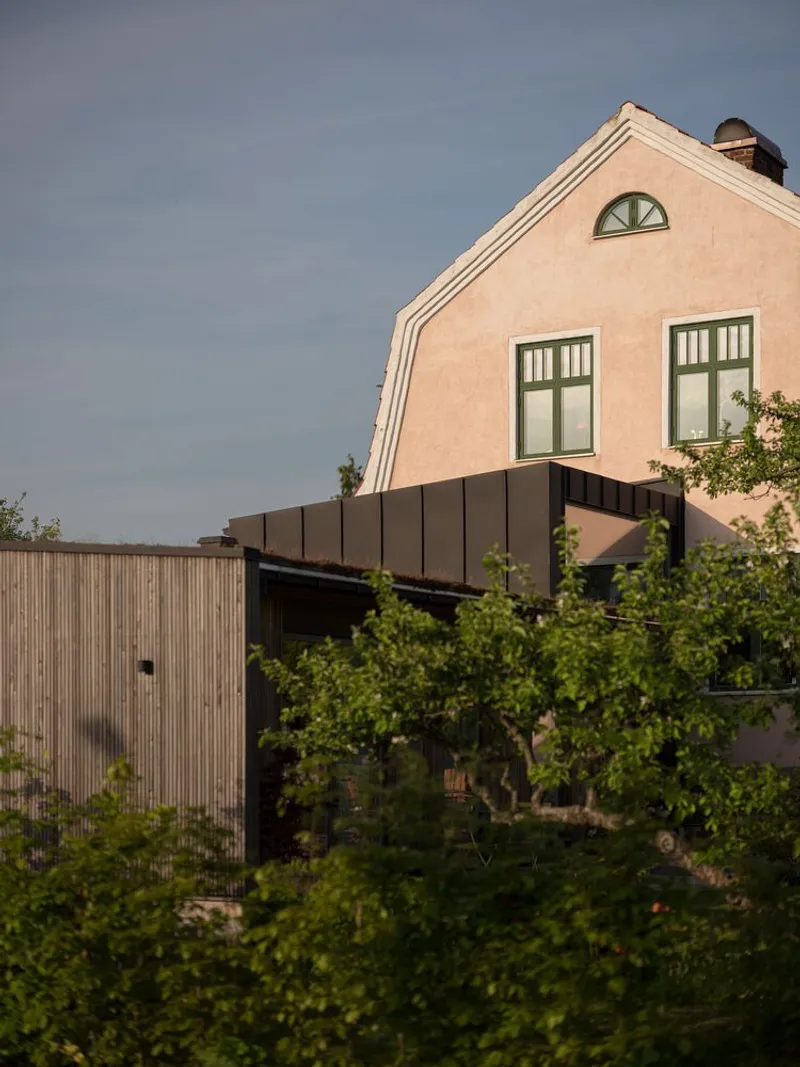
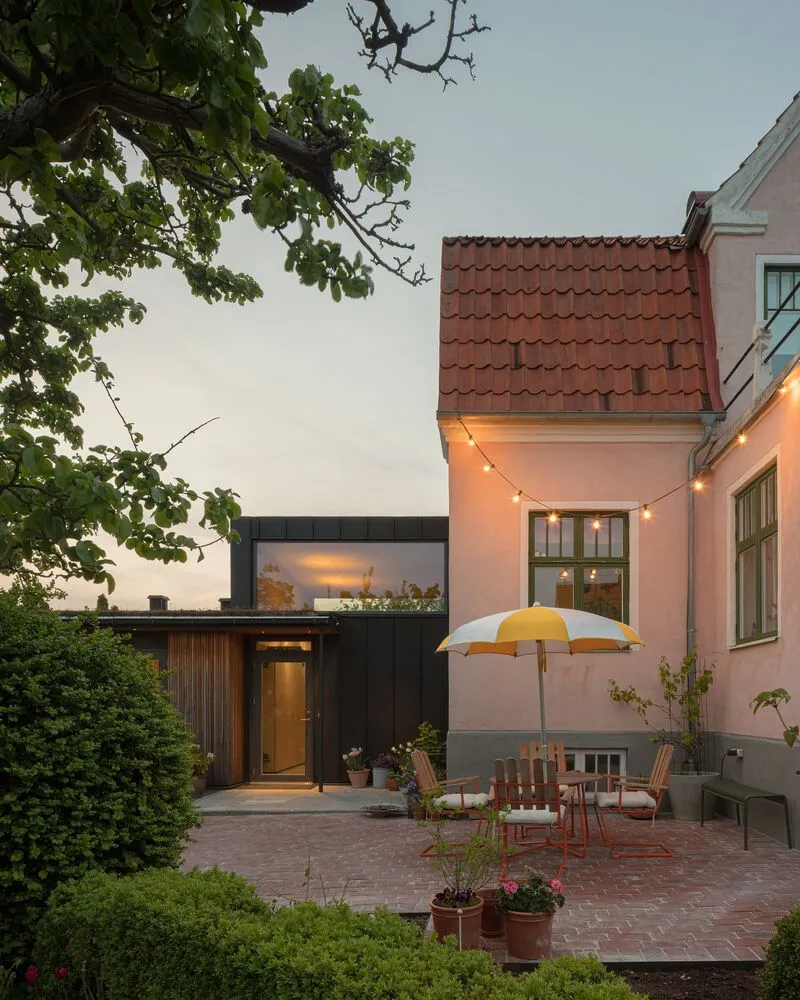
At twilight the extension reveals a second personality. The dark larch panels and zinc parapet recede into shadow, and the illuminated interior glows through its glass walls like a lantern set beneath the villa's arched gable window. The brick patio between old and new becomes a courtyard of sorts, strung with lights and furnished for outdoor meals. It is in these evening photographs that the contrast between the two volumes reads most clearly: rendered masonry and red clay tiles on one side, fine-grained timber and flat metal on the other, joined by a threshold of open air and warm light.
Rethinking the Entrance
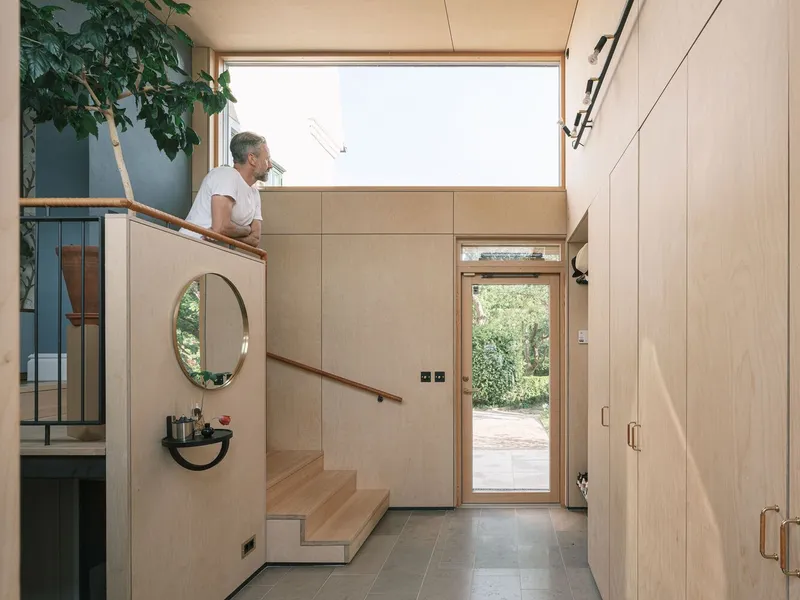
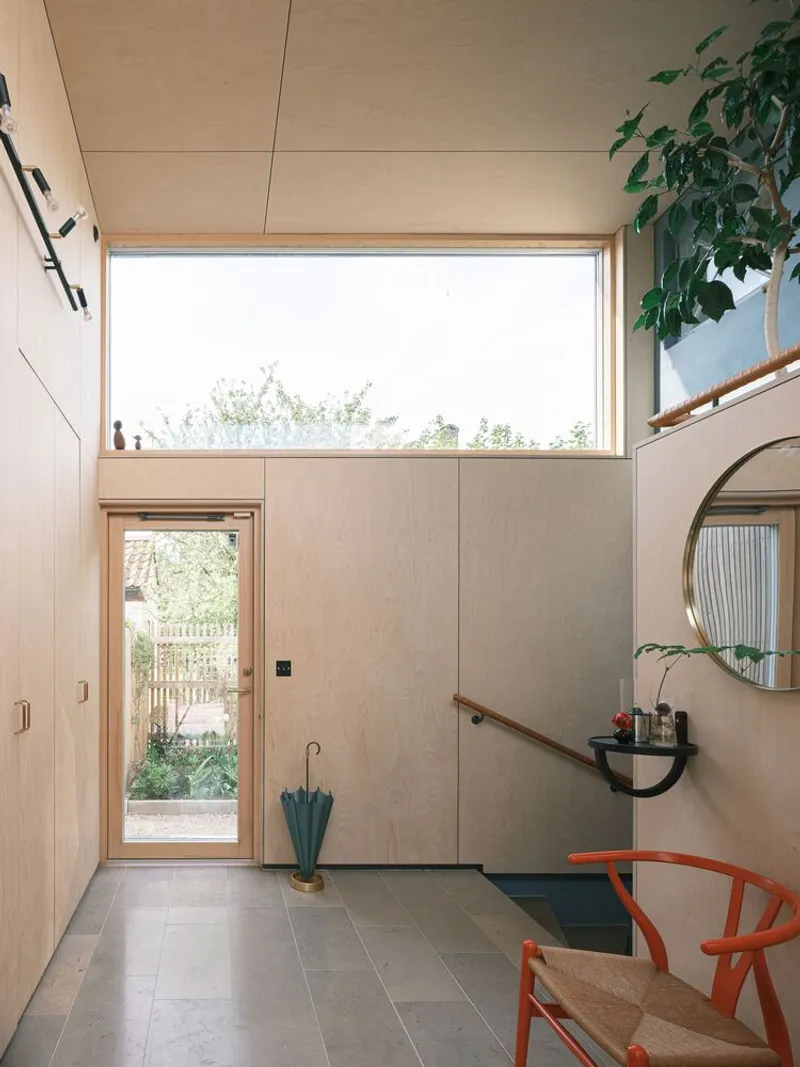
Before the extension, arriving at the villa meant climbing a flight of steps to a door at the top of a staircase. Sundberg moved the entrance down to ground level and wrapped it in a tall, birch-plywood-lined hall that doubles as the circulation spine between the house's different levels. A clerestory window at the top of this volume washes the stairwell with diffused skylight, making the transition from garden to interior feel gradual rather than abrupt.
The glazed door at the base opens directly onto the stone terrace, which the homeowners laid themselves alongside cast concrete steps. This DIY element is worth noting: the project was not a hands-off commission but a sustained conversation between architect and client, with the owners shaping the landscape details that stitch building to ground.
Plywood, Steel, and a Painted Blue Wall
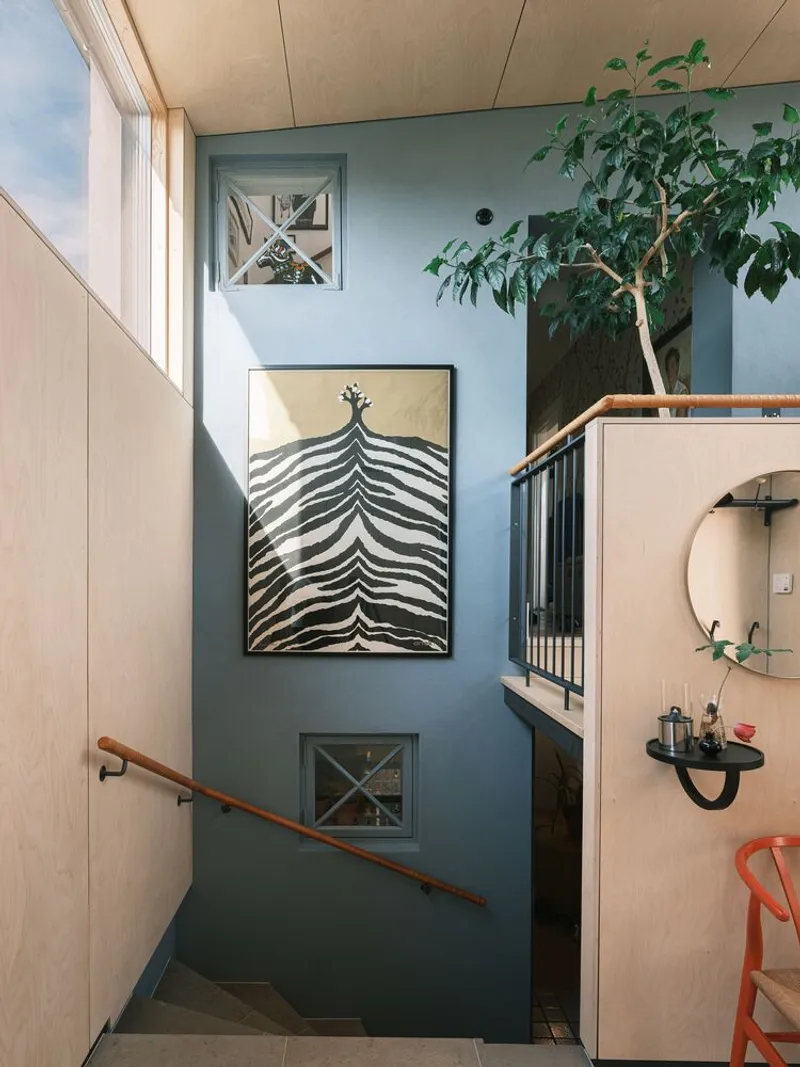

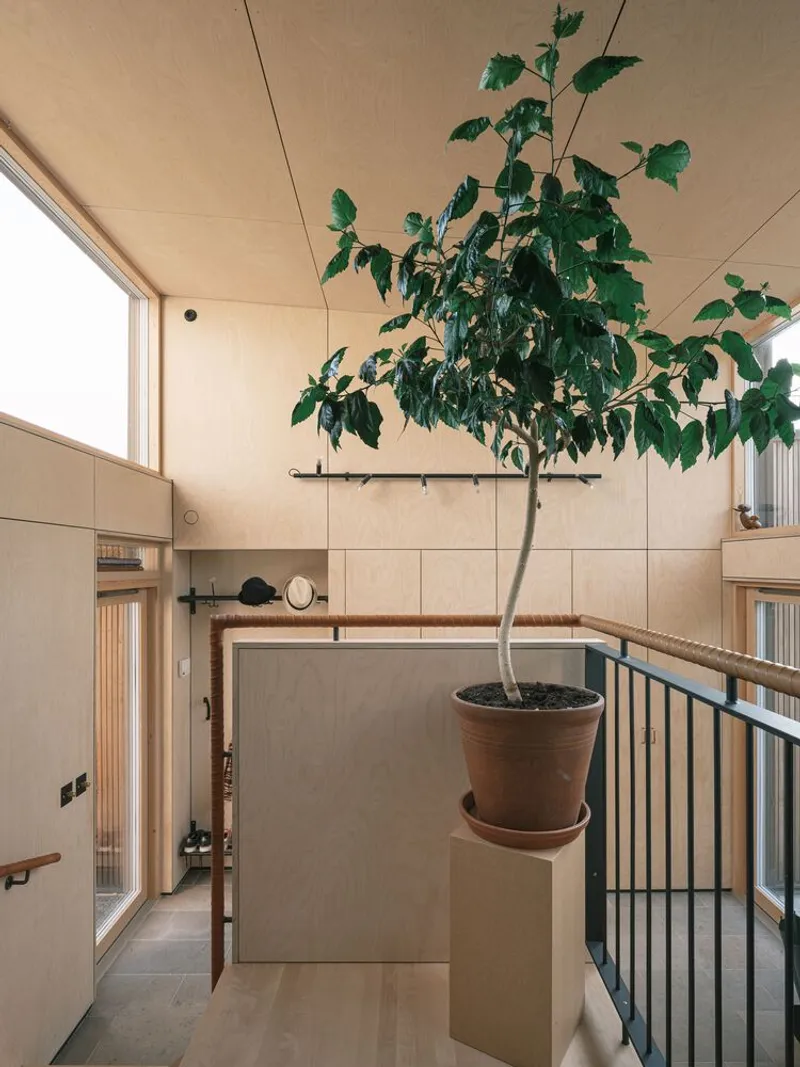
Inside, the interiors toggle between restraint and personality. Birch plywood covers every vertical surface of the new stairwell, giving it a warm, almost Scandinavian-cabin quality that contrasts neatly with the slender steel balustrade. Then, rounding a corner, you hit a wall painted a deep saturated blue, hung with a zebra print and shadowed by an indoor tree. It is a deliberately eccentric moment in an otherwise measured palette, and it works because the plywood backdrop is so calm.
The upper landing, visible from below through the open balustrade, catches light from a high clerestory that sits just under the zinc roofline. Potted plants cluster at the railing edge, reinforcing the sense that the garden does not stop at the glass door but filters upward through the house.
Plans and Drawings
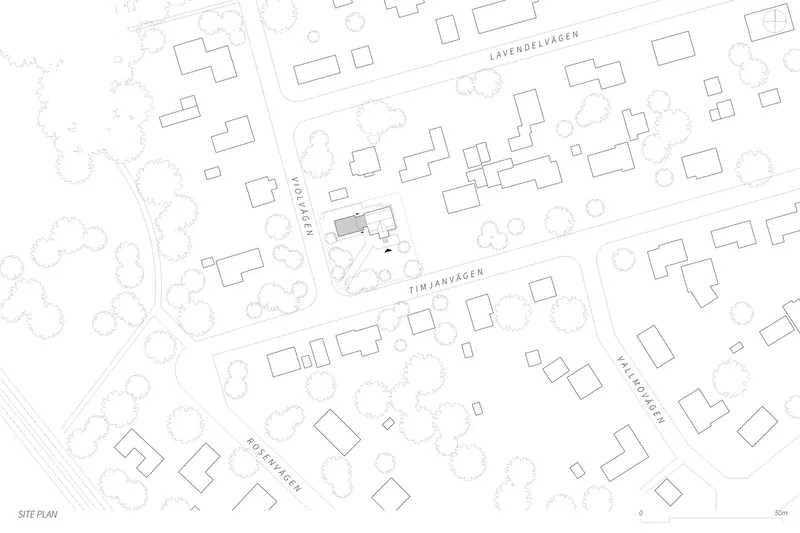
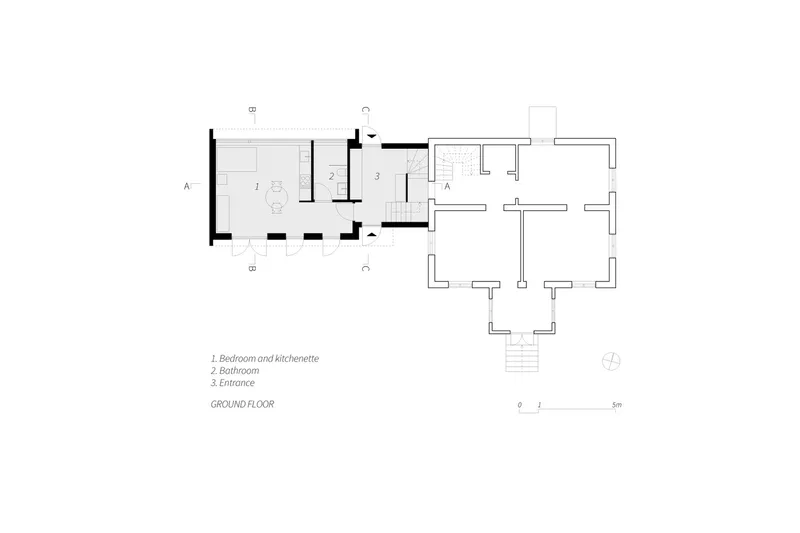
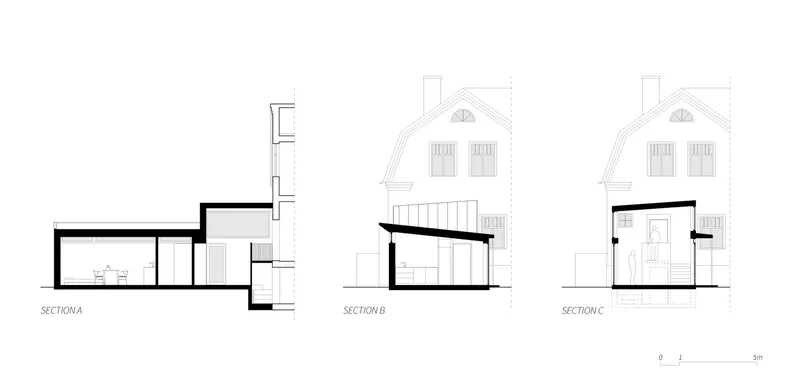
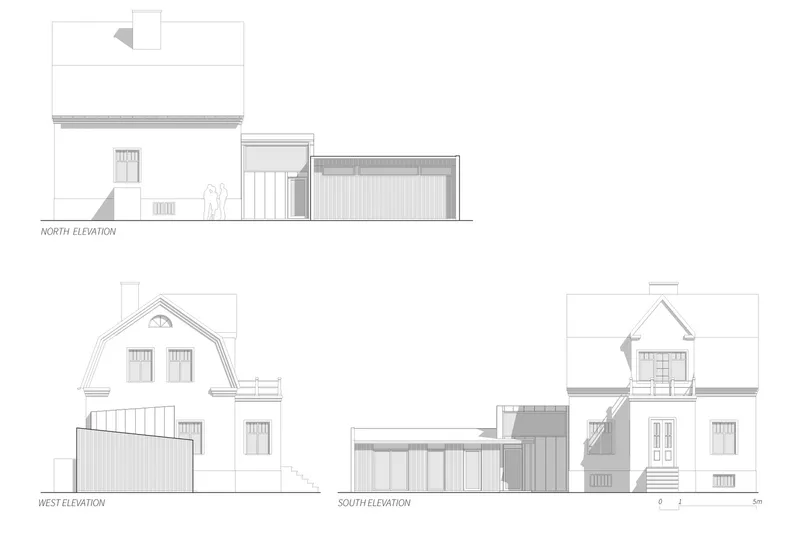
The site plan confirms just how tightly the extension is hemmed in by tree canopies. Its footprint is compact, essentially one room wide, stretching along the villa's flank. The ground floor plan shows the sequence clearly: you enter through the new hall, turn to ascend or continue straight into the guest suite with its kitchenette and ensuite bathroom. Sections reveal the key proportional move. The addition never exceeds one storey, keeping its roofline well below the villa's eaves. The four-sided elevation set, with human figures for scale, demonstrates how the flat zinc parapet mediates between the low timber wall and the existing gable, creating a deliberate gap that lets each volume breathe.
Why This Project Matters
Residential extensions are among the most common commissions in architecture, and they are also among the easiest to get wrong. The temptation is either to blend in through imitation or to stand out through spectacle. Sundberg's Timjan project charts a disciplined middle course: the extension has its own language, its own material logic, and its own relationship to the garden, yet it reads as a natural companion to a house built a hundred years earlier. The restraint in the palette, three materials, no applied color on the exterior, forces attention onto proportion, detailing, and the play of light on surface.
Beyond aesthetics, the project solves a real functional problem. Relocating the entrance to ground level transforms the daily experience of the house, turning a cramped upper-level arrival into a generous, light-filled hall that connects every floor. That a single compact addition can simultaneously fix circulation, add a guest suite, and redefine the garden boundary is a reminder that the best extensions are not about adding square meters. They are about rethinking how a house works.
Timjan House Extension, Lund, Sweden. Architect: Johan Sundberg Arkitektur. Completed 2020. Photography by Markus Linderoth.
About the Studio
Share Your Own Work on uni.xyz
If projects like this are the kind of work you want to make, uni.xyz is a place to publish your own, find collaborators, and enter design competitions.


Popular Articles
Popular articles from the community


U.GA Architects Wraps an Oval Rooftop Pool in Curved Board-Formed Concrete on Busan's Jeollidan-gil
In Busan's Jeonpo-dong, a 454 m² mixed-use block stacks a neighborhood facility, guest rooms and an oval rooftop pool inside spiraling concrete walls.

Cube Design Draws an Ecological Corridor Between Two Shenzhen Hills with the Nankai Building
Beside Shenzhen's container docks, the Nankai Building pairs stacked balconies with a climbing green screen to connect two hillsides across its height.

Jaramillo Van Sluys Arquitectura and Urbanismo Turn a Demolished Registry Lot in Quito into an Orchard Plaza
In Quito's Centro Histórico, a 2,800 m² plaza exposes the San Agustín convent wall and redraws its lost Augustinian orchard in volcanic stone.

David Macias Steps a Doorless Stone and Plaster House Down a Tropical Colombian Hillside
In the humid hills of Colombia, Threshold House replaces the front door with an open void and terraces its 850 m² down the slope instead of fighting it.

Similar Reads
You might also enjoy these articles


Hodi-Mandai Geram
Project Function: Preservation and revitalization of the Intangible heritage and socio-spatial identity of the Hodi by Housing, Cultural Memory Center, Sacred Grove, landscape, local tourism economy


Olio Towers: A Mid-Rise for Performers That Fuses Housing, Rehearsal, and Stage
Located blocks from Houston's Theater District, this modular tower stacks living units around a central performance atrium.

Oasis: Modular Green Housing Carved into Dhaka's Urban Fabric
A shortlisted Plugin Housing entry reclaims unauthorized settlements in Dhaka with stepped concrete volumes, green roofs, and ventilation-driven design.

Black Hole: A Floating Megastructure for the Post-Physical Era
Emiliano Mazzarotto envisions a spherical, self-scaling arena where e-sports, digital hotels, and holographic stadiums replace traditional public space.

Explore Building Extension Competitions
Discover active competitions in this discipline

Challenge to reimagine the Iron Throne

Photograph architecture without architects

Illustrate the lost glory of Angkor Wat - Render Challenge

Design challenge to reuse E-waste
Comments (0)
Please login or sign up to add comments
No comments yet. Be the first to comment!