

NH Village Architects Curves a Multi-Generational Home Around Courtyards in Rural Vietnam
Xom Me House in Ninh Bình province revives traditional Vietnamese rural living with perforated brick screens, zigzag gardens, and arc-shaped volumes.


Rural Vietnam is losing its young people. As demographics shift and land gets subdivided into tight urban-style parcels, the generous courtyards and verandas that once defined village life are disappearing. Xom Me House, completed in 2024 by NH Village Architects in Gia Vien District, Ninh Bình province, is an argument that none of this is inevitable. Rather than defaulting to the boxy concrete volumes that now dot the countryside, the architects bent their plan into an arc, wrapped it in perforated brick screens, and threaded gardens through every seam. The result is a house that feels simultaneously ancestral and contemporary.
What makes the project genuinely interesting is not the nostalgia but the method. The house is designed as a multi-generational compound: a place for ancestral worship, extended-family gatherings during festivals, and quiet daily routines. Instead of stacking those programs vertically or isolating them behind walls, NH Village Architects distribute them across a series of interconnected courtyards and terraces that make the outdoor space the primary social infrastructure. The building is, in many ways, organized around what it isn't: the voids between its white stucco volumes are where the life of the house actually happens.
An Arc-Shaped Plan That Catches the Breeze
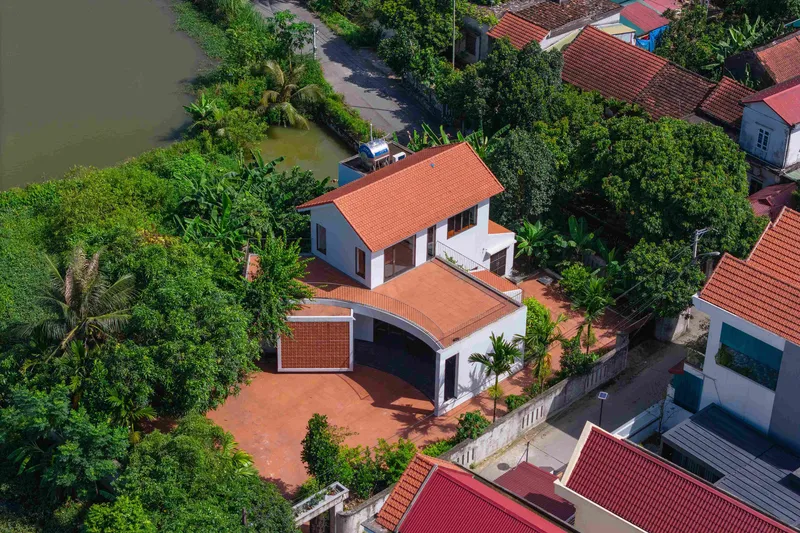
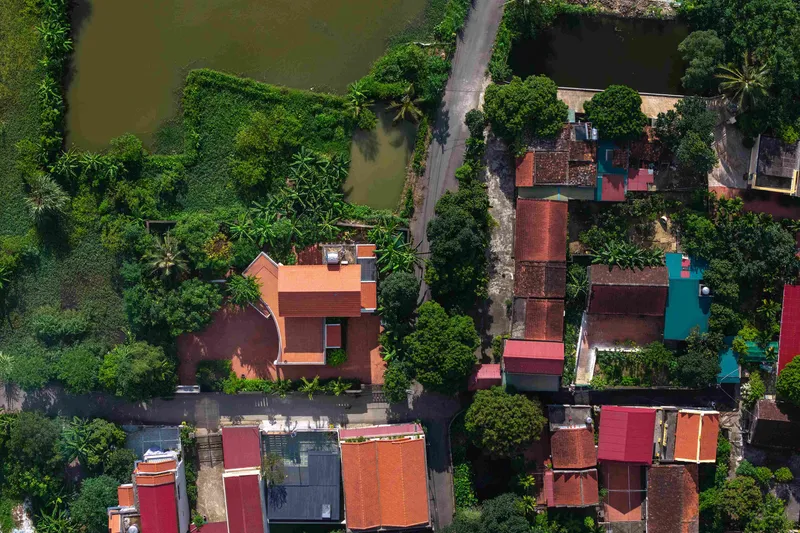
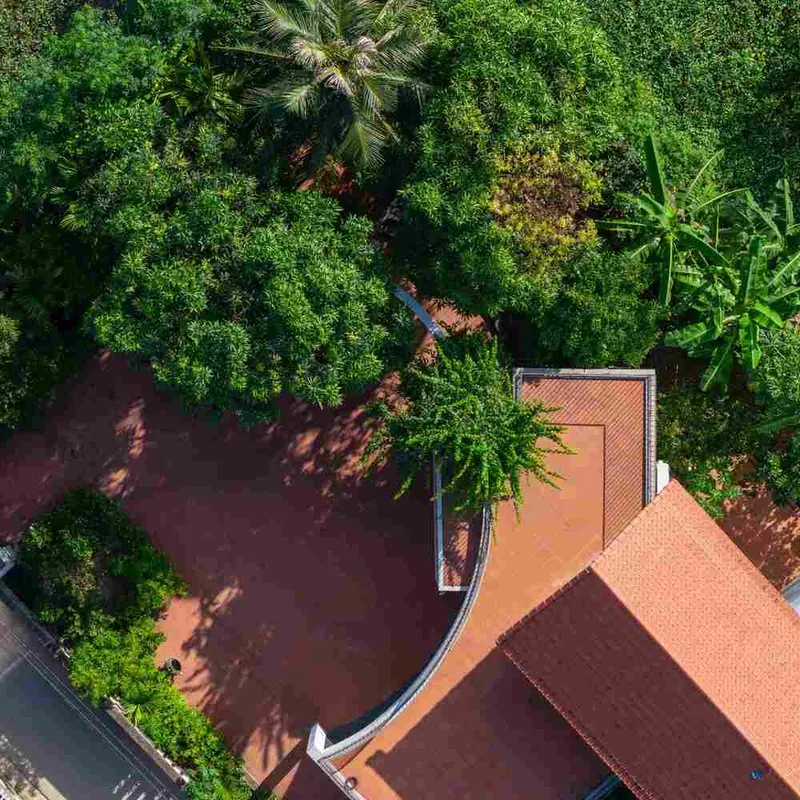
Seen from above, Xom Me House reads as a cluster of terracotta-roofed volumes curved to face south, orienting the compound toward the prevailing breezes. The arc is not a formal gesture for its own sake. It creates a front courtyard that widens toward the landscape and funnels wind through the living spaces, reducing the need for mechanical cooling. Large sliding doors along the curve allow the interior to open almost entirely to the gardens, turning ventilation into a spatial experience rather than a technical problem.
The aerial views reveal how thoroughly the house is embedded in its site. Dense tropical vegetation, a river, and palm trees press in from all sides, and the compound's terracotta roofs echo the warm tones of the earth beneath them. The building does not stand apart from the landscape; it negotiates with it, carving out pockets of shade and openness within the canopy.
Perforated Brick as Climate Filter and Cultural Marker
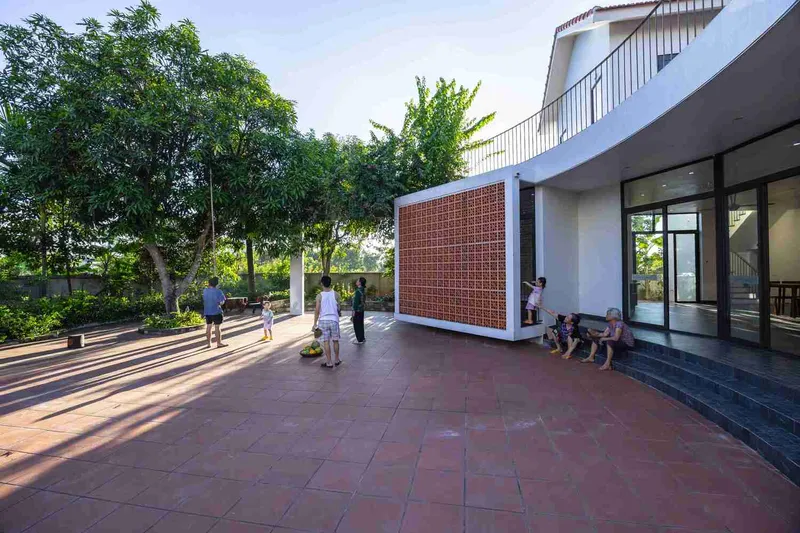
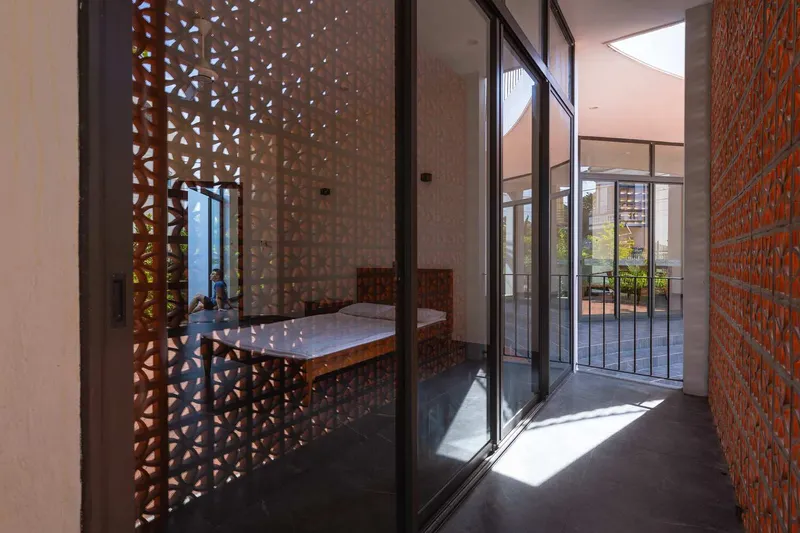
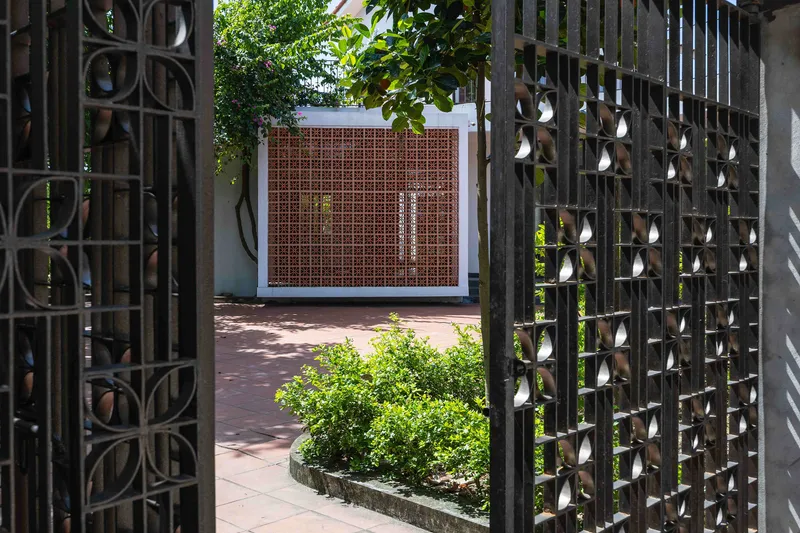
The defining material move is the perforated terracotta brick screen, which appears on nearly every facade and boundary wall. These screens do triple duty. Climatically, they filter direct sunlight into shifting patterns of shade while allowing cross-ventilation. Spatially, they mediate between public and private, letting occupants see the garden without being fully exposed to the street. And culturally, they reference the decorative brickwork found in older Vietnamese village architecture, grounding the house in a recognizable regional vocabulary.
The effect is most dramatic in the covered terrace and the glazed corridor, where afternoon light passes through the screens and projects geometric shadows across the terracotta tile floors. It is a simple technique, but the architects deploy it with enough variety, changing the pattern density and orientation from wall to wall, that the screens never become monotonous. The light quality shifts throughout the day, giving each room a distinct temporal character.
Courtyards as the Heart of Communal Life
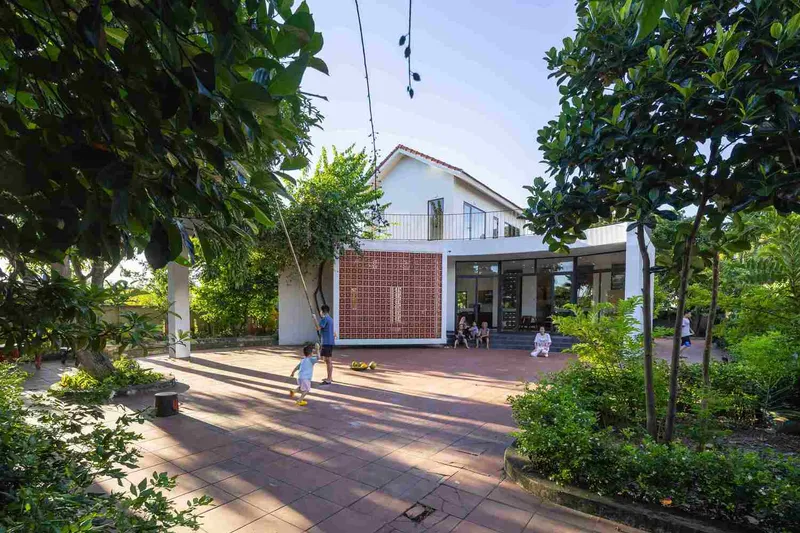
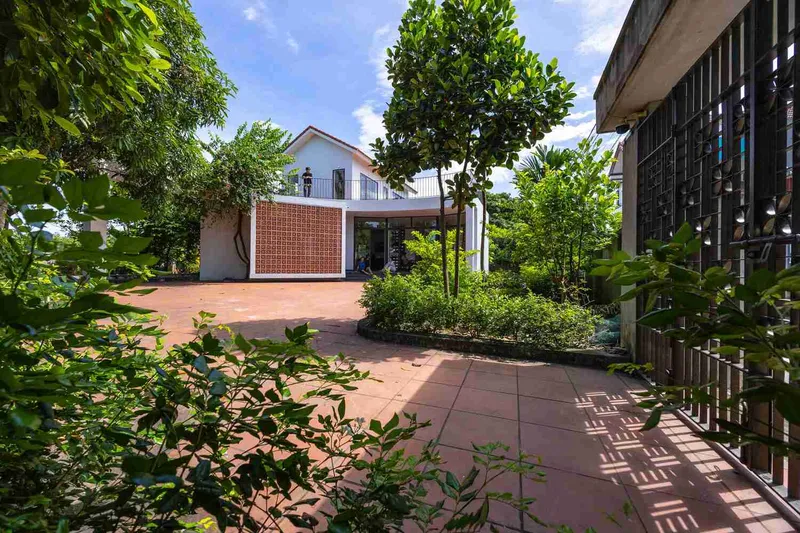
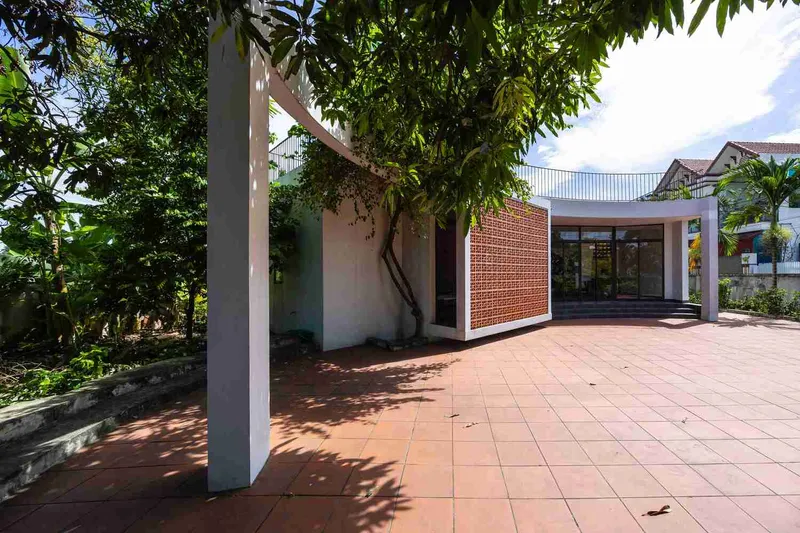
Traditional Vietnamese rural homes organized daily life around a hierarchy of outdoor spaces: the front yard for receiving guests, the rear garden for cooking and chores, the veranda for resting. Xom Me House revives this hierarchy but reconfigures it. A front courtyard paved in red ceramic tile extends beneath mature trees, providing a generous gathering space for festivals and ceremonies. Planted beds and decorative concrete screens define edges without creating barriers, keeping the compound visually porous.
Children playing beneath the tree canopy in the front court is the kind of scene that could feel staged, but here it reads as proof of concept. The space is scaled for real social use, not aesthetic photography. When the extended family arrives for ancestral worship or Tết celebrations, these outdoor rooms absorb the crowd. When the house is quiet, they become meditative garden spaces. The zigzag garden threading between the volumes ensures that greenery is never more than a few steps from any interior room.
Interior Spaces That Blur Inside and Out
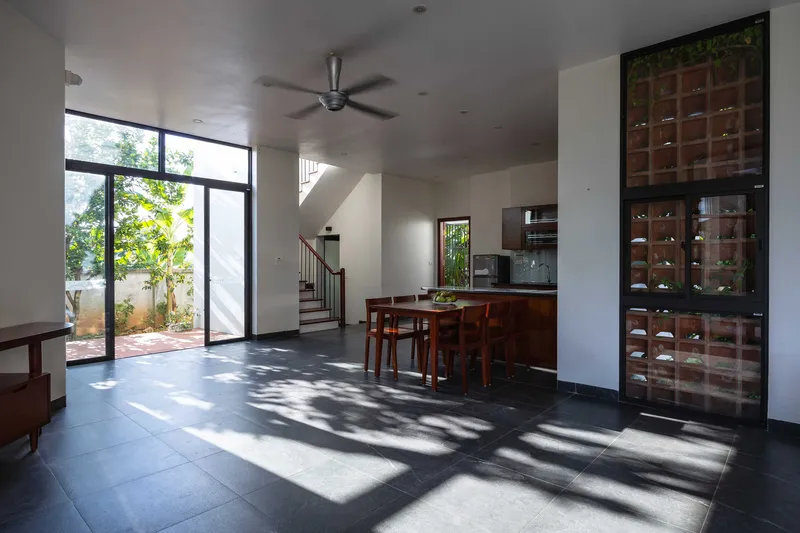
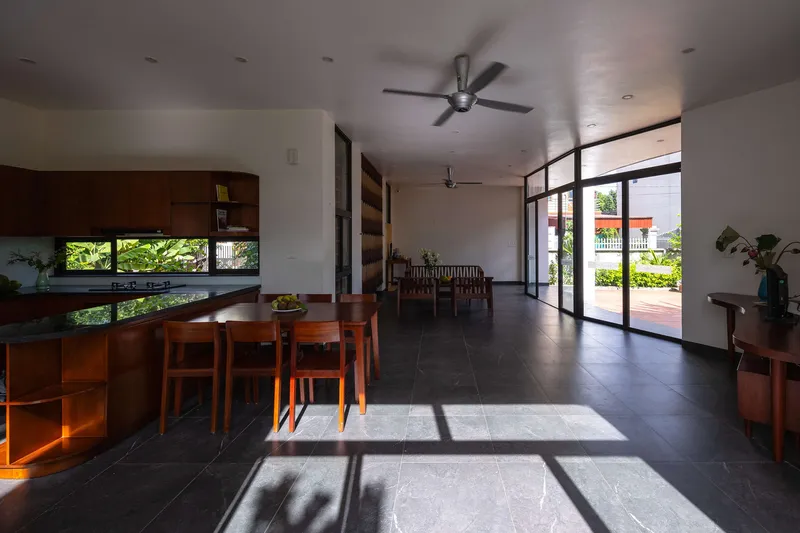
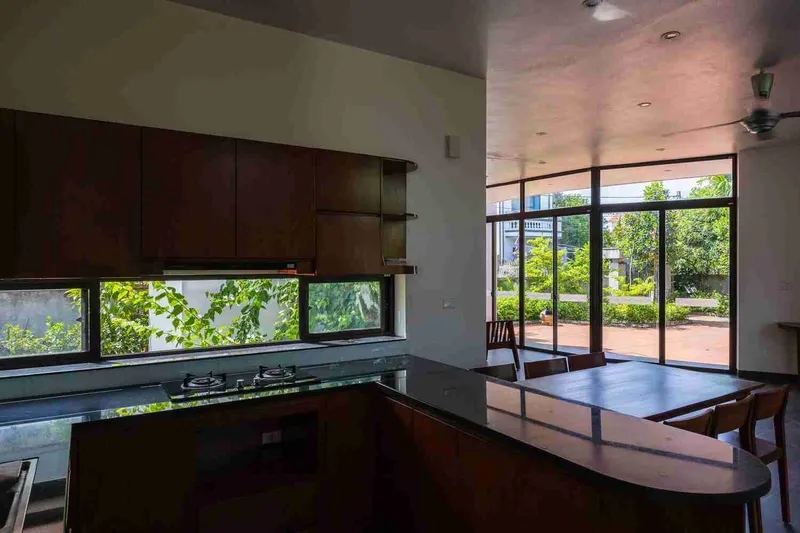
The ground level is given over to communal functions: an open-plan living and dining area with dark tile flooring that absorbs heat and anchors the space visually. Full-height glass doors on the courtyard side dissolve the wall plane, letting dappled sunlight flood the interior. The kitchen tucks behind dark timber cabinetry, with a horizontal window beneath the upper cabinets framing a strip of garden. It is a restrained palette: dark floors, white walls, natural light. The materials do the talking.
What works particularly well is the continuity of the floor plane. The dark tile extends from the living area through the glazed corridor and out to the terrace, blurring the boundary between conditioned and unconditioned space. You move through the house and barely register the threshold. The architecture encourages a way of living in which "indoors" and "outdoors" are not binary categories but a gradient.
Private Rooms with Bamboo and Timber
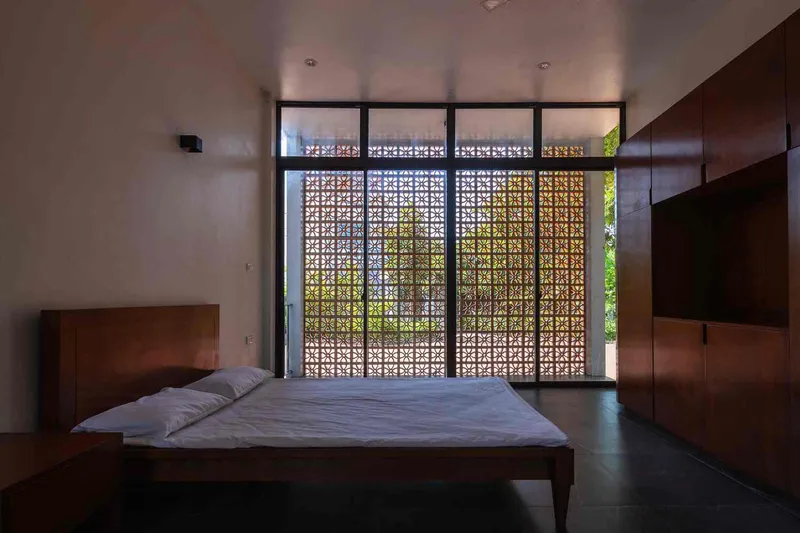
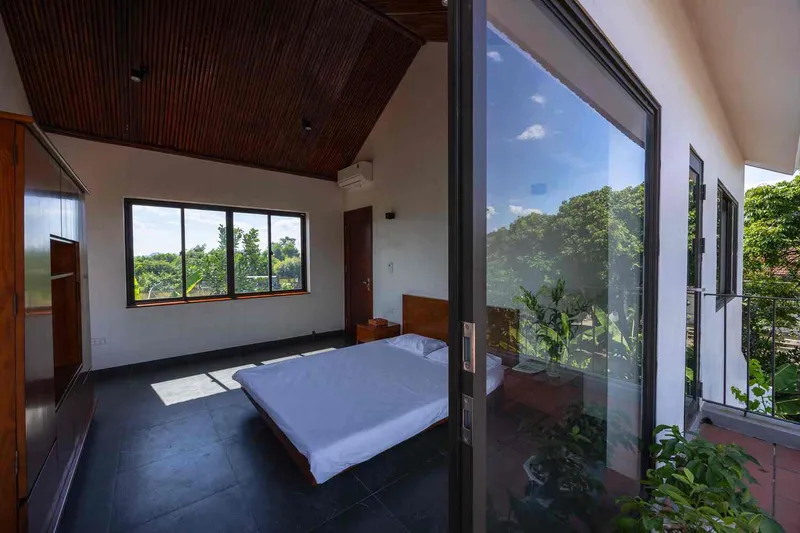
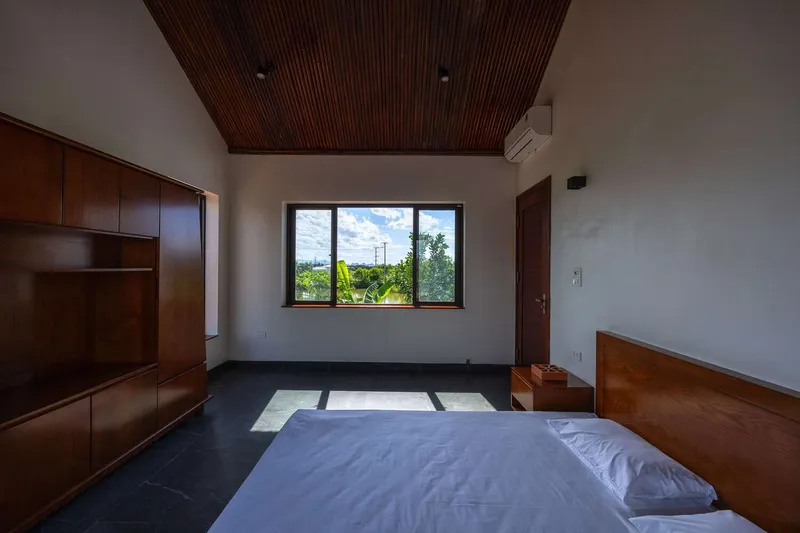
Bedrooms occupy the upper level, and the material register shifts. Timber slatted ceilings and bamboo panels replace the white plaster of the ground floor, wrapping the private rooms in warmth and texture. One bedroom faces a full-height perforated brick screen that filters daylight and frames garden views without sacrificing privacy. Another opens through glass doors onto a planted terrace beneath blue sky, treating the roof as an extension of the garden below.
The built-in cabinetry and restrained furnishing keep these rooms feeling spacious despite the compact plan. There is a deliberate economy here: every surface either frames a view, admits light, or stores something. The bamboo ceiling is not decoration; it unifies the upper level acoustically and visually, creating a sense of enclosure that contrasts with the openness of the communal spaces below. The house breathes differently at each level, and that difference is the architecture.
Street Presence and Contextual Form
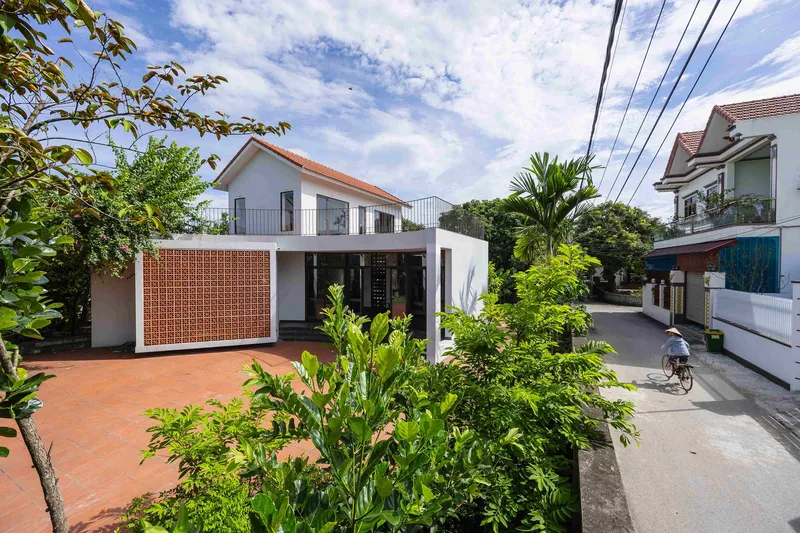
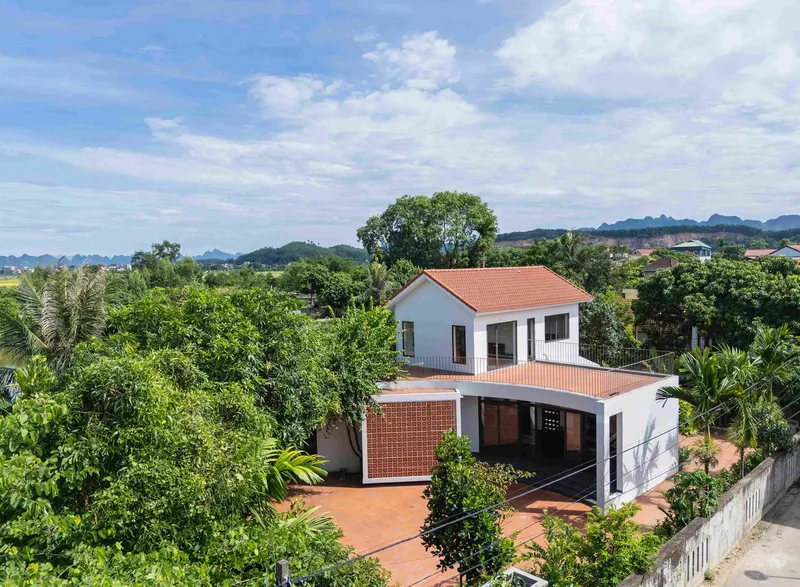
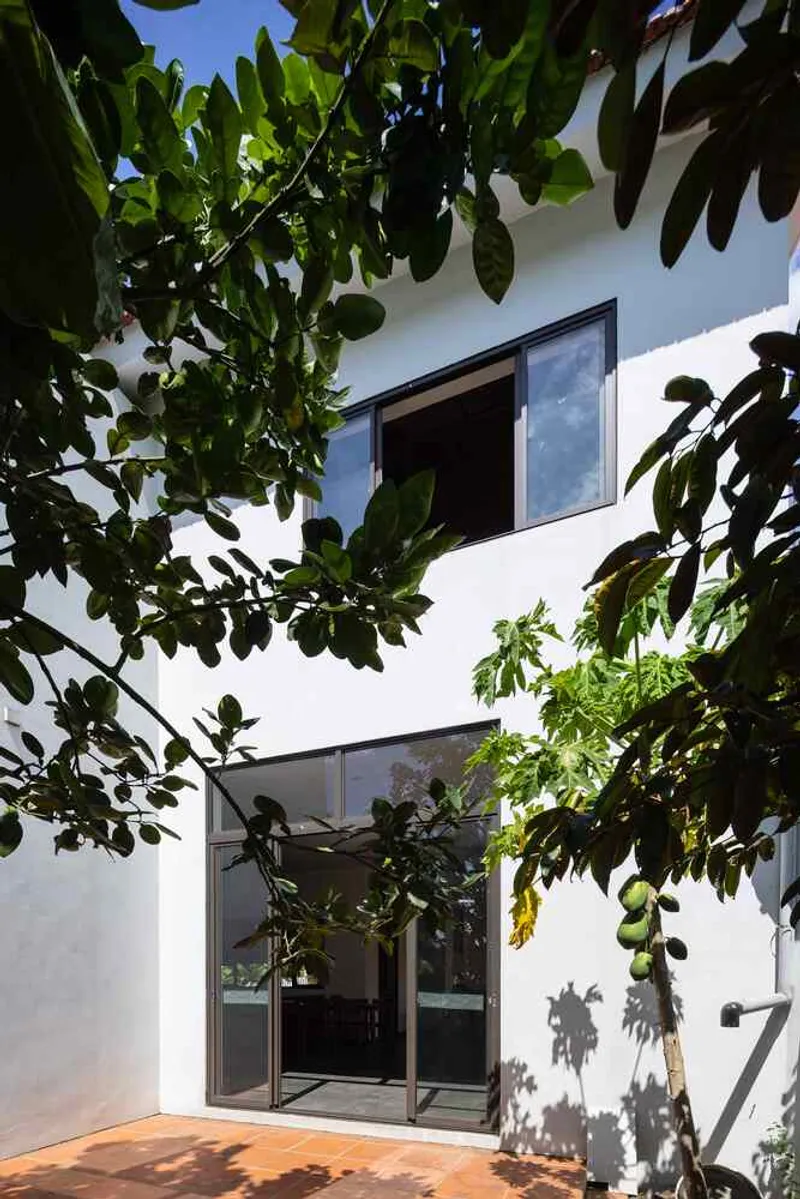
From the street, Xom Me House presents itself modestly: white stucco walls, terracotta roofs, a perforated screen that hints at the courtyard behind. It does not announce itself with cantilevered volumes or exposed concrete. Against the backdrop of Ninh Bình's limestone hills and lush vegetation, the two-storey volumes read as an outgrowth of the landscape rather than an imposition on it. The curved plan is barely perceptible from ground level, revealing itself only from the air.
The facade beneath the mature trees is the most telling image. Dappled shadows fall across the white plaster and glass doors, and the building seems to have been there long enough for the vegetation to claim it. That is the highest compliment a rural house can receive: not that it looks new and impressive, but that it looks like it belongs.
Plans and Drawings
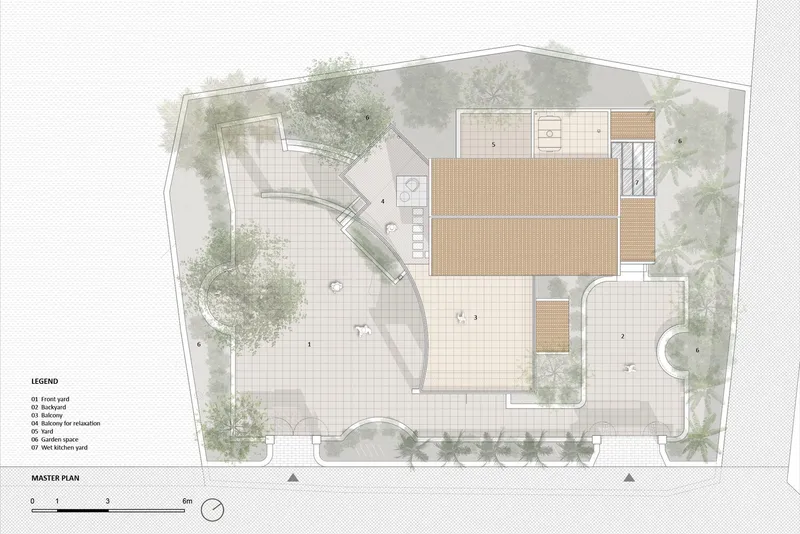
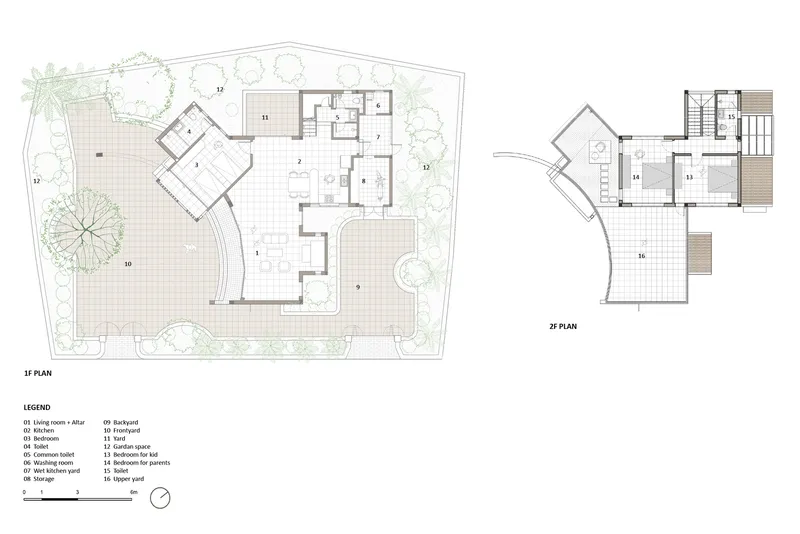
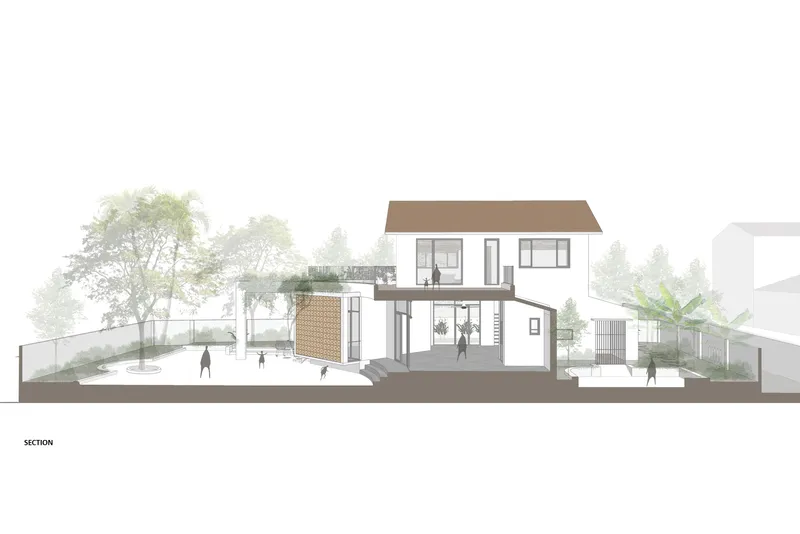
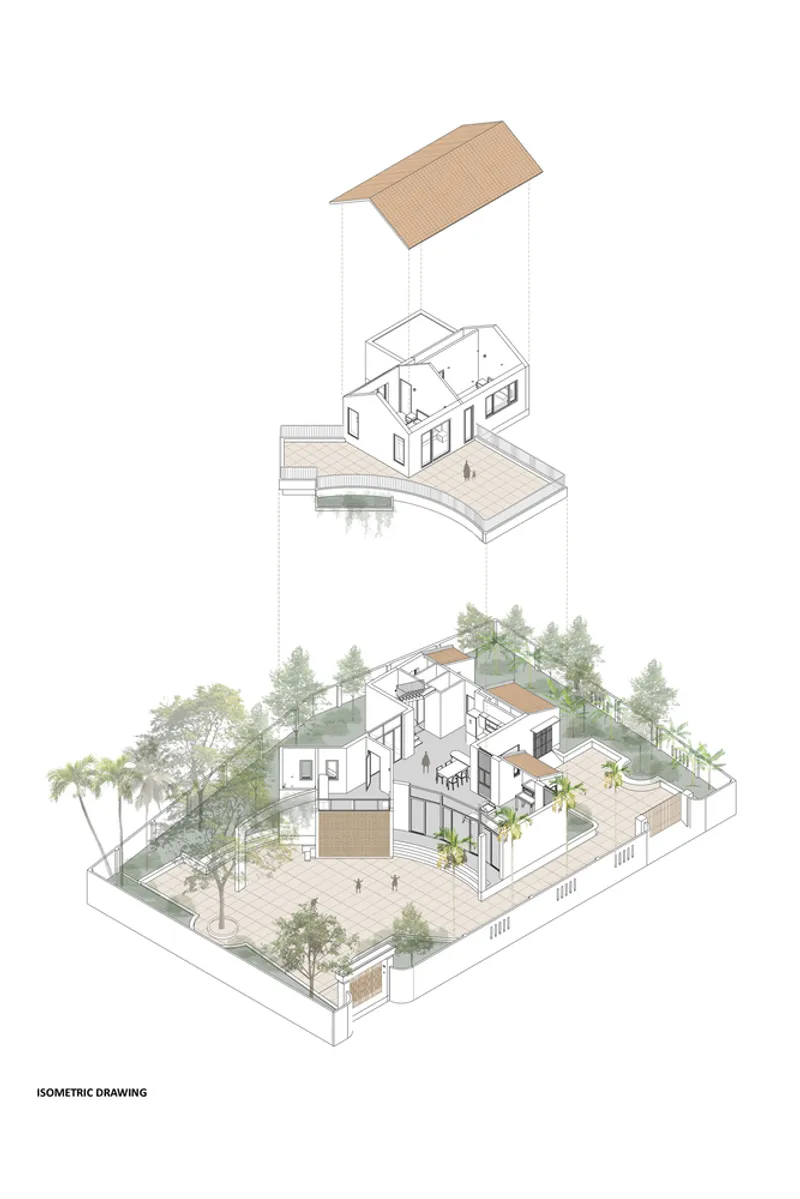
The site plan confirms the angled front yard strategy, showing how the arc-shaped plan creates a widening threshold between the street and the house. The ground floor plan reveals the open living space pivoting around the central courtyard, while the upper floor clusters bedrooms along the curve with access to terraces. The section drawing illustrates the relationship between the perforated screen wall and the double-height voids that drive natural ventilation. Most instructive is the isometric, which explodes the terracotta roof volumes to show how each one covers a distinct programmatic zone, unified by the landscape threading between them.
Why This Project Matters
Xom Me House is not trying to preserve rural Vietnamese architecture in amber. It is trying to prove that the spatial logic of the traditional village home, the courtyards, the verandas, the hierarchy of public and private outdoor rooms, can survive the pressures of modernization and land subdivision. That argument is made not through rhetoric but through plan geometry, material selection, and a willingness to let the garden do as much work as the building. The arc-shaped plan is a genuinely inventive response to climate, site, and social use.
More broadly, the project offers a counterpoint to the default mode of contemporary rural development across Southeast Asia, where concrete boxes replace timber and brick houses without any spatial compensation. NH Village Architects demonstrate that you can build in concrete and glass, use modern construction methods, and still produce a house that fosters the communal life that traditional models enabled. The perforated brick screens and terracotta tile are not nostalgia; they are working elements of a climate strategy. The courtyards are not leftover space; they are the primary rooms. That distinction, between aesthetic reference and functional inheritance, is what separates this house from sentimentality.
Xom Me House by NH Village Architects, Gia Vien District, Ninh Bình province, Vietnam, 2024. Photography by Trieu Chien.
About the Studio
Share Your Own Work on uni.xyz
If projects like this are the kind of work you want to make, uni.xyz is a place to publish your own, find collaborators, and enter design competitions.


Popular Articles
Popular articles from the community


longwave studio Reorganizes a 112 m² Tainan Apartment Around the Daily Routines of a Family and Two Cats
In Tainan, Taiwan, birch plywood, rust-red furniture and a freestanding plaster wall link arrival, storage, work and family life in one apartment.

Architekt Andreas Gruber Scatters 23 Dark Timber Chalets Across a South Tyrolean Forest Edge
In Molini di Tures, Amonti Chalets breaks a resort into a hamlet of gabled timber houses, with parking, storage and services pushed into the slope.

U.GA Architects Wraps an Oval Rooftop Pool in Curved Board-Formed Concrete on Busan's Jeollidan-gil
In Busan's Jeonpo-dong, a 454 m² mixed-use block stacks a neighborhood facility, guest rooms and an oval rooftop pool inside spiraling concrete walls.

Jaramillo Van Sluys Arquitectura and Urbanismo Turn a Demolished Registry Lot in Quito into an Orchard Plaza
In Quito's Centro Histórico, a 2,800 m² plaza exposes the San Agustín convent wall and redraws its lost Augustinian orchard in volcanic stone.

Similar Reads
You might also enjoy these articles


Hodi-Mandai Geram
Project Function: Preservation and revitalization of the Intangible heritage and socio-spatial identity of the Hodi by Housing, Cultural Memory Center, Sacred Grove, landscape, local tourism economy


Olio Towers: A Mid-Rise for Performers That Fuses Housing, Rehearsal, and Stage
Located blocks from Houston's Theater District, this modular tower stacks living units around a central performance atrium.

Oasis: Modular Green Housing Carved into Dhaka's Urban Fabric
A shortlisted Plugin Housing entry reclaims unauthorized settlements in Dhaka with stepped concrete volumes, green roofs, and ventilation-driven design.

Black Hole: A Floating Megastructure for the Post-Physical Era
Emiliano Mazzarotto envisions a spherical, self-scaling arena where e-sports, digital hotels, and holographic stadiums replace traditional public space.

Explore Architecture Competitions
Discover active competitions in this discipline

Challenge to reimagine the Iron Throne

Photograph architecture without architects

Illustrate the lost glory of Angkor Wat - Render Challenge

Design challenge to reuse E-waste
Comments (0)
Please login or sign up to add comments
No comments yet. Be the first to comment!