
Make (A) Room: Modular Timber Housing for Valencia's Urban Nomads
A shortlisted Plugin Housing entry rethinks the Nakagin Capsule Tower with CLT construction and adaptable living units in Valencia, Spain.


What if the Nakagin Capsule Tower had been built from wood, designed to adapt, and placed in a Mediterranean city where the sun actually works in your favor? That is the provocation behind "Make (A) Room," a modular housing proposal that takes Kisho Kurokawa's Metabolist icon apart, diagnoses its failures, and reassembles the concept using cross-laminated timber, photovoltaic panels, and spatial configurations tailored to people who never stay in one place for long.
Designed by Katarzyna Lech and Maja Pacek, the project was shortlisted in the Plugin Housing Challenge 2020. Sited in Valencia's Penya Roja neighbourhood, the scheme targets a growing demographic of remote workers, students, and mobile professionals who need compact, affordable, and customizable housing. Rather than replicating the Nakagin Tower's non-recyclable materials and inflexible structure, Lech and Pacek propose a system of CLT columns, beams, and modular panels that can be reconfigured and, eventually, recycled.
From Concrete Capsules to Timber Plug-Ins

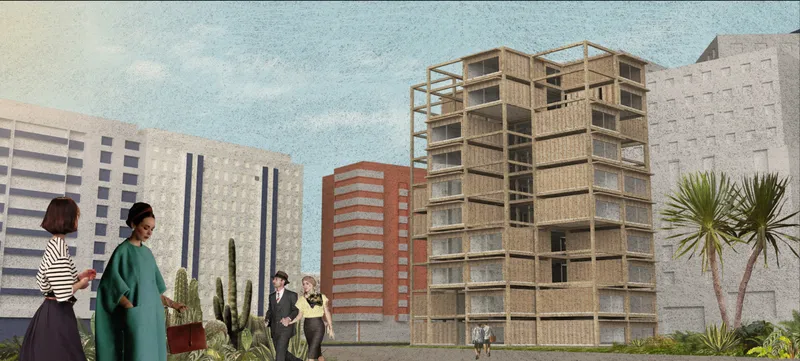
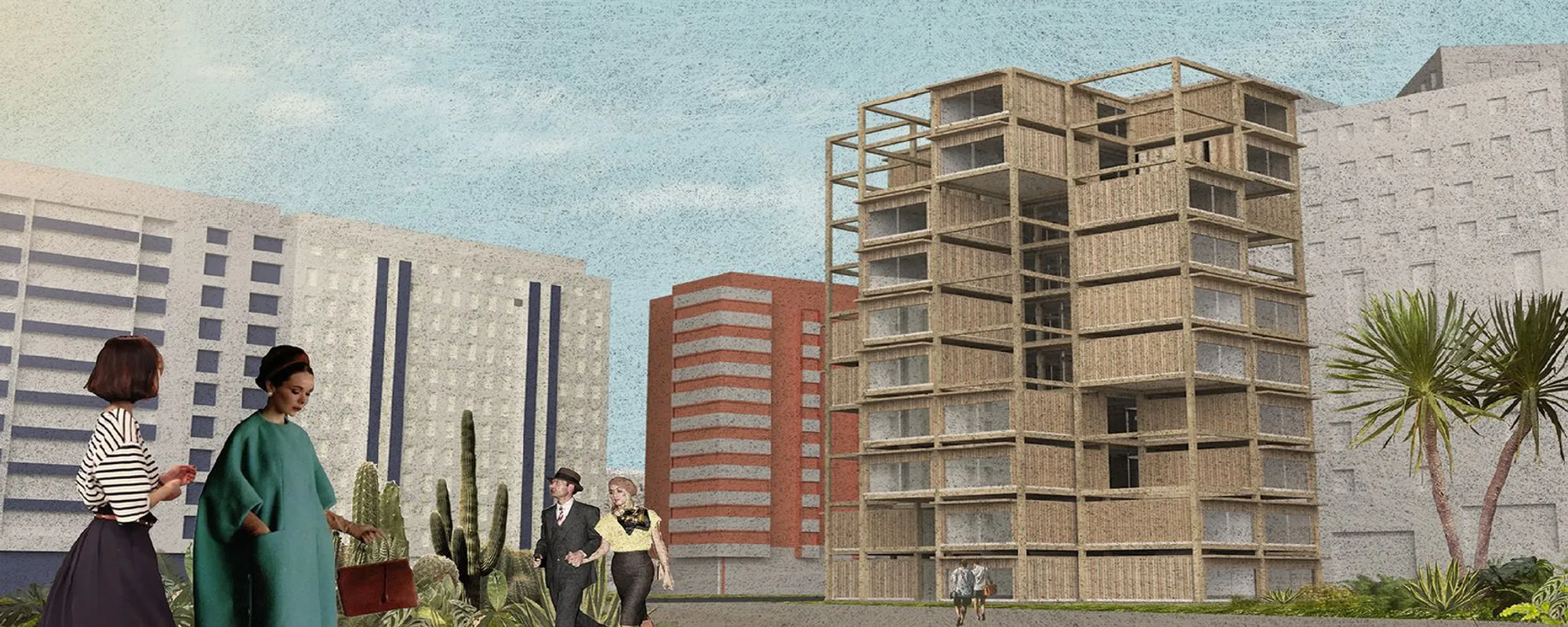
The first image reveals the project's conceptual lineage clearly: stacked white capsule units with circular windows recall the Nakagin Tower's language, but the material palette has shifted entirely. Weathered steel towers frame the composition, hinting at an industrial aesthetic that gives way to something warmer. In the rendered perspective, the design comes into focus as a timber frame residential tower with open structural bays. Palm trees at street level anchor the building in its Valencia context, and the exposed CLT frame reads as both honest and inviting.
Replacing concrete with recyclable wood systems is not merely a material swap; it fundamentally changes the carbon equation. CLT carries structural loads comparable to concrete while sequestering carbon during its lifespan. For a project concerned with urban density and climate change, this choice is the backbone of the entire argument.
Double-Height Commons and the Octagonal Plan

The elevation drawings and interior renderings show how the timber structure organizes social life. Double-height communal spaces punctuate the building's section, creating generous volumes where residents can gather, work, or simply move through at a different pace than the compact private units allow. The octagonal plan, visible in the structural logic of these drawings, promotes spatial variety by avoiding the monotonous corridor typology common to modular housing. Open shared spaces appear at each level, blending private and public life through communal lounges and outdoor terraces.
The building does not impose itself as a monolithic block on the city grid. Instead, its open ground-level zones enable natural ventilation and light penetration, a critical move in a climate where summer heat gain is a serious concern. Sun influence studies guided the placement of photovoltaic panels on the rooftops, and shading devices complement the building's orientation strategy.
A Central Core Surrounded by Individual Units

The axonometric drawing makes the organizational logic explicit. Individual residential units radiate outward from a central dining area, creating a cluster arrangement that encourages daily social interaction without sacrificing privacy. Each unit plugs into the shared core, reinforcing the scheme's plug-in heritage while grounding it in a communal living model. The geometry allows multiple unit configurations to coexist on a single floor: singles, couples, and small families each find a module scaled to their needs.
Living Inside the Module: Day-to-Night Transformations

The diagram sheet is where the project's human dimension becomes most legible. Floor plans, section drawings, and perspective vignettes illustrate modular living configurations populated by actual occupants going about their daily routines. Day-to-night transformations, built-in storage, and furniture designed to maximize usability within compact footprints are all documented here. The designers frame this as a DIY lifestyle: residents are not passive occupants but active participants in shaping their environment.
This "day in the module" approach is more than representational flourish. It demonstrates that a 15- or 20-square-meter unit, when designed with intentionality, can deliver comfort, personalization, and a genuine sense of ownership. The perspective vignettes show people cooking, working, sleeping, and socializing, all within a system of moving parts that responds to the rhythms of contemporary nomadic life.
Why This Project Matters
"Make (A) Room" does something that many Nakagin homages fail to do: it takes the critique seriously. The original capsule tower's inability to evolve was not a failure of vision but of material and systemic choices. By building the same plug-in ambition from CLT, integrating photovoltaic energy production suited to Valencia's climate, and organizing units around shared social infrastructure, Lech and Pacek demonstrate that modular housing can be both sustainable and genuinely adaptable.
The project also refuses to treat modularity as a purely technical exercise. Its octagonal geometry, communal terraces, and customizable interiors are all arguments for a way of living, not just a way of building. For a generation of urban nomads who move between cities and resist permanent spatial commitments, this kind of housing offers something rare: a framework that can grow, shrink, and change alongside the people who inhabit it.
View the Full Project
About the Designers
Designers: Katarzyna Lech, Maja Pacek
Enter a Design Competition on uni.xyz
uni.xyz runs architecture and design competitions year-round that reward proposals with spatial conviction and real site intelligence.
Project credits: KM team by Katarzyna Lech, Maja Pacek Plugin Housing Challenge 2020 (uni.xyz).



Popular Articles
Popular articles from the community


The Earth Pod: 3D Printed Homes for Resilient Refugee Communities
The Earth Pod reimagines refugee housing through 3D printed homes made from clay, combining resilience, self-sufficiency, and rapid shelter.

AL-JANNAH: Sustainable Architecture and Permaculture for Afghan Widows
AL-JANNAH uses sustainable architecture and permaculture to create resilient oasis of housing, learning, work and renewal for Afghan widows.

Co-Life: Senior Housing Design That Reconnects Older Adults With the City
Co-Life reimagines senior housing design through healing gardens, shared streets, workshops, and a sustainable community across generations.

EW PARK: Sustainable Architecture Reimagines the Future of Urban Parking
EW PARK reimagines city parking as a modular wooden tower combining automation, solar energy, electric mobility, and adaptable urban design.


Similar Reads
You might also enjoy these articles

Day and Night Park: A Time-Based Urban Newsstand in Beijing
A temporary urban newsstand in Beijing blending travel, light, and reading through poetic colors, compact form, and community-focused design.

Modernist Patio Renovation in El Masnou, Barcelona by Oliver Segura Arquitectura + Cebrià Arquitectura
Modernist patio renovation blending tradition and innovation with a movable pool, leveled floors, and Catalan materials in El Masnou.

Alto Residencial Coop: Cooperative Housing Development in Santiago de Compostela by Carbajo Barrios Arquitectos
A linear cooperative housing complex blending white volumes and perforated metal façades, enhancing community living, natural light, privacy, and urban integration.
Vil Genis School by BPA ARCHITECTURE – Massy, France
Vil Genis School in Massy, France, features sustainable design, south-facing classrooms, community integration, accessible spaces, and modern educational architecture.


Comments (0)
Please login or sign up to add comments
No comments yet. Be the first to comment!