

Edition Office Recasts the Australian Fibro Shack as a Permanent Home Among Spotted Gums
On a wooded slope above the Tomaga River in southern New South Wales, a mono-material timber house proves restraint is its own luxury.


Three hundred kilometers south of Sydney, the village of Mossy Point occupies a quiet spit of land where the Tomaga River meets the Tasman Sea. Towering spotted gum trees canopy the hillside, their smooth, silvery bark shifting color with the light. It is the kind of place where the original housing stock consisted of modest fibro shacks, cheap and cheerful structures built for summer holidays rather than year-round life. When Edition Office was asked to replace one of those shacks with a permanent home for clients facing the realities of late-stage Parkinson's disease, the brief demanded something that would be simultaneously robust, budget-conscious, accessible, and deeply attuned to its site on Yuin Country.
What makes Mossy Point House worth studying is not a single dramatic gesture but rather the disciplined accumulation of small, intelligent decisions. A bird's-mouth cut in the roofline splits social from private rooms. Cement-sheet cladding echoes the bark of the trees it sits among. Spotted gum flooring and hardwood plywood walls create a mono-material interior where the only spectacle is the changing quality of daylight. It is a house that treats economy as a design tool rather than a constraint, and it arrives at a kind of quiet authority precisely because nothing here is fighting for attention.
A Roof That Splits and Breathes
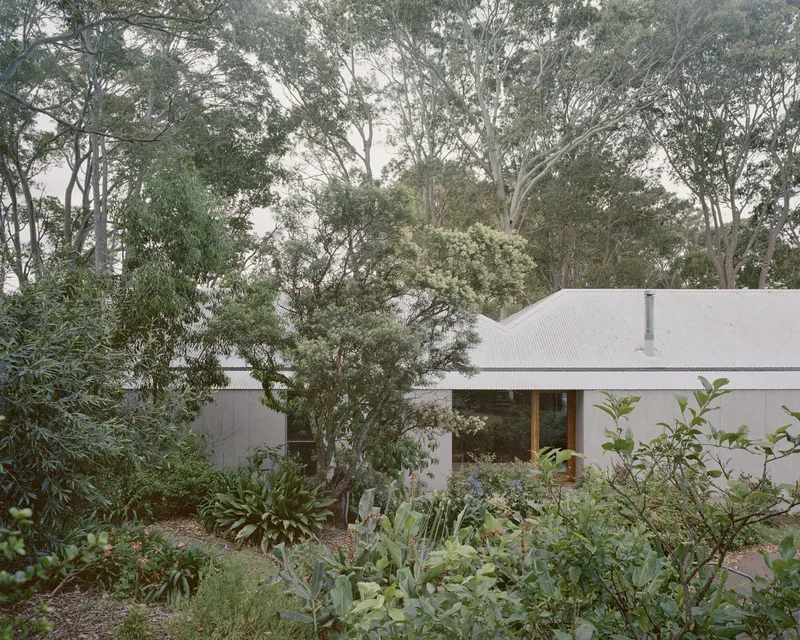
From the outside, the house reads as a long, metal-clad gable tucked into the slope, its profile calibrated to sit below the canopy line rather than compete with it. Only two mature spotted gums were removed, both identified as sick, and the remaining trees were treated as immovable coordinates around which the building's axis was plotted. The orientation follows the mountainscape of Yuin Country, aligning service zones to the south so that living spaces harvest maximum northern sun.
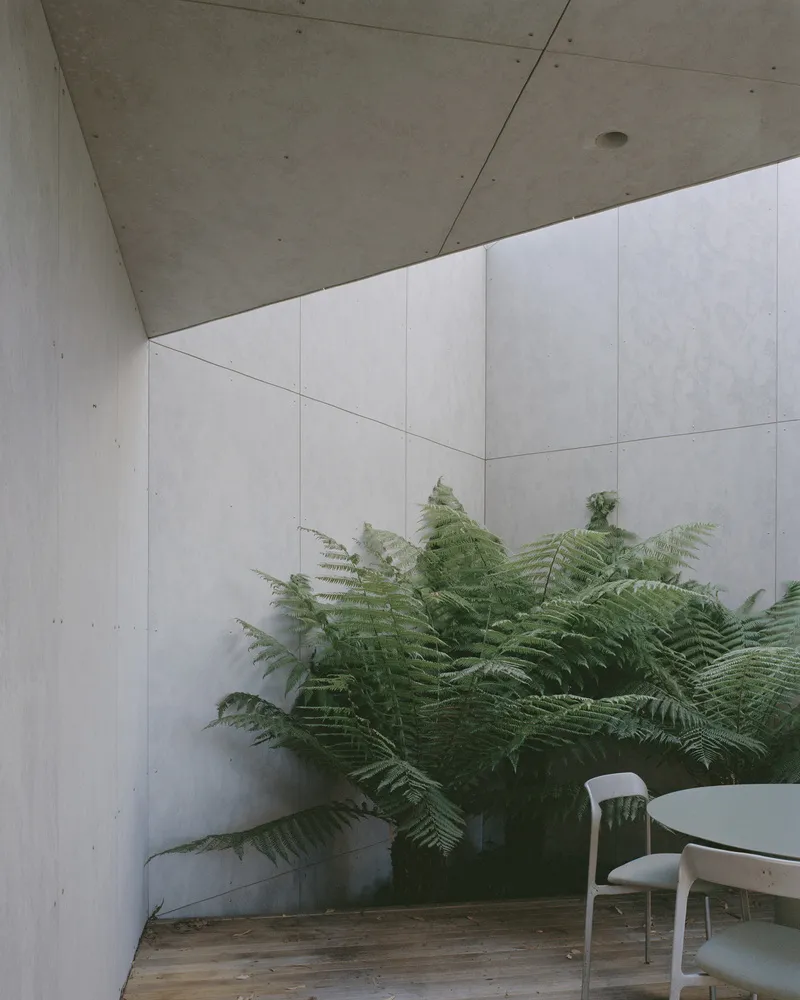
At the center of the roofline, a bird's-mouth cut-out opens the house to the sky and creates a sheltered courtyard where board-formed concrete walls support a fern garden. This void is the organizational fulcrum of the plan: arrive at the sharply angled entry wall and you navigate left toward private bedrooms or right toward the social volume of kitchen and living room. The cut-out also channels soft southern light deep into the plan, a counterpoint to the generous northern glazing.
Living Under the Plywood Canopy
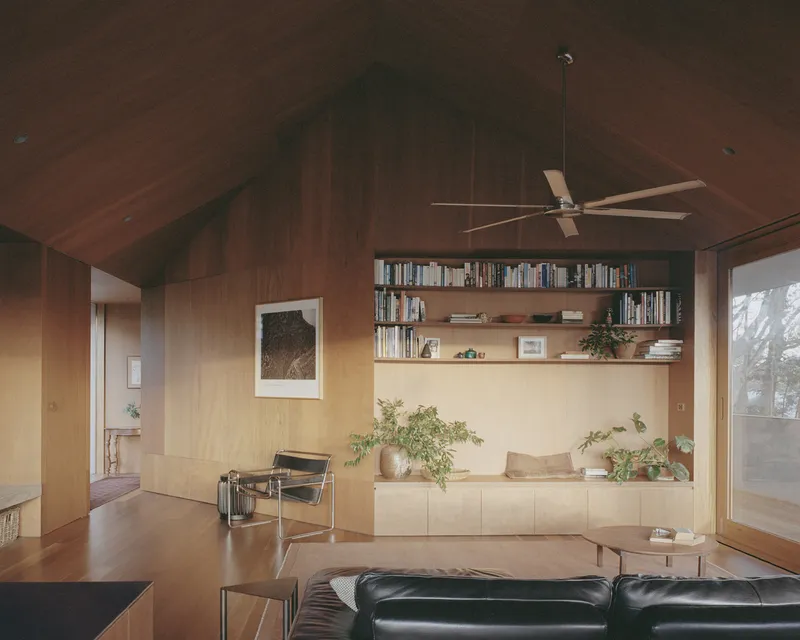
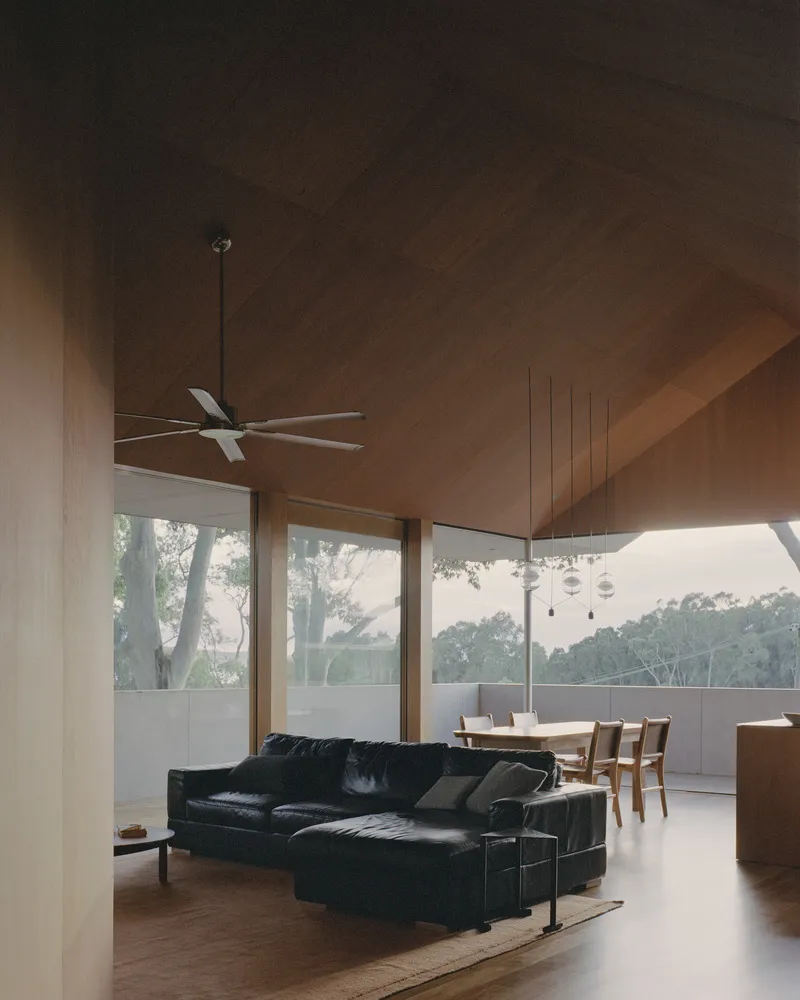
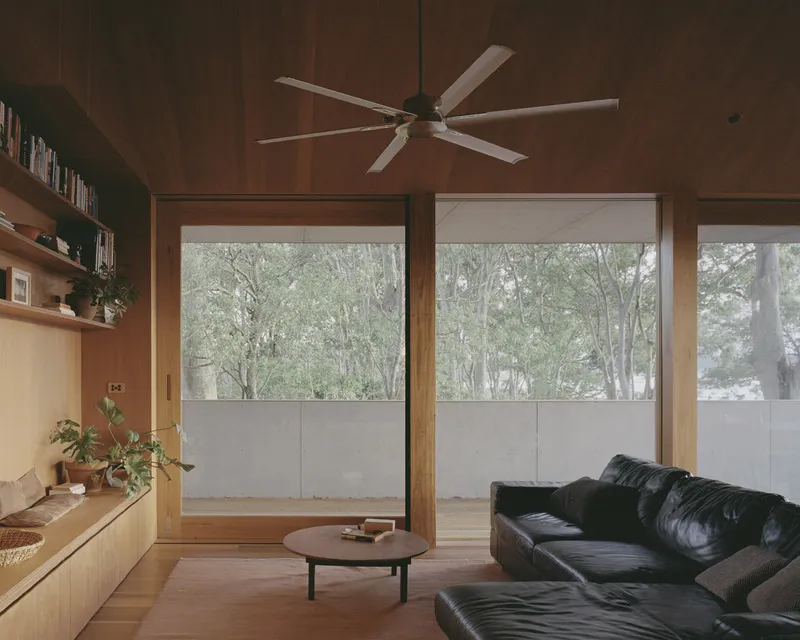
Step inside and the palette contracts to essentially one material: hardwood plywood. Walls, ceilings, and built-in shelving all share the same warm, blond surface, which means the eye registers volume and light rather than a catalog of finishes. The cathedral ceiling in the main living space rises along a slanted plane, amplifying the sense of space in what is, in reality, a disciplined footprint. At dusk, clerestory glazing along the ridge line catches the last of the sky, turning the ceiling into a glowing plane.
There is a deliberate chiaroscuro at work here. Edition Office has shaped each volume so that natural light enters from predictable directions and lands on predictable surfaces. The result is a house where the time of day is legible from almost any room, a quality that connects occupants to the rhythms of the site without requiring a panoramic window at every turn.
Dining at the Threshold
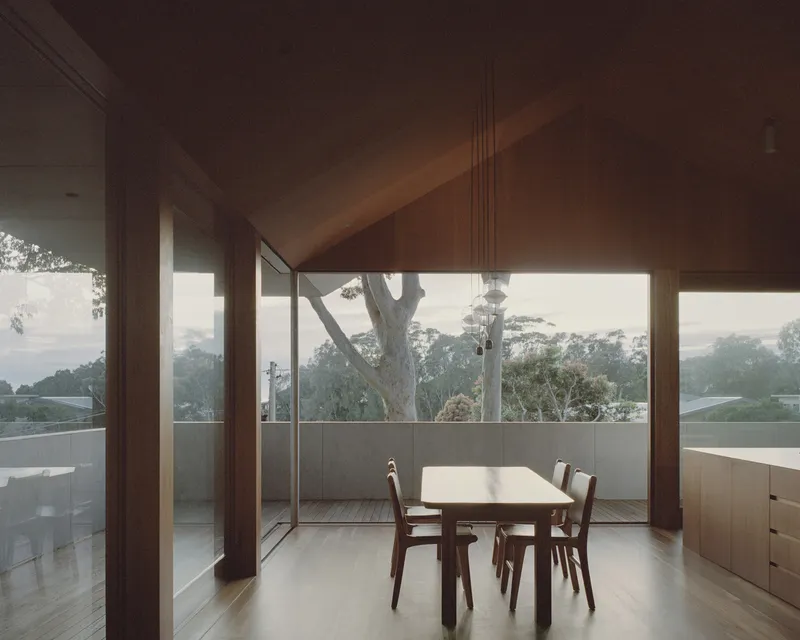
The dining area sits at a critical hinge between inside and out. Timber columns frame an opening onto a wrap-around terrace, where morning mist drifts through the eucalyptus canopy and filtered views reach toward the Tomaga River and its opening to the sea. A solid balustrade along the northern deck is a quietly clever move: it blocks sightlines to neighboring houses below while preserving the landscape panorama, trading visual transparency for actual privacy.
The house operates without any mechanical cooling. Ceiling fans and cross-ventilation handle the temperate climate of the south coast, while the all-electric energy strategy and passive solar orientation reduce operational costs. In a housing market that increasingly equates sustainability with expensive gadgetry, Mossy Point House demonstrates that the most effective environmental strategy is often spatial rather than technological.
Working the Details on a Modest Budget
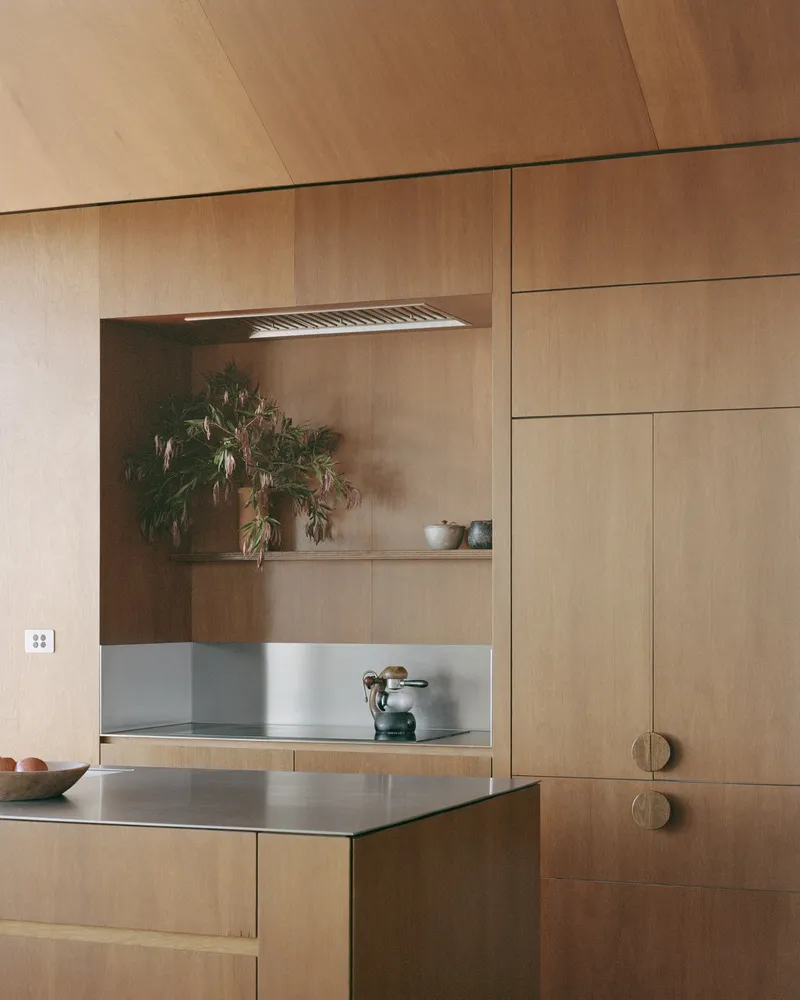
A recessed plywood niche in the kitchen, a stainless steel island benchtop, and pantry shelves fabricated from offcuts of the external Barestone cladding: these are the kind of details that reveal a practice thinking carefully about where money goes. Nothing is gratuitous. The repurposed offcuts are not just a sustainability talking point; they create a visual continuity between exterior and interior that would be difficult to achieve with a more expensive bespoke material.
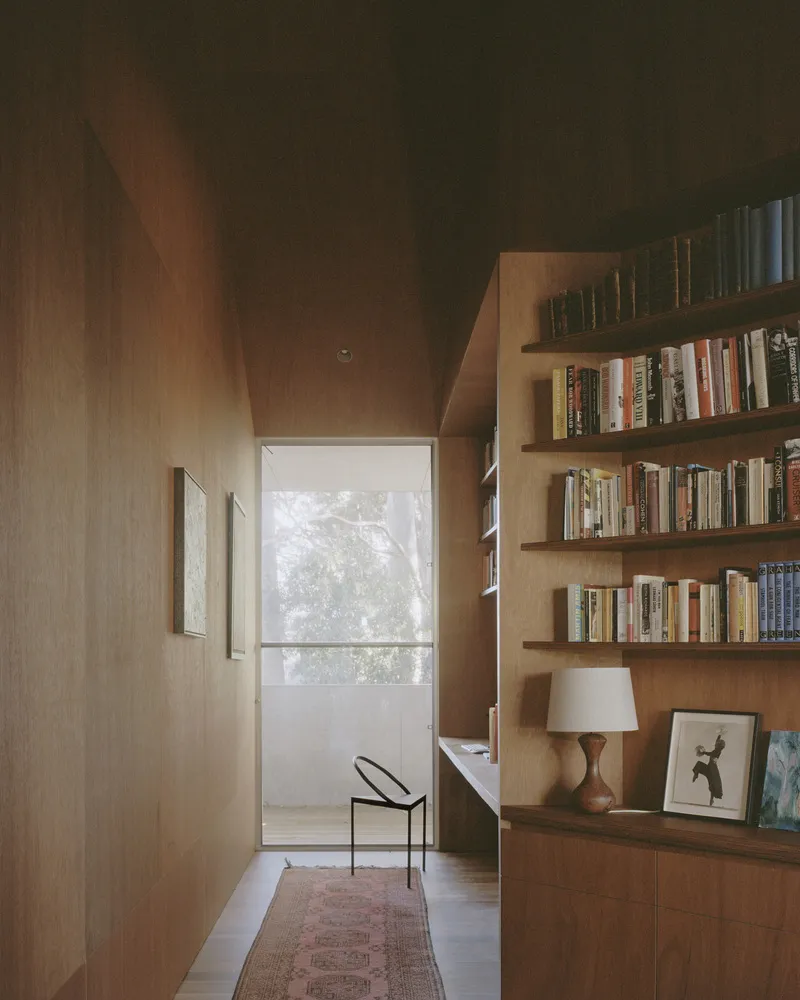
Down the hallway, built-in bookshelves line one wall before a glazed door frames a canopy of trees. Oversized doorways and a step-free primary floor respond to the client's accessibility needs without announcing themselves as medical accommodations. Custom stainless-steel grab rails in the bathroom are disguised as towel bars. The architecture of care here is embedded in proportion and detailing rather than bolted on as an afterthought.
Private Rooms, Soft Light
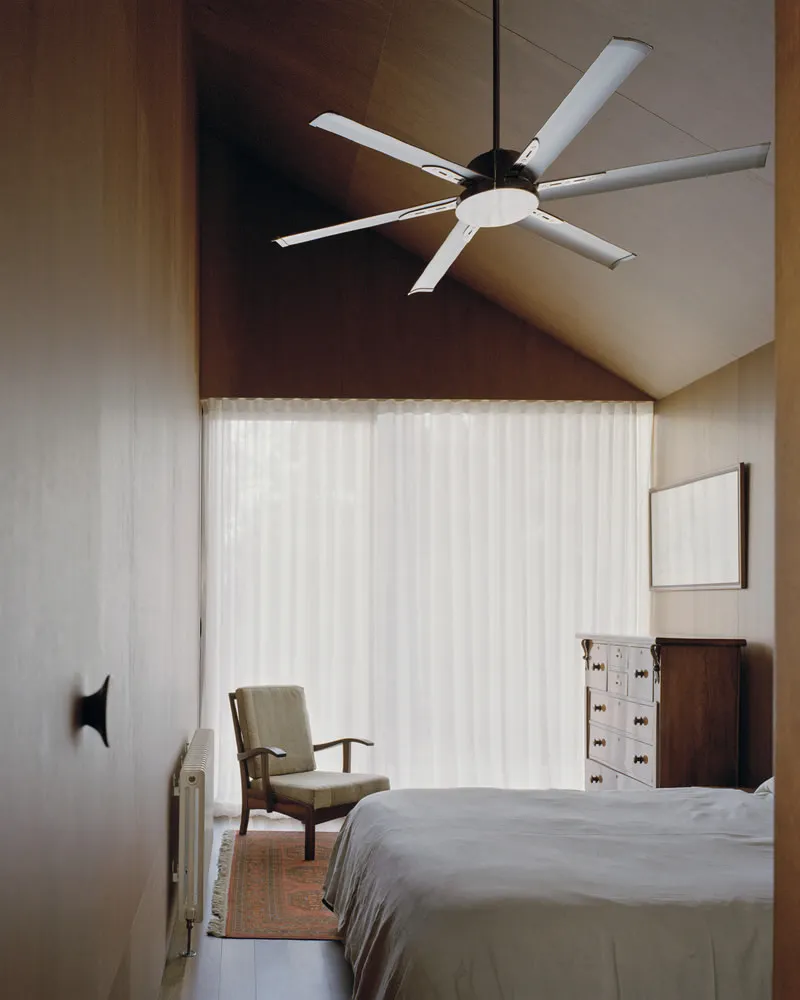
The bedroom wing occupies the quieter, more enclosed side of the bird's-mouth divide. A vaulted plywood ceiling rises to a gentle peak, and sheer curtains diffuse incoming daylight into a soft, even glow. The effect is monastic without being austere: the timber grain provides enough visual texture to keep the room from feeling blank, and the ceiling fan is the only mechanical element in sight.
Below the main level, a self-contained guest suite is tucked into the slope of the hillside, taking advantage of the site's natural fall to create a two-storey structure that reads as single-storey from the approach. It is an efficient use of section that adds program without adding sprawl, keeping the building's footprint tight against the existing trees.
Why This Project Matters
Mossy Point House is a corrective to the idea that regional Australian architecture must choose between rugged pragmatism and polished formalism. Edition Office has found a register that is neither: precise enough to reward close looking, relaxed enough to feel at home among spotted gums and ferns. The mono-material interior, the passive climate strategy, the accessibility features woven invisibly into the plan, all of these decisions compound into a house that performs well across multiple registers without inflating its ambitions or its budget.
More broadly, the project offers a persuasive argument for what happens when architects treat existing trees, modest budgets, and specific medical needs not as obstacles but as generators of form. The bird's-mouth void, the solid balustrade, the repurposed cladding offcuts: each of these moves originated in a constraint and ended up defining the character of the building. That is the kind of design intelligence that outlasts stylistic trends, and it is why this house deserves attention well beyond the south coast of New South Wales.
Mossy Point House by Edition Office. Located in Mossy Point, New South Wales, Australia. Photography by Rory Gardiner.
About the Studio
Share Your Own Work on uni.xyz
If projects like this are the kind of work you want to make, uni.xyz is a place to publish your own, find collaborators, and enter design competitions.


Popular Articles
Popular articles from the community


Singing Woman: An Opera House That Performs Before the Curtain Rises
Ovidiu Cristian Pavel's conceptual opera house translates Estonia's choral identity into a sculpted waterfront landmark facing the Baltic Sea.


FCC Arquitectura Expands a Portuguese Granite House with a Board-Marked Concrete Wing
In Portugal, JV House pairs a cleaned-up whitewashed and granite dwelling with a timber-shuttered concrete extension, courtyards and a garden pool.

Manzana Morphosis: Stretching Barcelona's Grid into a Living Landscape for 2050
A radical reworking of the Eixample manzana turns density into a tool for generous public space, vertical ecology, and environmental performance.

The Amber Palace Opera: A Geological Fiction Surfaces on Tallinn's Baltic Waterfront
Pierre Brillard reimagines a Baltic legend as a public landscape, opera house, and waterfront promenade rooted in Tallinn's coastal identity.

Similar Reads
You might also enjoy these articles


Hodi-Mandai Geram
Project Function: Preservation and revitalization of the Intangible heritage and socio-spatial identity of the Hodi by Housing, Cultural Memory Center, Sacred Grove, landscape, local tourism economy


Olio Towers: A Mid-Rise for Performers That Fuses Housing, Rehearsal, and Stage
Located blocks from Houston's Theater District, this modular tower stacks living units around a central performance atrium.

Oasis: Modular Green Housing Carved into Dhaka's Urban Fabric
A shortlisted Plugin Housing entry reclaims unauthorized settlements in Dhaka with stepped concrete volumes, green roofs, and ventilation-driven design.

Black Hole: A Floating Megastructure for the Post-Physical Era
Emiliano Mazzarotto envisions a spherical, self-scaling arena where e-sports, digital hotels, and holographic stadiums replace traditional public space.

Explore Architecture Competitions
Discover active competitions in this discipline

Challenge to reimagine the Iron Throne

Photograph architecture without architects

Illustrate the lost glory of Angkor Wat - Render Challenge

Design challenge to reuse E-waste
Comments (0)
Please login or sign up to add comments
No comments yet. Be the first to comment!