

Moving School: A Playground of Learning in the Philippines
Fostering educational enthusiasm through dynamic spaces and child-driven design.


The "Moving School" project, conceived by Minwoo Kim and LEE KYUNGSU, champions a fresh perspective on educational architecture in the Philippines. This award-winning design, recognized in the Play ON School competition, aspires to craft a vibrant and stimulating learning environment that cultivates a passion for education through child-centered design and integrated play spaces.
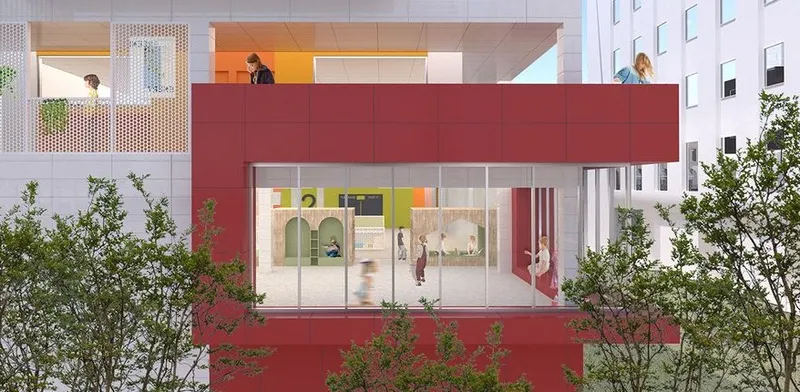
A Visually Dynamic and Interactive Design
At the heart of the "Moving School" concept lies a multifaceted understanding of movement, interpreted in three distinct ways. Firstly, the building's exterior showcases a captivating perforated plate facade, serving as a canvas for students' creativity, allowing them to adorn it freely, resulting in an ever-evolving and visually engaging aesthetic. Secondly, the school's design embraces active student participation in shaping their learning environment. Their creative contributions and interactions with the building become essential to its unique character. Thirdly, the school's layout prioritizes physical movement and play, with interconnected spaces, terraces, and vertical connections that seamlessly blend indoor and outdoor realms.
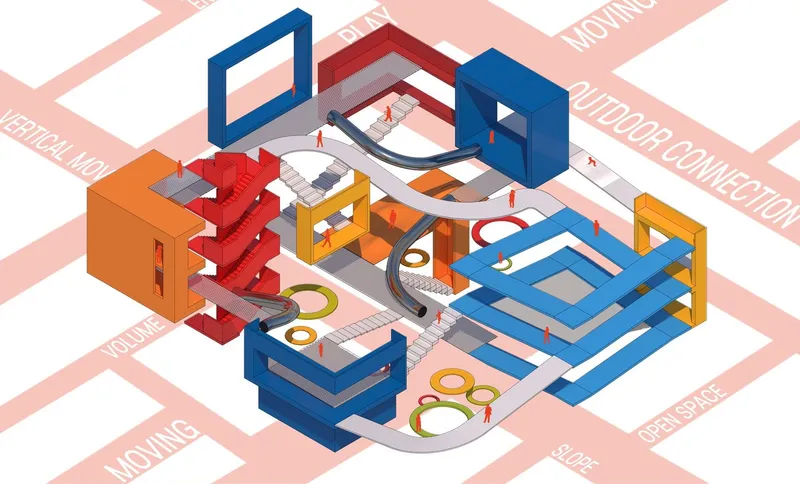
A Seamless Connection with Nature
The "Moving School" endeavors to establish a harmonious relationship between the structure and its surrounding environment. Terraces on the upper levels offer a fluid connection to the outdoors, fostering a sense of connection with nature even while inside. The ground floor features an open auditorium and cafe building supported by pilotis, creating an expansive open square that acts as an extension of the playground, expanding the possibilities for learning and p
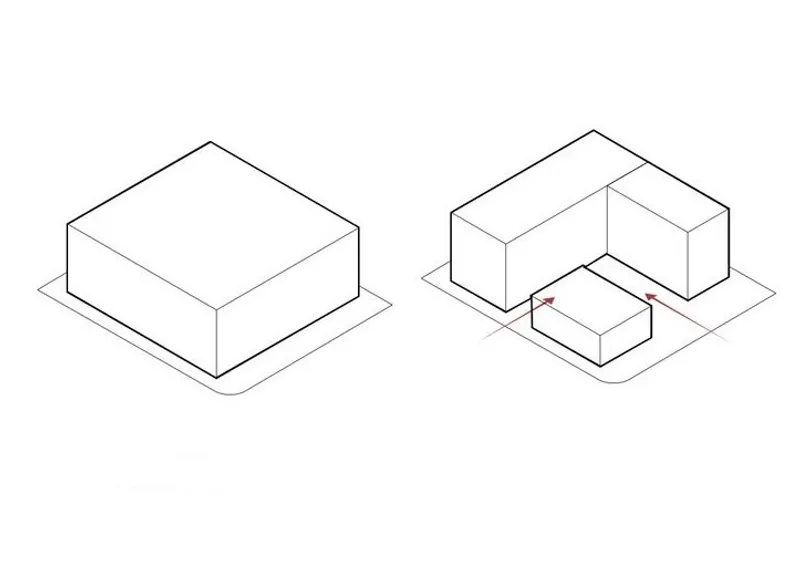
A Dynamic and Interconnected Structure
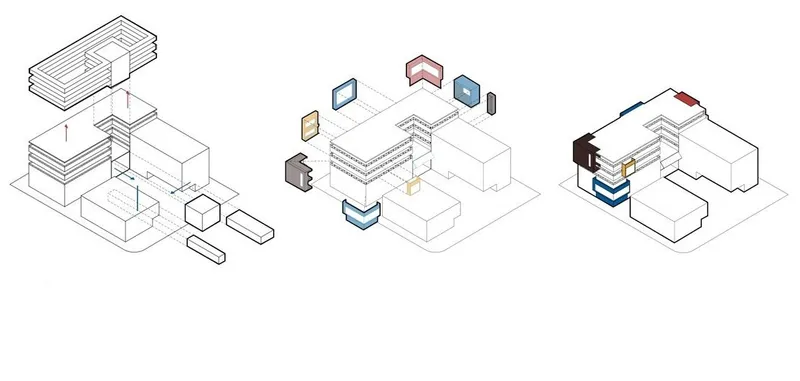
The design process involved a thoughtful manipulation of form, encompassing extrusion, strategic removal of building mass to create outdoor spaces, and skillful subtraction to interconnect spaces. This approach yielded a dynamic and interconnected structure characterized by key features such as an open auditorium that inspires imagination and play, a welcoming cafeteria that provides space for meals and relaxation, and an assembly hall that links the first and second floors, encouraging movement and interaction. An open library fosters a love of reading through its free-flowing design, while classrooms are thoughtfully designed to accommodate 300 students while incorporating playful elements like outdoor slides and corridors that promote physical activity.
Stimulating Playfulness and Movement
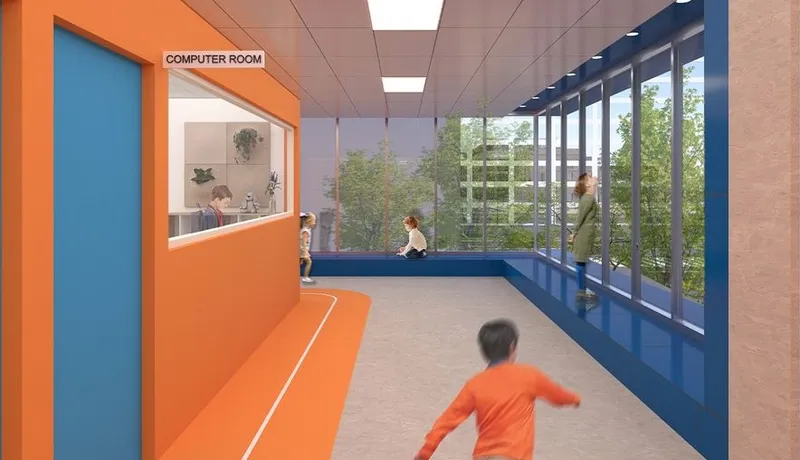
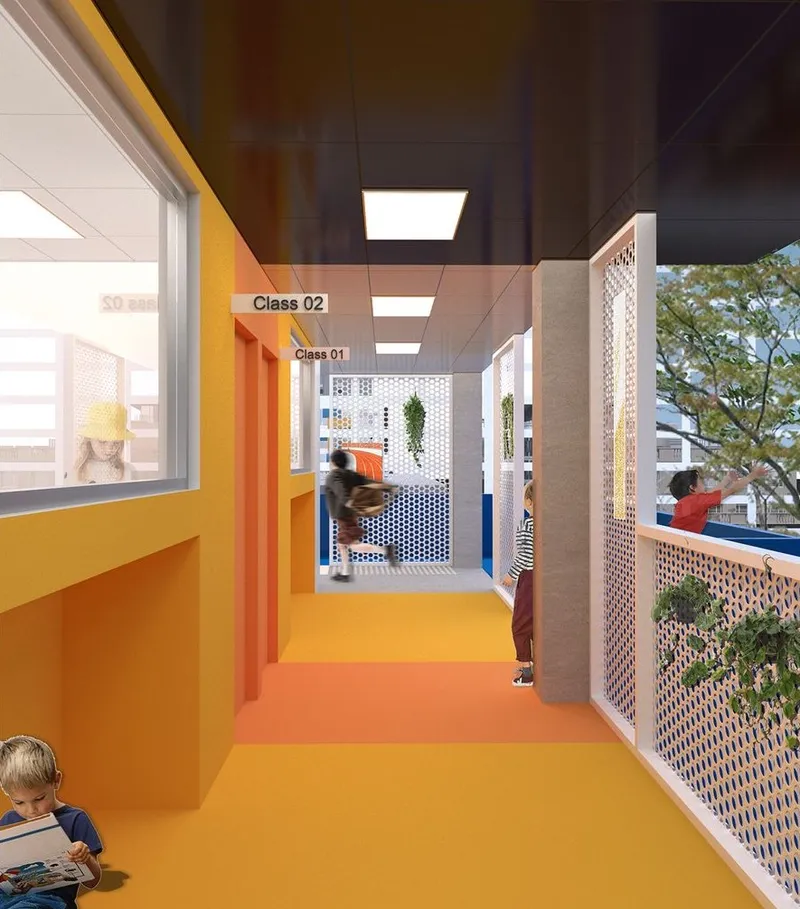
Volume masses, differentiated by color, are strategically placed throughout the school, adding to the playful ambiance and stimulating dynamic movement. Each color holds a specific intention: red to encourage active play and communication, brown to provide a sense of freedom and exploration in the corridors, blue to promote learning and concentration in the corridor spaces, and yellow to offer a space for rest and contemplation.
Expanding the Boundaries of Play
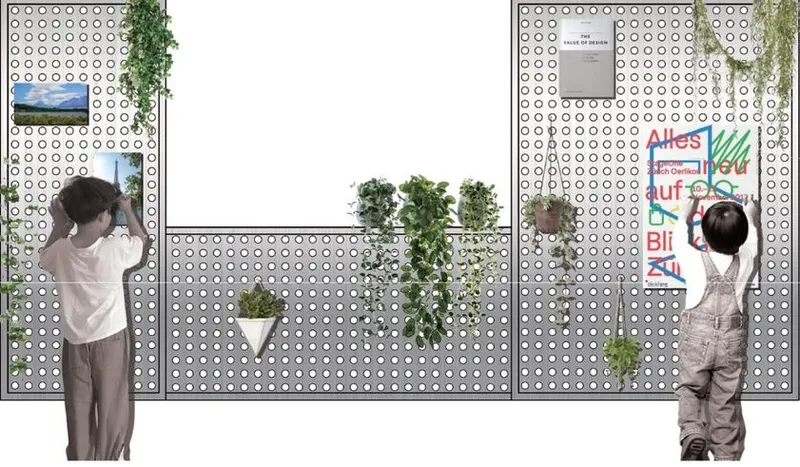
The facade design addresses the challenge of limited play spaces in urban schools by creating a dynamic and interconnected outdoor environment. Key elements include connected spaces, where the auditorium, open space, and cafe on the first floor merge to form an expansive play area, vertical folding doors that blur the boundaries between indoor and outdoor spaces, outdoor slides that offer a fun and engaging way to traverse floors, and perforated boards that empower children to personalize the facade with their artwork and creations.
A School that Evolves with its Students
The perforated plate elevation provides a unique opportunity for children to actively participate in shaping the school's appearance. They can decorate the boards with their artwork, plants, and personal belongings, fostering a sense of ownership and pride in their learning environment. This interactive element reinforces the concept of a "Moving School," where the building itself seems to evolve and adapt alongside the students' creativity.
A Vision for the Future of Education
In conclusion, the "Moving School" project embodies a bold and forward-thinking vision for education in the Philippines. By prioritizing movement, play, and child-centered design, it creates a dynamic and engaging learning environment that ignites a passion for learning and equips students with the skills and enthusiasm needed to thrive in the 21st century.


Popular Articles
Popular articles from the community


Cube Design Draws an Ecological Corridor Between Two Shenzhen Hills with the Nankai Building
Beside Shenzhen's container docks, the Nankai Building pairs stacked balconies with a climbing green screen to connect two hillsides across its height.

David Ortega Stacks a Two-Story Mexico City Penthouse Around a Steel Stair and a Pergola-Shaded Roof Terrace
In Colonia Roma, a 300 m² penthouse uses oak joinery, a planted steel stair and a slatted roof pergola to make a new-build apartment feel like a house.

longwave studio Reorganizes a 112 m² Tainan Apartment Around the Daily Routines of a Family and Two Cats
In Tainan, Taiwan, birch plywood, rust-red furniture and a freestanding plaster wall link arrival, storage, work and family life in one apartment.

Architekt Andreas Gruber Scatters 23 Dark Timber Chalets Across a South Tyrolean Forest Edge
In Molini di Tures, Amonti Chalets breaks a resort into a hamlet of gabled timber houses, with parking, storage and services pushed into the slope.

Similar Reads
You might also enjoy these articles


Vereda Arquitetos Renovates a 40-Square-Meter Apartment Inside Niemeyer's Copan Building
A compact unit in São Paulo's most iconic residential tower gets a material overhaul that pairs exposed concrete with bold blue Formica.

Shakur's House: Exposed Brick as an Interior Organiser in a 168 m² Mashhad Residence
Brick moves indoors in this Mashhad residence, where masonry walls, glass partitions and teal planes sequence a compact home without closing it off.

Day and Night Park: A Time-Based Urban Newsstand in Beijing
A temporary urban newsstand in Beijing blending travel, light, and reading through poetic colors, compact form, and community-focused design.

Modernist Patio Renovation in El Masnou, Barcelona by Oliver Segura Arquitectura + Cebrià Arquitectura
Modernist patio renovation blending tradition and innovation with a movable pool, leveled floors, and Catalan materials in El Masnou.


Comments (0)
Please login or sign up to add comments
No comments yet. Be the first to comment!