

Multi Terrace House by Hyunjoon Yoo Architects: A Masterpiece of Private Outdoor Living and Family-Centered Design in Seongnam-si, South Korea
Multi Terrace House by Hyunjoon Yoo Architects maximizes privacy and natural light through innovative terraced design on a sloped site.


The Multi Terrace House designed by Hyunjoon Yoo Architects is a stunning example of innovative residential architecture that masterfully integrates a sloping site to create a harmonious blend of indoor and outdoor living. Situated in the Unjung-dong housing complex in Seongnam-si, this family home redefines privacy and spatial openness, leveraging the natural topography to maximize the use of a private yard—a rare luxury in contemporary urban housing.
Architectural Concept and Site Utilization
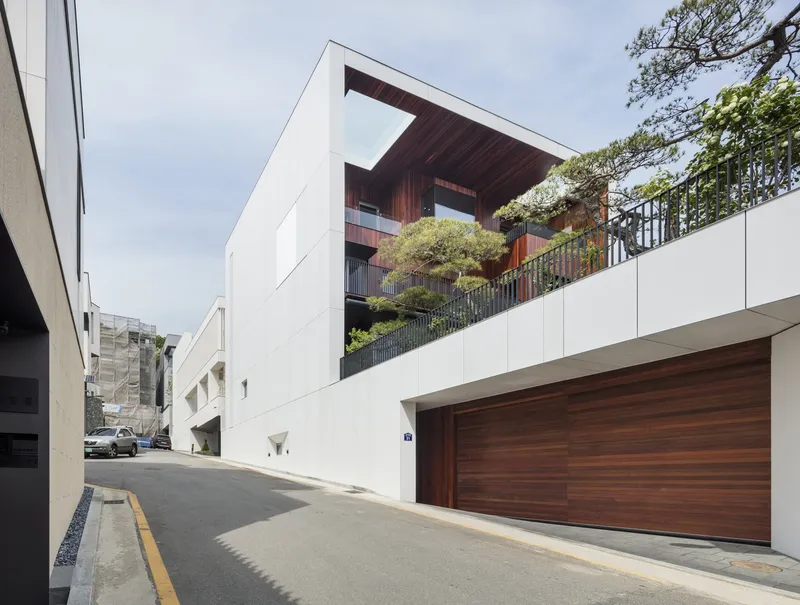
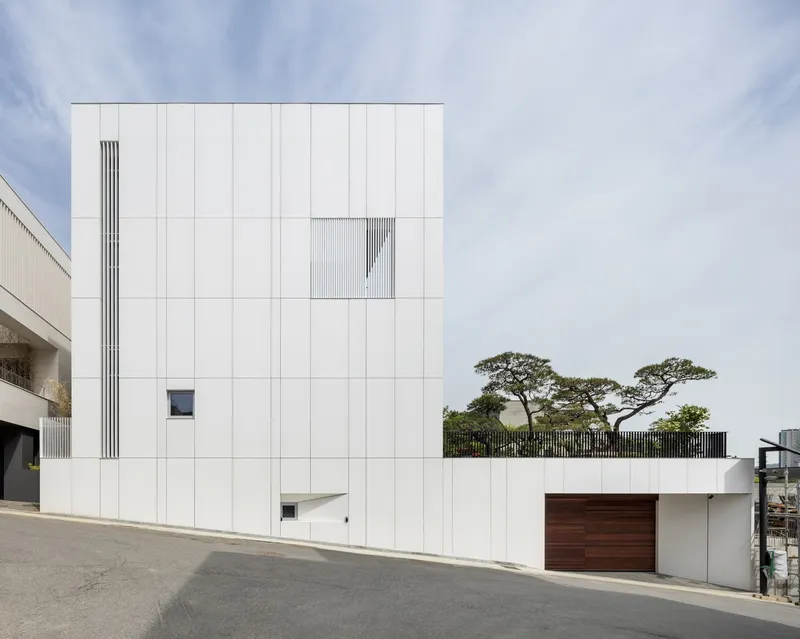
Unlike traditional single-family houses or compact apartments, which often struggle to balance outdoor space and privacy, the Multi Terrace House capitalizes on the natural difference in elevation between the street level and the first floor. This design advantage naturally forms a private front yard that enhances the home's usability and intimacy without compromising openness.
In many modern homes built on flat lots, privacy is achieved through narrow, enclosed courtyards bounded by perimeter walls—known as perimeter block housing—which, while private, can feel restrictive and closed off. By contrast, the Multi Terrace House actively embraces its sloped terrain to create an open yet private yard space, fostering a stronger connection with nature while preserving family privacy.

Client Needs and Family-Centered Design
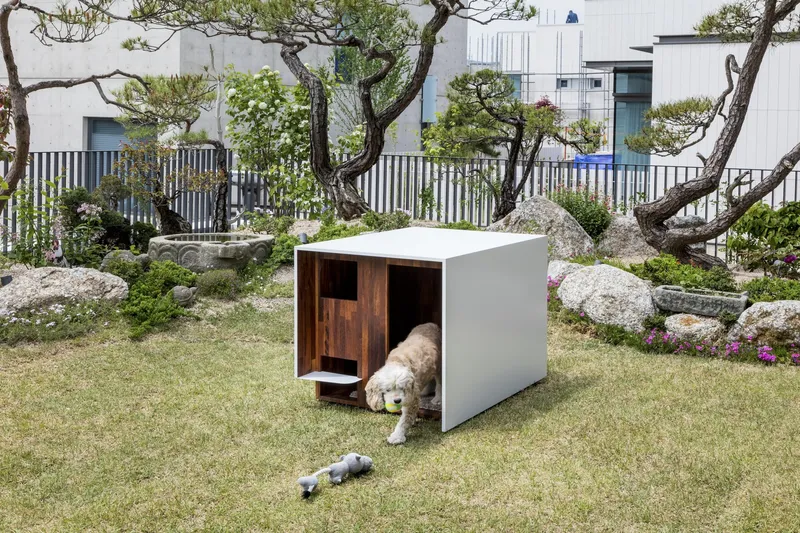
The home was commissioned by a married couple with two children, now living separately but maintaining close family ties. The brief was clear: to create a welcoming and safe environment where their children could visit and stay freely, and where their dog could roam safely outdoors. This family-oriented vision shaped the entire spatial organization of the house, balancing communal living with individual privacy.
Spatial Layout and Interior Planning
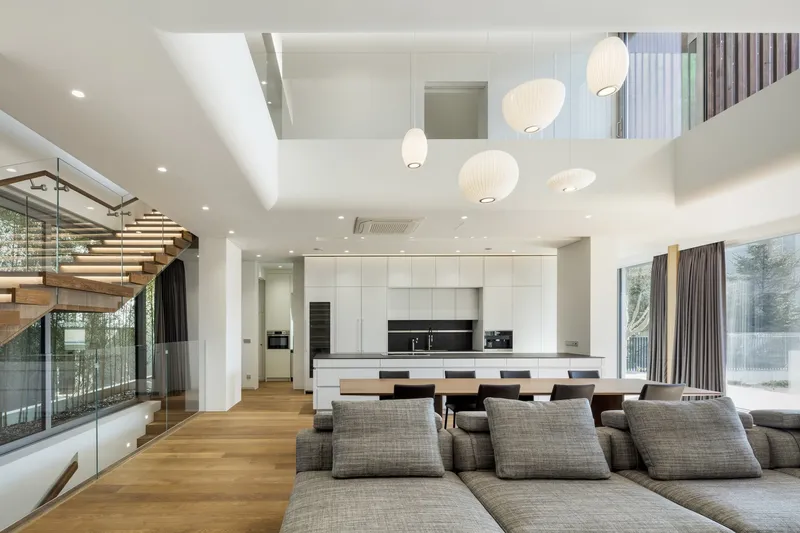
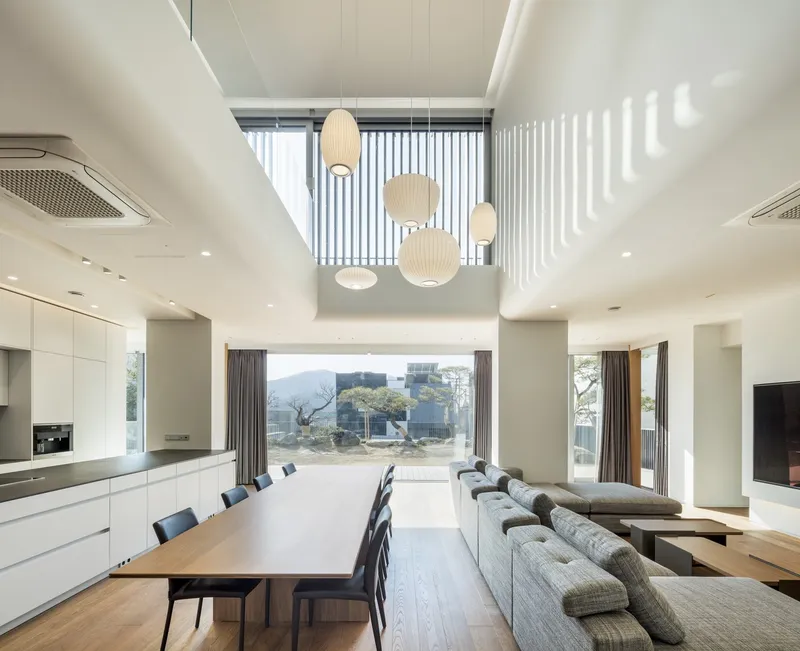
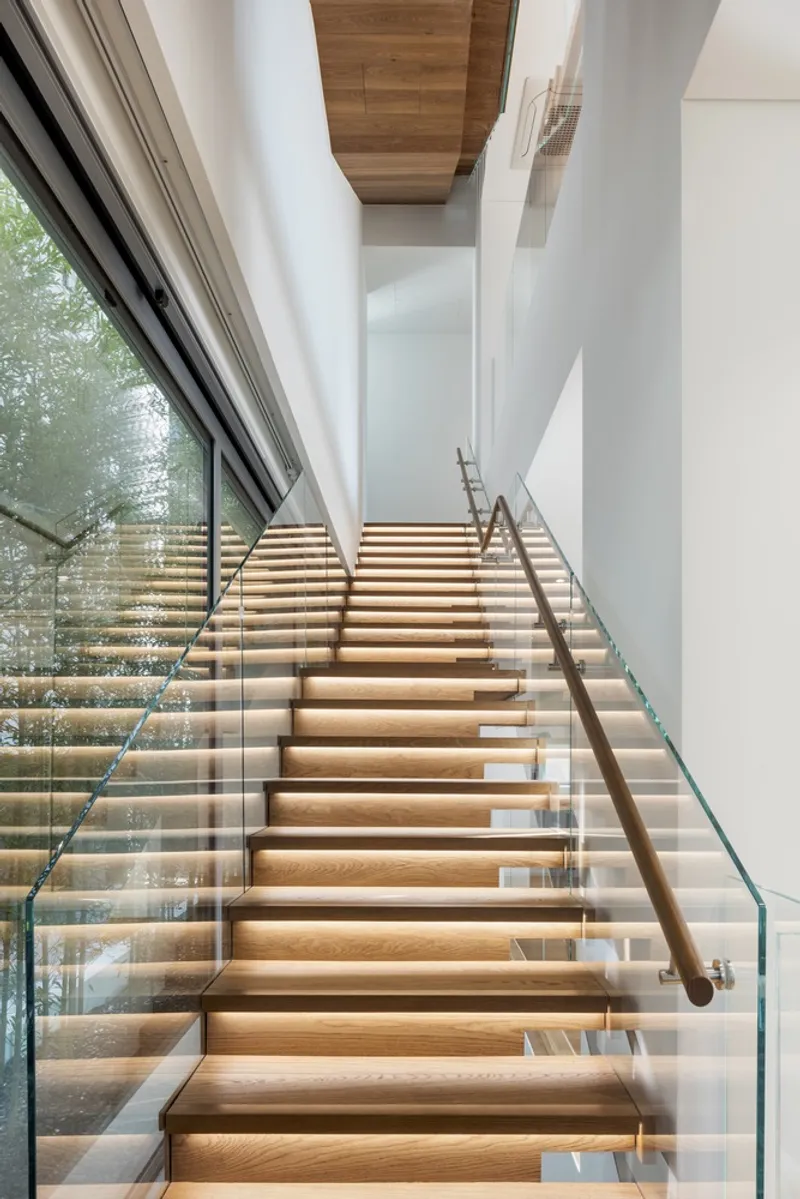
The residence is thoughtfully positioned on the north side of the site, deliberately orienting the yard towards the south to maximize sunlight and warmth. The first floor hosts the main social spaces, including a spacious living room and kitchen designed for family gatherings. A striking void space connects the first floor living room to the family room on the second floor, visually and physically linking the two levels and enhancing natural light penetration.
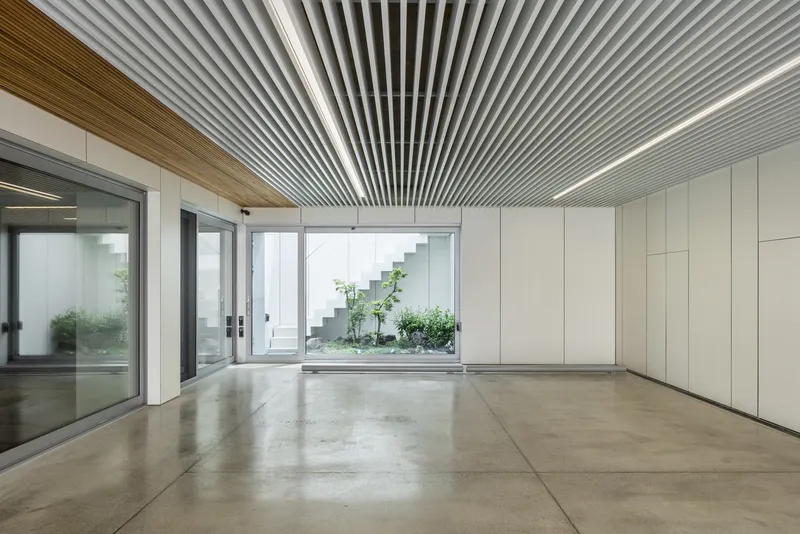
Large, unobstructed windows on both the north and south façades provide panoramic views, connecting the front yard, backyard, deck, and living room into a seamless, open living area. This design encourages fluid movement and interaction between indoor and outdoor spaces.
Second Floor: Private Spaces for Children
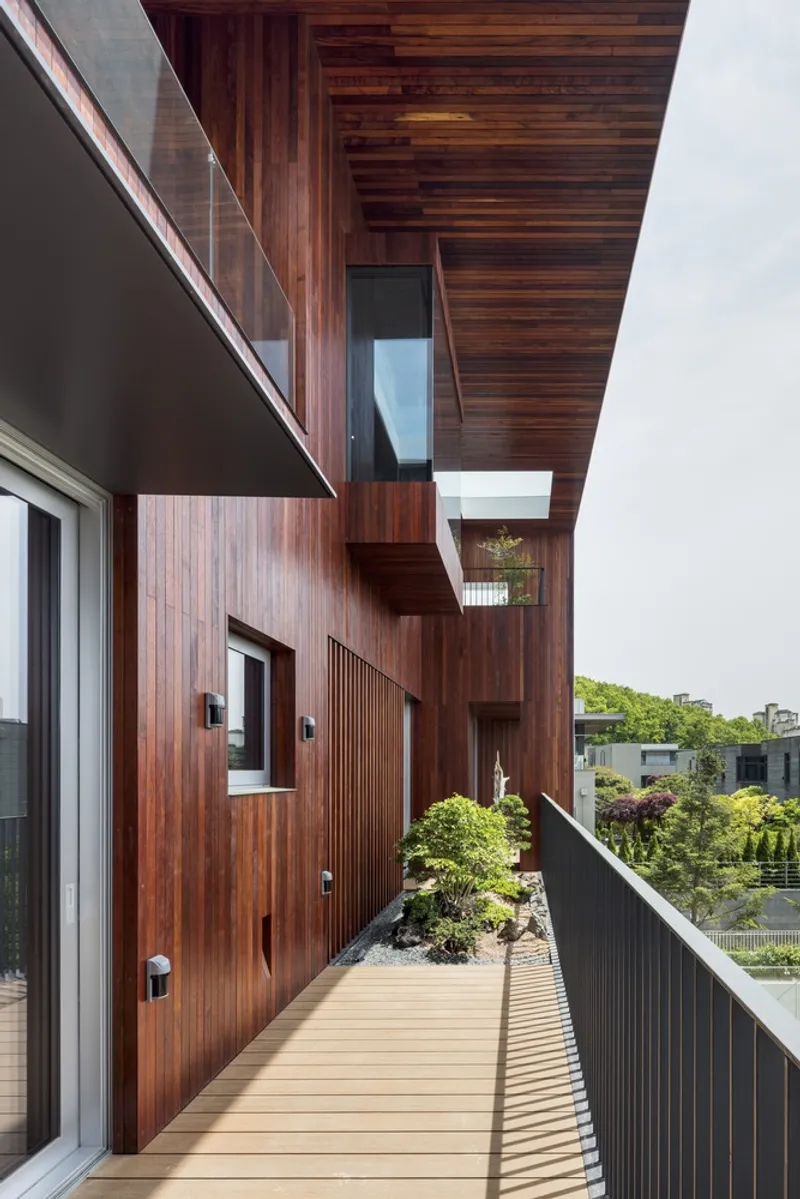
The second floor is dedicated to the couple’s children, featuring separate bedrooms for the son and daughter. These rooms are arranged around a central family room and the void space below, allowing visual connection through strategically placed interior windows. Each bedroom opens onto its own terrace, offering direct access to the yard below and reinforcing the indoor-outdoor relationship.
Third Floor: Private Retreat for the Couple
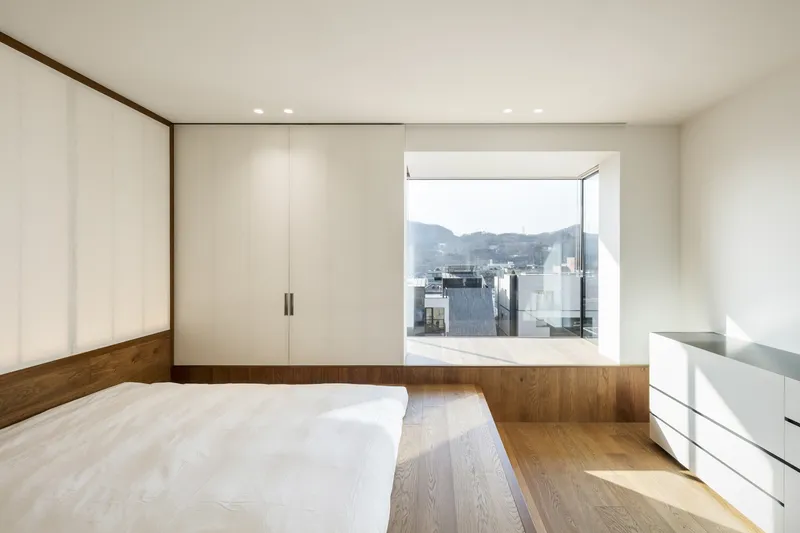
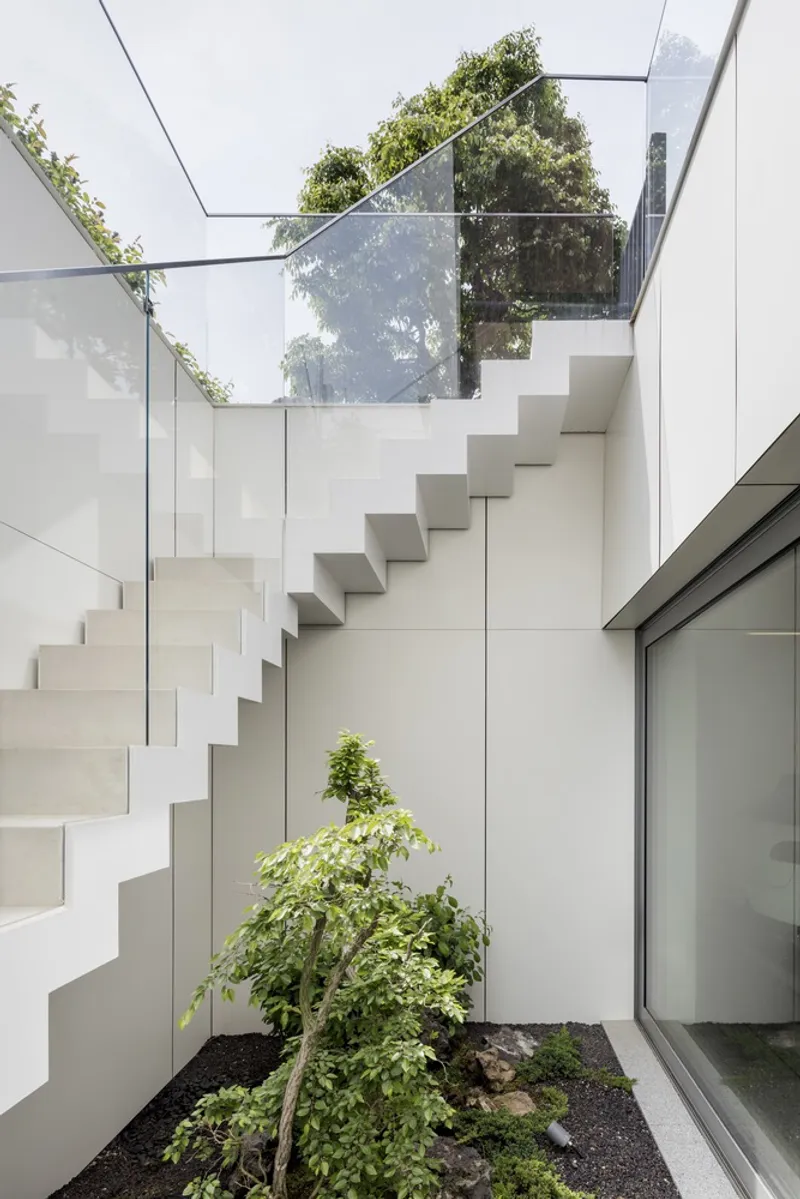
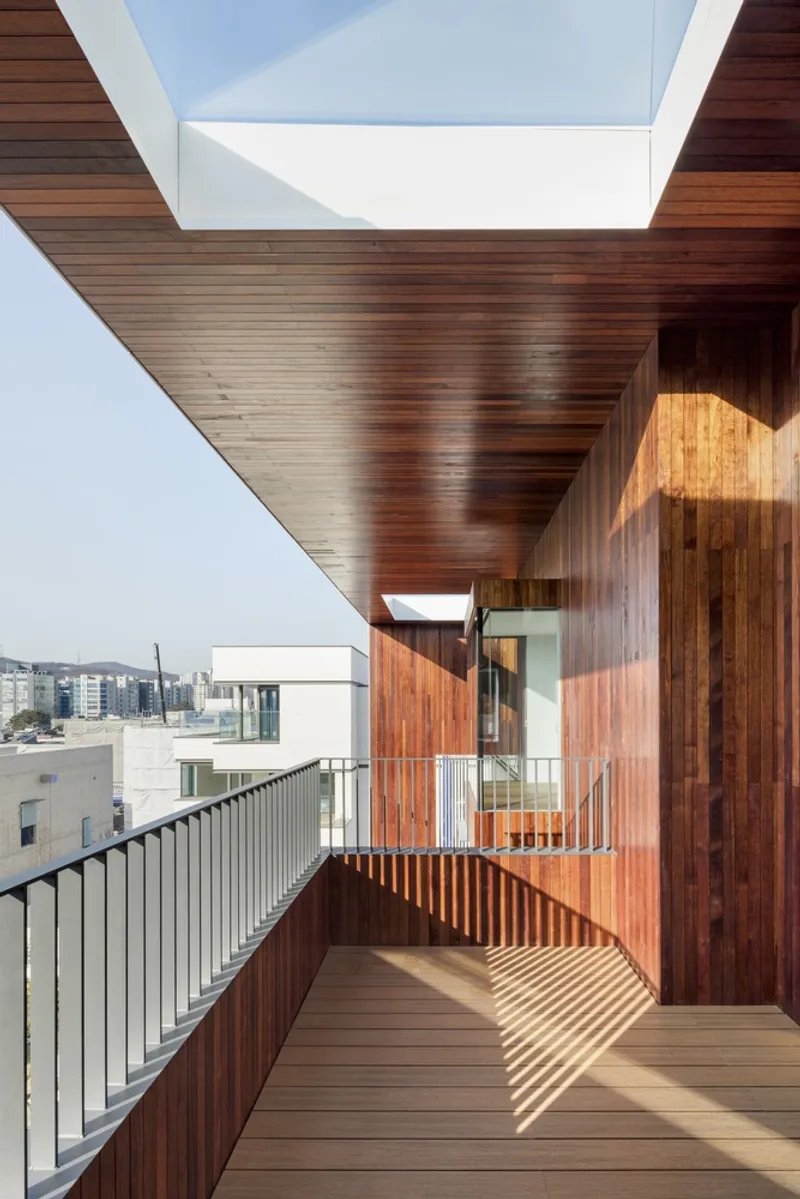
The third floor serves as the parents’ private sanctuary. At its core lies the master bedroom, flanked by two private rooms for each spouse, each with access to individual terraces. These terraces are thoughtfully designed to connect vertically with the terraces and yard below, creating a layered outdoor experience across all three levels. Instead of a terrace, the master bedroom features a distinctive protruding window that overlooks the yard, providing privacy while maintaining a connection with the landscape.
Materials, Structure, and Finishes
The house employs a refined palette of natural materials, including Merbau wood, GRC (Glass Fiber Reinforced Concrete), and other high-quality finishes that enhance both durability and aesthetic appeal. The structural integrity was ensured by SEN Engineering Group, with civil engineering support from ANAM ENG, while interior spaces were crafted by Kieda Partners and LSB Design. The construction was executed by JEHYO, resulting in a seamless realization of the architect’s vision.
The Multi Terrace House is a remarkable example of modern family home architecture that prioritizes privacy, natural light, and indoor-outdoor connectivity. By ingeniously leveraging the site’s natural slope, Hyunjoon Yoo Architects created a dynamic living environment that meets the complex needs of a contemporary family, embracing openness without sacrificing comfort or security.
All Photographs are works of Kyungsub Shin


Popular Articles
Popular articles from the community


Opera by the Sea Estonia: Three Shells Dissolving Architecture into Tallinn's Coastline
A winning opera house proposal replaces monumental form with interconnected shells that blur the boundary between building, park and Baltic Sea.

Opera on the Sea: Driftwood Logic Shapes a Timber Opera House on Estonia's Coast
Trevor Orgill's opera house translates the entangled drift of floating timber into a civic building where wood, water, and music converge.

Manzana Morphosis: Stretching Barcelona's Grid into a Living Landscape for 2050
A radical reworking of the Eixample manzana turns density into a tool for generous public space, vertical ecology, and environmental performance.

Faces of the Soviet Avant-Garde: Turning Moscow's Street Names into an Open-Air Museum
A network of sculptural installations across a Moscow residential district transforms forgotten architect names into spatial encounters with cultural memor

Similar Reads
You might also enjoy these articles


Hodi-Mandai Geram
Project Function: Preservation and revitalization of the Intangible heritage and socio-spatial identity of the Hodi by Housing, Cultural Memory Center, Sacred Grove, landscape, local tourism economy


Olio Towers: A Mid-Rise for Performers That Fuses Housing, Rehearsal, and Stage
Located blocks from Houston's Theater District, this modular tower stacks living units around a central performance atrium.

Oasis: Modular Green Housing Carved into Dhaka's Urban Fabric
A shortlisted Plugin Housing entry reclaims unauthorized settlements in Dhaka with stepped concrete volumes, green roofs, and ventilation-driven design.

Black Hole: A Floating Megastructure for the Post-Physical Era
Emiliano Mazzarotto envisions a spherical, self-scaling arena where e-sports, digital hotels, and holographic stadiums replace traditional public space.

Explore Architecture Competitions
Discover active competitions in this discipline

Challenge to reimagine the Iron Throne

Photograph architecture without architects

Illustrate the lost glory of Angkor Wat - Render Challenge

Design challenge to reuse E-waste
Comments (0)
Please login or sign up to add comments
No comments yet. Be the first to comment!