
Nicolás Oks Builds a Shingled Dome Pavilion into the Rocky Slopes of an Argentine River Valley
A 70-square-meter retreat near the El Durazno River in Villa Yacanto pairs charred timber with Jesuit stone walls and a conical roof.


Architecture that borrows its posture from the land it occupies tends to be either too literal or too restrained. Nicolás Oks manages neither extreme with this 70-square-meter pavilion in Villa Yacanto, Argentina, a project that reads as both ancient and precisely engineered. Set on a mountain slope only meters from the El Durazno River, the building tucks itself into existing dry-stacked stone terraces, remnants of Jesuit-era construction, and grows upward into a conical timber dome that punctuates the hillside like a geological event rather than an architectural imposition.
What makes this project genuinely interesting is the collision of craft traditions it orchestrates. Charred timber cladding, fieldstone masonry, steel cable tensioning, and a shingled dome form a single composition that never feels forced. The pavilion is small, but it carries the structural ambition and material rigor of something much larger. Oks treats the program as an excuse to test a sophisticated radial timber frame, and that structural idea becomes the building's primary spatial experience: a room defined not by its walls but by the geometry of its ceiling.
Landscape as Foundation
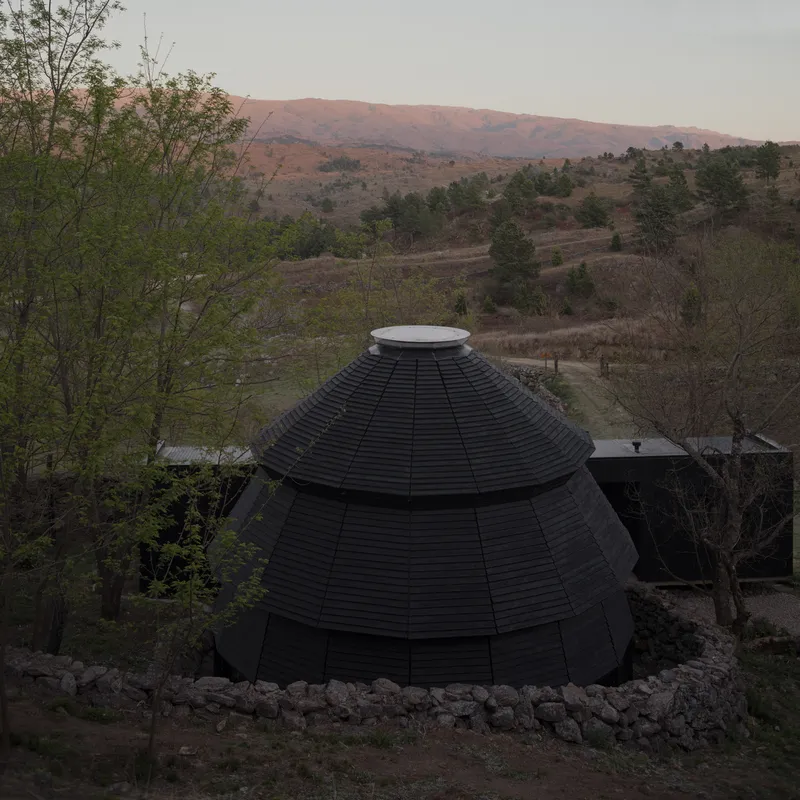
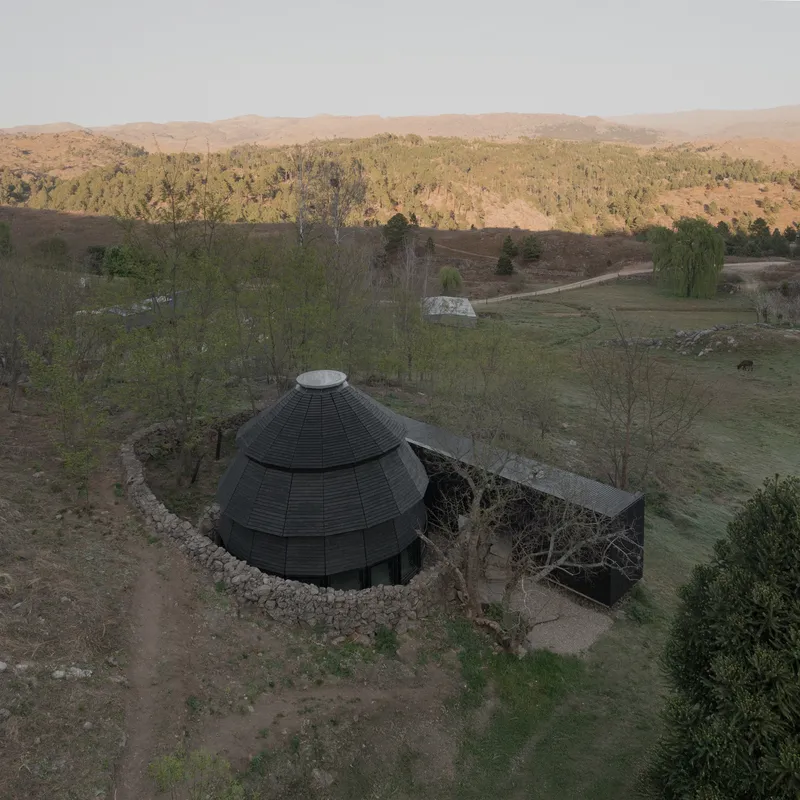
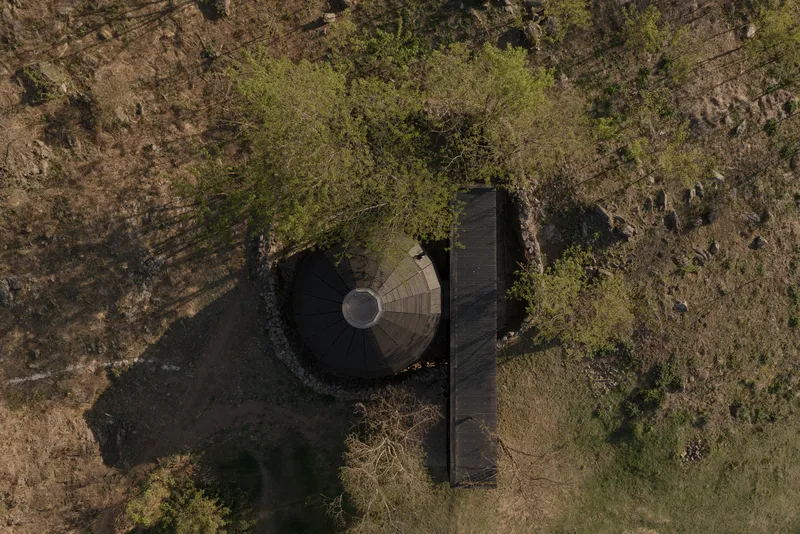
From above, the building barely registers as an intrusion. The black shingled dome and the linear rectangular wing hug the contour of the hillside, their dark surfaces absorbing into the dry grassland and exposed rock. The circular plan of the dome sits on a stone perimeter wall that appears to predate the building, and in some views it is genuinely difficult to separate the new construction from the terrain it inhabits.
The aerial perspective also reveals the organizational logic: a circular gathering volume connected to a service bar by a stone retaining wall that doubles as a circulation spine. The strategy is surgical. Rather than flatten the site, Oks terraces into it, using the existing topography and masonry as both structure and scenography.
Stone and Char
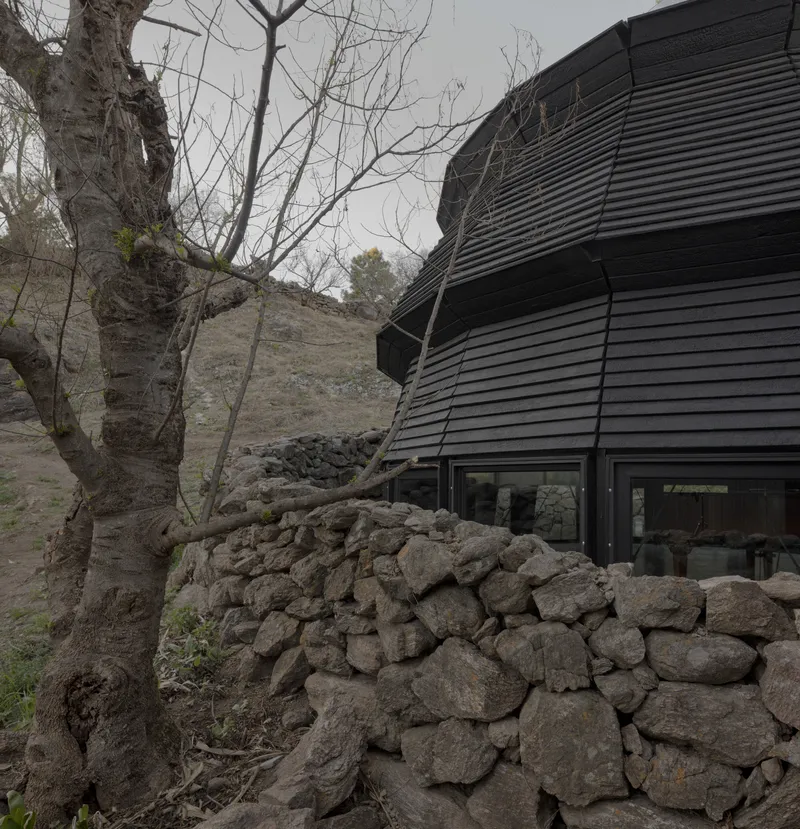
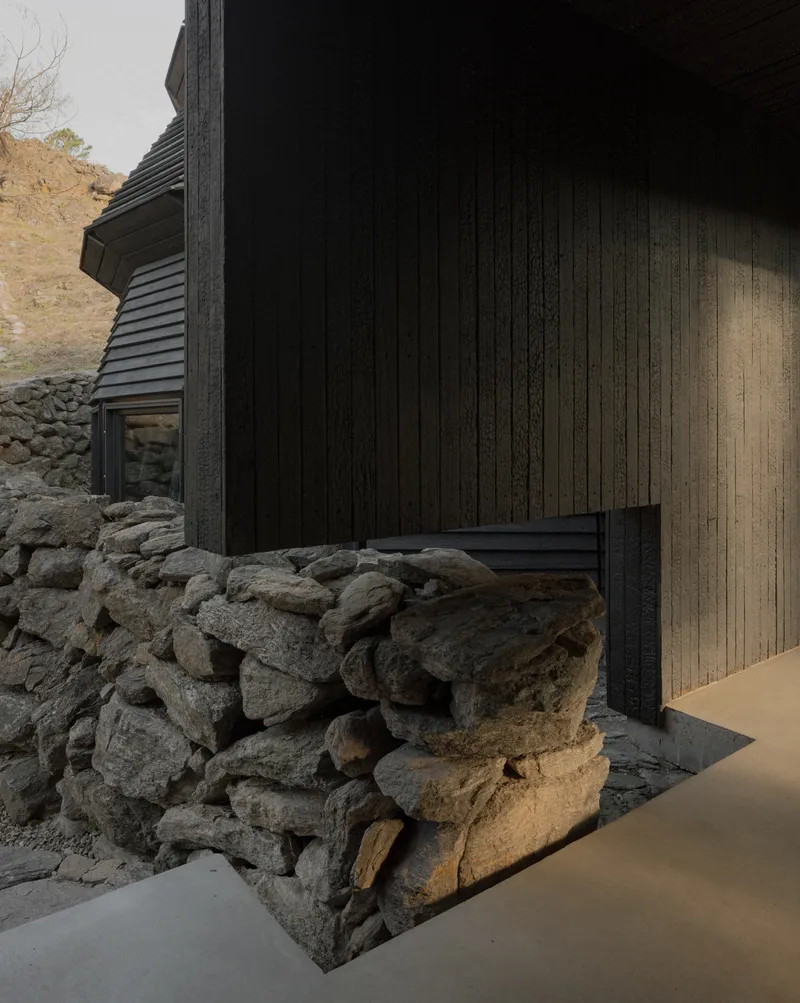
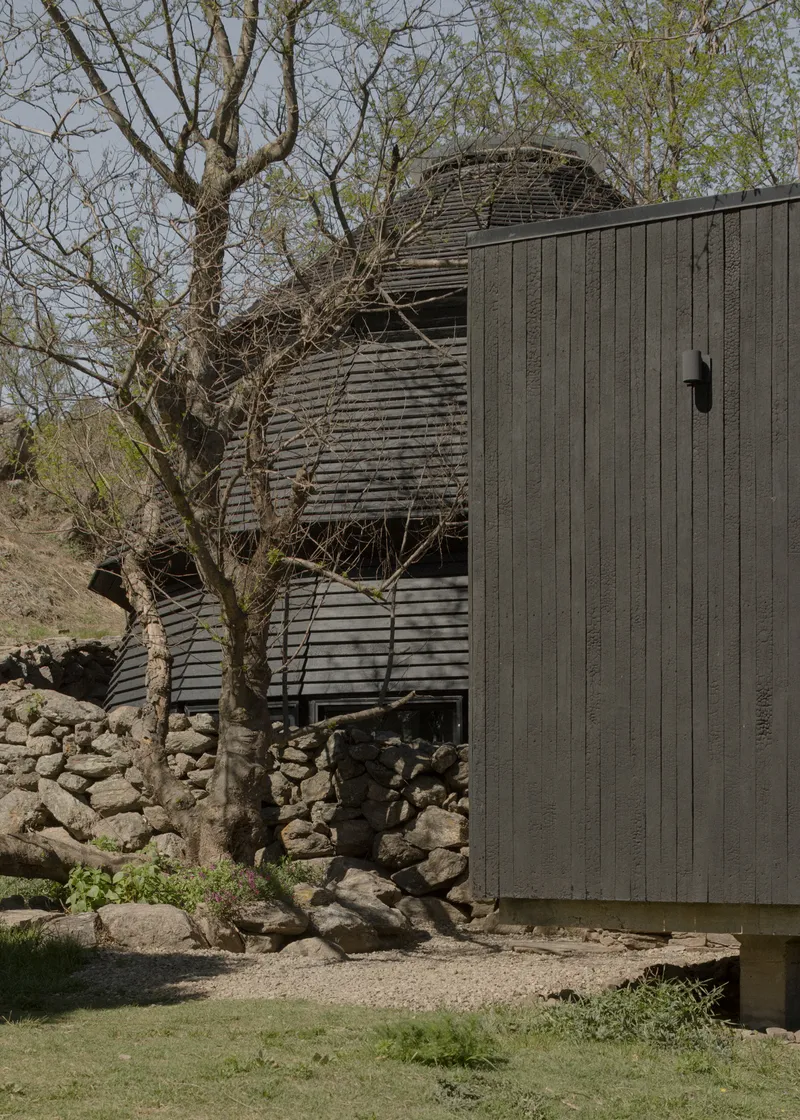
The material palette is deliberately limited: charred vertical timber boards, dry-stacked fieldstone, concrete floors, and black steel. Every joint between materials is legible. The charred cladding meets the stone base without a trim piece, and the texture contrast does all the compositional work. Shou sugi ban, the Japanese technique of charring wood, is used here not as a fashionable surface treatment but as a practical weather barrier that also ties the building chromatically to the volcanic stone of the site.
These details are best appreciated at the corners, where the blackened boards terminate against rough boulders. The building looks like it was excavated rather than erected, a quality that few architects achieve without resorting to earth-sheltered gimmicks.
The Linear Volume
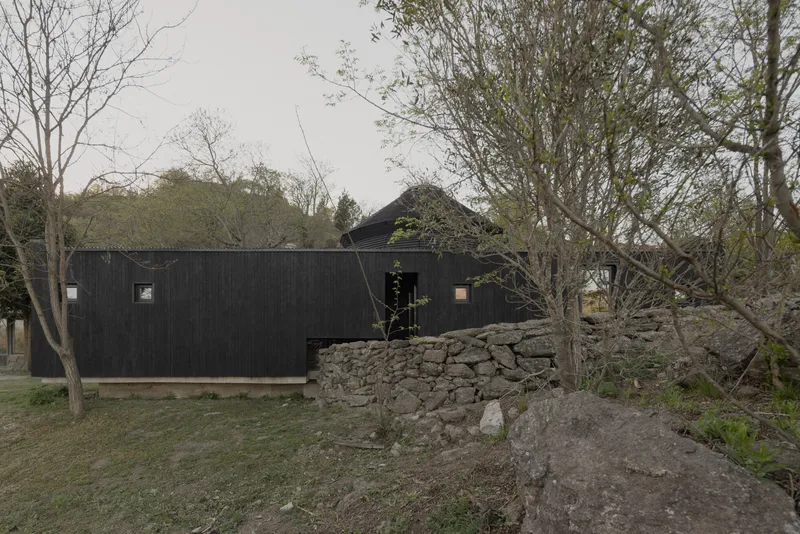
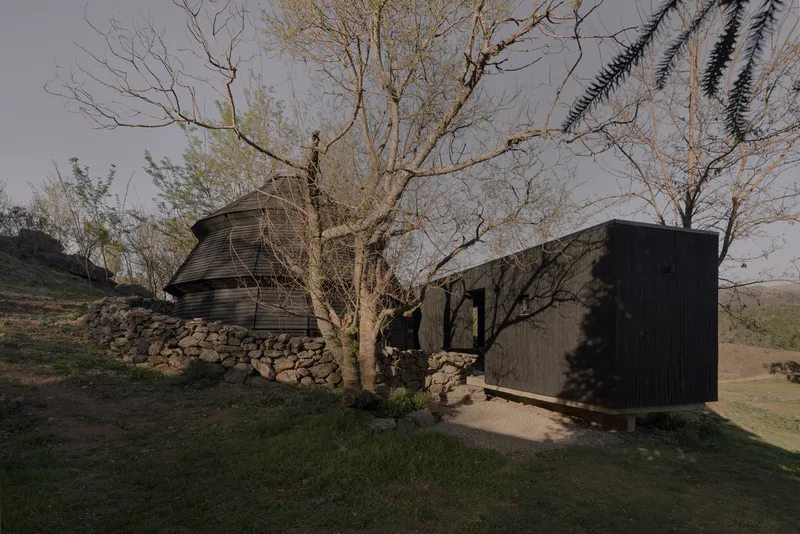
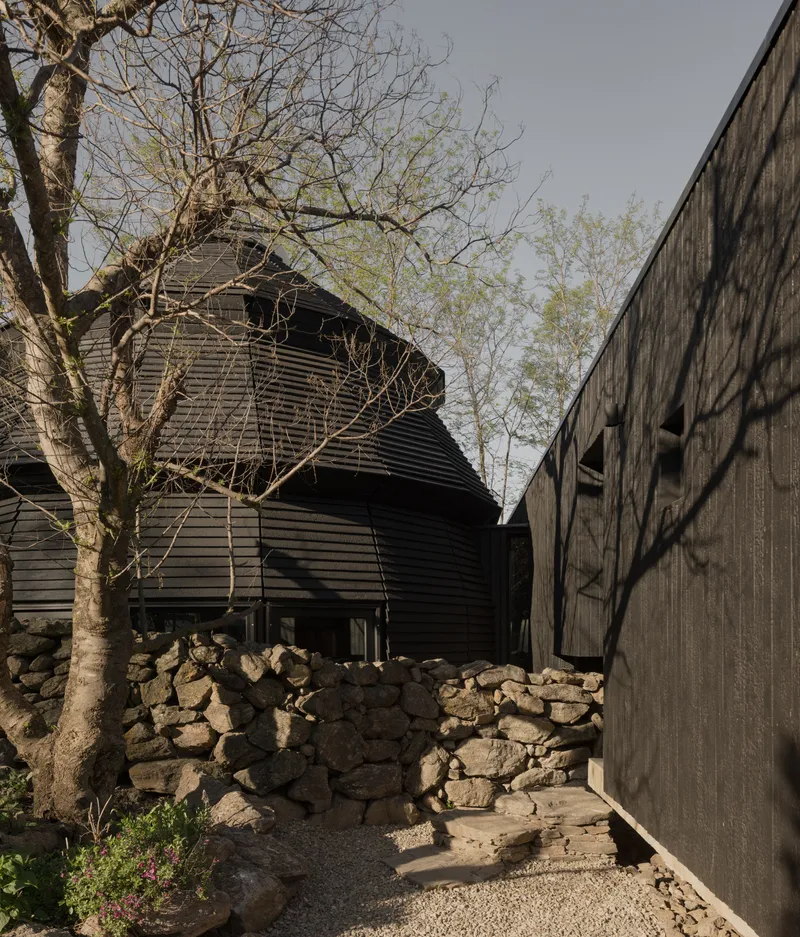
The rectangular wing is the quieter half of the composition. A long black box, it runs parallel to the stone retaining wall, creating a narrow gravel courtyard between old and new. The corridor between charred timber fence and stone wall has a processional quality: you move through the material history of the site before arriving at the dome.
Functionally, this bar houses the service spaces, sleeping, and bathing. Its proportions are deliberately compressed, making the eventual release into the conical volume all the more dramatic.
Interior Thresholds
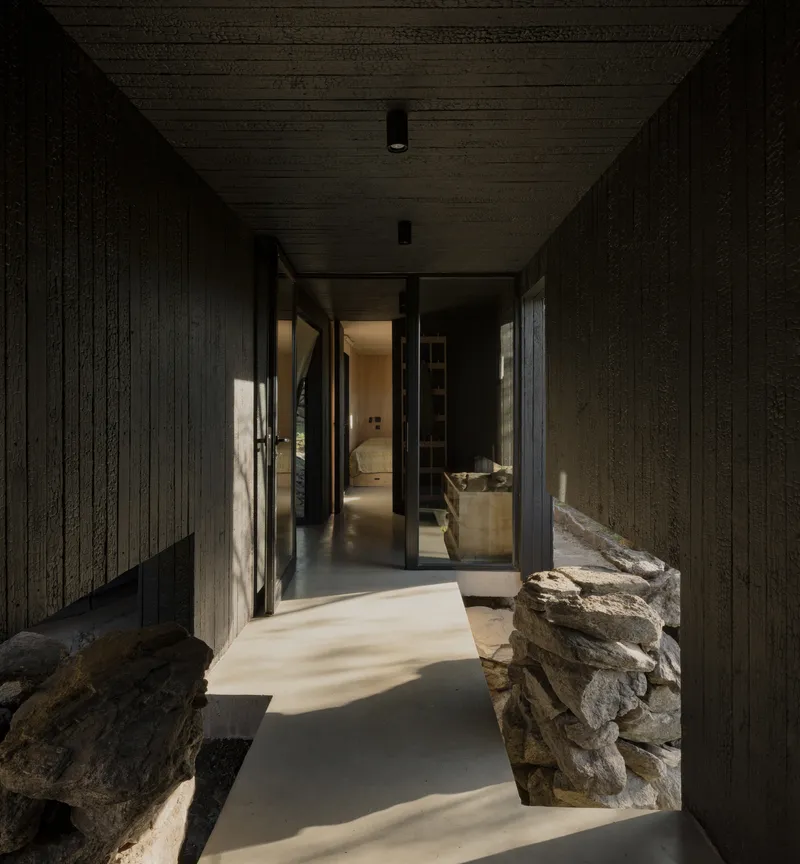
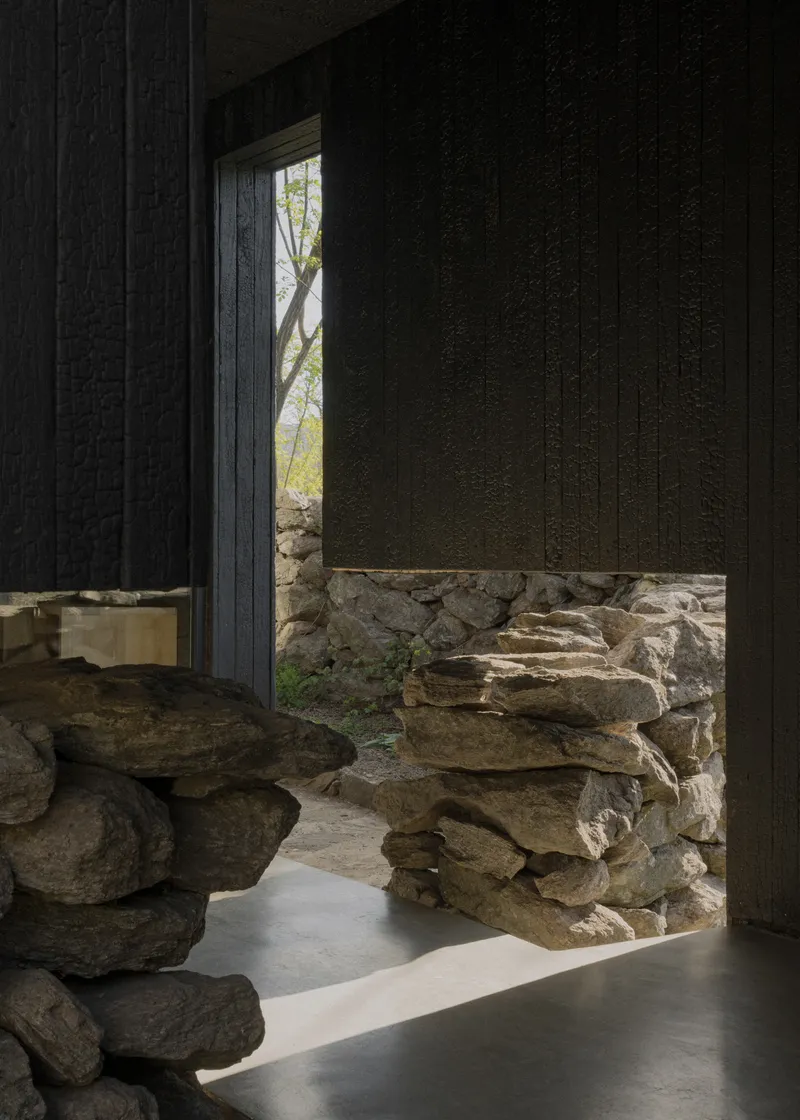
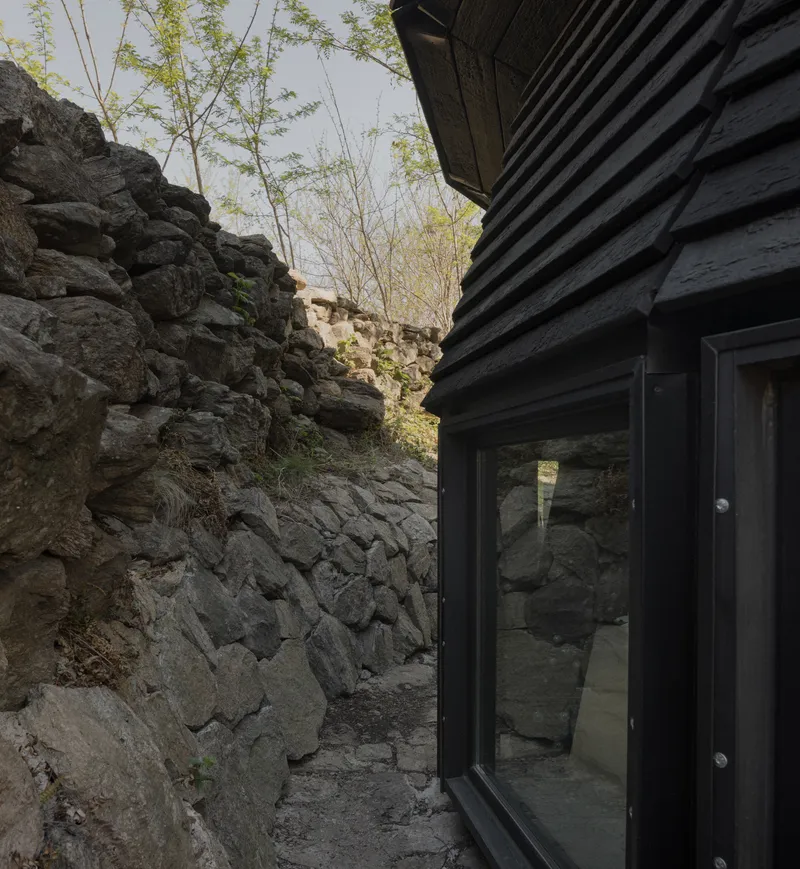
Light enters the linear volume through carefully placed openings that frame the stone walls outside. The corridor in image three is one of the strongest moments in the project: natural light rakes across the concrete floor while charred walls and fieldstone flanks create a cave-like compression. Oks uses the threshold between stone and timber as a recurring motif, turning every doorway into a moment of material negotiation.
The glass doors opening onto the narrow courtyard reinforce the idea that this building is carved from the hillside rather than placed upon it. Volcanic rock and timber exist on equal terms.
The Dome's Radial Structure
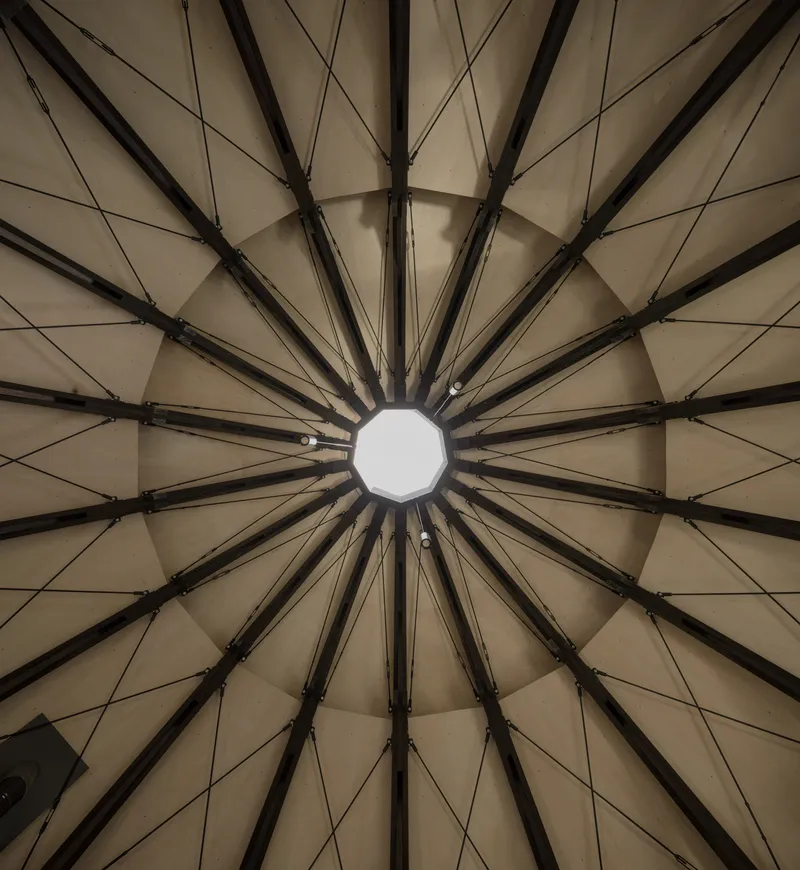
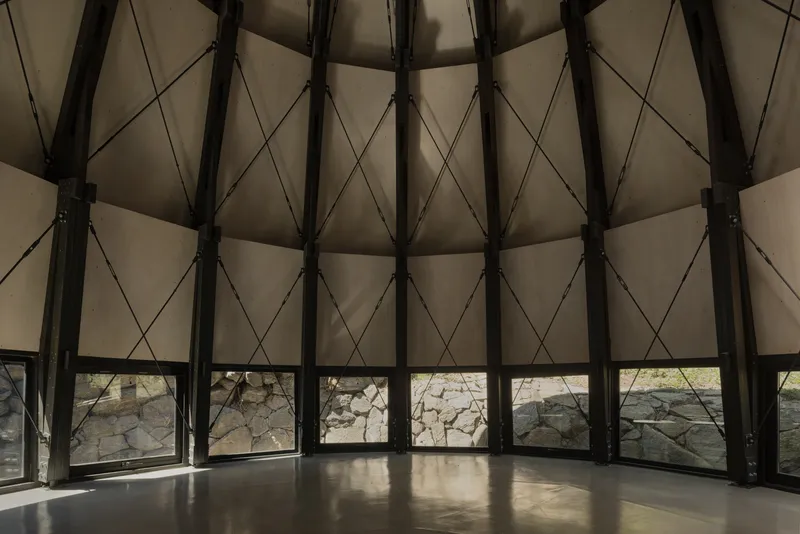
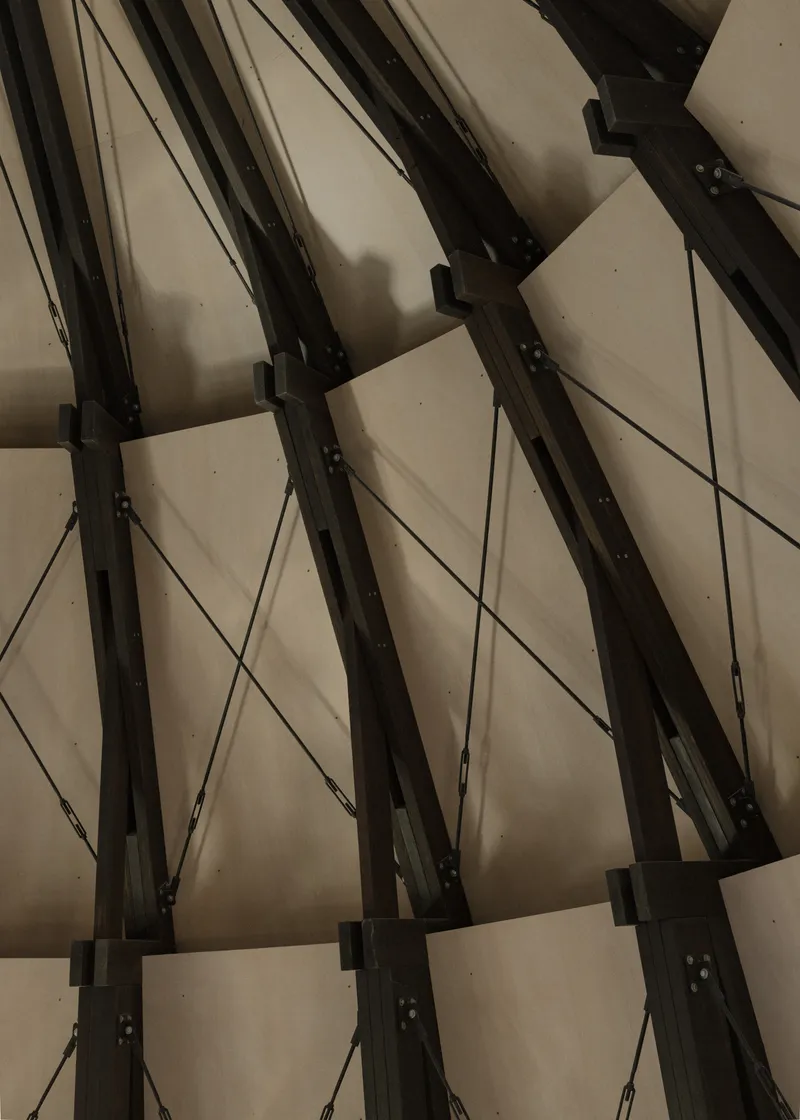
The conical roof is the technical heart of the project. Looking up from the interior, radiating steel beams converge on a circular skylight, braced by diagonal cables that give the ceiling the taut energy of a bicycle wheel. The structural logic is entirely exposed, and the connections are deliberately muscular: black steel plates, bolted joints, visible cable tensioners. Nothing is concealed, and nothing needs to be.
The ribbon windows at the base of the dome allow the landscape to enter at eye level while the oculus pulls light straight down the cone's axis. The result is a room that feels simultaneously compressed and infinite, its geometry funneling your gaze upward while the horizontal views anchor you to the river valley outside.
Living Under the Cone
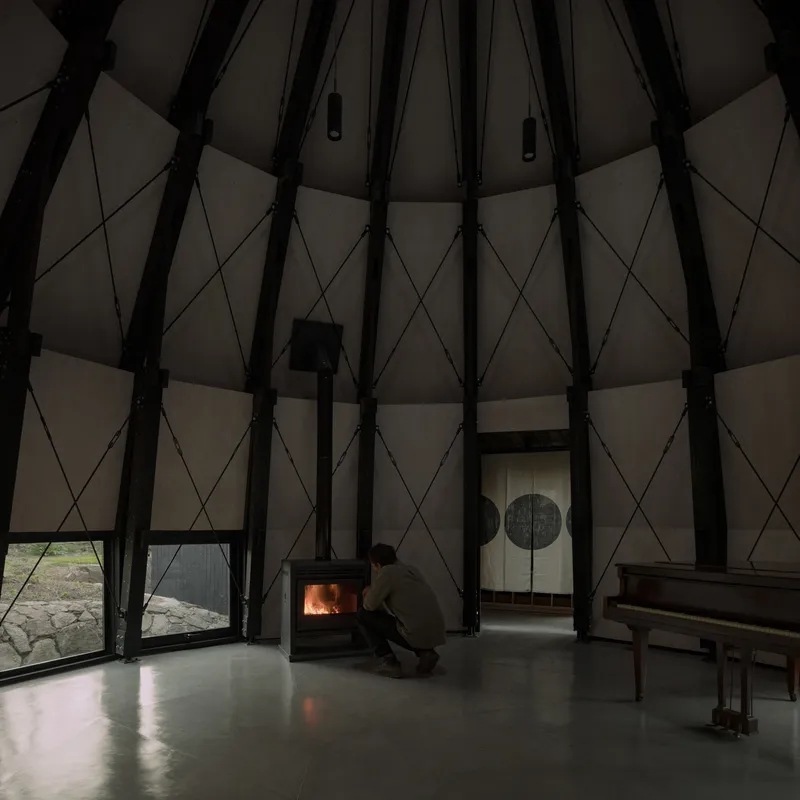
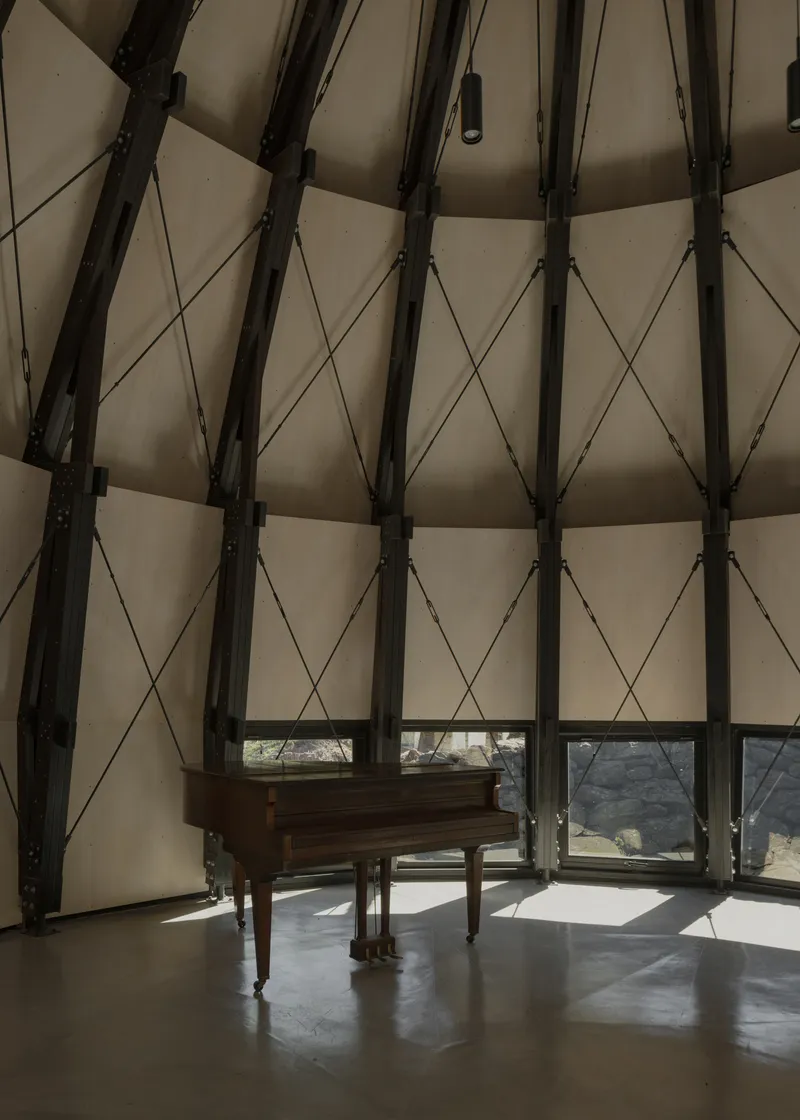
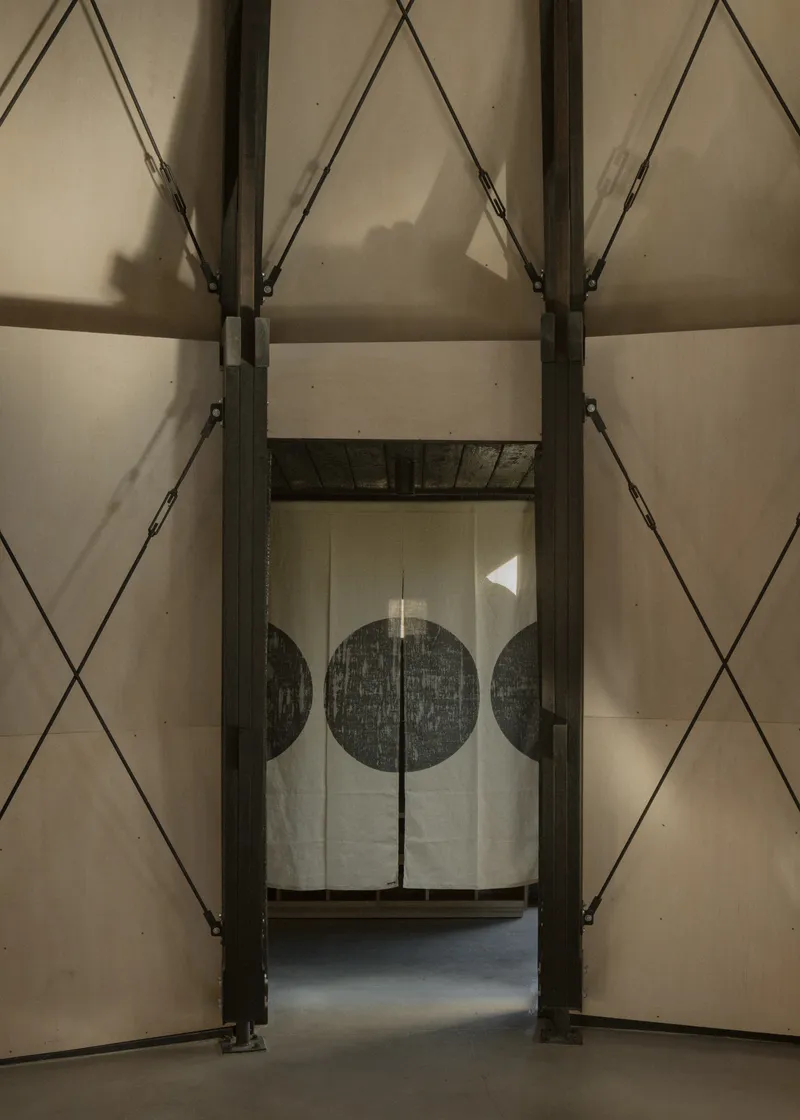
The dome is furnished sparingly. A wood stove anchors one side, a piano occupies another. A hanging textile with circular motifs provides a soft counterpoint to the exposed steel above. The polished concrete floor reflects the skylight, and at certain times of day a disc of light must travel across the room like a sundial. This is a space designed for gathering, for music, for the kind of slow occupation that only happens when a room has genuine atmospheric presence.
What strikes you is how the conical geometry eliminates the usual hierarchy of a room. There are no corners to claim, no obvious front or back. The circle distributes attention evenly, and the radial structure overhead reinforces that democracy. It is a generous room in every sense.
Domestic Details
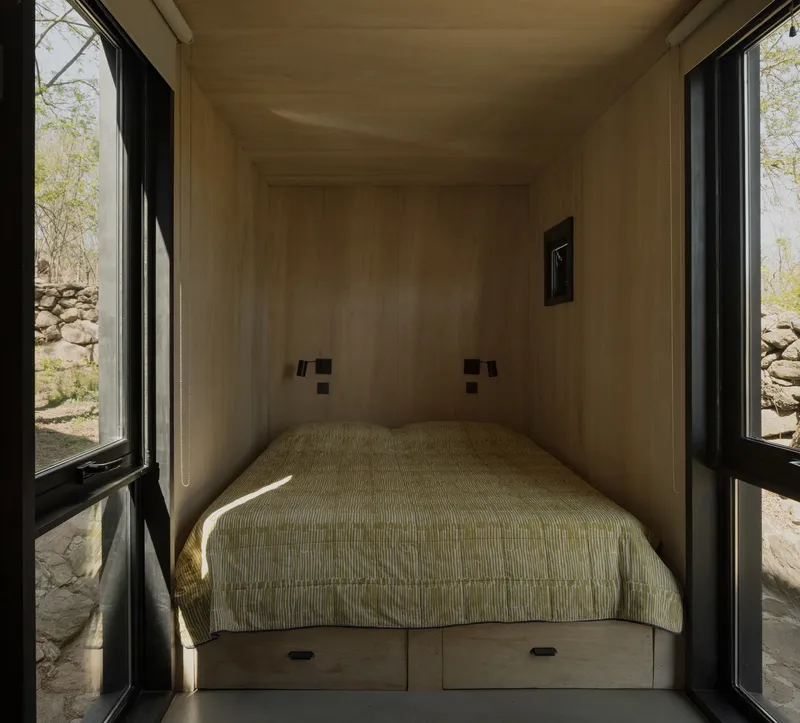
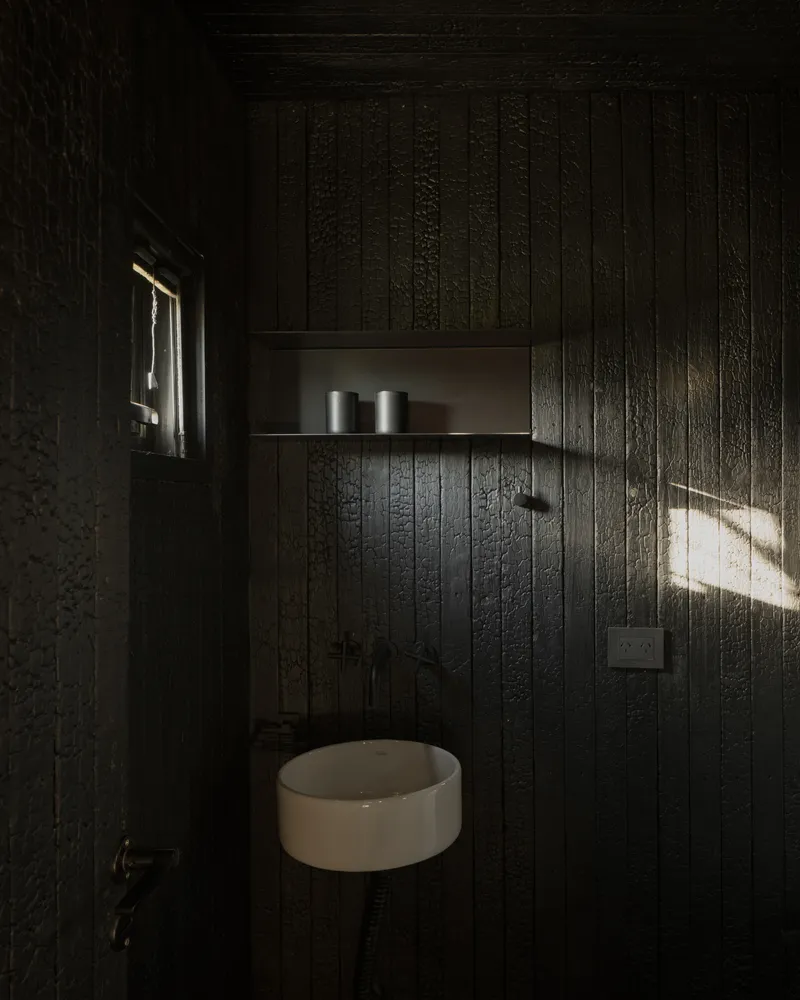
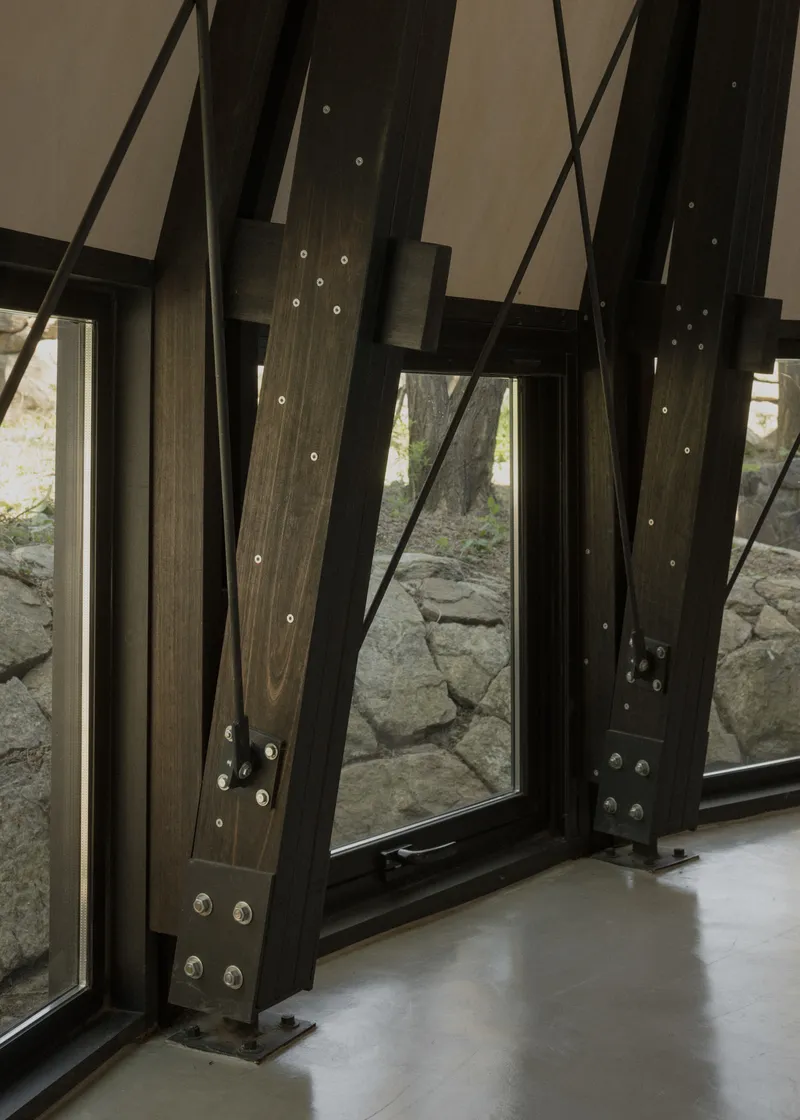
In the service wing, the details are compact and well-resolved. A built-in bed alcove lined in plywood sits between black-framed glazed doors that open directly to the stone wall, collapsing the distance between sleeping and landscape. The powder room, with its charred timber lining and simple round basin, treats even the most utilitarian room as an opportunity for material consistency.
The diagonal timber bracing visible through the windows, with its bolted steel connections, gives even the secondary spaces a view of the building's structural logic. Nothing is hidden behind drywall. The pavilion wears its construction as its interior finish.
After Dark
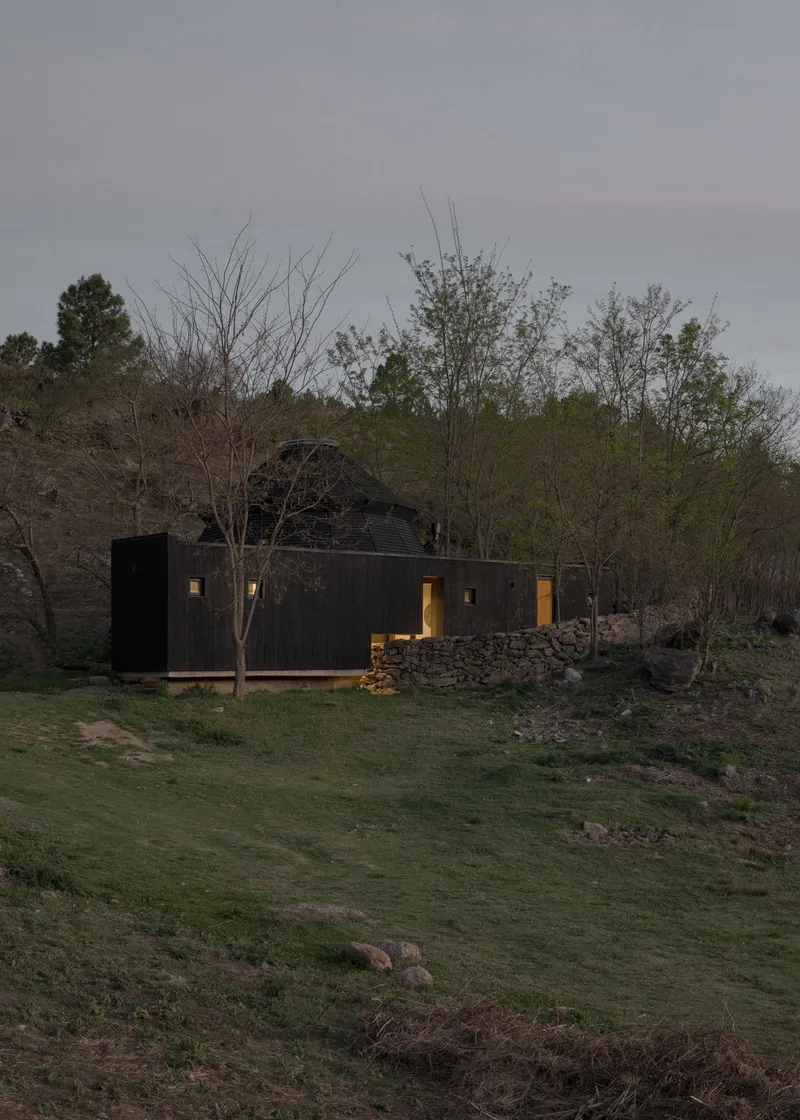
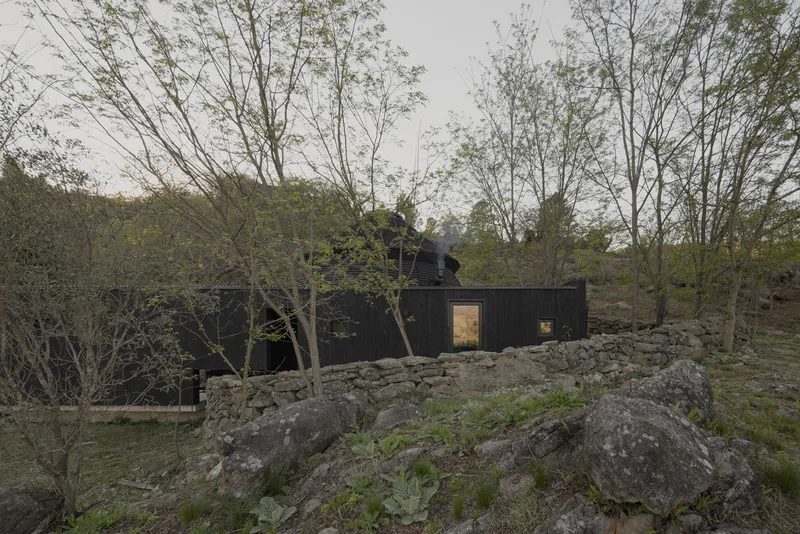
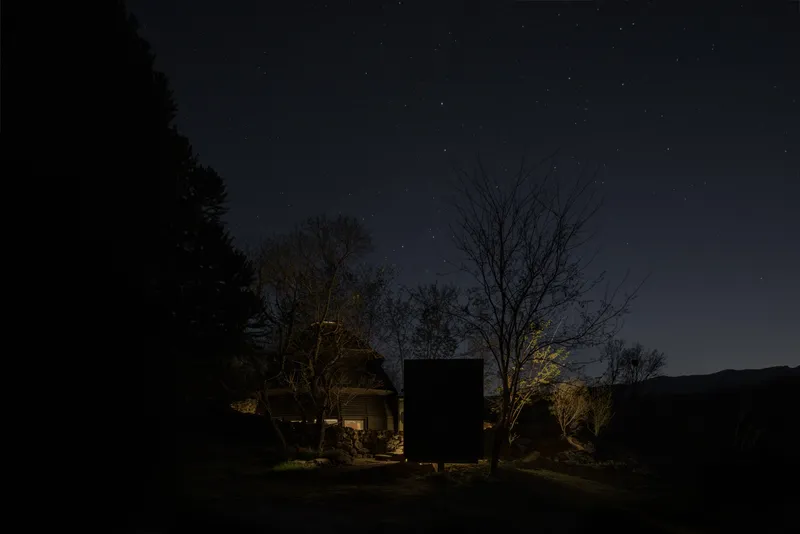
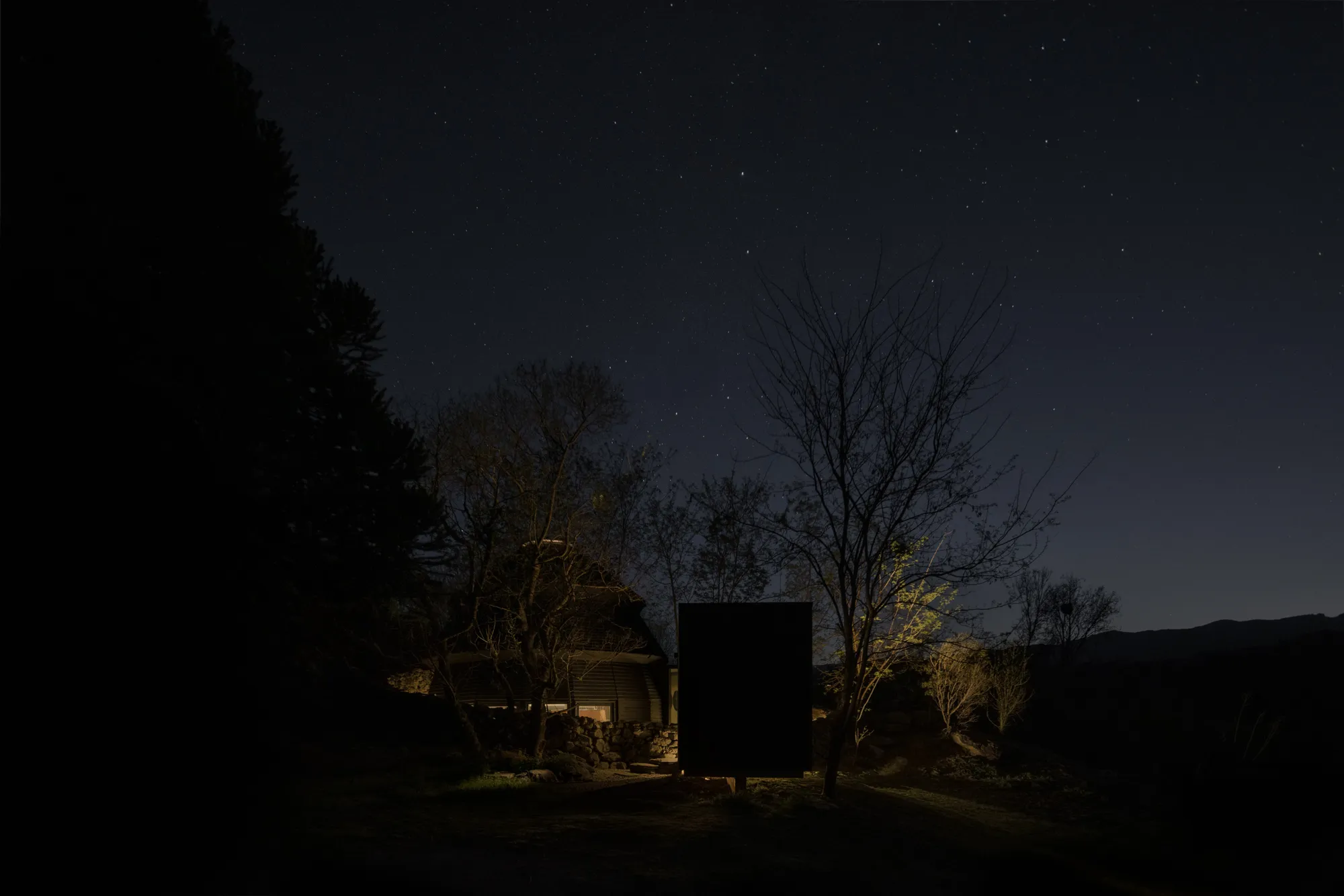
At night, the pavilion becomes a lantern on the hillside. Warm light spills through the window openings in the charred cladding, turning the black facade into a constellation of amber rectangles. The dome glows from within, its oculus now a beacon against the star field. Federico Cairoli's nighttime photographs capture the building at its most theatrical, and they confirm that the massing strategy works across every lighting condition.
The contrast between the dark, almost invisible cladding and the illuminated interior is the payoff of the all-black material strategy. During the day, the building recedes. At night, it announces itself.
Plans and Drawings
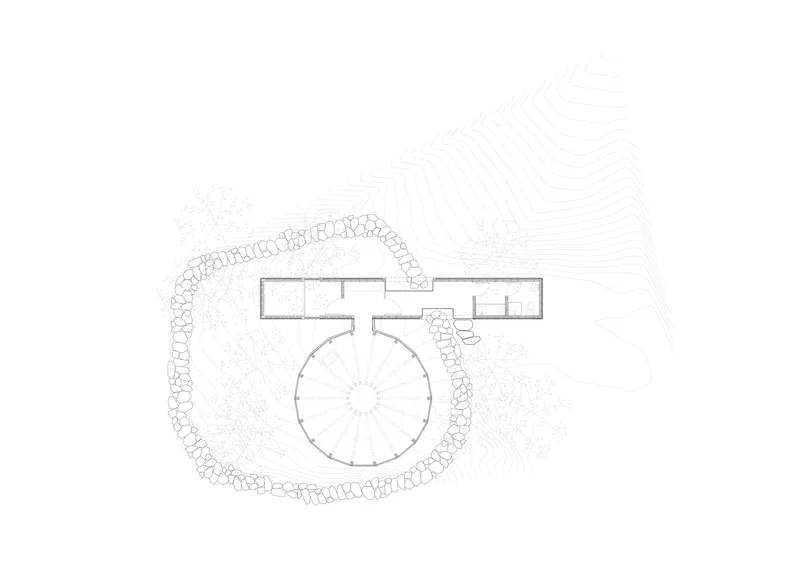
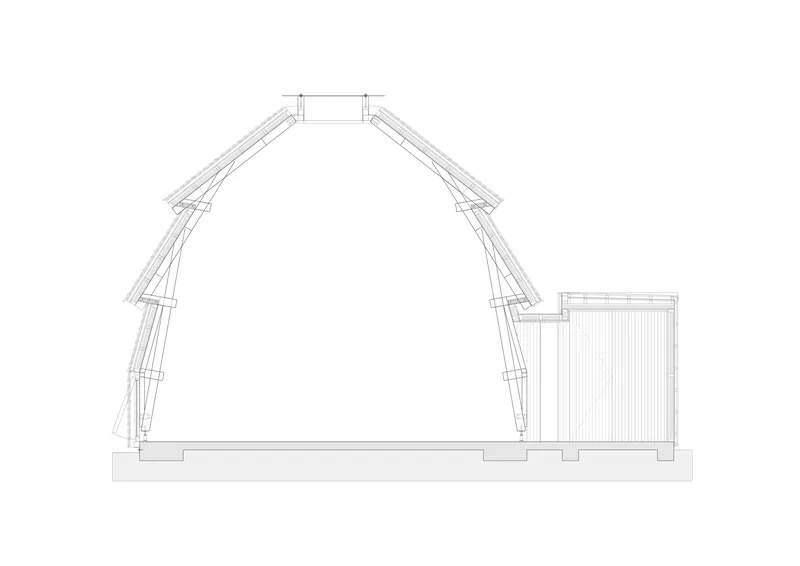
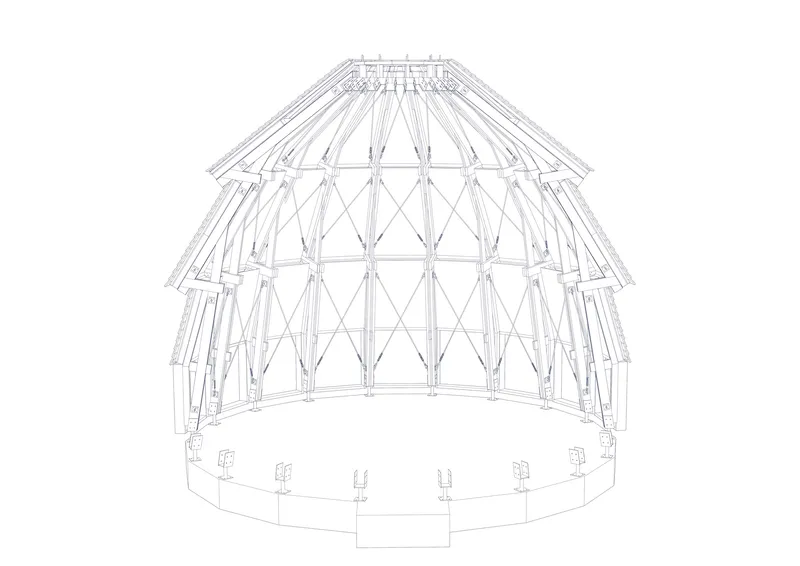
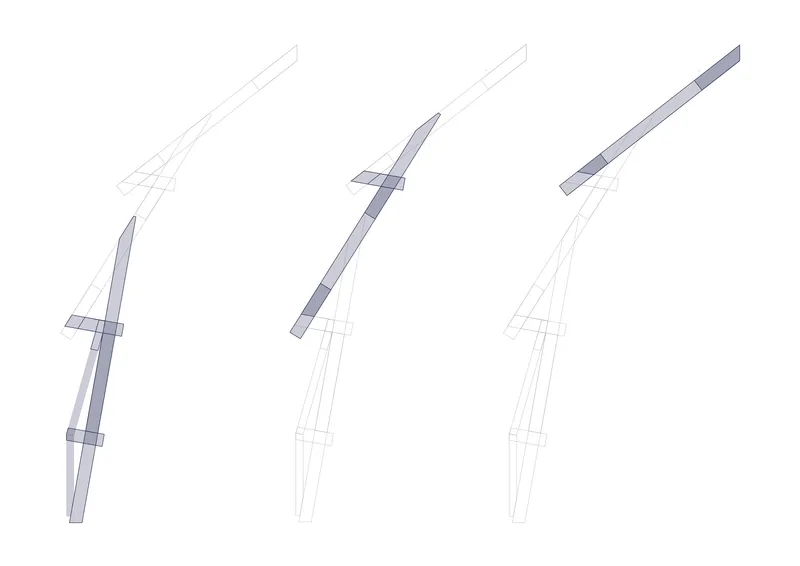
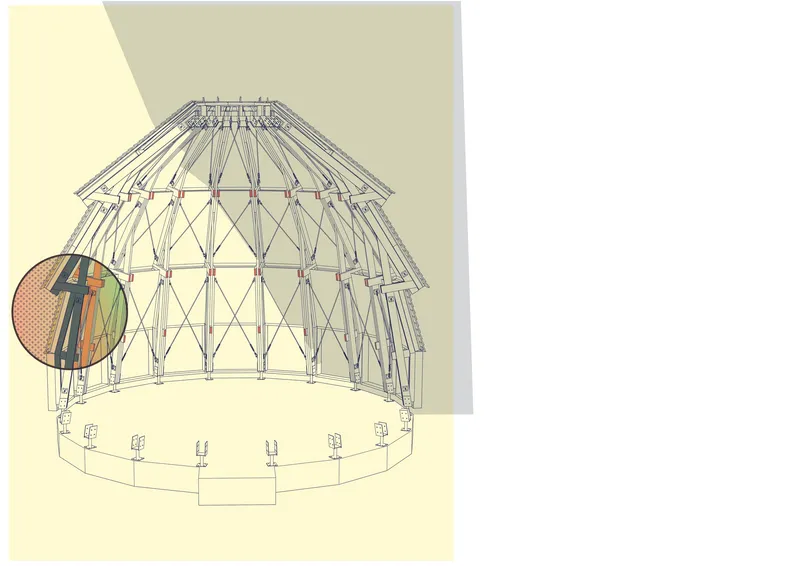
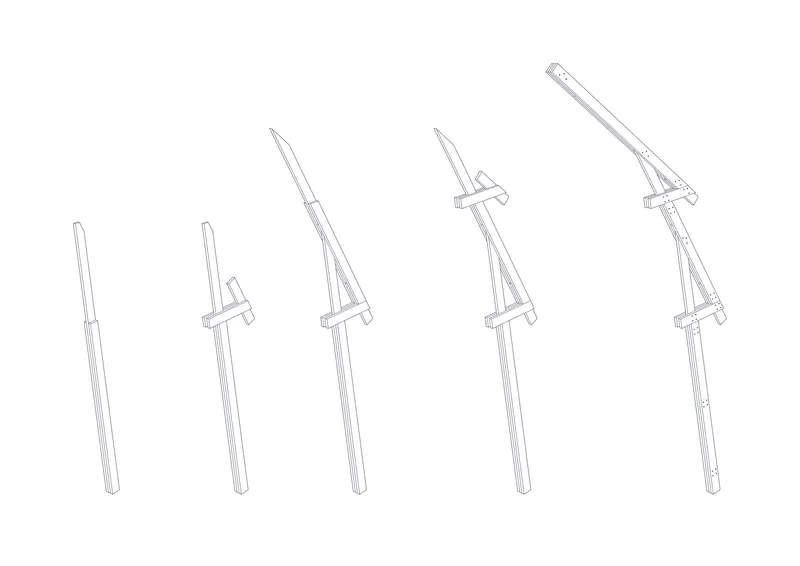
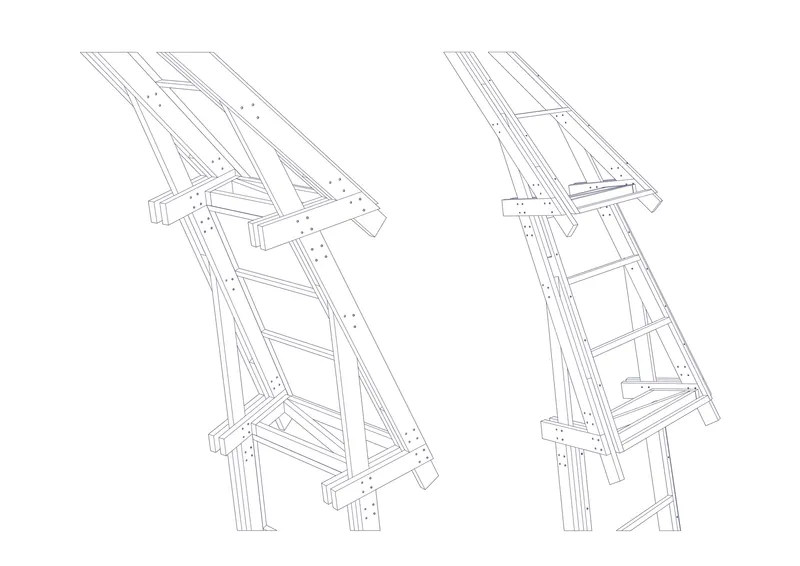
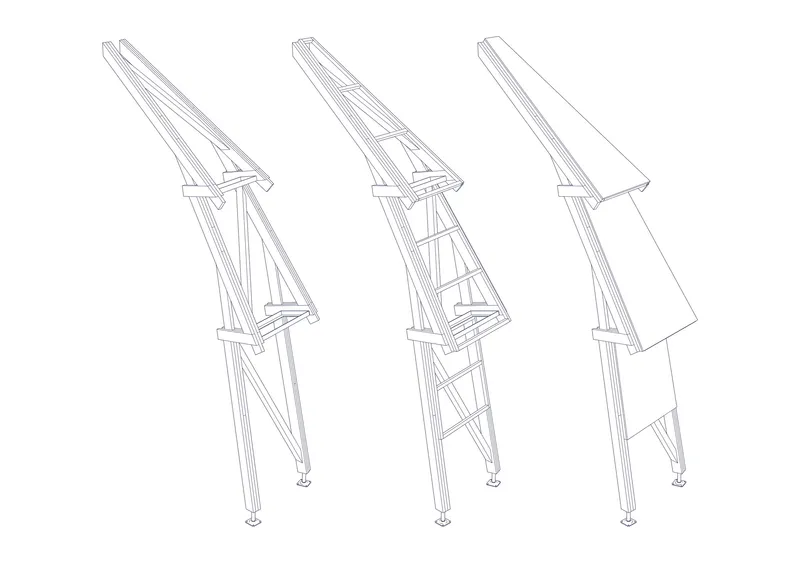
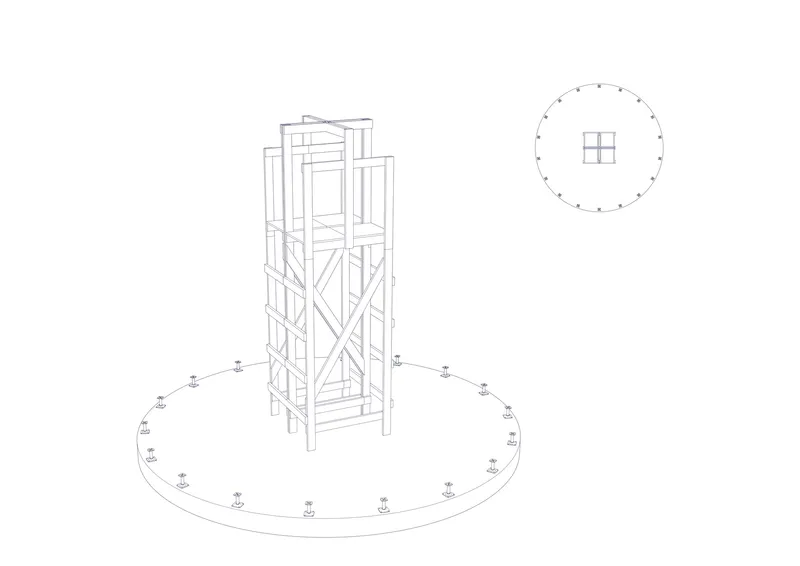
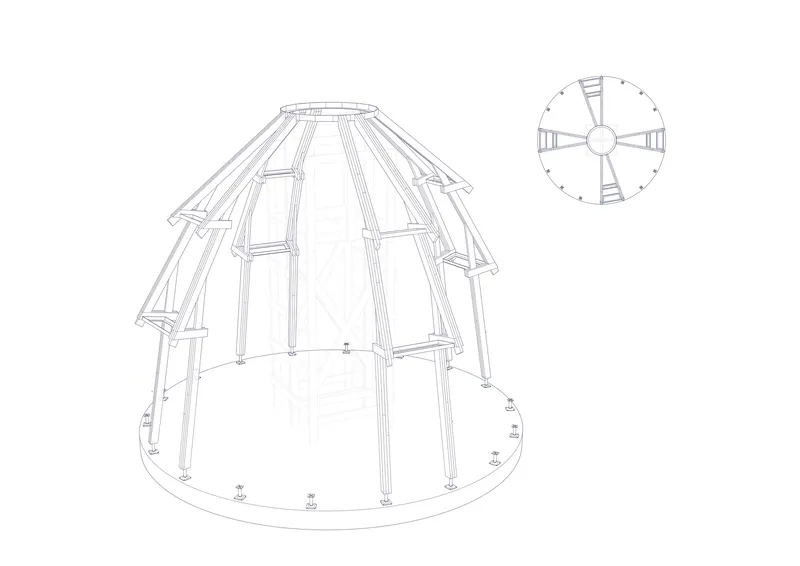
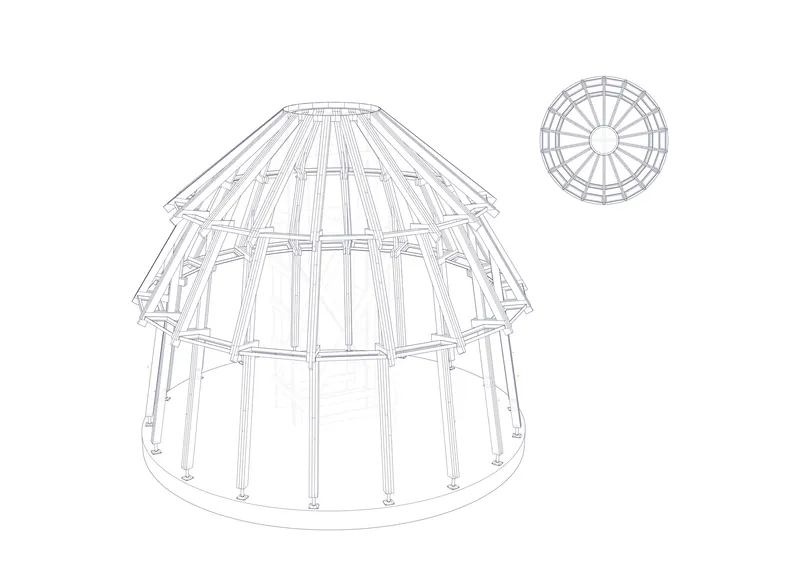
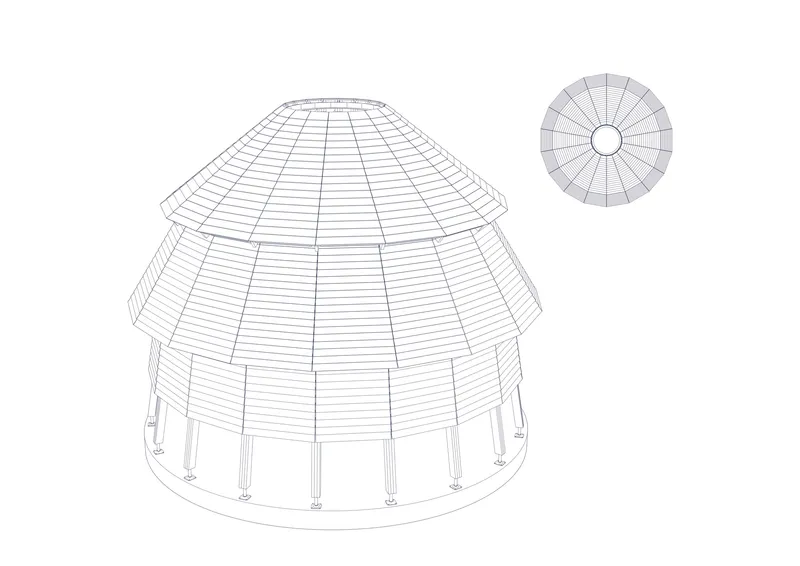
The drawing set reveals the engineering ambition behind the dome. The site plan shows how tightly the circular form locks into the existing stone perimeter. The section drawing exposes the full height of the conical roof and the compressed profile of the service bar. But the most instructive drawings are the axonometric sequences that break down the radial timber frame into its constituent modules: angled struts, horizontal cross-bracing, diagonal panels, and the central tower core that anchors the entire assembly.
The progressive diagrams showing the tilt sequence and panel cladding stages make clear that this is not a conventional timber frame. Each module is a triangulated truss that leans inward at a calculated angle, locked into place by horizontal connections and cable bracing. The drawings treat the dome as a kit of parts, and they suggest a construction sequence that could be replicated on similarly steep, remote sites.
Why This Project Matters
The Pavilion in El Durazno is a small building that takes big structural risks and lands them cleanly. In a moment when rural retreats tend to default to either minimal glass boxes or nostalgic vernacular pastiche, Nicolás Oks charts a third path: a building that is unmistakably contemporary in its engineering but deeply rooted in the material culture of its site. The charred timber, the Jesuit stone walls, the conical roof, these are not references. They are arguments for how new construction can participate in a landscape's layered history without deferring to it.
At 70 square meters, the project also makes a case for intensity over scale. Every square meter is working, structurally, spatially, and atmospherically. The radial dome provides a communal room that punches well above its footprint, and the linear service bar compresses domestic life into the tightest possible section. The result is a pavilion that feels both monastic and generous, a retreat that earns its remoteness through the quality of its construction rather than the exclusivity of its address.
Pavilion in El Durazno by Nicolás Oks, Villa Yacanto, Argentina. 70 m², completed 2024. Photography by Federico Cairoli.
About the Studio
Share Your Own Work on uni.xyz
If projects like this are the kind of work you want to make, uni.xyz is a place to publish your own, find collaborators, and enter design competitions.




Popular Articles
Popular articles from the community


Hill & Cross Opera: Sculptural Opera House Architecture Shaped by Tallinn’s Landscape and Identity
Hill & Cross Opera reimagines opera house architecture in Tallinn through its sculptural hill, civic plaza, glass wave and a luminous cross.

Co-Life: Senior Housing Design That Reconnects Older Adults With the City
Co-Life reimagines senior housing design through healing gardens, shared streets, workshops, and a sustainable community across generations.

Lunar Spiral: Space Architecture Shaped by the Mathematics of the Universe
Lunar Spiral reimagines space architecture through Fibonacci geometry, lunar regolith, levitating habitats, and self-sustaining Moon living.

The Ocean Hive: Sustainable Architecture for a Self-Sufficient Civilization at Sea
The Ocean Hive imagines sustainable architecture at sea, where modular habitats, algae, wave power and ocean waste sustain a growing colony.
Similar Reads
You might also enjoy these articles

Bao Huynh Watercolor Atelier: A Serene Art Retreat in Hội An
Bao Huynh Watercolor Atelier in Hội An blends multifunctional art spaces, sustainable design, local materials, and family-friendly living in a serene environment.

Atelier Macri Concept Store Interior Design by CASE-REAL
Atelier Macri store features a "ko" counter, walnut wood details, cork displays, blending retail, gallery, and seamless customer experiences.

Manuel Vargas Izquierdo Stadium and High-Performance Sports Center: Architectural Excellence in Jalpa de Méndez
The Manuel Vargas Izquierdo Stadium blends sustainable design, inclusive sports facilities, and cultural-inspired architecture, revitalizing Jalpa de Méndez’s public spaces.

KAKR Buluh Awar Hall: Revitalizing Community and Ecology Through Bamboo Architecture
Community built bamboo hall revitalizes Buluh Awar village, empowering youth, restoring ecology, celebrating vernacular craftsmanship through sustainable architecture and culture.

Explore Pavilion Competitions
Discover active competitions in this discipline



Challenge to design a portable theatre


Challenge to design a portable music platform


Challenge to design an open learning module for the elderly
Comments (0)
Please login or sign up to add comments
No comments yet. Be the first to comment!