

NON GRAMME: A Cinema Where Architecture Becomes the Screen
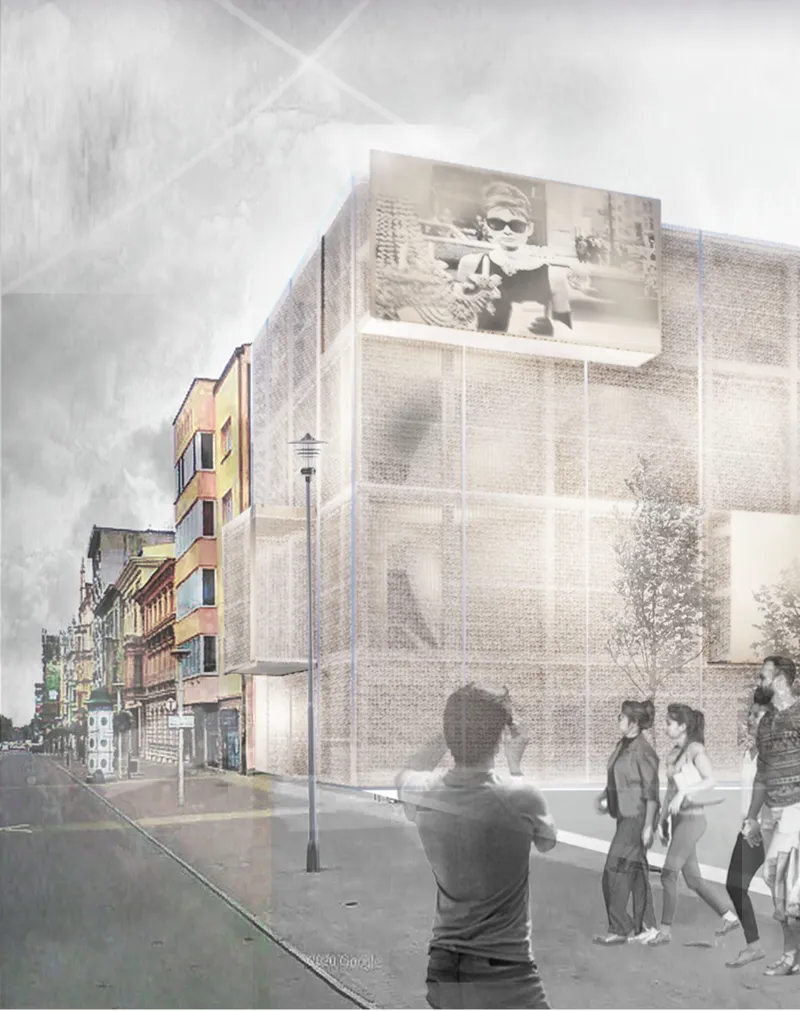
On Piotrkowska Street in Łódź, a perforated facade dissolves the line between projected image, audience, and city life.


Cinema has always depended on architecture. The darkened room, the carefully positioned audience, the screen, the projector, and the controlled path from entrance to seat have shaped the way generations experience film. Yet as moving images have escaped the theater and entered homes, laptops, tablets, and phones, the traditional cinema has been forced to reconsider what makes collective moviegoing meaningful.
NON GRAMME responds to that question through futuristic architecture that transforms cinema from passive observation into spatial participation.
Designed by Marysia Opłatek in association with Politechnika Wrocłwska, the proposal was selected as an Editor’s Choice entry of Cinema Futurismo.
Built around the statement “NO BOUNDARIES,” NON GRAMME imagines a cinema in which the audience no longer sits outside the film. Instead, architecture, projections, people, movement, light, smoke, and the surrounding city become parts of a single cinematic frame.
Reimagining Cinema Through Futuristic Architecture
The central argument of NON GRAMME begins with a familiar condition: watching films at home has become ordinary.
If viewers can access movies almost anywhere, simply presenting a larger image inside a dark room is no longer necessarily enough to make cinema distinctive. The project therefore asks what architecture can contribute that personal screens cannot.
Its answer is immersion.
NON GRAMME proposes an environment in which watching becomes an active spatial experience. Rather than concentrating every viewer toward one rectangular screen, the building distributes cinematic images throughout a three-dimensional interior.
The audience can look upward, downward, across the room, toward other viewers, or through the building toward the city outside.
Film is no longer restricted to a surface.
It becomes an architectural condition.
This positions NON GRAMME within a wider contemporary conversation about cinema architecture, where movie theaters increasingly operate as cultural, sensory, and spatial environments rather than simply enclosed screening rooms. Contemporary cinema projects have similarly explored immersive experiences, multifunctional spaces, and new relationships between film, material, and architecture.
Łódź as a Cinematic Setting
The project is located on Piotrkowska Street in Łódź, Poland, placing its futuristic cinema within a city closely associated with cinematic culture.
This location is important to the proposal.
Instead of isolating cinema from everyday urban life, NON GRAMME positions the building directly within one of the city's active cultural corridors. Historic facades, pedestrians, commercial activity, public movement, and the architecture of Piotrkowska Street form a constantly changing backdrop.
The building therefore becomes both a cinema and an urban viewing instrument.
Visitors look into the theater.
Viewers look back toward the street.
Projected images become visible through portions of the facade.
The city itself becomes another moving picture.
This relationship gives the project a compelling contradiction. While its spatial and technological ideas look toward the future, its setting connects them to the existing memory and identity of Łódź.
NON GRAMME does not reject the traditional city in pursuit of futuristic architecture. Instead, it inserts a new cinematic experience into it.
Architecture Constructed Like a Film
One of the project's strongest conceptual moves is its treatment of the building as though it were itself a movie.
Traditional film is composed through frames, shots, perspectives, editing, distance, and movement. NON GRAMME translates these cinematic tools into architectural space.
The proposal identifies familiar cinematographic compositions such as the long shot, full shot, American shot, medium shot, and close-up and reinterprets them as positions from which viewers experience the movie.
A person located farther from an image experiences something comparable to a long shot.
Another viewer occupies a more intimate visual position.
Elsewhere, spectators can experience images from above, below, or directly within the projected action.
Diagrams develop additional perspectives including high-angle, bird's-eye, low-angle, worm's-eye, and head-on views.
Architecture becomes a camera system.
Instead of a director controlling the audience's single viewpoint, spectators occupy different spatial relationships to the same cinematic event.
The result challenges one of the most established conventions of cinema architecture: the idea that every seat should provide approximately the same image.
In NON GRAMME, difference becomes the experience.
From Spectators to Participants
Conventional cinema establishes a clear hierarchy.
There is the movie.
There is the screen.
There is the audience.
NON GRAMME deliberately destabilizes all three.
Its central ambition is to reduce the distinction between viewer and viewed. The project proposes that cinema should become something people inhabit rather than something they simply watch.
This change has significant consequences for spatial planning.
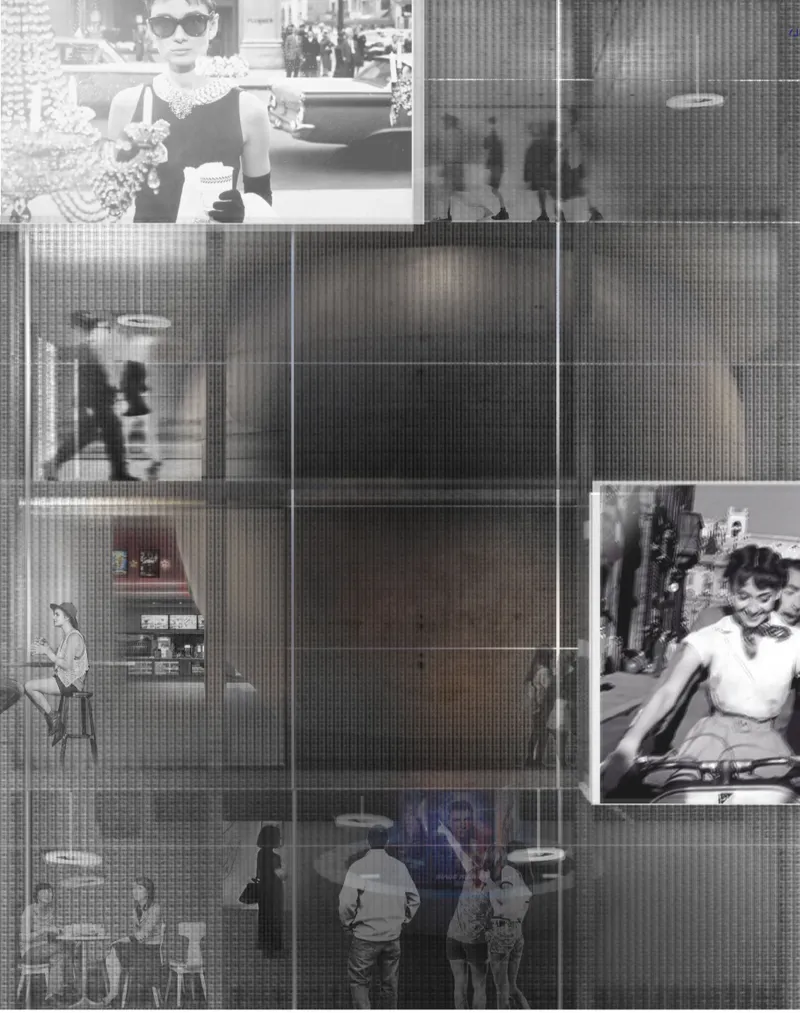
Visitors can move through the building while images appear around them. Different audience members become visible through projected scenes. A spectator standing behind a translucent image may momentarily appear to occupy the same visual composition as an actor.
The distinction between film character and cinema visitor becomes ambiguous.
That ambiguity is exactly the point.
Holographic Cinema Without a Conventional Screen
Technology provides the mechanism for this transformation.
Instead of depending entirely on solid projection screens, NON GRAMME proposes smoke-based holographic projection.
Projectors cast moving imagery onto controlled clouds or layers of smoke generated inside dedicated spaces. Light interacting with this suspended medium produces semi-transparent moving images.
The architectural consequence is crucial.
A conventional screen creates a boundary. It tells the audience precisely where the fictional world begins and ends.
The smoke projection attempts to remove that edge.
Because the projected image is translucent, viewers can perceive other people and architectural elements through it. Spectators may therefore appear inside the image rather than exclusively in front of it.
This technique transforms projection from a flat visual object into a spatial layer.
The project deliberately favors a comparatively simple technological principle rather than imagining an entirely fictional digital system. Its design research emphasizes light, projection, smoke, acoustic separation, and controlled viewing geometry.
Technology is treated as an architectural material.
The Spherical Cinema as an Immersive Core
At the heart of NON GRAMME is a large spherical screening environment extending vertically through the building.
The sphere disrupts the familiar geometry of the rectangular cinema auditorium.
Its curved surface creates the potential for projected images to surround viewers rather than remain located directly ahead. Seating modules are arranged around this cinematic volume at varying orientations and positions.
This means that one audience member may experience a scene from a relatively conventional viewpoint while another watches from above or below.
The project even investigates sightlines that exceed the restricted viewing geometry of conventional cinemas, allowing viewers to perceive projected content from unconventional positions.
The sphere therefore becomes more than an auditorium.
It is an inhabitable cinematic instrument.
Its presence also organizes circulation and program around itself, producing a strong spatial center within the otherwise rectilinear building envelope.
A Cinema Designed Around Different Viewers
NON GRAMME does not assume that every cinema visitor wants the same degree of experimentation.
This is particularly evident in its seating strategy.
The project associates different seating locations with different cinematographic shots. Positions corresponding to the American shot provide a comparatively familiar viewing experience, while medium-shot and close-up locations place visitors much closer to the visual action.
This approach introduces choice into the auditorium.
One visitor might prefer a recognizable cinematic relationship.
Another might deliberately choose a more intense and unconventional perspective.
Instead of designing one supposedly ideal seat and reproducing it hundreds of times, NON GRAMME proposes multiple types of engagement.
This makes the audience part of the architectural composition.

A Semi-Transparent Facade Between Film and City
The concept of disappearing boundaries continues through the building envelope.
The facade is conceived using partially transparent or visually permeable panels. During the day, these elements provide shading and control light while still allowing relationships between interior and exterior.
At night, the same envelope can transform.
Projected movement, silhouettes, changing illumination, and activity within the cinema can become perceptible from Piotrkowska Street.
The facade therefore behaves almost like another screen, but unlike a traditional cinema screen, it works in both directions.
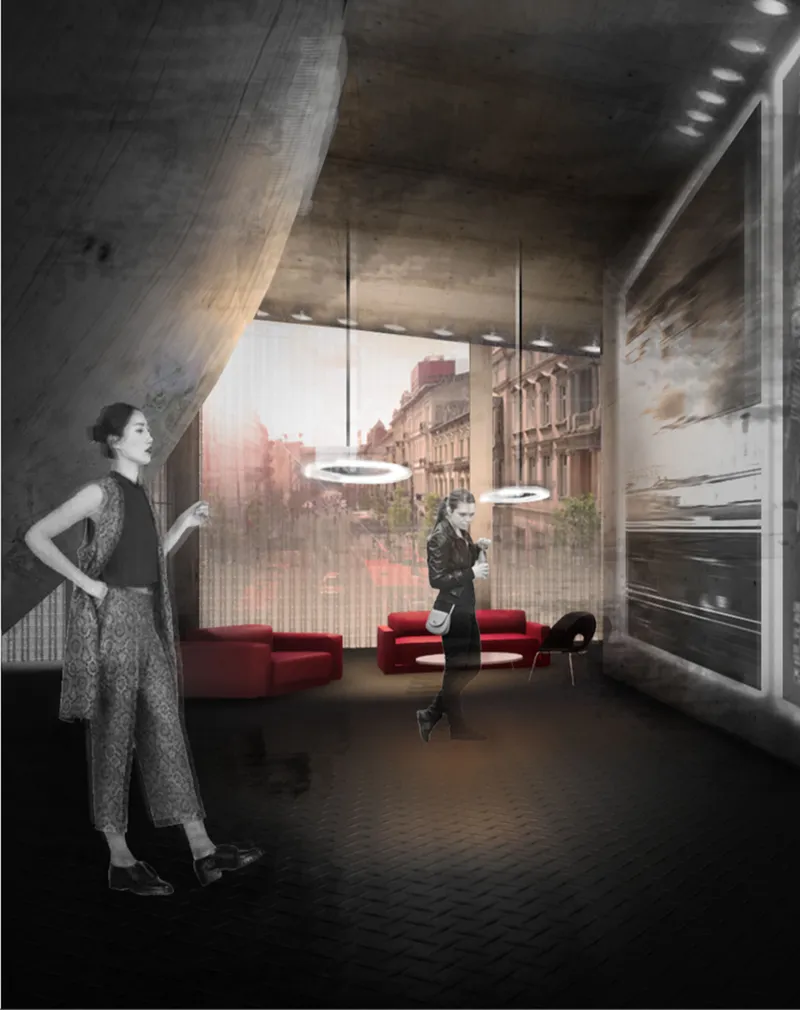
Visitors inside see the city.
Pedestrians outside perceive fragments of the cinematic interior.
Screens integrated with balcony spaces further strengthen this condition, allowing spectators to encounter movies while simultaneously observing street life.
The city and cinema begin to overlap.
From Cinemascope to Architectural Form
The project's formal development also draws directly from cinema.
Its structural concept references Cinemascope, a system historically associated with expanding the horizontal cinematic image.
NON GRAMME translates the logic of projected light and framing into its architectural composition.
The building is assembled as a sequence of structural elements, floors, balconies, screens, membranes, and the central spherical projection environment. Diagrams break the project into layers, almost as if the architecture itself were being separated into frames of a film reel.
Rather than using cinematic imagery merely as decoration, the proposal allows film grammar to influence the organization of the building.
This is where the project's futuristic architecture becomes especially interesting.
Its futuristic quality does not depend primarily on unusual form.
It comes from changing the rules of how a familiar building type operates.
When Architecture Could Change Filmmaking
NON GRAMME also raises a larger question: if spectators can inhabit the cinematic frame, must filmmakers begin composing films differently?
Traditional cinematography assumes a predetermined viewpoint.
NON GRAMME removes that certainty.
A director designing content for this environment might have to consider people watching from above, below, behind, beside, or even apparently within a scene.
Characters could appear at human scale beside spectators.
Movement could migrate vertically through the auditorium.
A sequence might be designed differently depending on the viewer's position.
The building therefore suggests that futuristic cinema architecture could influence not only theater design but also filmmaking itself.
Architecture becomes part of the medium.
Cinema as a Social Experience Again
Despite its technological experimentation, NON GRAMME ultimately addresses a social problem.
Cinema has historically been collective.
Hundreds of people entered the same room, watched the same story, and responded together.
Streaming has changed that relationship. Movies are now frequently consumed individually and privately.
NON GRAMME argues that architecture can give people a reason to gather again.
Its answer is not simply bigger screens or more luxurious seats.
Instead, it makes the presence of other people essential to the experience.
Because holographic images remain partially transparent, other audience members can appear within projected scenes. The viewer becomes aware not only of the film but also of the people sharing the environment.
Cinema once again becomes social, but in a new way.
The audience is not simply a crowd facing forward.
It becomes part of the composition.
“No Boundaries” as an Architectural Principle
The phrase “NO BOUNDARIES” summarizes virtually every aspect of NON GRAMME.
There is no rigid boundary between film and audience.
No absolute boundary between screen and room.
No fixed boundary between interior cinema and exterior street.
No requirement that every viewer occupy the same perspective.
No assumption that architecture must remain separate from cinematography.
Even the building envelope resists complete visual separation.
This continuous dissolution of thresholds makes NON GRAMME more than a speculative movie theater. It becomes an exploration of what happens when architectural space begins behaving like media.
A Futuristic Architecture of Participation
The most compelling aspect of NON GRAMME is that its vision of the future is fundamentally spatial.
It does not predict cinema through increasingly sophisticated screens alone.
Instead, it asks what happens when the screen disappears.
Smoke becomes projection material.
The facade becomes an urban frame.
The sphere becomes an immersive auditorium.
Seats become camera positions.
Spectators become characters.
Piotrkowska Street becomes scenery.
Architecture becomes cinema.
For Marysia Opłatek and Politechnika Wrocłwska, the future of film is therefore not defined simply by technological advancement. It is defined by participation.
As an Editor’s Choice entry of Cinema Futurismo, NON GRAMME presents a provocative model for futuristic architecture in which the movie theater is no longer a container for images.
It is the image.
It is the frame.
And most importantly, it is a place where the audience is finally allowed to step inside the film.


Popular Articles
Popular articles from the community


Manzana Morphosis: Stretching Barcelona's Grid into a Living Landscape for 2050
A radical reworking of the Eixample manzana turns density into a tool for generous public space, vertical ecology, and environmental performance.

Singing Woman: An Opera House That Performs Before the Curtain Rises
Ovidiu Cristian Pavel's conceptual opera house translates Estonia's choral identity into a sculpted waterfront landmark facing the Baltic Sea.
Faces of the Soviet Avant-Garde: Turning Moscow's Street Names into an Open-Air Museum
A network of sculptural installations across a Moscow residential district transforms forgotten architect names into spatial encounters with cultural memor

Opera on the Sea: Driftwood Logic Shapes a Timber Opera House on Estonia's Coast
Trevor Orgill's opera house translates the entangled drift of floating timber into a civic building where wood, water, and music converge.

Similar Reads
You might also enjoy these articles

Healing Façade: A Modular Chapel System That Restores Ethiopia's Sacred Forests
Winner of the Eco-Chapel competition, this circular timber façade collects water from air to rebuild soil and reforest degraded Ethiopian landscapes.
Kaffeebühnen: Where Coffee Shop Architecture Becomes a Civic Stage in Vienna
A linear sequence of timber boxes, transparent shells, and open yards turns the Viennese café tradition into a public performance space.
Eco Chapel: A Modular Forest Pavilion That Grows Like the Landscape It Protects
Hexagonal timber modules weave through existing trees, turning a chapel into a living system for prayer, education, and reforestation.


Urban Forest: A Vertical Ecosystem for 5,000 Workers in Singapore's Changi Business Park
Radially stacked pods and layered green decks turn a 7-acre plot into 47 acres of ecological workspace projected for 2040.

Comments (0)
Please login or sign up to add comments
No comments yet. Be the first to comment!