Oil Spill is a Crime: Environmental Design That Turns Ecological Disaster Into Visual Evidence
Oil Spill is a Crime uses environmental design to expose marine destruction and confront human responsibility for ecological harm.
Environmental crises are often communicated through statistics, reports, scientific studies, and news headlines. Yet numbers alone can struggle to communicate the emotional weight of ecological destruction. Oil Spill is a Crime approaches the subject differently, transforming the devastating effects of marine pollution into an intense work of environmental design built around evidence, illustration, texture, contrast, and visual storytelling.
Created by Tzu Ching Chen, the project confronts one of the most destructive consequences of human activity: oil spills and their impact on marine ecosystems. Rather than treating these incidents as distant environmental events, the design reframes them through the visual language of investigation and accountability.
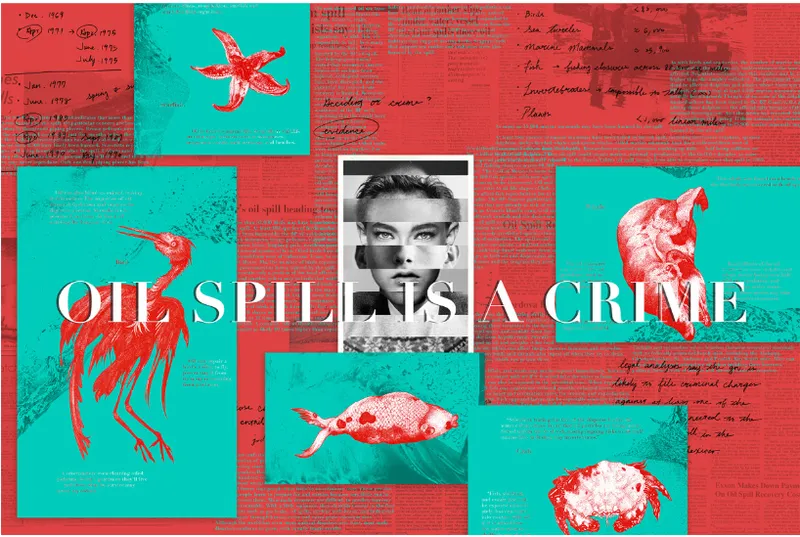
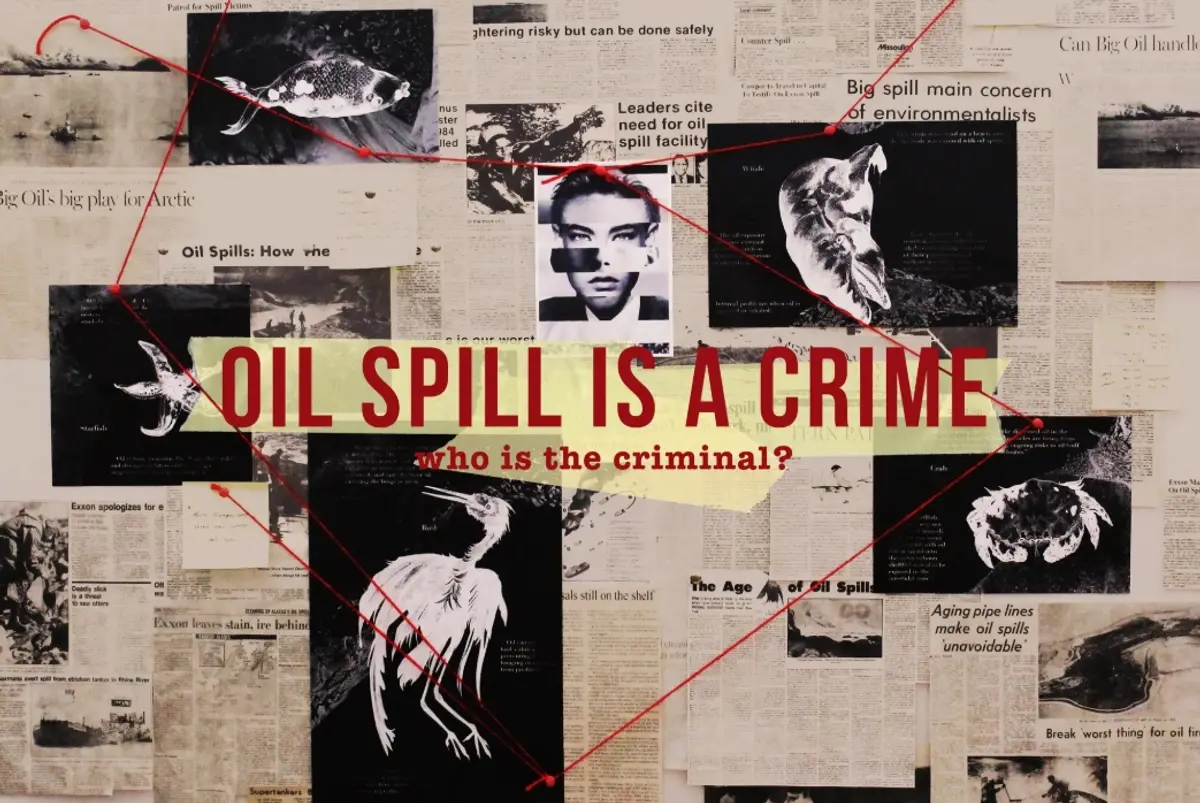
The result is a graphic composition structured like a crime board.
Images of injured wildlife, historic newspaper fragments, a human portrait, hand-drawn illustrations, distressed surfaces, and connecting lines collectively transform ecological destruction into a visual case against human negligence. The project does not simply document an environmental problem. It asks viewers to consider responsibility.
Oil Spill is a Crime was recognized as the Winner entry of Smudge, demonstrating the power of visual communication to translate a global environmental issue into an immediate and emotionally resonant design experience.


Environmental Design as a Tool for Awareness
The central intention behind Oil Spill is a Crime is clear: to bring attention to the devastating consequences of oil spills and to make their effects on marine life difficult to ignore.
Oil pollution is frequently presented through images of darkened shorelines, damaged habitats, contaminated water, and animals covered in crude oil. Tzu Ching Chen takes this familiar imagery and reconstructs it through a carefully developed environmental design language that combines research with illustration and material experimentation.
The project relies on strong visual contrasts to communicate urgency.
Black ink dominates the animal drawings. Pale, aged surfaces create the appearance of archived evidence. Dark oil-like textures spread unpredictably across the composition. Newspaper fragments introduce documentary information, while flashes of stronger color guide attention through the final crime-board arrangement.
Together, these elements create a visual atmosphere that feels investigative, historical, unsettling, and accusatory.
Instead of presenting marine pollution as an abstract environmental subject, the project treats it as evidence of an ongoing human-made crisis.
Turning an Oil Spill Into a Crime Scene
One of the project's strongest conceptual decisions is its use of the crime board as the primary visual framework.
Crime boards are typically associated with investigations. Photographs, documents, notes, suspects, locations, and connections are assembled so that individual pieces of evidence can be understood as part of a larger event.
Here, the same visual logic is applied to oil pollution.
Marine animals become victims.
Historical reports become evidence.
Oil spill events become recurring incidents.
Humanity occupies the position of the responsible actor.
This shift in perspective changes how the viewer encounters the subject. The project is no longer simply asking people to observe environmental damage. It is asking them to investigate the relationship between human actions and ecological consequences.
The human portrait incorporated into the collage reinforces this idea. Rather than identifying a single individual as responsible, the portrait functions symbolically. It points toward the wider role people, industries, institutions, and collective decisions can play in environmental destruction.
Through this strategy, the graphic composition becomes a visual argument about accountability.
Marine Life as the Central Evidence
The project's emotional force comes largely from its depiction of animals affected by oil pollution.
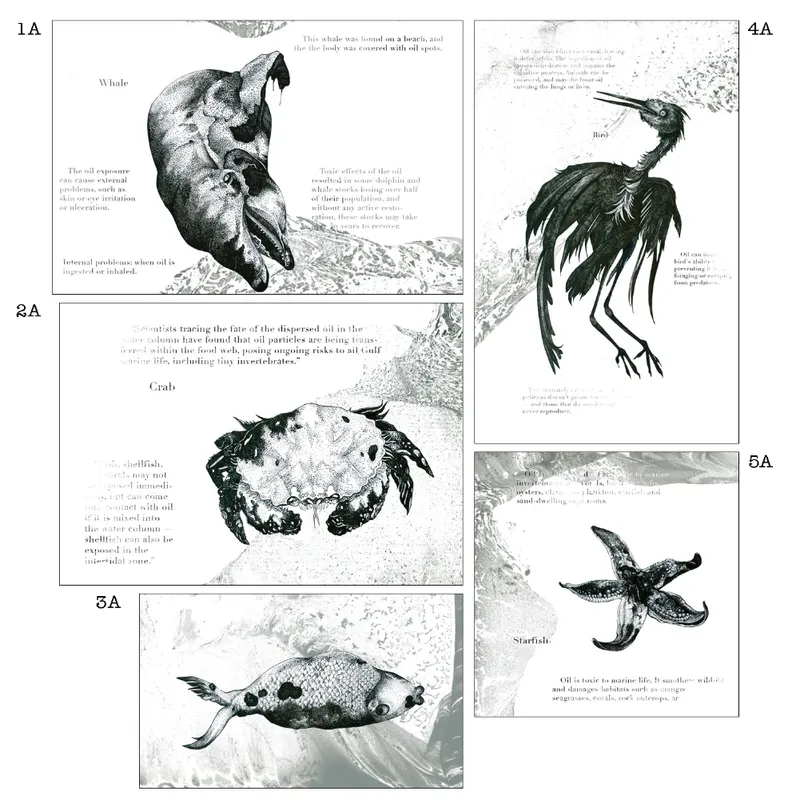
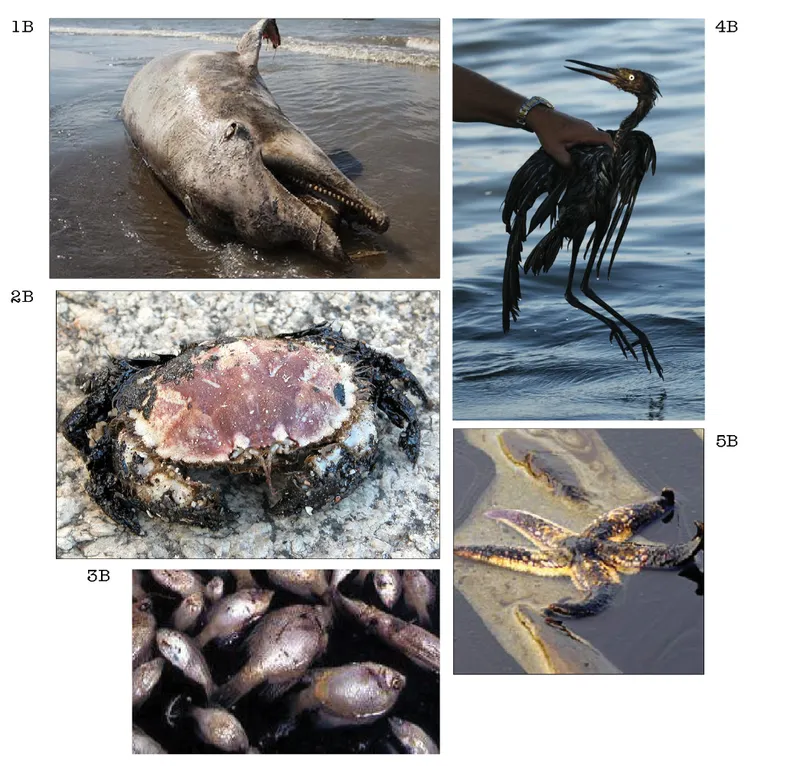
The process documentation shows studies of several marine and coastal species, including a whale, crab, fish, bird, and starfish. These subjects are not illustrated as decorative wildlife. They are represented as damaged organisms whose bodies reveal the consequences of contamination.
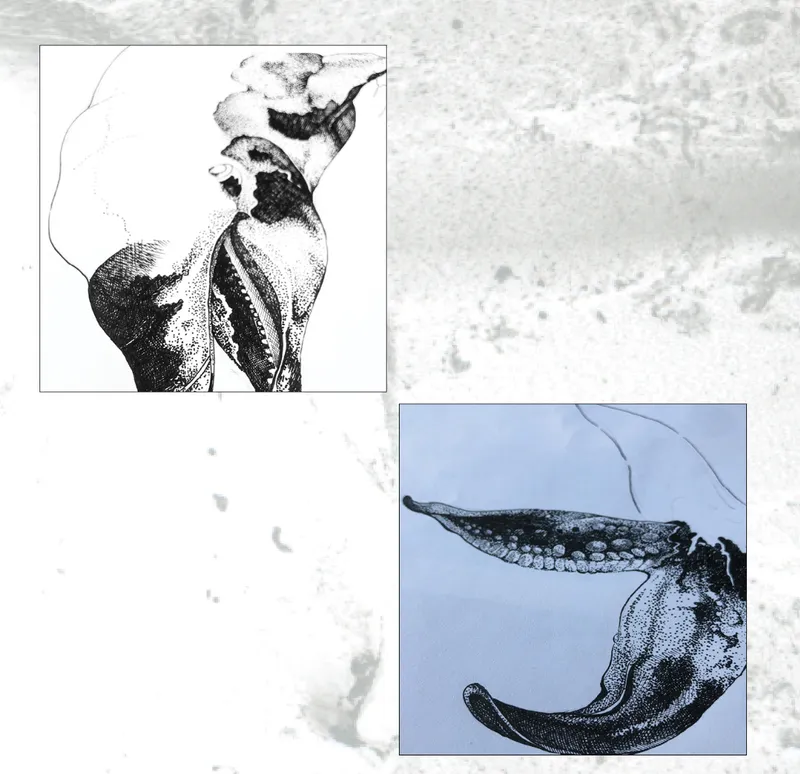
The drawings use ink with stippling and hatching techniques, producing highly detailed black-and-white imagery.
This choice is significant to the project's visual identity.
Fine lines, dense marks, and areas of darkness create a sense of physical deterioration while also giving the illustrations an archival quality. They resemble scientific drawings, printmaking studies, or evidence taken from an older investigative document.
The restrained drawing technique contrasts sharply with the brutality of the subject.
Rather than relying entirely on graphic photographs, the project translates real environmental suffering into carefully constructed illustrations. This allows the viewer to examine the consequences of an oil spill while maintaining the project's distinctive artistic language.
The whale, bird, crab, fish, and starfish collectively represent the broad vulnerability of marine ecosystems. Different species occupy different ecological conditions, yet all can become connected through the same source of pollution.
That relationship strengthens the project's environmental narrative.
Research Before Representation
The development process behind Oil Spill is a Crime shows that the final composition was not produced as an isolated visual experiment.
Initial sketchbook pages reveal a research-driven approach.
Early notes investigate oil spills, marine animals, ecological effects, historical incidents, and possible graphic treatments. Rough compositions gradually develop into more detailed studies as the direction becomes clearer.
The first sketches establish the project's subject and begin organizing information. Later pages examine animals, composition, textures, and methods for representing contamination.
This research becomes essential because the project depends on the relationship between factual environmental consequences and emotional visual communication.
The final artwork therefore does not begin with aesthetics alone. Its visual decisions emerge from the information collected during the development process.
This gives the work an important characteristic of effective environmental design: the graphic language supports the message rather than competing with it.
Stippling, Hatching, and the Language of Printmaking
A particularly important part of the project's visual identity is the use of hand-rendered illustration.
Tzu Ching Chen uses ink to portray injured or killed animals through stippling and hatching. These techniques build volume and shadow through repeated marks rather than smooth digital gradients.
The approach introduces both precision and discomfort.
From a distance, the animals appear clearly recognizable. At closer range, their bodies dissolve into hundreds of individual marks, patches of darkness, damaged textures, and areas of intense contrast.
This visual fragmentation mirrors the project's larger theme.
Oil pollution disrupts ecological systems. Similarly, the illustrations visually break the animal forms into fields of marks and shadows.
The decision to reference historical printmaking techniques also supports the project's investigative atmosphere. Combined with aged paper and newspaper fragments, the drawings appear almost like evidence collected across different periods of time.
The effect suggests that oil pollution is not a single isolated event. It belongs to a longer history of environmental damage.
Creating the Oil Spill Texture
The project's material experimentation becomes particularly visible in its background surfaces.
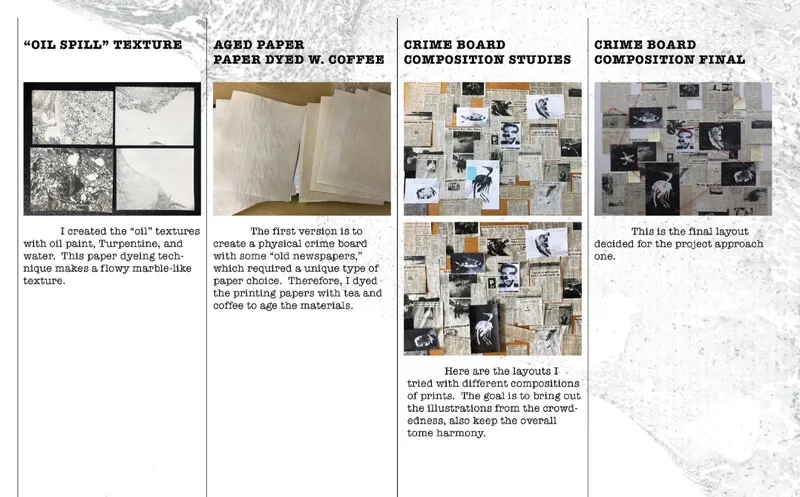
To produce the appearance of spilled oil, the designer experimented with oil paint, turpentine, and water, allowing the materials to generate irregular, flowing patterns.
The resulting textures resemble marbled liquid, contaminated surfaces, and expanding pools of oil.
Importantly, the texture is not simply a decorative background.
Its unpredictable edges visually communicate the uncontrolled movement of pollution. The patterns appear to spread beyond defined boundaries, echoing the way an environmental disaster can extend across water, shorelines, habitats, and ecosystems.
The contrast between these fluid surfaces and the carefully controlled ink drawings creates a productive tension.
One element is precise.
The other is unstable.
Together they reinforce the relationship between vulnerable living organisms and environmental contamination.
This material exploration gives the environmental design strategy a tactile quality that purely digital effects may not have achieved.


Coffee-Dyed Paper and the Construction of History
Another significant material experiment involved aging paper with tea and coffee.
The designer wanted the crime board to resemble an accumulation of older documents and historical records. Instead of relying only on digitally simulated textures, physical sheets were stained to achieve irregular discoloration and variations in tone.
This process gives the final composition an archival appearance.
The papers look used, handled, stored, and rediscovered.
That visual aging is particularly effective because oil spills are not exclusively contemporary events. The graphic system suggests a history of repeated environmental incidents and unresolved consequences.
The aged documents therefore operate conceptually as much as aesthetically.
They imply memory.
They imply evidence.
Most importantly, they imply repetition.
The environmental crisis presented in the work does not belong exclusively to one moment. It is shown as part of an accumulated record of human action.
Newspapers as Documentary Evidence
Historic newspaper material plays another important role in the final composition.
The articles provide a recognizable visual language of public reporting. Headlines, columns, photographs, and printed fragments establish a documentary context around the hand-drawn illustrations.
This creates a layered relationship between information and emotion.
The newspaper communicates that oil spills are reported events.
The illustrations reveal their consequences.
The human portrait introduces responsibility.
The connecting composition encourages viewers to interpret relationships between all three.
As a result, the project moves beyond the conventional environmental poster format. Instead of presenting one dominant image with a single statement, the crime board asks viewers to discover connections across multiple fragments.
The act of viewing becomes investigative.
Composition Through Controlled Crowdedness
Developing the final crime board required experimentation with different layouts.
The process images show several composition studies in which illustrations, newspaper fragments, photographs, and textured papers are repositioned to determine how the elements should interact.
The challenge was to create density without losing hierarchy.
A crime board naturally benefits from visual complexity because it suggests an accumulation of information. However, excessive disorder could weaken communication.
The final composition therefore balances crowdedness with enough structure for individual illustrations to remain visible.
Large dark images create anchors.
Newspaper fragments establish an underlying field.
Smaller documents fill transitional spaces.
Connecting lines move across the board and visually link different pieces of information.
This organization transforms apparent disorder into intentional storytelling.
The viewer is encouraged to move from one fragment to another rather than reading the project through a single linear sequence.
Sharp Contrast as an Emotional Device
Contrast is one of the project's most effective communication tools.
Black illustrations sit against faded paper.
Dark oil textures interrupt pale surfaces.
Clean photographic references contrast with distressed graphic treatments.
The organized structure of evidence conflicts with the chaotic ecological consequences being represented.
These contrasts reinforce the project's central message.
Oil spills introduce something violent and unnatural into complex ecosystems. The design communicates this visual intrusion through abrupt shifts in tone, texture, image density, and material quality.
The imagery therefore does more than explain environmental damage. It attempts to make the viewer feel its disruption.
Graphics as a Call for Action
The project also raises a broader question about the responsibility of visual communication.
In an environment saturated with information, designers constantly compete for attention. Environmental issues face an additional challenge because audiences can become accustomed to seeing repeated images of disasters without necessarily engaging with their causes or consequences.
Oil Spill is a Crime responds by transforming information into an experience.
Rather than simply telling viewers that oil spills damage marine ecosystems, it gives the issue a recognizable narrative structure: a crime has occurred, there are victims, evidence exists, and responsibility must be considered.
This framing creates an immediate emotional entry point.
It also demonstrates how environmental design and graphic communication can operate as forms of advocacy.
A visual work cannot solve marine pollution by itself, but it can influence attention. It can make an issue visible. It can reorganize familiar information so that audiences encounter it from a new perspective.
Most importantly, it can ask a question that statistics alone may not communicate as forcefully:
Who should be held responsible?
Human Responsibility at the Center of the Narrative
The project's title, Oil Spill is a Crime, is intentionally direct.
It removes distance between environmental destruction and human action.
The design does not treat pollution as an unfortunate visual phenomenon. Instead, it frames it as the result of decisions with consequences.
This position becomes especially clear through the juxtaposition of harmed wildlife and the human portrait.
Animals experience the consequences, but they did not create the conditions that produced them.
The imbalance is central to the project's emotional message.
By placing human responsibility within the crime-board composition, the design encourages viewers to consider their own relationship with environmental systems, industries, consumption, regulation, and collective accountability.
The project is therefore not solely about marine animals.
It is also about human behavior.
Environmental Design Beyond Aesthetics
One of the most compelling aspects of Oil Spill is a Crime is that its aesthetic decisions remain closely connected to its concept.
The aged paper suggests historical accumulation.
The newspaper clippings provide documentary context.
The ink drawings express vulnerability and loss.
The oil-inspired textures represent contamination.
The crime-board framework establishes investigation.
The human portrait introduces accountability.
None of these elements operates independently. Together, they construct a unified environmental narrative.
This coherence is what gives the project its strength.
The final outcome demonstrates how environmental design can communicate ecological concerns through the deliberate organization of imagery, texture, material, typography, illustration, and narrative.
The work asks the audience not only to look, but also to interpret.
From Sketchbook to Final Crime Board
The process documentation adds another layer of value to the project because it reveals how gradually the concept was refined.
Early research created the intellectual foundation.
Sketching identified possible subjects.
Illustration studies established an appropriate visual language.
Material experiments produced oil-like textures and aged surfaces.
Composition tests explored density and hierarchy.
Finally, these components were assembled into the completed crime board.
The progression shows a design methodology in which research, experimentation, and visual communication remain interconnected throughout development.
Each stage contributes something essential to the final result.
The project therefore becomes a compelling example of how a powerful concept can evolve through iterative graphic design rather than emerging from a single visual gesture.
Oil Spill is a Crime: Visual Communication With Consequence
At its core, Oil Spill is a Crime is about making environmental destruction visible.
Tzu Ching Chen transforms the consequences of oil pollution into a graphic investigation where marine animals become witnesses to a larger ecological failure.
Through stippled illustrations, damaged textures, archival newspaper fragments, aged paper, photographic references, and the visual structure of a crime board, the project creates an atmosphere of loss, evidence, and accountability.
Its strength lies in refusing to separate aesthetics from responsibility.
Every material and graphic decision contributes to the environmental message.
As the Winner entry of Smudge, the project demonstrates how environmental design can move beyond visual attraction and become a mechanism for awareness. It turns a familiar global issue into a carefully constructed narrative that asks viewers to reconsider the human role within ecological destruction.
Oil Spill is a Crime ultimately presents design as more than an act of representation.
It presents design as an accusation, a record, a warning, and a call for accountability.

Popular Articles
Popular articles from the community
The Ocean Hive: Sustainable Architecture for a Self-Sufficient Civilization at Sea
The Ocean Hive imagines sustainable architecture at sea, where modular habitats, algae, wave power and ocean waste sustain a growing colony.
Play: Fragments of Their World
Familiar architecture becomes modular playground design, creating safe spaces where displaced children can learn, connect, imagine and play.
Co-life: Sustainable Architecture for Age-Friendly Community Living
Co-life reimagines sustainable architecture for seniors through courtyards, rammed earth, shared gardens, and spaces designed for belonging.
Little Red Riding Hood: Architectural Design as a Journey Through Fear, Light, and Storytelling
Little Red Riding Hood reimagines the fairy tale through architectural design shaped by fear, light, scale, memory, uncertainty, and choice.
Similar Reads
You might also enjoy these articles
Eco Chapel: A Green Architecture Pavilion Designed in Symbiosis with the Forest
Eco Chapel uses green architecture to weave prayer, learning and reuse into a forest pavilion shaped by modular hexagonal canopies for life.
Kaffeebühnen: Coffee Shop Architecture Designed as a Civic Stage Between Vienna’s City and Park
Kaffeebühnen turns coffee shop architecture into a civic stage, linking Vienna’s park edge, urban life, warm timber yards, and coffee craft.
Healing Façade: Sustainable Architecture for Reforestation, Community, and Sacred Ecology in Ethiopia
Healing Façade reimagines sustainable architecture as a living wall that restores soil, catches water and renews Ethiopia's forest churches.
Urban Forest: A Vertical Ecosystem for 5,000 Workers in Singapore's Changi Business Park
Radially stacked pods and layered green decks turn a 7-acre plot into 47 acres of ecological workspace projected for 2040.
Explore Graphic Design Competitions
Discover active competitions in this discipline
Design a brochure to showcase the effects of the technosphere
Challenge to illustrate ‘A tale of Two Cities’
Deconstructivism - Illustration Design Challenge
Challenge to reimagine the Iron Throne
Comments (0)
Please login or sign up to add comments
No comments yet. Be the first to comment!