
On the way
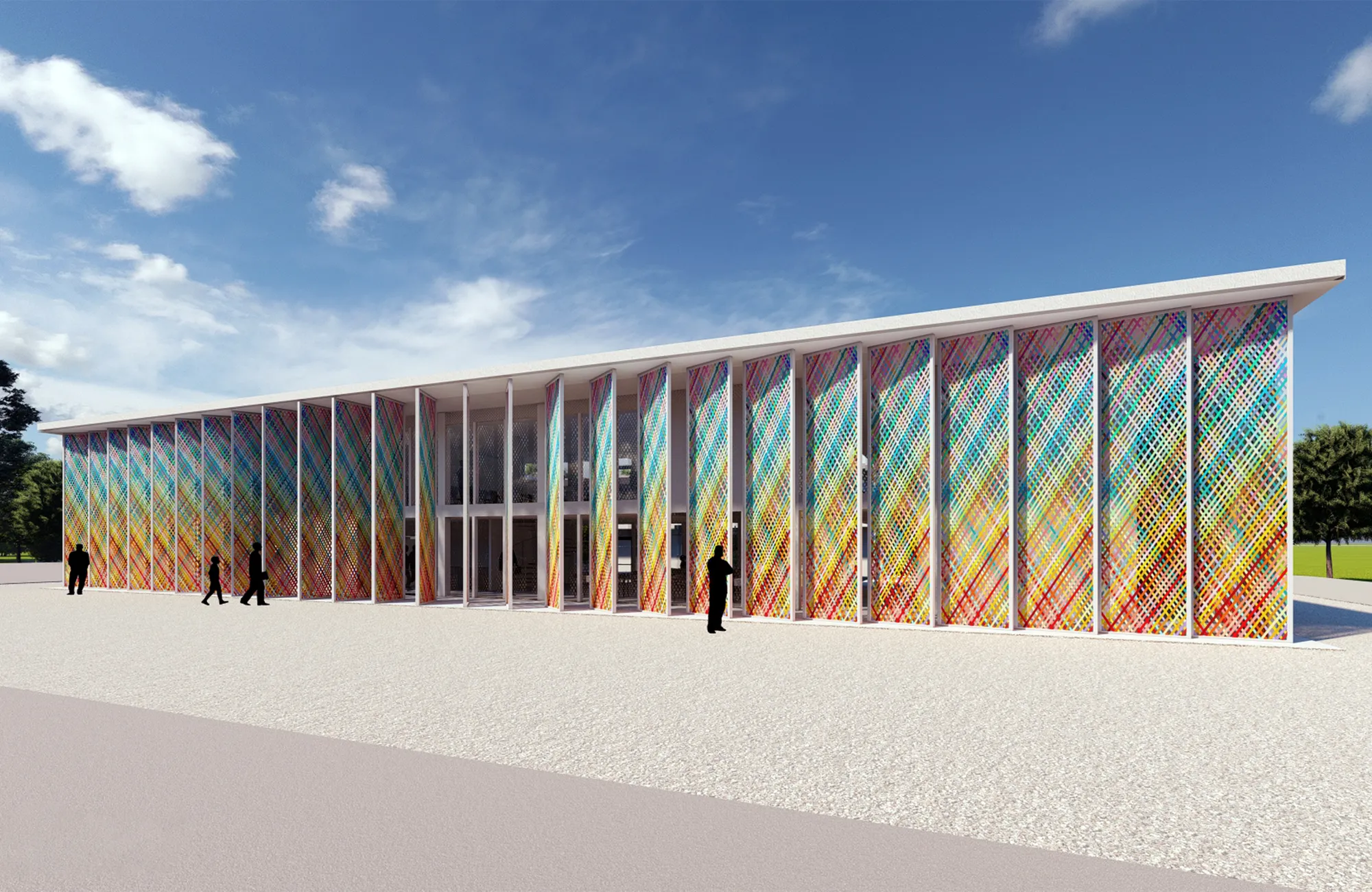
The building of highway motel inspired by Indian traditions and local arts in India with using recycled materials.
Purpose of the Building
The Highway Motel has 3 main objectives to satisfy:
- Allow quick pitstops for relief and refreshing of oneself
- Allow spaces to share and consume meals
- Allow spaces for sleep and longer rests.
The building is designed for about 100 truck drivers on Indian Highways and must be cost-effective. The design should be able to adapt to changing needs of its users.
Urban design
The plot is located in the southern part in India, nearby the cities Pallakad and Kuzmalmannam, along the National Highway 544 from Salem to Kalamassery. In this area are towns and buildings are spread unequally, so in our area are mainly fields and nature. The designed building is located close by the highway; the connection to it is crucial, and so, slipways and space for parking next to the road are necessary. The building is situated in the middle of the given plot, with the back part being a free space with trees, that could also potentially be used for parking spots, and the front of the building is designed as a public space.
Architectural solution
The Motel building is inspired by traditional Indian trucks, which have vibrant colours and decorations. Truckers in India are the main transportation system for goods in the country, making their jobs crucial in solving the needs of good delivery. Drivers are mostly away from their families so they try to bring some traditions to their trucks through original decorations, making their trucks a second home, but on wheels.
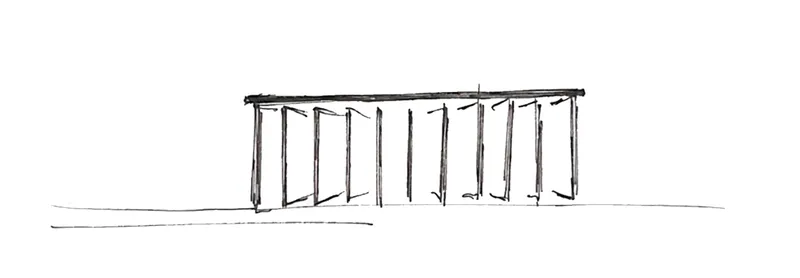
Noting this, the building has panels designed which mimic the truck colours, while also protecting the building from heat and sunlight. India is heavily polluted with plastic waste, and for this reason the material chosen for the panels is recycled plastic. The colours are based on their traditions and religion, the earth’s colours come from the bottom to the top where the blue relates to the sky. Most of the panels can rotate to regulate the shadow and heat coming into the building. The building is divided into 4 main parts that together make a block with an atrium in the middle. This form really helps with ventilation and is inspired by Indian traditional houses. Water tanks are located under the atrium to store collected rainwater for later re-use. The space on the front of the building is public whereas the space at the back is reserved for the guests of the Motel. The building from the outside is colourful and distinct, while the atrium inside is a serene space that is calmer. The use of wood in the design contrasts the colourful panels, and possibly a colourful chapel (which is not designed yet).

Primary acreage
Build up area: 1 200 m²
Total usable area: 2 202 m²
Enclosed area: 8 604 m²
Disposition solution
The panels at the front of the building guide the visitors to the main glass door entrance which leads to the reception. The reception also has a locker room for belongings and its own toilet. A separate entry for employees is located at the left side of the building, while there is also one for stock, leading to the kitchen and cafeteria. The cafeteria can be accessed from right side of the reception, and it is also possible to enter the space using glass doors which are around this space. The second floor can be reached by the use of a spiral staircase. A shop which provides basic things for daily uses is located in the left corner of the building. There is also a stock area for the shop and technical equipment of the building. Private toilets and showers for men and women are situated at the end of the block, while on the other side a barrier-free toilet, public toilets, and showers are designed. The last block offers rooms which are designed to accommodate 4 or 6 people. In each room there is a small corridor with a wardrobe and a place to relax, with the table and 2 chairs, a wash-basin, and bunk beds. On the second floor there is also an area dedicated to the restaurant and technical appliance storage, such as the cleaning room, the storage for clean and dirty sheets, and a laundry for the guests. 2 more blocks of toilets and showers can also be found, while the rest of the space in the floor is dedicated to the rooms. The rooms available accommodate up to 100 people, while the restaurant may accommodate up to 78 people. The atrium has residential stairs which are sunken into the floor. At the bottom is a small chapel for praying.
Design and material solution
The building has a combined support system, where the structure is supported with walls and columns. The walls are width is 300mm and the dimensions of the columns are 300 x 300mm. The building is in a modular system of 4 x 4m (also the size of the rooms). There are used beams with the height about 350 mm and the reinforced ceiling slab has a thickness of 160mm. Internal height in the building is 2700mm and the construction height is 3200mm. The facade has panels with steel frames that are filled with recycled plastic tapes of different colours. The material used would be methacrylate or alternatively steel chains could be used. Some of them will be fixed and will support the building. The walls and columns are coloured white and in the atrium is tiled and the railings used are wooden.



Popular Articles
Popular articles from the community


Conexión: Biophilic Design Reimagines High-Rise Living in Hong Kong
Conexión reimagines high-rise living in Hong Kong through biophilic design, green facades, shared spaces, daylight, water and nature within.

Hill & Cross Opera: Sculptural Opera House Architecture Shaped by Tallinn’s Landscape and Identity
Hill & Cross Opera reimagines opera house architecture in Tallinn through its sculptural hill, civic plaza, glass wave and a luminous cross.

The Ocean Hive: Sustainable Architecture for a Self-Sufficient Civilization at Sea
The Ocean Hive imagines sustainable architecture at sea, where modular habitats, algae, wave power and ocean waste sustain a growing colony.

Co-Life: Senior Housing Design That Reconnects Older Adults With the City
Co-Life reimagines senior housing design through healing gardens, shared streets, workshops, and a sustainable community across generations.

Similar Reads
You might also enjoy these articles

The Rhythm of Seasons
A Farmers' Market Connecting Nature and the City
LIVING LEDGES
A living place

More Than a Building-Designing a Living System
More Than a Building-Designing a Living System
Base Beyond
DESERT COMPOUND ARID: TOURISM OF ABSENCE AND ABUNDANCE






Comments (0)
Please login or sign up to add comments
No comments yet. Be the first to comment!