

Three Firms from Mexico and Colombia Weave a Narrow Community Center into Mexico City's Urban Fabric
PILARES Cuicuilco transforms a sliver of leftover land near an ancient pyramid into a ramping sequence of courtyards, classrooms, and rooftop orchards.


When the Mexico City government launched a competition to seed small community centers across underserved neighborhoods, three studios on the shortlist did something unusual: they merged forces. TO (Mexico), UdeB Arquitectos (Colombia), and AGENdA (Colombia) each had been selected to design one center independently, but they recognized that a shared framework would produce a more resilient, replicable system. The result is PILARES Cuicuilco, a 700-square-meter community hub sited on a remnant parcel near the ancient Cuicuilco Pyramid, in a zone marked by high population density, a young demographic, and pressing social challenges.
What makes this project genuinely interesting is not its altruism but its architectural argument. The site is punishingly narrow and long, the kind of leftover geometry cities usually pave over for parking. The architects treat that constraint as a generator: a continuous ramp replaces the street, stitching together courtyards of endemic planting with flexible indoor rooms, climbing to rooftops that harvest rainwater, host open-air theater, and frame views of the surrounding volcanic landscape. Every element, from the slender iron-and-laminated-wood structure to the permeable pergola canopy, is calibrated for maximum adaptability and minimum material.
A Structural Skeleton of Iron and Wood
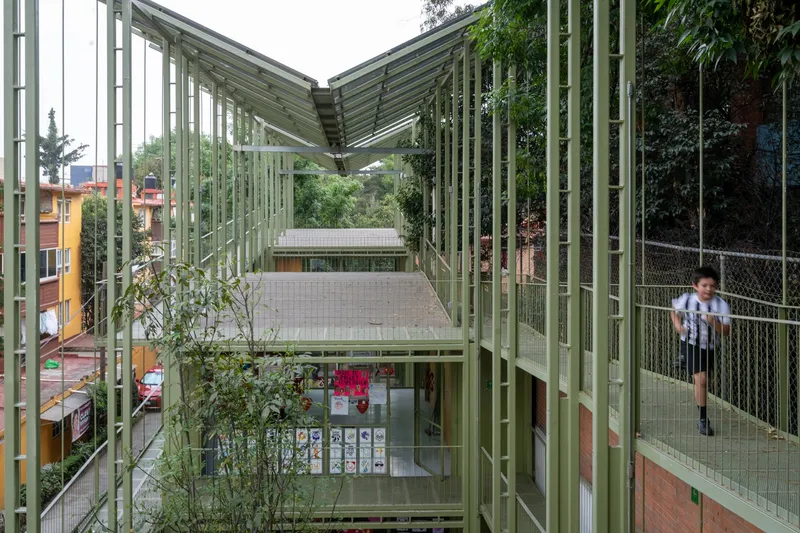
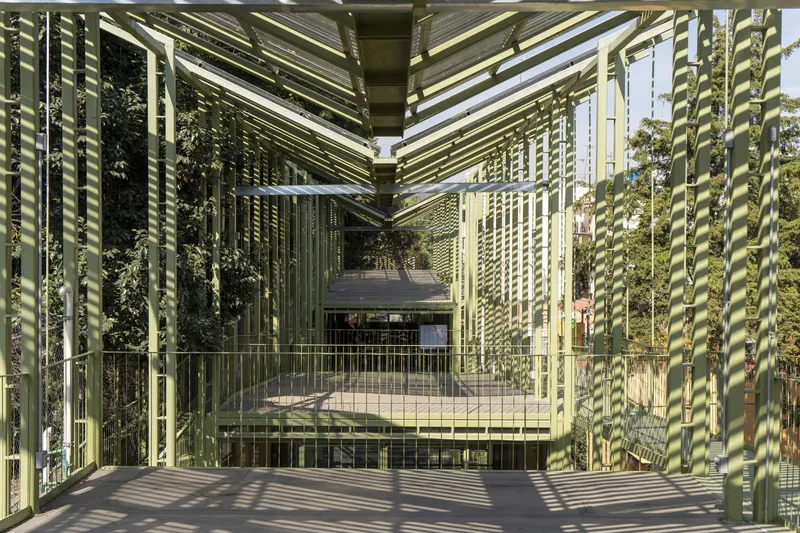
The building's frame is deliberately skinny. Slender iron columns, painted a muted green that reads almost institutional until sunlight hits them, combine with certified laminated wood to create a hybrid structure that is both load-bearing and atmospheric. The thinness is strategic: it maximizes usable floor area on a site that has almost none to spare, while allowing air and light to pass through the building rather than around it.
More importantly, the structure is the architecture. There are no heavy partition walls dictating permanent program. The iron-and-wood lattice defines space, screens views, and supports walkways without ever closing them off. A room that hosts guitar lessons in the morning can become a yoga studio by afternoon. That flexibility is not theoretical; the center already runs programming in ballet, computer science, tai chi, cycling, embroidery, and more.
The Ramp as Street
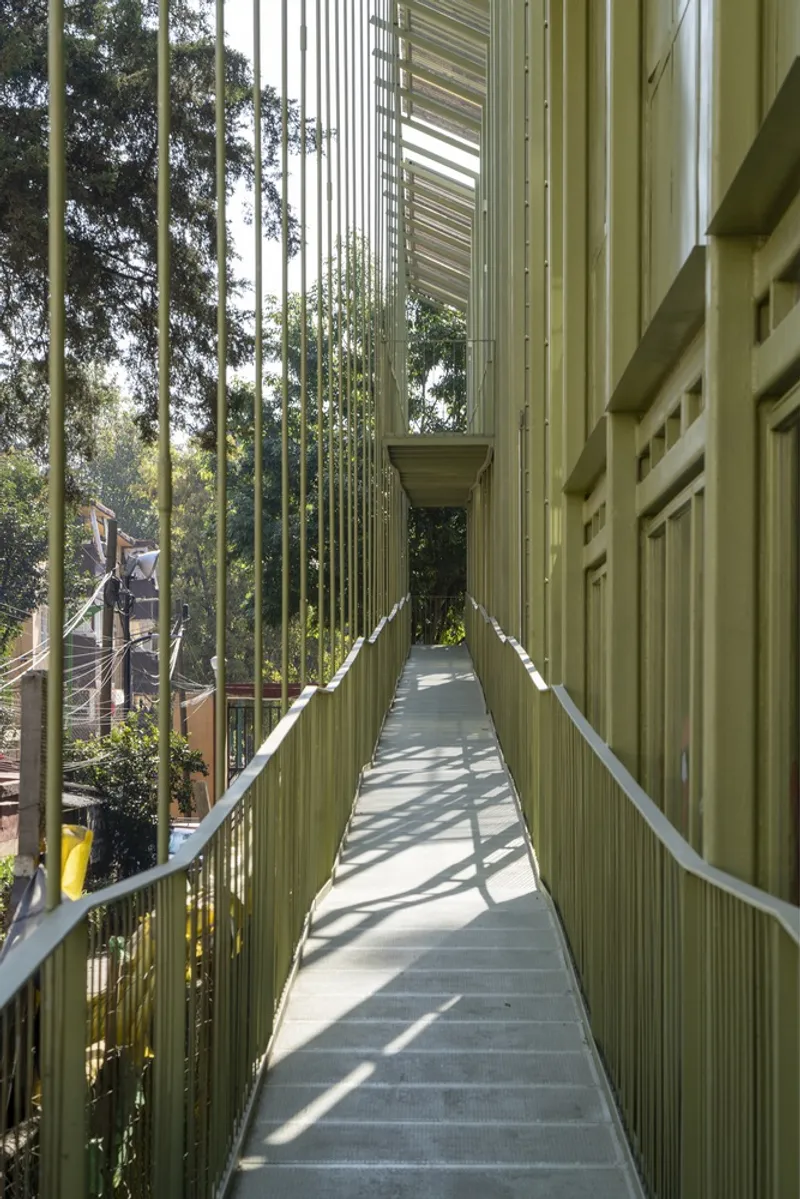
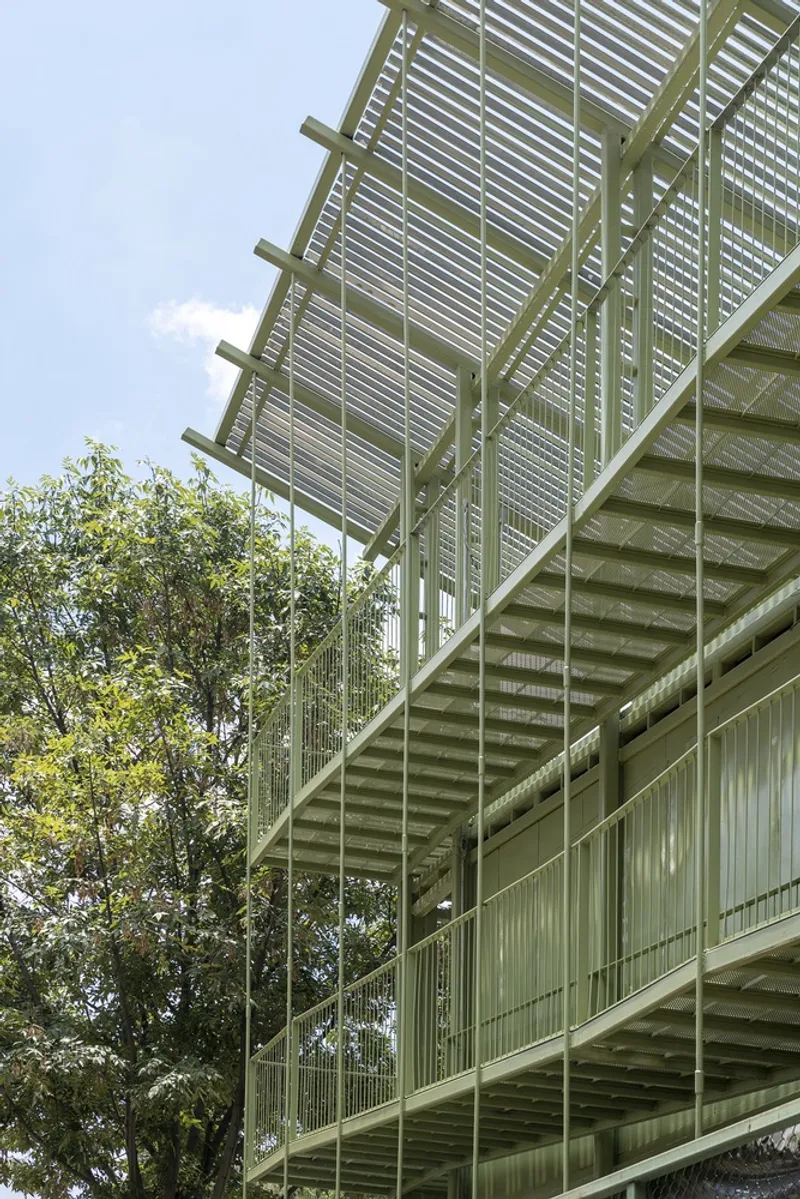
Accessibility here is not an afterthought bolted onto a stair-centric plan. The primary circulation is a ramp that begins at street level and threads upward through the entire building, connecting every courtyard, classroom, and rooftop without a single step. For residents with disabilities this means total access, but for everyone else it means the act of moving through the building becomes a promenade, a slow reveal of courtyards and sky.
The narrow pedestrian bridges that link levels function almost like covered streets. Vertical steel slats line each side, casting rhythmic shadows across the concrete deck that shift throughout the day. It is a simple device, but it transforms a utilitarian corridor into something almost cinematic, and it costs nothing beyond thoughtful orientation.
Courtyards and Endemic Planting
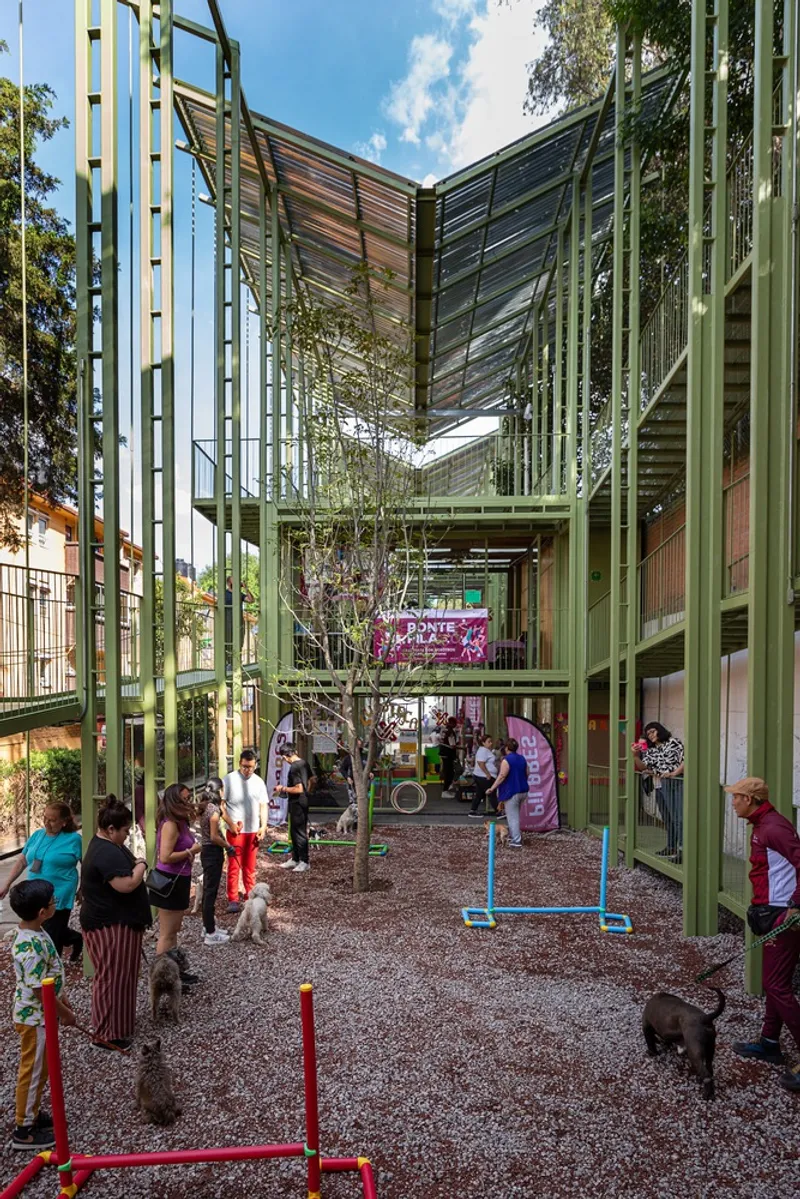
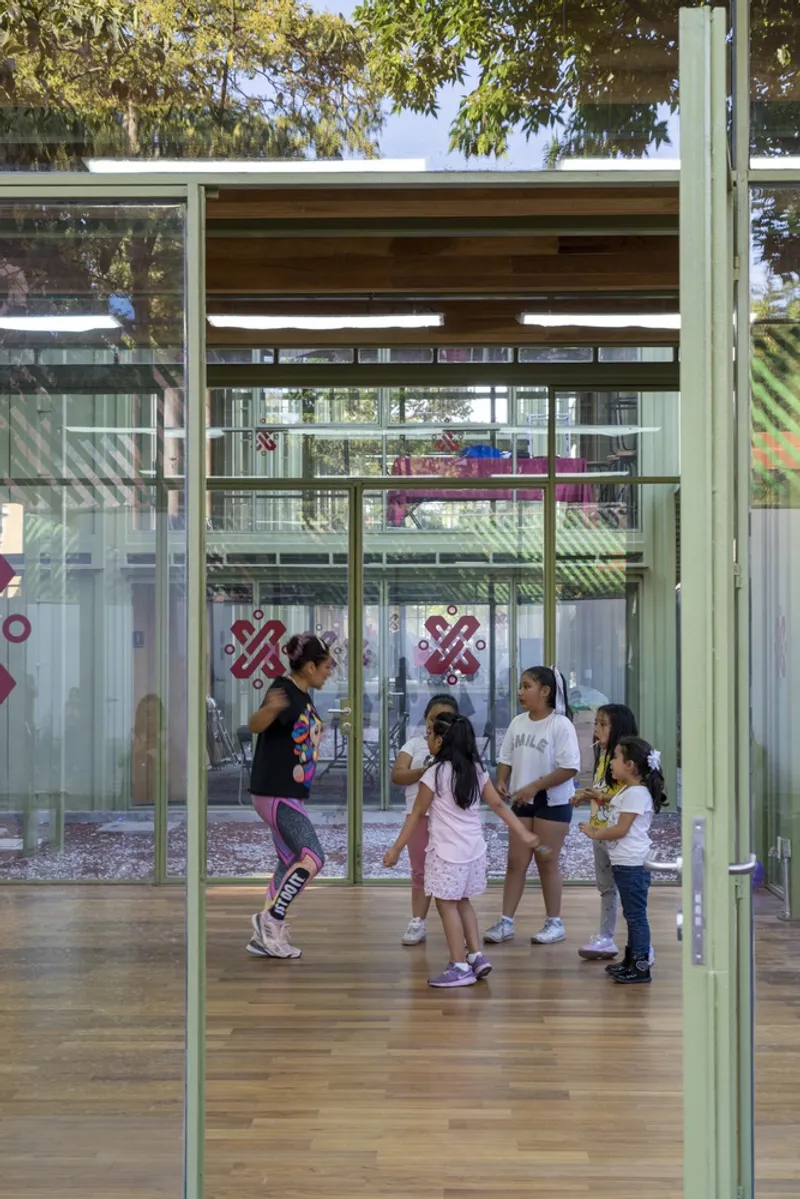
On a plot this tight, open space is a luxury. The architects carve it out anyway, inserting gravel-surfaced courtyards punctuated by endemic trees that root the project in its specific ecology. These are not ornamental gardens; they are social condensers. Families gather beneath the slatted canopy, children play on the timber decks, and the planting filters air while reducing the heat island effect on surrounding streets.
The courtyards also serve as environmental engines. The pergola structure overhead is designed to let wind pass through freely while channeling rainwater toward collection systems on the roof. In a city that oscillates between flood and drought, that dual function is not a green marketing checkbox. It is survival infrastructure.
Canopy, Climate, and the Rooftop
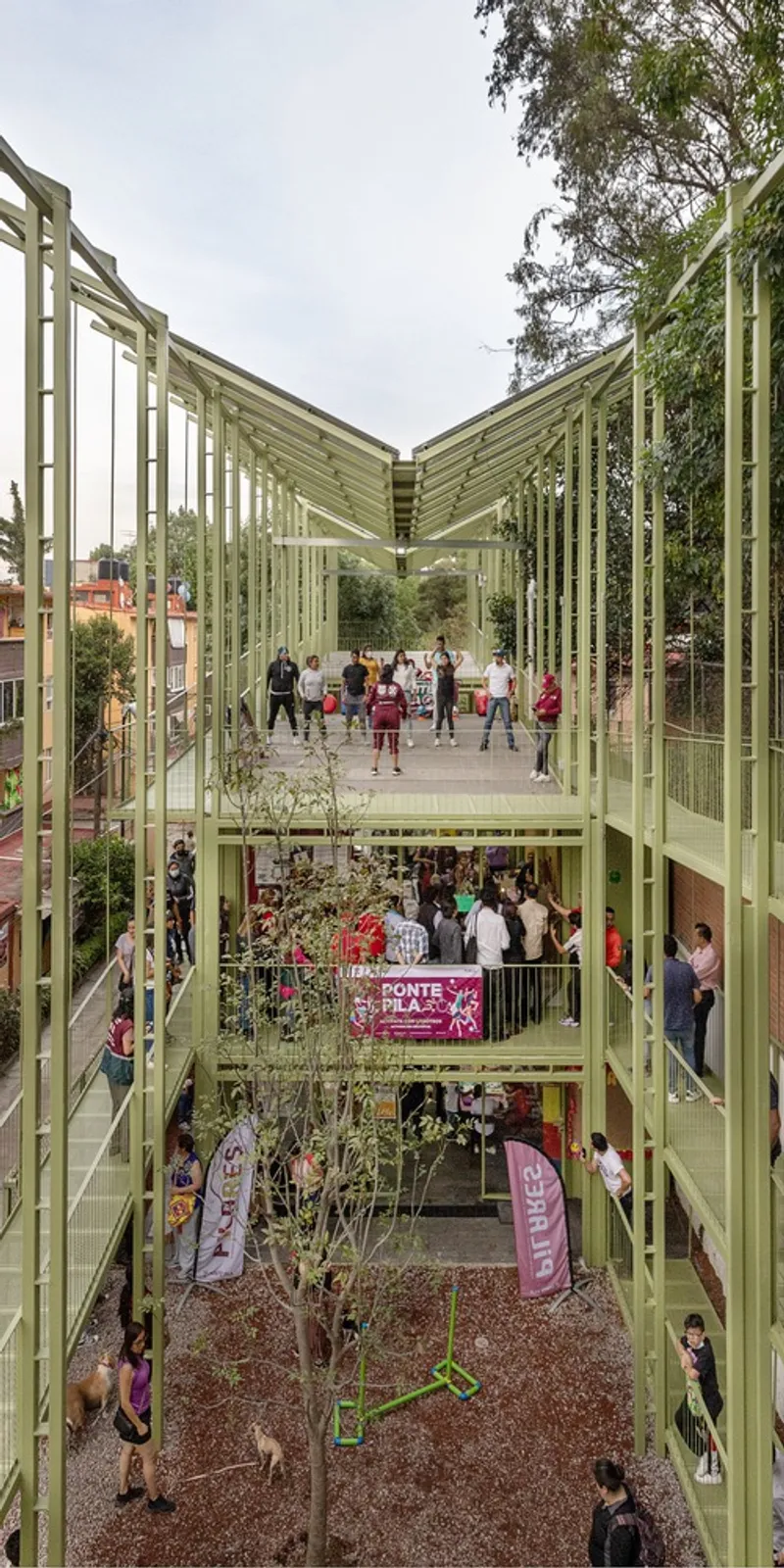
The V-shaped canopy that crowns the building is its most legible gesture from the street. It is also its most functional. The butterfly profile funnels rainwater to central collection points, feeding a harvesting system that addresses Mexico City's chronic water scarcity. Up on the roof, the collected water supports urban orchards and irrigates planting beds that double as outdoor classrooms.
At dusk, the upper levels glow. Children on the rooftop and in the courtyards below are visible through the open frame, and the building reads as a vertical section of community life. The rooftops also offer unobstructed sightlines to geographic landmarks, including the nearby Cuicuilco Pyramid, anchoring a very new building in a very old landscape.
Permeability as Urban Strategy
The site sits near the entrance to three large residential complexes. That adjacency is deliberate; the PILARES program targets neighborhoods with lower social development indices and higher rates of violence, particularly among young people aged 15 to 29. The building's dynamic facade, with its balconies and exterior promenades, is designed to link physically and visually to the neighboring housing blocks. It refuses to be a fortress.
Louvered screens and cantilevered walkways extend the building's social reach beyond its property line. You can see activity inside from the street. You can hear music. That transparency is a conscious inversion of the walled, inward-facing typology that dominates much of Mexico City's residential fabric. The architects understand that a community center only works if the community can see itself reflected in it.
Why This Project Matters
PILARES Cuicuilco is not a monument. It is a system. The collaborative framework developed by TO, UdeB Arquitectos, and AGENdA was conceived from the start to be repeatable: same construction logic, same material palette, same commitment to accessibility and passive climate strategy, adapted to the specific dimensions and demographics of each site. That ambition, designing a replicable prototype rather than a one-off showpiece, is rarer than it should be in public architecture.
What elevates the project beyond policy compliance is its spatial generosity on an absurdly constrained site. The architects found room for courtyards, ramps, orchards, theater stages, and classrooms on a sliver of land that most developers would have deemed unbuildable. They did it with modest materials, clear structural logic, and an unwavering commitment to openness. If this is what community infrastructure looks like when three studios from two countries pool their intelligence, the model deserves replication well beyond Mexico City.
PILARES Cuicuilco Community Center, designed by TO, UdeB Arquitectos, and AGENdA. Located on Calle Zapote, Mexico City, Mexico. 700 m². Photography by Jaime Navarro.
About the Studio
Share Your Own Work on uni.xyz
If projects like this are the kind of work you want to make, uni.xyz is a place to publish your own, find collaborators, and enter design competitions.


Popular Articles
Popular articles from the community


Cube Design Draws an Ecological Corridor Between Two Shenzhen Hills with the Nankai Building
Beside Shenzhen's container docks, the Nankai Building pairs stacked balconies with a climbing green screen to connect two hillsides across its height.

longwave studio Reorganizes a 112 m² Tainan Apartment Around the Daily Routines of a Family and Two Cats
In Tainan, Taiwan, birch plywood, rust-red furniture and a freestanding plaster wall link arrival, storage, work and family life in one apartment.

David Ortega Stacks a Two-Story Mexico City Penthouse Around a Steel Stair and a Pergola-Shaded Roof Terrace
In Colonia Roma, a 300 m² penthouse uses oak joinery, a planted steel stair and a slatted roof pergola to make a new-build apartment feel like a house.

Jaramillo Van Sluys Arquitectura and Urbanismo Turn a Demolished Registry Lot in Quito into an Orchard Plaza
In Quito's Centro Histórico, a 2,800 m² plaza exposes the San Agustín convent wall and redraws its lost Augustinian orchard in volcanic stone.

Similar Reads
You might also enjoy these articles


Hodi-Mandai Geram
Project Function: Preservation and revitalization of the Intangible heritage and socio-spatial identity of the Hodi by Housing, Cultural Memory Center, Sacred Grove, landscape, local tourism economy


Olio Towers: A Mid-Rise for Performers That Fuses Housing, Rehearsal, and Stage
Located blocks from Houston's Theater District, this modular tower stacks living units around a central performance atrium.

Oasis: Modular Green Housing Carved into Dhaka's Urban Fabric
A shortlisted Plugin Housing entry reclaims unauthorized settlements in Dhaka with stepped concrete volumes, green roofs, and ventilation-driven design.

Black Hole: A Floating Megastructure for the Post-Physical Era
Emiliano Mazzarotto envisions a spherical, self-scaling arena where e-sports, digital hotels, and holographic stadiums replace traditional public space.

Explore Urban Design Competitions
Discover active competitions in this discipline

Design challenge to equip cities with modern furniture

Challenge to reimagine the Iron Throne

Photograph architecture without architects

Illustrate the lost glory of Angkor Wat - Render Challenge
Comments (0)
Please login or sign up to add comments
No comments yet. Be the first to comment!