

Pinwheel House by JM Architecture – A Prefabricated Wooden Pavilion Overlooking Lake Maggiore
Pinwheel House by JM Architecture is a prefabricated wooden pavilion in Italy, blending sustainable design, pentagonal geometry, and panoramic Lake Maggiore views.


The Pinwheel House, designed by JM Architecture, is a striking example of contemporary prefabricated wooden architecture set amidst the oak forests of Luino, Italy, near the Swiss border. Completed in 2022, this 200 m² custom-designed home redefines sustainable living, combining modern prefabrication techniques with thoughtful spatial planning.
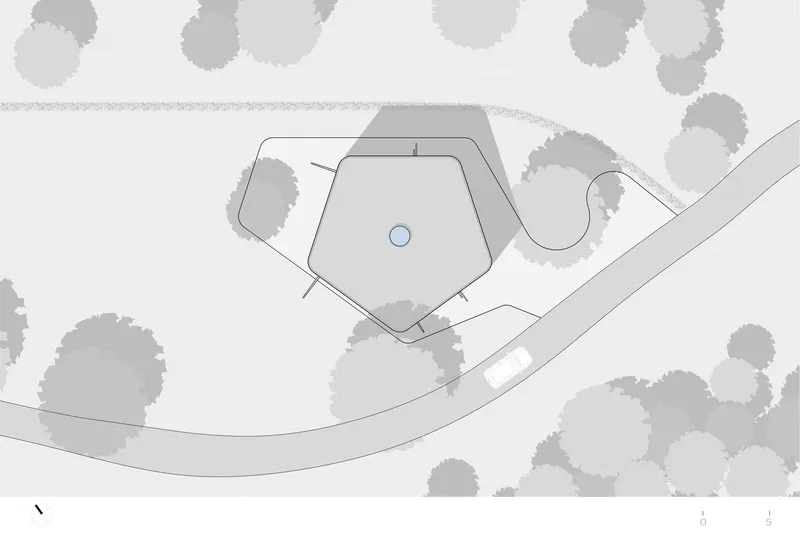
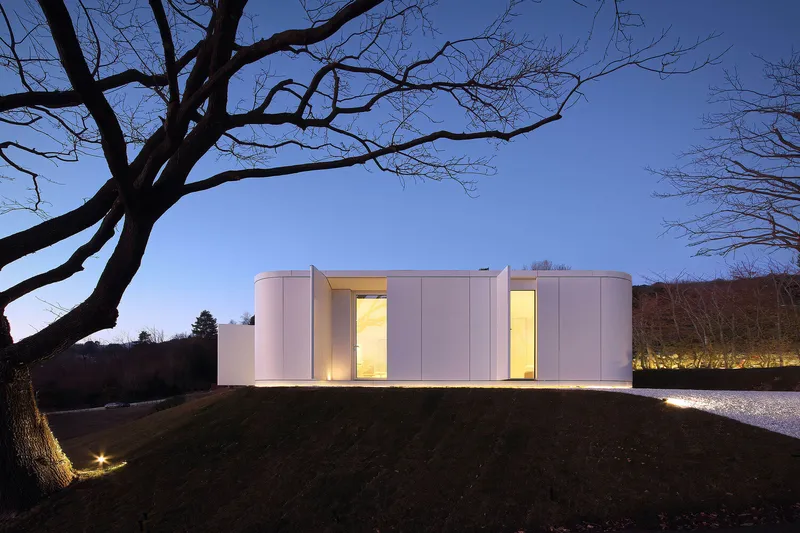
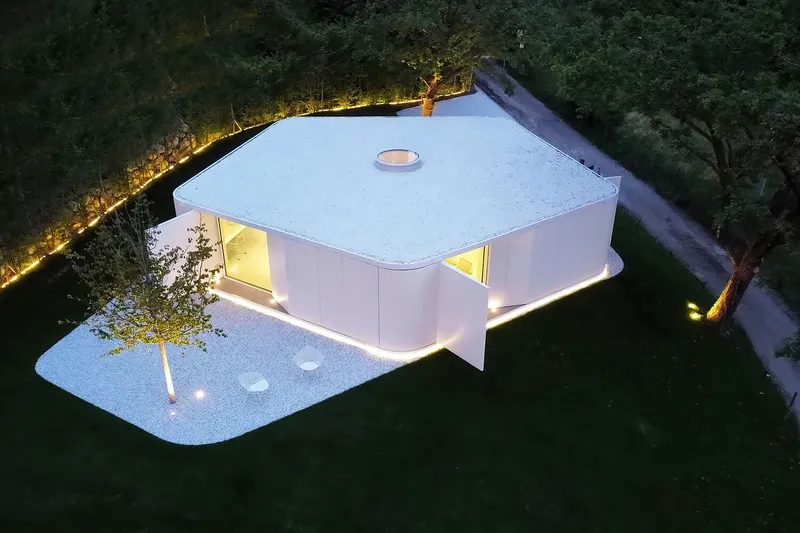
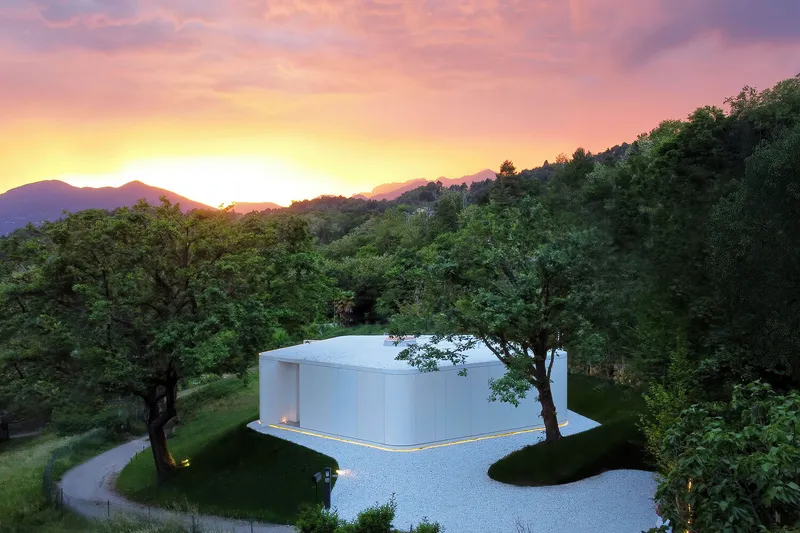
Nestled on a natural terrace overlooking Lake Maggiore, the one-story pavilion takes its name from its distinctive pentagonal geometry. This shape is not arbitrary but a direct response to the site’s slope, building setback requirements, and natural topography. The result is a sculptural yet functional form that blends with its environment while optimizing views of the surrounding lake valley.
Design Concept and Layout
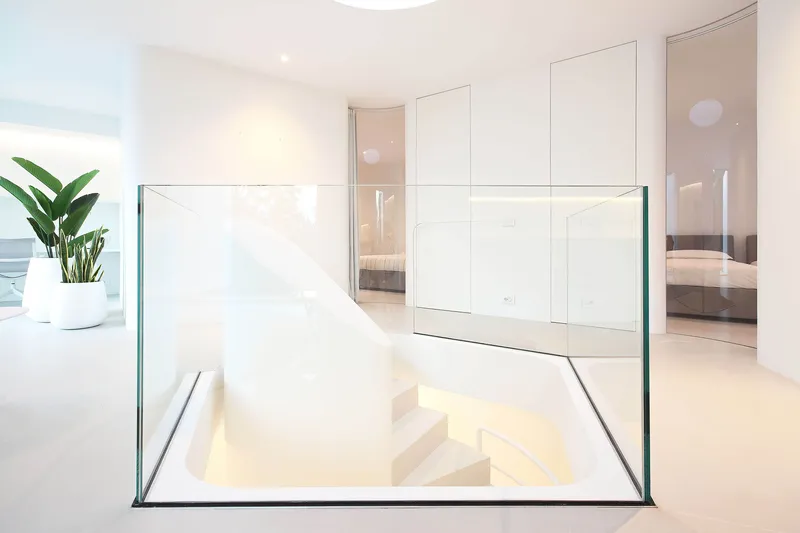
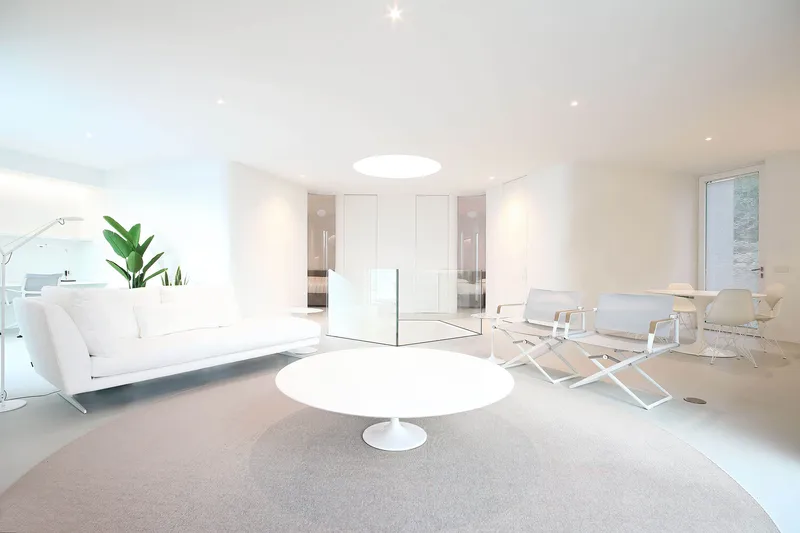
The house is organized around a central circular skylight and staircase, eliminating the need for corridors and maximizing efficiency. This “center of gravity” creates a radial spatial arrangement:
- Open-plan living, study, and kitchen areas flow seamlessly together.
- Two bedrooms and two bathrooms provide privacy with minimal partitions.
- A lower-level basement accommodates a home cinema, storage, and technical rooms, all surrounding the central staircase.
The geometry and layout reflect a pinwheel-like rotation, where each side of the pentagon radiates outward with rounded edges and crisp white facades.
Construction and Materiality
The house’s prefabricated timber frame system was assembled on-site in just one week, resting on a cast-in-place concrete basement. Externally, the building combines:
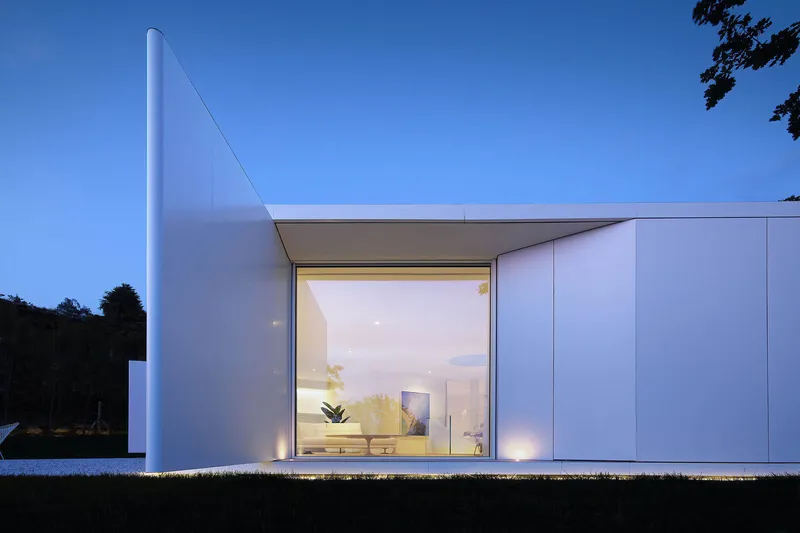
- White concrete panel cladding
- Composite aluminum shutters of varying sizes
- Generous openings in living spaces for panoramic views, with smaller, more intimate windows in private areas
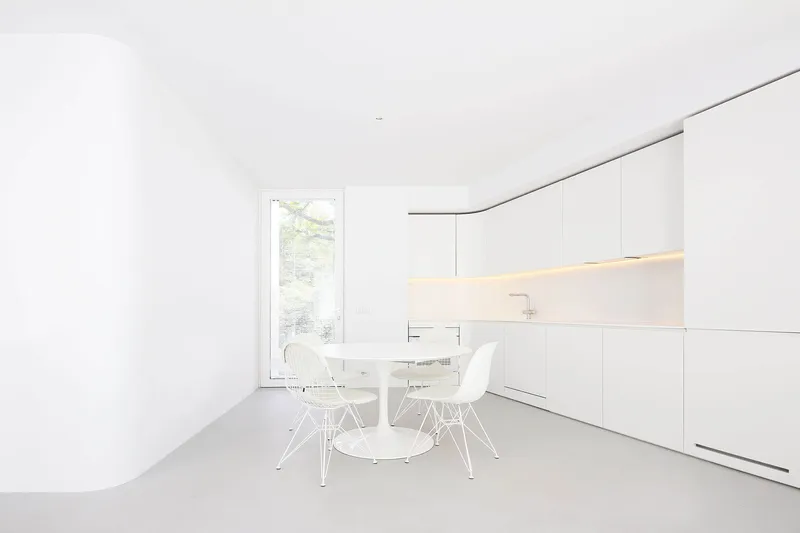
Inside, the palette is intentionally minimal: white concrete floors, plastered walls, and monochrome furnishings. This purity enhances the home’s pavilion-like character, allowing natural light to define the interior atmosphere.
Landscape and Outdoor Living
The pavilion integrates elegantly with its landscape. A white gravel pathway leads from the narrow countryside road to the house, doubling as both access and an outdoor sitting area. To the southwest, a sliding window opens the living room to the lake valley, while the study connects to a tranquil outdoor terrace.
Sustainability and Energy Efficiency
From the outset, the design emphasized low maintenance and energy efficiency. Key sustainable strategies include:
- Highly insulated prefabricated wood construction
- Radiant floor heating
- Hot water and heating provided by an electric heat pump system
- Energy supplied by a remote photovoltaic solar farm
This approach ensures reduced operational costs while promoting eco-friendly living in harmony with the environment.
The Pinwheel House by JM Architecture is more than a vacation home; it is a contemporary architectural statement that showcases the potential of prefabricated timber construction. By merging modern design, site-responsive geometry, and sustainable technologies, the house exemplifies a minimal yet refined lifestyle amidst the serene natural setting of Lake Maggiore.
All photographs are works of Jacopo Mascheroni


Popular Articles
Popular articles from the community


Cube Design Draws an Ecological Corridor Between Two Shenzhen Hills with the Nankai Building
Beside Shenzhen's container docks, the Nankai Building pairs stacked balconies with a climbing green screen to connect two hillsides across its height.


The Amber Palace Opera: A Geological Fiction Surfaces on Tallinn's Baltic Waterfront
Pierre Brillard reimagines a Baltic legend as a public landscape, opera house, and waterfront promenade rooted in Tallinn's coastal identity.

David Ortega Stacks a Two-Story Mexico City Penthouse Around a Steel Stair and a Pergola-Shaded Roof Terrace
In Colonia Roma, a 300 m² penthouse uses oak joinery, a planted steel stair and a slatted roof pergola to make a new-build apartment feel like a house.

Aquadapt: An Underwater Habitat That Rewrites Its Rooms by the Hour
Curved modules ring the seabed while one shell shifts from breakfast room to cinema, farm and football pitch as residents' needs change.

Similar Reads
You might also enjoy these articles


Hodi-Mandai Geram
Project Function: Preservation and revitalization of the Intangible heritage and socio-spatial identity of the Hodi by Housing, Cultural Memory Center, Sacred Grove, landscape, local tourism economy


Olio Towers: A Mid-Rise for Performers That Fuses Housing, Rehearsal, and Stage
Located blocks from Houston's Theater District, this modular tower stacks living units around a central performance atrium.

Oasis: Modular Green Housing Carved into Dhaka's Urban Fabric
A shortlisted Plugin Housing entry reclaims unauthorized settlements in Dhaka with stepped concrete volumes, green roofs, and ventilation-driven design.

Black Hole: A Floating Megastructure for the Post-Physical Era
Emiliano Mazzarotto envisions a spherical, self-scaling arena where e-sports, digital hotels, and holographic stadiums replace traditional public space.

Explore Architecture Competitions
Discover active competitions in this discipline

Challenge to reimagine the Iron Throne

Photograph architecture without architects

Illustrate the lost glory of Angkor Wat - Render Challenge

Design challenge to reuse E-waste
Comments (0)
Please login or sign up to add comments
No comments yet. Be the first to comment!