
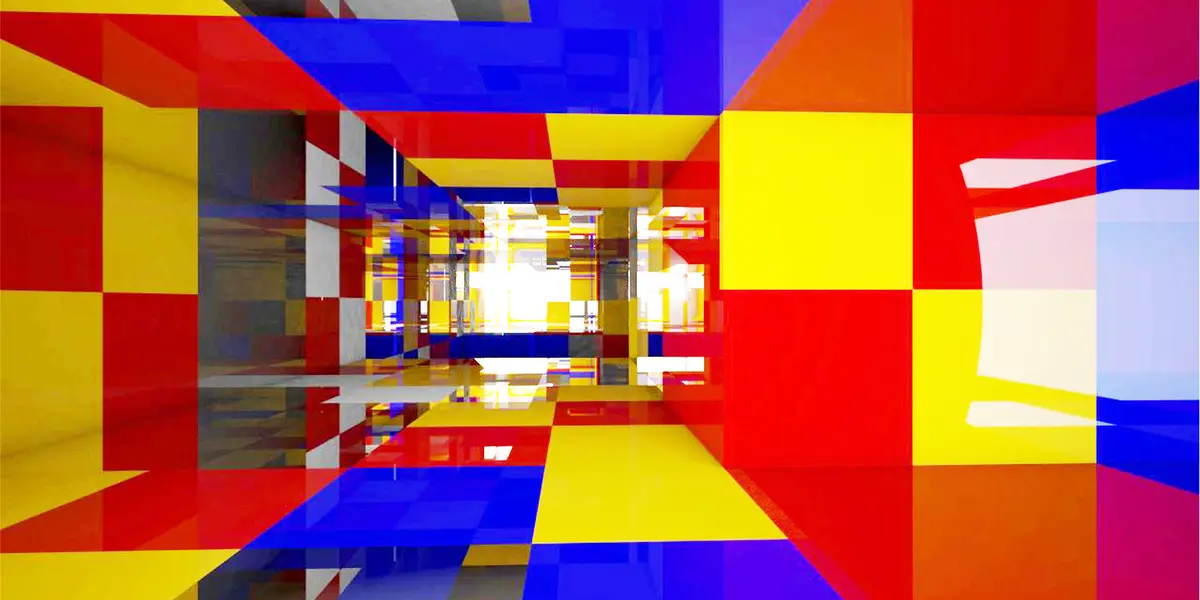
Purpose-Built Classroom
Adaptive classroom with modular furniture as an improvement from the conventional classroom.

1. Purpose-Built Classroom is a transformable classroom design, using a modular furniture design to accommodate and adapt to the classroom needs. The concept allows students and teachers to arrange their own classroom , directly participating in the class’ design. Children are very explorative in their learning curve, which means a strict and monotone design could, in a way, hinder their creative process. Transformable classroom allows the learning process to be more fun and less boring, while still being a proper classroom.
2. The design aims to break the common classroom layout by reorganizing the class itself and repurposing the class’ furniture, not only as a medium for learning but also for playing and entertainment. The common rows and column layout of a K-12 classroom is not bad per se, but now younger generation are more exploited to the world, which means their curiosity could be endless. This desire to explore on younger generation open up a new discussion about the current classroom design and system. Modular classroom breaks the common listen-to-teacher system of learning. Instead, a more open and flexible classroom allows students to explore more. Architecturally, modular designs allow for a more efficient and effective design, while also allow for an endless design possibility, as the nature of modular design follows the human needs. Even though the base model is basically the same, the modularity allows for different design for each needs.
3. As stated above, the key method of design are modularity and flexibility, in order to efficiently and effectively accommodate the children’s endless learning curve. Modularity and flexibility can help children in their learning process, by not hindering their creative and explorative minds, even in the smallest scale. In this case, the furniture plays a major role as usually, common classroom furniture like table and chair are overlooked in the design. By letting the children arrange their learning experience, from the way they sit, the way the look to the teacher, the way they interact with their friends etc., this allow children to explore their creativity endlessly. Furthermore, breaking the K-12 rows and columns layout could allow children to choose what they want to learn, instead of completely being fed on by the teacher.
4. Three main programs of the project are Study, Discuss and Play. These programs were achieved by studying the development milestone of children, specifically for 3-5 years old. At age 3, children usually learn about simple commands and movement, such as moving up and down, jumping and climbing. At age 4, the activities become more complex as they started to learn not only their physics, but also their mind. They are now able to learn how to stack objects and are now starting to learn social interaction. At age 5, their developed body allows them for even harder activities. They also started to increase their social understanding, and are now able to do small chores, like setting up tables and chairs. From these studies, the class programs were concluded, which is to train children’s abilities, according to their age. In this case, the programs accommodate the children’s learning need for basic movement, creativity, social interaction and doing task.
5. Since children are the main user of the design, child safety is a must. The overall material for this project is Plastic Composite. This material is applied mostly on the modular furniture. The light characteristic of the material allows children to move and interact these modules. The modules itself are designed with a curved edges. Light object and curved edges avoid accidents that could happen to children when they are using or moving these furnitures.
6. The class itself are made prefabricatedly, which allows future expansion because of it’s easy-to-build character. Furthermore, since most of the furnitures are modular prefabricated plastic modules, this allows an easier design application by reorganizing an existing classroom with the prefabricated modules.
7. Each modules in the design corresponds to the number of children, which means each modules belongs to each student. This module contains sets of chairs and a table which is an essential media for student. If a time comes when classroom have to close again, the students can easily bring their own modules to home to continue their learning process, while still having the modular experience that they have when they were still in class.

Popular Articles
Popular articles from the community


Cloaked Colonization: A Mobile Underwater Habitat That Moves Like a Fish
Micah Abaya's shortlisted EHC Pacific entry reimagines ocean settlement as a dispersed network of self-sustaining architectural organisms.
Extended Shell: Retrofitting Kolkata's Balconies as Living Urban Thresholds
A modular retrofit system recovers the social and environmental intelligence of Kolkata's historic verandas for contemporary Park Street residents.

Opera on the Sea: Driftwood Logic Shapes a Timber Opera House on Estonia's Coast
Trevor Orgill's opera house translates the entangled drift of floating timber into a civic building where wood, water, and music converge.

Singing Woman: Contemporary Architecture Inspired by Estonia’s Voice and the Sea
Singing Woman turns Estonia’s song culture into flowing opera house architecture, blending public life, landscape, sea, and national memory.

Similar Reads
You might also enjoy these articles

Day and Night Park: A Time-Based Urban Newsstand in Beijing
A temporary urban newsstand in Beijing blending travel, light, and reading through poetic colors, compact form, and community-focused design.

Modernist Patio Renovation in El Masnou, Barcelona by Oliver Segura Arquitectura + Cebrià Arquitectura
Modernist patio renovation blending tradition and innovation with a movable pool, leveled floors, and Catalan materials in El Masnou.

Alto Residencial Coop: Cooperative Housing Development in Santiago de Compostela by Carbajo Barrios Arquitectos
A linear cooperative housing complex blending white volumes and perforated metal façades, enhancing community living, natural light, privacy, and urban integration.
Vil Genis School by BPA ARCHITECTURE – Massy, France
Vil Genis School in Massy, France, features sustainable design, south-facing classrooms, community integration, accessible spaces, and modern educational architecture.

Explore Modular Furniture Competitions
Discover active competitions in this discipline


Challenge to design luxury tourism on rails

VR headsets Storefront design competition

Competition to design a workstation for architects

Designing a staircase for a client
Comments (0)
Please login or sign up to add comments
No comments yet. Be the first to comment!