

Re-grouping: Fiberglass Cubes as a Civic Toolkit for Philadelphia's 40,000 Vacant Lots
A modular system of lightweight, internally lit units transforms neglected streets and empty blocks into participatory public space across Philadelphia.


Philadelphia has over 40,000 vacant lots. That number alone tells a story of disinvestment, but it also represents an extraordinary canvas for tactical intervention. Re-grouping takes that canvas seriously, proposing a system of lightweight fiberglass cubes that can be deployed across the city's neglected streets, infrastructure gaps, and forgotten squares to generate instant, affordable public space. The modules are internally lit for nighttime use, movable, and endlessly reconfigurable: a single unit might serve as a bench, a bike rack, an art pedestal, or a planter, depending on what a neighborhood needs at any given moment.
Designed by Shannon McLain and Petra Stanev, Re-grouping was shortlisted in the Urbanscape: Symbiosis competition. The project roots itself in Philadelphia's existing culture of grassroots reclamation, where residents, artists, and cyclists are already mending potholes, converting empty blocks into gardens, and filling public space with murals and skate parks. Rather than proposing a top-down masterplan, the designers offer a distributed toolkit that amplifies this bottom-up energy with a coherent visual and spatial system.
Mapping Neglect, Plotting Activation
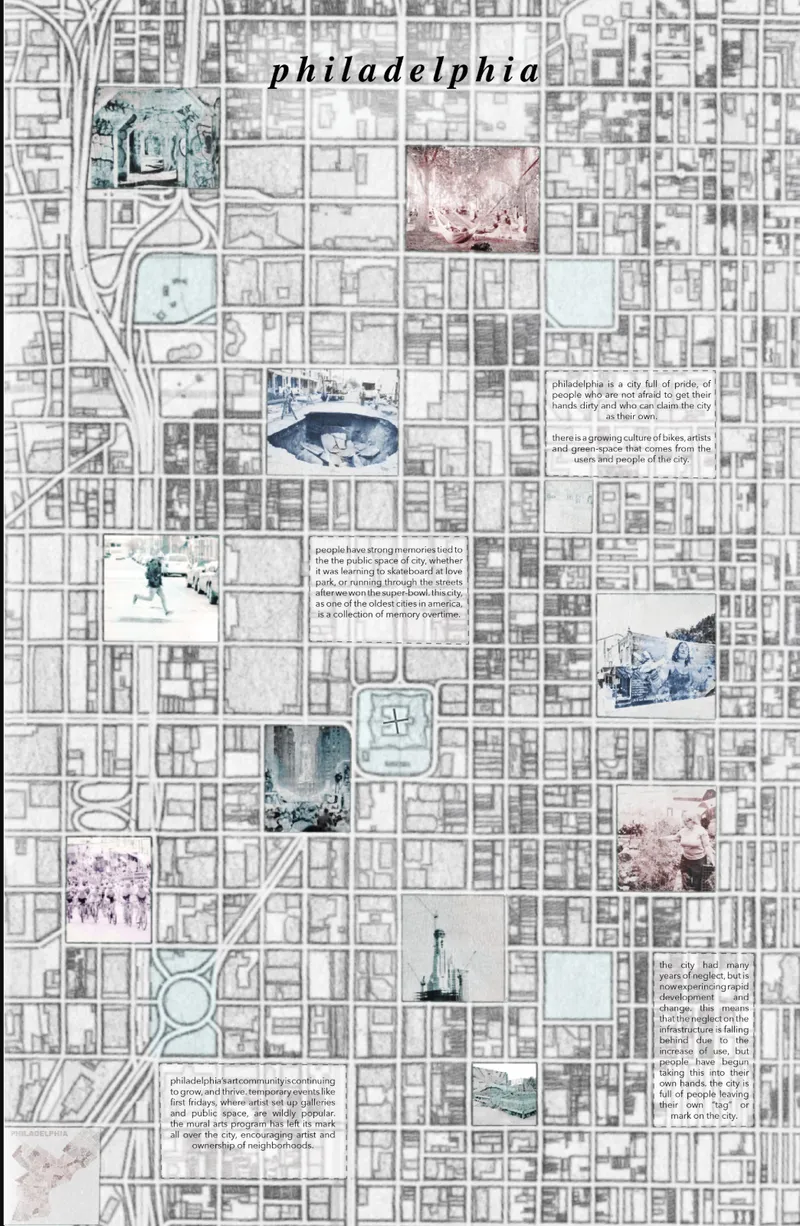
The site plan reads less like a conventional drawing and more like a field guide. Watercolor vignettes and annotations are overlaid on a gridded street map, identifying the specific vacant lots, infrastructure gaps, and underperforming public squares where modules could be deployed. The approach is deliberately non-prescriptive. Instead of fixing locations for permanent installations, the plan marks a constellation of opportunity sites, acknowledging that the city's needs shift seasonally, culturally, and politically. Philadelphia's grid-based, brick-built DNA provides the spatial logic; the modules provide the flexibility.
Nine Strategies, One System
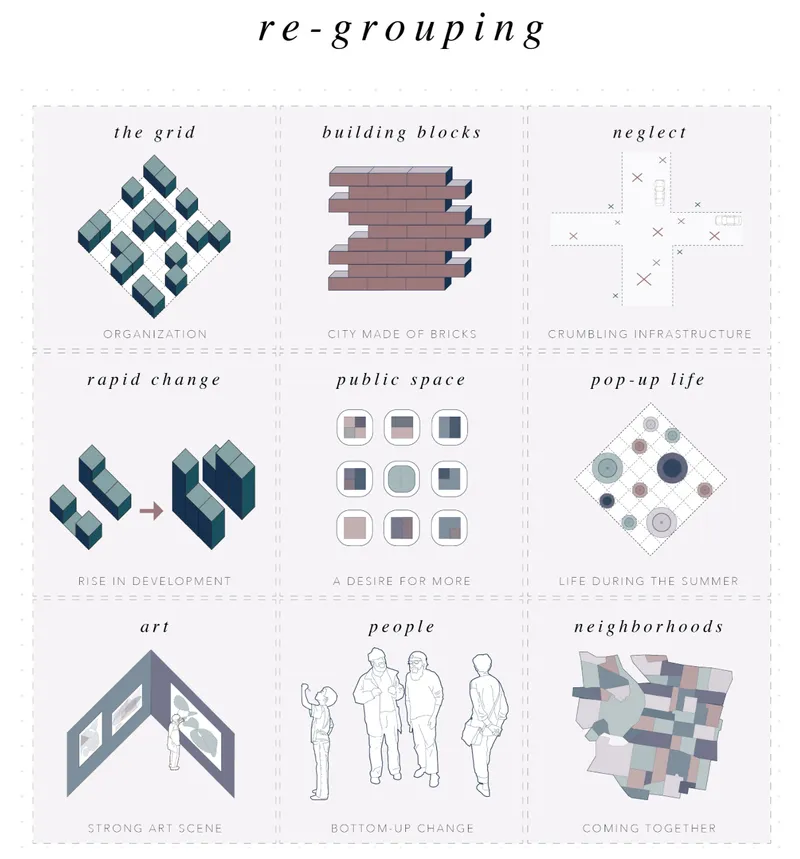
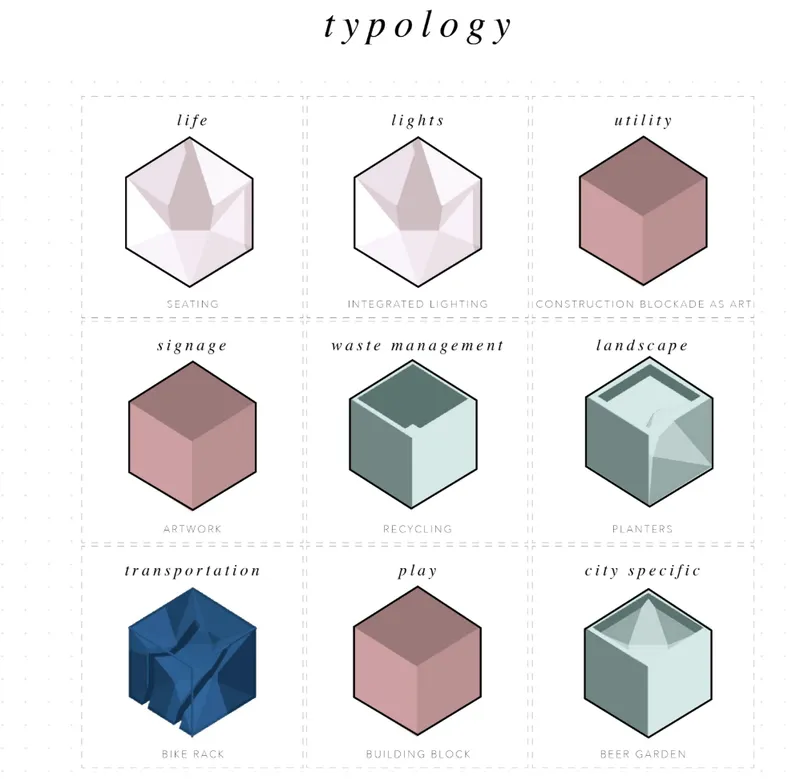
Two diagrams lay out the operational grammar of the project. The first identifies nine distinct urban intervention strategies through isometric and plan icons: from beer gardens and block parties to temporary classrooms and art installations. Each strategy describes a social scenario rather than a fixed program, emphasizing that the same physical unit can host radically different activities. The second diagram categorizes nine cube typologies by function, spanning seating, display surfaces, play structures, and landscape elements. The cube form is deliberately simple, echoing children's building blocks to signal accessibility and imagination.
What makes this legible as a system rather than a collection of objects is the geometric neutrality of the unit. Its dimensions and fiberglass materiality make it scalable, reusable, and cheap enough for city-wide deployment. Assembled across multiple sites, the cubes create a recognizable visual identity, a kind of civic brand that links disparate neighborhoods into a shared network of participatory spaces.
Street-Level Proof: Seating and Crosswalks Reimagined
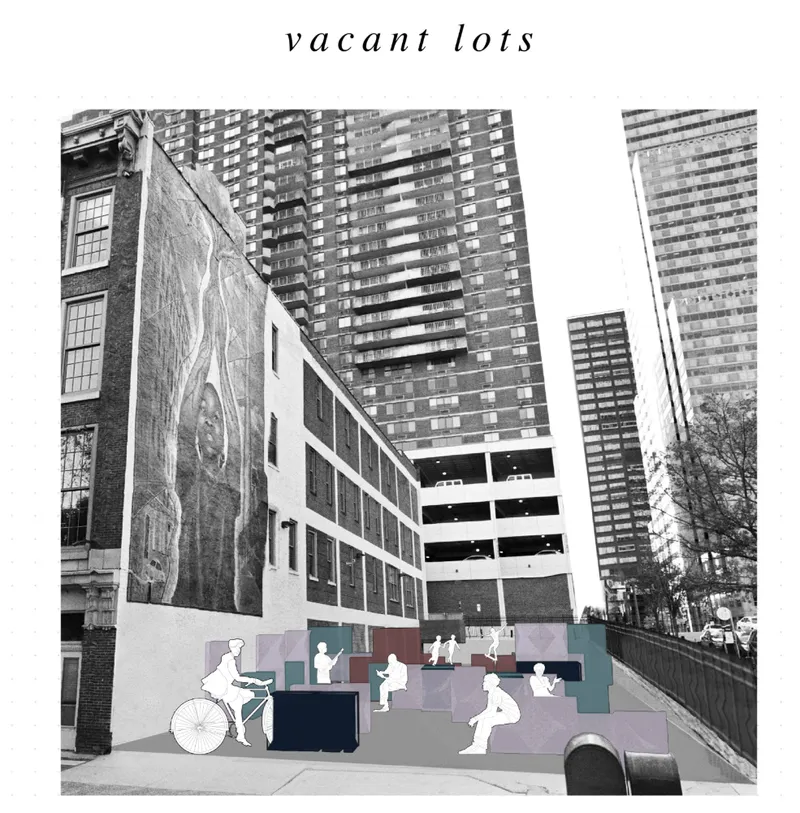
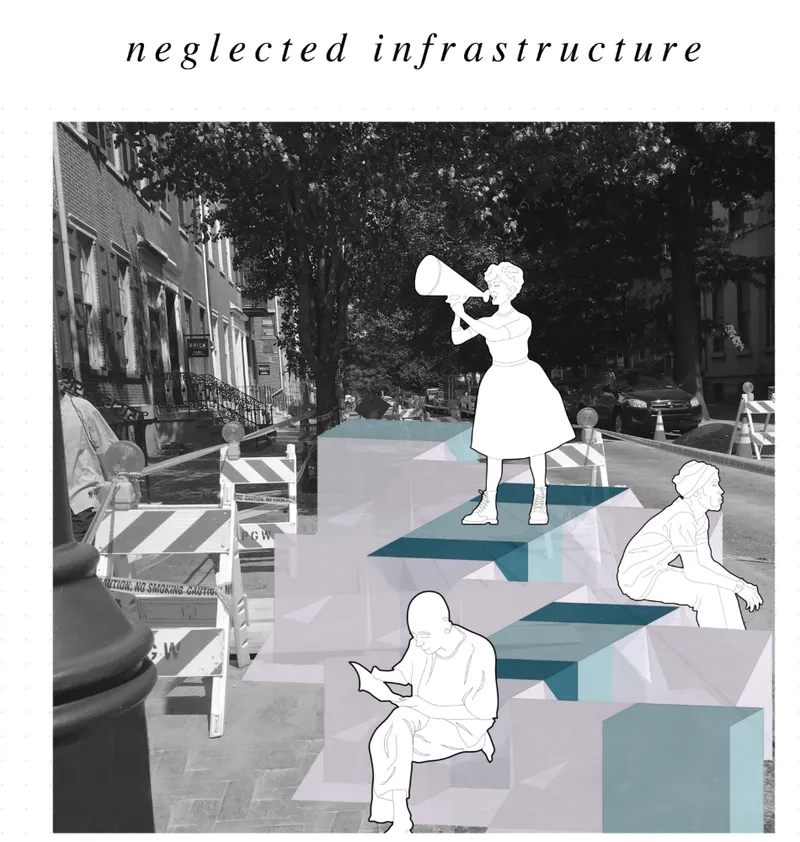
The photomontages ground the system in real Philadelphia conditions. One image positions a proposed street seating installation beneath residential towers, with silhouetted figures occupying the cubes as casual, informal furniture. The modules sit confidently in the existing streetscape without trying to compete with the architecture around them. A second montage shows a pedestrian platform with geometric paving at a tree-lined crosswalk, suggesting that the cubes can also redefine movement patterns, not just rest points. Together, the images argue that even small, modular insertions can shift the atmosphere of a block from neglected to activated.
The use of silhouettes is a smart representational choice. It avoids prescribing a specific user demographic and instead suggests that anyone could inhabit these spaces. The internally lit units also hint at the project's potential to extend the usability of public space well past sunset, a critical consideration in neighborhoods where darkness often signals danger rather than opportunity.
Why This Project Matters
Re-grouping makes a compelling case that urban design does not always require permanence or massive capital investment to be meaningful. In a city where civic space is shrinking and development pressure is accelerating, a lightweight, reconfigurable system offers something rare: the ability to respond in real time to local needs and cultural energy. The project treats Philadelphia's 40,000 vacant lots not as liabilities but as latent infrastructure, waiting for the right catalyst.
McLain and Stanev have designed something that sits at the intersection of product design, urban strategy, and community organizing. The fiberglass cube is simple enough to be deployable tomorrow, yet its systemic logic is ambitious enough to reshape how a city thinks about public space. By positioning the public as an active stakeholder rather than a passive consumer of designed environments, Re-grouping argues that the most resilient architecture might be the kind that invites everyone to rearrange it.
View the Full Project
About the Designers
Designers: Shannon McLain, Petra Stanev
Enter a Design Competition on uni.xyz
uni.xyz runs architecture and design competitions year-round that reward proposals with spatial conviction and real site intelligence.
Project credits: Re-grouping by Shannon McLain, Petra Stanev Urbanscape: Symbiosis (uni.xyz).


Popular Articles
Popular articles from the community


Aquadapt: An Underwater Habitat That Rewrites Its Rooms by the Hour
Curved modules ring the seabed while one shell shifts from breakfast room to cinema, farm and football pitch as residents' needs change.


Cube Design Draws an Ecological Corridor Between Two Shenzhen Hills with the Nankai Building
Beside Shenzhen's container docks, the Nankai Building pairs stacked balconies with a climbing green screen to connect two hillsides across its height.

graciastudio Turns a Viewless Tijuana Lot Inward Around a Courtyard of Concrete, Timber and Trees
In Tijuana, Jorge Gracia's GA2 House stacks a timber-clad private floor over exposed concrete and replaces a missing view with a planted interior patio.

Singing Woman: An Opera House That Performs Before the Curtain Rises
Ovidiu Cristian Pavel's conceptual opera house translates Estonia's choral identity into a sculpted waterfront landmark facing the Baltic Sea.

Similar Reads
You might also enjoy these articles

Vereda Arquitetos Renovates a 40-Square-Meter Apartment Inside Niemeyer's Copan Building
A compact unit in São Paulo's most iconic residential tower gets a material overhaul that pairs exposed concrete with bold blue Formica.

Shakur's House: Exposed Brick as an Interior Organiser in a 168 m² Mashhad Residence
Brick moves indoors in this Mashhad residence, where masonry walls, glass partitions and teal planes sequence a compact home without closing it off.

Day and Night Park: A Time-Based Urban Newsstand in Beijing
A temporary urban newsstand in Beijing blending travel, light, and reading through poetic colors, compact form, and community-focused design.

Modernist Patio Renovation in El Masnou, Barcelona by Oliver Segura Arquitectura + Cebrià Arquitectura
Modernist patio renovation blending tradition and innovation with a movable pool, leveled floors, and Catalan materials in El Masnou.

Comments (0)
Please login or sign up to add comments
No comments yet. Be the first to comment!