

RE-UN Bound: Modular Playground Design That Turns Play Into Learning
RE-UN Bound reimagines playground design through low-cost modular structures that turn play into learning, confidence and community for kids


Project by: MANOGNA MALEMPATI, Prateek Vikal, Srivardhan Rajalingam, Lochan Aradhya M Recognition: Editor's Choice entry of Re-imagining Play 2020
Reimagining Playground Design for Children in Refugee Camps
Play is often understood as a recreational activity, something that begins after essential needs have been addressed. RE-UN Bound challenges that assumption. The project approaches playground design as a form of social infrastructure, capable of supporting learning, communication, movement, creativity, confidence, and community-building among children living in refugee camps.
Developed for the context of the Kutupalong refugee camp in Bangladesh, the proposal responds to children growing up in an environment shaped by displacement, limited infrastructure, restricted educational opportunities, and uncertainty. Rather than defining play through conventional swings, slides, or fixed recreational equipment, RE-UN Bound creates an adaptable architectural system that encourages children to determine how play happens.
At the center of the project is a simple belief: play is not a luxury, play is a necessity.
The design therefore moves beyond the conventional playground and asks a more fundamental architectural question: how can a small, inexpensive structure provide children with the freedom to move, experiment, cooperate, learn, invent, and simply be children?

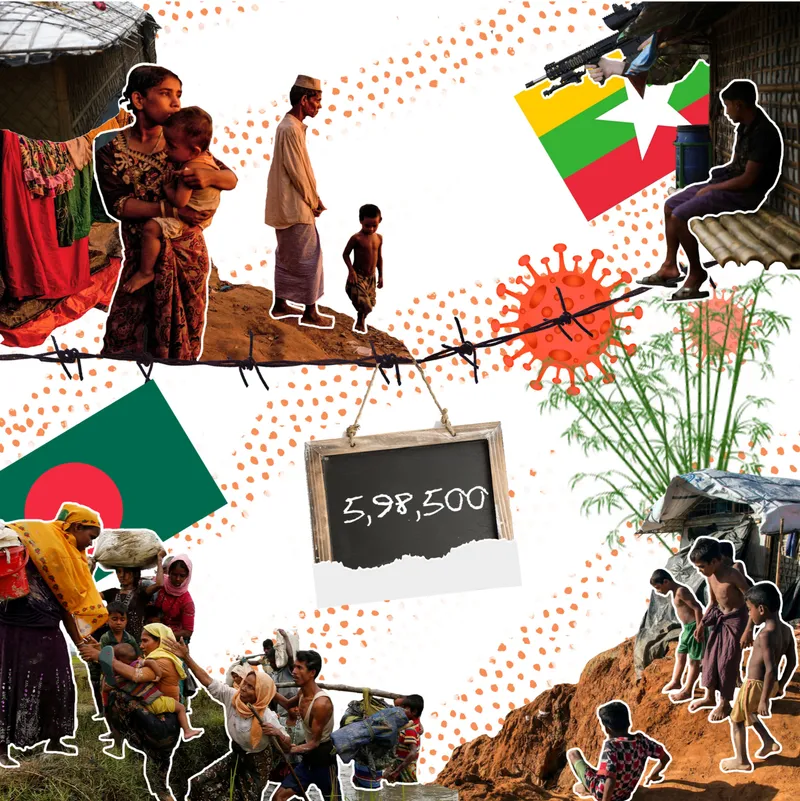
Understanding the Context of Kutupalong
The design begins with an analysis of the social and spatial conditions surrounding children in Kutupalong.
Displacement affects far more than housing. When families leave their homes because of conflict, children may also lose familiar schools, playgrounds, neighborhoods, friendships, routines, and spaces associated with safety. In temporary settlements, essential infrastructure understandably becomes the immediate priority, which can leave very little dedicated space for childhood development.
RE-UN Bound identifies this absence of play as an architectural issue.
The project recognizes that children living in such environments may experience prolonged uncertainty and limited access to formal recreation or education. Their surroundings can also restrict opportunities for experimentation, social interaction, independent decision-making, and physical activity.
Instead of proposing a conventional playground that depends on specialized equipment, RE-UN Bound searches for a system capable of functioning within these limitations.
Its playground design is intentionally resourceful, open-ended, inexpensive, and adaptable.
Play as an Architectural Tool
The project treats play as more than entertainment.
Playing can involve balancing, running, crawling, climbing, hanging, jumping, building, communicating, sharing, imagining, observing, competing, cooperating, and solving problems. These actions allow children to develop physical abilities while simultaneously strengthening social and cognitive skills.
RE-UN Bound transforms these activities into an architectural program.
The proposal identifies multiple forms of play, including:
- active and physical play
- adventurous play
- creative play
- individual play
- sensory play
- social play
- reflective play
- basic learning
- collaborative building
- learning through shapes and numbers
This diversity is significant because the architecture does not dictate one predetermined experience. Instead, the system creates conditions from which different experiences can emerge.
A climbing surface may become a game. A suspended rope can become an obstacle. A plane may become a floor, wall, net, frame, screen, seat, climbing element, or learning surface.
The child becomes an active participant in interpreting the architecture.
From Defined Playground to Open-Ended Play
Traditional playground equipment often tells children exactly how it should be used. A swing is for swinging. A slide is for sliding. A ladder is for climbing.
RE-UN Bound deliberately moves away from that rigidity.
The project proposes an undefined and flexible playground design in which the same architectural framework can accommodate multiple programs. This allows children to invent activities rather than simply consume predefined ones.
The idea becomes particularly important in the age of highly structured entertainment and digital gaming. Instead of competing through spectacle or technology, RE-UN Bound creates excitement through adaptability.
Children are given incomplete architectural conditions and invited to complete them through movement and imagination.
This changes the role of playground architecture. The designer no longer provides every answer. The designer provides a framework for discovery.
Reimagining Play Through a Modular System
The architectural logic begins with a compact 2 x 2 x 2 metre module.
Rather than treating this volume as a finished object, the designers break it down into basic spatial components: volume, plane, line, point, and mass.
These elementary components become the vocabulary from which multiple playground configurations can be created.
By changing the position, orientation, density, and relationship between planes and lines, a single modular frame can support dramatically different activities.
The resulting system is less like a conventional playground and more like an architectural construction kit.
One configuration can support climbing. Another can become a suspended net. Another can contain ropes, hoops, seating, crawl spaces, balance elements, or learning surfaces.
This modular approach gives the project considerable flexibility.
Instead of transporting an entire finished playground, communities can construct variations according to available materials, age groups, site conditions, and local requirements.
Six Planes, Numerous Possibilities
The design studies show how the six planes of the cubic framework can be manipulated to generate different types of play.
Rotation, subdivision, suspension, and repositioning transform the same fundamental module into multiple spatial scenarios.
The iterations include activities such as cricket, lounging, crawling, sitting, rope hanging, musical play, swinging, climbing, balancing, weaving, football, rolling, wall climbing, inclined movement, and roof-net activities.
The intention is not to create a catalogue of fixed playground equipment.
Instead, these examples demonstrate how a simple architectural logic can produce a large number of possibilities.
The question mark placed at the center of the design diagram is particularly important. It suggests that the proposed configurations are not the final answer. Children and communities can continue generating alternatives.
That open-endedness gives RE-UN Bound much of its architectural strength.
Low-Cost Materials as a Design Strategy
One of the project's most practical characteristics is its reliance on locally accessible materials.
The construction diagrams explore bamboo, timber, ropes, cargo nets, tyres, bolts, and straightforward wooden connections. Rather than relying on specialized manufacturing or complex prefabricated playground equipment, the proposal uses construction methods that can potentially be understood, repaired, modified, and replicated locally.
This is crucial to the concept.
A playground that depends heavily on proprietary components risks becoming unusable when individual parts fail. RE-UN Bound instead considers maintenance and adaptation as part of the architecture itself.
Its construction vocabulary includes bamboo and rope joints, tyre swings, cargo-net knots, timber connections, eye bolts, rope joinery, and simple member connections.
The result is a form of low-cost playground design where architectural intelligence comes primarily from configuration rather than expensive materials.


Building With What Is Available
Material accessibility also allows the concept to respond to different geographical conditions.
Bamboo may be suitable in one region, while timber or other locally available structural members could be used elsewhere. Rope networks can change according to available resources. Reused tyres can become suspended play elements. Locally fabricated pieces can replace standardized commercial equipment.
This gives RE-UN Bound the potential to function as a design methodology rather than a single finished object.
The system establishes rules, dimensions, relationships, and construction principles while allowing individual communities to determine the final architectural expression.
Such flexibility is particularly valuable within humanitarian contexts where material availability, labor, budgets, and site conditions can change considerably.
Playground Design as an Extension of Community Space
RE-UN Bound also imagines the playground as more than a children's object.
The proposal describes play spaces as extensions of everyday community life. They can become places for gathering, learning, observing, sharing, building, and interacting across different age groups.
This shifts the playground from an isolated recreational zone into a communal spatial resource.
A modular structure constructed by residents can develop a different relationship with its community than a finished playground delivered from outside. Participation in building, repairing, and modifying the space can contribute to a sense of collective involvement.
Children, too, are not treated merely as passive users.
The flexible system gives them opportunities to interpret and appropriate space, helping generate a sense of ownership over their immediate environment.
Learning Without a Classroom
One of the strongest themes within RE-UN Bound is the overlap between education and play.
The project recognizes that learning does not require a conventional classroom to occur.
Counting can happen through movement. Geometry can be understood through shapes. Communication develops through group activity. Coordination emerges through balancing and climbing. Problem-solving becomes necessary when navigating obstacles. Creativity appears when children assign new meanings to unfamiliar structures.
This relationship makes the playground simultaneously recreational and educational without turning play into formal instruction.
Children remain free to explore, but learning becomes embedded within the experience.
The approach is especially relevant where continuous access to formal schooling may be difficult. RE-UN Bound does not propose playgrounds as replacements for education. Instead, it demonstrates how architecture can provide an additional informal environment where essential abilities continue developing.
Communication, Collaboration, Creativity and Confidence
Four ideas repeatedly shape the project: communication, collaboration, creativity, and confidence.
The designers view these qualities as central outcomes of play.
A child navigating the structure alone develops confidence and spatial awareness. A group carrying out a shared activity practices communication. Building or changing something encourages creativity. Games requiring coordination strengthen collaboration.
The architecture provides the setting, while interaction creates the outcome.
This is why the proposal avoids excessively specific programs.
An undefined environment can potentially generate more varied relationships between children because it leaves room for negotiation. Participants must decide what a space means, how a game works, who participates, and how rules change.
In this sense, playground architecture becomes a social framework.
Designing Across Ages and Abilities
The modular character of the system also allows different levels of physical difficulty.
Lower or simpler elements can support basic movement and sensory activities, while elevated ropes, climbing structures, nets, and hanging components can produce more adventurous conditions.
Creative, educational, physical, individual, and group activities coexist within the broader system.
This diversity gives the project the capacity to accommodate children with different interests rather than assuming that everyone engages with play in the same way.
Successful playground design is therefore approached not as the creation of one perfect activity, but as the creation of multiple opportunities.
Safety Without Eliminating Exploration
The project attempts to balance freedom with safety.
Its modular grid gives the playground an understandable structural order, while nets, ropes, frames, and enclosed configurations provide different levels of containment. Children can move through spaces that feel adventurous without requiring architecture to become visually or spatially restrictive.
This relationship is critical.
If a play environment becomes excessively controlled, experimentation disappears. If it becomes completely uncontrolled, accessibility and safety can become concerns.
RE-UN Bound searches for an intermediate condition where structure provides security while children retain agency over how the environment is used.
Architecture That Can Change Over Time
Another major strength of the proposal is its capacity for transformation.
Because the playground is assembled from repeated modular components, it does not need to remain fixed throughout its lifespan.
Elements can potentially be repaired, replaced, repositioned, expanded, or reconfigured.
A small installation can grow. One play condition can evolve into another. Different activities can appear as children grow or community requirements change.
This gives the architecture a temporal dimension.
Instead of assuming that the designer can predict every future requirement, RE-UN Bound accepts change as a fundamental part of the system.
That makes the concept particularly relevant to temporary and rapidly changing settlements.
A DIY Construction Language
The project's detailed construction studies reinforce the practicality of its architectural concept.
Rather than presenting only idealized renderings, the drawings examine how bamboo poles can be connected, how ropes can be tied, how nets can be created, how tyres can be suspended, and how wooden elements can meet.
These details support the project's broader ambition of creating something that can be assembled using accessible skills and materials.
DIY construction is therefore not simply a cost-saving device.
It becomes part of the social logic of the project.
The more understandable a system is, the easier it becomes for communities to maintain and modify it without depending continuously on external specialists.
Juror Kazi Fida Islam on RE-UN Bound
The project's combination of affordability, diversity, and practical construction was also highlighted during the Re-imagining Play 2020 jury process.
Kazi Fida Islam, Chairman and Principal Architect at River & Rain, Bangladesh, praised the team's ability to incorporate a wide range of activities for children of different ages while working with basic and low-cost materials.
His assessment emphasized that the competition's objectives were successfully translated into an architectural proposal through a structural system that appeared relatively easy to execute.
This observation reinforces one of RE-UN Bound's most convincing qualities: complexity is achieved through use rather than construction.
The project does not require an elaborate formal object to generate varied experiences. A straightforward framework produces complexity because children can interact with it in many different ways.
At the same time, the jury feedback identified areas where the proposal could have been developed further.
Islam noted that although the analysis of the design objectives was strong, the structural foundations required greater clarity. This is an important architectural consideration, particularly for elements involving climbing, swinging, hanging, and dynamic loading.
The jury also suggested that the presentation of the ideas could be strengthened.
These comments identify a clear distinction between the conceptual success of RE-UN Bound and the level of technical resolution that would be required to move the project toward implementation.
From Conceptual System to Buildable Infrastructure
The foundation question raised by the jury is particularly relevant to the next stage of development.
A modular playground may appear lightweight, but children climbing, swinging, running, and jumping introduce considerable dynamic forces. Connections between bamboo, timber, ropes, nets, and the ground would therefore require careful structural testing.
Future development could explore alternative foundation strategies suited to temporary settlements, including removable anchors, weighted bases, driven posts, or other systems that minimize permanent ground disturbance.
Durability, material weathering, rope replacement, fall protection, drainage, and maintenance protocols would also become important considerations.
Addressing these elements would allow the project's conceptual adaptability to be supported by greater technical precision.
Why RE-UN Bound Matters
RE-UN Bound demonstrates how architecture can address needs that are easily overlooked during humanitarian emergencies.
Shelter, sanitation, healthcare, food, and safety remain fundamental, but childhood development also depends on environments where children can explore, interact, imagine, and exercise agency.
The project makes a compelling case for treating play as infrastructure.
Its architecture is deliberately modest. There is no monumental form and no dependency on advanced technology. Instead, intelligence is embedded within the system: a repeatable frame, adaptable planes, accessible materials, straightforward connections, and an open-ended program.
This simplicity is what allows the concept to expand.
A cube becomes a playground.
A rope becomes a climbing route.
A net becomes a floor.
A plane becomes a wall.
A frame becomes a social space.
The architecture does not determine what must happen next.
It asks children to decide.
Playground Design Beyond Boundaries
The title RE-UN Bound captures the project's central ambition.
It is about becoming unbound from rigid definitions of playgrounds, while also reconnecting play with learning, social development, physical activity, and community.
The project asks architecture to provide possibilities rather than prescriptions.
Its modular language supports running, hanging, balancing, climbing, crawling, sitting, building, learning, collaborating, imagining, and inventing. More importantly, the combinations can continue changing.
For refugee children whose lives have already been shaped by circumstances beyond their control, this ability to make choices within a space carries particular significance.
RE-UN Bound creates a framework where children can determine the game, alter the rules, negotiate with others, test their abilities, and discover new uses for familiar materials.
Architecture for the Freedom to Play
Ultimately, RE-UN Bound is not simply a proposal for playground equipment.
It is a proposal for an environment in which play becomes a tool for personal and collective development.
Through an adaptable playground design, the project links architecture with movement, informal education, creativity, communication, collaboration, and confidence. Its modular construction system allows inexpensive materials to generate varied experiences, while its open-ended spatial language gives children freedom to interpret the environment themselves.
Its recognition as an Editor's Choice entry of Re-imagining Play 2020 reflects the strength of this idea, while the jury's comments point toward the technical questions that could make the system even more convincing as a built intervention.
RE-UN Bound ultimately argues for a simple but important principle: children do not need architecture to tell them exactly how to play.
They need architecture that gives them the opportunity to begin.


Popular Articles
Popular articles from the community


Architekt Andreas Gruber Scatters 23 Dark Timber Chalets Across a South Tyrolean Forest Edge
In Molini di Tures, Amonti Chalets breaks a resort into a hamlet of gabled timber houses, with parking, storage and services pushed into the slope.

GROUP A Strips a 1969 Rotterdam Harbor Headquarters to Its Frame and Wraps It in Timber Louvers
In Rotterdam's M4H harbor district, Ferro Offices reuses a 1969 frame, adds one timber storey and reaches BREEAM-NL Outstanding.

Cube Design Draws an Ecological Corridor Between Two Shenzhen Hills with the Nankai Building
Beside Shenzhen's container docks, the Nankai Building pairs stacked balconies with a climbing green screen to connect two hillsides across its height.

David Ortega Stacks a Two-Story Mexico City Penthouse Around a Steel Stair and a Pergola-Shaded Roof Terrace
In Colonia Roma, a 300 m² penthouse uses oak joinery, a planted steel stair and a slatted roof pergola to make a new-build apartment feel like a house.

Similar Reads
You might also enjoy these articles
Healing Façade: A Modular Chapel System That Restores Ethiopia's Sacred Forests
Winner of the Eco-Chapel competition, this circular timber façade collects water from air to rebuild soil and reforest degraded Ethiopian landscapes.
Kaffeebühnen: Where Coffee Shop Architecture Becomes a Civic Stage in Vienna
A linear sequence of timber boxes, transparent shells, and open yards turns the Viennese café tradition into a public performance space.
Eco Chapel: A Modular Forest Pavilion That Grows Like the Landscape It Protects
Hexagonal timber modules weave through existing trees, turning a chapel into a living system for prayer, education, and reforestation.


Urban Forest: A Vertical Ecosystem for 5,000 Workers in Singapore's Changi Business Park
Radially stacked pods and layered green decks turn a 7-acre plot into 47 acres of ecological workspace projected for 2040.


Comments (0)
Please login or sign up to add comments
No comments yet. Be the first to comment!