

React Architects Carve an Inhabitable Landscape into a Cycladic Hillside on Paros
LofoS Residence dissolves the boundary between architecture and terrain on a Greek island slope facing Naxos across the Aegean.


On a hill above Kostos on the island of Paros, a mountain path winds through olive groves where goats and donkeys still set the pace. It is precisely this path, and the terrain it follows, that gave React Architects their organizing principle for LofoS Residence. Rather than planting a villa on top of the slope, lead architects Natasha Deliyianni and Yiorgos Spiridonos chose to grow one out of it: 280 square meters of living space conceived as earthwork, where rooftops become gardens, walls become retaining edges, and the distinction between built form and ground simply ceases to apply.
What makes LofoS genuinely interesting is not the white plaster, which is standard Cycladic vocabulary, but the refusal to treat landscape as decoration applied after the architecture is done. Eva Papadimitriou's landscape design is co-authored with the building itself; planted roofs cascade down the hill, a guest house sits in an adjacent plot connected by the same continuous terrain, and the pool nestles into a courtyard that reads as a natural depression. The project, nominated for the 2026 Mies van der Rohe Award, proposes that the most radical thing you can do on a Greek island hillside is not to stand out from it.
Architecture as Topography

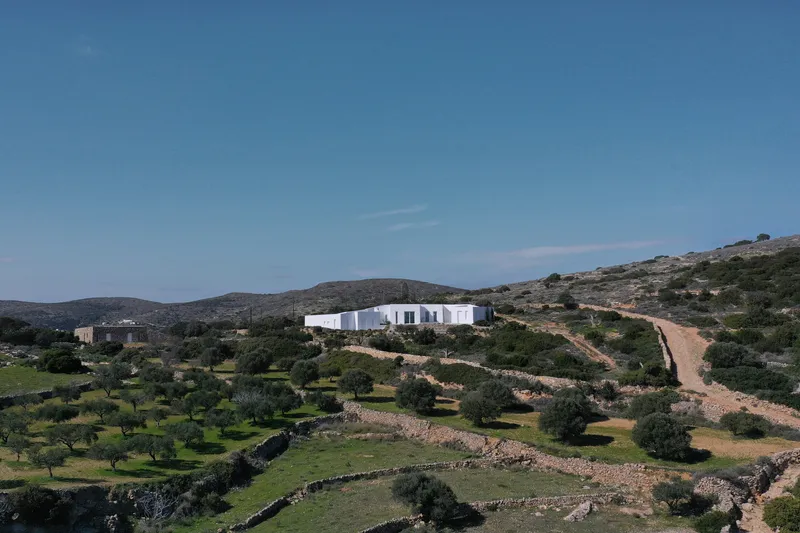

Seen from a distance, LofoS reads less as a house and more as a cluster of white forms that could be geological outcrops or agricultural terraces. The massing fragments into several low volumes that step down the hillside, respecting the existing contour lines rather than cutting a flat platform into the slope. Stone walls from the surrounding terraced fields find a visual echo in the building's horizontal lines. The decision to stay low, to spread rather than stack, means the residence never breaks the ridgeline against the sky.
From the aerial vantage, the planted roofs confirm the intention: the building gives back to the landscape what it took during construction. Gravel, native grasses, and succulents colonize the roof surfaces, making the architecture increasingly invisible as it matures. The orientation faces east toward Naxos, which means every primary living space catches the morning light and the evening silhouette of the neighboring island becomes a permanent backdrop.
The Roofscape as Living Room

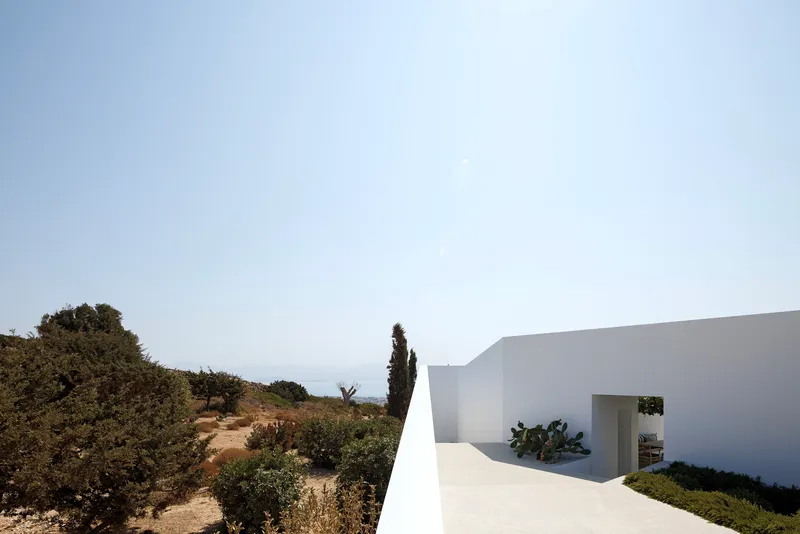

React Architects treat the roof not as a leftover surface but as the project's most generous public space. White plastered parapets double as built-in seating, curved planters hold drought-resistant species, and the views toward the mountain ridgelines are framed with the precision of a camera lens. There is a deliberate looseness to the layout: corners round off, edges thicken into benches, and the line between parapet and planter blurs. The rooftop terrace extending toward the sea, with its cactus silhouettes against the horizon, has the quality of a Mediterranean belvedere that happens to sit on top of a house.
The strategy also has a practical dimension. Accessible rooftops on a hillside site allow every level of the house to connect directly to an outdoor surface at grade. You never climb stairs to reach the outdoors; you simply step out onto whatever piece of ground your room touches. That continuity between interior and exterior is the project's most effective spatial trick.
Thresholds and Passages

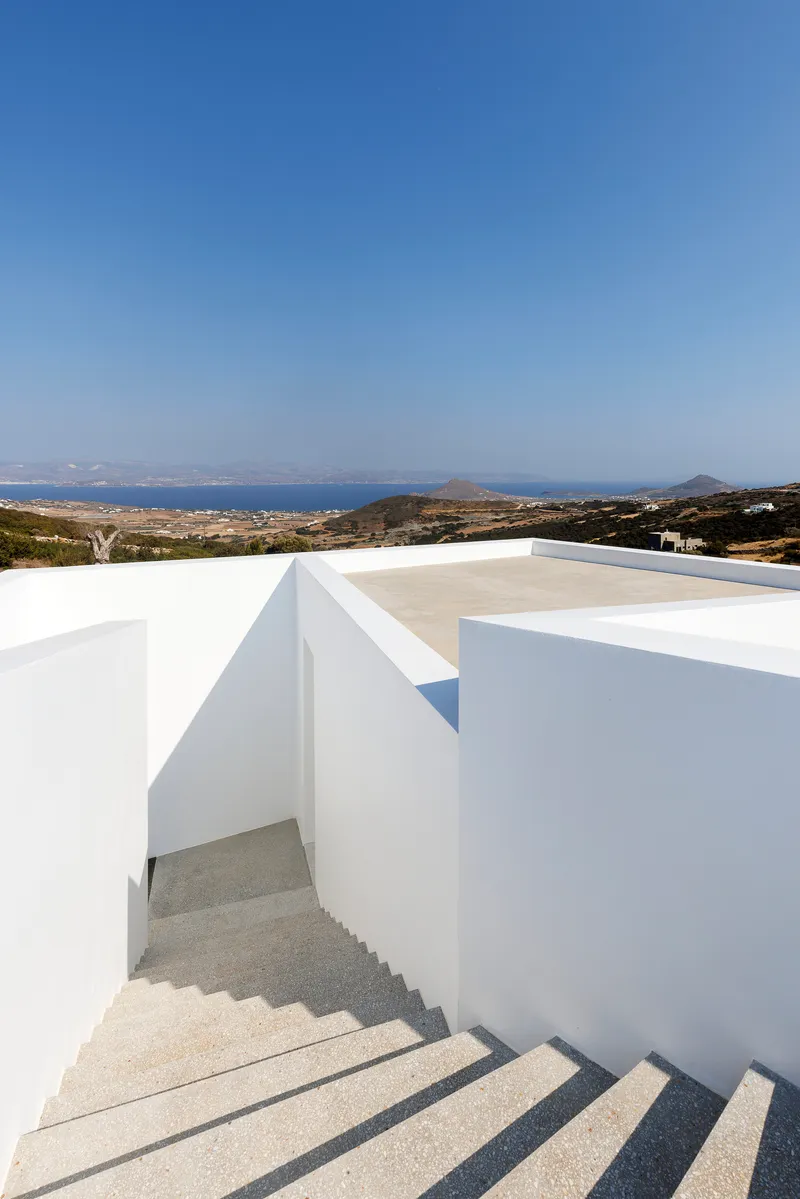
Circulation in LofoS is cinematic. Exterior staircases emerge from groundcover planting, framed by white rendered walls that compress the view before releasing it. The terrazzo staircase descending between walls, with a slice of coastal landscape visible at the bottom, is a classic sequence of compression and release that architects have used since the Acropolis. But here the effect feels unforced, almost incidental, as though the path simply carved itself between the volumes.
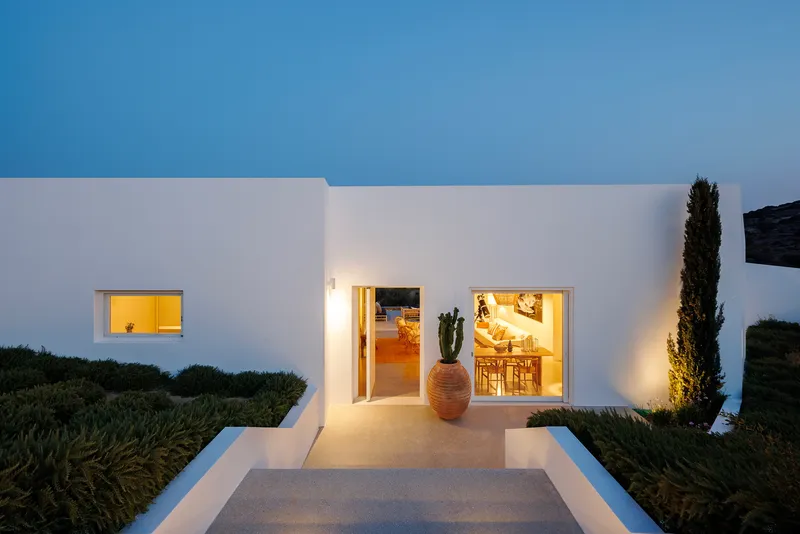
The entry at dusk, with its terracotta pot flanked by cactus and cypress, sets the tone for the entire experience: vernacular elements composed with contemporary restraint. There are no grand gestures at the front door, just a quiet transition from the mountain path into domestic space. The fact that the plot is bordered by a route still used by animals gives this threshold a particular poignancy: you arrive at the house the same way the goats do.
White Volumes at Twilight


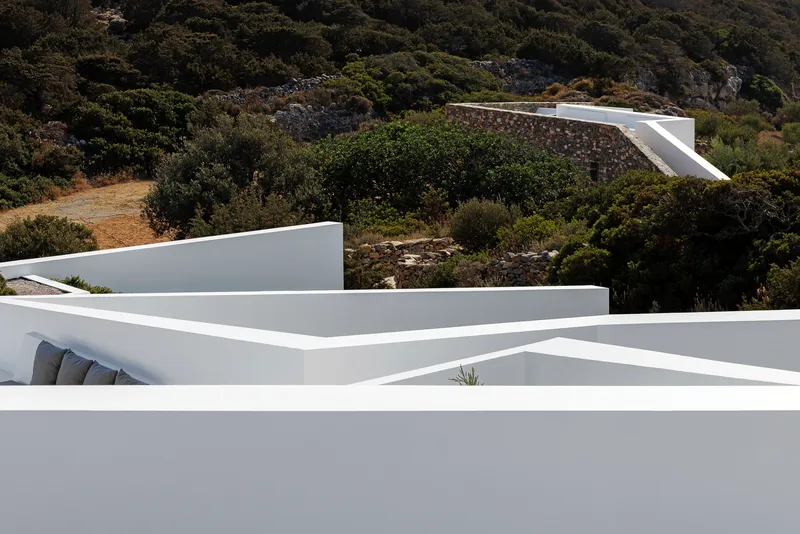
At dusk, the house reveals a second personality. Uplighting catches the underside of cypress canopies and the soft curves of the white walls, turning the complex into something theatrical. The overlapping rooflines cascading down the hillside read as a small settlement rather than a single residence, which is exactly the right reading for a Cycladic context where villages have always been aggregations of small volumes rather than singular gestures.
The presence of cypress trees, planted close to the building, introduces vertical counterpoints to the relentless horizontality. Their dark columnar forms punctuate the white surfaces and will, over time, soften the edges of the architecture further. React Architects clearly understand that a building on Paros is never finished when the contractor leaves; it is finished when the landscape reclaims it.
Interior Warmth Against Cycladic White

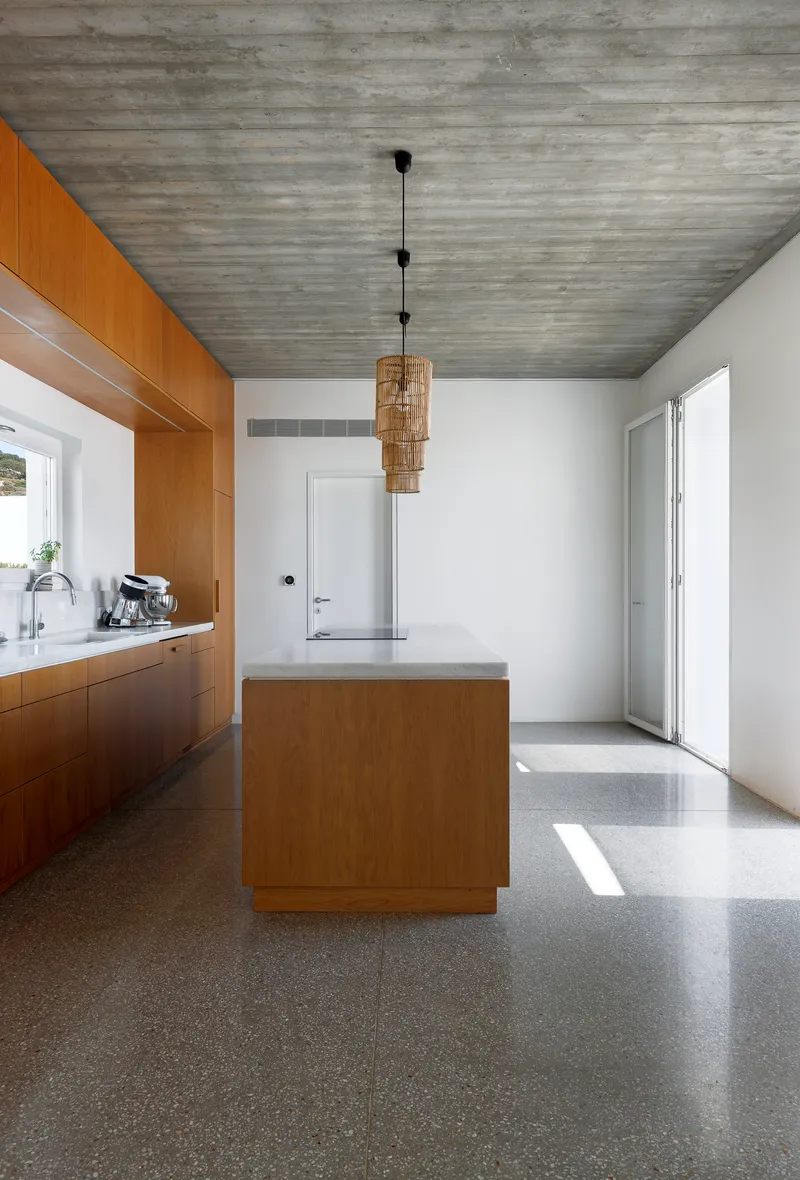

Inside, the material palette shifts decisively. Polished terrazzo floors in warm tones lead down to dining spaces where a timber table sits beneath woven pendant lights, and the kitchen features a generous timber island under board-formed concrete ceilings. The choice of wood, supplied by Kritikos Wood, introduces a tactile warmth that the exterior deliberately withholds. The board-formed concrete overhead is left raw, its grain visible, establishing a dialogue between craft and mass that keeps the interiors from feeling precious.
The infinity pool, positioned at the building's lowest terrace, extends the material language of polished stone into the landscape. Loungers and native grasses share the deck, and the view drops away toward the sloping terrain below. It is a restrained composition that avoids the resort-brochure cliché: no vanishing edge toward the sea, just a quiet stretch of water held within the hillside.
Aerial Legibility


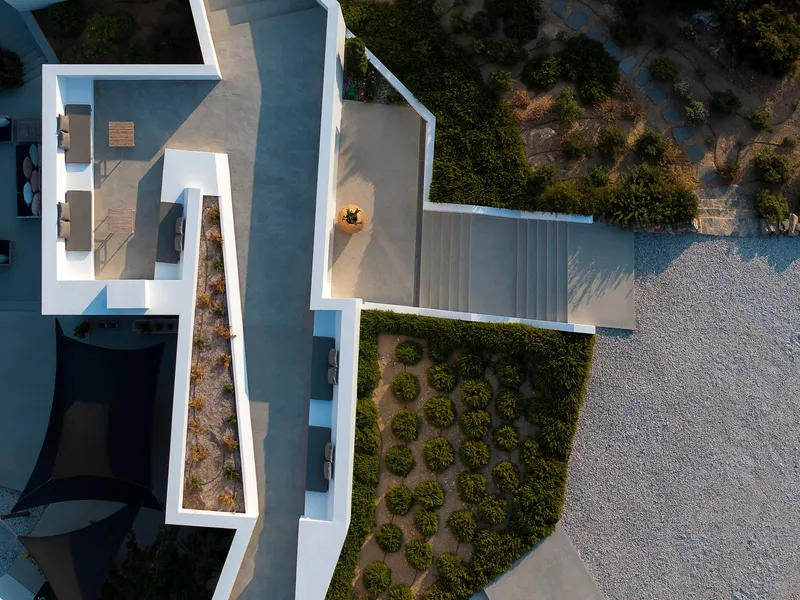
Drone photography reveals the project's organizational logic most clearly. The angular white roofscape, with its central courtyard pool and surrounding olive groves, reads as a topographic map made real. Courtyards, timber decks, and gravel beds alternate across the roof surfaces, creating a patchwork of microclimates and uses. The guest house, visible in the adjacent lot, extends the composition without duplicating it, suggesting that the landscape strategy could absorb additional program over time.
From above, the green roofs are not afterthoughts but the primary surface of the building. They connect visually to the surrounding planted beds, making it difficult to tell where the building's footprint begins and the garden ends. That ambiguity is the project's central thesis, and the aerial views are its clearest proof.
Plans and Drawings

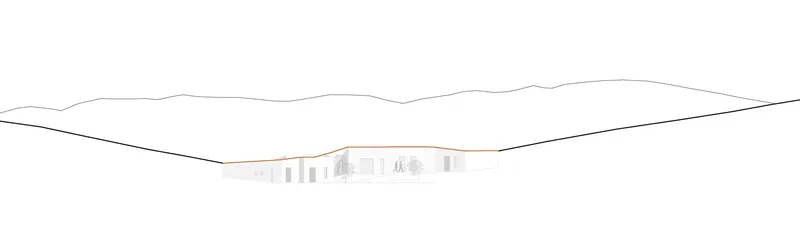
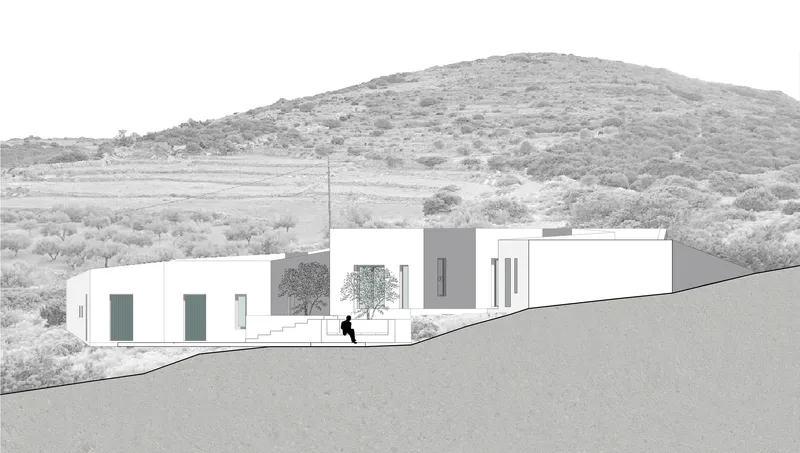
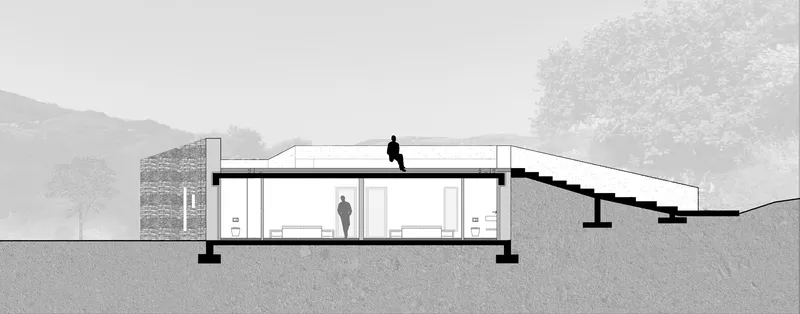
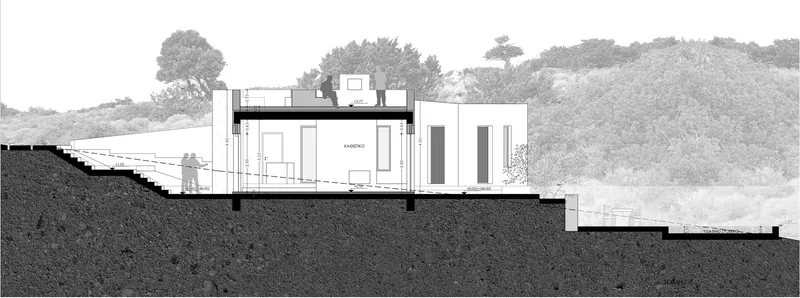
The floor plan reveals a curving footprint that wraps around the pool courtyard, with rooms fanning out along the slope rather than stacking vertically. The curved geometry is not arbitrary: it follows the natural contour of the hill, minimizing excavation and keeping each room close to the ground plane. The sections are particularly revealing. They show how the residence embeds itself into the slope, with the exterior stair ascending from the lowest level to the rooftop gardens above. The figures drawn into the sections give a sense of the modest ceiling heights, which keep the volumes subordinate to the landscape. The elevations confirm the deliberate horizontality: even the tallest wall barely exceeds two stories, and the planted trees in front will eventually screen much of it from view.
Why This Project Matters
The Cyclades face an architectural crisis of taste. Instagram has turned the whitewashed cube into a branding exercise, and luxury villas on Paros and Mykonos increasingly treat the landscape as a stage set for infinity pools. LofoS pushes back against that tendency without retreating into nostalgia. It uses the local vocabulary of white plaster, stone terraces, and clustered volumes, but reorganizes them around a landscape-first logic that is genuinely contemporary. The nomination for the 2026 Mies van der Rohe Award suggests that this approach has caught the attention of jurors looking for alternatives to spectacle.
React Architects have demonstrated that the most compelling move on a Mediterranean hillside is not to dominate it but to become part of it. The project's real achievement is temporal: as the planted roofs thicken, as the cypress trees mature, as the native grasses fill in around the terrazzo stairs, LofoS will become progressively less visible and progressively more alive. That is a rare thing in residential architecture, where permanence and photogenic clarity usually win out over ecological patience.
LofoS Residence by React Architects (Natasha Deliyianni, Yiorgos Spiridonos), Kostos, Paros, Greece. 280 m², completed 2024. Landscape architecture by Eva Papadimitriou (Outside). Photography by Panagiotis Voumvakis.
About the Studio
Share Your Own Work on uni.xyz
If projects like this are the kind of work you want to make, uni.xyz is a place to publish your own, find collaborators, and enter design competitions.


Popular Articles
Popular articles from the community


Opera on the Sea: Driftwood Logic Shapes a Timber Opera House on Estonia's Coast
Trevor Orgill's opera house translates the entangled drift of floating timber into a civic building where wood, water, and music converge.

Temporary Home for Dogs: A Reversed Zoo Rethinks Animal Shelter Architecture
In Bucharest, a sinuous corridor and freed landscape flip the logic of containment, designing a shelter that works to make itself unnecessary.

Cloaked Colonization: A Mobile Underwater Habitat That Moves Like a Fish
Micah Abaya's shortlisted EHC Pacific entry reimagines ocean settlement as a dispersed network of self-sustaining architectural organisms.
Faces of the Soviet Avant-Garde: Turning Moscow's Street Names into an Open-Air Museum
A network of sculptural installations across a Moscow residential district transforms forgotten architect names into spatial encounters with cultural memor

Similar Reads
You might also enjoy these articles

Bao Huynh Watercolor Atelier: A Serene Art Retreat in Hội An
Bao Huynh Watercolor Atelier in Hội An blends multifunctional art spaces, sustainable design, local materials, and family-friendly living in a serene environment.

Atelier Macri Concept Store Interior Design by CASE-REAL
Atelier Macri store features a "ko" counter, walnut wood details, cork displays, blending retail, gallery, and seamless customer experiences.

Manuel Vargas Izquierdo Stadium and High-Performance Sports Center: Architectural Excellence in Jalpa de Méndez
The Manuel Vargas Izquierdo Stadium blends sustainable design, inclusive sports facilities, and cultural-inspired architecture, revitalizing Jalpa de Méndez’s public spaces.

KAKR Buluh Awar Hall: Revitalizing Community and Ecology Through Bamboo Architecture
Community built bamboo hall revitalizes Buluh Awar village, empowering youth, restoring ecology, celebrating vernacular craftsmanship through sustainable architecture and culture.


Comments (0)
Please login or sign up to add comments
No comments yet. Be the first to comment!