
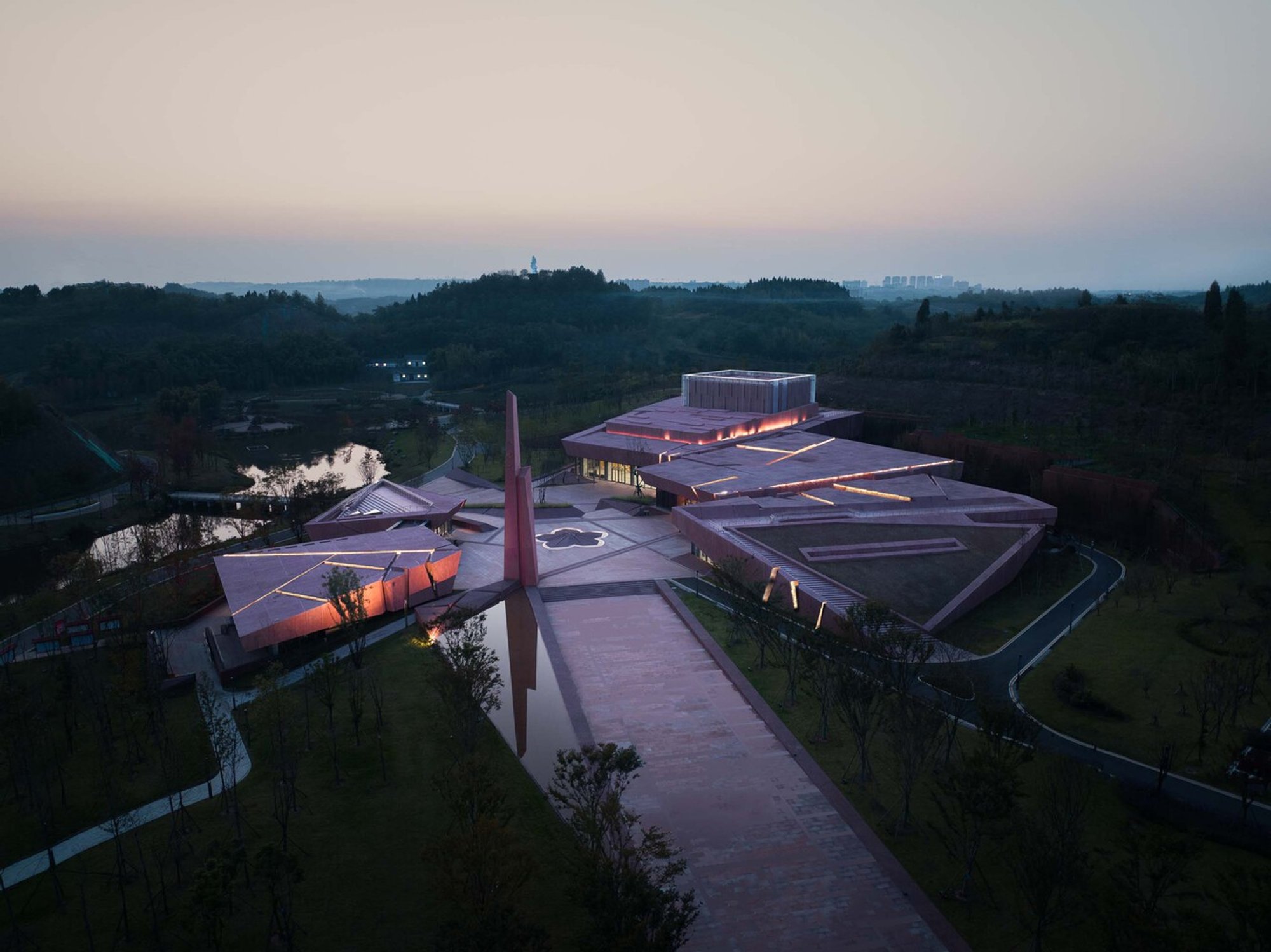
Red Education Base of Jiang Jie Hometown by SADI
Memorial complex in Zigong blending landscape, symbolism, and radial architecture, honoring Jiang Jie through immersive spatial storytelling and cultural identity.

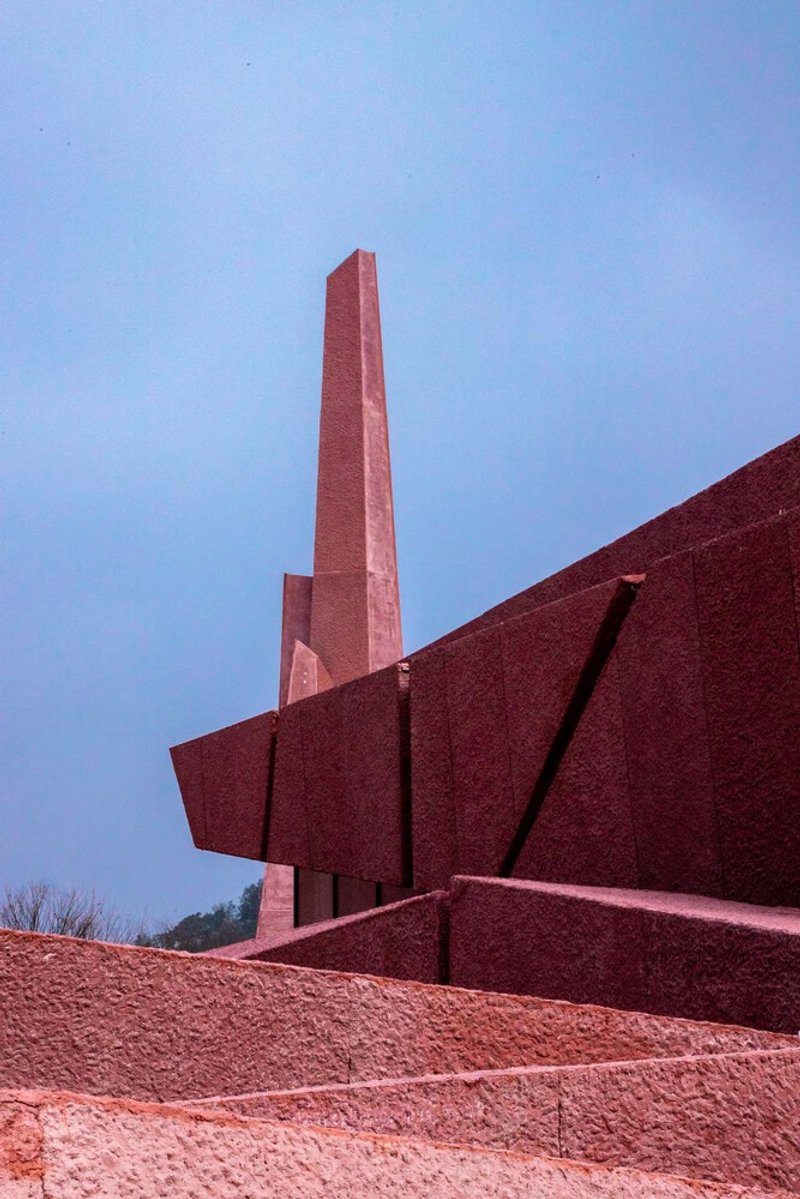
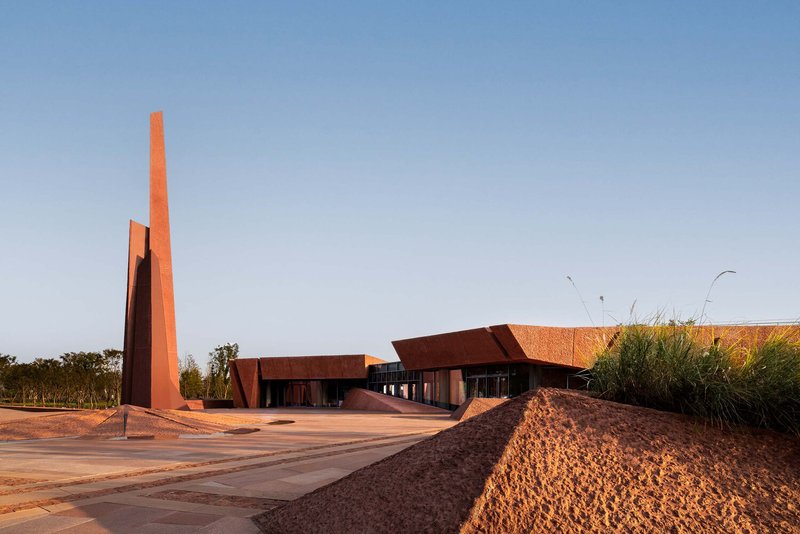
The Red Education Base of Jiang Jie Hometown, designed by SADI, stands as a powerful cultural landmark in Zigong. Completed in 2021, this 12,374-square-meter museum and memorial complex redefines how architecture can preserve history while shaping collective memory. Rooted in the legacy of revolutionary martyr Jiang Jie, the project transforms her hometown into a symbolic and educational destination.
Cultural Context and Urban Identity
Before the project’s realization, Jiang Jie’s connection to Zigong was relatively unknown. The development of this red education base repositioned the city as her birthplace, embedding her legacy into its urban identity. Rather than relying on physical artifacts: few of which remain due to her early death: the design draws from symbolic imagery such as the “red rock,” “red plum,” and “red star,” which define her cultural and ideological significance.
Site Strategy and Landscape Integration
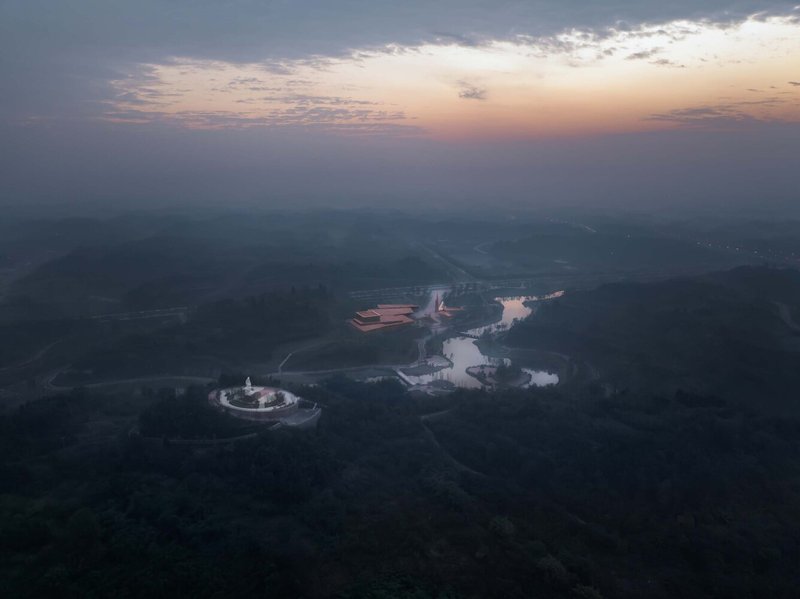
Located in Jiangjiawan, the site reflects the traditional spatial qualities of southern Sichuan villages: nestled between mountains, facing water bodies, and surrounded by bamboo landscapes. The masterplan spans approximately 270,000 square meters and includes the restoration of Jiang Jie’s former residence, the redesign of Red Plum Square, and the construction of a new memorial hall.
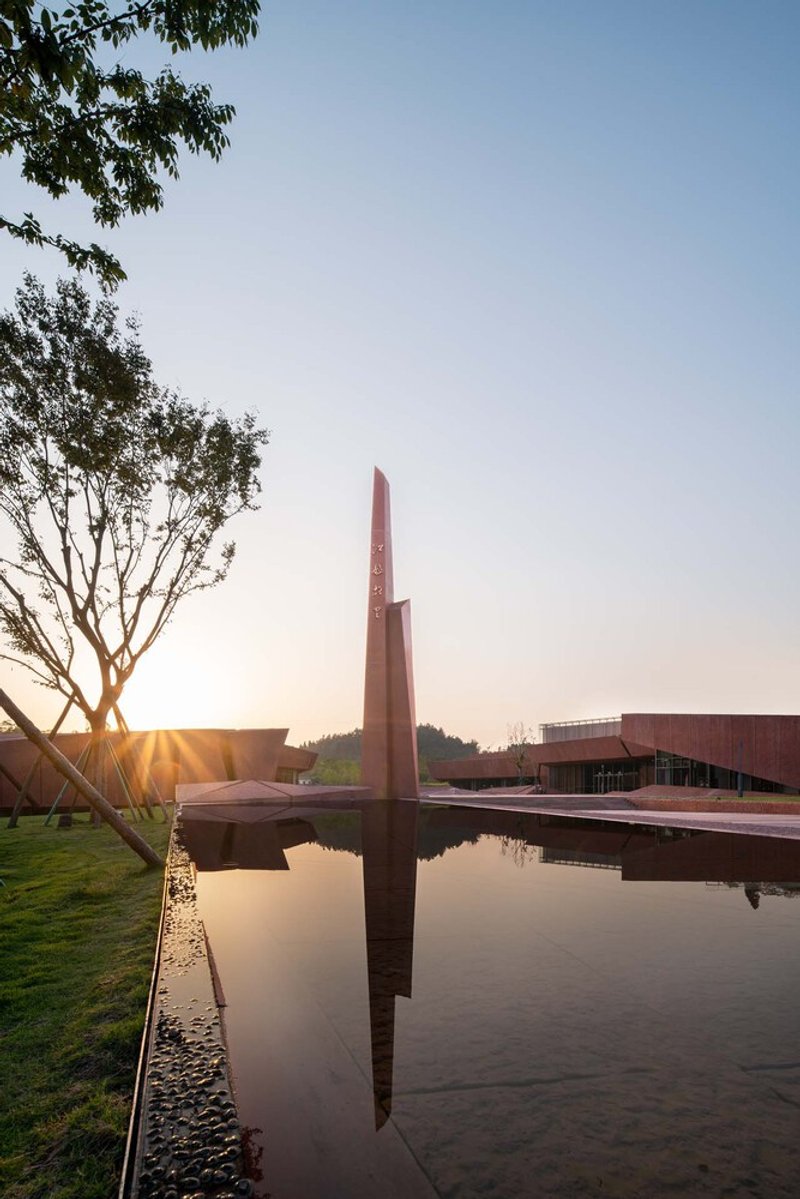
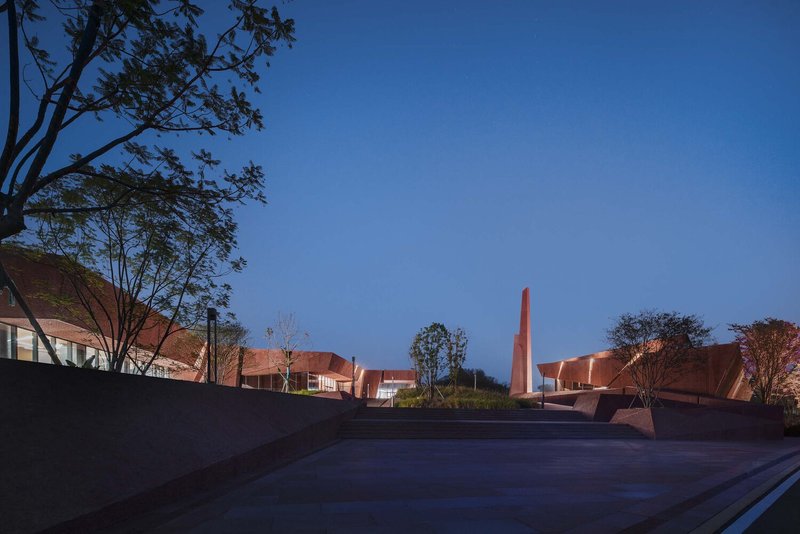
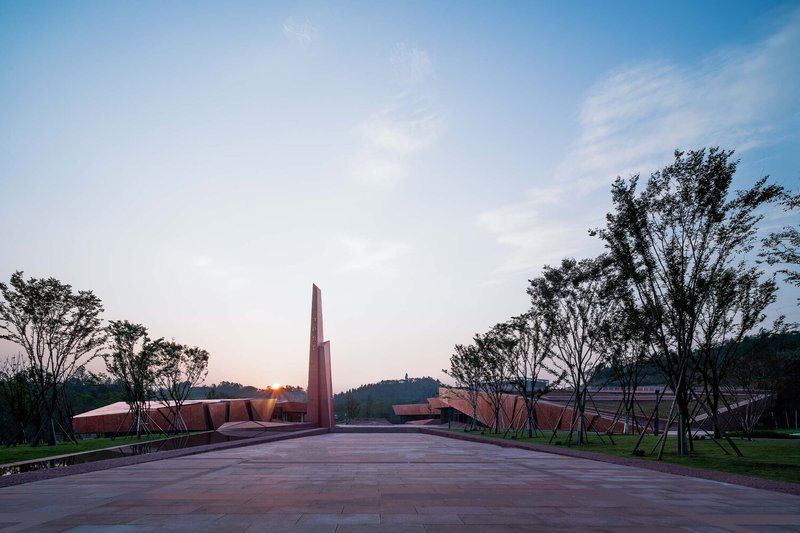
To preserve authenticity, the original residence remains largely untouched, with exhibitions relocated to the new structure. The memorial hall is strategically positioned on a lower eastern hillside, forming a symbolic axis aligned with the statue and the original home. This eastward orientation reinforces the poetic and ideological narrative of “facing the light.”
Architectural Concept: The Rising Red Rock
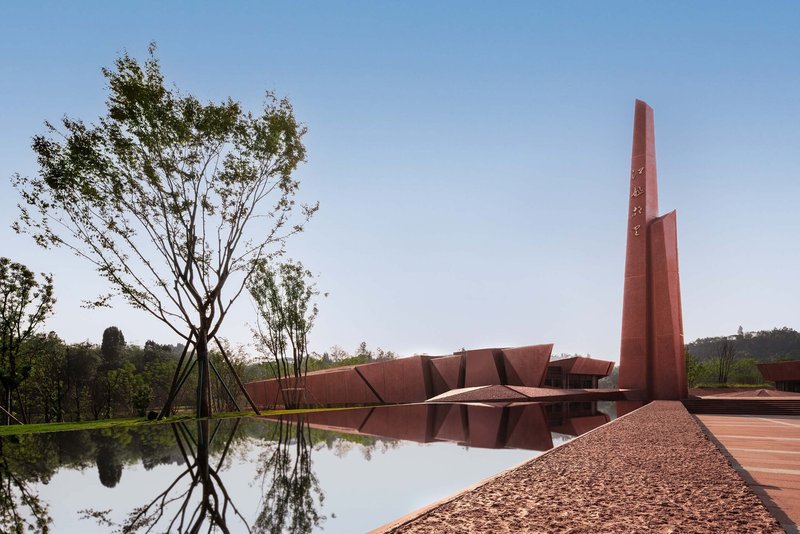
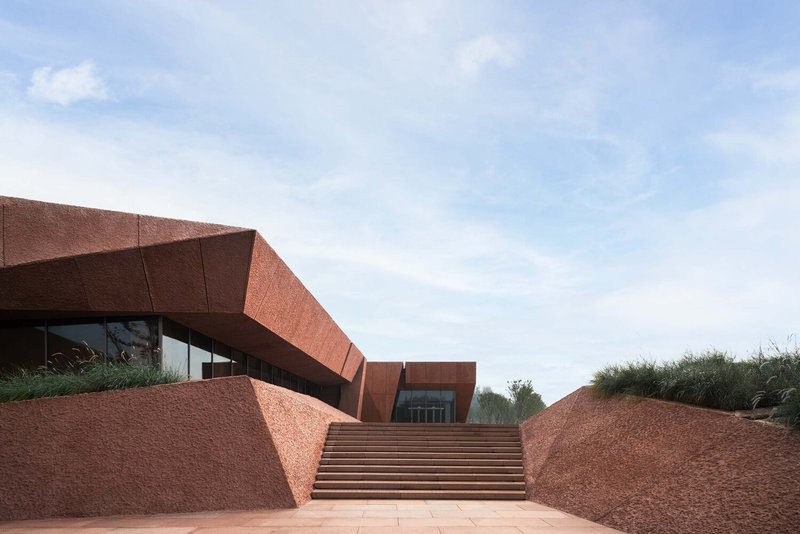
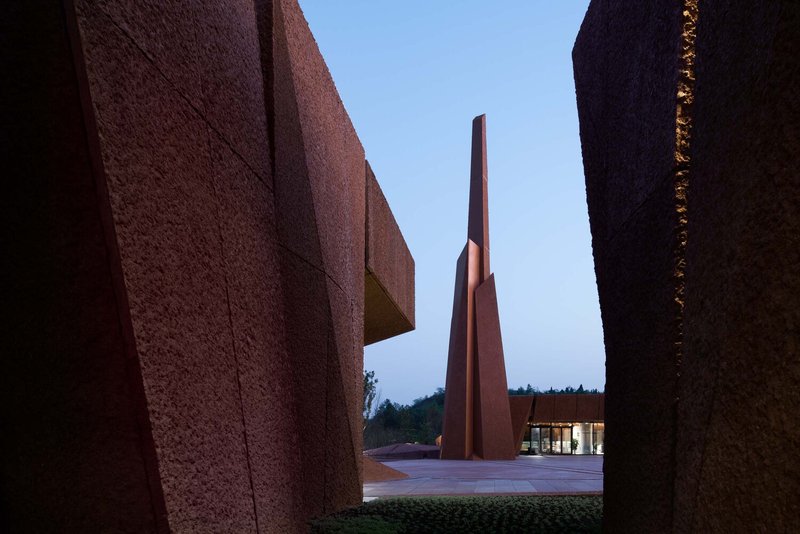
The architectural language is deeply rooted in landscape integration and symbolic expression. The building emerges from the terrain like a “red rock,” achieved by embedding the structure into the hillside and minimizing its visual height. This creates a layered spatial progression along the axis, enhancing the experiential journey.
The plan adopts a pentagram configuration, split at the center to create a visual corridor aligned with the site’s axis. This radial layout organizes circulation efficiently while generating a strong centripetal force that converges at the central square, a space designed for public gatherings and commemorative ceremonies.
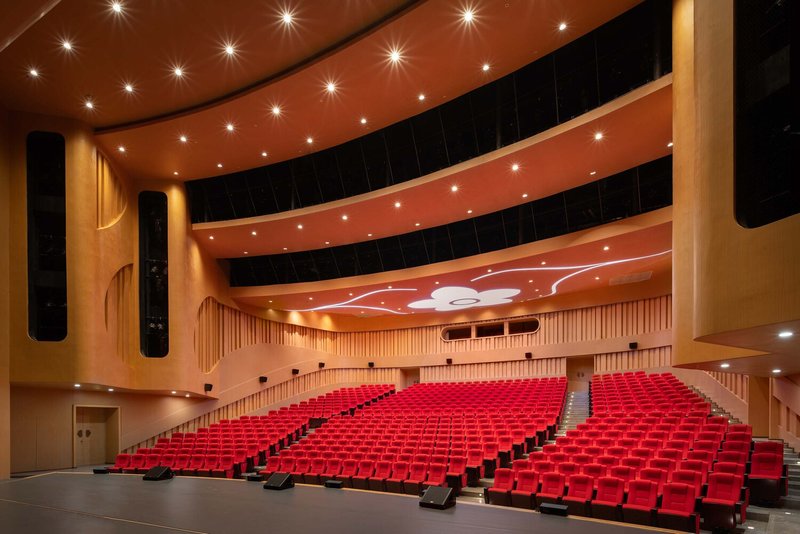
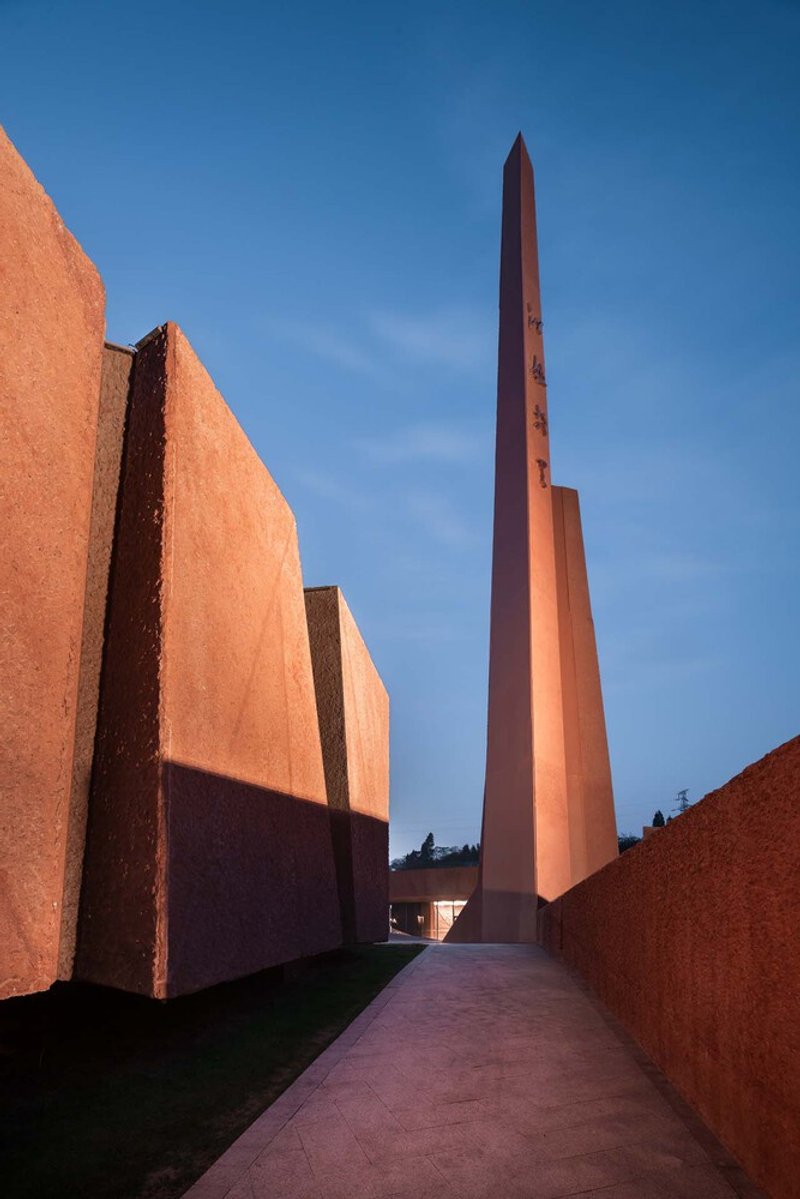
Spatial Experience and Form Expression
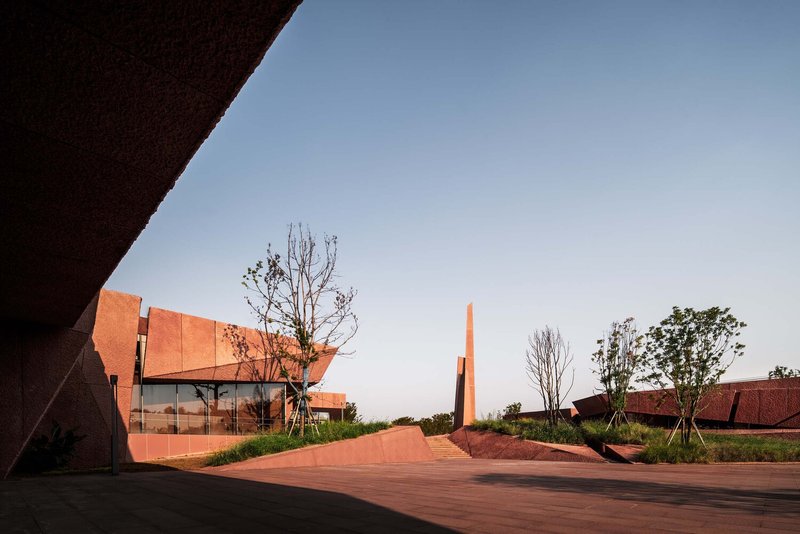
The building’s sculptural quality is achieved through volumetric segmentation, producing dynamic forms and natural voids. These gaps extend vertically, allowing light to penetrate deep into the interior. The resulting interplay of light and shadow creates an emotional and immersive environment, symbolizing the journey from darkness toward hope.
Contrasts between narrow transitional spaces and expansive plazas evoke the कठिन revolutionary path and the aspirational vision of the future. Pathways integrated into sloped volumes guide visitors seamlessly across different levels, reinforcing the narrative sequence.
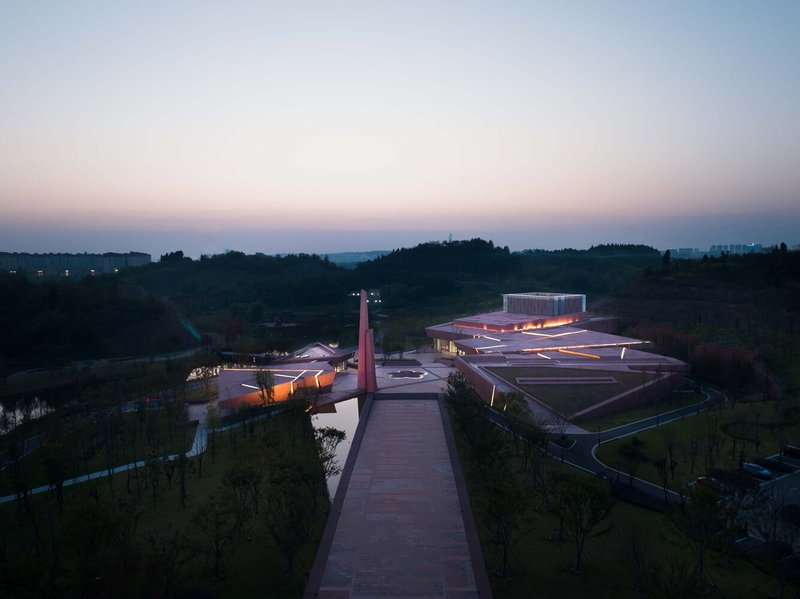
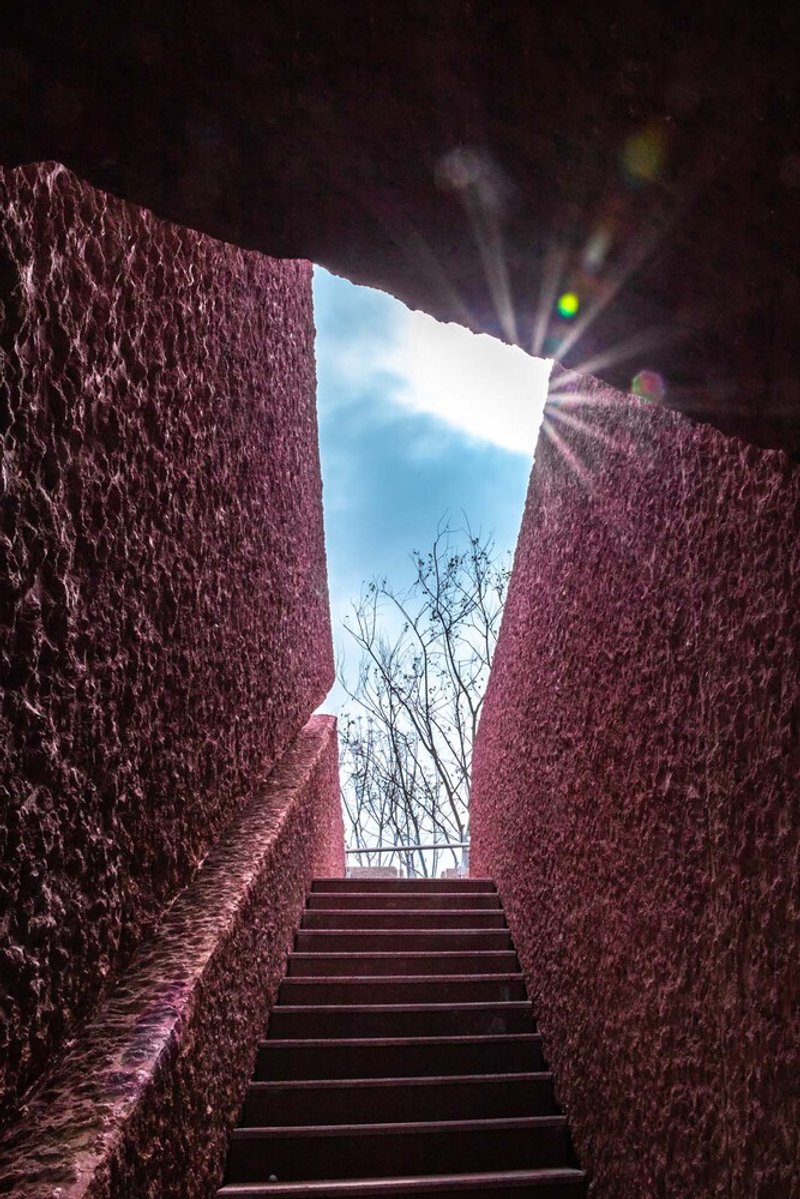
Materiality and Construction Innovation
The exterior is clad in GRC (Glass Fiber Reinforced Concrete) panels, carefully textured to evoke the rugged essence of red rock. Prefabrication techniques were employed to ensure precision, reduce construction time, and maintain consistency in surface quality.
A Living Memorial
Since its completion, the project has become a vibrant center for remembrance and education. Designed not only as a static monument but as an ակտիվ public space, it continuously hosts commemorative events and cultural activities. The architecture successfully translates ideological symbolism into spatial experience, creating a meaningful dialogue between history, landscape, and contemporary design.
All photographs are works of
404NF STUDIO




Popular Articles
Popular articles from the community

Fifth NRE Jazz Club – De Bever Architecten: Eindhoven’s Revitalized Cultural Hub
Historic gas factory transformed into Fifth NRE Jazz Club blending modern sustainability, jazz culture, dining, and heritage architecture seamlessly.
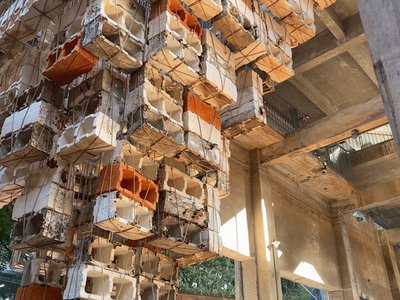
Inverted Architecture Installation by Studio Link-Arc: Exploring the Intersection of Architecture and Living Organisms
Inverted Architecture Installation by Studio Link-Arc blends mycelium, sustainability, inverted design, ecological cycles, and urban adaptive architecture in Shenzhen.
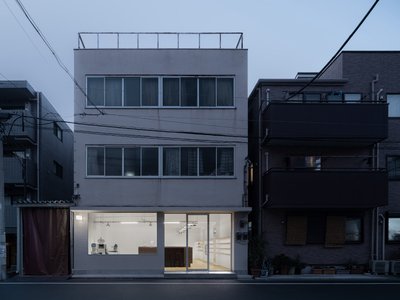
Atelier Macri Concept Store Interior Design by CASE-REAL
Atelier Macri store features a "ko" counter, walnut wood details, cork displays, blending retail, gallery, and seamless customer experiences.


The Ken Roberts Memorial Delineation Competition (Krob)
As the most senior architectural drawing competition currently in operation anywhere in the world, it draws hundreds of entries each year, awarding the very best submissions in a series of medium-based categories.


Similar Reads
You might also enjoy these articles


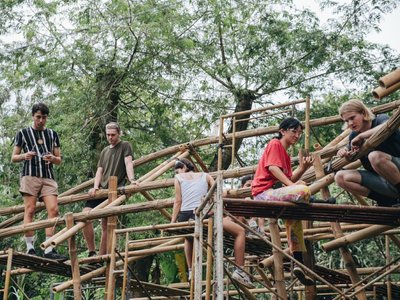
Bamboo Housing Challenge 2026: Design Affordable, Sustainable Homes Using Bamboo
An international design competition by Bamboo U and IBUKU inviting architects and designers to reimagine affordable housing using bamboo — with the winning design built full-scale in Bali.

Computational Design & Education: Beegraphy Design Awards Introduces 7th Category (Featuring Jiyun's Innovative Approach)
Dive into Beegraphy’s 7th Design Awards category, where computational design meets education to create immersive, interactive learning tools, inspired by Jiyun’s work.
From Parametric Lighting to Urban Furniture: Join the 2nd Workshop in Beegraphy’s Computational Design Series
Dive into Cutting-Edge Design Techniques and Practical Applications with Industry Experts

Explore Architecture Competitions
Discover active competitions in this discipline




The International Standard for Design Portfolios


The Global Benchmark for Architecture Dissertation Awards


The Global Benchmark for Graduation Excellence


Challenge to reimagine the Iron Throne
Comments (0)
Please login or sign up to add comments
No comments yet. Be the first to comment!