
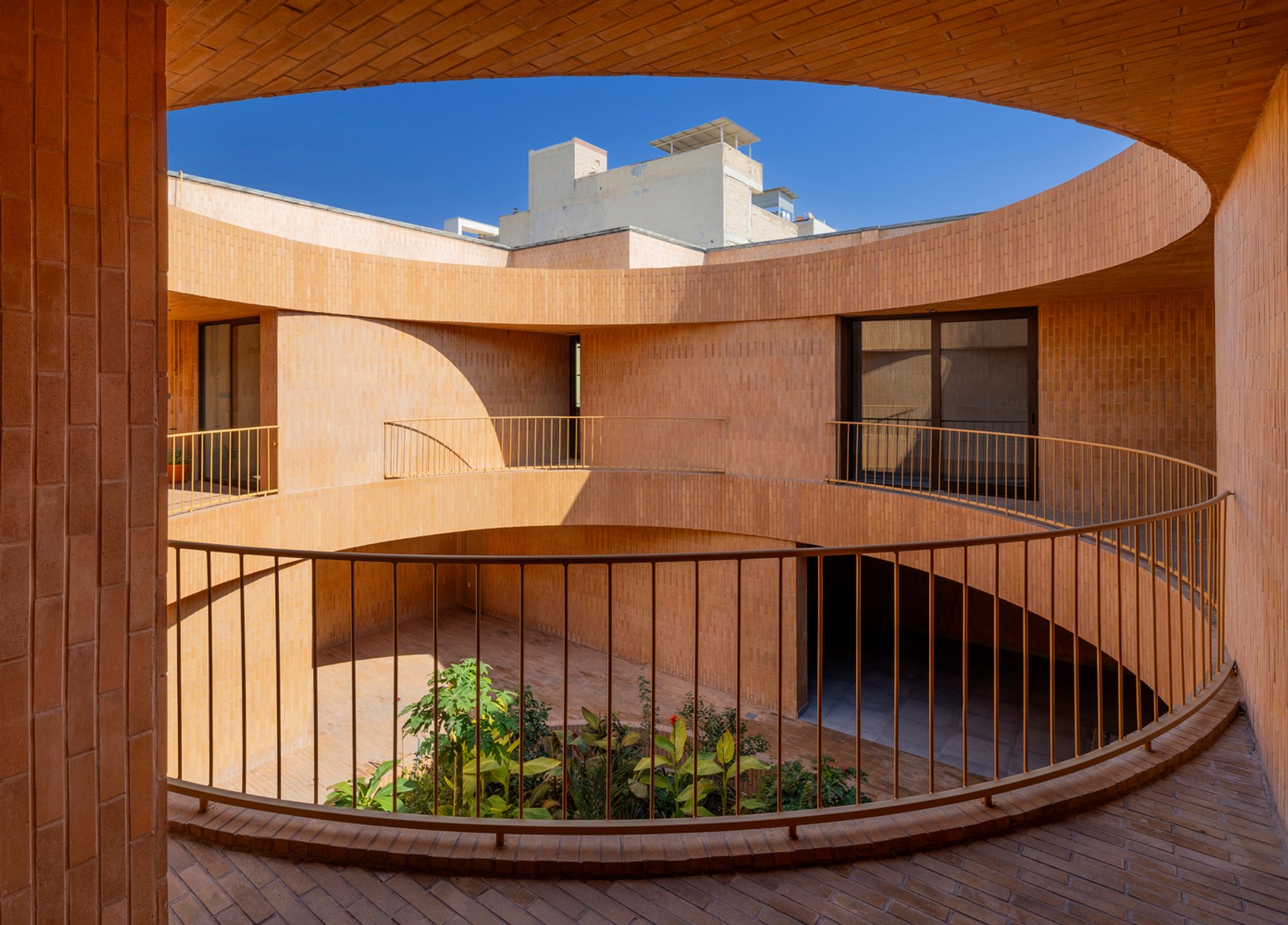
Rediscovering Tradition: The Dezful House and Its Central Courtyard Architecture
A modern reimagining of traditional Iranian courtyard homes, blending heritage-inspired design with sustainable, climate-responsive architecture in Dezful, Iran.

Iranian courtyard houses were designed for a very specific problem. The summer is hot. The privacy rules are strict. The plot is narrow. The street is dusty. The answer, developed over centuries, was to turn the house inward around a shaded garden and keep the exterior almost blank. The Dezful House, designed by Mohsen Kazemianfard and Parima Jahangard of Fundamental Approach Architects, takes that same logic and applies it to a 420 m² single-family home at the end of a narrow alley in Dezful, Iran.
Completed in 2024, the project is a contemporary interpretation of the Persian courtyard house, with one important update: the courtyard is circular. That single geometric decision changes almost everything about how the rooms meet the sky, how the shade moves across the brick, and how ventilation loops through the plan. Published on uni.xyz, the project is one of the clearest recent arguments that traditional typologies can still produce new architecture if you take them seriously.
The Brief: A Narrow Plot in a Dense City
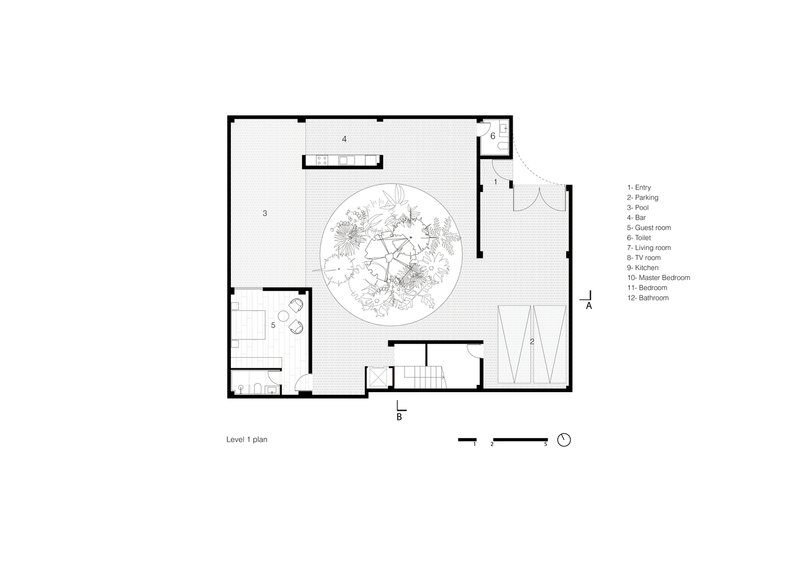
The ground floor plan is the project's most informative drawing. A rectangular site sits at the end of a narrow alley, surrounded by neighbours. At the centre, a perfectly circular courtyard is carved out of the plan. Around it: entry, parking, pool, bar, guest room, living room, TV room, and kitchen. Every habitable space faces the courtyard. Nothing important faces the street. This is the Persian courtyard logic in its most concentrated form.
The circular courtyard is the key move. A square or rectangular courtyard works fine, and most historic examples are exactly that. But the circle removes corners, distributes shade evenly throughout the day, and gives the plan a centre of gravity that a rectangle cannot. It also makes every room slightly different, because every room meets the courtyard at a different tangent. Same typology, new geometry.
The Courtyard: A Circle Carved Through the House
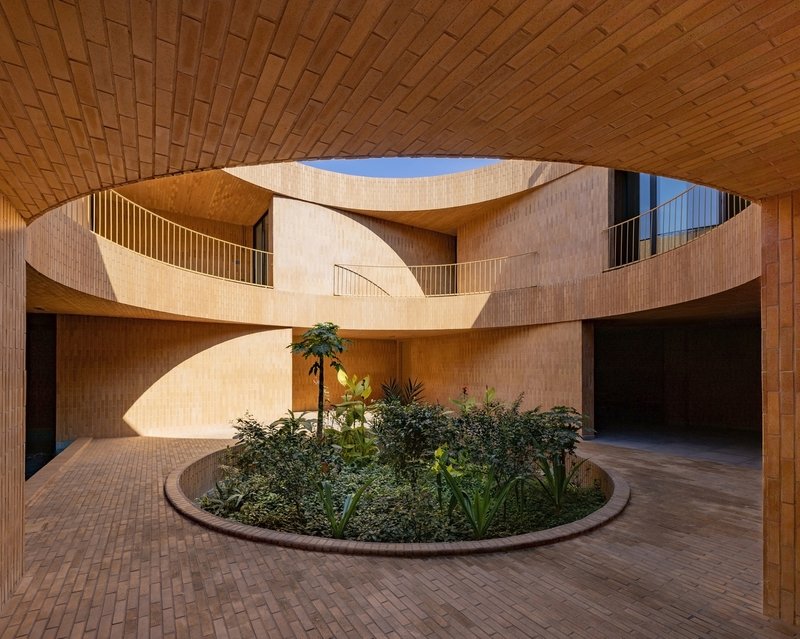
The ground-level courtyard photograph shows the result. A circular void rises through the full height of the house. Warm geometric brick lines the walls. A raised planter at the base holds palms, ferns, and flowering shrubs. An upper balcony curves overhead. The effect is half Persian riwaq, half rotunda. You look up and see sky and brick and leaves, all framed by the same circle.
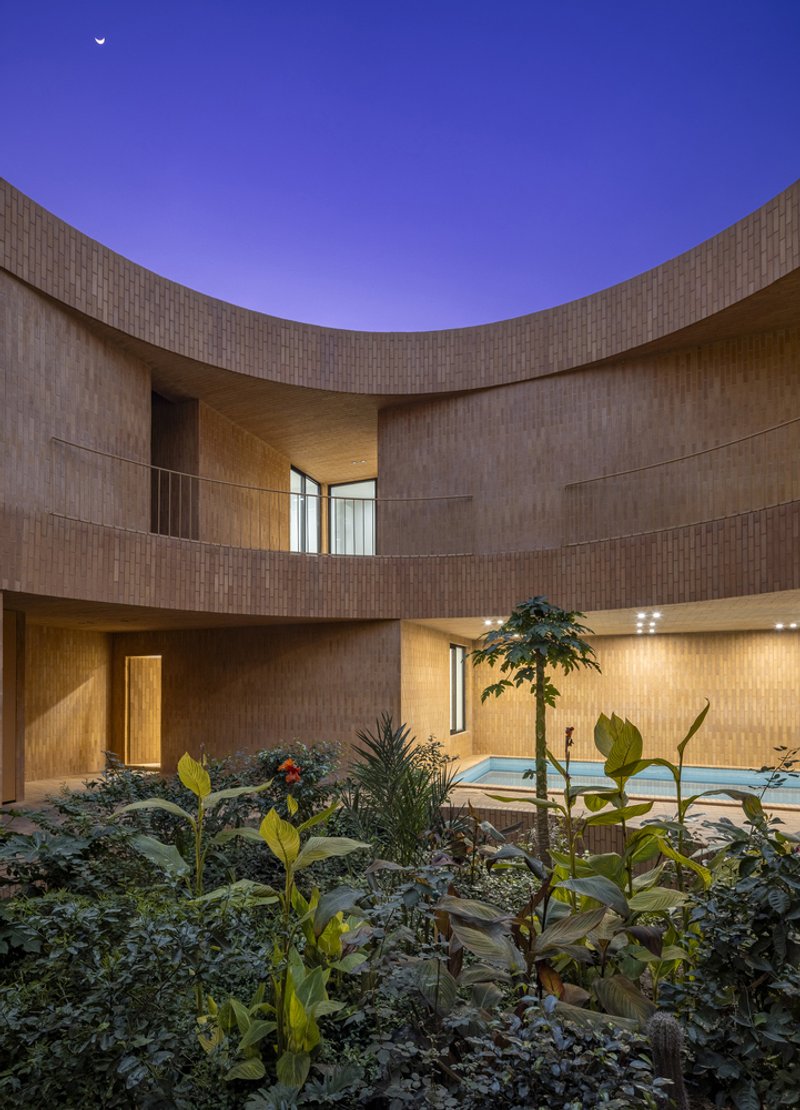
The dusk photograph is the most atmospheric. At sunset, the interior rooms glow warmly against a deep purple sky. The courtyard planting fills the base. The curved brick wall becomes a frame for the garden rather than a wall around it. The composition reads like a restored Safavid courtyard rendered in fair-faced brick, and that historical echo is the project's deliberate ambition.
The Edge: Curved Verandas and a Pool
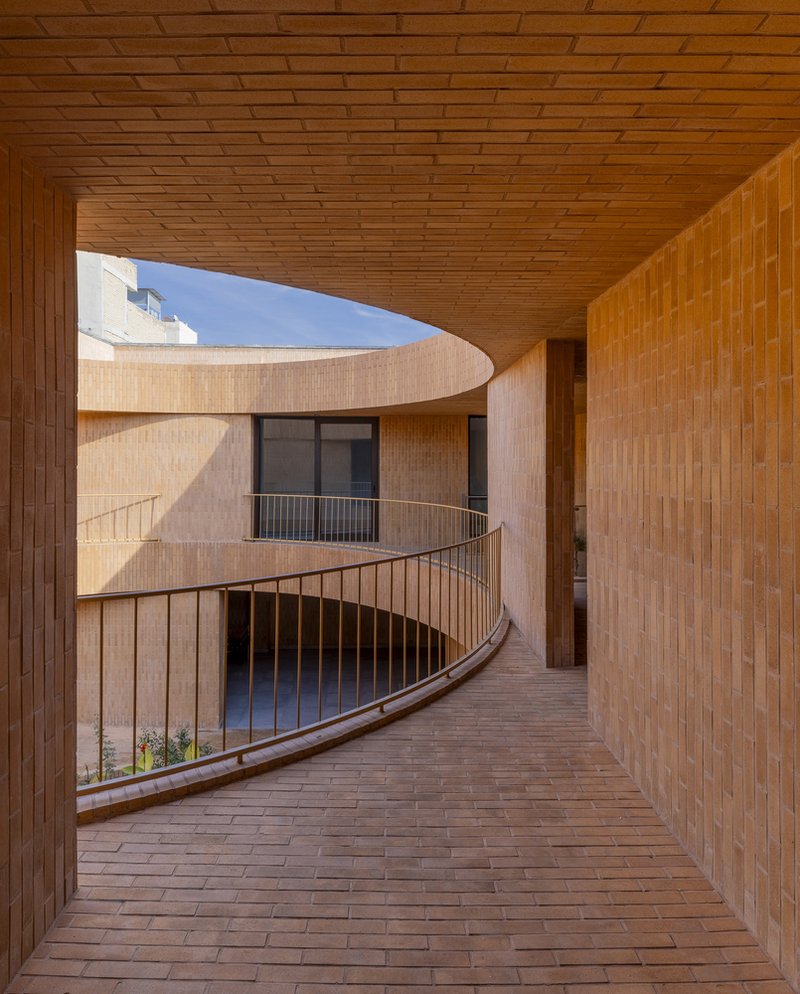
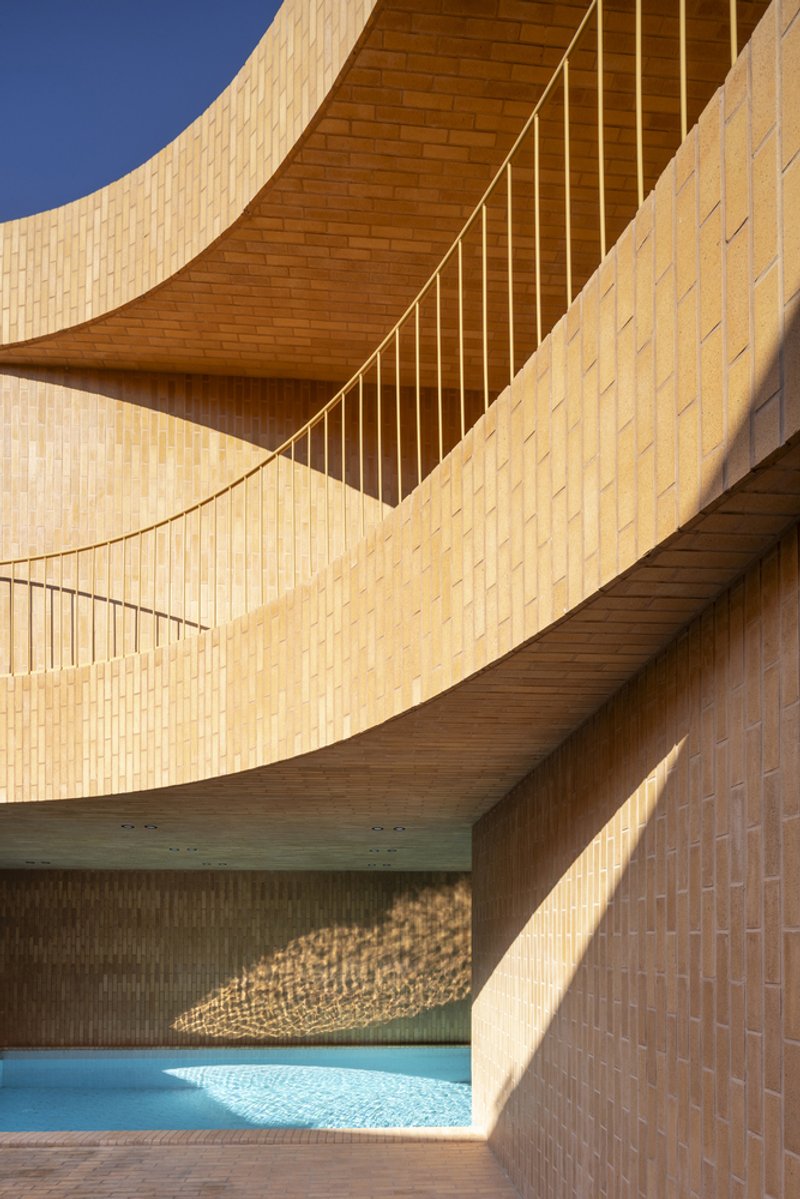
The veranda photograph shows how the project handles the transition between inside and out. A curved brick passage follows the edge of the courtyard, deep enough to stay in shade through the hottest hours. The opening above is wide enough to catch sky and air. The veranda is the Iranian eyvan reinterpreted: a semi-open room that mediates between the private interior and the central void.
Below the cantilevered upper floor, a lap pool runs along one edge of the courtyard and ends at a sculptural log feature. The water does visible cooling work in the hot semi-arid climate: the evaporation from the pool draws air across the courtyard and into the surrounding rooms. The log is decorative and functional at once, a reminder that the courtyard is an ecosystem as much as a room.
The Interior: Timber, Tile, and Brick
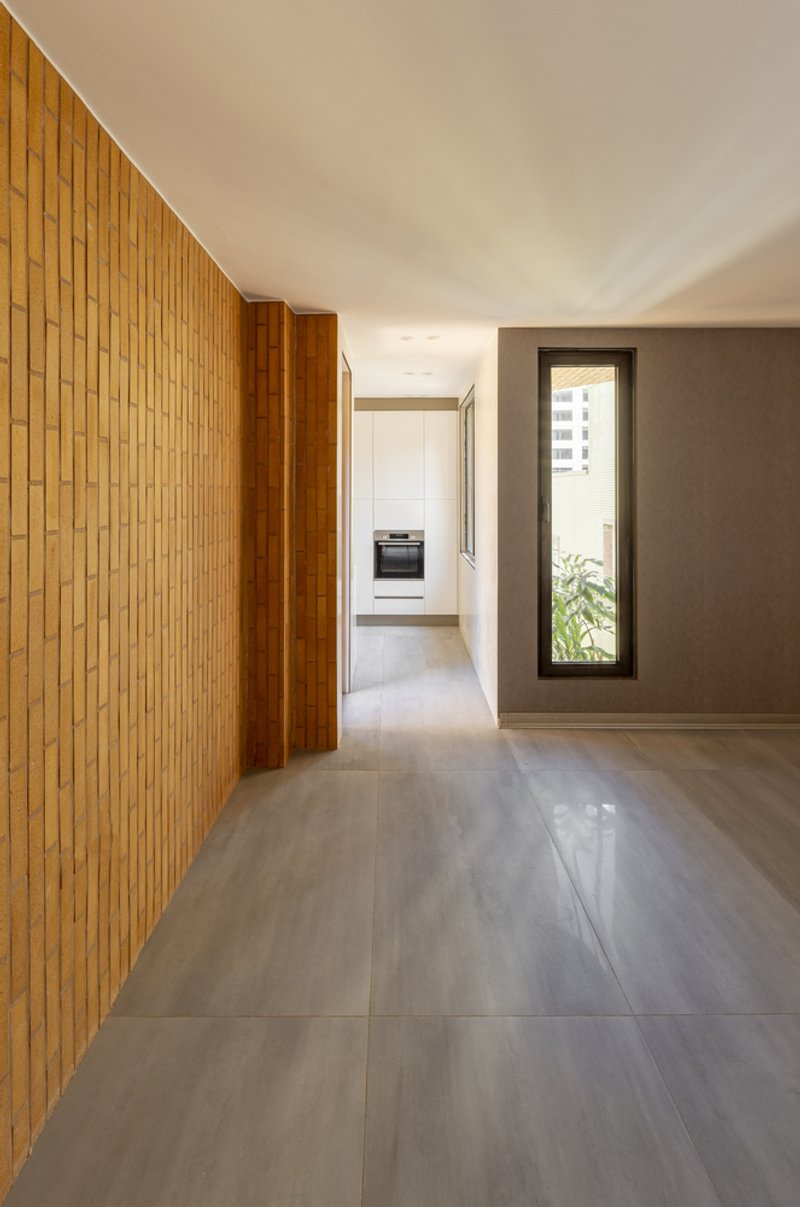
The interior hallway shows the project's material restraint. A timber slat wall on one side, grey tile floor, a tall window framing the next room. The palette is warm, calm, and tight. There are no decorative flourishes. The walls are doing most of the work by not asking for attention, which is exactly what a courtyard house needs them to do. The courtyard is the event. The rooms are the frame.
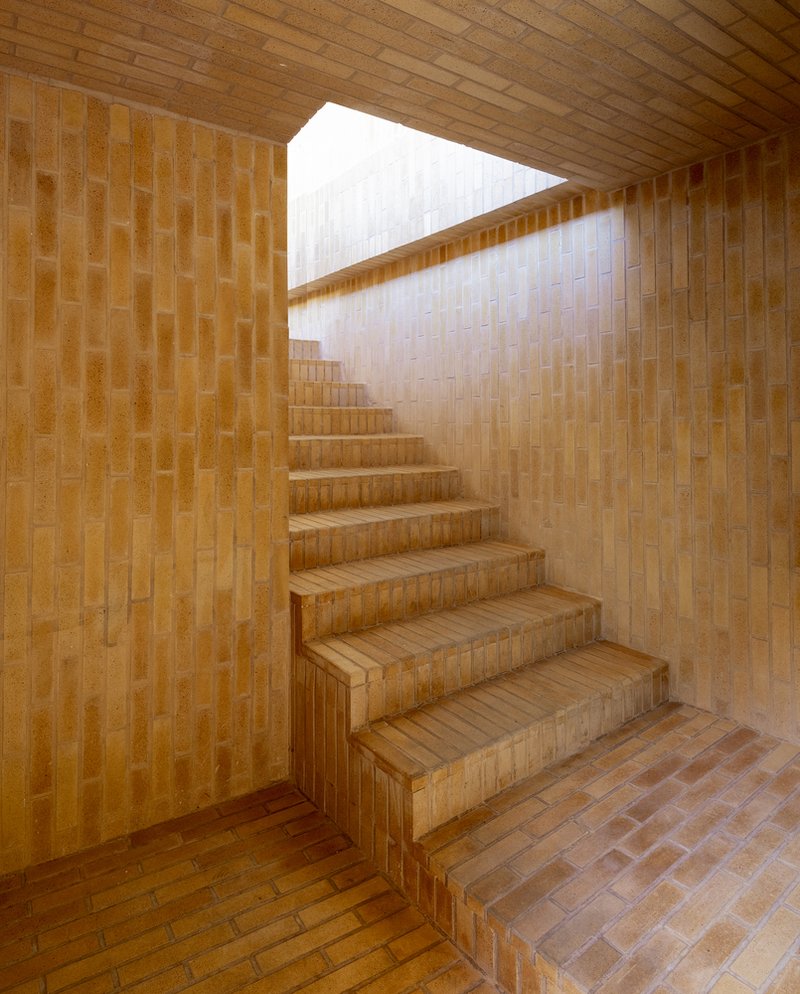
The brick staircase is the project's most quietly confident detail. The stair rises inside a shaft of warm geometric brick with soft light entering from above. The brick is laid tightly and consistently. The shadows deepen at each step. Nothing is overdesigned. This is the kind of interior that survives because it is restrained: small changes over time, a family's life, will not erode the architecture because the architecture does not depend on any single decorative element.
The Climate: Cross-Ventilation Diagrammed
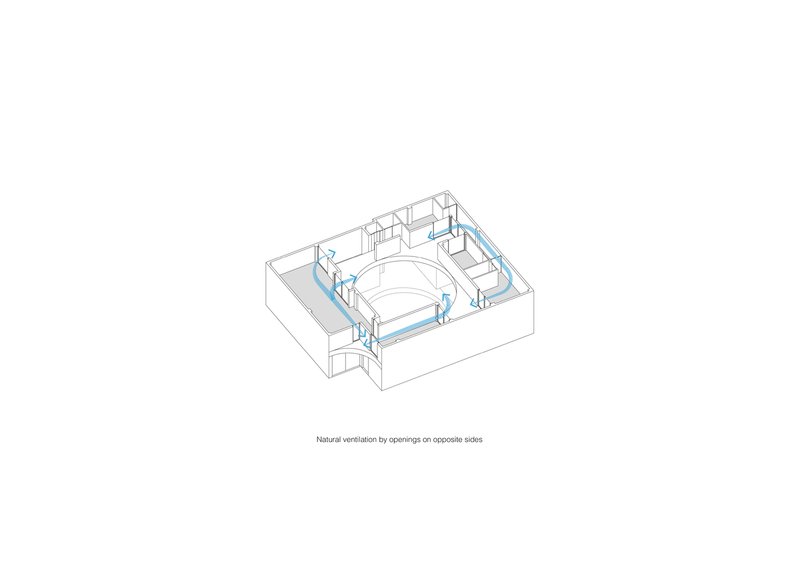
The ventilation diagram is the technical proof of the project. An axonometric shows the house as a simple rectangular volume with the circular courtyard carved from its centre. Blue arrows trace cross-ventilation paths: air enters through openings on one side, passes through the rooms, loops around the courtyard, and exits through openings on the opposite side. No mechanical system is shown. The plan is the cooling strategy.
This is what traditional Iranian courtyard houses always did, and the diagram is the reason the typology still works today. In Dezful's hot semi-arid climate, cross-ventilation through a shaded courtyard with a water feature is still the cheapest, quietest, and most reliable way to cool a house. The circular courtyard, because it has no stagnant corners, improves the airflow pattern over a rectangular one. The geometry and the climate strategy are the same decision.
Why This Project Matters
Most contemporary takes on traditional typologies fall into one of two traps. They either copy the historic form without its climate logic, or they keep the logic but strip out the cultural language. The Dezful House does neither. The circular courtyard is a new geometry, but it performs the same cultural and environmental work as the historic rectangular ones. The brick is a material choice that reads as Iranian without any decorative quoting. The passive cooling system is drawn as carefully as the brick coursing.
For anyone studying Iranian courtyard architecture, vernacular typology revival, or passive cooling in hot semi-arid climates, the Dezful House is a useful reference. It proves that a typology is not the same as a style. You can update the geometry, the materials, and the construction methods and still be faithful to the typology if you protect the ideas that made the typology necessary in the first place: privacy, shade, family life, and the courtyard as the centre of gravity.
View the Full Project
About the Architects
Architects: Mohsen Kazemianfard and Parima Jahangard, Fundamental Approach Architects
Location: Dezful, Iran · Area: 420 m² · Completed: 2024
Photography: Parham Taghioff
Enter a Design Competition on uni.xyz
If courtyard typologies, regional architecture, or passive cooling design is the kind of work you want to pursue, uni.xyz runs competitions year-round that reward projects grounded in climate, culture, and craft.
Project credits: The Dezful House by Fundamental Approach Architects. Photographs by Parham Taghioff.




Popular Articles
Popular articles from the community

VEIVE Architects Builds a Mountain Hostel That Disappears into a Hangzhou Hillside
On the Huihang Ancient Trail in Xiangjian Village, a shelter of wood, steel, and rammed earth roots itself in the rural landscape.
BAUEN Builds Two Rammed Earth Volumes in Paraguay Inspired by the Ovenbird's Nest
In San Bernardino, a house of compacted earth channels the instinct of a constructive bird to shelter life from the Paraguayan summer.
Johnston Architects Reimagines the Methow Valley Hay Barn as a Small-Town Library in Winthrop
A 7,300-square-foot timber library channels the region's agrarian vernacular to serve a rural Washington community of 400 year-round residents.
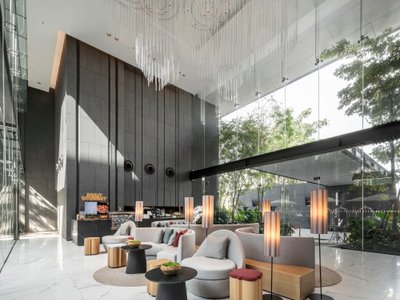
IDIN Architects Wraps a Hua Hin Hotel Around a Private Courtyard to Escape the City
Dusit D2 Hua Hin turns an urban infill site in Thailand's family vacation heartland into a self-contained resort through courtyard planning.


Similar Reads
You might also enjoy these articles

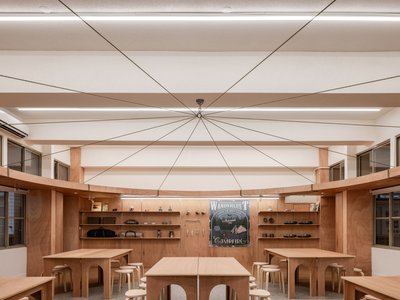
317studio Turns an 87 m² Classroom into a Forest Clearing for Scouts in New Taipei City
A rope canopy, student-made specimens, and campfire geometry replace rows of desks in this Scouting classroom in Xizhi District.
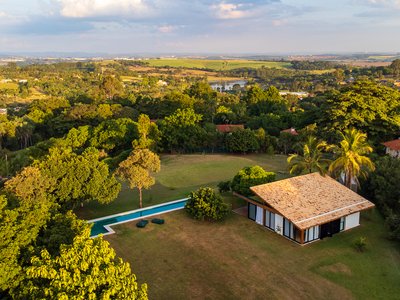
24 7 Arquitetura Builds a Timber Pavilion as a Family's First Act on a 5,000 m² Brazilian Plot
In Jaguariúna, a prefabricated glulam house nestles among mature trees as the opening move of a larger residential masterplan.
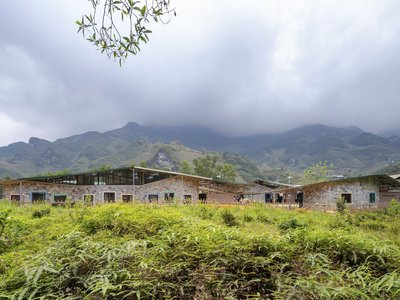
1+1>2 Architects Build a School from 900 Blocks of Hmong Stone on Vietnam's Rocky Plateau
On a barren valley in Ha Giang province, a community quarried its own stone to raise a kindergarten and primary school rooted in Hmong identity.
100A Associates Builds a Volcanic Stone Retreat on Jeju Island Rooted in Ritual and Restraint
Watarstay [Wa:Tar] in Bongseong-ri channels Jeju's basalt, reed, and hemp into a 150 m² hospitality space shaped by contemplation.


Explore Architecture Competitions
Discover active competitions in this discipline




The International Standard for Design Portfolios


The Global Benchmark for Architecture Dissertation Awards


The Global Benchmark for Graduation Excellence


Challenge to reimagine the Iron Throne
Comments (0)
Please login or sign up to add comments
No comments yet. Be the first to comment!