
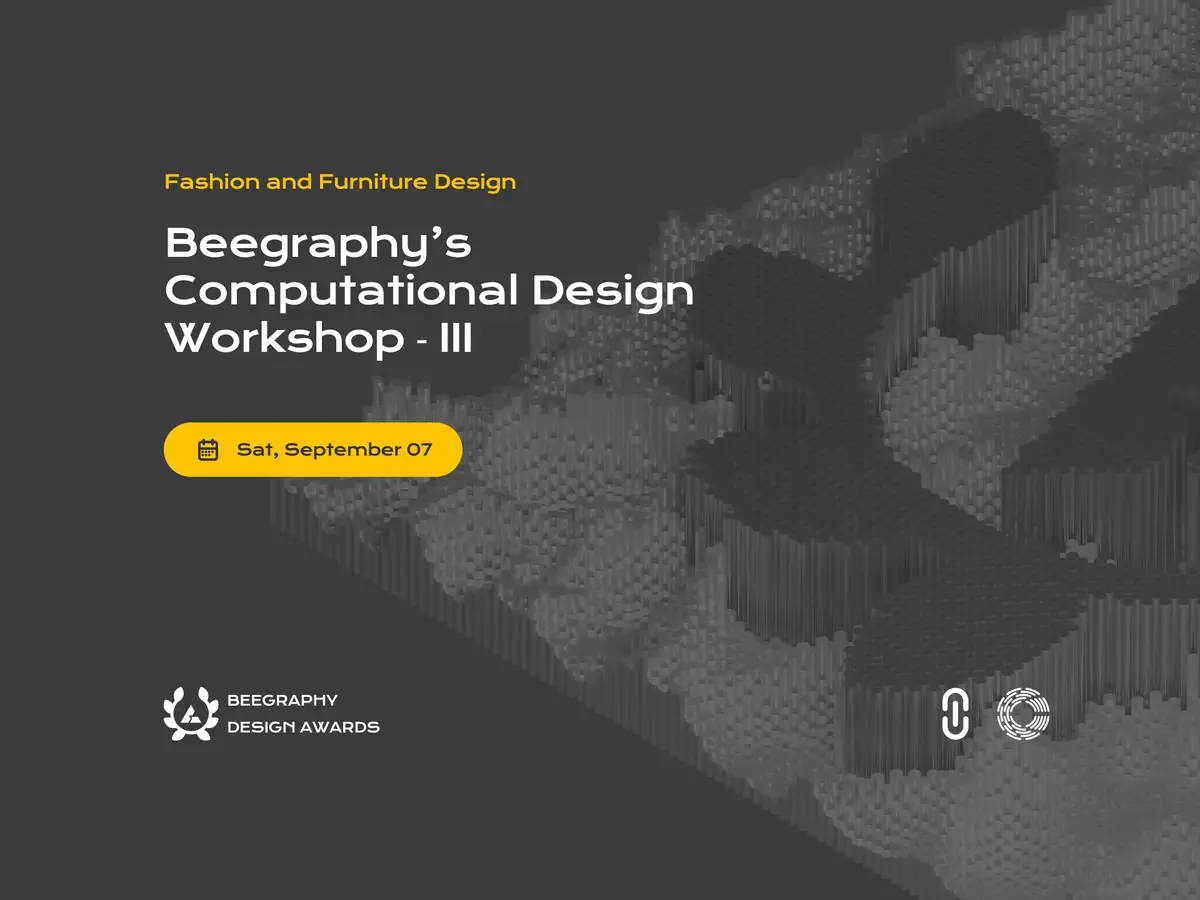
Reimagining Creativity with Beegraphy: Join Us for Workshop 3
Explore the potential of parametric design in fashion, furniture, and education at Workshop 3 by Beegraphy. Join us on 7th September, 12:00 PM GMT. Register now!


We are excited to announce Workshop 3, where we continue to explore the vast possibilities of parametric design with Beegraphy. This workshop focuses on the innovative application of computational design in fashion, furniture, and education. Whether you’re a designer, educator, or just curious about the intersection of technology and creativity, Workshop 3 offers insights and skills to elevate your projects to the next level.
Workshop 3 Overview
Part A: Fashion & Jewelry
Step into the future of fashion with our session on computational design for fashion and jewelry. This session will demonstrate how parametric design can transcend traditional methods, enabling the creation of bespoke accessories and garments that are more intricate, bold, and personalized. Here’s what we’ll cover:
- Breaking Down Forms for Parametric Logic: Learn how to deconstruct fashion and jewelry designs into their parametric elements to unlock endless possibilities for customization.
- Creating Variations and Repetitions of Patterns: Discover how to generate and manipulate patterns, allowing for dynamic and unique design iterations.
- Understanding Fabrication's Influence on Form: Explore how different fabrication techniques, from 3D printing to laser cutting, impact the design and how to adapt your concepts accordingly.
- Applying Fabrication Logic and Preparing for Printing: Master the process of applying fabrication logic to your designs and preparing them for production, ensuring that your creations are both stunning and feasible.
Example Use Case: Imagine creating a custom, intricately patterned fashion piece that adjusts to the wearer’s preferences in real-time. Parametric design allows you to effortlessly generate variations, ensuring each piece is as unique as its wearer.
Part B: Furniture & Home Furnishing
Embrace the third wave of furniture design, where computation meets craftsmanship. This session will guide you through the process of creating stunning, personalized furniture and home furnishings that cater to individual tastes and spatial constraints. We’ll cover:
- Understanding Computational Potential in Furnishing: Discover what can be achieved through computational design in the realm of furniture and home decor.
- Logic Building for Form Creation: Learn how to develop the logic behind intricate forms, enabling you to create designs that are both functional and aesthetically pleasing.
- Exploring Fabrication’s Impact on Design: Understand how different fabrication methods influence the final form and structure of your furniture, from modular designs to complex joinery.
- Innovating in Joinery, Modularity, and Customization: Explore fresh approaches to joinery, modularity, and customization, making your designs adaptable and tailored to specific needs.
Example Use Case: Picture designing a customizable furniture unit that adapts to different spaces and styles. With parametric design, you can create a system that easily adjusts in size, configuration, and aesthetic, offering endless possibilities for customization.
Part C: Education
Discover how computational design can revolutionize the educational experience by making learning more interactive and engaging. This session will show you how to leverage parametric principles to simplify complex concepts and create compelling educational modules. We’ll explore:
- Introduction to Computational Design for Education: Get an overview of how computational design can be applied to educational settings, enhancing both teaching and learning experiences.
- Strategies for Interactive Learning Experiences: Learn techniques to create interactive, engaging educational content that captivates and educates simultaneously.
- Simplifying Complex Concepts with Computational Tools: Understand how to use computational tools to break down complex ideas into manageable, understandable parts.
- Case Studies Demonstrating Impact: Review real-world examples of how computational design has transformed educational outcomes, offering inspiration and insights for your projects.
- Practical Exercises in Designing Educational Modules: Put theory into practice by designing your own educational modules using parametric principles, preparing you to innovate in the classroom.
Example Use Case: Explore the concept connecting Earth and Sun, geometric positioning and tracing the sunpath. Parametric design makes this possible, creating an engaging and educational experience that brings abstract concepts to life.
Join Us for Workshop 3
Don’t miss out on the opportunity to explore the creative potential of computational design in fashion, furniture, and education. Workshop 3 offers a deep dive into practical applications, hands-on learning, and innovative thinking.
Date & Time: 7th September 2024 at 12:00 PM GMT
Google Meet Link: Join the Workshop
Add to Calendar: Add this and future workshop to Your Calendar
We can’t wait to see you there!


Popular Articles
Popular articles from the community


Opera on the Sea: Driftwood Logic Shapes a Timber Opera House on Estonia's Coast
Trevor Orgill's opera house translates the entangled drift of floating timber into a civic building where wood, water, and music converge.

Cloaked Colonization: A Mobile Underwater Habitat That Moves Like a Fish
Micah Abaya's shortlisted EHC Pacific entry reimagines ocean settlement as a dispersed network of self-sustaining architectural organisms.

The Amber Palace Opera: A Geological Fiction Surfaces on Tallinn's Baltic Waterfront
Pierre Brillard reimagines a Baltic legend as a public landscape, opera house, and waterfront promenade rooted in Tallinn's coastal identity.

Tsunami Convergenics: Turning Catastrophic Ocean Forces into Underwater Housing Infrastructure
A speculative underwater settlement off the coast of Onagawa, Japan, treats tsunamis and typhoons as energy sources rather than threats.

Similar Reads
You might also enjoy these articles

Day and Night Park: A Time-Based Urban Newsstand in Beijing
A temporary urban newsstand in Beijing blending travel, light, and reading through poetic colors, compact form, and community-focused design.

Modernist Patio Renovation in El Masnou, Barcelona by Oliver Segura Arquitectura + Cebrià Arquitectura
Modernist patio renovation blending tradition and innovation with a movable pool, leveled floors, and Catalan materials in El Masnou.

Alto Residencial Coop: Cooperative Housing Development in Santiago de Compostela by Carbajo Barrios Arquitectos
A linear cooperative housing complex blending white volumes and perforated metal façades, enhancing community living, natural light, privacy, and urban integration.
Vil Genis School by BPA ARCHITECTURE – Massy, France
Vil Genis School in Massy, France, features sustainable design, south-facing classrooms, community integration, accessible spaces, and modern educational architecture.


Comments (0)
Please login or sign up to add comments
No comments yet. Be the first to comment!