

A 14-Year Dialogue Built in Timber and Trust
Rosenbaum's Sacred Yawanawa Village in the Brazilian Amazon is architecture as cultural reciprocity, not imposition.


Deep in the Tarauacá river basin of Acre state, where the Brazilian Amazon folds into itself in an unbroken canopy, a building compound has emerged that refuses every convention of humanitarian architecture. The Sacred Yawanawa Village, designed by São Paulo studio Rosenbaum, is the product of 14 years of sustained collaboration with the Yawanawa people. That timeline alone is worth pausing on. In an industry addicted to speed and spectacle, the idea that a design practice would embed itself in a relationship measured in decades rather than deadlines tells you something about the ambition here.
What makes the project genuinely significant is not its remoteness or its eco credentials, though both are remarkable. It is the fact that the architecture reads as indigenous authorship mediated through technical expertise, rather than the other way around. At 358 square meters, the built area is modest. But the drawings, the structural ingenuity, and the spatial choreography reveal a project that treats an Amazonian community's spatial intelligence as the primary design driver.
Roofscape as Cultural Signature

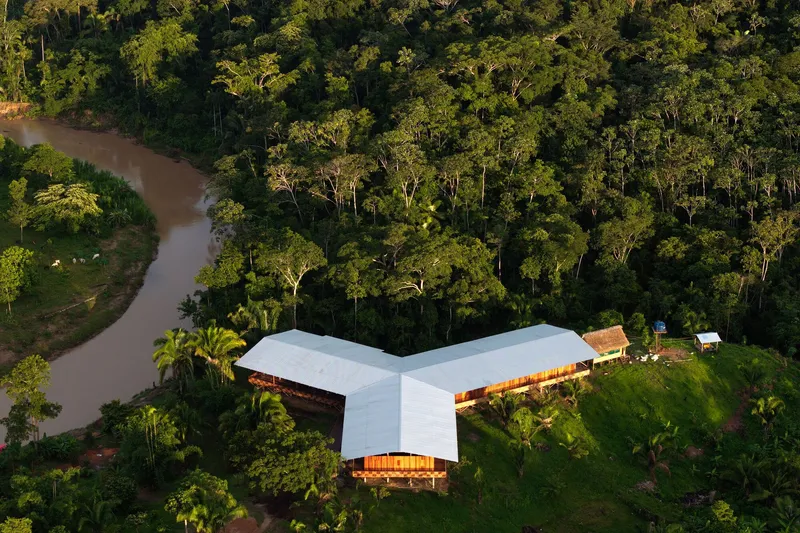

From above, the compound's roofline is its most legible gesture. The primary structure reads as a butterfly or tri-winged form: wide metallic planes that float over timber volumes below. These roofs are not decorative. They are climatic machines, calibrated for a site that receives torrential rain and relentless equatorial sun. The cantilevers extend well beyond the walls, creating deep shade and protecting the open corridors from downpours while allowing air to move freely beneath.
The aerial views show how the compound sits in relation to the river, not dominating the bank but settling alongside it. Scattered pavilions extend the settlement pattern rather than consolidating into a single monolithic volume. The effect is closer to a village than a building, which is, of course, entirely the point.
The Radial Heart


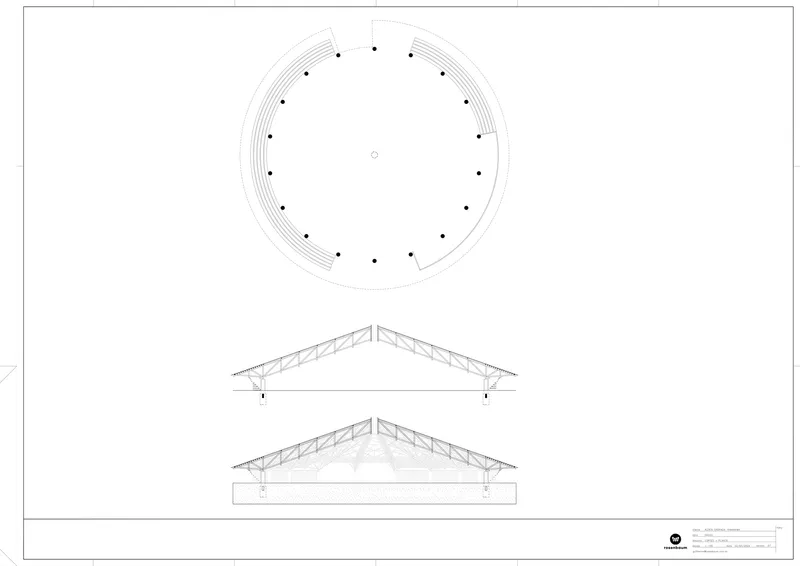
The circular structure at the center of the compound is the project's spiritual and geometric anchor. Looking up into it reveals a radial timber roof framework with a central oculus, the kind of detail that collapses the distance between sacred architecture and structural engineering. Woven bamboo ceiling panels fill the bays between ribs, filtering light and referencing indigenous craft techniques without reducing them to ornament.
At ground level, the interiors confirm the logic. Hammocks slung between timber walls, exposed structural frames opening directly to vegetation: these are not romanticized images of "primitive" living. They are precise spatial arrangements that acknowledge how the Yawanawa actually inhabit space, with the forest not as backdrop but as participant.
Timber Screens and the In-Between
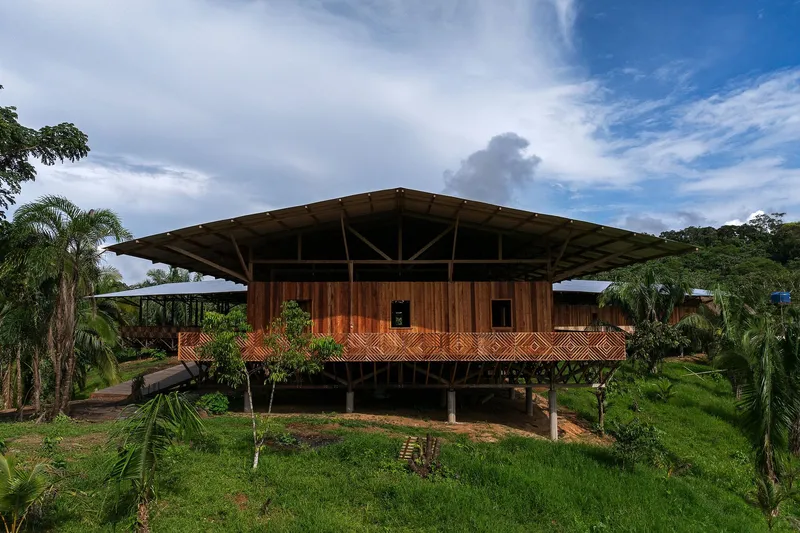
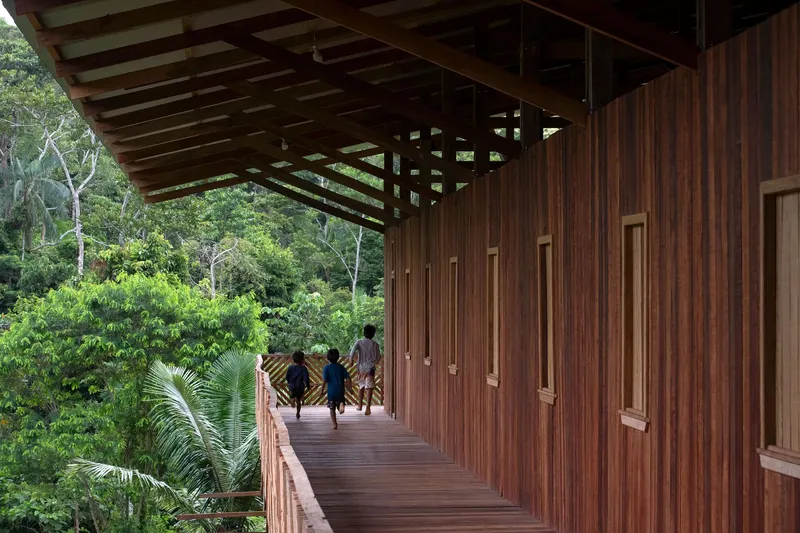

Rosenbaum's handling of the building's edges is where the design thinking becomes most articulate. Patterned timber balustrades wrap the corridors and elevated walkways, creating a zone that is neither inside nor outside. The geometric patterns cut into the railings are drawn from Yawanawa graphic traditions, but they are executed at an architectural scale that transforms them from surface decoration into spatial filters. Light, air, and sightlines all pass through these screens differently depending on the time of day and the angle of approach.
The front elevation captures this strategy clearly: a cantilevered roof hovers over timber cladding and patterned balustrade, with palm trees flanking the entrance as if they were always part of the composition. Children running through the dappled light of covered corridors confirm that the architecture works at the scale of daily life, not just the photographer's lens.
Framing the Forest
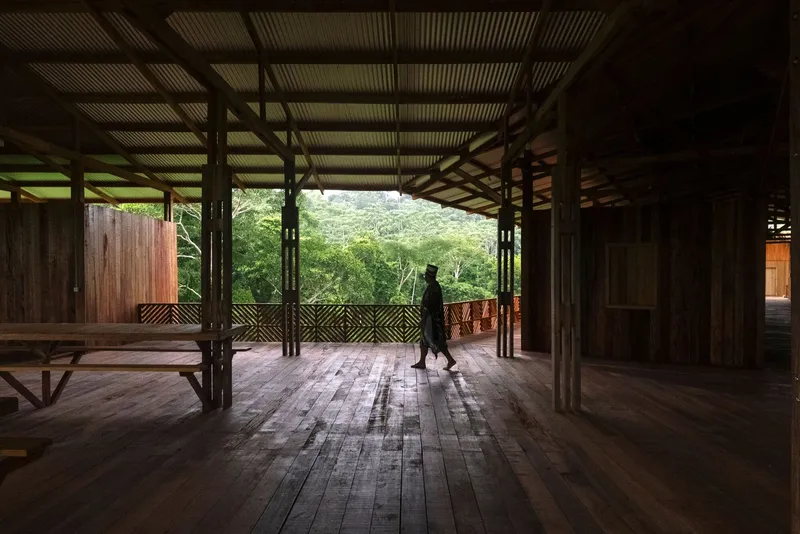

The covered walkways and elevated decks function as framing devices. Every corridor terminates in a view of vegetation or river. This is not coincidental. The architecture consistently positions the surrounding landscape as the primary visual content, with the built fabric serving as a disciplined frame. Exposed timber beams and columns create a rhythmic progression along these paths, and the overcast Amazonian sky diffuses light evenly across the timber surfaces.
Four silhouetted figures standing at a geometric balustrade, gazing at a dense tropical hillside: that single image encapsulates the project's spatial proposition. The building exists to organize the relationship between people and forest, not to compete with it.
Structural Clarity
The structural system is legible everywhere you look. Slender columns, diagonal bracing, exposed trusses: nothing is hidden behind finishes, and nothing needs to be. The honesty of the construction serves a practical purpose in a location where maintenance must be straightforward and materials sourced locally. But it also serves a cultural one. The Yawanawa build with an understanding of structure that is inherently transparent. Concealing the bones of a building behind plasterboard would have been a foreign imposition.
Plans and Drawings
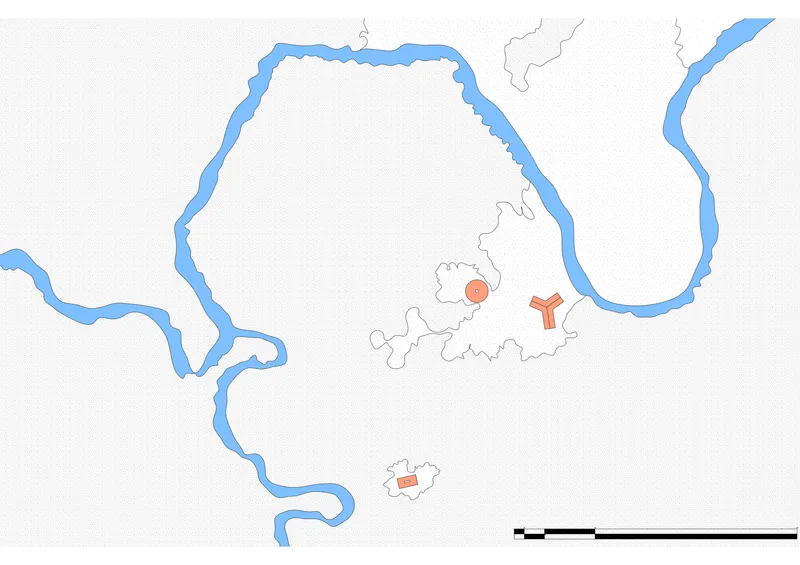

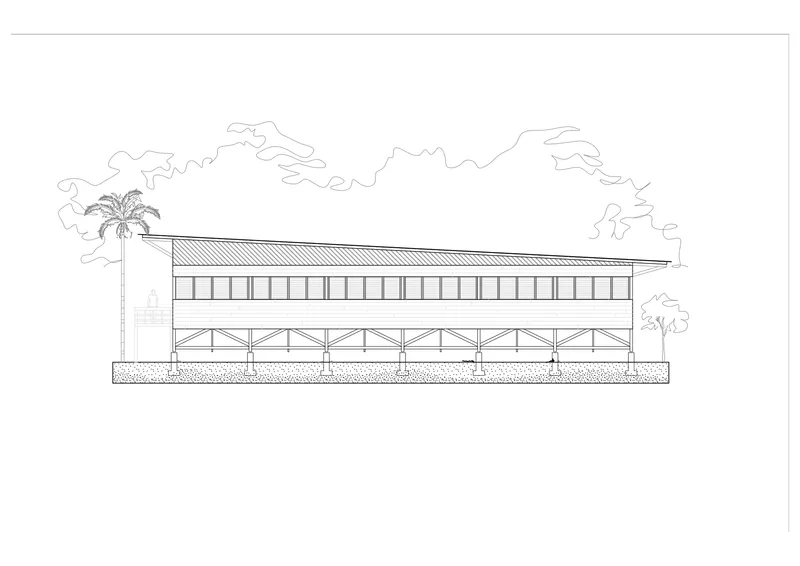



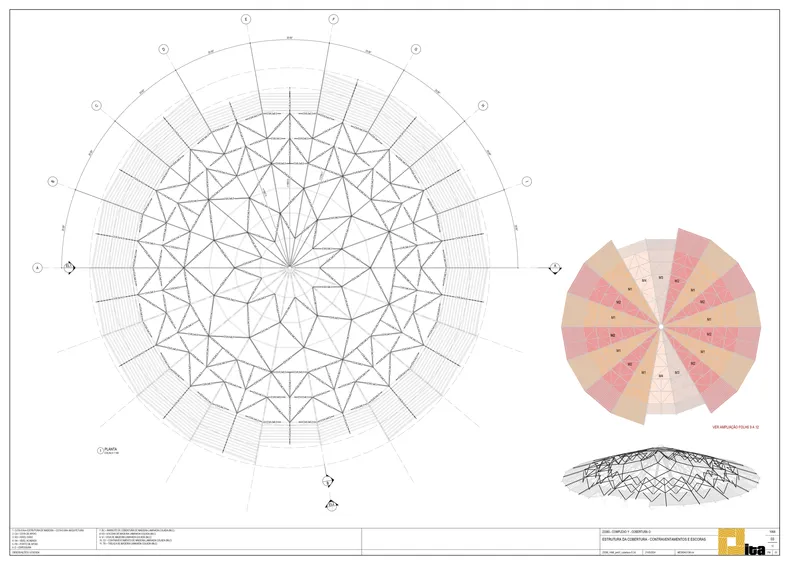
The drawing set reveals the full scope of the design intelligence at work. The site plan shows how the compound negotiates a meandering river and its tributaries, orienting buildings to catch prevailing breezes while maintaining proximity to the water. Floor plans depict a rectangular layout organized around a central gathering space, with perimeter sleeping rooms arranged for cross-ventilation and communal life.
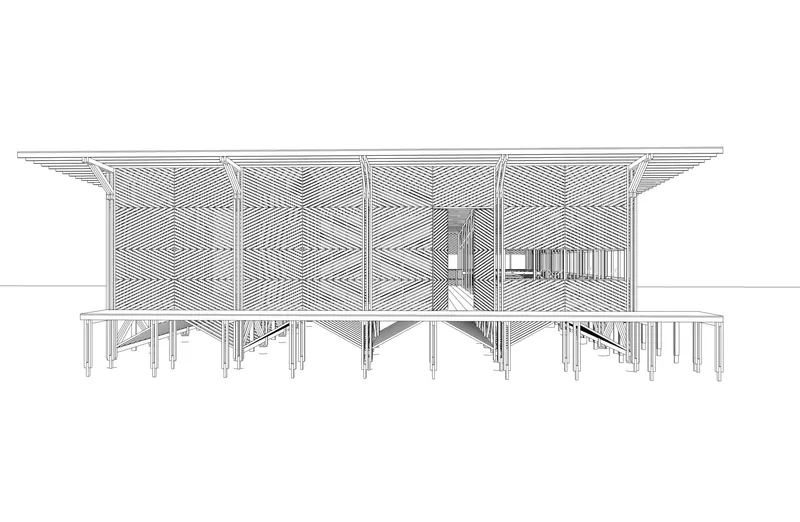
The exploded axonometric is particularly instructive, breaking the assembly into discrete layers: roof plane, ceiling slats, trusses, columns, and floor slab. Each layer is legible as an independent system, and the drawing makes clear how they interlock without requiring complex joinery or imported fasteners. The circular structure's radial geometry, shown in plan and section, uses triangulated trusses to achieve a wide clear span with minimal material, an elegant resolution of the tension between communal scale and structural efficiency.
Sections through the linear pavilions reveal how the sheltering roof creates distinct interior volumes, a generous gathering hall beneath the highest point of the truss, and more intimate spaces at the perimeter where the roof slopes down. The elevation drawings of patterned timber screen panels above slender colonnades read almost like textile designs translated into architecture, reinforcing the project's commitment to Yawanawa visual culture at every scale.
Why This Project Matters
The Sacred Yawanawa Village stands as a corrective to the extractive model that still dominates much of architectural practice in indigenous contexts. Too often, "community engagement" means a few workshops followed by a design that could have been produced without them. Rosenbaum's 14-year commitment to this collaboration is not a marketing narrative; it is the project's structural foundation. The architecture that results is specific in a way that cannot be replicated elsewhere, because it belongs to this community, this river, this forest.
For those of us watching from outside, the takeaway is not that every project needs 14 years of lead time. It is that the depth of relationship between designer and community is legible in the built outcome. You can see it in the patterned screens, in the hammock-scaled interiors, in the way the roof planes defer to the canopy rather than rising above it. Architecture that listens this carefully tends to last, not because of its materials, but because the people it serves recognize themselves in it.
Sacred Yawanawa Village by Rosenbaum, Tarauacá, Brazil. 358 m². Completed 2025. Photography by Leonardo Finotti.
About the Studio
Share Your Own Work on uni.xyz
If projects like this are the kind of work you want to make, uni.xyz is a place to publish your own, find collaborators, and enter design competitions.


Popular Articles
Popular articles from the community


Tsunami Convergenics: Turning Catastrophic Ocean Forces into Underwater Housing Infrastructure
A speculative underwater settlement off the coast of Onagawa, Japan, treats tsunamis and typhoons as energy sources rather than threats.
Cloaked Colonization: A Mobile Underwater Habitat That Moves Like a Fish
Micah Abaya's shortlisted EHC Pacific entry reimagines ocean settlement as a dispersed network of self-sustaining architectural organisms.

Singing Woman: Contemporary Architecture Inspired by Estonia’s Voice and the Sea
Singing Woman turns Estonia’s song culture into flowing opera house architecture, blending public life, landscape, sea, and national memory.
Opera by the Sea Estonia: Three Shells Dissolving Architecture into Tallinn's Coastline
A winning opera house proposal replaces monumental form with interconnected shells that blur the boundary between building, park and Baltic Sea.

Similar Reads
You might also enjoy these articles

Bao Huynh Watercolor Atelier: A Serene Art Retreat in Hội An
Bao Huynh Watercolor Atelier in Hội An blends multifunctional art spaces, sustainable design, local materials, and family-friendly living in a serene environment.

Atelier Macri Concept Store Interior Design by CASE-REAL
Atelier Macri store features a "ko" counter, walnut wood details, cork displays, blending retail, gallery, and seamless customer experiences.

Manuel Vargas Izquierdo Stadium and High-Performance Sports Center: Architectural Excellence in Jalpa de Méndez
The Manuel Vargas Izquierdo Stadium blends sustainable design, inclusive sports facilities, and cultural-inspired architecture, revitalizing Jalpa de Méndez’s public spaces.

KAKR Buluh Awar Hall: Revitalizing Community and Ecology Through Bamboo Architecture
Community built bamboo hall revitalizes Buluh Awar village, empowering youth, restoring ecology, celebrating vernacular craftsmanship through sustainable architecture and culture.

Explore Traditional Architecture Competitions
Discover active competitions in this discipline

Challenge to reimagine the Iron Throne

Photograph architecture without architects

Illustrate the lost glory of Angkor Wat - Render Challenge

Design challenge to reuse E-waste
Comments (0)
Please login or sign up to add comments
No comments yet. Be the first to comment!