

Sanjay Puri Architects Wraps a Jaipur Office Tower in a Living, Breathing Double Skin
On one of Jaipur's busiest roads, a tilting twin-volume office building uses jaali-inspired screens and perimeter planters to fight heat, noise, and monoto


Tonk Road in Jaipur is not the kind of address that invites contemplation. It is loud, congested, and lined with aging commercial buildings that treat the street as an afterthought. The Magnus Office by Sanjay Puri Architects is the first new development to arrive here in some time, and it treats that context not as a problem to wall off but as a design prompt. The result is a 15,646 square meter office building whose form, skin, and section are all calibrated to the specific hostilities of this particular stretch of Rajasthan.
What makes the project genuinely interesting is the way it stacks several performance strategies into a single legible gesture. The western facade splits into two volumes that tilt in opposite directions, creating a zigzag profile that prevents neighboring terraces from looking directly into each other. A three-foot planter zone wraps the entire perimeter between a perforated screen envelope and the glazed interior wall, forming a continuous buffer of soil and greenery that absorbs road noise and intercepts solar gain before it reaches the glass. None of these moves are decorative. Each one solves a measurable problem, and together they produce a building that looks unlike anything else on the road precisely because it is paying closer attention to the road than anything else on it.
Two Volumes, One Argument

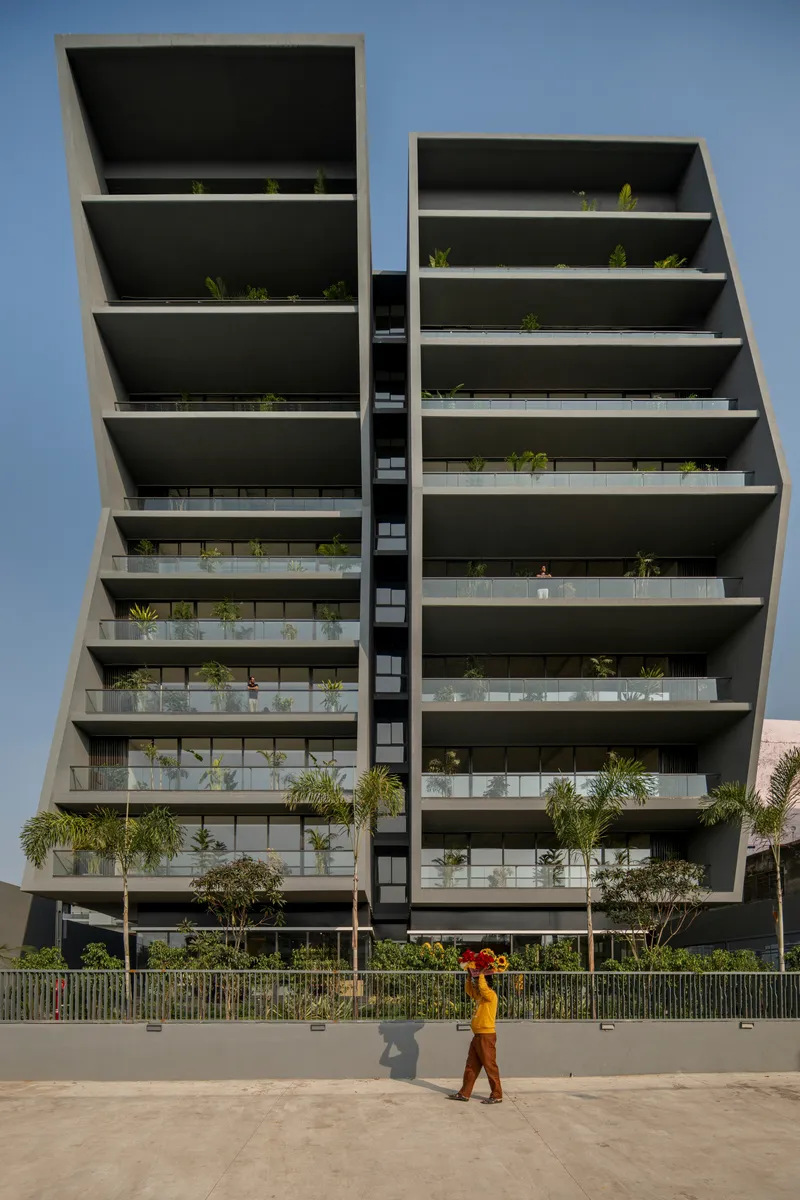

From a distance, the Magnus Office reads as two towers leaning away from each other, one volume tilting forward and the other tilting back along the western facade. The opposing inclines are not a stylistic flourish. They establish visual separation between the stacked terraces on each side, giving every outdoor deck a degree of privacy that a conventional flat facade would never permit. In a speculative office building where tenants are unknown at the time of design, this kind of spatial diplomacy is critical.
The aerial perspective reveals how the building rises above the low-rise commercial fabric around it. The dual-volume silhouette gives the tower a distinctive profile against Jaipur's hazy skyline, an identity that functions at the urban scale without relying on height alone. The massing is the message: this is a building that knows where it is.
The Planted Perimeter

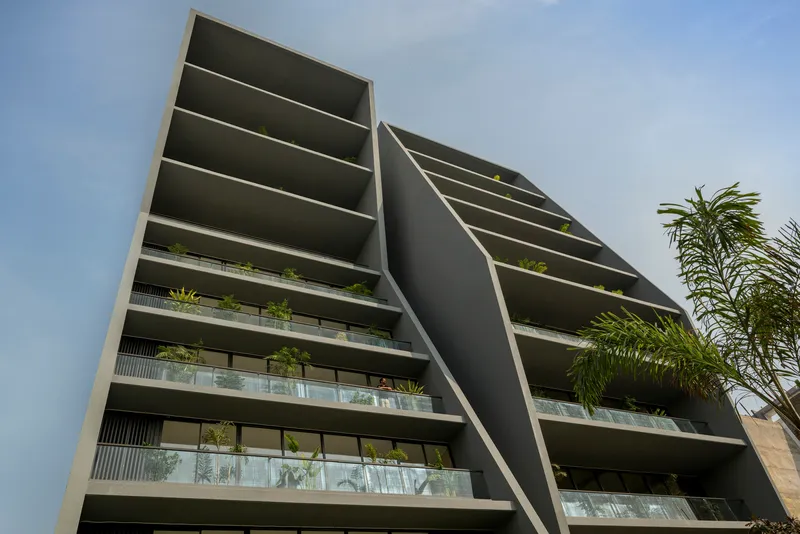

The staggered balconies that wrap the facade are not aftermarket amenities. They are structural extensions of the floor plates, their edges lined with planter beds that hold continuous bands of greenery. Every floor gets an outdoor deck. Every deck gets vegetation. The cumulative effect, visible clearly from the street, is a building that appears to be growing upward through its own landscaping rather than wearing it as decoration.
Structurally, columns are pushed to the perimeter, freeing each floor plate for open-plan office layouts that tenants can configure without negotiating around internal columns. Services and the circulation core sit along the southern edge, keeping the premium facades clear for workspace and terraces. The lower floors house smaller office units while the upper floors accommodate larger tenants, a pragmatic gradient that matches market demand to floor plate geometry.
Jaali Reinterpreted in Foam Concrete


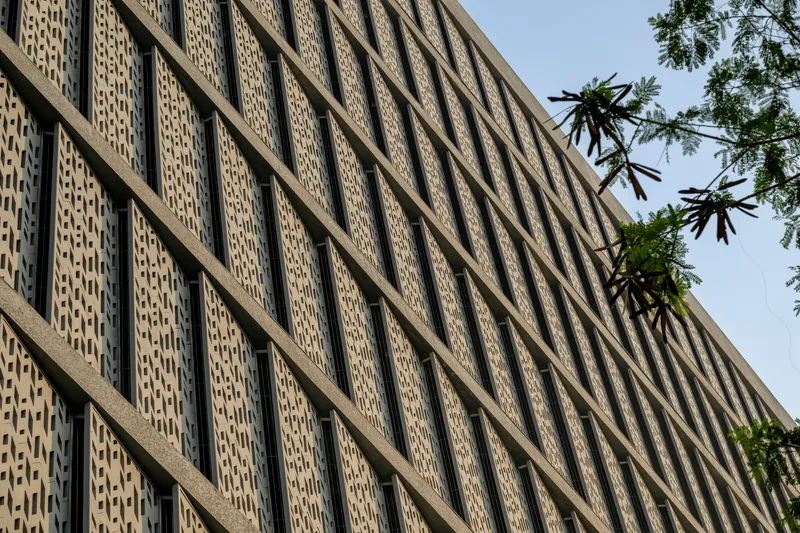
Rajasthan's architectural heritage includes centuries of carved stone jaali screens, perforated lattice walls that filter light and encourage air movement through buildings. Sanjay Puri Architects translate that principle into a contemporary material: lightweight foam concrete composed primarily of recycled content. The perforated panels are framed by a concrete grid and arrayed across the east, west, and portions of the north and south facades, forming a deep second skin that sits outboard of the glazed wall behind it.
The pattern is not merely referential. Each panel admits daylight while blocking direct solar radiation, and the thermal mass of the foam concrete adds insulation value that a metal screen would not provide. On the east and west elevations, some panels are mounted on rotatable frames so occupants can adjust the degree of openness throughout the day. The screens transform the facade from a static boundary into a tunable instrument that responds to the sun's arc.
Shadow as Interior Material

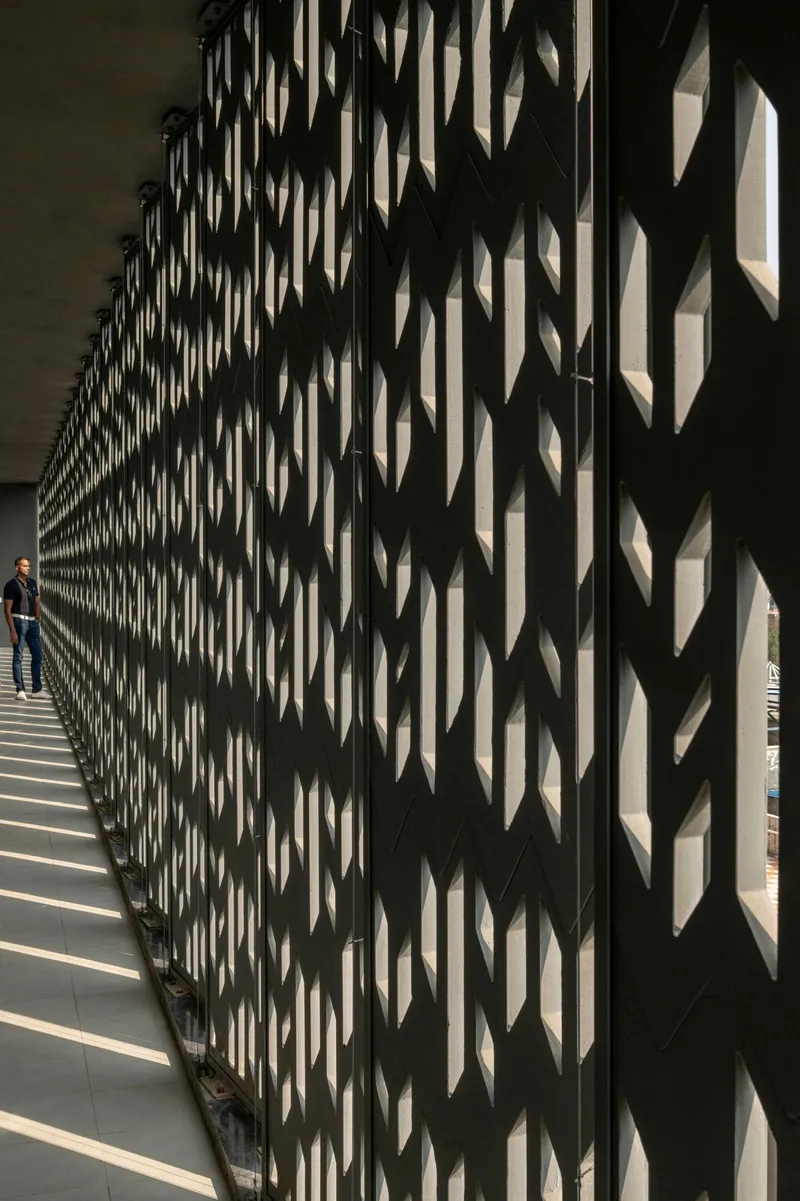

Inside, the perforated screens and louvered panels project constantly shifting shadow patterns across corridors, lobbies, and seating areas. The chevron-patterned screen walls turn sunlight into diagonal striations that move across the floor over the course of a day, creating a visual rhythm that is more engaging than any applied finish. A corridor becomes a sundial. A waiting area becomes a study in geometry.
The interior seating zones benefit from the three-foot buffer between screen and glass. Potted palms and upholstered furniture sit in a diffused, warm light that feels nothing like the harsh glare of Jaipur's afternoon sun. The building performs its climate work so effectively that the interiors barely register the hostility of the environment outside.
Inside the Office Floors


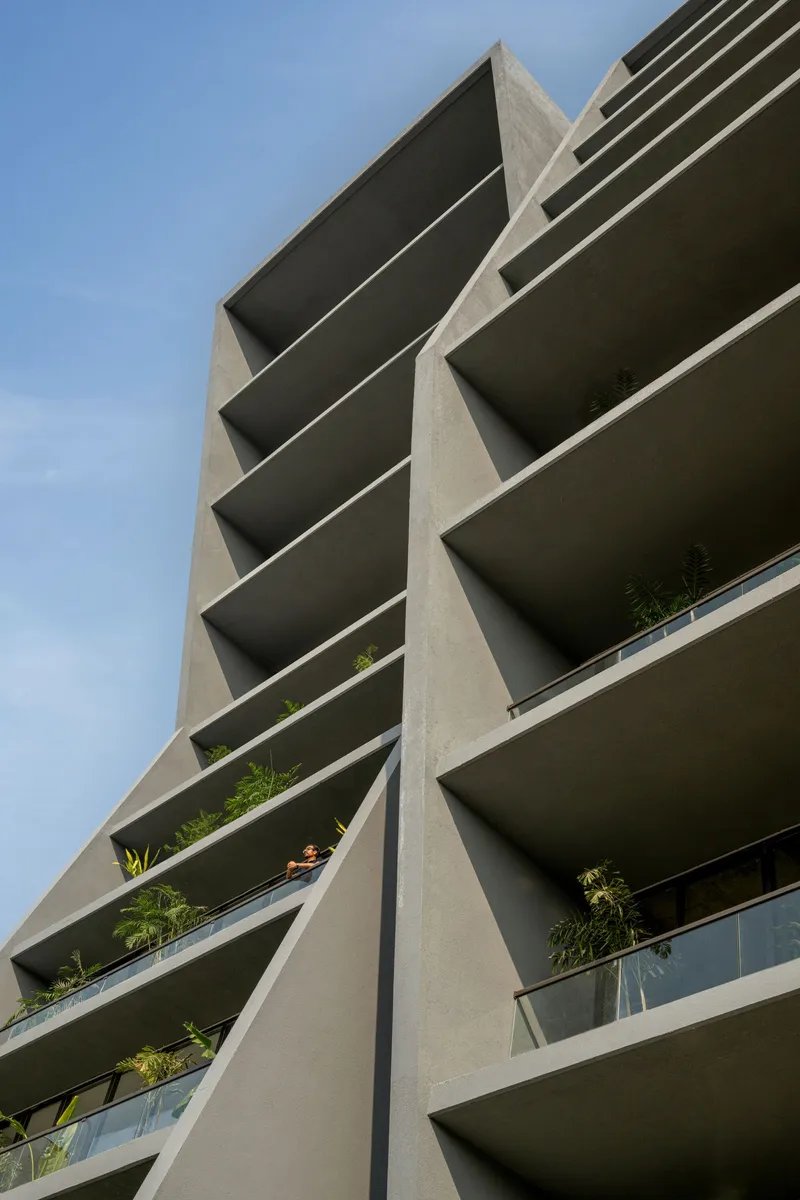
Full-height glazing on the inner wall gives office tenants panoramic views across the city. Because the screen envelope has already done the heavy lifting on solar control, the glass can be generous without turning the workspace into a greenhouse. At dusk, the terraces become social spaces where silhouetted figures stand among potted plants, looking out over the low-rise fabric of Jaipur with the distant Aravalli hills on the horizon.
The ground floor departs from the typical office lobby. It houses a restaurant and conference facility that open onto a landscaped plaza at street level, activating the base of the building in a way that most speculative office developments in Indian cities neglect entirely. The terrace level adds a cafeteria, gym, and outdoor garden, concentrating amenity space at the top where views and breezes are best.
Street Presence and Urban Scale


The building's street presence is assertive without being aggressive. Deep concrete balcony slabs, planted edges, and the layered screen facade give the elevation a visual density that holds its own against the visual noise of Tonk Road. At twilight, illuminated floor plates glow behind the screen, transforming the facade into a lantern that signals the building's presence from blocks away. The ground-level plaza with planted beds provides a rare moment of breathing room on a road that offers almost none.
Motorcycles, auto-rickshaws, and pedestrians pass constantly in the foreground of every street-level photograph. The Magnus Office does not pretend this traffic does not exist. Instead, the continuous planter zone, the foam concrete screens, and the recessed glazing work in concert to absorb noise and filter particulate air before it reaches the occupied spaces. Climate design, in this case, is also urban design.
Facade Tectonics


Close-up views reveal the tectonic logic holding the facade together. Diagonal concrete bracing intersects with perforated infill panels in a rhythm that alternates solid and void, structure and screen. The cantilevered upper volumes create deep recesses where planter troughs sit in permanent shade, their greenery sustained by the building's water recycling and rainwater harvesting systems. Rooftop solar panels offset a portion of the energy load.
The construction cost of approximately $5.2 million USD for a building of this size and complexity is notable. The use of fly ash bricks, an RCC frame, and foam concrete screens composed of recycled materials keeps the budget grounded while the formal ambition remains high. Sanjay Puri Architects demonstrate that envelope sophistication does not require luxury-grade materials; it requires intelligence about what each layer is doing.
Plans and Drawings


The ground floor plan confirms the lobby entrance and parking area organized around a central courtyard with planted edges, a strategy that introduces daylight and ventilation deep into the plan. The first floor plan shows the open office layout enabled by perimeter columns and a rear service core, with a terrace running along the back facade. Both building sections illustrate the full stack: underground parking, a publicly accessible ground floor, office floors of increasing size, and a planted terrace at the crown. The opposing facade angles are most legible in section, where the zigzag profile makes plain the privacy logic between adjacent outdoor decks.
Why This Project Matters
The Magnus Office matters because it refuses the two default modes available to commercial architecture in rapidly developing Indian cities. It is neither a generic glass box pretending to be in Singapore nor a nostalgic pastiche of Rajasthani motifs. Instead, it takes a regional building tradition, the perforated screen, and re-engineers it as a multi-layered environmental system that addresses heat, noise, privacy, and identity simultaneously. The jaali is not a citation. It is a working component.
For a speculative office building on a chaotic arterial road, this level of design commitment is unusual. Sanjay Puri Architects have built a case that the commercial real estate market in India's Tier 1 cities can absorb sophisticated passive design when the cost equation is right. At roughly $335 per square meter, the Magnus Office proves that climate-responsive architecture is not a premium add-on. It is a competitive advantage, and one that more developers along roads like Tonk Road would be wise to notice.
Magnus Office by Sanjay Puri Architects. Jaipur, India. Site area: 2,390.80 sq.m.; built-up area: 15,646 sq.m. Completed 2025. Lead Architect: Sanjay Puri. Design Team: Chandan Joshi, Sonali Chougule. Client: Mahima Real Estate Pvt. Ltd. Photography by Vinay Panjwani.
About the Studio
Share Your Own Work on uni.xyz
If projects like this are the kind of work you want to make, uni.xyz is a place to publish your own, find collaborators, and enter design competitions.


Popular Articles
Popular articles from the community

Cloaked Colonization: A Mobile Underwater Habitat That Moves Like a Fish
Micah Abaya's shortlisted EHC Pacific entry reimagines ocean settlement as a dispersed network of self-sustaining architectural organisms.
Opera by the Sea Estonia: Three Shells Dissolving Architecture into Tallinn's Coastline
A winning opera house proposal replaces monumental form with interconnected shells that blur the boundary between building, park and Baltic Sea.
Temporary Home for Dogs: A Reversed Zoo Rethinks Animal Shelter Architecture
In Bucharest, a sinuous corridor and freed landscape flip the logic of containment, designing a shelter that works to make itself unnecessary.

Opera on the Sea: Driftwood Logic Shapes a Timber Opera House on Estonia's Coast
Trevor Orgill's opera house translates the entangled drift of floating timber into a civic building where wood, water, and music converge.

Similar Reads
You might also enjoy these articles

Bao Huynh Watercolor Atelier: A Serene Art Retreat in Hội An
Bao Huynh Watercolor Atelier in Hội An blends multifunctional art spaces, sustainable design, local materials, and family-friendly living in a serene environment.

Atelier Macri Concept Store Interior Design by CASE-REAL
Atelier Macri store features a "ko" counter, walnut wood details, cork displays, blending retail, gallery, and seamless customer experiences.

Manuel Vargas Izquierdo Stadium and High-Performance Sports Center: Architectural Excellence in Jalpa de Méndez
The Manuel Vargas Izquierdo Stadium blends sustainable design, inclusive sports facilities, and cultural-inspired architecture, revitalizing Jalpa de Méndez’s public spaces.

KAKR Buluh Awar Hall: Revitalizing Community and Ecology Through Bamboo Architecture
Community built bamboo hall revitalizes Buluh Awar village, empowering youth, restoring ecology, celebrating vernacular craftsmanship through sustainable architecture and culture.

Explore Office Competitions
Discover active competitions in this discipline

Challenge to reimagine the Iron Throne

Photograph architecture without architects

Illustrate the lost glory of Angkor Wat - Render Challenge

Design challenge to reuse E-waste
Comments (0)
Please login or sign up to add comments
No comments yet. Be the first to comment!