

Seed City: Underground Urbanism in the Sahara
An underground ring city buried beneath the Saharan sand, using the desert's own geology as insulation, structure, and climate control.


What if you planted a city the way you plant a seed: underground, in the dark, where conditions are stable and resources are close? Seed City: Wadi Al-Hitan, a project by Randy Luo, takes the metaphor literally. It proposes burying an entire urban settlement beneath the Saharan sand, using the desert's own geology as insulation, structure, and climate control.
Shortlisted in the Extreme Habitat Challenge: Sahara on uni.xyz, the project is named after Wadi Al-Hitan (the Valley of the Whales) in Egypt's Western Desert, a UNESCO World Heritage Site where ancient whale fossils lie embedded in sandstone. The name signals the ambition: a city fossilised into its landscape, as deep and as permanent as geological time.
Going Underground: The Core Strategy

The surface of the Sahara is hostile: temperatures above 50°C, sandstorms, extreme UV, near-zero humidity. Two metres below the surface, conditions are radically different. The sand provides thermal mass that buffers temperature swings. Groundwater is accessible. Wind is eliminated. By building underground, Seed City sidesteps the desert's worst conditions entirely.
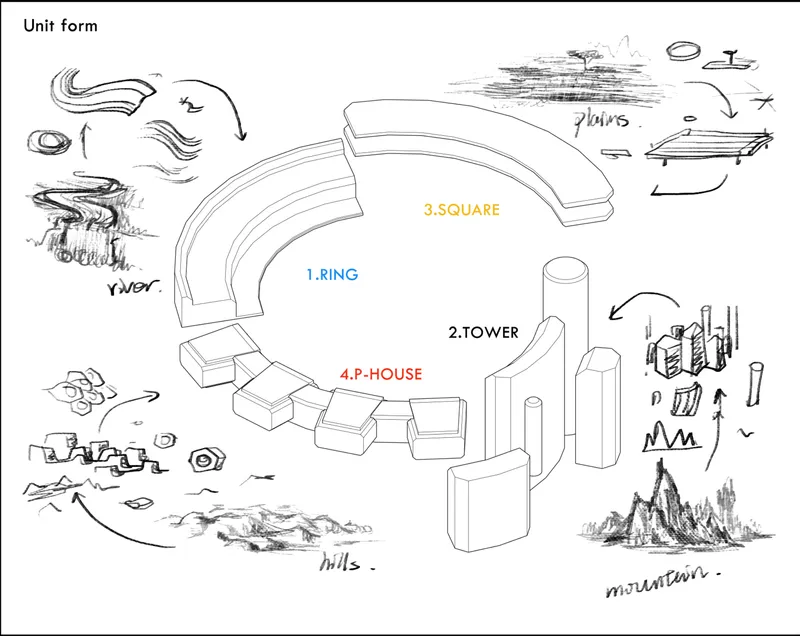
The project proposes four building typologies, each derived from a different terrain condition: rings for open plains, towers for vertical connections, squares for flat sites, and P-houses for slopes. The cutaway drawing shows robotic arms assembling the ring structure's interior framework, a detail that signals the project is thinking about how this gets built, not just how it looks.
The Ring City: Multi-Level Urbanism
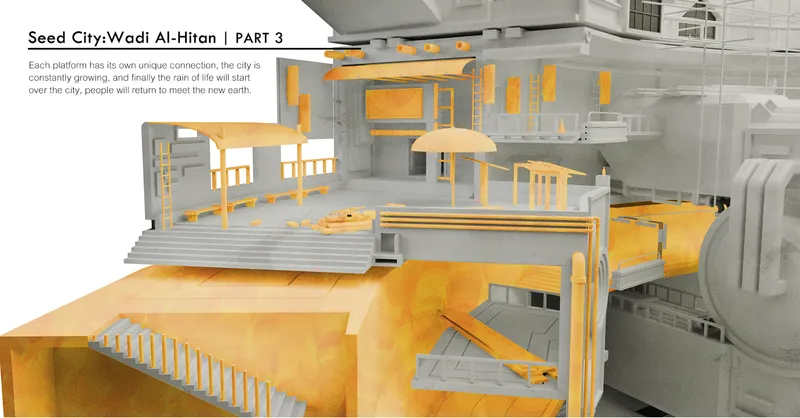
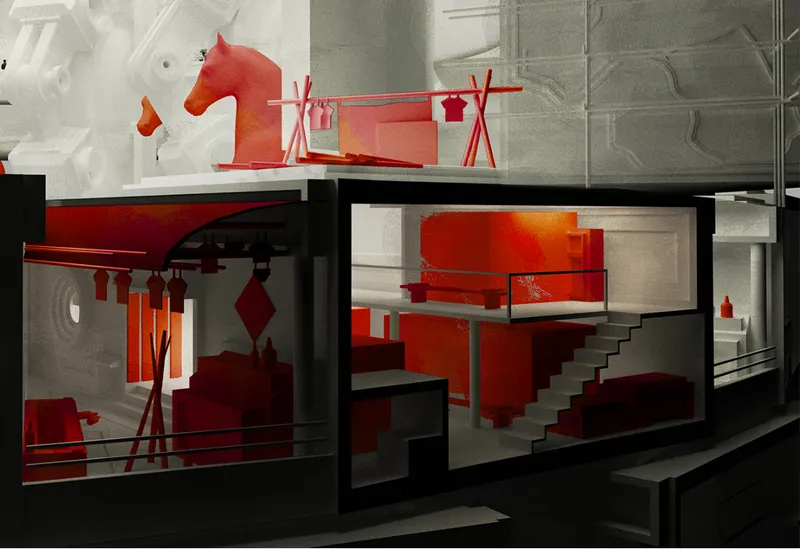
The primary urban form is a large ring, built incrementally underground. Each ring contains multiple levels of programme: residential units, workshops, governance spaces, public gathering areas, and infrastructure. The levels are connected by stairs, ramps, and open voids that bring light and air down from the surface.
The interior renderings are unexpectedly warm. One shows a dwelling unit with a red sculptural horse figure, a staircase, and ambient lighting that feels more like a gallery apartment than a bunker. This is important. Underground architecture has an image problem: people imagine damp, dark corridors. Seed City argues that subterranean space can be generous, colourful, and inhabited with personality.
Rotational Modules: A City That Reconfigures
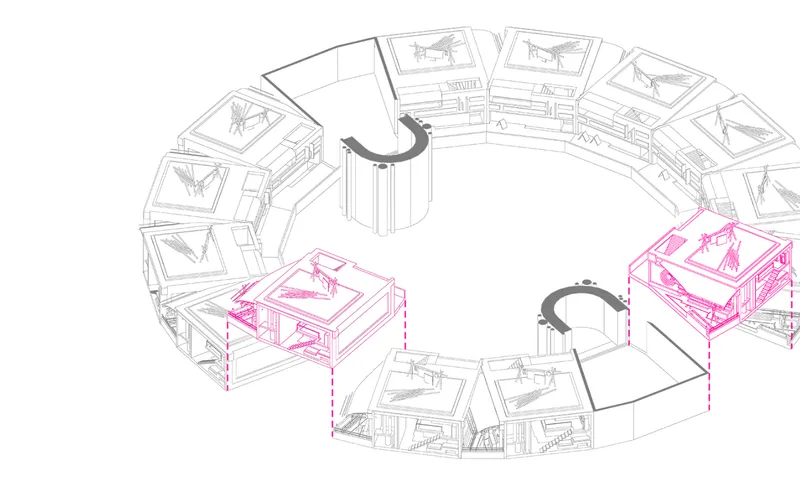
The housing units are modular and rotational. They sit along the curved ring plan and can be detached, repositioned, or replaced as the community's needs change. This is not just flexibility as a concept. It is flexibility as a structural system: the modules plug into the ring the way components plug into a circuit board.
The practical implication is that the city can grow without demolishing what already exists. New modules are added to the ring's edge. Old modules are rotated or swapped. The city evolves without ever needing a master plan revision.
Looking Down: The Vertical Community

The most striking image in the project is the aerial view looking straight down into the ring. Terraced levels spiral inward. Pink-accented public spaces and organic rock formations punctuate the grey structure. People are visible at every level, living, walking, gathering. The city reads as a geological section brought to life.
The text on the board reads: People began to return to their original state and began to look for fun in life, not from the perspective of the conqueror. This is a philosophical statement embedded in an architectural drawing. Seed City is not about conquering the desert. It is about disappearing into it and finding a richer life below.
Why This Project Matters
Underground architecture is one of the least explored strategies in extreme habitat design. Most competition entries build upward or outward. Seed City builds downward, which changes every assumption: about climate, about light, about materials, about how a city feels to walk through. The result is one of the most spatially original entries in the EHC Sahara competition.
For anyone studying subterranean urbanism, modular housing, or resource-driven design, this project offers a clear, visually compelling framework. It proves that going underground does not mean going dark.
View the Full Project
About the Designer
Designer: Randy Luo
Enter a Design Competition on uni.xyz
If underground urbanism, modular architecture, or extreme environment design is the kind of work you want to pursue, uni.xyz runs competitions year-round that reward bold structural thinking.
Project credits: Seed City: Wadi Al-Hitan by Randy Luo. Shortlisted, Extreme Habitat Challenge: Sahara (uni.xyz).


Popular Articles
Popular articles from the community


The Amber Palace Opera: A Geological Fiction Surfaces on Tallinn's Baltic Waterfront
Pierre Brillard reimagines a Baltic legend as a public landscape, opera house, and waterfront promenade rooted in Tallinn's coastal identity.

Singing Woman: An Opera House That Performs Before the Curtain Rises
Ovidiu Cristian Pavel's conceptual opera house translates Estonia's choral identity into a sculpted waterfront landmark facing the Baltic Sea.
Manzana Morphosis: Stretching Barcelona's Grid into a Living Landscape for 2050
A radical reworking of the Eixample manzana turns density into a tool for generous public space, vertical ecology, and environmental performance.

Temporary Home for Dogs: A Reversed Zoo Rethinks Animal Shelter Architecture
In Bucharest, a sinuous corridor and freed landscape flip the logic of containment, designing a shelter that works to make itself unnecessary.

Similar Reads
You might also enjoy these articles

Shakur's House: Exposed Brick as an Interior Organiser in a 168 m² Mashhad Residence
Brick moves indoors in this Mashhad residence, where masonry walls, glass partitions and teal planes sequence a compact home without closing it off.

Day and Night Park: A Time-Based Urban Newsstand in Beijing
A temporary urban newsstand in Beijing blending travel, light, and reading through poetic colors, compact form, and community-focused design.

Modernist Patio Renovation in El Masnou, Barcelona by Oliver Segura Arquitectura + Cebrià Arquitectura
Modernist patio renovation blending tradition and innovation with a movable pool, leveled floors, and Catalan materials in El Masnou.

Alto Residencial Coop: Cooperative Housing Development in Santiago de Compostela by Carbajo Barrios Arquitectos
A linear cooperative housing complex blending white volumes and perforated metal façades, enhancing community living, natural light, privacy, and urban integration.

Comments (0)
Please login or sign up to add comments
No comments yet. Be the first to comment!