

Silent Meditation Cabin: Off-Grid Stillness in a Two-Level Timber Pavilion
A compact plywood-clad retreat splits living and meditation across two levels, anchored by a panoramic window facing open landscape.


Strip a dwelling down to its most essential acts, storage below and stillness above, and you arrive at something close to this project: a tiny timber pavilion whose entire reason for existing is to help its occupant sit quietly and pay attention. The Silent Meditation Cabin treats architecture itself as a form of restraint, removing every non-essential element until what remains is a compact, off-grid shell calibrated for focus, natural light, and an unbroken visual connection to the surrounding landscape.
Designed by Vadym Mylostiuk, the project was shortlisted for Architecture on the Clock, a competition that challenges designers to develop compelling architectural ideas within tight constraints. Sited in a clearing among tall pines and positioned at the edge of still water, the cabin uses its setting as both backdrop and participant: the landscape is not merely visible but instrumentalized as the primary interior experience.
A Clearing Among Pines: Siting as Spatial Strategy

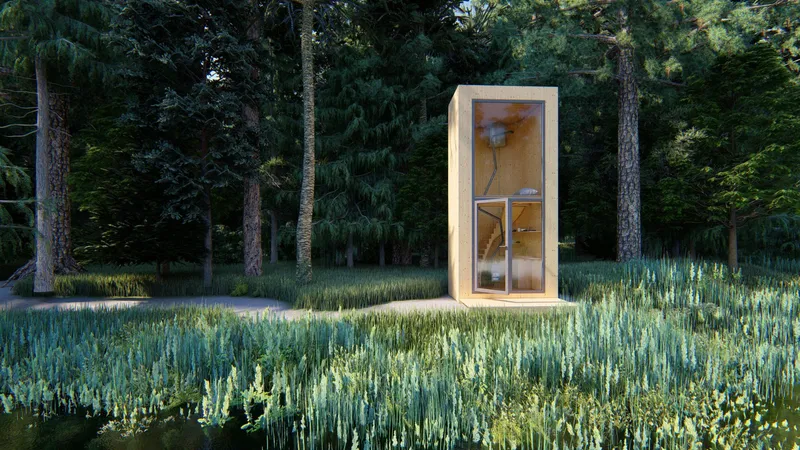
The cabin's placement in a pine-edged clearing is deliberate. Tall conifers form a natural boundary that screens the structure from the wider world, creating a sense of enclosure before you even step inside. In the front view at dusk, wildflower grasses rise nearly to the threshold, blurring the line between ground plane and building. The full-height glazed door operates as both entry point and primary aperture, collapsing the distinction between interior and exterior when open and framing the meadow like a painting when closed.
What makes this siting work is its simplicity. There is no elaborate landscaping, no deck, no transitional boardwalk. You walk through grass and arrive. That directness mirrors the building's programmatic clarity: everything non-essential has been edited out.
Plywood Skin and Water: The Pavilion in Its Landscape
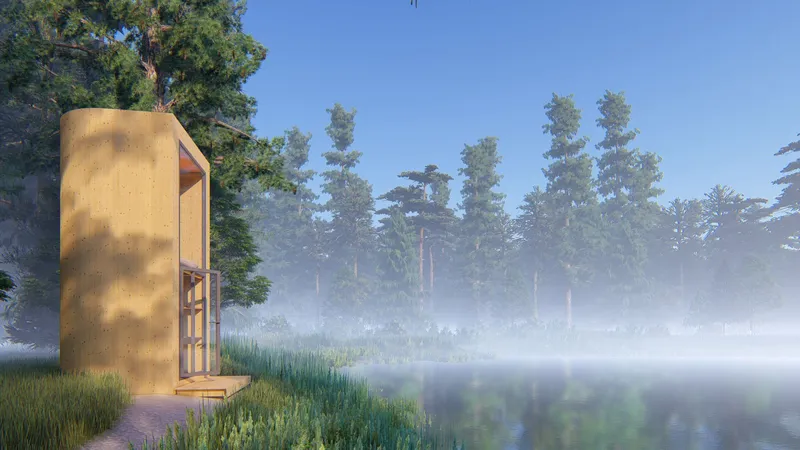
Seen from the side, the plywood-clad volume reads as a single clean extrusion, its warm timber tones contrasting with the cool mist rising off the water below. The material choice is pragmatic: plywood is lightweight, economical, and lends itself to off-grid construction where elaborate supply chains are impractical. Its grain pattern also introduces a subtle texture that keeps the minimalist form from feeling sterile.
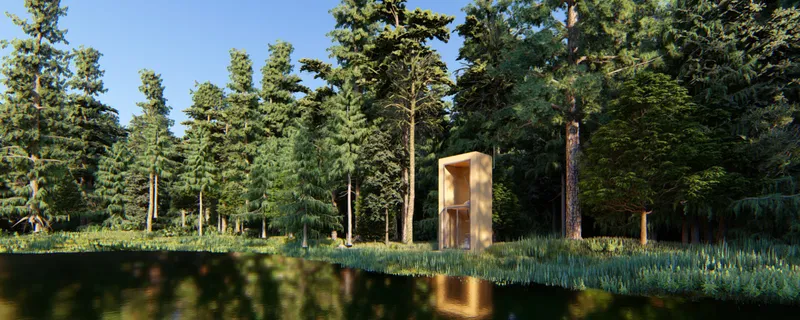
The distant pond view reveals how the cabin anchors itself to the waterline without dominating it. Reflected in the still surface under a blue sky, the shelter appears almost buoyant. Its modest footprint means it reads less as an imposition on the landscape and more as an object that has settled into it. The open door in this view reinforces the idea of permeability: air, light, and the sound of water are all invited in.
Two Levels, Two Modes: Storage Below, Stillness Above
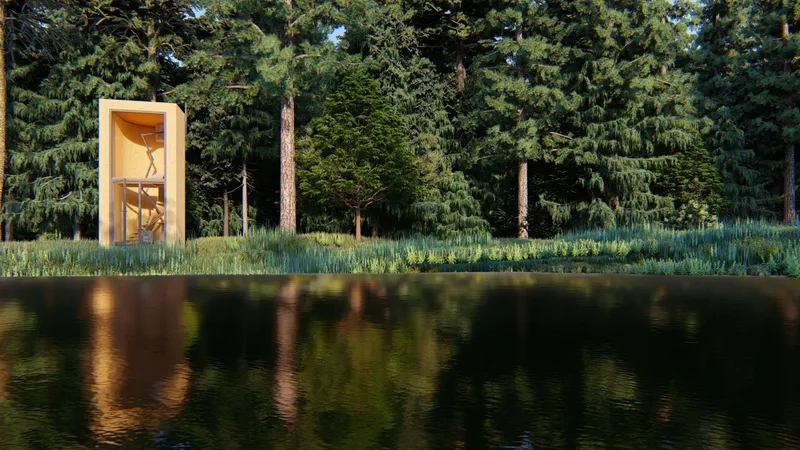
The cabin's section is organized around a straightforward split. The lower level handles the practical business of living: storage and functional necessities are compressed into a compact footprint so that everything above can be given over to meditative practice and rest. Seen at twilight with the interior illuminated, the glazed facade turns the upper volume into a lantern, its warm glow reflected in the lake. The panoramic window, which is the cabin's most prominent architectural gesture, fills the meditation space with diffused natural light during the day and frames the darkening landscape at night.
As an off-grid structure, the cabin carries an implicit argument about sufficiency. There is no utility connection tethering it to infrastructure, no surplus square footage to maintain. The design asks how little architecture you actually need in order to create the conditions for sustained attention, and the answer it offers is surprisingly modest: a dry enclosure, a view, and vertical separation between doing and being.
Why This Project Matters
Meditation spaces in architecture often rely on heavy symbolic gestures: raked gravel, ceremonial thresholds, dramatic light wells. The Silent Meditation Cabin resists all of that. Its power comes from subtraction, not addition. By reducing the programme to two stacked zones and wrapping them in a simple timber shell with one generous opening, Mylostiuk demonstrates that contemplative architecture does not require spiritual decoration. It requires clarity of intent.
The project also contributes to a growing conversation around off-grid micro-architecture and intentional living. It shows that a compact footprint, when carefully organized, can accommodate both the mundane requirements of daily life and the aspirational goal of sustained mindfulness. For a competition entry developed under tight time constraints, the consistency between concept, siting, materiality, and programme is notably cohesive. It is a small building with a precise argument, and that precision is exactly what makes it worth studying.
View the Full Project
About the Designers
Designer: Vadym Mylostiuk
Enter a Design Competition on uni.xyz
uni.xyz runs architecture and design competitions year-round that reward proposals with spatial conviction and real site intelligence.
Project credits: Silent Meditation Cabin by Vadym Mylostiuk Architecture on the Clock (uni.xyz).


Popular Articles
Popular articles from the community


Manzana Morphosis: Stretching Barcelona's Grid into a Living Landscape for 2050
A radical reworking of the Eixample manzana turns density into a tool for generous public space, vertical ecology, and environmental performance.

Tsunami Convergenics: Turning Catastrophic Ocean Forces into Underwater Housing Infrastructure
A speculative underwater settlement off the coast of Onagawa, Japan, treats tsunamis and typhoons as energy sources rather than threats.

Temporary Home for Dogs: A Reversed Zoo Rethinks Animal Shelter Architecture
In Bucharest, a sinuous corridor and freed landscape flip the logic of containment, designing a shelter that works to make itself unnecessary.

Opera by the Sea Estonia: Three Shells Dissolving Architecture into Tallinn's Coastline
A winning opera house proposal replaces monumental form with interconnected shells that blur the boundary between building, park and Baltic Sea.

Similar Reads
You might also enjoy these articles

Day and Night Park: A Time-Based Urban Newsstand in Beijing
A temporary urban newsstand in Beijing blending travel, light, and reading through poetic colors, compact form, and community-focused design.

Modernist Patio Renovation in El Masnou, Barcelona by Oliver Segura Arquitectura + Cebrià Arquitectura
Modernist patio renovation blending tradition and innovation with a movable pool, leveled floors, and Catalan materials in El Masnou.

Alto Residencial Coop: Cooperative Housing Development in Santiago de Compostela by Carbajo Barrios Arquitectos
A linear cooperative housing complex blending white volumes and perforated metal façades, enhancing community living, natural light, privacy, and urban integration.
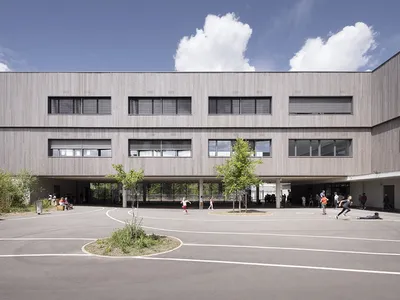
Vil Genis School by BPA ARCHITECTURE – Massy, France
Vil Genis School in Massy, France, features sustainable design, south-facing classrooms, community integration, accessible spaces, and modern educational architecture.

Explore Meditation Space Competitions
Discover active competitions in this discipline

Challenge to design mud housing for contemporary communities

Challenge to reimagine the Iron Throne

Photograph architecture without architects

Illustrate the lost glory of Angkor Wat - Render Challenge
Comments (0)
Please login or sign up to add comments
No comments yet. Be the first to comment!