
ISA Folds a Metal-Clad Superporch into Detroit's Historic Midtown Fabric
Six55 Detroit stacks 36 apartments behind a faceted metal facade that bends to meet its neighbors in the Willis-Selden Historic District.


Detroit lost roughly two-thirds of its population between the 1960s and 1970s, leaving Midtown with a streetscape defined as much by vacancy as by the handsome mid-rise apartments and Victorian houses that survived. Inserting a new building into that context is less about filling a gap than about calibrating scale, material, and social ambition so the gap actually heals. ISA - Interface Studio Architects took on exactly that problem with Six55 Detroit, a 37,000 square-foot, four-story mixed-use building on West Willis Street in the Willis-Selden Local Historic District. The result is a tight, C-shaped volume wrapped in standing seam and corrugated metal that manages to feel both industrial and neighborly.
What makes the project worth studying is the way it takes a regulatory constraint, the required front yard setback, and turns it into the building's signature gesture. ISA calls it the "superporch," a deep, folded recess in the facade that borrows from the recessed multi-level porches found on the district's older apartment buildings and then amplifies them. The fold does three things at once: it creates sheltered outdoor balconies for west-facing units, it mediates between a larger structure on one side and a smaller Victorian house on the other, and it frames a ground-level cafe and landscaped yard that pull the sidewalk into the building's social orbit. One move, three payoffs.
The Fold as Urban Negotiation
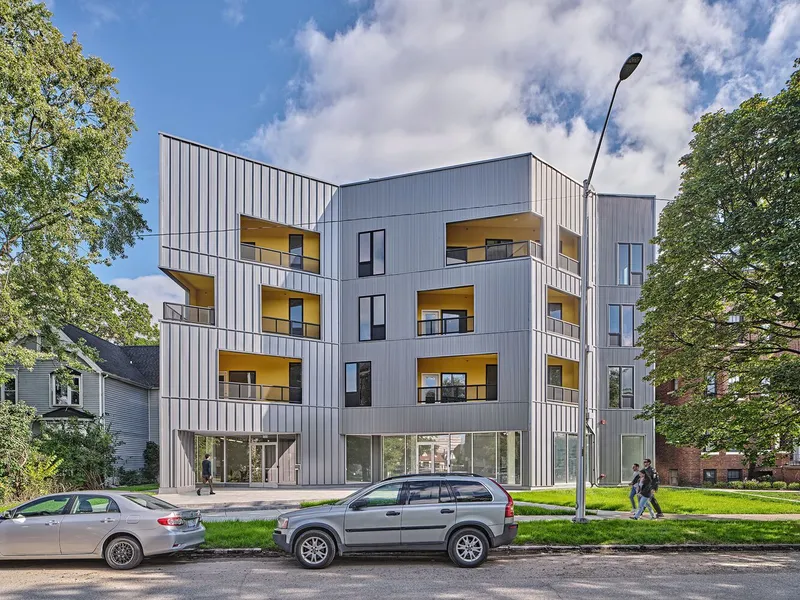
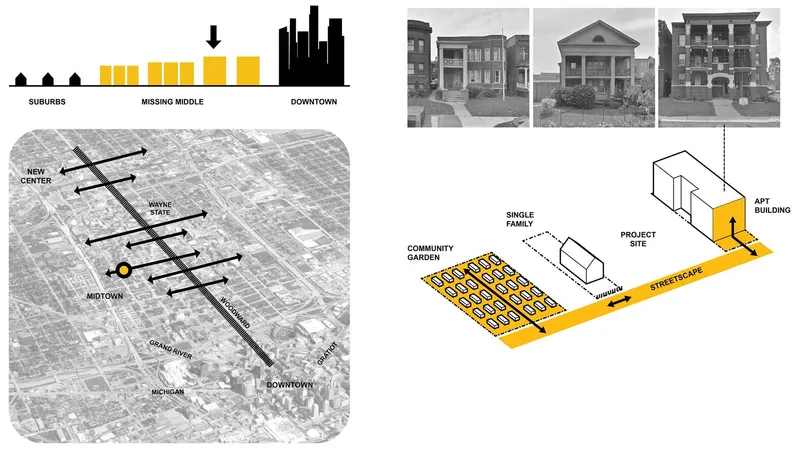
The street elevation reads as a single faceted plane that bends in and out depending on which neighbor it faces. On the side abutting a larger contemporary building, the facade pulls inward. On the side adjacent to a modest Victorian house, it pushes outward, gradually stepping down in visual mass. The effect is a building that does not impose a single datum on the block but instead negotiates its profile in real time. The diagram and site massing studies make clear that ISA treated the project as an act of stitching rather than insertion, mapping the building's footprint against the surrounding grain of lots, setbacks, and voids.
That folded geometry also produces something less abstract: genuine depth. Metal panels in varying widths wrap the entire skin, and the creases catch light and shadow throughout the day, so the facade never looks flat. Bright orange accent panels mark the recessed superporch zones, drawing the eye to the social spaces carved into the volume. It is a high skin-to-interior ratio strategy executed in a single, mid-priced material, which keeps costs practical while delivering a level of surface complexity usually associated with much larger budgets.
Metal Skin and Detroit Memory
Choosing metal cladding for a Detroit building is never a neutral act. The city's identity is still inseparable from fabrication, stamping, and assembly lines, even as those industries have contracted. ISA leans into the reference without being literal. Standing seam panels run vertically, corrugated panels shift rhythm across the facade, and the widths vary enough to read as a composed surface rather than a warehouse wall. The orange accents keep the palette from tipping into austerity, giving the superporch bays a warm glow that reads against the cooler silver and gray tones.
Material choices here also serve a practical argument about infill housing economics. Wrapping a complex folded geometry in a single cladding system simplifies detailing and procurement. The result is a building that punches above its weight visually while staying within the budget constraints that define most mid-rise residential development in post-industrial cities. It is a useful reminder that character and cost discipline are not enemies.
Living Inside the Fold
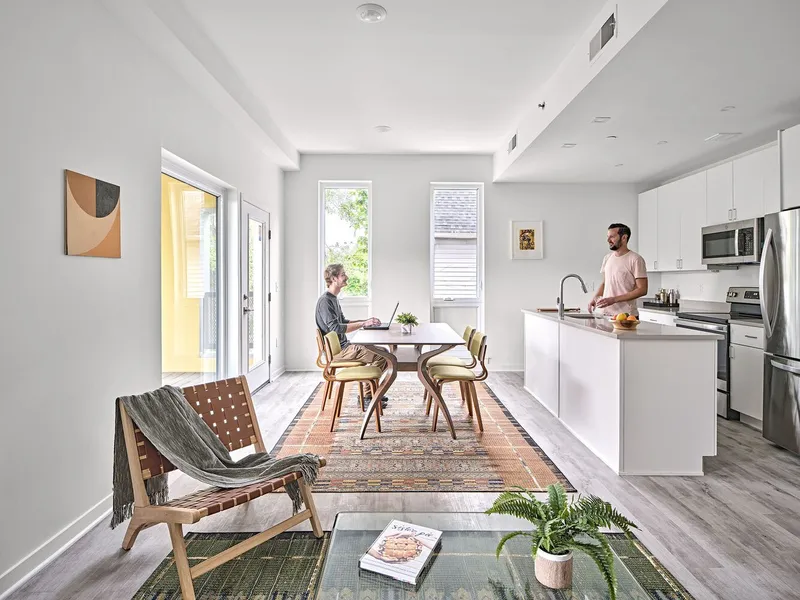
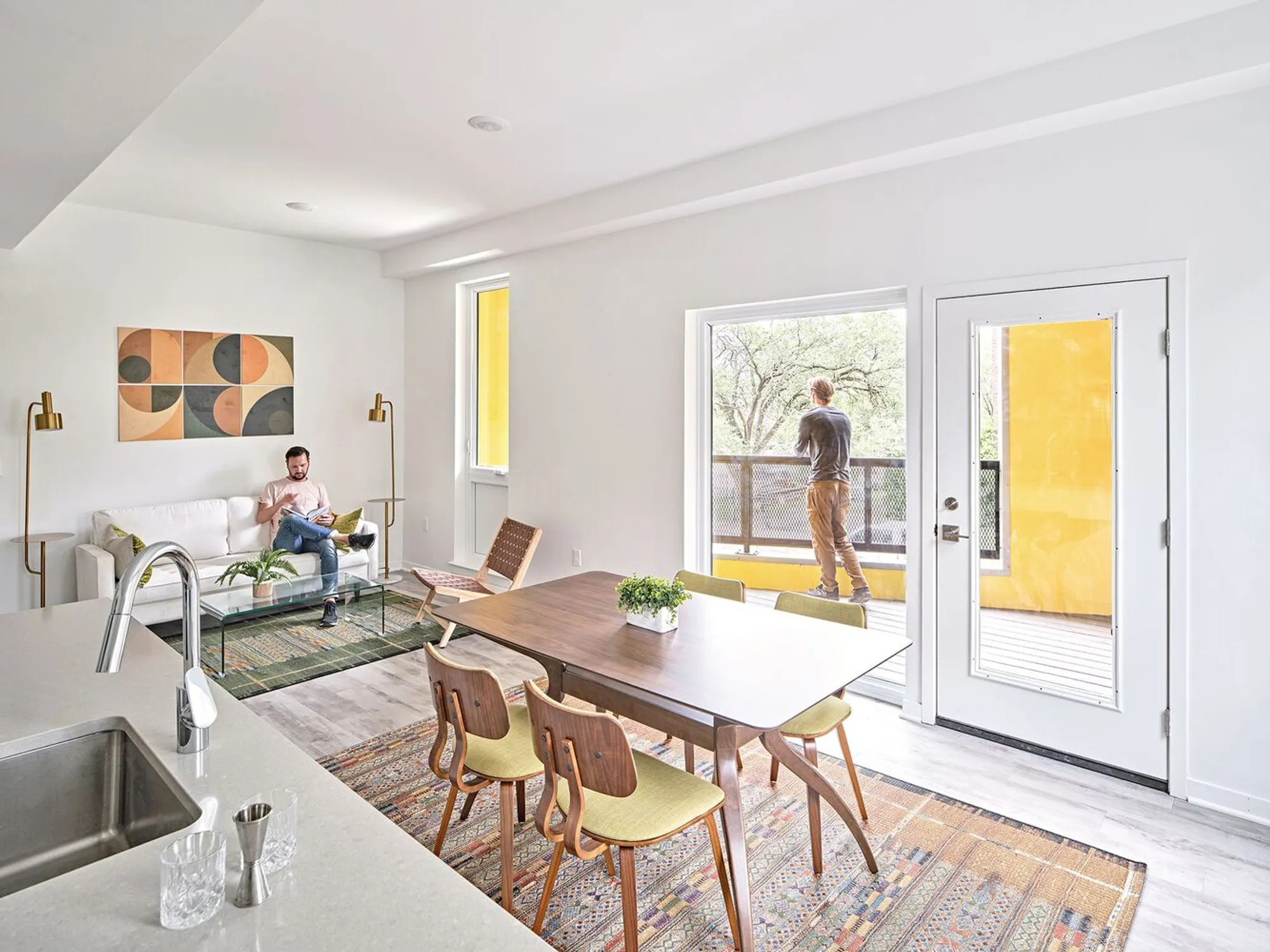
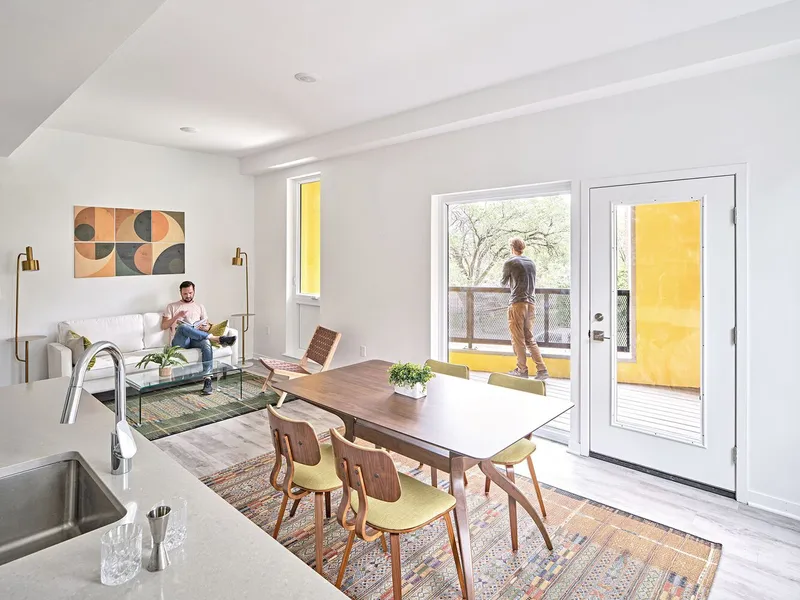
Interior photographs reveal open-plan living and kitchen spaces that connect directly to the deep balconies through full-height glazed doors. The units are modestly scaled, 36 apartments split among nine studios, eighteen one-bedrooms, and nine two-bedrooms, but the generosity of daylight and the visual extension into the balcony space make them feel larger than their square footage. The yellow-orange walls of the balcony bays carry the exterior accent color inward, creating a threshold zone that belongs to both inside and outside.
Views from the upper floors look out over neighboring rooftops and tree canopy, offering a perspective on Midtown that reinforces the sense of being embedded in a neighborhood rather than hovering above it. A common roof deck at the top of the building provides a shared version of the same experience. The C-shaped plan, with its open court facing the street, means that most units enjoy dual orientation and cross ventilation, a quiet functional benefit of a form driven primarily by contextual and social logic.
Ground Floor as Public Invitation
The ground floor program is deliberately hybrid. A cafe and lobby occupy the street-facing edge, while 25 parking spaces are tucked behind and beneath the residential volume. The landscaped front yard, mandated by the historic district's setback requirements, doubles as an outdoor extension of the cafe, blurring the line between private development and public amenity. In a city where vast stretches of streetscape lack any activation at all, that blur matters. It signals that the building is not just housing units but a piece of infrastructure that gives something back to the sidewalk.
Plans and Drawings
The diagrammatic drawings lay out ISA's thinking in plan and isometric. Context maps position the building within the broader Midtown grid, showing how the yellow-highlighted infill volume relates to surrounding blocks, lot sizes, and existing fabric. The isometric massing study is particularly revealing: it shows the fold as a continuous operation that begins at the ground plane setback and propagates upward through all four stories, locking the building's social strategy and its formal strategy into a single gesture.
Why This Project Matters
Six55 Detroit is not a flagship cultural institution or a developer's trophy tower. It is 36 apartments, a cafe, and a parking lot on a block that needed all three. That ordinariness is the point. The project demonstrates that infill housing in a shrinking city does not have to choose between contextual deference and architectural ambition. By taking one idea, the superporch, and letting it organize everything from facade geometry to unit layout to street-level activation, ISA produces a building that is legible, specific, and genuinely useful to its neighborhood.
The broader lesson is about material honesty and formal economy. A single cladding system, one primary geometric operation, and a clear programmatic hierarchy add up to a building that communicates its intentions at a glance. In a city where so much of the built environment has been either demolished or left to decay, that kind of clarity is its own form of optimism. Six55 suggests that Detroit's next chapter can be written in metal panels and folded planes, one careful infill project at a time.
Six55 Detroit by ISA - Interface Studio Architects. Location: Midtown, Detroit, Michigan, USA. Area: 37,000 SF. Year: 2023. Photography by Jason Keen.
About the Studio
Share Your Own Work on uni.xyz
If projects like this are the kind of work you want to make, uni.xyz is a place to publish your own, find collaborators, and enter design competitions.




Popular Articles
Popular articles from the community


Conexión: Biophilic Design Reimagines High-Rise Living in Hong Kong
Conexión reimagines high-rise living in Hong Kong through biophilic design, green facades, shared spaces, daylight, water and nature within.

Hill & Cross Opera: Sculptural Opera House Architecture Shaped by Tallinn’s Landscape and Identity
Hill & Cross Opera reimagines opera house architecture in Tallinn through its sculptural hill, civic plaza, glass wave and a luminous cross.

Riyadh For All: Intergenerational Urban Design for Active Aging in Rabat
Riyadh For All reimagines urban design in Rabat with intergenerational co-living, adaptive courtyards, and Moroccan cultural exchange today.

Lunar Spiral: Space Architecture Shaped by the Mathematics of the Universe
Lunar Spiral reimagines space architecture through Fibonacci geometry, lunar regolith, levitating habitats, and self-sustaining Moon living.

Similar Reads
You might also enjoy these articles


Hodi-Mandai Geram
Project Function: Preservation and revitalization of the Intangible heritage and socio-spatial identity of the Hodi by Housing, Cultural Memory Center, Sacred Grove, landscape, local tourism economy


Olio Towers: A Mid-Rise for Performers That Fuses Housing, Rehearsal, and Stage
Located blocks from Houston's Theater District, this modular tower stacks living units around a central performance atrium.

Oasis: Modular Green Housing Carved into Dhaka's Urban Fabric
A shortlisted Plugin Housing entry reclaims unauthorized settlements in Dhaka with stepped concrete volumes, green roofs, and ventilation-driven design.

Black Hole: A Floating Megastructure for the Post-Physical Era
Emiliano Mazzarotto envisions a spherical, self-scaling arena where e-sports, digital hotels, and holographic stadiums replace traditional public space.


Explore Mixed-Use Competitions
Discover active competitions in this discipline


Challenge to design mud housing for contemporary communities


Challenge to reimagine the Iron Throne


Photograph architecture without architects


Illustrate the lost glory of Angkor Wat - Render Challenge
Comments (0)
Please login or sign up to add comments
No comments yet. Be the first to comment!