

SKLON: A Curving Climatic Envelope That Rethinks Youth Housing in Moscow
Bioclimatic geometry meets communal living as a sculptural arc deflects wind, captures light, and redefines the urban hostel typology.


What happens when you stop treating a hostel like a warehouse for sleep and start treating it like a climatic instrument? SKLON answers that question with a building that bends. Literally. Conceived as a sculptural arc calibrated to Moscow's seasonal extremes, the project deflects winter winds off the Moskva River, funnels summer breezes through communal terraces, and orients its massing to capture optimal daylight without overheating. The designers call it "un-hostelifying": retaining the affordability and density of communal housing while engineering spatial dignity through environmental logic rather than decorative gesture.
SKLON is the work of Salman Faris and Santhosh Suresh, published on uni.xyz as a speculative prototype for mixed-class, mixed-density cities. The site sits in one of Moscow's densifying districts, surrounded by the Moskva River, upcoming commercial plots, and former industrial lands like the AMO ZIL complex. Seasonal wind corridors, an exposed river edge, and the certainty of future high-density development next door made a conventional block plan untenable. Every curve in SKLON traces back to a measurable site force.
A Central Courtyard Carved by Wind and Program
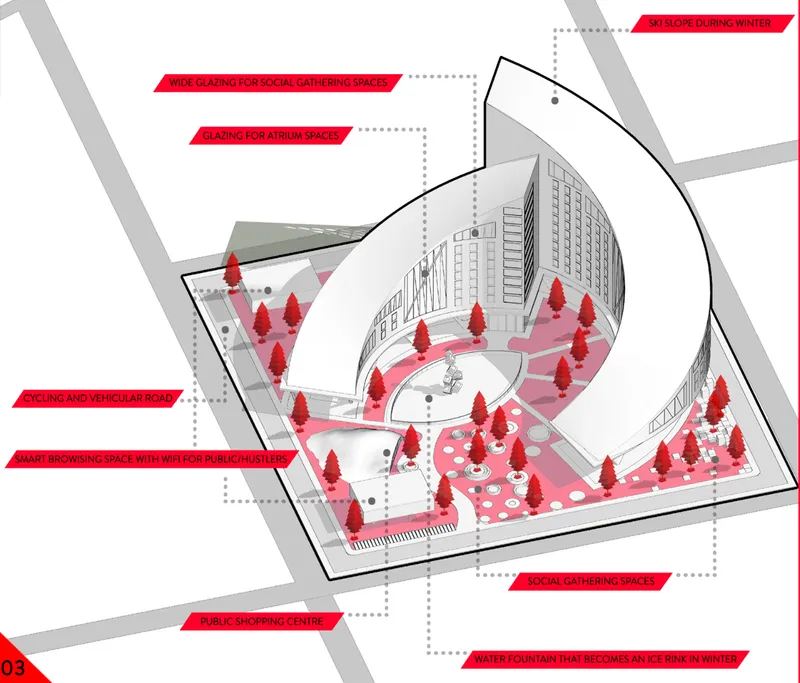
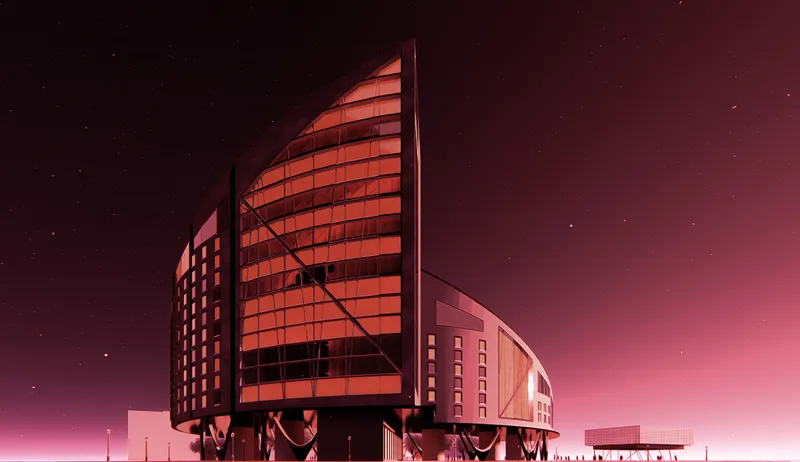
The axonometric site plan reveals how SKLON's curving volumes wrap around a central courtyard punctuated by red-canopied trees and labeled public zones. This is not a leftover void between buildings; it is the social heart of the scheme, shaped by the same aerodynamic logic that defines the exterior envelope. Ground-floor porosity, achieved by elevating the structure on diagonal supports, allows air to pass beneath the building mass, reducing heat island effects and inviting pedestrian movement through what would otherwise be a sealed perimeter.
The twilight rendering makes the structural ambition legible. A glass tower rises alongside lower curved volumes, all lifted on angled columns that blur the boundary between streetscape and building edge. The transparency at ground level is deliberate: it converts the base into a social spine where indoor and outdoor activities overlap, turning arrival into an act of community participation rather than corridor navigation.
From Block to Arc: Sculpting Form Through Environmental Forces
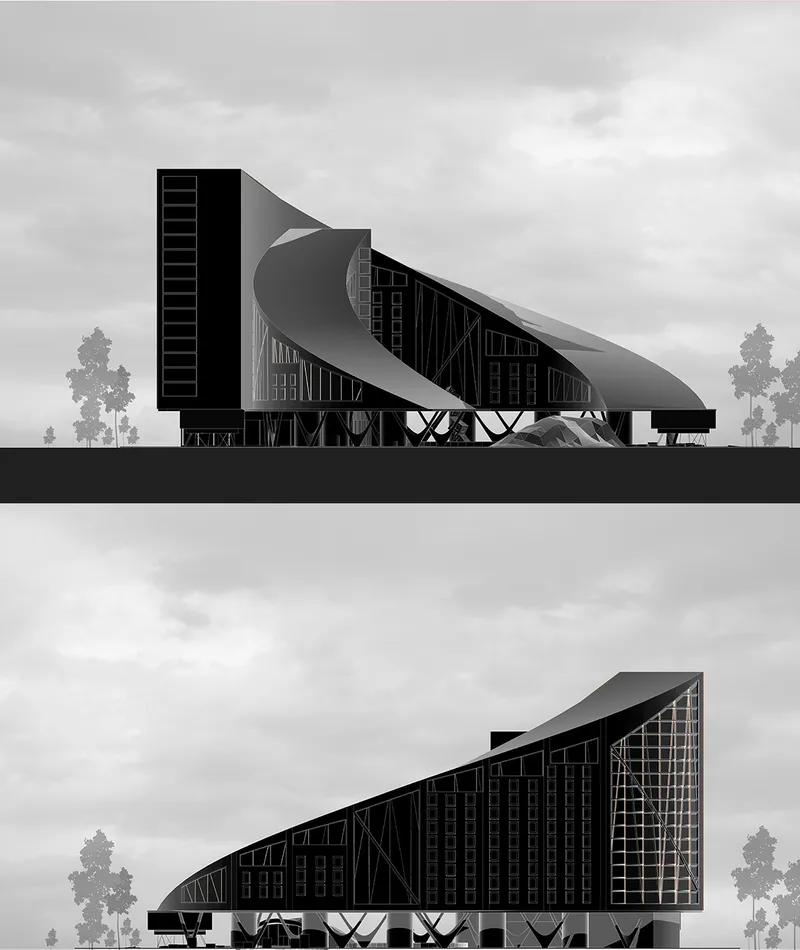
The elevation drawings expose the sweeping roof geometry in profile, showing how a continuous curve runs over the diagonal structural supports with mature trees flanking the composition at grade. SKLON's form did not arrive as a sketch; it evolved through a sequence of operations on a simple cubic mass. Vertical stacking addressed density and height restrictions. Quarter divisions opened wind channels and maximized river views. Sculpted slopes enabled natural snow run-off, a critical performance requirement in Moscow's winters. Merged wings closed the loop, creating a unified environmental envelope rather than a collection of discrete volumes.
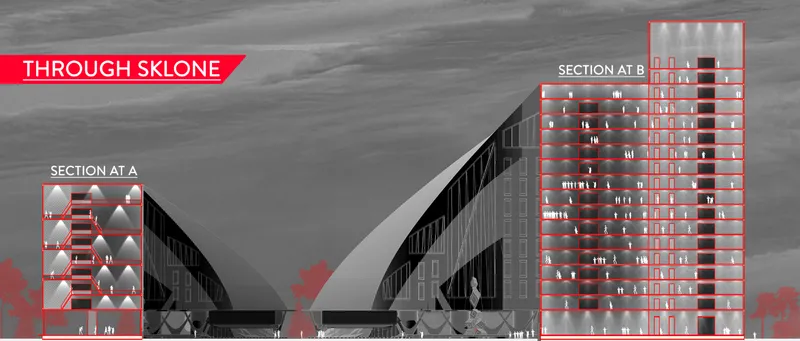
The section drawings cut through both the tower and the low-rise volumes, revealing their interior relationship. Communal terraces appear on every level, varied unit types accommodate diverse occupants, and curved clusters replace the monotony of double-loaded corridors. Pedestrian figures at the base give scale to the column-lifted ground plane, where the building meets the city not as a wall but as a permeable threshold. The spatial organization is the anti-hostel: density without repetition, economy without spatial poverty.
Wind, Noise, and the Invisible Architecture of Comfort
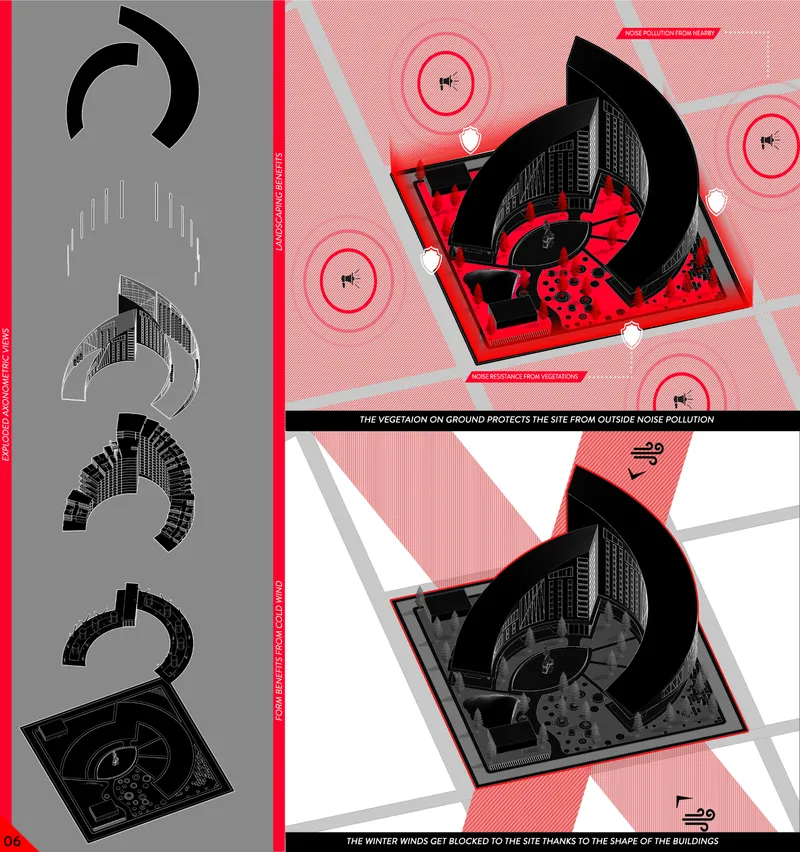
The analytical diagrams are where SKLON's bioclimatic argument becomes most convincing. Plan and axonometric views map noise and wind patterns around the curving forms, showing how the arc deflects icy winter currents channeled from the river edge while redirecting gentler summer breezes into the courtyard and terrace zones. Vegetation belts along the perimeter provide natural sound and dust filtration, shielding residents from traffic noise that will only intensify as surrounding commercial plots develop.
These are not abstract environmental aspirations layered onto a predetermined shape. The massing itself is the environmental strategy. Solar orientation prevents overheating in summer while ensuring adequate daylight penetration in Moscow's low-angle winter sun. The raised ground plane allows cold air to drain beneath the building rather than pooling at entrances. Building mass stabilizes temperature differentials across seasons. SKLON treats passive design not as an add-on but as the generative logic of form.
Scaling the Prototype: Urban Context and Future Density
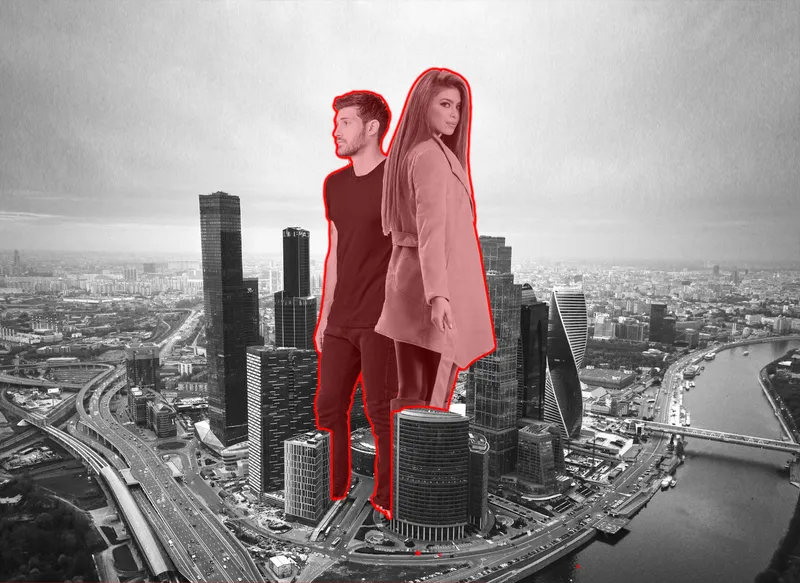
The aerial photograph of the tower district, with two composited figures standing at colossal scale over the waterfront, is provocative rather than literal. It positions SKLON's ambitions within the broader urban narrative of Moscow's post-industrial riverfront, where former factory lands are being converted into high-density mixed-use quarters. The image suggests that the human body, not the speculative real estate parcel, should be the measure of new development. SKLON is sited precisely where this tension between industrial heritage and metropolitan aspiration plays out most acutely.
By designing for the forces already present on the site, including incoming density, rising noise levels, and seasonal climate swings, Faris and Suresh propose a prototype that could adapt to analogous conditions in other rapidly densifying cities. The curving geometry is not a formal signature; it is a transferable strategy. Change the wind data, shift the solar angles, adjust the noise sources, and the arc recalibrates.
Why This Project Matters
Youth housing is one of architecture's most neglected typologies. It gets budgeted like infrastructure and designed like afterthought, producing corridors of identical rooms that do nothing for the people inside them or the cities around them. SKLON refuses that bargain. By grounding every formal decision in environmental data, the project demonstrates that bioclimatic design and social generosity are not competing agendas. They are the same agenda, expressed through geometry.
What makes Faris and Suresh's work compelling is its refusal to separate performance from experience. The wind diagrams are not supplementary analysis; they are the design. The curved clusters are not aesthetic preference; they are circulation strategy. The raised ground plane is not sculptural posture; it is thermal management. SKLON offers a credible prototype for how communal housing can be climate-responsive, spatially dignified, and scalable, all at the same time.
View the Full Project
About the Designers
Designers: Salman Faris, Santhosh Suresh
Enter a Design Competition on uni.xyz
uni.xyz runs architecture and design competitions year-round that reward proposals with spatial conviction and real site intelligence.
Project credits: SKLON by Salman Faris, Santhosh Suresh.


Popular Articles
Popular articles from the community


The Amber Palace Opera: A Geological Fiction Surfaces on Tallinn's Baltic Waterfront
Pierre Brillard reimagines a Baltic legend as a public landscape, opera house, and waterfront promenade rooted in Tallinn's coastal identity.

Cloaked Colonization: A Mobile Underwater Habitat That Moves Like a Fish
Micah Abaya's shortlisted EHC Pacific entry reimagines ocean settlement as a dispersed network of self-sustaining architectural organisms.

Extended Shell: Retrofitting Kolkata's Balconies as Living Urban Thresholds
A modular retrofit system recovers the social and environmental intelligence of Kolkata's historic verandas for contemporary Park Street residents.

Opera on the Sea: Driftwood Logic Shapes a Timber Opera House on Estonia's Coast
Trevor Orgill's opera house translates the entangled drift of floating timber into a civic building where wood, water, and music converge.

Similar Reads
You might also enjoy these articles
The Amber Palace Opera: A Geological Fiction Surfaces on Tallinn's Baltic Waterfront
Pierre Brillard reimagines a Baltic legend as a public landscape, opera house, and waterfront promenade rooted in Tallinn's coastal identity.
Dynamic Modules Shelter: A Telescopic Ring for Mountain Pilgrimage
A circular modular framework of steel, bamboo, and fabric grows vertically with demand, wrapping communal ground in adaptable shelter.

Singing Woman: Contemporary Architecture Inspired by Estonia’s Voice and the Sea
Singing Woman turns Estonia’s song culture into flowing opera house architecture, blending public life, landscape, sea, and national memory.
HYPERBLOCK: Flexible Urban Design for Barcelona’s Future City
HYPERBLOCK reimagines Barcelona as flexible urban design, layering density, daylight, public space and adaptable housing above Cerdà’s grid.

Comments (0)
Please login or sign up to add comments
No comments yet. Be the first to comment!