

Smart Rotating Shoe Tower: Ferris Wheel Logic Applied to Vertical Shoe Storage
Liu Ming and Xiao Han borrow the rotating loop of a ferris wheel to turn a tall cabinet into a motorised carousel for storing and displaying shoes.


Most shoe storage fails at the same point: the pair you want is always on the shelf you cannot reach. The Smart Rotating Shoe Tower responds by refusing to let shelves stay put. It borrows the loop of a ferris wheel and turns it upright inside a cabinet, so the collection travels to the user rather than the other way around. The idea is simple enough to explain in one sentence, and that is its strength.
Developed by Liu Ming and Xiao Han, the project begins from an observation about how people live with their shoes. Owning dozens or even hundreds of pairs is no longer unusual, yet the market offers few solutions that are both practical and worth looking at. The designers frame their answer as a problem of vertical space: take the floor area of a single cabinet, stack the storage upward, and use rotation to keep every level within reach.
A Tall, Narrow Volume That Doubles as a Graphic Surface


The first rendering places the tower in a domestic setting: a yellow and purple cabinet printed with basketball player silhouettes, standing beside a white brick wall with a leather jacket on a hook. The cabinet reads less like furniture and more like a piece of the owner's identity, which suits a design aimed at people who treat their shoes as a collection rather than a necessity.
The second image lines up three versions in tan camouflage, white and black. This is a smart move. The tower's form stays constant while the skin changes, so the same mechanism can disappear into a minimal interior or take over as a statement object. Because the footprint is narrow and the height does the work, the cabinet claims very little floor while asserting a strong vertical presence.
Tilted Trays That Present the Shoe Instead of Hiding It

With the cabinet open, the interior shows its most considered detail. The trays, finished in pastel pink, mint and blue, are tilted rather than flat, holding boots, sneakers and loafers at an angle toward the viewer. That tilt does two jobs. It turns each tray into a small display shelf, the way a shop shows its stock, and it makes the selection faster because the shoe is already facing you when its tray arrives. The variety of footwear in the image also matters: the trays seem built to take a tall boot as readily as a low loafer, which is where many fixed shoe racks struggle.
Sneaker Culture and Street Art as the Design's Source Material

A collage of sneaker illustrations, graffiti artwork and a 3D street painting, with a pedestrian walking past on a wet road, sets the cultural reference point. It explains the graphic finishes seen earlier. The designers are not treating shoe storage as a neutral utility; they are tying it to a culture in which footwear is collected, customised and shown off. This is where the tower's ambition goes beyond tidiness: it wants the cabinet to carry the same visual energy as the shoes inside it.
Inside the Loop: Gear Motor, Touch Switch and an Exploded Mechanism

The technical sheet is the most convincing part of the presentation. Exploded detail drawings set out the rotating rack, a gear motor drives the loop, and a touch switch handles control. The sheet also includes a patent certificate, which signals that the designers have taken the mechanism past the image stage. The ferris wheel analogy becomes literal here: trays hang from a continuous rotating system, and one touch brings the chosen level down to a comfortable height.
What the drawings show is a clean division of labour. The motor and switch take on the effort of reaching, the tilted trays take on display, and the outer shell takes on expression. Each layer can be refined on its own terms, a sensible structure for a product that wants to be both an appliance and a piece of interior design.
Why This Project Matters
The Smart Rotating Shoe Tower reminds us that design at the scale of furniture can still draw on architectural thinking. The core move, trading floor area for height and solving access through movement, is the same logic behind stacked parking systems and paternoster lifts, scaled down to a bedroom corner. Liu Ming and Xiao Han apply it to an ordinary domestic frustration and come away with something both useful and legible.
The project is at its best where function and display overlap: the tilted tray, the interchangeable skin, the single touch that brings a pair forward. The next step is to show the tower at work across a full rotation and in a range of real rooms, so the efficiency claims can be judged against actual use. Even so, the proposal makes a clear case that storage does not have to mean concealment, and that a collection can be organised and celebrated at once.
View the Full Project
About the Designers
Enter a Design Competition on uni.xyz
uni.xyz runs architecture and design competitions year-round that reward proposals with spatial conviction and real site intelligence.
Project credits: Smart Rotating Shoe Tower by Liu Ming, Xiao Han.


Popular Articles
Popular articles from the community


Temporary Home for Dogs: A Reversed Zoo Rethinks Animal Shelter Architecture
In Bucharest, a sinuous corridor and freed landscape flip the logic of containment, designing a shelter that works to make itself unnecessary.

Extended Shell: Retrofitting Kolkata's Balconies as Living Urban Thresholds
A modular retrofit system recovers the social and environmental intelligence of Kolkata's historic verandas for contemporary Park Street residents.

Opera by the Sea Estonia: Three Shells Dissolving Architecture into Tallinn's Coastline
A winning opera house proposal replaces monumental form with interconnected shells that blur the boundary between building, park and Baltic Sea.

Faces of the Soviet Avant-Garde: Turning Moscow's Street Names into an Open-Air Museum
A network of sculptural installations across a Moscow residential district transforms forgotten architect names into spatial encounters with cultural memor

Similar Reads
You might also enjoy these articles


Healing Façade: A Modular Chapel System That Restores Ethiopia's Sacred Forests
Winner of the Eco-Chapel competition, this circular timber façade collects water from air to rebuild soil and reforest degraded Ethiopian landscapes.
Kaffeebühnen: Where Coffee Shop Architecture Becomes a Civic Stage in Vienna
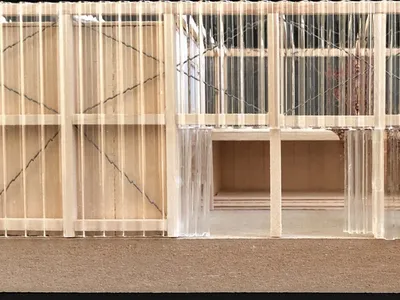
A linear sequence of timber boxes, transparent shells, and open yards turns the Viennese café tradition into a public performance space.

Eco Chapel: A Modular Forest Pavilion That Grows Like the Landscape It Protects
Hexagonal timber modules weave through existing trees, turning a chapel into a living system for prayer, education, and reforestation.


Urban Forest: A Vertical Ecosystem for 5,000 Workers in Singapore's Changi Business Park
Radially stacked pods and layered green decks turn a 7-acre plot into 47 acres of ecological workspace projected for 2040.

Explore Furniture Design Competitions
Discover active competitions in this discipline

Challenge to design luxury tourism on rails

VR headsets Storefront design competition

Competition to design a workstation for architects

Designing a staircase for a client
Comments (0)
Please login or sign up to add comments
No comments yet. Be the first to comment!