SPACE BRIDGE – A Transformative Vision in Pedestrian Bridge Architecture
A transformable pedestrian bridge architecture concept redefining urban space, mobility, and public life along the waterfront.


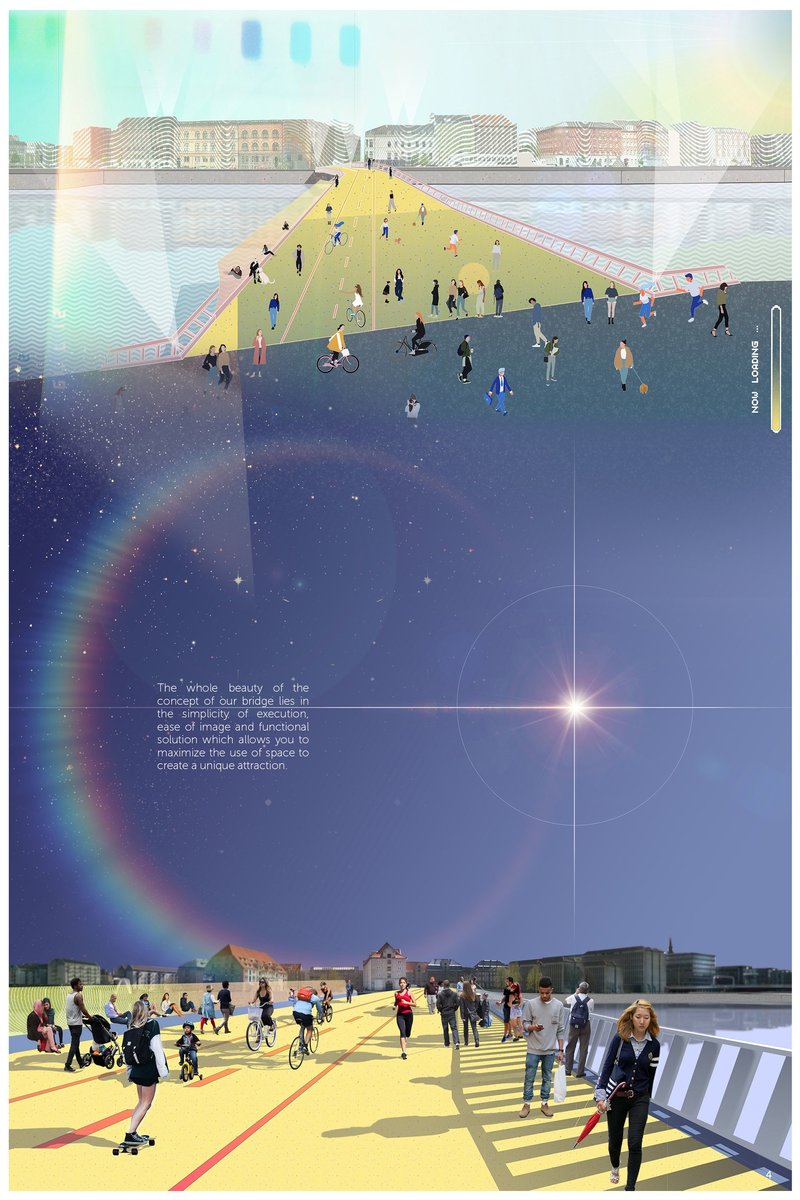
In the evolving discourse of pedestrian bridge architecture, infrastructure is no longer limited to movement alone. Today’s bridges are expected to perform as public spaces, urban landmarks, and dynamic social condensers. Space Bridge embodies this progressive shift — transforming a simple river crossing into a multifunctional urban platform that maximizes spatial efficiency while activating the waterfront.
Designed by Евгений Зайцев, Taras Chepikov, Egor Vorobev, and настя шкарупа, the project proposes a new model of urban bridge design that merges mobility, recreation, and adaptive functionality into a single architectural gesture.
At its core, the beauty of the concept lies in the simplicity of execution and clarity of form. The structure achieves a powerful spatial impact through a restrained architectural language, proving that pedestrian bridge architecture can be both minimal and transformative.
Urban Bridge Design as Public Space
Rather than treating the bridge as a narrow transitional corridor, the proposal expands its usable surface, creating a generous platform suspended above the water. This widening strategy allows the bridge to operate as an active public realm — not just a passage.
Parallel routes for cyclists and pedestrians ensure safe and intuitive circulation. The cycling lane maintains efficient linear movement, while the walking path invites slower engagement with the river landscape. The separation of flows improves safety while preserving visual continuity.
But mobility is only the beginning.
The expanded deck integrates zones for gathering, rest, and informal recreation. The bridge becomes an elevated urban square — a space where people meet, observe, relax, and participate in city life. This approach situates the project firmly within contemporary pedestrian bridge architecture, where infrastructure doubles as civic space.
A Transformable Bridge: Adaptive Urban Infrastructure
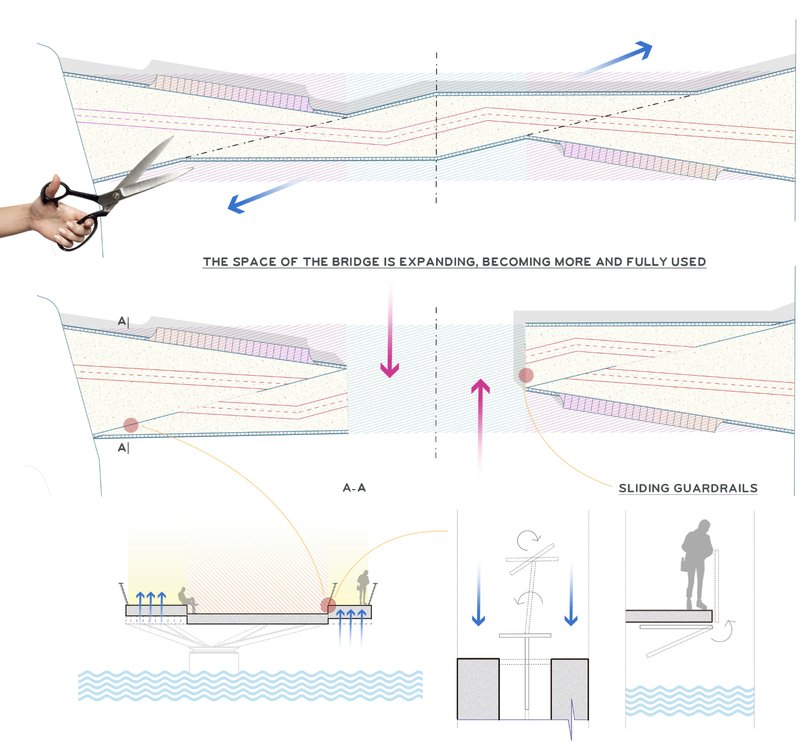
A defining feature of the Space Bridge is its adaptability. The structure responds to river transport requirements through a movable mechanism that allows sections of the bridge to separate when needed.
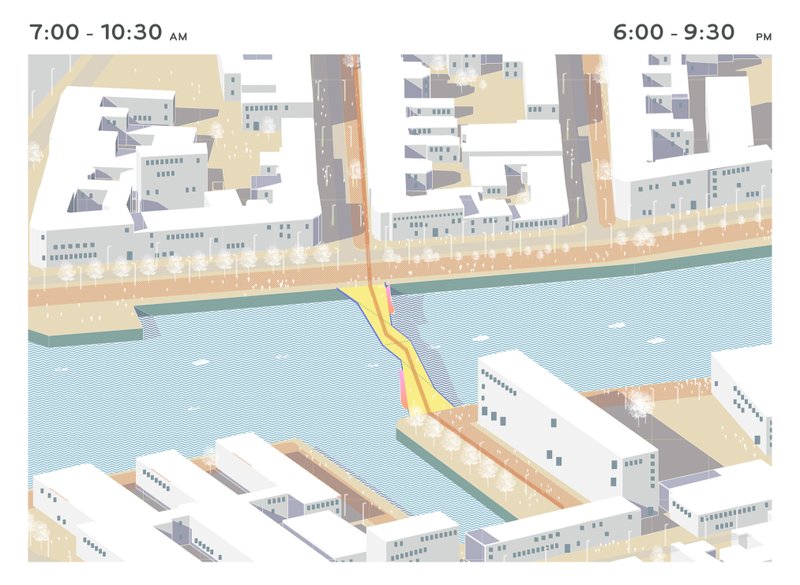
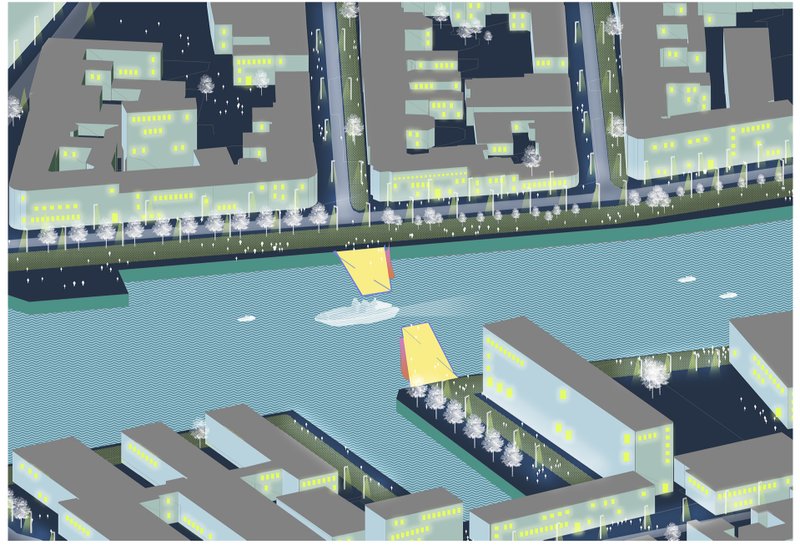
During peak commuting hours — from morning to evening — the bridge operates as a continuous connector between both sides of the city. Outside those time frames, the central section opens, allowing uninterrupted passage for river traffic.
This dual condition reflects intelligent urban bridge design. The bridge is neither static nor purely mechanical; instead, it becomes a responsive piece of infrastructure integrated with the rhythms of the city.
Sliding guardrails and sectional expansion systems further enhance the flexibility of the space. As the deck adjusts, the available public area increases, demonstrating how pedestrian bridge architecture can adapt to multiple urban scenarios without sacrificing aesthetic clarity.
Information, Movement, and Recreation
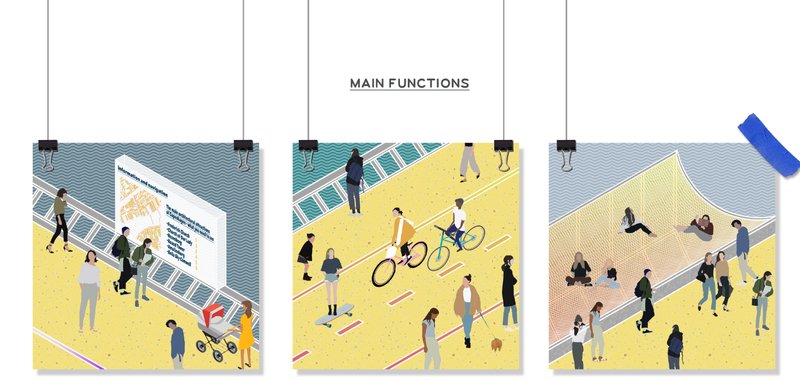
The bridge is conceived as an information node as well as a physical connector. Integrated panels and visual markers guide users through the city, highlighting key destinations and urban routes. In this way, the bridge functions as an orientation device — a gateway into the broader urban fabric.
Two clearly defined route systems structure the experience:
- Cycling Route: Direct, efficient, and optimized for speed.
- Walking Route: Scenic, interactive, and connected to rest zones.
Along the widened areas, spaces for relaxation introduce a softer layer to the infrastructure. Seating elements and hammock-like resting zones encourage people to pause and engage with the waterfront environment.
This layering of functions — movement, information, leisure — reinforces the bridge’s identity as more than transportation. It becomes a cultural and spatial catalyst.
Light, Simplicity, and Visual Identity
Visually, the bridge stands out through its strong geometric clarity. The bold linear expansion across the water creates a striking silhouette against the urban skyline.
At night, integrated lighting transforms the structure into a glowing urban landmark. The luminous surface emphasizes its role as a connector while enhancing safety and visibility. The contrast between the calm river below and the illuminated public surface above strengthens the symbolic presence of the bridge.
The design demonstrates how pedestrian bridge architecture can achieve iconic character without excessive formal complexity. Instead of relying on sculptural extravagance, the project derives identity from proportion, adaptability, and public engagement.
Maximizing Space, Creating Attraction
The entire concept is driven by a fundamental principle: maximizing the use of space to generate a unique attraction.
By expanding the deck, organizing parallel flows, and introducing adaptable mechanisms, the Space Bridge transforms a necessary crossing into a destination. It invites daily commuters, cyclists, tourists, and residents to inhabit it — not simply pass through it.
In doing so, the project redefines urban bridge design as a tool for placemaking. It demonstrates that pedestrian bridge architecture can:
- Activate waterfront zones
- Improve multimodal mobility
- Create inclusive public space
- Adapt to environmental and transport demands
- Strengthen urban identity
A Contemporary Model for Future Cities
As cities increasingly prioritize sustainable mobility and public realm activation, pedestrian bridge architecture must evolve beyond basic connectivity. The Space Bridge offers a compelling model — one that integrates infrastructure, landscape, and civic life.
Through clarity of concept, flexibility of structure, and generosity of space, the project transforms a simple crossing into a vibrant urban platform. It stands as an example of how thoughtful urban bridge design can shape the experience of the city itself.
In its simplicity lies its strength — a bridge that expands space, connects communities, and becomes a living part of the urban fabric.