

Stanaćev Granados Perches a Timber and Glass House on a Chilean Coastal Hillside for Visiting Grandparents
A 105-square-meter retreat in Matanzas doubles as a vacation rental when a retired German couple isn't spending time with family.


The brief for this house is disarmingly specific: a retired German couple wanted a place near their grandchildren in Chile, comfortable enough for months-long stays, economical to build, and capable of earning its keep as a vacation rental in between visits. Stanaćev Granados, led by Manu Granados and Nataša Stanaćev, responded with a compact 105-square-meter volume that sits lightly on a windswept hillside above Matanzas, a small coastal town where fog rolls in at dawn and the Pacific light turns golden by late afternoon.
What makes the project worth studying is not any single formal gesture but the way it resolves a tangle of competing demands. The house must be robust against coastal weather yet open to views. It must feel generous for two people yet remain small enough to heat and maintain. It must read as a permanent home for its owners and as a desirable getaway for strangers. The architects answer all of this with a disciplined section: a grounded, corrugated metal base capped by a glazed rooftop pavilion that turns the roof into the most desirable room in the house.
Anchored to the Hill


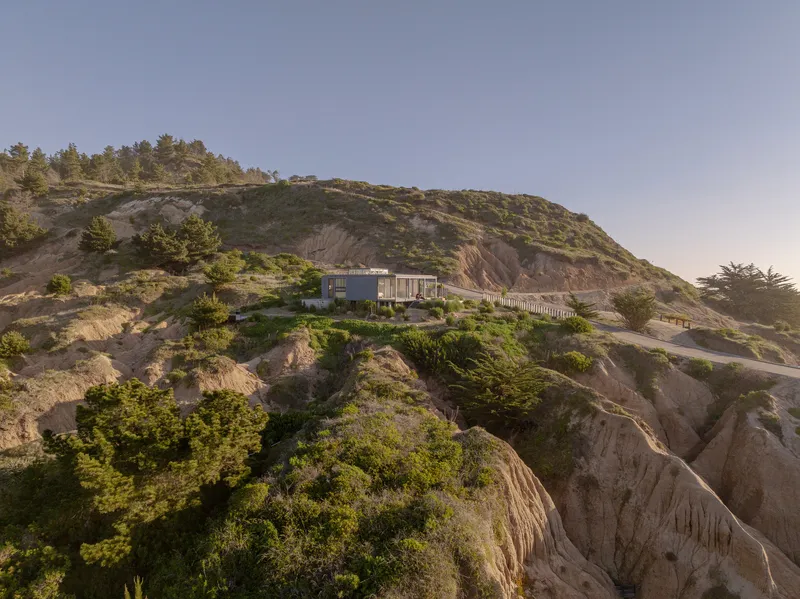
Matanzas sits where Chile's coastal range meets the Pacific, and the site is a rocky, scrub-covered hillside with serious exposure to wind and marine air. The aerial and distant views make the house's strategy legible: a low, horizontal volume pinned to the slope on concrete pier foundations, following the contour rather than fighting it. There is no grand entrance drive or manicured lawn, just a winding road and the native landscape pressing in on every side.
By keeping the footprint tight and elevating parts of the structure on pilotis, the architects minimize earthwork and preserve the existing drainage patterns. The building reads less as an imposition on the landscape and more as a barnacle clinging to rock, which is exactly the right posture for a site this exposed.
Two Materials, Two Moods

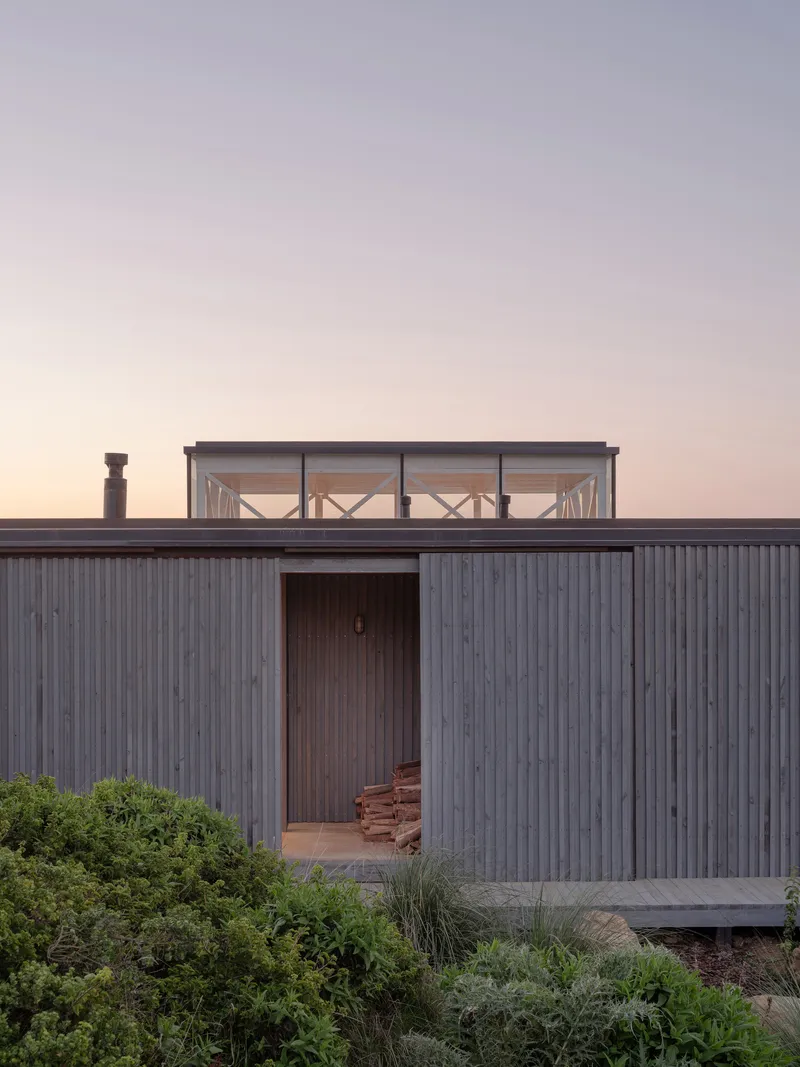

The facade alternates between corrugated metal cladding, used for the main enclosed volume, and vertical timber ribs that wrap specific zones. The metal is practical: it weathers well in salt air, sheds rain efficiently, and keeps costs down. The timber, by contrast, signals habitation and warmth. Where the two materials meet, you understand the programmatic logic. Metal wraps the sleeping and service quarters; timber marks the social thresholds, the entry, the covered terrace, the moments where inside and outside negotiate.
Crowning everything is the glazed steel-frame pavilion on the roof. It is visually lighter than the base, almost hovering, and its transparency makes it glow at twilight like a lantern on the hillside. The contrast between opaque base and transparent crown gives the house a sectional drama that a single-story plan this small rarely achieves.
The Rooftop Pavilion


The glazed upper volume is the house's most compelling move. Surrounded by planted native grasses that soften the boundary between structure and sky, it functions as an outdoor living room with a hot tub and panoramic views of the coastal hills. The steel frame is slender enough to nearly disappear when seen from inside, and the planting gives it a quality of being both sheltered and exposed. On a misty morning, the grasses blur into the fog and the glass walls seem to dissolve.
For a vacation rental, this space is the selling point. For the grandparents, it is the reward for climbing a ladder, a private retreat above the domestic routine of the floor below. The architects understood that a 105-square-meter house needs at least one moment of spatial extravagance, and they placed it on the roof where it costs the least in plan area and delivers the most in experience.
Sliding Open to the Landscape


At ground level, the house engages its site through a series of sliding doors set within the corrugated and timber facades. When open, the covered terrace becomes an extension of the interior, framed by boulders and native ornamental grasses planted by landscape firm Landscapers Chile. A curved concrete pathway approaches the entry, a gentle formal gesture that slows your arrival and sets up the threshold between wild hillside and domestic enclosure.
The decision to elevate part of the volume on pilotis creates a protected outdoor zone beneath the house, useful in a climate where coastal fog and drizzle can linger for hours. It also lets the planting grow under and around the structure, reinforcing the sense that the house is a guest on the hillside rather than its owner.
Light, Timber, and the Interior Section

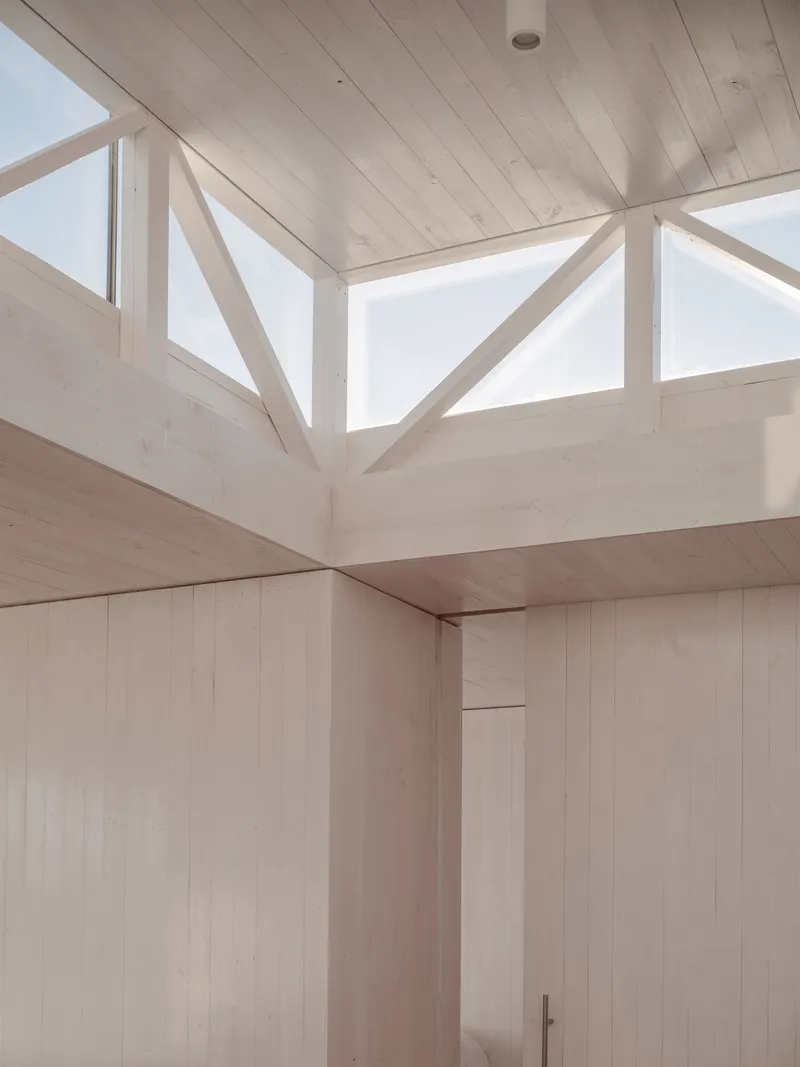
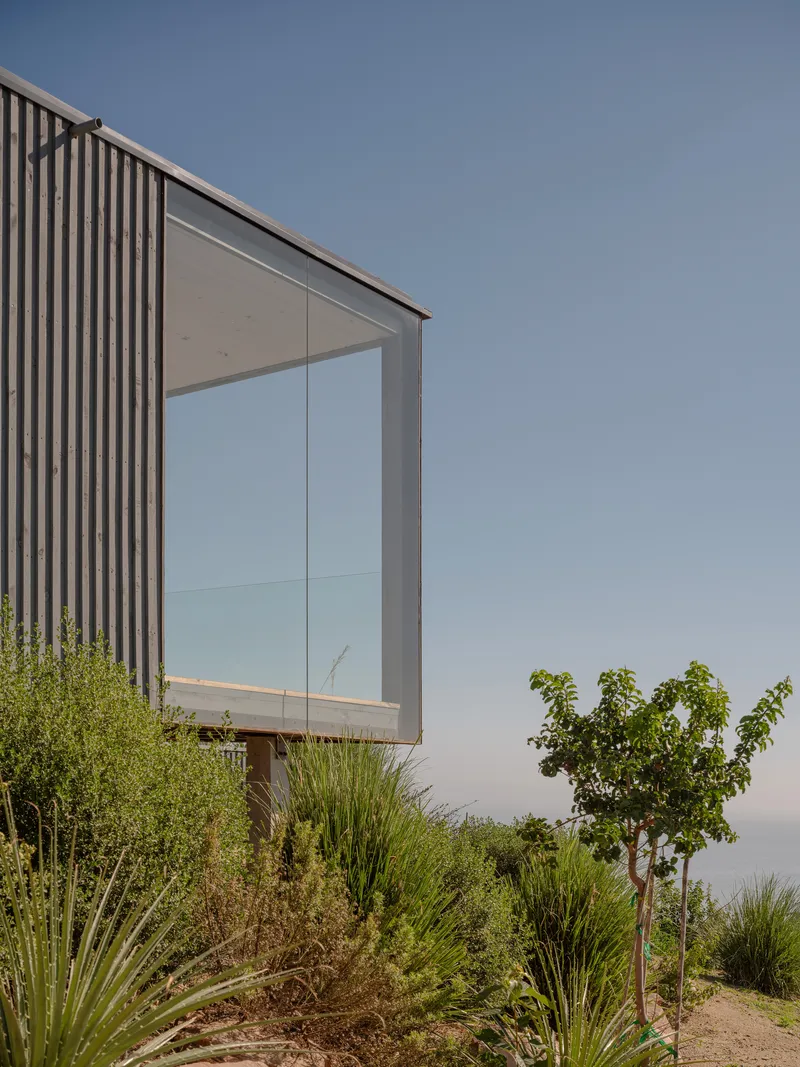
Inside, the palette simplifies to pale timber on walls, ceiling, and exposed structure. A clerestory monitor runs along the ridge, flooding the central living space with zenithal light and casting sharp triangular shadows from the timber bracing onto the ceiling plane. The effect is almost church-like in its quietness: light enters from above, the walls glow, and the proportions feel taller than the modest floor area would suggest.
The clerestory is the section's real engine. It ventilates the interior by drawing warm air upward, brings in diffused coastal light without the glare of a west-facing window, and gives the single-story plan a vertical dimension that keeps it from feeling squat. For a house that must perform as both year-round residence and short-term rental, this interior character, warm, luminous, and spatially generous, does the heavy lifting.
Twilight Presence
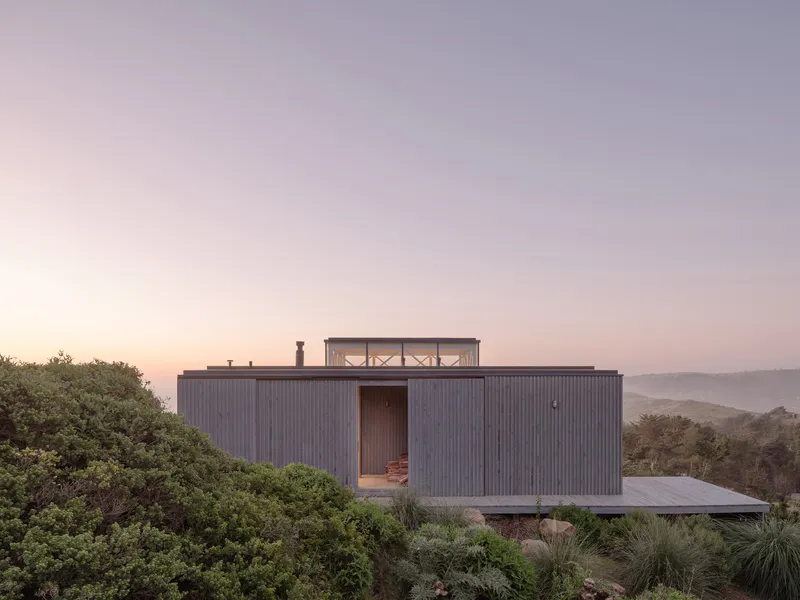
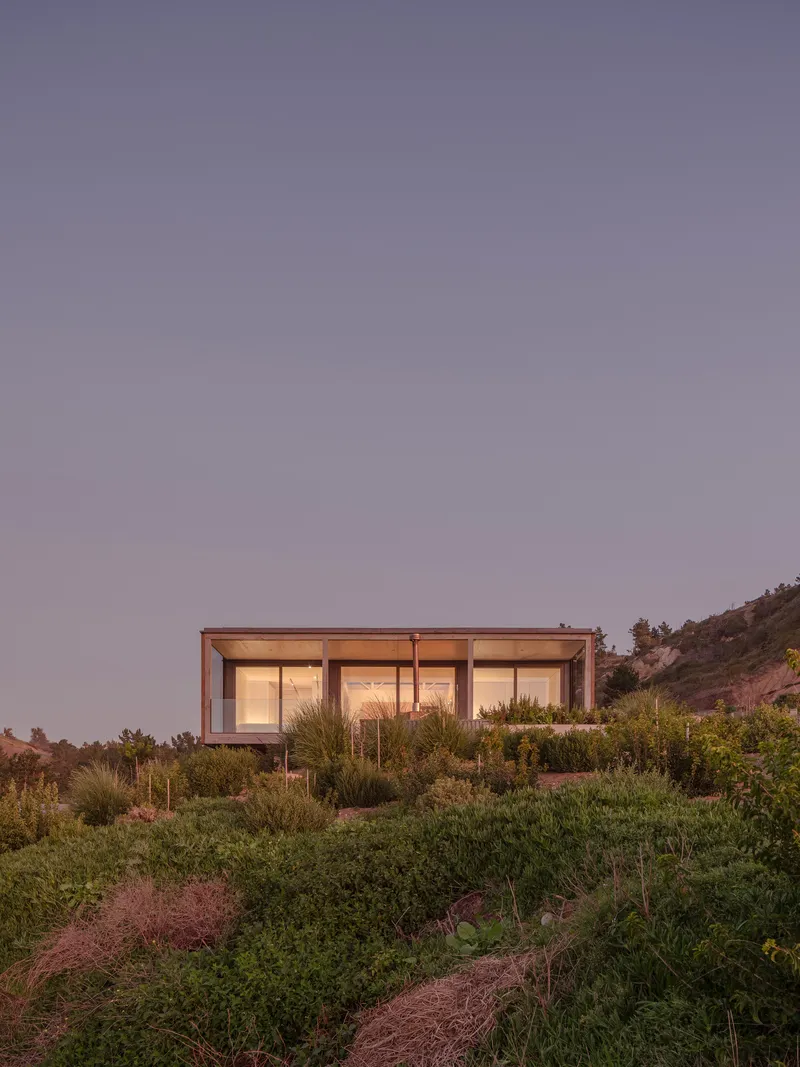

The house performs well at dusk. Marcos Zegers captures it repeatedly at the threshold between day and night, when interior lighting transforms the glazed pavilion into a beacon and the corrugated metal catches the last warmth of the setting sun. From a distance, the building is a small point of habitation on an otherwise empty hillside. Up close, the interplay of warm light spilling through glass and the textured shadows of the timber ribs give the facade a depth that disappears in flat daylight.
There is something poignant about the scale. At 105 square meters, this is not a grand coastal villa. It is a house sized for two people who want to be near family, watch the fog come in, and then hand the keys to someone else for a few weeks. The twilight images capture that duality: intimate from within, visible from afar.
Plans and Drawings
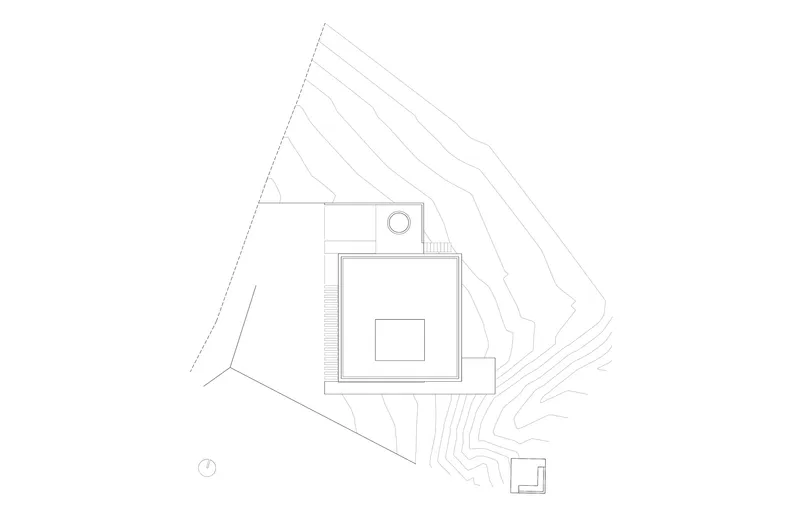

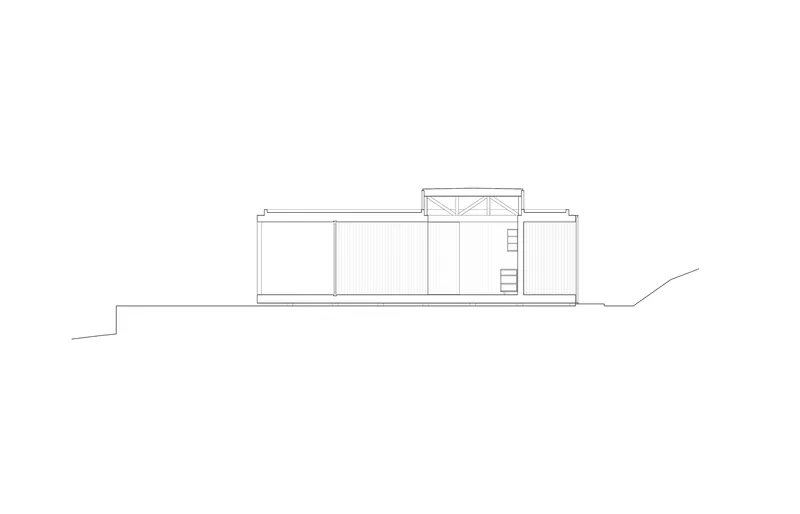


The site plan confirms what the aerials suggest: a single rectilinear volume oriented along the slope's contour, minimizing cut and fill. The floor plan reveals a compact, symmetrical layout with a central living and dining area flanked by two bedrooms and their bathrooms, a clear bipartite arrangement that works equally well for a couple and for rental guests who want separation. Ladder access to the rooftop terrace keeps the plan free of a staircase footprint.
The elevation drawing shows the low horizontal profile with the clerestory monitor rising at the center, giving the house its characteristic silhouette. The exploded axonometric is the most revealing drawing: concrete pier foundations anchor the structure to the hillside, a timber platform and frame sit above, and the roof structure lifts to create the glazed pavilion. General contractor Lignatec executed a system that is essentially a timber kit elevated on concrete point loads, an approach that keeps construction fast, dry, and minimally invasive on a sensitive coastal site.
Why This Project Matters
The Grandparents' House is a useful counter-example to the prevailing logic of coastal residential architecture, where clients and architects often chase ever-larger footprints and dramatic cantilevers. Here, the restraint is the story. A compact plan, two honest materials, a smart section, and a landscape strategy that lets the site stay wild. Nothing about the project demands attention, yet every decision holds up to scrutiny.
Stanaćev Granados also demonstrates that dual-use programming, personal residence plus vacation rental, does not have to result in bland, market-driven interiors. The clerestory, the rooftop garden room, the timber warmth: these are authorial choices that serve both the couple who commissioned the house and the strangers who will discover it later. At 105 square meters, the house proves that generosity is a matter of proportion and light, not square footage.
Grandparents' House by Stanaćev Granados (lead architects Manu Granados and Nataša Stanaćev), Matanzas, Chile. 105 m², completed 2021. General contractor: Lignatec. Landscape: Landscapers Chile. Photography by Marcos Zegers.
About the Studio
Share Your Own Work on uni.xyz
If projects like this are the kind of work you want to make, uni.xyz is a place to publish your own, find collaborators, and enter design competitions.


Popular Articles
Popular articles from the community


Manzana Morphosis: Stretching Barcelona's Grid into a Living Landscape for 2050
A radical reworking of the Eixample manzana turns density into a tool for generous public space, vertical ecology, and environmental performance.
Extended Shell: Retrofitting Kolkata's Balconies as Living Urban Thresholds
A modular retrofit system recovers the social and environmental intelligence of Kolkata's historic verandas for contemporary Park Street residents.

The Amber Palace Opera: A Geological Fiction Surfaces on Tallinn's Baltic Waterfront
Pierre Brillard reimagines a Baltic legend as a public landscape, opera house, and waterfront promenade rooted in Tallinn's coastal identity.

Singing Woman: Contemporary Architecture Inspired by Estonia’s Voice and the Sea
Singing Woman turns Estonia’s song culture into flowing opera house architecture, blending public life, landscape, sea, and national memory.

Similar Reads
You might also enjoy these articles

Bao Huynh Watercolor Atelier: A Serene Art Retreat in Hội An
Bao Huynh Watercolor Atelier in Hội An blends multifunctional art spaces, sustainable design, local materials, and family-friendly living in a serene environment.

Atelier Macri Concept Store Interior Design by CASE-REAL
Atelier Macri store features a "ko" counter, walnut wood details, cork displays, blending retail, gallery, and seamless customer experiences.

Manuel Vargas Izquierdo Stadium and High-Performance Sports Center: Architectural Excellence in Jalpa de Méndez
The Manuel Vargas Izquierdo Stadium blends sustainable design, inclusive sports facilities, and cultural-inspired architecture, revitalizing Jalpa de Méndez’s public spaces.

KAKR Buluh Awar Hall: Revitalizing Community and Ecology Through Bamboo Architecture
Community built bamboo hall revitalizes Buluh Awar village, empowering youth, restoring ecology, celebrating vernacular craftsmanship through sustainable architecture and culture.

Explore Generation Competitions
Discover active competitions in this discipline

Challenge to design a portable theatre

Challenge to design a portable music platform

Challenge to design an open learning module for the elderly

Challenge to design mud housing for contemporary communities
Comments (0)
Please login or sign up to add comments
No comments yet. Be the first to comment!