

Studio WhiteScape Wraps a Bengaluru Home in Concrete Lace and Trumpet Tree Gold
On a 1,200 sq. ft. corner plot flanked by a hillock and Tabebuia groves, The Blooming Haus stacks 6,000 sq. ft. of living around light-filled courtyards.


A 1,200 square foot corner plot in Bengaluru is not the kind of site that invites ambition. It invites compromise: stack rooms, push walls to boundaries, seal the envelope, move on. Studio WhiteScape refused every one of those shortcuts with The Blooming Haus, a 6,000 square foot residence completed in 2025 that treats its constraints as generative forces. The plot sits at a south-west intersection with a hill and temple to the east and a scattering of Tabebuia trees, pink and golden trumpet varieties, marking the street edge. Rather than clearing the site and ignoring its context, the architects built around and through those conditions, pulling the landscape into the section of the house itself.
What makes this project genuinely interesting is how it distributes communal life vertically. Every floor gets its own recreational gathering space, its own courtyard, its own relationship to the sky. The result is not a single living room with bedrooms stacked above it but a continuous social landscape that spirals upward through planted terraces, double-height voids, and perforated screens. The building's concrete shell is raw and unapologetic, but the light that passes through its chevron-cut walls and timber louvers transforms every surface into something ephemeral, patterned, constantly shifting.
A Concrete Veil Among the Blossoms

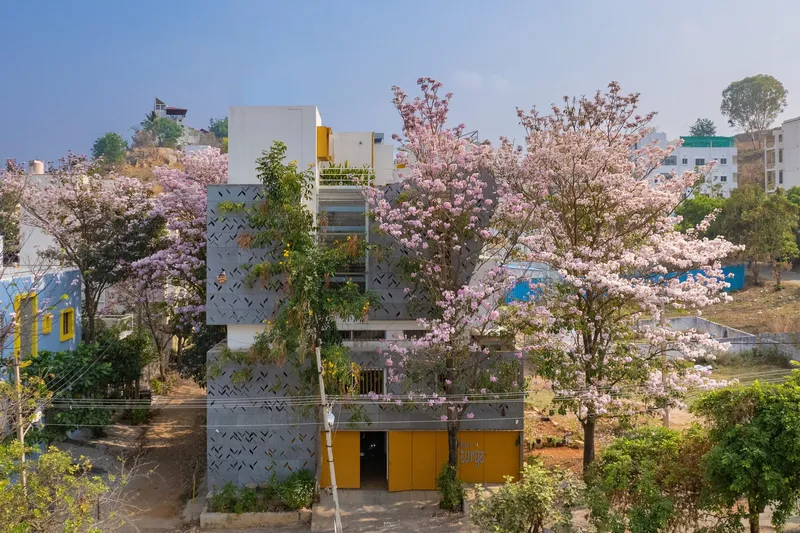
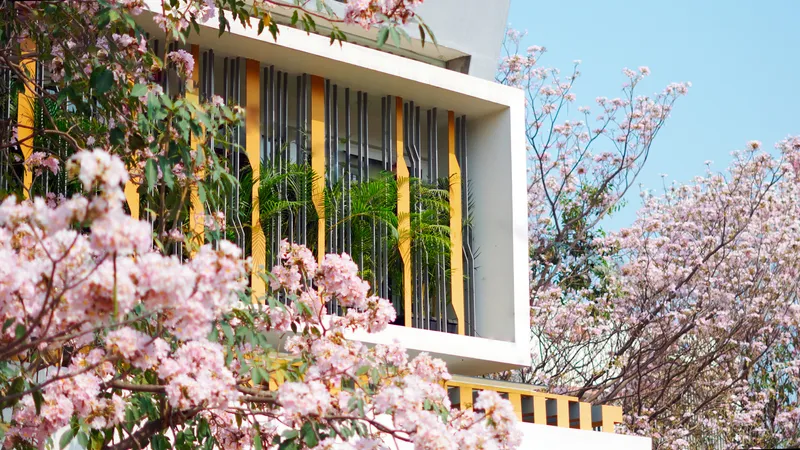
The facade is the project's public argument. Perforated concrete panels with herringbone and chevron patterns wrap the street-facing elevations, their geometric regularity offset by the organic sprawl of Tabebuia branches pressing against them. When the trees bloom, pink petals fill the gaps between concrete and steel, collapsing the boundary between building and canopy. The yellow accents, visible at window reveals, stair rails, and louver frames, pick up the tone of the Golden Trumpet Tree on site, turning a color choice into a site-specific reference.
Jaisalmer and black Kota stones cascade down the entrance stairs, grounding the composition in weight and tactility at the threshold. The material palette reads as deliberate: raw concrete for the envelope, warm timber for interior screens, natural stone for transitions between inside and out. Nothing is clad or concealed. The building wears its structure openly.
Courtyards as Vertical Infrastructure


The courtyards here are not decorative. They are structural to the section, puncturing through multiple floors to pull light and ventilation deep into the plan. The double-height planted court visible at the center of the house acts as a thermal chimney, drawing hot air upward and out through operable louvers at the roof level. River stones, climbing plants, and a narrow water channel at ground level create a microclimate that tempers the Bengaluru heat without mechanical intervention.
Each courtyard is scaled differently. Some are tight vertical shafts lined with timber battens, casting ruled shadows across polished floors. Others open wide enough for a mature tree to grow through, its canopy visible from the upper terraces. The patterned floor tiles in the courtyard shown in image 18 introduce a layer of graphic precision that contrasts with the loose, organic planting around it. The effect is a house that breathes at multiple points, never relying on a single atrium to do all the environmental work.
Light as a Design Material

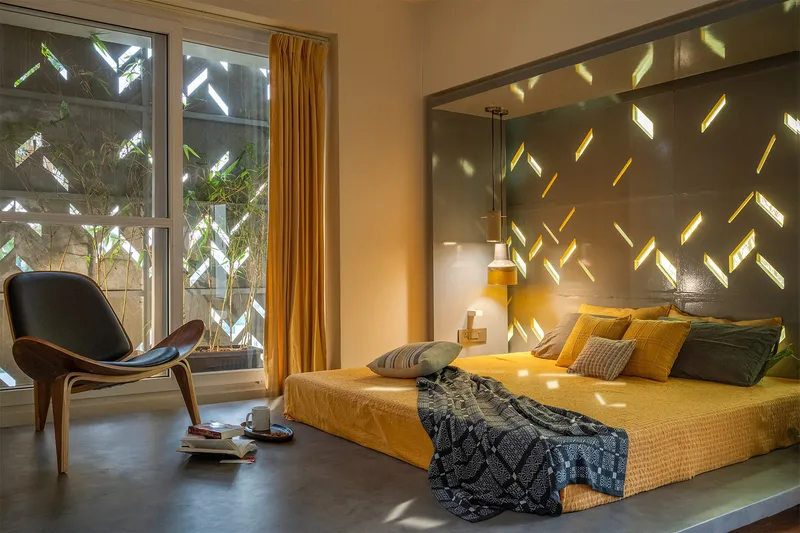

Studio WhiteScape treats sunlight the way a textile designer treats thread: it is woven, filtered, directed, and patterned. The angled timber louver clerestory on the upper floor casts parallel stripes across the grey tile, transforming a corridor into a sundial. In the bedroom, a perforated concrete wall throws dappled light across the bed, creating a constantly shifting pattern that responds to the sun's angle throughout the day. These are not accidental effects. They are designed, calibrated by the geometry of each screen and opening.
The chevron screen wall facing the garden does double duty: it provides privacy from the street while framing views of bamboo and trumpet tree branches through its diamond-shaped apertures. The light passing through this screen reads as a pixelated image of the garden beyond, blurring the line between wall and window. For a house on a tight urban plot, this strategy of controlled porosity is essential. It allows the family to feel surrounded by landscape without actually being exposed to neighbors or traffic.
The Double-Height Living Core


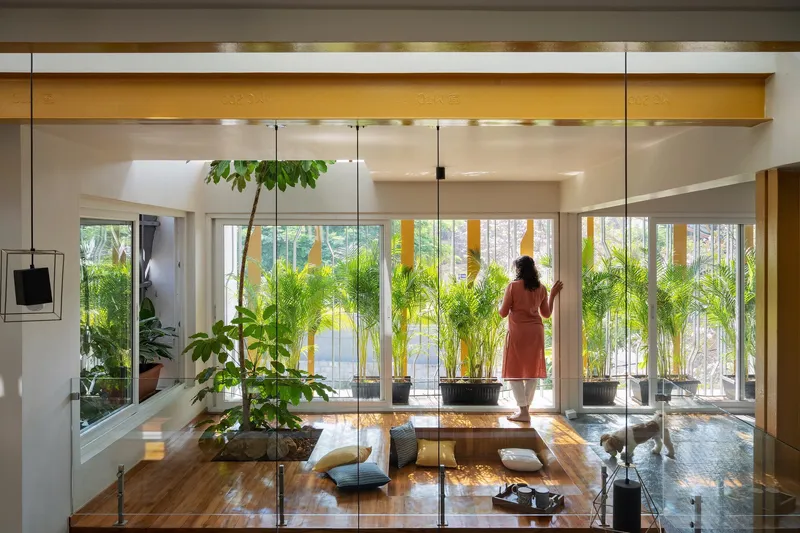
The first-floor living room is the gravitational center of the house, a double-height volume framed by floor-to-ceiling timber-and-glass doors that open onto planted courtyards on two sides. The proportions are generous for a 1,200 square foot footprint, which tells you something about how aggressively the architects carved space vertically to compensate for horizontal limits. A mezzanine overlook connects the upper bedrooms to this volume, so the living room is never isolated; it is always visible, always connected to the rest of the house.
Potted palms and bamboo in the adjacent courtyards serve as a green middle ground between the polished interior and the raw concrete shell. The grey tile floor with yellow triangular inlays extends the house's color logic into the ground plane, a small detail that reinforces the overall coherence of the design. The dining area and pooja room sit adjacent, flowing into the kitchen without hard partitions, so the first floor reads as one continuous social landscape.
Stairs, Thresholds, and In-Between Spaces
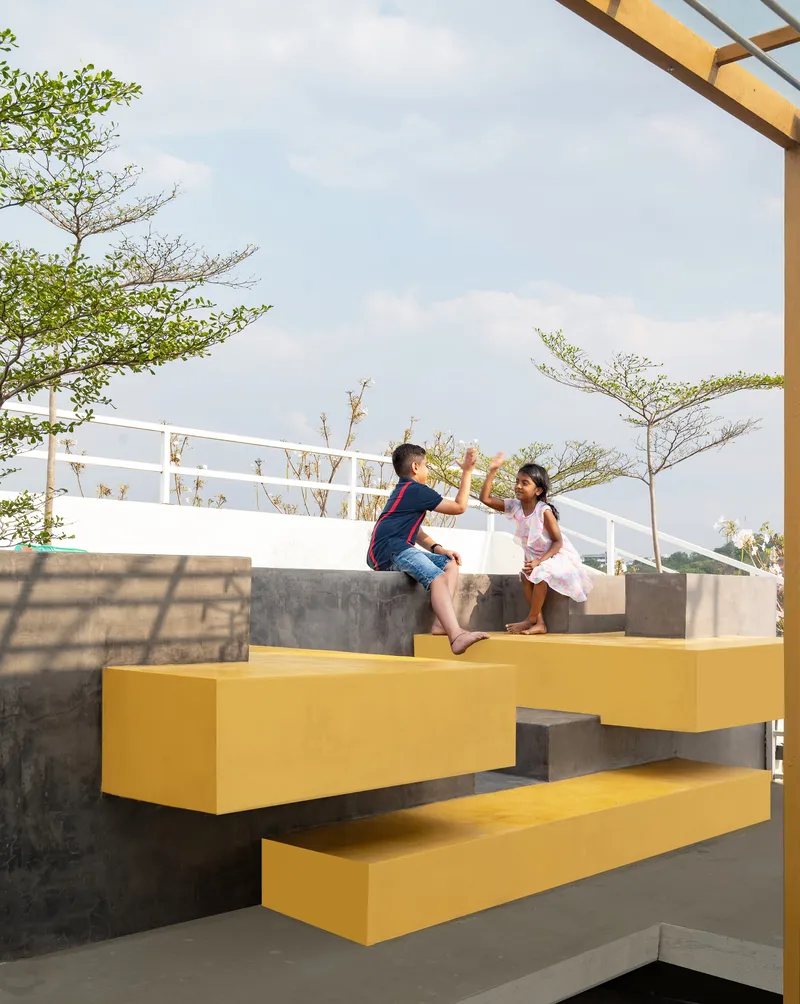
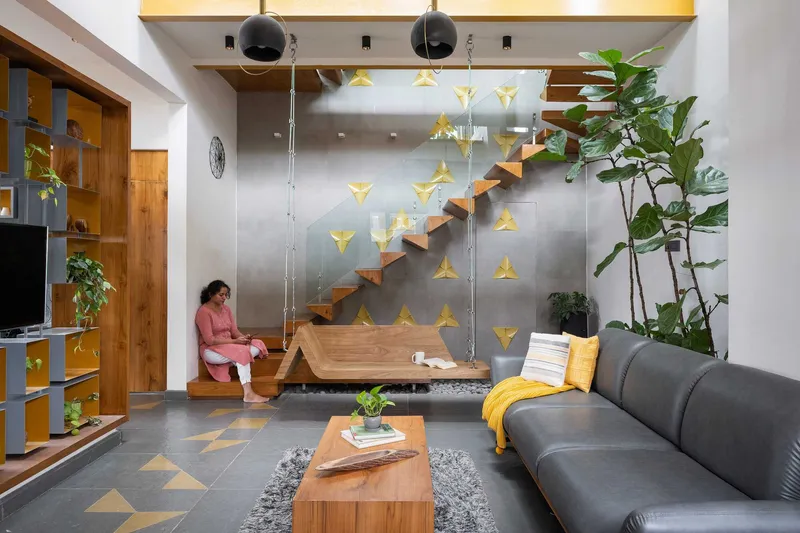

The cantilevered yellow steel stair is the most photogenic element in the house, and it earns its visibility. It connects the upper terrace to the roof garden in open air, with no enclosure, so climbing it feels like ascending through the tree canopy. The two children playing on it in the photograph are not staged decoration; they demonstrate how the stair functions as a recreational space in its own right, not just circulation.
Inside, a floating timber staircase set against a dark steel panel wall anchors the vertical circulation with a different material character: heavier, warmer, more contained. The triangular yellow floor tile accents at its base echo the exterior stair's color, threading a visual continuity between inside and outside. The double-height entry space with its modular shelving unit and rope railings introduces yet another stair language, one that feels domestic and handcrafted rather than industrial. Three distinct stair typologies in one house is ambitious, but it works because each one belongs to a different spatial condition.
Intimate Rooms with Considered Details
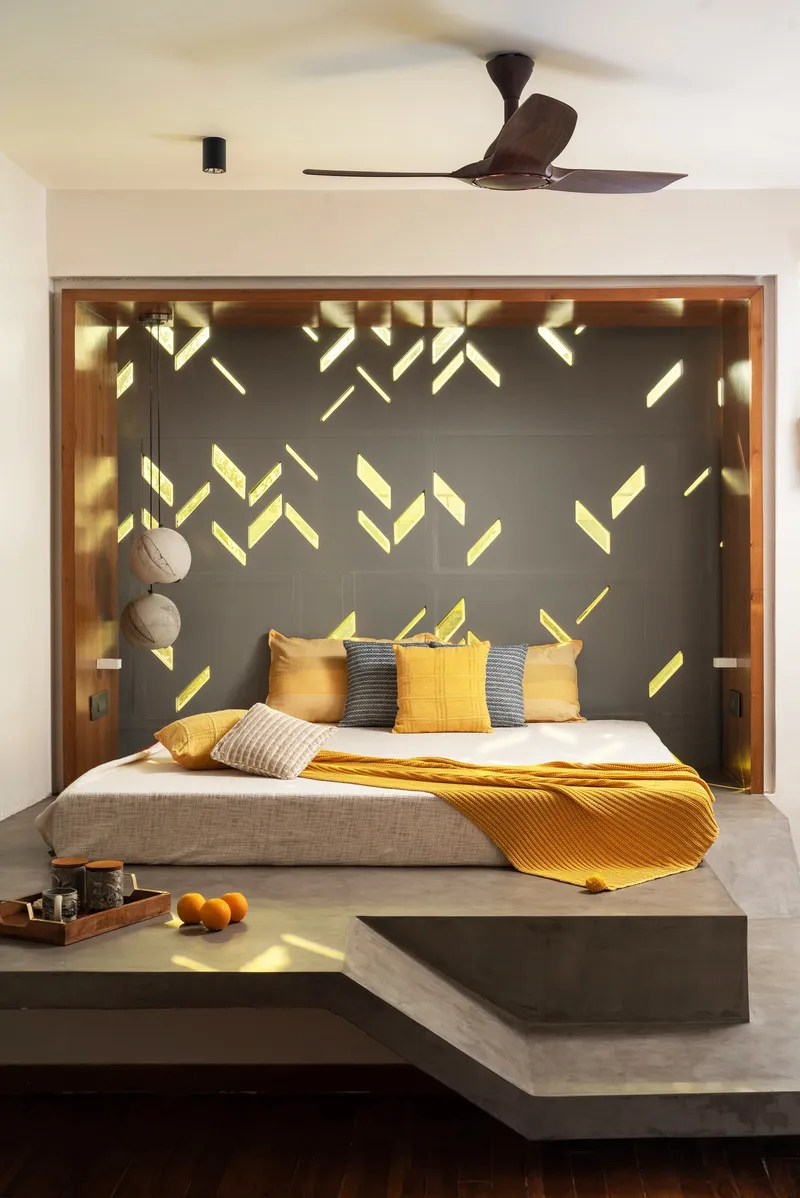


The bedrooms pull back from the house's public exuberance. The alcove bedroom with its timber frame and backlit chevron cutouts is a masterclass in restraint: the geometric shadow pattern is the only ornament, and it shifts with the time of day. The raised timber platform with its skylight overhead creates a reading nook that feels like a treehouse, elevated above the main living spaces and bathed in overhead light. A woman sits reading while a dog rests nearby. The scene is ordinary, which is exactly the point. Good architecture accommodates the mundane as gracefully as it handles the dramatic.
The kitchen balances warmth and precision with yellow countertops, timber-framed windows, and a glass mezzanine railing that borrows light from the double-height living room. Two wooden bar stools face a horizontal window that frames bare branches and a distant landscape, turning a cooking counter into a viewing platform. The work area on another floor repeats this strategy: a built-in desk faces a perforated metal screen, with yellow wall niches providing storage and color simultaneously.
Rooftop and Terraces
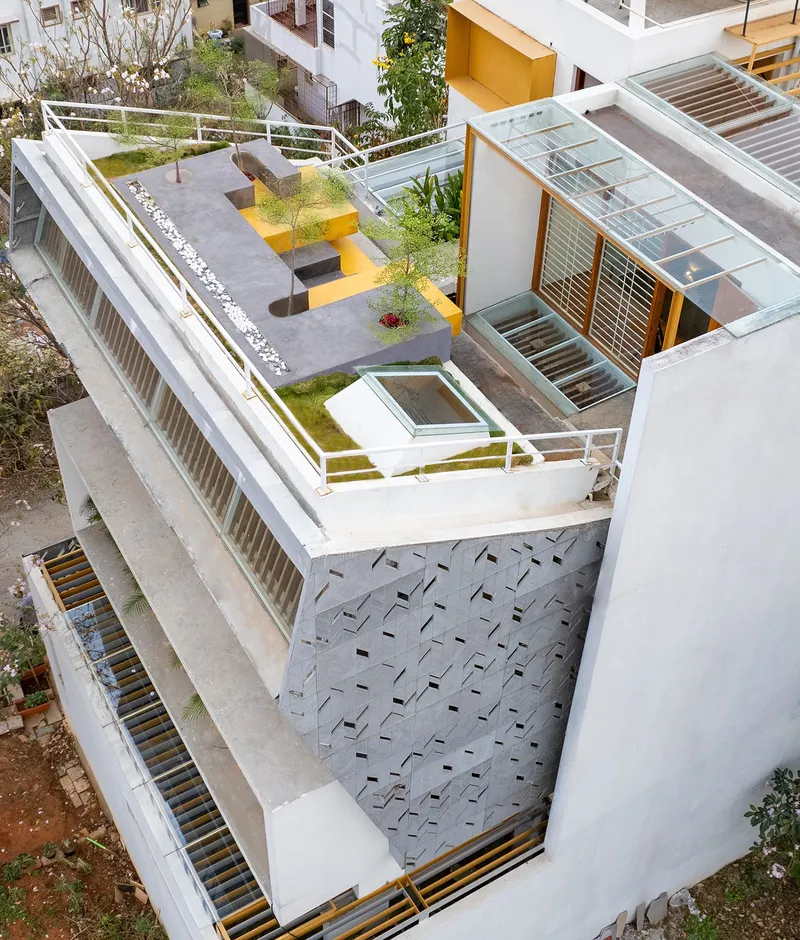


The aerial view reveals how the rooftop garden, planted terraces, and perforated courtyard paving compose a layered topography across the building's footprint. From above, the house reads less like a box and more like a series of stacked gardens connected by concrete slabs. The yellow accents, scattered across railings, window reveals, and stair elements, register as bright punctuation marks against the grey and green.
Built-in benches at window openings create sit-out zones that frame specific views: two figures on an exterior terrace in one instance, the hillock and temple in another. These moments of repose are distributed across every level, fulfilling the design brief of giving each floor its own congregational space. The house does not force the family into a single living room; it scatters opportunities for gathering across its entire vertical section.
Plans and Drawings

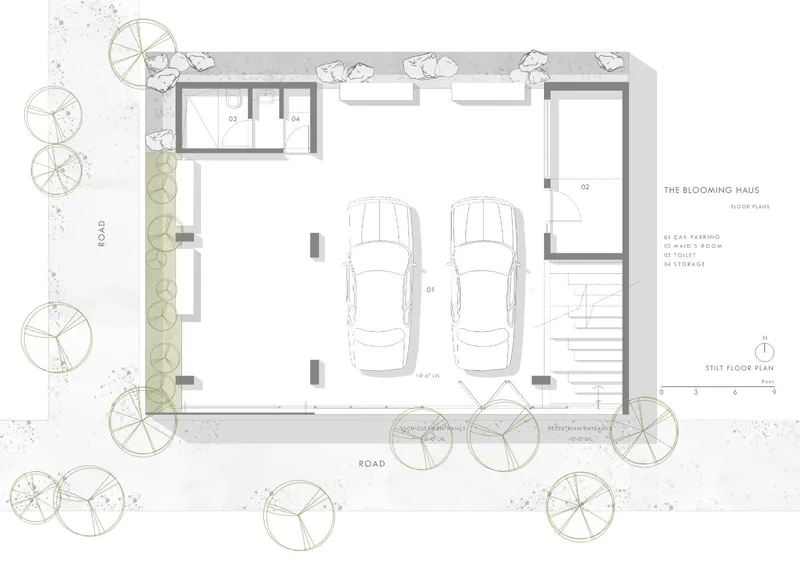
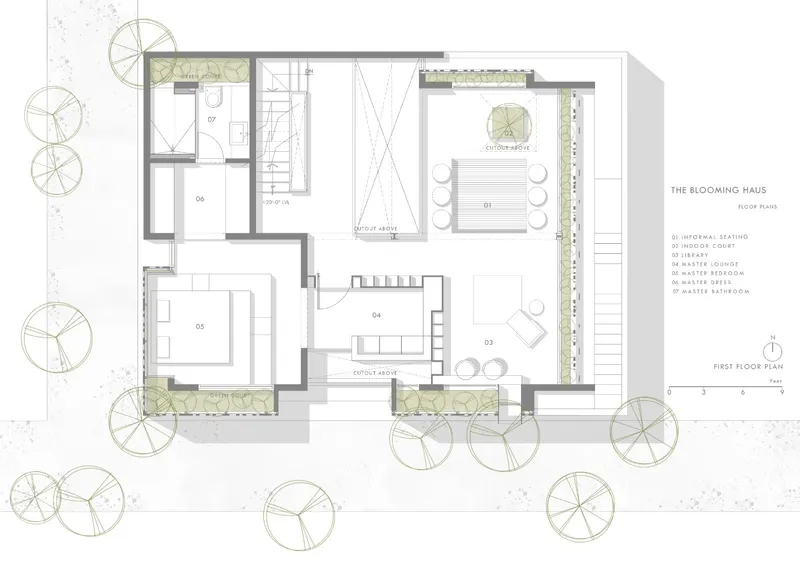
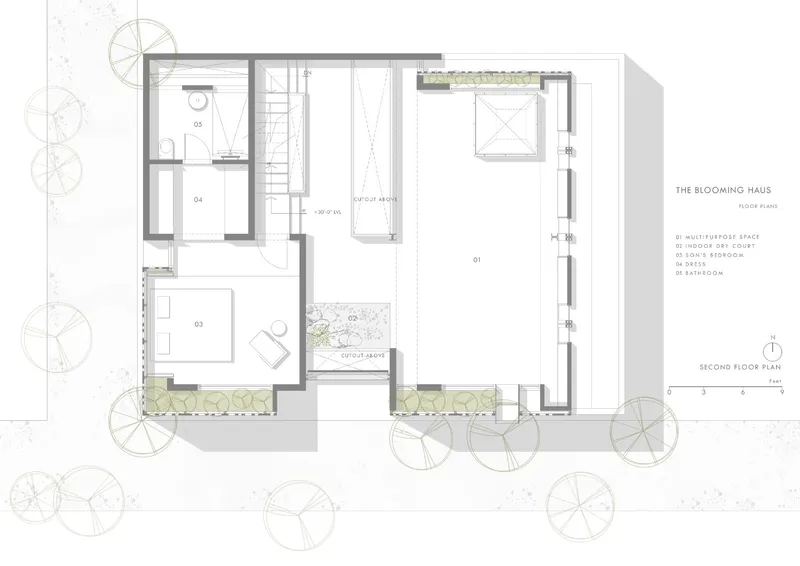

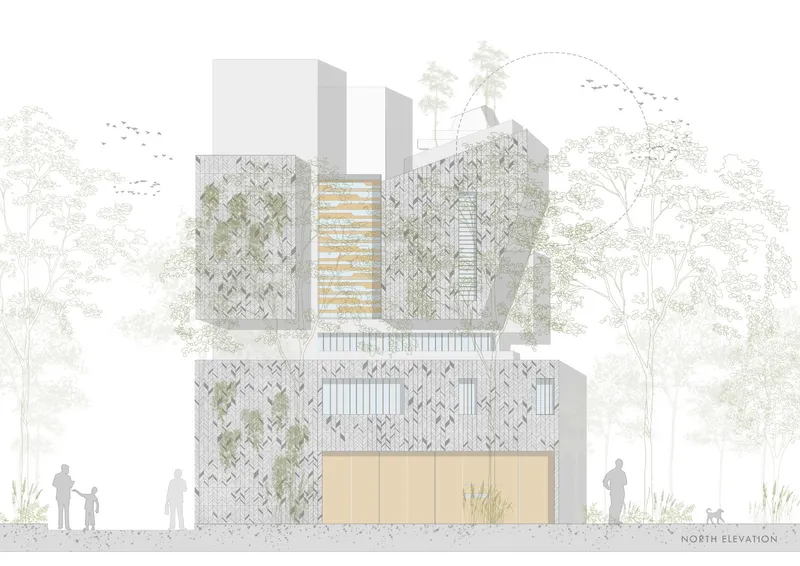


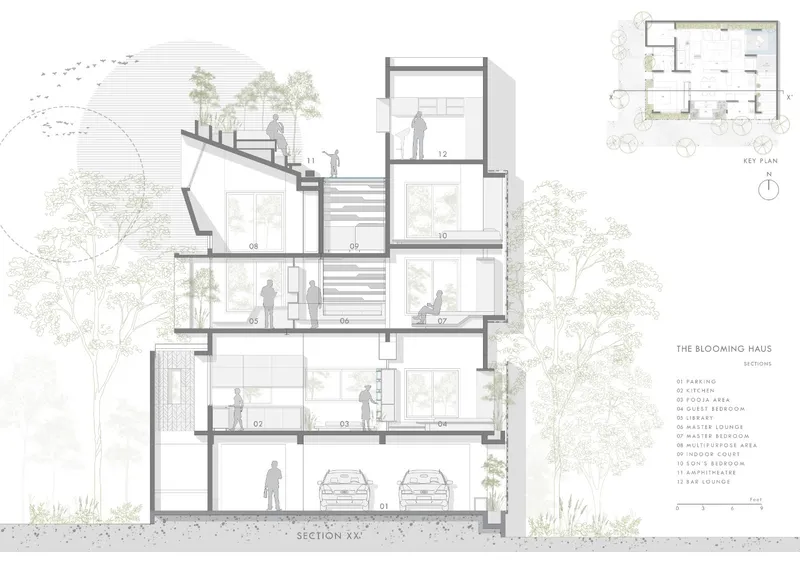


The floor plans reveal the discipline behind the project's apparent looseness. Parking for four cars occupies the basement, freeing the ground and upper levels entirely for living. The ground floor plan shows how two planted courtyards are carved from the footprint, creating cross-ventilation paths and light wells that would otherwise be impossible on a corner site this compact. Each successive floor steps back or extends differently, so no two plans are identical.
The sections are the most revealing drawings. They show the split-level organization in full: cascading stairs link half-floors, so the vertical distance between any two spaces feels shorter than it actually is. Planted terraces appear at nearly every level, creating a continuous green section that runs from the basement ramp to the roof garden. The axonometric drawing places the house in its neighborhood context, showing how the dark, perforated volume holds its own against the forested hillside to the east. It is a compact building that reads as expansive, a dense plan that feels porous.
Why This Project Matters
The Blooming Haus is a pointed rebuttal to the conventional Indian urban house, which typically treats the plot as a container to be filled and the facade as a surface to be decorated. Studio WhiteScape instead treats the plot as a landscape to be curated and the facade as a filter to be calibrated. The result is a house that performs environmentally, through passive ventilation, daylighting, and planted terraces, while also performing socially, through distributed gathering spaces that keep a multi-generational family connected across six thousand square feet of vertical living.
What sets this project apart from other courtyard houses in Indian practice is its refusal to separate the garden from the architecture. The Tabebuia trees are not landscaping applied after construction; they are the reason the house looks, feels, and works the way it does. The yellow accents reference the Golden Trumpet Tree. The perforated screens frame the pink blossoms. The courtyards grow trees through the section. The house does not sit next to nature; it is threaded through it. On a 1,200 square foot urban plot, that achievement is not just admirable. It is instructive.
The Blooming Haus by Studio WhiteScape. Bengaluru, India. Plot area: 1,200 sq. ft.; built-up area: 6,000 sq. ft. Completed 2025. Photography by Arch Pro.
About the Studio
Share Your Own Work on uni.xyz
If projects like this are the kind of work you want to make, uni.xyz is a place to publish your own, find collaborators, and enter design competitions.


Popular Articles
Popular articles from the community


Temporary Home for Dogs: A Reversed Zoo Rethinks Animal Shelter Architecture
In Bucharest, a sinuous corridor and freed landscape flip the logic of containment, designing a shelter that works to make itself unnecessary.

Opera by the Sea Estonia: Three Shells Dissolving Architecture into Tallinn's Coastline
A winning opera house proposal replaces monumental form with interconnected shells that blur the boundary between building, park and Baltic Sea.

Cloaked Colonization: A Mobile Underwater Habitat That Moves Like a Fish
Micah Abaya's shortlisted EHC Pacific entry reimagines ocean settlement as a dispersed network of self-sustaining architectural organisms.
Tsunami Convergenics: Turning Catastrophic Ocean Forces into Underwater Housing Infrastructure
A speculative underwater settlement off the coast of Onagawa, Japan, treats tsunamis and typhoons as energy sources rather than threats.

Similar Reads
You might also enjoy these articles

Bao Huynh Watercolor Atelier: A Serene Art Retreat in Hội An
Bao Huynh Watercolor Atelier in Hội An blends multifunctional art spaces, sustainable design, local materials, and family-friendly living in a serene environment.

Atelier Macri Concept Store Interior Design by CASE-REAL
Atelier Macri store features a "ko" counter, walnut wood details, cork displays, blending retail, gallery, and seamless customer experiences.

Manuel Vargas Izquierdo Stadium and High-Performance Sports Center: Architectural Excellence in Jalpa de Méndez
The Manuel Vargas Izquierdo Stadium blends sustainable design, inclusive sports facilities, and cultural-inspired architecture, revitalizing Jalpa de Méndez’s public spaces.

KAKR Buluh Awar Hall: Revitalizing Community and Ecology Through Bamboo Architecture
Community built bamboo hall revitalizes Buluh Awar village, empowering youth, restoring ecology, celebrating vernacular craftsmanship through sustainable architecture and culture.

Explore M Square Architectural Design Competitions
Discover active competitions in this discipline

Challenge to design a portable theatre

Design Challenge - Contemporary interpretation of a religious complex

Challenge to design a portable music platform

Challenge to design an open learning module for the elderly
Comments (0)
Please login or sign up to add comments
No comments yet. Be the first to comment!