

SUO and Style-A Drape 30,000 Stone Tiles Across a Sacred Mountaintop in Takamatsu
A 220-metre glass corridor winds through the forests of Yashima, reviving a fading landmark above the Seto Inland Sea.


Yashima is a storied peak. The flat-topped mountain overlooking Takamatsu and the Seto Inland Sea holds designation as both a national landmark and a natural monument, a site layered with history that once drew tourists in droves during the 1970s. But the infrastructure built for those visitors aged badly, and one by one the sightseeing facilities were demolished. Strict preservation rules made rebuilding nearly impossible, and the mountaintop slipped toward irrelevance. SUO and Style-A were tasked with reversing that decline, and the solution they arrived at after more than three years of design is less a building than a terrain: a 220-metre-long glass corridor that loops, rises, and dips with the topography, capped by an undulating roof clad in locally quarried Aji granite.
What makes Yashima Mountaintop Park genuinely compelling is the refusal to impose a singular volume on a site that resists one. The structure negotiates a three-metre change in elevation by alternately touching the ground and lifting off it, generating six distinct gardens, a central courtyard, lookout terraces, and a café without ever reading as separate buildings. The roof is the unifying gesture: a continuous, organic canopy whose 34,000 hand-set stone shingles required a tile setter versed in traditional shrine construction and a full 3D CAD drawing plotting the position of every single piece. It is painstaking work in service of a building that wants to look effortless.
Roofscape as Terrain
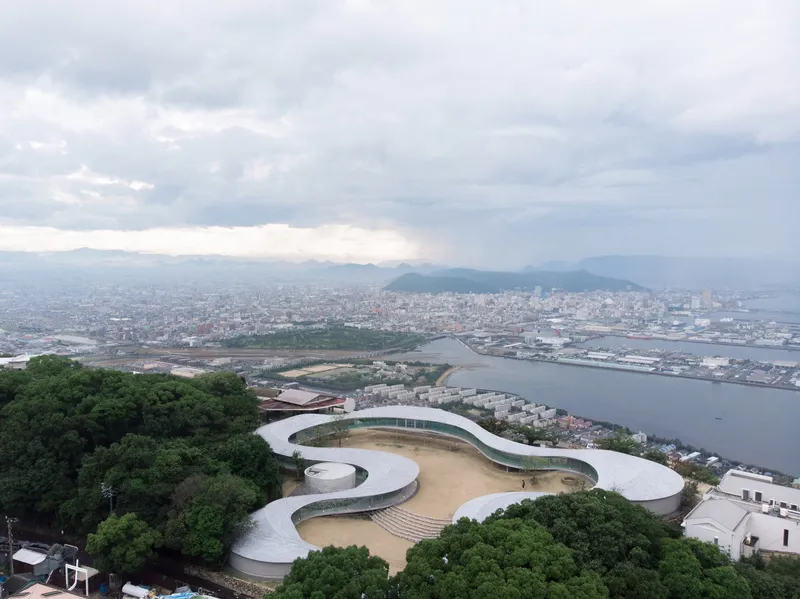
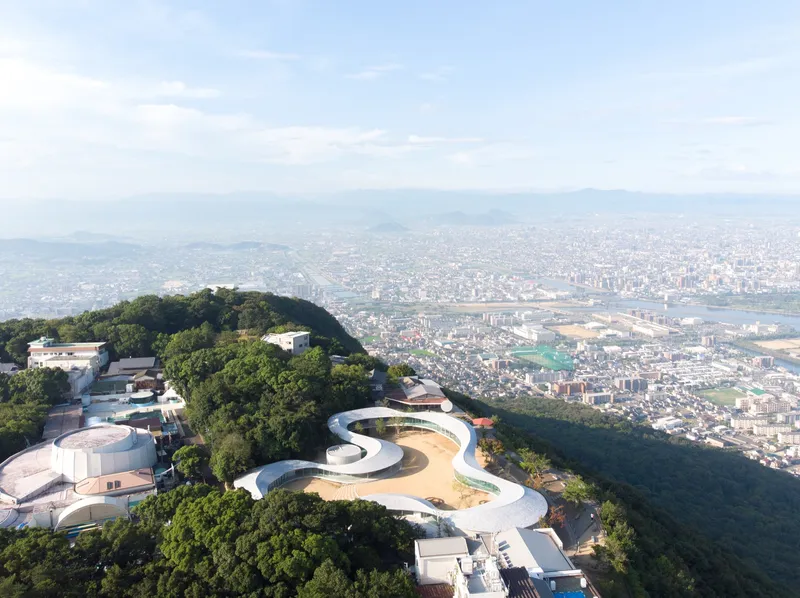
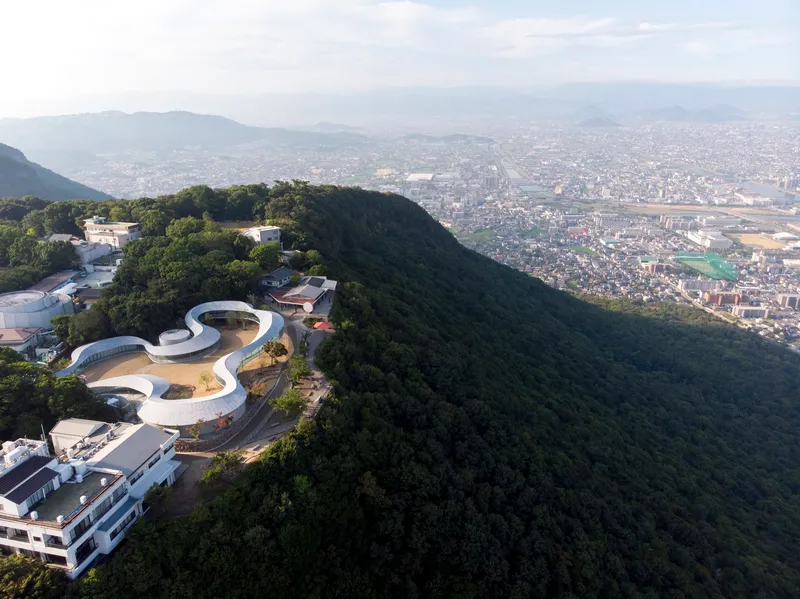
From the air, the building reads as a geological event. The white roof ribbons outward from its central courtyard in lobed forms that mirror the canopy of the surrounding forest rather than cutting against it. SUO conceived the structure as "part of terrain," and the aerial perspectives confirm the ambition: the roof's peaks and valleys echo the ridgeline, and its pale stone surface catches light the way an exposed rock face would. The building is 1,178 square metres of enclosed space stretched across a 3,416-square-metre site, which means it occupies roughly a third of its footprint. The rest is garden, courtyard, and forest.
That proportional restraint matters on a protected site where digging deep foundations was off the table. Shallow concrete footings support the structure, and the roof frame, composed of over 2,000 unique I-beams and pipe beams welded together, keeps the load light. The result is a building that hovers more than it sits, its thin white-steel columns barely registering against the glass walls behind them.
Stone and Craft at Altitude
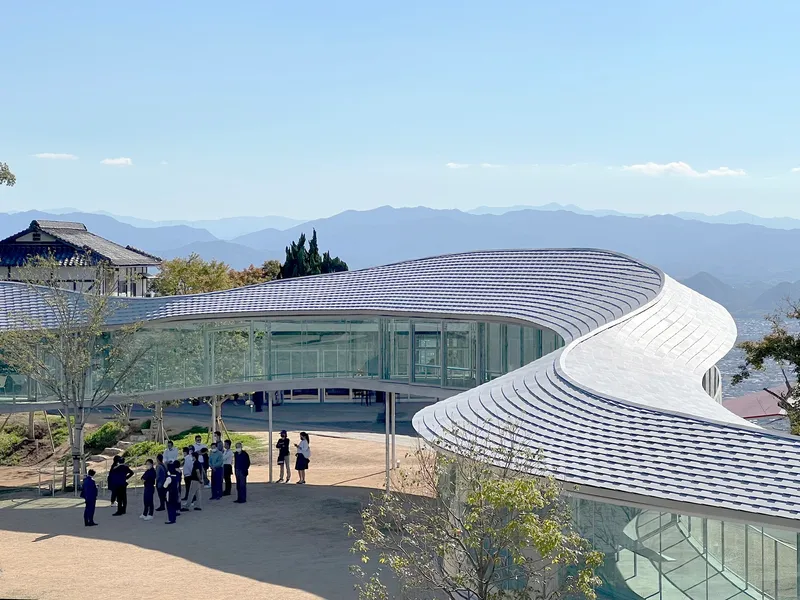

The roof tiles are Aji stone, a grey granite quarried in the towns of Mure-Cho and Aji-Cho adjacent to Yashima. The material is no obscure local curiosity: it is the same stone Isamu Noguchi favored, working from his Shikoku studio not far from this site. The Sanuki Stone Processing Association produced 30,000 one-centimetre-thick rectangular tiles, each attached to waterproof sheets and wood panels before installation. Because the building's plan is organic, with no straight edges or repeated modules, every tile position was individually mapped in a 3D CAD model. The installers needed the spatial intuition of traditional shrine roofers to translate digital coordinates into physical placement on a surface that curves in multiple directions simultaneously.
Choosing Aji stone was not just a nod to regional identity. The material ages gracefully in maritime climates, developing a patina that will eventually blur the boundary between built surface and natural outcrop. Over decades, the roof should darken and weather into the mountain itself.
The Glass Corridor and Its Variable Heights
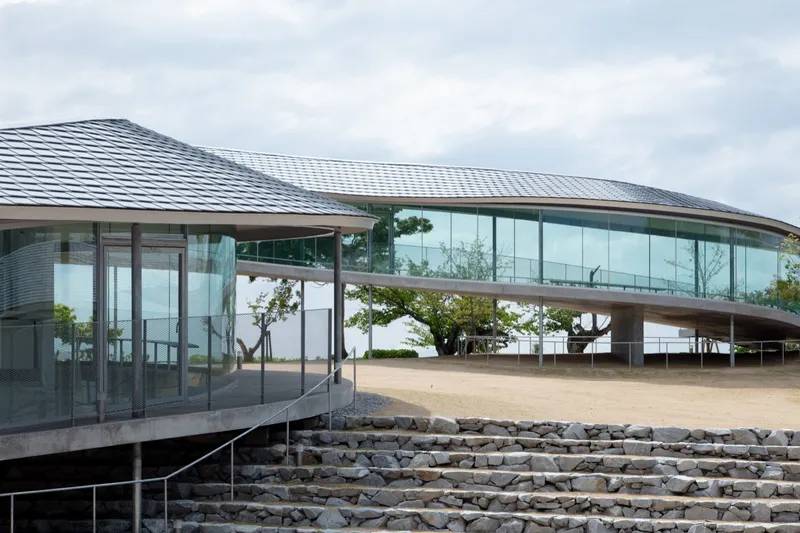

The 220-metre glass corridor is the spine of the visitor experience. Full-height glazing wraps the interior pathway, with sheets measuring close to seven feet wide, while the glass height itself shifts dramatically from four feet in the panorama painting gallery to fifteen feet in the café. That variation is not arbitrary. Lower glass compresses the view, framing it like a painting; taller glass opens the body upward and outward, turning the café into a belvedere. In select locations, the glass toggles between the inner and outer edge of the structure, pulling inward to create open-air terraces sheltered by the roof overhang.
The choice of double-paned tempered glass in exposed sections is a direct response to typhoon season, when winds on the mountaintop can reach 230 feet per second. Elsewhere, single-pane panels suffice. The structural pragmatism is invisible to the visitor, who simply experiences a continuous walk through forest, courtyard, and sky.
Courtyard and Garden Rooms
The cloverleaf plan defines six gardens that capitalize on different orientations and views of the Seto Inland Sea. At the center, a courtyard is dotted with bespoke circular benches and retained trees. Drystone steps traverse the sloping interior, doubling as informal seating, a detail that collapses the distinction between infrastructure and furniture. The corridor's width is not constant: it narrows and widens to manipulate the visitor's peripheral awareness of the surrounding forest, producing the sensation of walking through a dense grove even while enclosed in glass.
The amphitheater-like stone steps visible at the building's edge reinforce the landscape-first hierarchy. Visitors gather on them as they would on a natural hillside, oriented toward the view rather than toward the architecture. The building frames without competing.
Structural Lightness on Protected Ground
The engineering constraints on Yashima were severe. National monument status prohibited deep excavation, so the design relies on a nine-inch-thick reinforced concrete floor slab held up by galvanized four-inch-diameter hollow steel-pipe columns, with concrete shear wall segments strategically placed to resist lateral forces. The roof frame, despite its organic appearance, is a precision-welded lattice of more than 2,000 I-beams and pipe beams, each unique in dimension and angle. The angled gypsum board ceiling conceals this structure entirely, presenting visitors with a smooth, cave-like underside.
The thinness of the columns is critical to the building's character. They almost disappear against the landscape, allowing the roof to appear to float. It is a deliberate illusion: what looks like effortless hovering is the product of extremely precise load distribution across shallow footings.
Plans and Drawings

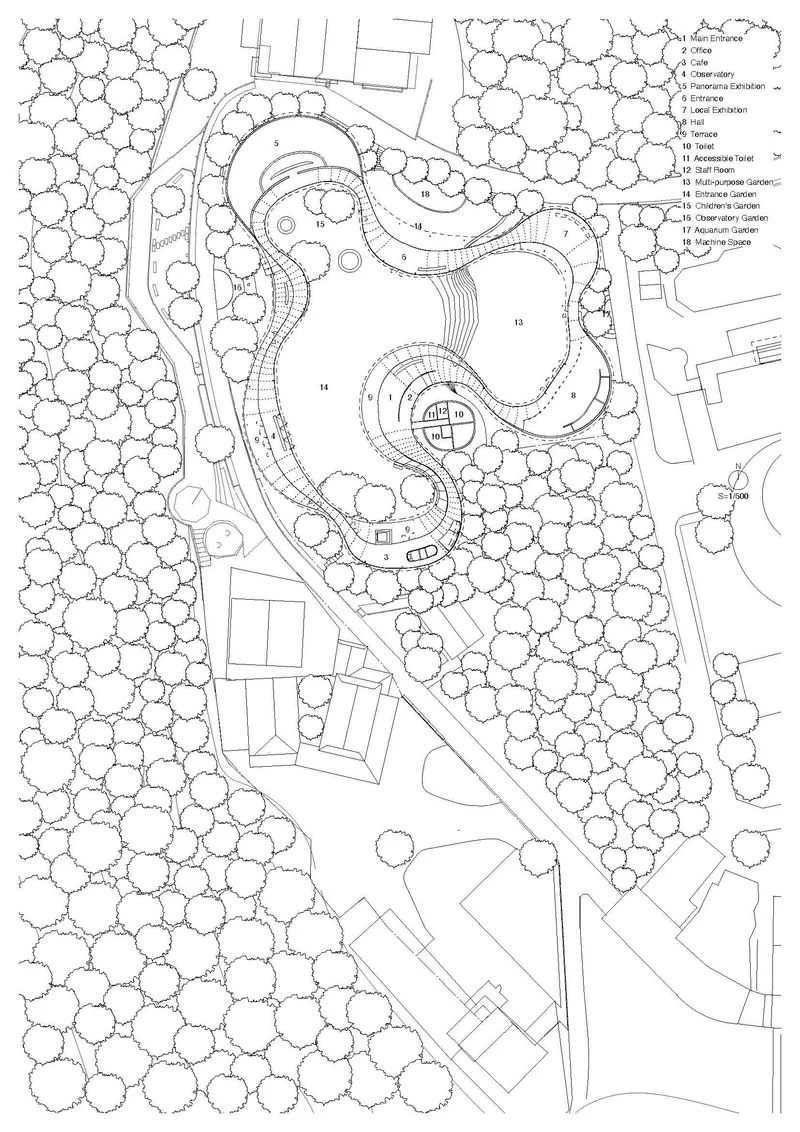
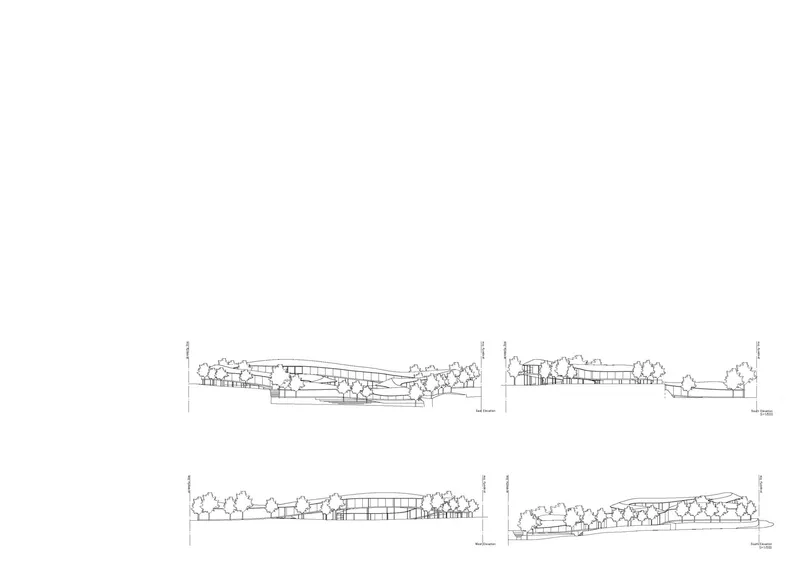


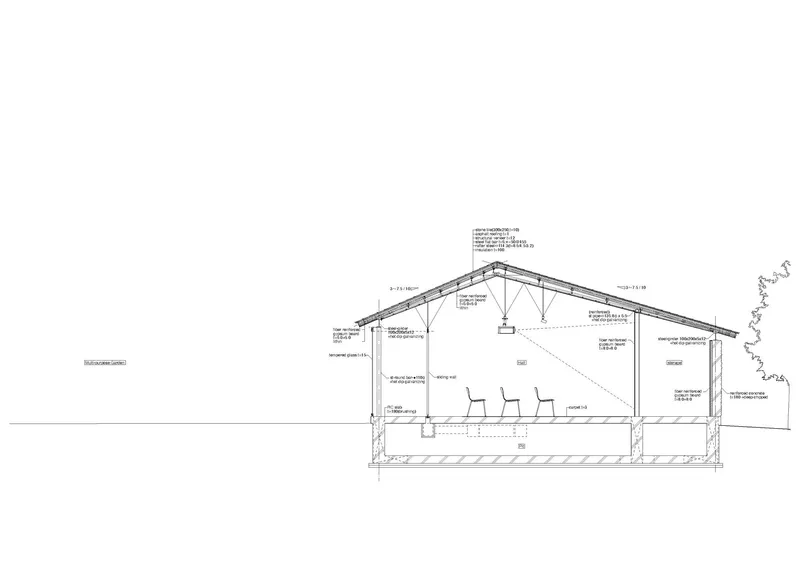
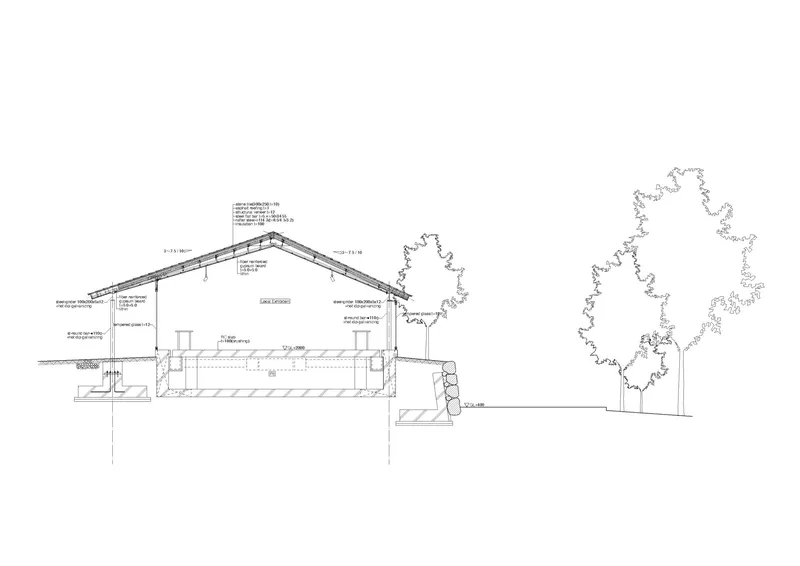
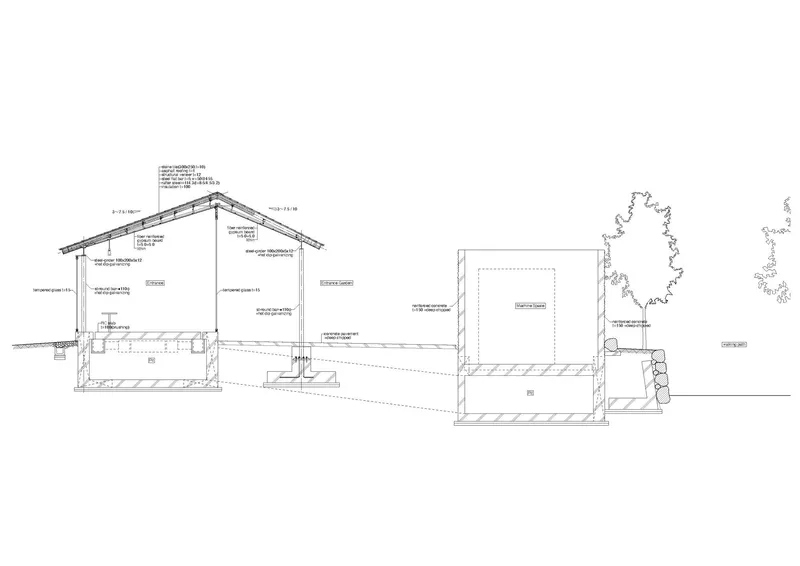
The site plans reveal the organic geometry in full: the lobed structures nestle into the existing tree coverage with minimal clearing, and contour lines confirm how closely the building tracks the natural slope. The elevations show just how low the structure reads against the hillside, never breaking the tree canopy. In section, the repeated gabled volumes step down the terrain in a rhythmic sequence, with each peak corresponding to a programmatic shift, from gallery to café to lookout. The detailed sections annotate material assemblies and dimension the roof trusses, exposing the gap between the expressive stone exterior and the pragmatic steel skeleton beneath.
Why This Project Matters
Yashima Mountaintop Park is proof that heavy regulation does not have to produce timid architecture. SUO and Style-A turned every constraint, shallow foundations, no deep cuts, typhoon resistance, protected forest, into a design driver. The building is genuinely site-specific in a way that goes beyond the term's usual marketing usage. Its plan follows topography. Its materials are quarried next door. Its glass heights respond to wind speed. Its roof will weather into the mountain. None of this is incidental.
As a first commission for SUO, founded by Takashi Suo in 2015, the project is a remarkable debut: six years of design and construction yielding a building that manages to be simultaneously monumental in ambition and self-effacing in presence. It restores a fading destination not by shouting but by listening to the site and then building something that feels like it was always supposed to be there. That is a rare quality, and it is earned rather than claimed.
Yashima Mountaintop Park by SUO and Style-A. Takamatsu, Japan. 1,178 m². Completed 2022.
About the Studio
Share Your Own Work on uni.xyz
If projects like this are the kind of work you want to make, uni.xyz is a place to publish your own, find collaborators, and enter design competitions.


Popular Articles
Popular articles from the community


Singing Woman: Contemporary Architecture Inspired by Estonia’s Voice and the Sea
Singing Woman turns Estonia’s song culture into flowing opera house architecture, blending public life, landscape, sea, and national memory.

Temporary Home for Dogs: A Reversed Zoo Rethinks Animal Shelter Architecture
In Bucharest, a sinuous corridor and freed landscape flip the logic of containment, designing a shelter that works to make itself unnecessary.
Extended Shell: Retrofitting Kolkata's Balconies as Living Urban Thresholds
A modular retrofit system recovers the social and environmental intelligence of Kolkata's historic verandas for contemporary Park Street residents.
Faces of the Soviet Avant-Garde: Turning Moscow's Street Names into an Open-Air Museum
A network of sculptural installations across a Moscow residential district transforms forgotten architect names into spatial encounters with cultural memor

Similar Reads
You might also enjoy these articles

Bao Huynh Watercolor Atelier: A Serene Art Retreat in Hội An
Bao Huynh Watercolor Atelier in Hội An blends multifunctional art spaces, sustainable design, local materials, and family-friendly living in a serene environment.

Atelier Macri Concept Store Interior Design by CASE-REAL
Atelier Macri store features a "ko" counter, walnut wood details, cork displays, blending retail, gallery, and seamless customer experiences.

Manuel Vargas Izquierdo Stadium and High-Performance Sports Center: Architectural Excellence in Jalpa de Méndez
The Manuel Vargas Izquierdo Stadium blends sustainable design, inclusive sports facilities, and cultural-inspired architecture, revitalizing Jalpa de Méndez’s public spaces.

KAKR Buluh Awar Hall: Revitalizing Community and Ecology Through Bamboo Architecture
Community built bamboo hall revitalizes Buluh Awar village, empowering youth, restoring ecology, celebrating vernacular craftsmanship through sustainable architecture and culture.

Explore Power Station Competitions
Discover active competitions in this discipline

Challenge to reimagine the Iron Throne

Photograph architecture without architects

Illustrate the lost glory of Angkor Wat - Render Challenge

Design challenge to reuse E-waste
Comments (0)
Please login or sign up to add comments
No comments yet. Be the first to comment!