

City in the Arctic: Enclosed Modules for Sustainable Habitation in Extreme Cold
A shortlisted vision for self-sustaining Arctic urbanism built around zonal heating, inflatable capsules, and modular scalability.


What does a city look like when the starting premise is that humans should barely be there at all? City in the Arctic answers that question with a radical enclosure strategy: a self-sustaining urban organism sealed against one of the planet's harshest climates, where multi-layered insulation, zonal heating, and inflatable double-shell capsules replace the conventional relationship between building and ground. Rather than adapting standard construction to polar conditions, the project rethinks habitation from first principles, treating the city itself as a climate machine.
Designed by Олег Шишов, this shortlisted entry in the EHC - Arctic competition proposes an enclosed structure that houses residential modules, workspaces, recreation areas, and education facilities within a single integrated system. The ambition is clear: sustain long-term human presence in the Arctic without degrading the environment that makes it so difficult to inhabit.
Looking Up Through the Climate Shell

The fisheye view upward through a circular atrium reveals the project's spatial DNA. Perforated metal screens filter light while suspended colored panels hint at the programmatic diversity layered throughout the structure. This is not a passive skylight but an active environmental interface, controlling solar gain, ventilation, and visual orientation for inhabitants who may go weeks without stepping outside. The geometry of the atrium suggests that every interior moment is calibrated to compensate for the monotony of an Arctic exterior.
Stacking Spheres: The Modular Tower Section


The section drawing exposes the structural logic: a modular tower built from spherical residential units stacked above green enclosed chambers at the base. The spheres function as individual habitation capsules, their geometry optimizing volume-to-surface-area ratios to minimize heat loss. At ground level, enclosed greenery zones serve as both recreation space and biological air processing, a living layer that anchors the tower's internal ecosystem.
Paired with the section is a thermal zoning diagram that maps day and night temperature differentials across the tower's height. Blue and yellow gradients indicate how passive heating techniques maintain distinct climate bands within the same structure. This zonal approach is the project's most technically compelling idea: rather than heating the entire enclosure uniformly, the system allocates energy where and when it is needed, drastically reducing external dependency. The inflatable capsules with their double-shell insulation are the mechanism that makes this gradient possible, trapping warmth in occupied zones while allowing buffer spaces to run cooler.
Clustered Growth: Master Plan and Phased Expansion


The master plan reads like a biological diagram. Color-coded circular clusters identify program zones: residential, workspace, education, and recreation, each given its own territory but connected through shared infrastructure. Areas marked for new construction indicate that the design is conceived not as a fixed object but as an expandable framework. The modular logic that governs the individual capsule scales up to the urban plan itself.
A companion diagram on a black field maps phased programmatic growth over time. Colored cellular clusters propagate outward, illustrating how the city can accommodate population increases without compromising its ecological balance. The progression from initial settlement to mature urban fabric is made legible as a sequence of accretions rather than a single master stroke. This scalability is essential for Arctic contexts where logistics, funding, and population growth are all unpredictable variables.
Why This Project Matters
Arctic architecture tends to oscillate between two poles: rugged survival shelters and utopian megastructures. City in the Arctic occupies a more productive middle ground. Its zonal heating strategy and inflatable double-shell capsules are grounded in thermodynamic logic, not spectacle. The modular framework acknowledges that no one can predict exactly how an Arctic settlement will grow, so the architecture must be a system rather than a plan.
What distinguishes Шишов's approach is the insistence that minimizing human impact and maximizing human comfort are not opposing goals. By sealing inhabitants within an intelligent enclosure and letting the Arctic remain undisturbed outside, the project reframes sustainability not as sacrifice but as design intelligence. For a competition focused on extreme environment habitation, that reframing is exactly the kind of thinking that deserves recognition.
View the Full Project
About the Designers
Designer: Олег Шишов
Enter a Design Competition on uni.xyz
uni.xyz runs architecture and design competitions year-round that reward proposals with spatial conviction and real site intelligence.
Project credits: City in the Arctic by Олег Шишов EHC - Arctic (uni.xyz).


Popular Articles
Popular articles from the community

Temporary Home for Dogs: A Reversed Zoo Rethinks Animal Shelter Architecture
In Bucharest, a sinuous corridor and freed landscape flip the logic of containment, designing a shelter that works to make itself unnecessary.
Faces of the Soviet Avant-Garde: Turning Moscow's Street Names into an Open-Air Museum
A network of sculptural installations across a Moscow residential district transforms forgotten architect names into spatial encounters with cultural memor
Tsunami Convergenics: Turning Catastrophic Ocean Forces into Underwater Housing Infrastructure
A speculative underwater settlement off the coast of Onagawa, Japan, treats tsunamis and typhoons as energy sources rather than threats.
Opera by the Sea Estonia: Three Shells Dissolving Architecture into Tallinn's Coastline
A winning opera house proposal replaces monumental form with interconnected shells that blur the boundary between building, park and Baltic Sea.

Similar Reads
You might also enjoy these articles
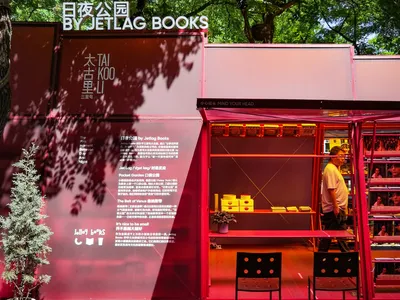
Day and Night Park: A Time-Based Urban Newsstand in Beijing
A temporary urban newsstand in Beijing blending travel, light, and reading through poetic colors, compact form, and community-focused design.

Modernist Patio Renovation in El Masnou, Barcelona by Oliver Segura Arquitectura + Cebrià Arquitectura
Modernist patio renovation blending tradition and innovation with a movable pool, leveled floors, and Catalan materials in El Masnou.
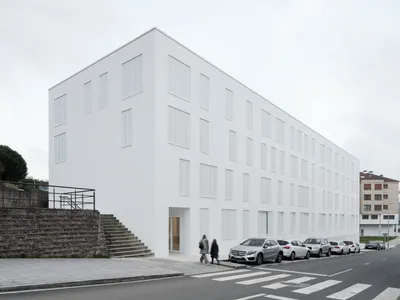
Alto Residencial Coop: Cooperative Housing Development in Santiago de Compostela by Carbajo Barrios Arquitectos
A linear cooperative housing complex blending white volumes and perforated metal façades, enhancing community living, natural light, privacy, and urban integration.
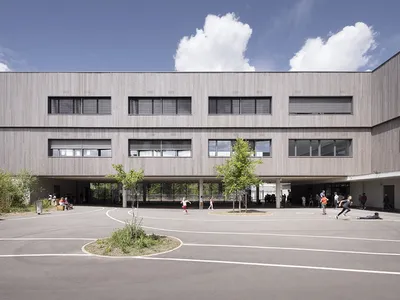
Vil Genis School by BPA ARCHITECTURE – Massy, France
Vil Genis School in Massy, France, features sustainable design, south-facing classrooms, community integration, accessible spaces, and modern educational architecture.


Comments (0)
Please login or sign up to add comments
No comments yet. Be the first to comment!