
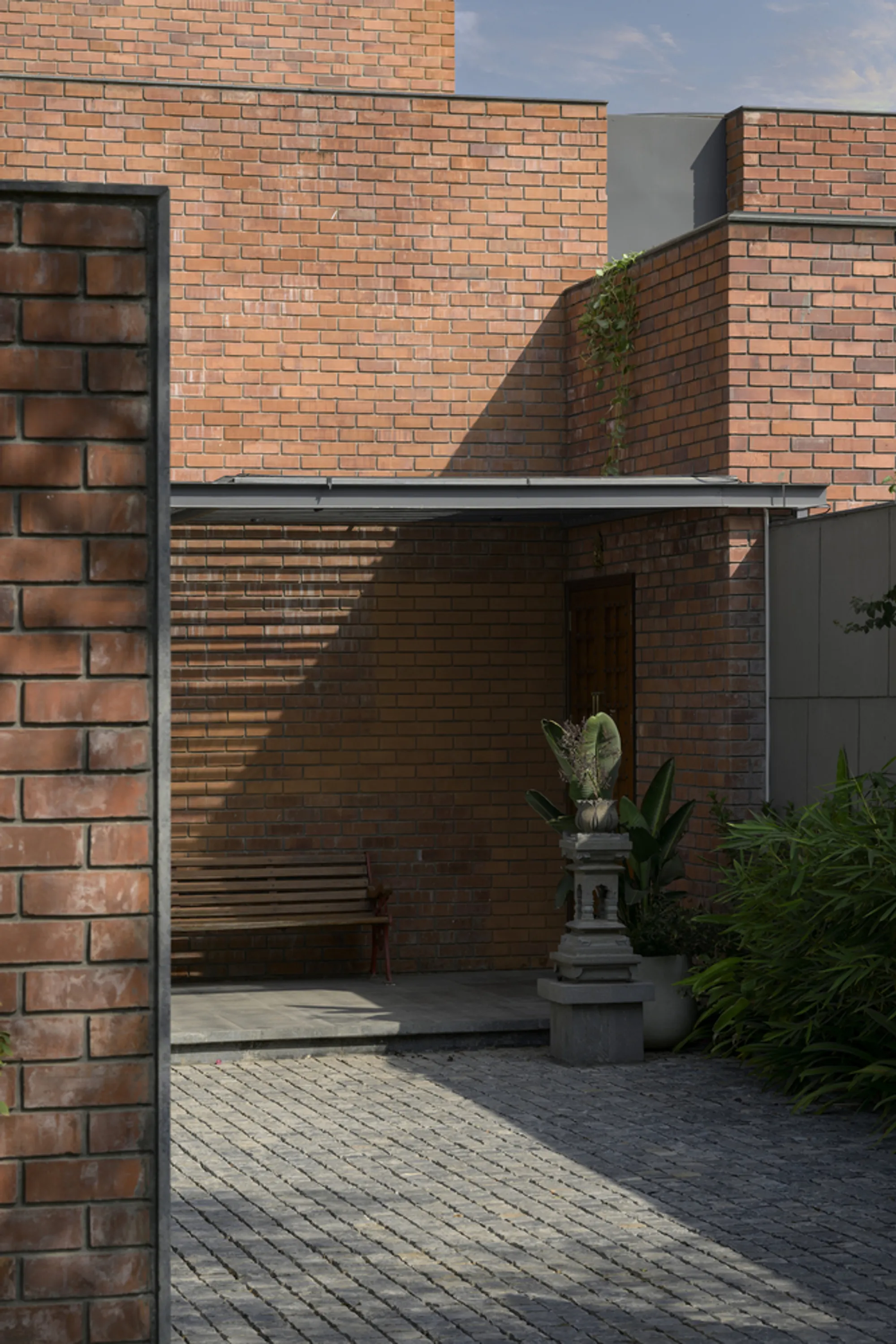
Studio PPBA Revives the Wada Courtyard House in a Maharashtra Riverside Village
Verandah House in Nhavi Sandas reinterprets the traditional brick-and-stone courtyard dwelling for climate-responsive modern living.


In Nhavi Sandas, a small riverside village in Maharashtra's Haveli City, the courtyard house once defined the built landscape. These structures, known locally as Wadas, combined thick stone bases with brick walls and open central courts to temper the heat, funnel breezes, and organize domestic life around a shared outdoor room. As the village modernized, these buildings gave way to concrete boxes that neither breathed with the climate nor carried the memory of place. Verandah House, a 150 square meter residence designed by Studio PPBA and completed in 2023, is a direct counter-argument: proof that the old spatial logic still works, provided someone is willing to rethink its materials and proportions for a contemporary household.
What makes the project genuinely interesting is not its nostalgia but its discipline. The architects took the Wada's core principles: a hidden entrance, a mediating verandah, a courtyard that organizes public and private life on opposing flanks, and rebuilt them with a stripped-down palette of raw concrete, locally sourced clay brick, black basalt flooring, and white interiors. The result is a house that looks monolithic and almost fortified from the village street yet dissolves into layered outdoor rooms once you cross the threshold. It is a small building with a big argument about how regional building traditions can outperform mechanical systems when taken seriously.
Village Context and the Weight of Brick
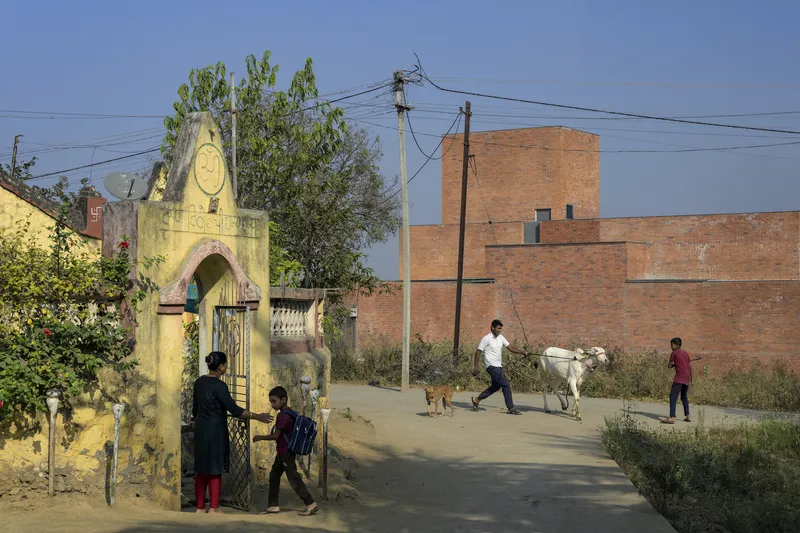
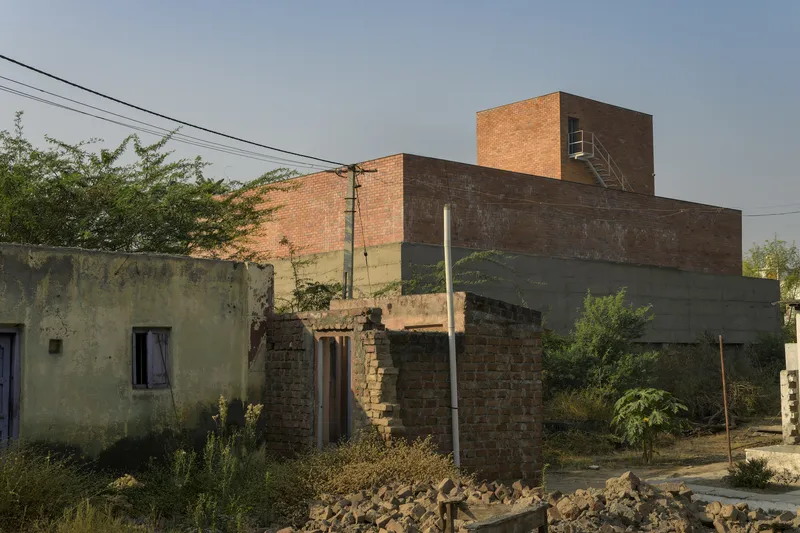
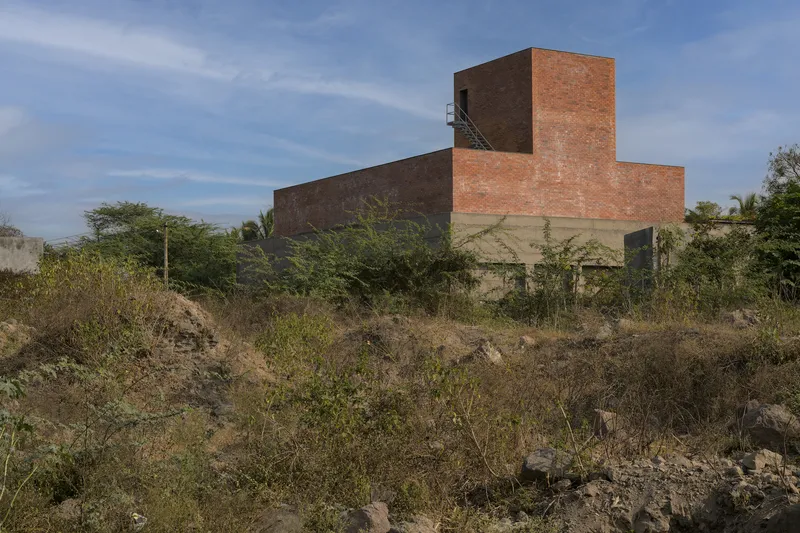
Seen from the village road, Verandah House registers as a cluster of red brick volumes rising above the low-rise fabric of painted gateways, power lines, and cattle paths. The decision to build in locally sourced clay brick was not merely aesthetic. Brick regulates indoor temperature far better than the plastered concrete block that has become the default in rural Maharashtra, and its warm ochre tone weaves the house into a streetscape that still carries traces of the old Wada vocabulary. The slightly rough, unfinished surfaces accept the patina of weather without complaint.
The massing reads as two interlocking rectangular volumes set at a slight angle to each other, a move visible in the site drawings but also palpable at ground level. That rotation creates pockets of outdoor space along the boundary, small planted courts that screen the interior from neighbours while pulling air through the house. From the overgrown terrain surrounding the plot, the building looks almost archaeological: a new ruin already at home in the landscape.
The Hidden Threshold
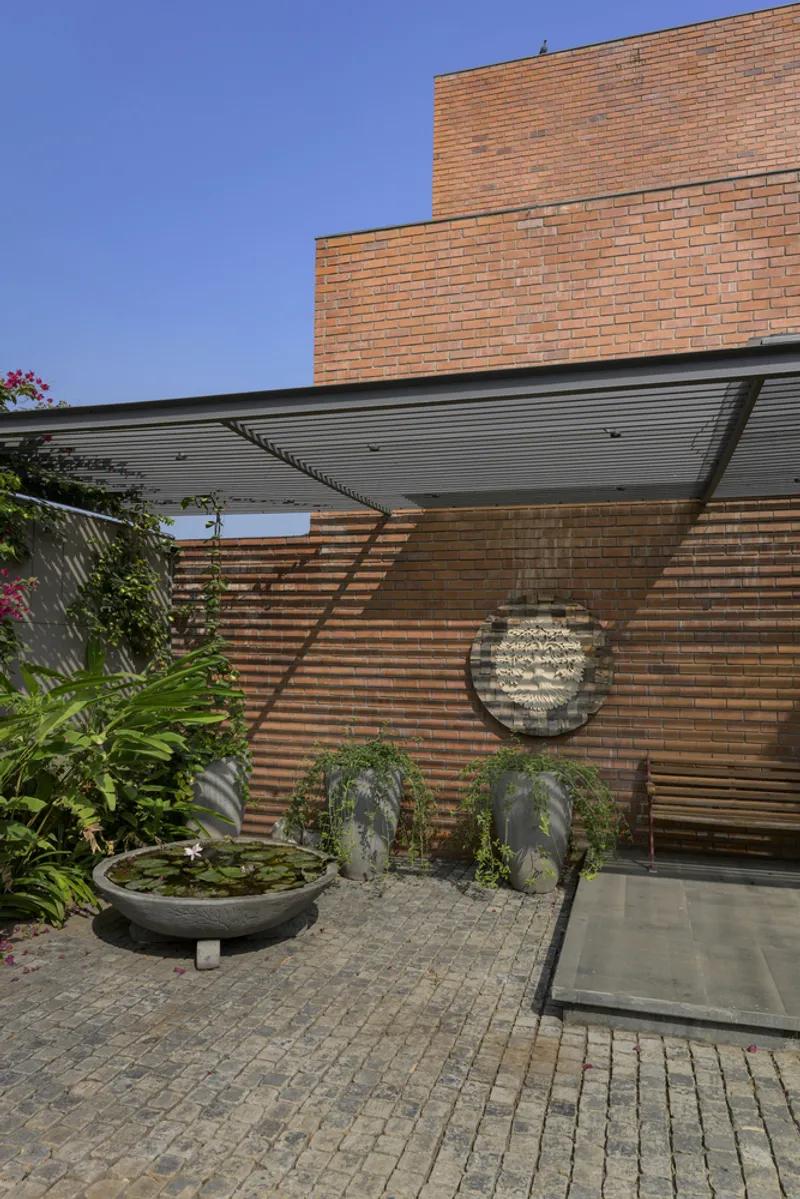
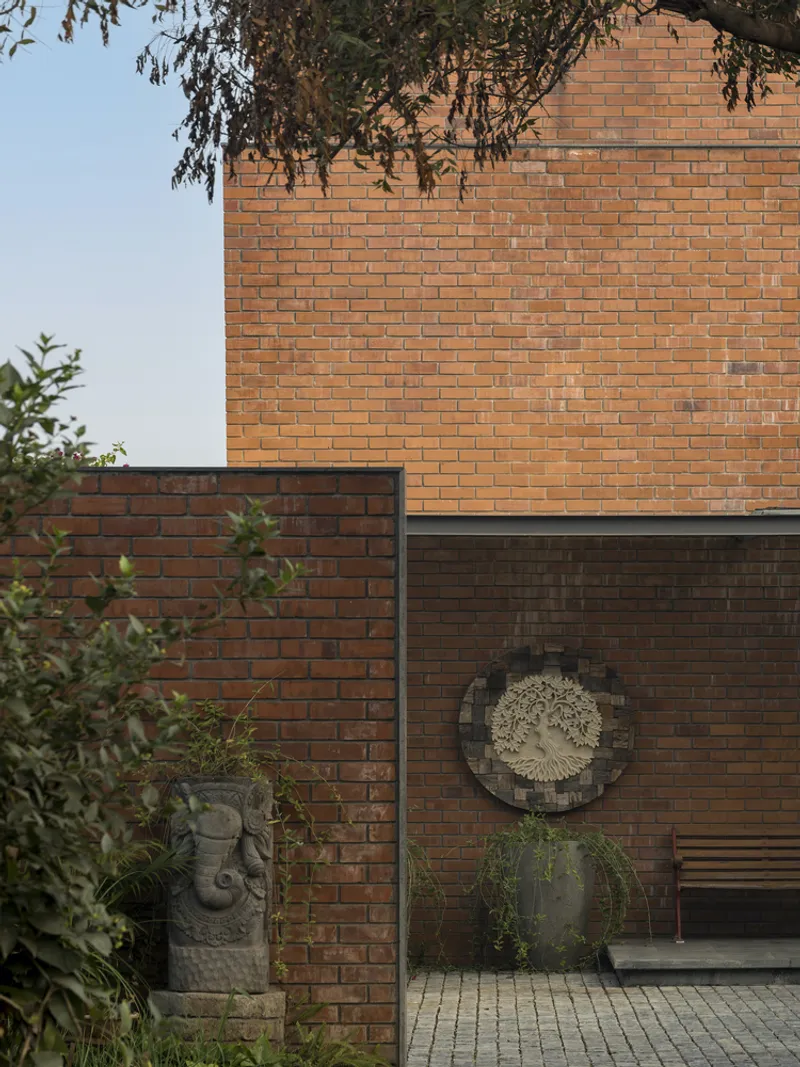
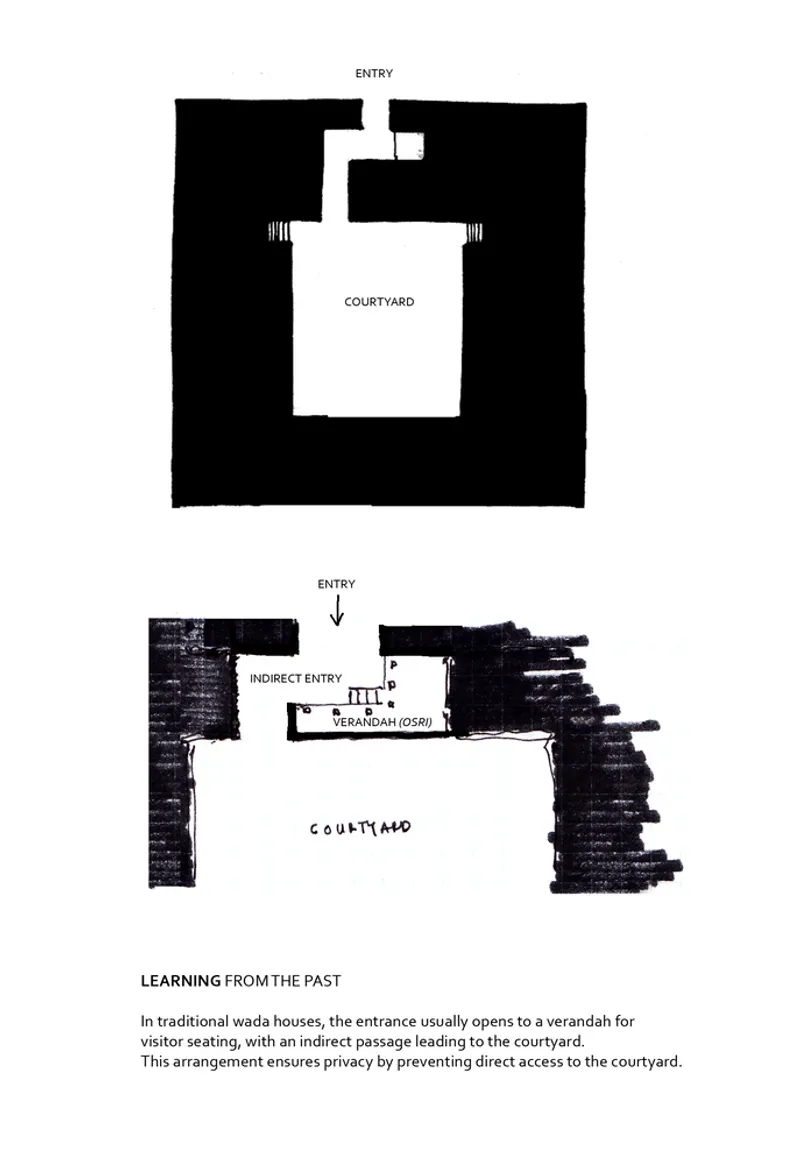
The entrance is one of the project's strongest gestures. Rather than announcing itself with a formal porch or a gate, the way in is integrated into the building's mass so that it nearly disappears. A circular sculptural relief set into the brick wall marks the point of entry beneath a slatted wood screen and corrugated metal canopy. The indirect sequence, documented in the architects' own diagrams, routes you through a compressed passage before releasing you into the verandah and then the courtyard beyond.
That choreography of compression and release is borrowed directly from the Wada typology, where the transition from street to home was always mediated, never abrupt. Here it does double duty: it provides security and privacy on a village street where life is very public, and it amplifies the experiential impact of the courtyard when you finally reach it. At dusk, with tree branches silhouetted against the warm brick, the threshold becomes almost ceremonial.
Courtyard and Verandah as Climate Engine
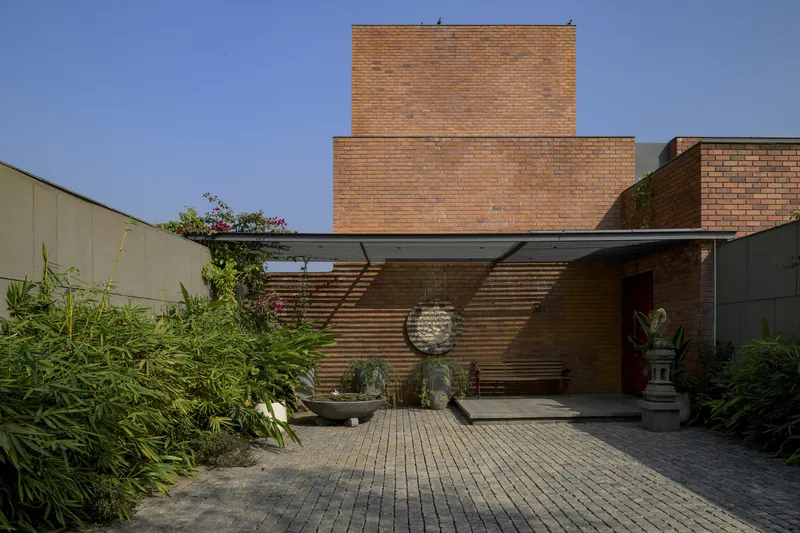
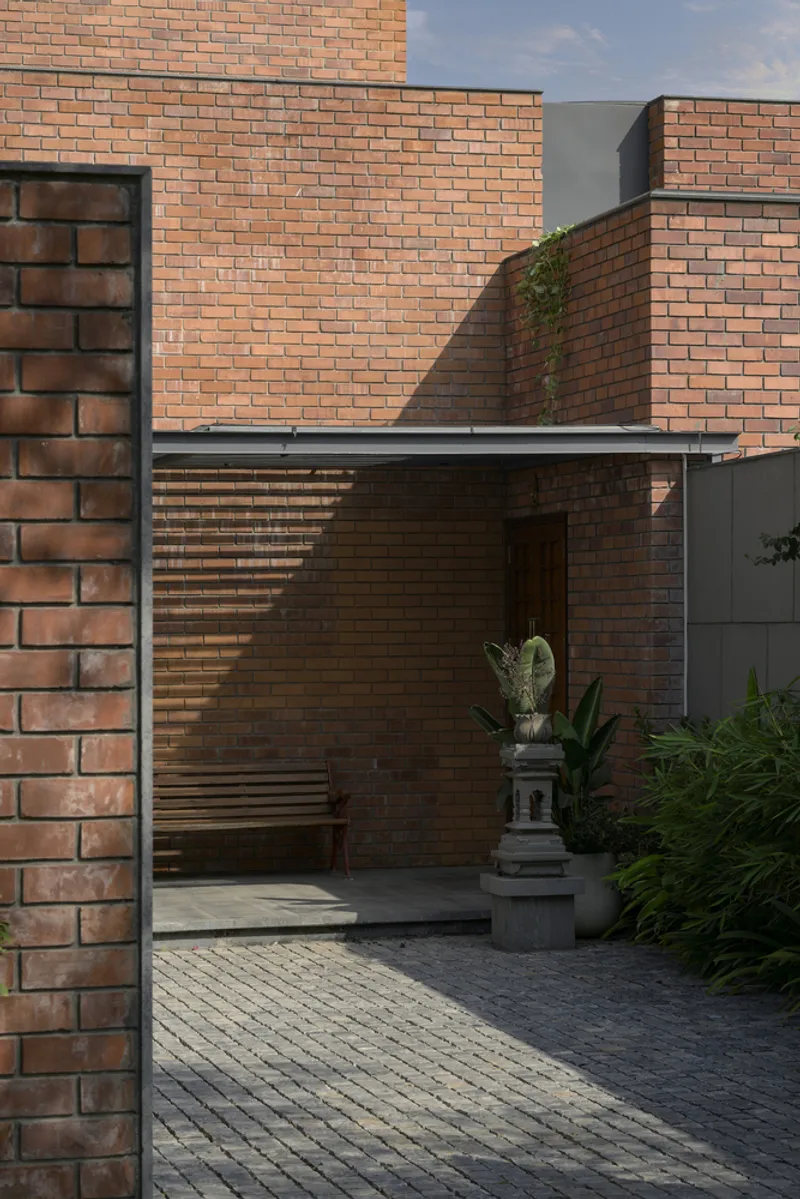
The central courtyard and the semi-outdoor verandah that wraps it are not decorative additions. They are the building's primary climate strategy. The courtyard pulls hot air upward and draws cooler air in through openings at the perimeter, a stack-effect mechanism that traditional Wada builders understood empirically. The verandah, paved in stone and shaded by a corrugated canopy with horizontal wood screens, acts as a circulation spine linking every room to the outdoors without exposing occupants to direct sun or rain.
Studio PPBA reinforced this passive cooling with additional small courtyards and planters along the plot boundary. These narrow green pockets serve as cross-ventilation channels, pulling air laterally through the plan. The combined effect means the house can largely avoid mechanical cooling in a climate where summer temperatures regularly push past 40 degrees Celsius. That is not a minor achievement on a 380 square meter plot.
Interior Life in White and Basalt
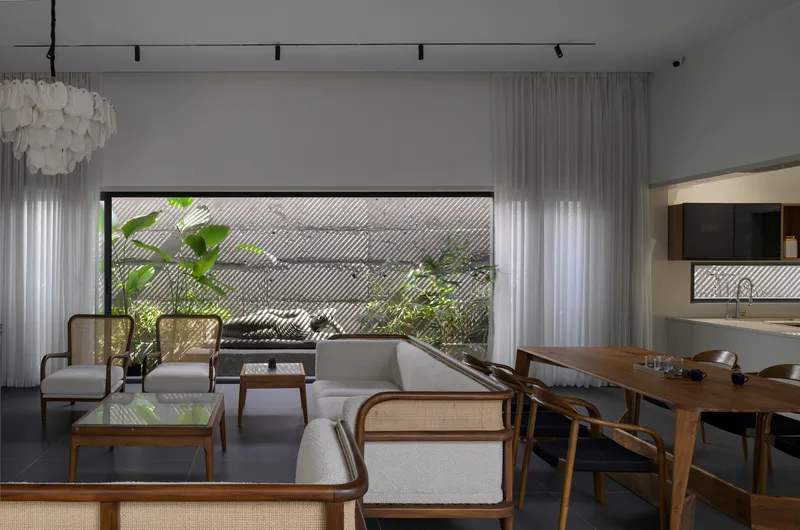
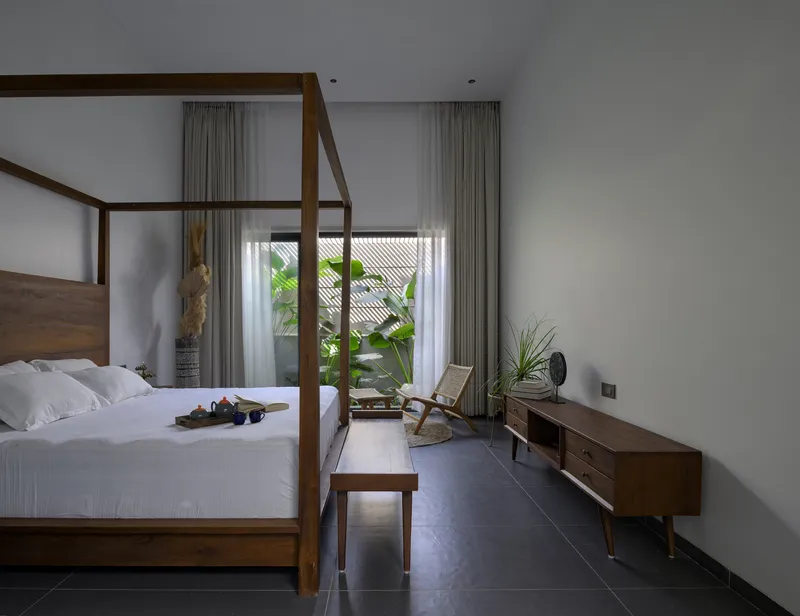
Step inside and the palette shifts dramatically. Where the exterior is earthy and monolithic, the interiors are rendered in fresh white tones that amplify the natural light entering through courtyards and horizontal windows. Black basalt flooring anchors the rooms with a cool, dense surface underfoot, while wooden furniture, including a handsome timber four-poster bed, introduces warmth without competing with the architecture.
The open living and dining area occupies one flank of the plan, oriented toward a horizontal window that frames the slatted screen wall and greenery beyond. On the opposite side, two bedrooms and a bathroom retreat behind the courtyard, screened by sheer curtains that filter light from the planted courts. The division is clean: communal life on one side, private life on the other, with the verandah and courtyard acting as a hinge. It is a plan that could be explained in a single sentence, and that simplicity is its strength.
Plans and Drawings
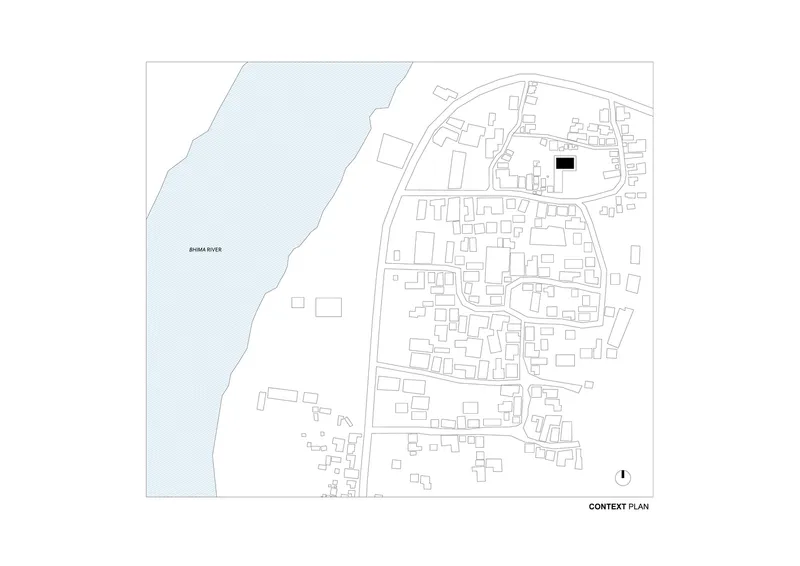
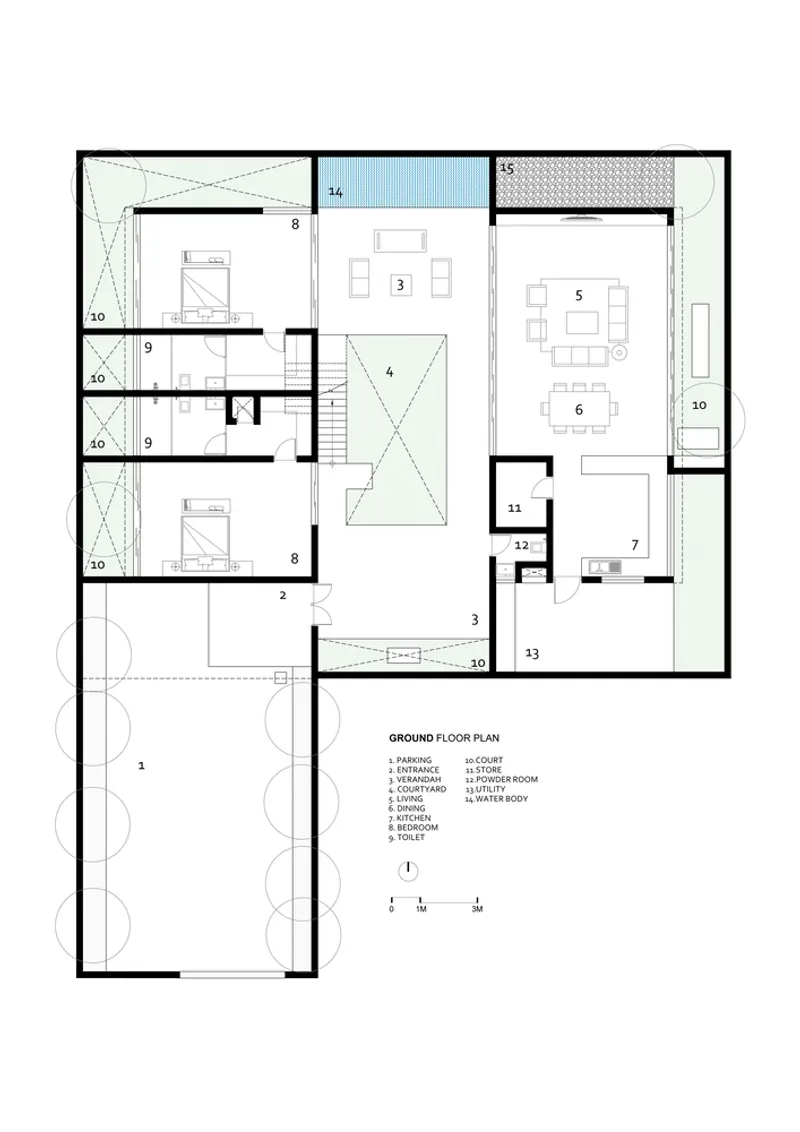
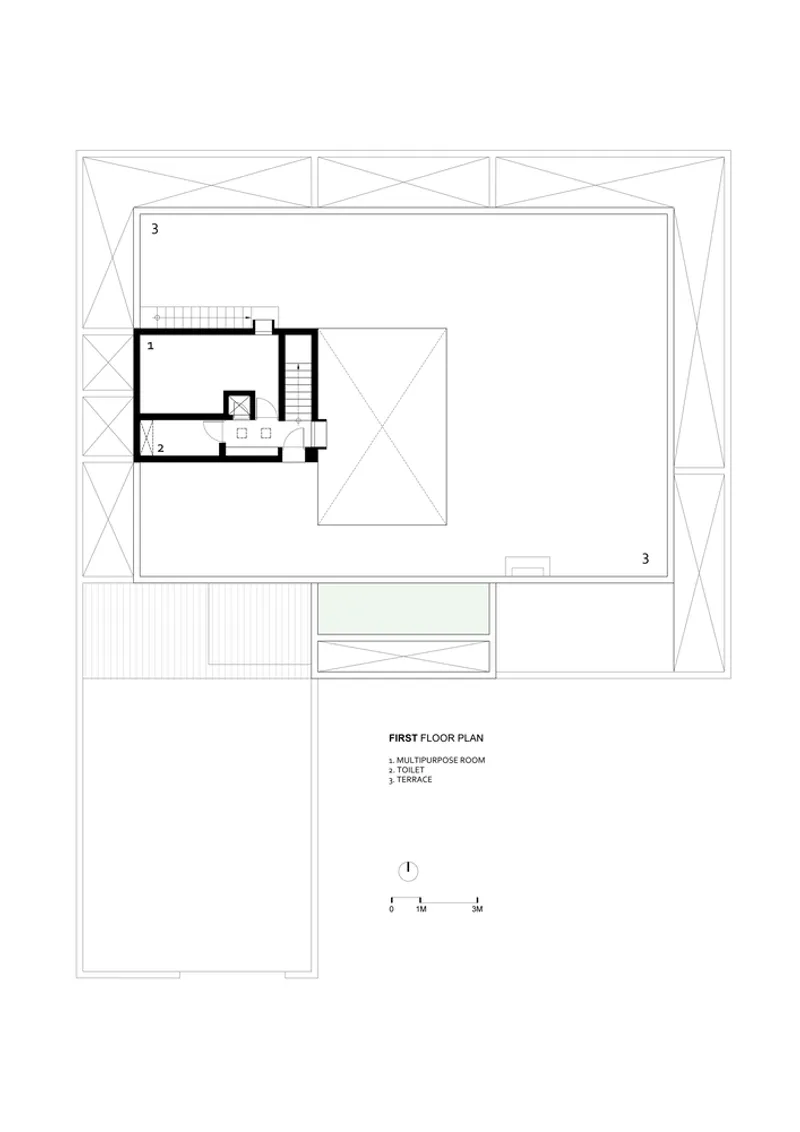

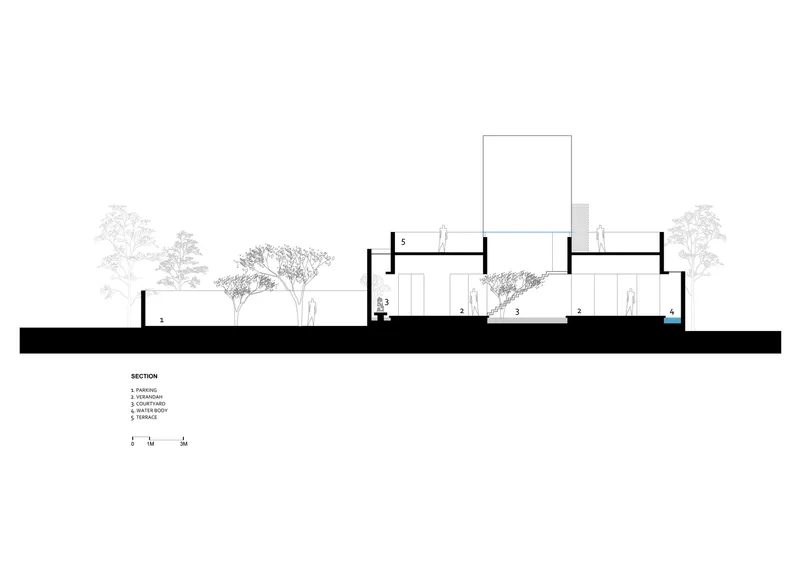
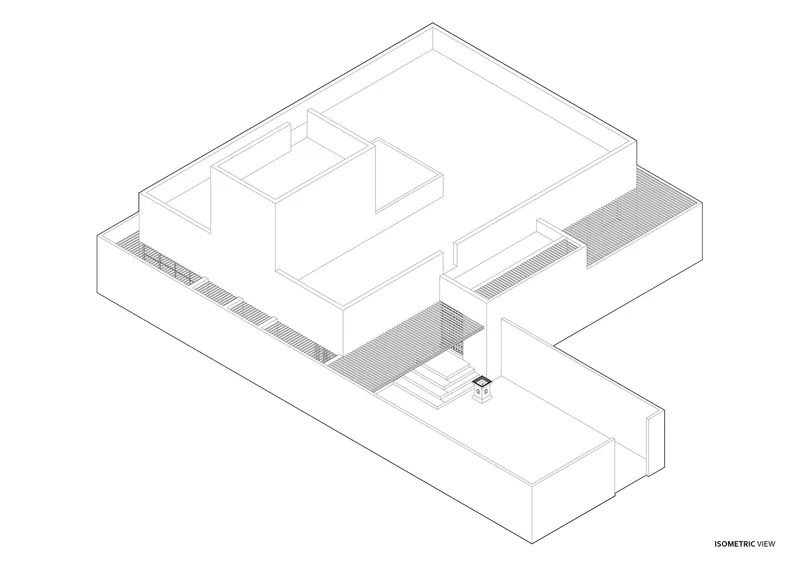
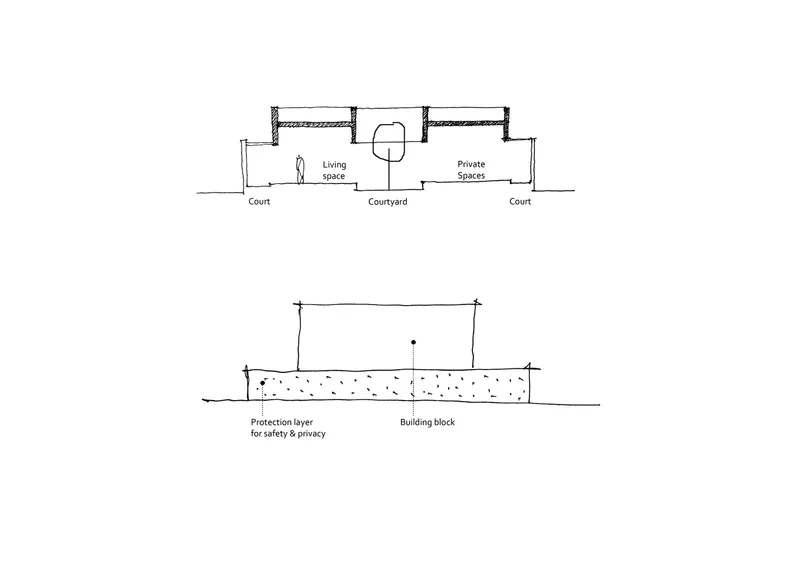
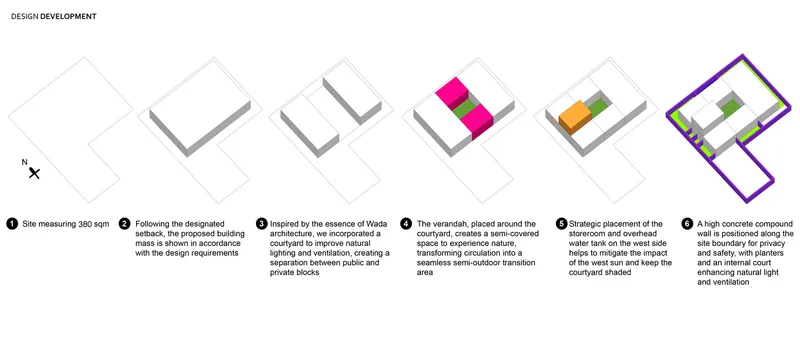
The drawing set tells the story of the project's logic with admirable clarity. The context plan shows the site embedded within a dense settlement along the river, confirming the tight grain that the architects had to negotiate. Ground and first floor plans reveal how rooms wrap the central courtyard, with a stairwell and tower element punctuating the composition. The section drawing cuts through the multi-level residence and its central tower, exposing the vertical relationships between living space, courtyard, and surrounding trees.
Most revealing is the axonometric sequence that traces the massing development from two simple rectangular volumes to the final interlocking compound with courtyard, terraces, and boundary courts. It reads like a tutorial in subtractive design: you start with mass, carve out voids for light and air, and let the resulting geometry define the rooms. The sketch diagrams of the indirect entry sequence and the sectional relationship between living space, courtyard, and flanking outer courts confirm that every spatial move was deliberate and driven by climate and culture rather than formal ambition.
Why This Project Matters
Verandah House matters because it refuses the false choice between tradition and modernity. In a context where vernacular building knowledge is being lost to expedient construction, Studio PPBA demonstrated that the Wada's spatial principles, its hidden entries, mediating verandahs, central courts, and heavy masonry walls, are not relics. They are active design strategies that outperform air conditioning, create richer spatial experiences, and root a building in its place. The architects did not embalm tradition; they stress-tested it against a contemporary program and a tight budget, and it held up.
At 150 square meters, the house is modest in scale but outsized in ambition. It asks a question that every architect working in rapidly urbanizing Indian villages should be grappling with: what if the most sustainable thing you can build is the thing your grandparents already knew how to build, recalibrated with contemporary detailing and honest materials? Verandah House suggests the answer is worth pursuing, one brick at a time.
Verandah House by Studio PPBA. Nhavi Sandas, Haveli City, Maharashtra, India. 150 m². Completed 2023. Photography by Hemant Patil.
About the Studio
Share Your Own Work on uni.xyz
If projects like this are the kind of work you want to make, uni.xyz is a place to publish your own, find collaborators, and enter design competitions.



Popular Articles
Popular articles from the community


Hill & Cross Opera: Sculptural Opera House Architecture Shaped by Tallinn’s Landscape and Identity
Hill & Cross Opera reimagines opera house architecture in Tallinn through its sculptural hill, civic plaza, glass wave and a luminous cross.

Co-Life: Senior Housing Design That Reconnects Older Adults With the City
Co-Life reimagines senior housing design through healing gardens, shared streets, workshops, and a sustainable community across generations.

Riyadh For All: Intergenerational Urban Design for Active Aging in Rabat
Riyadh For All reimagines urban design in Rabat with intergenerational co-living, adaptive courtyards, and Moroccan cultural exchange today.

The Musturak Paradise: Senior Living Architecture for a Connected Future in Temara, Morocco
The Musturak Paradise reimagines senior living architecture in Temara via private homes, social spaces, culture, community, and shared care.


Similar Reads
You might also enjoy these articles


Hodi-Mandai Geram
Project Function: Preservation and revitalization of the Intangible heritage and socio-spatial identity of the Hodi by Housing, Cultural Memory Center, Sacred Grove, landscape, local tourism economy


Olio Towers: A Mid-Rise for Performers That Fuses Housing, Rehearsal, and Stage
Located blocks from Houston's Theater District, this modular tower stacks living units around a central performance atrium.

Oasis: Modular Green Housing Carved into Dhaka's Urban Fabric
A shortlisted Plugin Housing entry reclaims unauthorized settlements in Dhaka with stepped concrete volumes, green roofs, and ventilation-driven design.

Black Hole: A Floating Megastructure for the Post-Physical Era
Emiliano Mazzarotto envisions a spherical, self-scaling arena where e-sports, digital hotels, and holographic stadiums replace traditional public space.


Explore Vinyasa Architecture Competitions
Discover active competitions in this discipline



Challenge to reimagine the Iron Throne


Photograph architecture without architects


Illustrate the lost glory of Angkor Wat - Render Challenge


Design challenge to reuse E-waste
Comments (0)
Please login or sign up to add comments
No comments yet. Be the first to comment!